Perspective: Highly stable vapor-deposited glasses
Pith reviewed 2026-06-26 12:37 UTC · model grok-4.3
The pith
Vapor-deposited glasses achieve higher density, lower enthalpy, and greater kinetic stability than any glass made by cooling a liquid for the same molecule.
A machine-rendered reading of the paper's core claim, the machinery that carries it, and where it could break.
Core claim
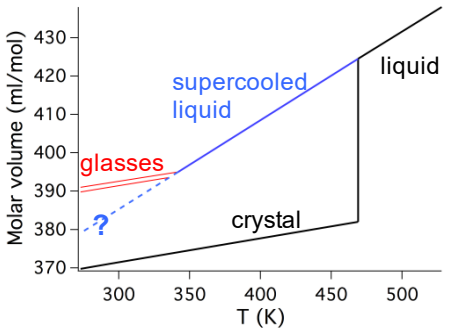
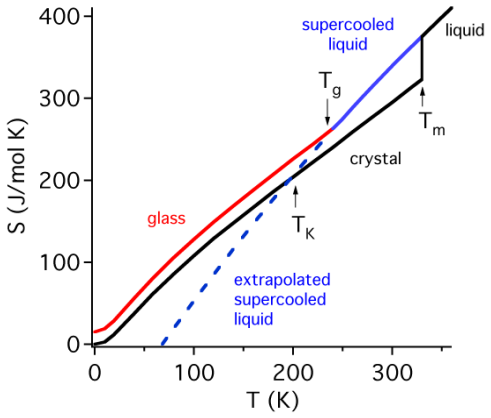
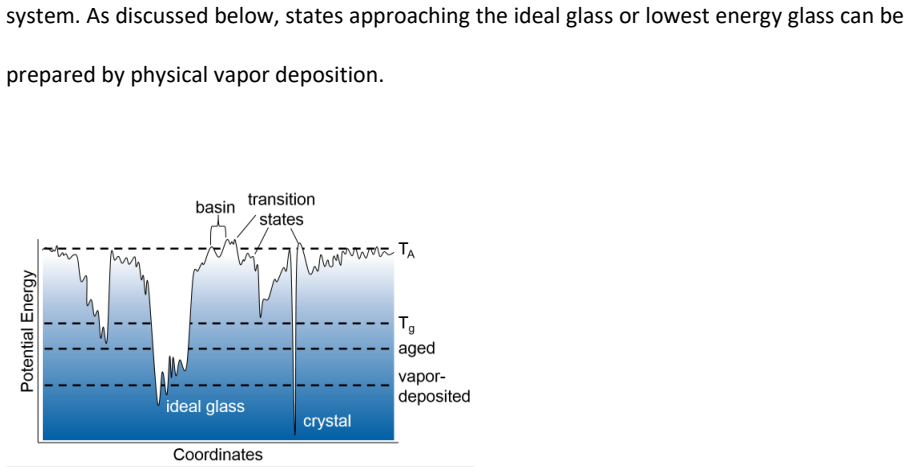
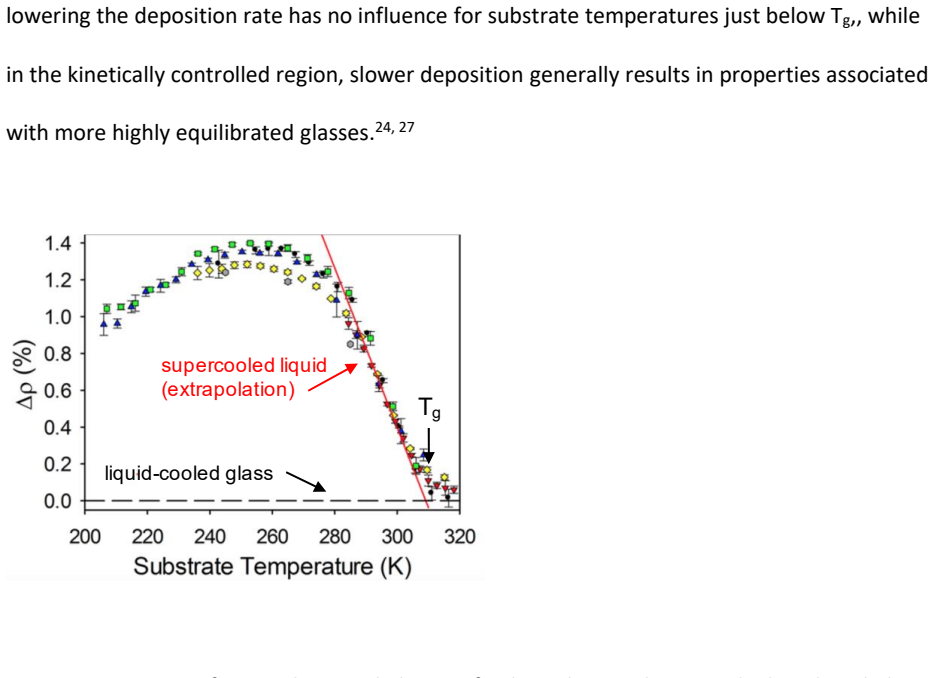
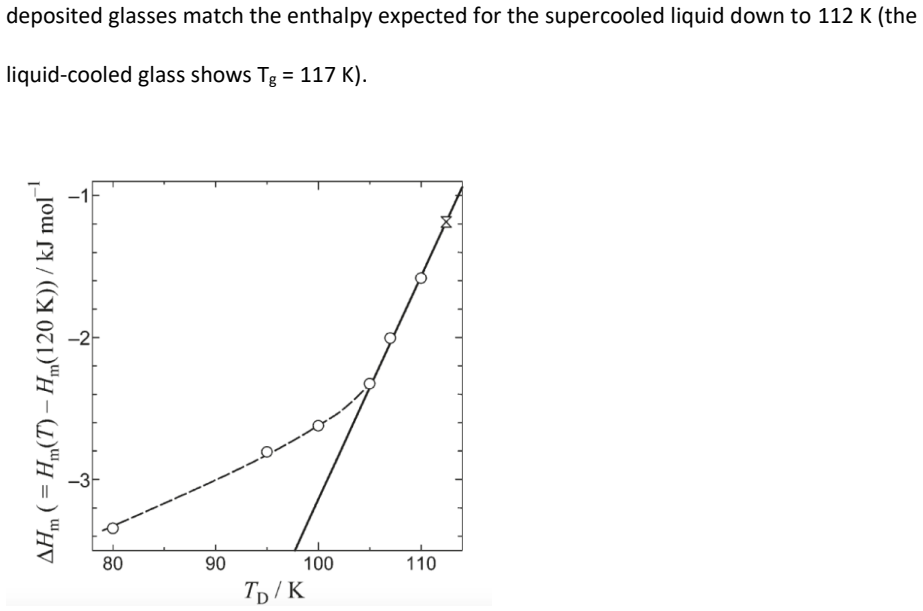
For a given molecule, vapor-deposited glasses can have higher density and lower enthalpy than any glass prepared by cooling a liquid and they exhibit greatly enhanced kinetic stability. Because these glasses can approach the bottom of the amorphous part of the potential energy landscape, they provide direct insights into the properties expected for the ideal glass. The perspective explores the links to liquid-cooled glasses and supercooled liquids, discusses the generality of the phenomenon for organic molecules, and considers prospects for other classes of materials.
What carries the argument
Physical vapor deposition that produces amorphous films with enhanced molecular packing and reduced potential energy relative to liquid-cooled glasses.
If this is right
- Vapor-deposited glasses supply an experimental route to measure properties expected for the ideal glass.
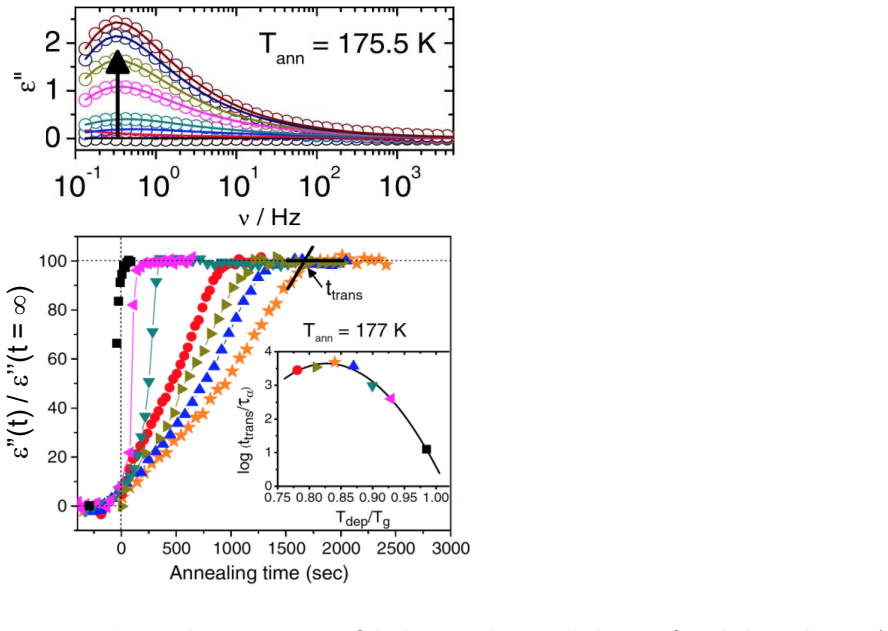
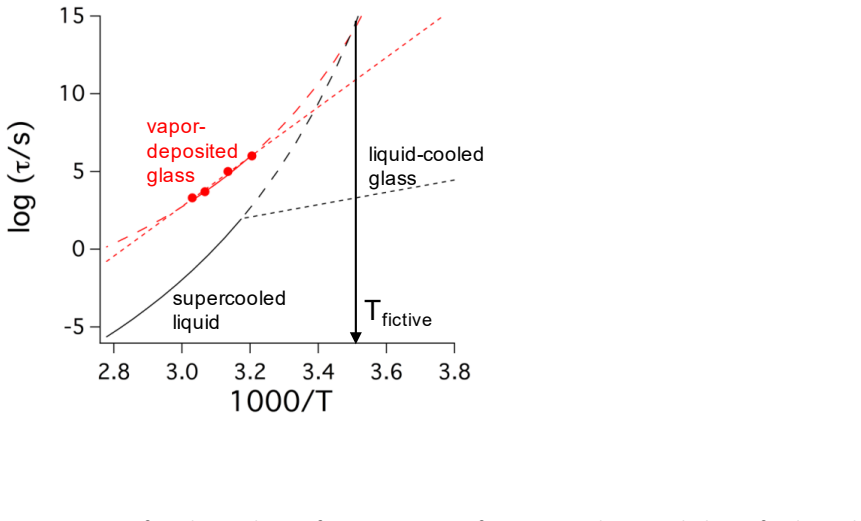
- Enhanced kinetic stability implies much longer structural relaxation times than liquid-cooled glasses at the same temperature.
- The observed connections to deeply supercooled liquids suggest that stable glasses can test predictions from glass-transition theories.
- The reported generality for organic molecules indicates that many small-molecule systems can form such stable states.
- Extension to other material classes would broaden the experimental access to low-energy amorphous states.
Where Pith is reading between the lines
- The same deposition approach might produce stable glasses in inorganic or metallic systems where liquid cooling is harder to control.
- If stable glasses truly near the ideal state, they could serve as reference materials for testing models of glass aging and rejuvenation.
- Applications in thin-film devices could exploit the higher density and stability to improve lifetime or performance without changing the molecule.
- Comparative studies of vapor-deposited versus liquid-cooled glasses at matched enthalpy could isolate the role of preparation history in dynamics.
Load-bearing premise
Vapor-deposited glasses can approach the bottom of the amorphous part of the potential energy landscape.
What would settle it
Preparation and measurement of a liquid-cooled glass for the same molecule that matches or exceeds the density and enthalpy of the most stable vapor-deposited glass.
Figures
read the original abstract
This article describes recent progress in understanding highly stable glasses prepared by physical vapor deposition and provides perspective on further research directions for the field. For a given molecule, vapor-deposited glasses can have higher density and lower enthalpy than any glass that can be prepared by the more traditional route of cooling a liquid, and such glasses also exhibit greatly enhanced kinetic stability. Because vapor-deposited glasses can approach the bottom of the amorphous part of the potential energy landscape, they provide insights into the properties expected for the ideal glass. Connections between vapor-deposited glasses, liquid-cooled glasses, and deeply supercooled liquids are explored. The generality of stable glass formation for organic molecules is discussed along with the prospects for stable glasses of other types of materials.
Editorial analysis
A structured set of objections, weighed in public.
Referee Report
Summary. This perspective article summarizes recent progress on highly stable glasses prepared by physical vapor deposition. It states that, for a given molecule, vapor-deposited glasses exhibit higher density, lower enthalpy, and greatly enhanced kinetic stability relative to any glass obtainable by cooling the liquid; it further argues that these materials approach the bottom of the amorphous potential energy landscape and thereby furnish insights into the ideal glass, while exploring connections to liquid-cooled glasses and deeply supercooled liquids and discussing generality across organic molecules and prospects for other materials.
Significance. If the summarized experimental consensus holds, the perspective supplies a coherent overview that situates vapor-deposited glasses within the potential-energy-landscape framework and identifies concrete future research directions. This synthesis is useful for the soft-matter community because it consolidates literature results on density, enthalpy, and kinetic stability without introducing new primary claims or derivations.
Simulated Author's Rebuttal
We thank the referee for their positive evaluation of the manuscript and for recommending acceptance. The referee's summary accurately captures the scope and intent of this perspective article.
Circularity Check
No significant circularity; perspective summarizes external results
full rationale
The manuscript is a perspective article that summarizes established experimental literature on vapor-deposited glasses rather than presenting new derivations, equations, or fitted models. No load-bearing steps reduce by construction to inputs, self-citations, or ansatzes. Claims of higher density, lower enthalpy, and kinetic stability are framed as literature consensus for organic molecules; the ideal-glass connection is presented as interpretive perspective, not a premise required for the reported observations. The paper is self-contained against external benchmarks with no internal reductions that match the enumerated circularity patterns.
Axiom & Free-Parameter Ledger
Reference graph
Works this paper leans on
-
[1]
Yokoyama, Molecular orientation in small-molecule organic light-emitting diodes
D. Yokoyama, Molecular orientation in small-molecule organic light-emitting diodes. J. Mater. Chem. 21, 19187-19202 (2011)
2011
-
[2]
Hikawa, M
H. Hikawa, M. Oguni and H. Suga, Construction of an Adiabatic Calorimeter for a Vapor- Deposited Sample and Thermal Characterization of Amorphous Butyronitrile. J. Non-Cryst. Solids 101, 90-100 (1988)
1988
-
[3]
Haida, H
O. Haida, H. Suga and S. Seki, New Finding of 3 Kinds of Glassy State for Cyclohexene as a Single Compound. Chem. Lett. 2, 79-82 (1973). 49
1973
-
[4]
S. F. Swallen, K. L. Kearns, M. K. Mapes, Y. S. Kim, R. J. McMahon, M. D. Ediger, T. Wu, L. Yu and S. Satija, Organic glasses with exceptional thermodynamic and kinetic stability. Science 315, 353-356 (2007)
2007
-
[5]
D. J. Plazek and J. H. Magill, Physical Properties of Aromatic Hydrocarbons. I. Viscous and Viscoelastic Behavior of 1:3:5-Tri-α-Naphthyl Benzene. J. Chem. Phys. 45, 3038-3050 (1966)
1966
-
[6]
S. L. Simon, J. W. Sobieski and D. J. Plazek, Volume and enthalpy recovery of polystyrene. Polymer 42, 2555-2567 (2001)
2001
-
[7]
Kauzmann, Chem
W. Kauzmann, Chem. Rev. 43, 219-256 (1948)
1948
-
[8]
S. S. Chang and A. B. Bestul, Heat-Capacity and Thermodynamic Properties of Ortho- Terphenyl Crystal, Glass, and Liquid. J. Chem. Phys. 56, 503-516 (1972)
1972
-
[9]
M. D. Ediger, C. A. Angell and S. R. Nagel, Supercooled liquids and glasses. J. Phys. Chem. 100, 13200-13212 (1996)
1996
-
[10]
Adam and J
G. Adam and J. H. Gibbs, On the Temperature Dependence of Cooperative Relaxation Properties in Glass-Forming Liquids. J. Chem. Phys. 43, 139 (1965)
1965
-
[11]
Goldstein, Viscous Liquids and Glass Transition - a Potential Energy Barrier Picture
M. Goldstein, Viscous Liquids and Glass Transition - a Potential Energy Barrier Picture. J. Chem. Phys. 51, 3728-+ (1969)
1969
-
[12]
P. G. Debenedetti and F. H. Stillinger, Supercooled liquids and the glass transition. Nature 410, 259-267 (2001)
2001
-
[13]
Lubchenko and P
V. Lubchenko and P. G. Wolynes, Theory of Structural Glasses and Supercooled Liquids. Annu. Rev. Phys. Chem. 58, 235-266 (2007)
2007
-
[14]
Franz and G
S. Franz and G. Parisi, Phase diagram of coupled glassy systems: A mean-field study. Phys. Rev. Lett. 79, 2486-2489 (1997). 50
1997
-
[15]
S. S. Dalal and M. D. Ediger, Molecular Orientation in Stable Glasses of Indomethacin. J Phys Chem Lett 3, 1229-1233 (2012)
2012
-
[16]
K. L. Kearns, S. F. Swallen, M. D. Ediger, T. Wu, Y. Sun and L. Yu, Hiking down the energy landscape: Progress toward the Kauzmann temperature via vapor deposition. J. Phys. Chem. B 112, 4934-4942 (2008)
2008
-
[17]
R. C. Bell, H. F. Wang, M. J. Iedema and J. P. Cowin, Nanometer-resolved interfacial fluidity. J. Am. Chem. Soc. 125, 5176-5185 (2003)
2003
-
[18]
L. Zhu, C. W. Brian, S. F. Swallen, P. T. Straus, M. D. Ediger and L. Yu, Surface Self- Diffusion of an Organic Glass. Phys. Rev. Lett. 106, 256103 (2011)
2011
-
[19]
Yu, Surface mobility of molecular glasses and its importance in physical stability
L. Yu, Surface mobility of molecular glasses and its importance in physical stability. Advanced Drug Delivery Reviews 100, 3-9 (2016)
2016
-
[20]
J. D. Stevenson and P. G. Wolynes, On the surface of glasses. J. Chem. Phys. 129, 234514 (2008)
2008
-
[21]
Rabochiy, P
P. Rabochiy, P. G. Wolynes and V. Lubchenko, Microscopically Based Calculations of the Free Energy Barrier and Dynamic Length Scale in Supercooled Liquids: The Comparative Role of Configurational Entropy and Elasticity. J. Phys. Chem. B 117, 15204-15219 (2013)
2013
-
[22]
Mirigian and K
S. Mirigian and K. S. Schweizer, Theory of activated glassy relaxation, mobility gradients, surface diffusion, and vitrification in free standing thin films. J. Chem. Phys. 143 (2015)
2015
-
[23]
S. S. Dalal, Z. Fakhraai and M. D. Ediger, High-Throughput Ellipsometric Characterization of Vapor-Deposited Indomethacin Glasses. J. Phys. Chem. B 117, 15415-15425 (2013). 51
2013
-
[24]
Fakhraai, T
Z. Fakhraai, T. Still, G. Fytas and M. D. Ediger, Structural Variations of an Organic Glassformer Vapor-Deposited onto a Temperature Gradient Stage. J Phys Chem Lett 2, 423-427 (2011)
2011
-
[25]
K. L. Kearns, P. Krzyskowski and Z. Devereaux, Using deposition rate to increase the thermal and kinetic stability of vapor-deposited hole transport layer glasses via a simple sublimation apparatus. J. Chem. Phys. 146, 203328 (2017)
2017
-
[26]
Bhattacharya and V
D. Bhattacharya and V. Sadtchenko, Enthalpy and high temperature relaxation kinetics of stable vapor-deposited glasses of toluene. J. Chem. Phys. 141, 094502 (2014)
2014
-
[27]
Y. Z. Chua, M. Ahrenberg, M. Tylinski, M. D. Ediger and C. Schick, How much time is needed to form a kinetically stable glass? AC calorimetric study of vapor-deposited glasses of ethylcyclohexane. J. Chem. Phys. 142, 054506 (2015)
2015
-
[28]
Lyubimov, M
I. Lyubimov, M. D. Ediger and J. J. de Pablo, Model vapor-deposited glasses: Growth front and composition effects. J. Chem. Phys. 139, 144505 (2013)
2013
-
[29]
D. R. Reid, I. Lyubimov, M. D. Ediger and J. J. de Pablo, Age and structure of a model vapour-deposited glass. Nature Communications 7, 13062 (2016)
2016
-
[30]
Berthier, P
L. Berthier, P. Charbonneau, E. Flenner and F. Zamponi, Origin of ultrastability in vapor- deposited glasses. Phys. Rev. Lett. 119, 188022 (2017)
2017
-
[31]
Tylinski, M
M. Tylinski, M. S. Beasley, Y. Z. Chua, C. Schick and M. D. Ediger, Limited surface mobility inhibits stable glass formation for 2-ethyl-1-hexanol. J. Chem. Phys. 146, 203317 (2017)
2017
-
[32]
Ramos, M
S. Ramos, M. Oguni, K. Ishii and H. Nakayama, Character of Devitrification, Viewed from Enthalpic Paths, of the Vapor-Deposited Ethylbenzene Glasses. J. Phys. Chem. B 115, 14327- 14332 (2011). 52
2011
-
[33]
Chen and R
Z. Chen and R. Richert, Dynamics of glass-forming liquids. XV. Dynamical features of molecular liquids that form ultra-stable glasses by vapor deposition. J. Chem. Phys. 135, 124515 (2011)
2011
-
[34]
Leon-Gutierrez, A
E. Leon-Gutierrez, A. Sepúlveda, G. Garcia, M. T. Clavaguera-Mora and J. Rodríguez- Viejo, Stability of thin film glasses of toluene and ethylbenzene formed by vapor deposition: an in situ nanocalorimetric study. PCCP 12, 14693-14698 (2010)
2010
-
[35]
Leon-Gutierrez, A
E. Leon-Gutierrez, A. Sepulveda, G. Garcia, M. T. Clavaguera-Mora and J. Rodriguez- Viejo, Stability of thin film glasses of toluene and ethylbenzene formed by vapor deposition: an in situ nanocalorimetric study (vol 12, pg 14693, 2010). PCCP 18, 8244-8245 (2016)
2010
-
[36]
Yamamuro, I
O. Yamamuro, I. Tsukushi, A. Lindqvist, S. Takahara, M. Ishikawa and T. Matsuo, Calorimetric study of glassy and liquid toluene and ethylbenzene: Thermodynamic approach to spatial heterogeneity in glass-forming molecular liquids. J. Phys. Chem. B 102, 1605-1609 (1998)
1998
-
[37]
L. M. Wang and R. Richert, Measuring the configurational heat capacity of liquids. Phys. Rev. Lett. 99, 185701 (2007)
2007
-
[38]
Y. S. Chen, M. Zhu, A. Laventure, O. Lebel, M. D. Ediger and L. Yu, Influence of Hydrogen Bonding on the Surface Diffusion of Molecular Glasses: Comparison of Three Triazines. J. Phys. Chem. B 121, 7221-7227 (2017)
2017
-
[39]
Rafols-Ribe, M
J. Rafols-Ribe, M. Gonzalez-Silveira, C. Rodriguez-Tinoco and J. Rodriguez-Viejo, The role of thermodynamic stability in the characteristics of the devitrification front of vapour-deposited glasses of toluene. PCCP 19, 11089-11097 (2017). 53
2017
-
[40]
Ninarello, L
A. Ninarello, L. Berthier and D. Coslovich, Models and Algorithms for the Next Generation of Glass Transition Studies. Physical Review X 7, 021039 (2017)
2017
-
[41]
Berthier, P
L. Berthier, P. Charbonneau, D. Coslovich, A. Ninarello, M. Ozawa and S. Yaida, Configurational entropy measurements in extremely supercooled liquids that break the glass ceiling. Proceedings of the National Academy of Sciences 114, 11356-11361 (2017)
2017
-
[42]
Berthier and R
L. Berthier and R. L. Jack, Evidence for a Disordered Critical Point in a Glass-Forming Liquid. Phys. Rev. Lett. 114, 205701 (2015)
2015
-
[43]
Kob and L
W. Kob and L. Berthier, Probing a Liquid to Glass Transition in Equilibrium. Phys. Rev. Lett. 110, 245702 (2013)
2013
-
[44]
Richert, Scaling vs
R. Richert, Scaling vs. Vogel-Fulcher-type structural relaxation in deeply supercooled materials. Physica A 287, 26-36 (2000)
2000
-
[45]
G. B. McKenna and J. Zhao, Accumulating evidence for non-diverging time-scales in glass-forming fluids. J. Non-Cryst. Solids 407, 3-13 (2015)
2015
-
[46]
Hecksher, A
T. Hecksher, A. I. Nielsen, N. B. Olsen and J. C. Dyre, Little evidence for dynamic divergences in ultraviscous molecular liquids. Nat Phys 4, 737-741 (2008)
2008
-
[47]
Sepulveda, M
A. Sepulveda, M. Tylinski, A. Guiseppi-Elie, R. Richert and M. D. Ediger, Role of Fragility in the Formation of Highly Stable Organic Glasses. Phys. Rev. Lett. 113, 045901 (2014)
2014
-
[48]
K. J. Dawson, L. Zhu, L. Yu and M. D. Ediger, Anisotropic structure and transformation kinetics of vapor-deposited indomethacin glasses. J. Phys. Chem. B 115, 455-463 (2011)
2011
-
[49]
K. J. Dawson, L. A. Kopff, L. Zhu, R. J. McMahon, L. Yu, R. Richert and M. D. Ediger, Molecular Packing in Highly Stable Glasses of Vapor-Deposited Tris-naphthylbenzene Isomers. J. Chem. Phys. 136, 094505 (2012). 54
2012
-
[50]
Wojnarowska, K
Z. Wojnarowska, K. Adrjanowicz, P. Wlodarczyk, E. Kaminska, K. Kaminski, K. Grzybowska, R. Wrzalik, M. Paluch and K. L. Ngai, Broadband Dielectric Relaxation Study at Ambient and Elevated Pressure of Molecular Dynamics of Pharmaceutical: Indomethacin. J. Phys. Chem. B 113, 12536-12545 (2009)
2009
-
[51]
Rodriguez-Tinoco, M
C. Rodriguez-Tinoco, M. Gonzalez-Silveira, J. Rafols-Ribe, A. F. Lopeandia and J. Rodriguez-Viejo, Transformation kinetics of vapor-deposited thin film organic glasses: the role of stability and molecular packing anisotropy. PCCP 17, 31195-31201 (2015)
2015
-
[52]
E. A. A. Pogna, C. Rodriguez-Tinoco, G. Cerullo, C. Ferrante, J. Rodriguez-Viejo and T. Scopigno, Probing equilibrium glass flow up to exapoise viscosities. P Natl Acad Sci USA 112, 2331-2336 (2015)
2015
-
[53]
J. Zhao, S. L. Simon and G. B. McKenna, Using 20-million-year-old amber to test the super-Arrhenius behaviour of glass-forming systems. Nature Communications 4, 1783 (2013)
2013
-
[54]
J. Q. Wang, Y. Shen, J. H. Perepezko and M. D. Ediger, Increasing the kinetic stability of bulk metallic glasses. Acta Mater. 104, 25-32 (2016)
2016
-
[55]
Butler and P
S. Butler and P. Harrowell, The Origin of Glassy Dynamics in the 2d Facilitated Kinetic Ising-Model. J. Chem. Phys. 95, 4454-4465 (1991)
1991
-
[56]
Chandler and J
D. Chandler and J. P. Garrahan, Dynamics on the Way to Forming Glass: Bubbles in Space-Time. Annu. Rev. Phys. Chem. 61, 191-217 (2010)
2010
-
[57]
G. H. Fredrickson and H. C. Andersen, Kinetic Ising-Model of the Glass-Transition. Phys. Rev. Lett. 53, 1244-1247 (1984)
1984
-
[58]
Butler and P
S. Butler and P. Harrowell, Glassy Relaxation at Surfaces - the Correlation Length of Cooperative Motion in the Facilitated Kinetic Ising-Model. J. Chem. Phys. 95, 4466-4470 (1991). 55
1991
-
[59]
S. F. Swallen, K. Traynor, R. J. McMahon, M. D. Ediger and T. E. Mates, Stable Glass Transformation to Supercooled Liquid via Surface-Initiated Growth Front. Phys. Rev. Lett. 102, 065503 (2009)
2009
-
[60]
S. S. Dalal and M. D. Ediger, Influence of Substrate Temperature on the Transformation Front Velocities That Determine Thermal Stability of Vapor-Deposited Glasses. J. Phys. Chem. B 119, 3875-3882 (2015)
2015
-
[61]
Zhang and Z
Y. Zhang and Z. Fakhraai, Invariant Fast Diffusion on the Surfaces of Ultrastable and Aged Molecular Glasses. Phys. Rev. Lett. 118 (2017)
2017
-
[62]
Leonard and P
S. Leonard and P. Harrowell, Macroscopic facilitation of glassy relaxation kinetics: Ultrastable glass films with frontlike thermal response. J. Chem. Phys. 133, 244502 (2010)
2010
-
[63]
P. G. Wolynes, Spatiotemporal structures in aging and rejuvenating glasses. Proc Natl Acad Sci U S A 106, 1353-1358 (2009)
2009
-
[64]
R. L. Jack and L. Berthier, The melting of stable glasses is governed by nucleation-and- growth dynamics. J. Chem. Phys. 144, 244506 (2016)
2016
-
[65]
Cubeta, D
U. Cubeta, D. Bhattacharya and V. Sadtchenko, Communication: Surface-faciliated softening of ordinary and vapor-deposited glasses. J. Chem. Phys. 147, 071101 (2017)
2017
-
[66]
K. L. Kearns, M. D. Ediger, H. Huth and C. Schick, One Micrometer Length Scale Controls Kinetic Stability of Low-Energy Glasses. J Phys Chem Lett 1, 388-392 (2010)
2010
-
[67]
Douglass and P
I. Douglass and P. Harrowell, Can a stable glass be superheated? Modelling the kinetic stability of coated glassy films. J. Chem. Phys. 138 (2013)
2013
-
[68]
C. J. Fullerton and L. Berthier, Density controls the kinetic stability of ultrastable glasses. Europhys. Lett. 119, 36003 (2017). 56
2017
-
[69]
K. L. Kearns, T. Still, G. Fytas and M. D. Ediger, High-Modulus Organic Glasses Prepared by Physical Vapor Deposition. Adv. Mater. 22, 39-+ (2010)
2010
-
[70]
C. M. Roland, S. Hensel-Bielowka, M. Paluch and R. Casalini, Supercooled dynamics of glass-forming liquids and polymers under hydrostatic pressure. Rep. Prog. Phys. 68, 1405-1478 (2005)
2005
-
[71]
Kudlik, S
A. Kudlik, S. Benkhof, T. Blochowicz, C. Tschirwitz and E. Rossler, The dielectric response of simple organic glass formers. J. Mol. Struct. 479, 201-218 (1999)
1999
-
[72]
H. B. Yu, M. Tylinski, A. Guiseppi-Elie, M. D. Ediger and R. Richert, Suppression of beta Relaxation in Vapor-Deposited Ultrastable Glasses. Phys. Rev. Lett. 115, 185501 (2015)
2015
-
[73]
Vogel and E
M. Vogel and E. Rossler, Slow beta process in simple organic glass formers studied by one- and two-dimensional H-2 nuclear magnetic resonance. I. J. Chem. Phys. 114, 5802-5815 (2001)
2001
-
[74]
Vogel and E
M. Vogel and E. Rossler, Slow beta process in simple organic glass formers studied by one and two-dimensional H-2 nuclear magnetic resonance. II. Discussion of motional models. J. Chem. Phys. 115, 10883-10891 (2001)
2001
-
[75]
R. C. Zeller and R. O. Pohl, Thermal Conductivity and Specific Heat of Noncrystalline Solids. Phys Rev B 4, 2029-2041 (1971)
2029
-
[76]
W. A. Phillips, Structure and the Low-Temperature Properties of Amorphous Solids. J. Non-Cryst. Solids 31, 267-283 (1978)
1978
-
[77]
P. W. Anderson, B. I. Halperin and C. M. Varma, Anomalous Low-Temperature Thermal Properties of Glasses and Spin Glasses. Philosophical Magazine 25, 1-& (1972). 57
1972
-
[78]
Perez-Castaneda, C
T. Perez-Castaneda, C. Rodriguez-Tinoco, J. Rodriguez-Viejo and M. A. Ramos, Supression of tunneling two-level systems in ultrastable glasses of indomethacin. Proceedings of the National Academy of Sciences, 11275-11280 (2014)
2014
-
[79]
D. R. Queen, X. Liu, J. Karel, T. H. Metcalf and F. Hellman, Excess Specific Heat in Evaporated Amorphous Silicon. Phys. Rev. Lett. 110, 135901 (2013)
2013
-
[80]
Perez-Castaneda, R
T. Perez-Castaneda, R. J. Jimenez-Rioboo and M. A. Ramos, Two-level systems and boson peak remain stable in 110-million-year-old amber glass. Phys. Rev. Lett. 112, 165901- 165901 (2014)
2014
discussion (0)
Sign in with ORCID, Apple, or X to comment. Anyone can read and Pith papers without signing in.