REVIEW 2 minor 1 cited by
A hybrid quantum thermodynamic uncertainty relation holds for normal-superconducting conductors with any real superconducting gap.
Reviewed by Pith at T0; open to challenge. T0 means a machine referee read the full paper against a public rubric. the ladder, T0–T4 →
Proves a hybrid quantum TUR for N-S conductors valid for arbitrary superconducting gap by showing nonequilibrium excess noise has positive representation in scattering formalism.
T0 review reviewed 2026-06-26 challenge →
load-bearing objection The paper proves a hybrid TUR for NS conductors that holds at arbitrary gap with mixed Andreev-quasiparticle processes by representing excess noise positively.
A thermodynamic uncertainty relation for (hybrid) N--S coherent conductors
The pith
A machine-rendered reading of the paper's core claim, the machinery that carries it, and where it could break.
The reading
Core claim
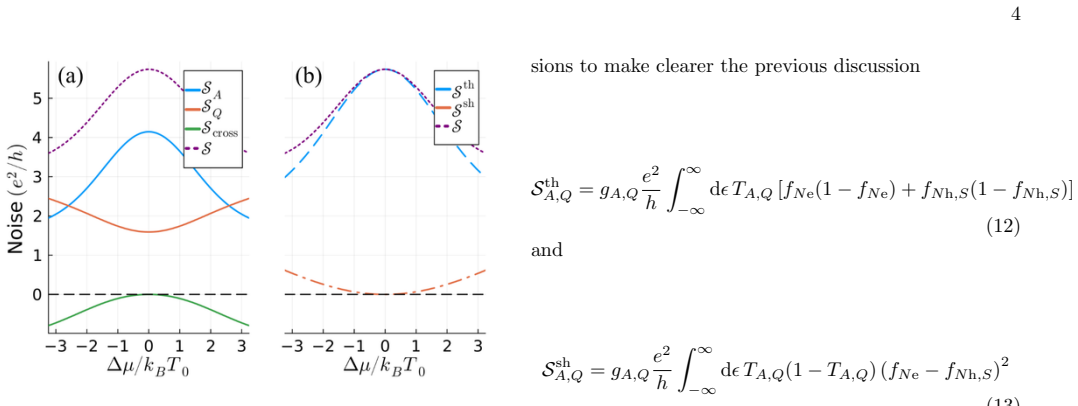
Using the Anantram-Datta scattering formalism, the charge current and zero-frequency noise are decomposed into Andreev, quasiparticle, and interference contributions. The nonequilibrium excess noise admits a positive representation independent of the superconducting gap. This positive representation proves a hybrid quantum thermodynamic uncertainty relation valid for arbitrary real gaps, extending the pure Andreev case to regimes where quasiparticle and Andreev processes coexist.
What carries the argument
The positive representation of the nonequilibrium excess noise derived from the decomposition of current and noise in the Anantram-Datta formalism.
Load-bearing premise
The Anantram-Datta scattering formalism allows decomposition of current and noise such that the nonequilibrium excess noise has a positive representation independent of the gap value.
What would settle it
An observation that the nonequilibrium excess noise takes negative values for some superconducting gap value, or a direct violation of the uncertainty bound in a hybrid conductor with mixed processes.
Editorial analysis
A structured set of objections, weighed in public.
Referee Report
Summary. The manuscript claims to prove a hybrid quantum thermodynamic uncertainty relation (TUR) for normal-superconducting (N-S) coherent conductors. Using the Anantram-Datta scattering formalism, the charge current and zero-frequency noise are decomposed into Andreev, quasiparticle, and interference contributions. The central technical step is showing that the nonequilibrium excess noise admits a positive representation independent of the real superconducting gap Δ; this representation is then used to establish a TUR that extends the pure Andreev case to regimes where quasiparticle and Andreev processes coexist.
Significance. If the positive representation of the excess noise holds without additional assumptions, the result supplies a universal dissipation-precision bound for hybrid quantum conductors. The approach is grounded in standard scattering theory and provides a concrete way to accommodate interference terms while preserving the TUR structure, which is a useful extension beyond the pure Andreev limit.
minor comments (2)
- The abstract states that a proof of the positive representation exists, but the manuscript would benefit from an explicit outline or appendix summarizing the key algebraic steps that establish positivity and Δ-independence, to facilitate verification.
- Notation for the decomposed currents (Andreev, quasiparticle, interference) should be introduced with a clear table or equation block early in the text for readability.
Simulated Author's Rebuttal
We thank the referee for the careful reading and positive assessment of our manuscript, including the accurate summary of the hybrid quantum TUR and the role of the positive representation of nonequilibrium excess noise. We note the recommendation for minor revision and will incorporate any editorial or typographical suggestions in the revised version.
Circularity Check
No significant circularity; derivation self-contained in scattering formalism
full rationale
The paper decomposes charge current and zero-frequency noise via the standard Anantram-Datta scattering formalism into Andreev, quasiparticle, and interference terms. It then shows that nonequilibrium excess noise (after equilibrium subtraction) admits a positive representation independent of the real gap value Δ. This representation is used to prove the hybrid TUR. No step reduces by construction to a fitted input, self-definition, or load-bearing self-citation; the central claim is a direct consequence of algebraic properties of the scattering decomposition rather than an ansatz or renamed empirical pattern. The argument is therefore self-contained against external benchmarks in mesoscopic transport theory.
Axiom & Free-Parameter Ledger
Cite this review
Pith. "Pith review of A thermodynamic uncertainty relation for (hybrid) N--S coherent conductors." pith.science (2026). https://pith.science/paper/5WIOPS4K
@misc{pith2026260621555,
  author       = {Pith},
  title        = {Pith review of: A thermodynamic uncertainty relation for (hybrid) N--S coherent conductors},
  year         = {2026},
  howpublished = {\url{https://pith.science/paper/5WIOPS4K}},
  note         = {Machine review of arXiv:2606.21555}
}
read the original abstract
Thermodynamic uncertainty relations establish fundamental bounds between current fluctuations and entropy production in nonequilibrium systems. In hybrid normal superconducting conductors, transport is governed by the coexistence of quasiparticle transmission and Andreev reflection, where electron hole conversion transfers charge through the superconducting condensate. Using the Anantram Datta scattering formalism, we decompose the charge current and zero-frequency noise into Andreev, quasiparticle, and interference contributions. Although the interference term prevents a simple additive bound at the level of individual noise components, we show that the nonequilibrium excess noise admits a positive representation. This allows us to prove a hybrid quantum thermodynamic uncertainty relation valid for an arbitrary real superconducting gap. Our result extends the pure Andreev quantum TUR to regimes where quasiparticle and Andreev processes coexist, clarifying how superconducting coherence reshapes current fluctuations while preserving a universal dissipation precision constraint in hybrid quantum conductors.
Figures



Forward citations
Cited by 1 Pith paper
-
Thermodynamic bound on the Fano factor of a coherent thermoelectric heat engine
Heat-engine operation forces a universal Fano-factor floor of F>1/2 for fermionic coherent thermoelectric transport and F>1 for bosonic or classical carriers.
Reference graph
Works this paper leans on
-
[1]
A. C. Barato and U. Seifert,Thermodynamic uncertainty relation for biomolecular processes, Phys. Rev. Lett.114, 158101 (2015)
2015
-
[2]
T. R. Gingrich, J. M. Horowitz, N. Perunov, and J. L. England,Dissipation bounds all steady-state current fluc- tuations, Phys. Rev. Lett.116, 120601 (2016)
2016
-
[3]
J. M. Horowitz and T. R. Gingrich,Thermodynamic uncertainty relations constrain non-equilibrium fluctua- tions, Nat. Phys.16, 15 (2020)
2020
-
[4]
Seifert,Stochastic thermodynamics, fluctuation the- orems and molecular machines, Rep
U. Seifert,Stochastic thermodynamics, fluctuation the- orems and molecular machines, Rep. Prog. Phys.75, 126001 (2012)
2012
-
[5]
Brandner, T
K. Brandner, T. Hanazato, and K. Saito,Thermody- namic bounds on coherent transport in periodically driven conductors, Phys. Rev. Lett.120, 090601 (2018)
2018
-
[6]
Ptaszy´ nski and M
K. Ptaszy´ nski and M. Esposito,Entropy production in open systems: The predominant role of intraenvironment correlations, Phys. Rev. Lett.123, 200603 (2019)
2019
-
[7]
Hasegawa and T
Y. Hasegawa and T. Van Vu,Fluctuation theorem uncer- tainty relation, Phys. Rev. Lett.123, 110602 (2019)
2019
-
[8]
Brandner and K
K. Brandner and K. Saito,Thermodynamic uncertainty relations for coherent transport, Physical Review Letters 135, 046302 (2025)
2025
-
[9]
A. F. Andreev,The thermal conductivity of the interme- diate state in superconductors, Sov. Phys. JETP19, 1228 (1964)
1964
-
[10]
G. E. Blonder, M. Tinkham, and T. M. Klapwijk,Tran- sition from metallic to tunneling regimes in supercon- ducting microconstrictions: Excess current, charge im- balance, and supercurrent conversion, Phys. Rev. B25, 4515 (1982)
1982
-
[11]
universal
C. W. J. Beenakker,Three “universal” mesoscopic Josephson effects, Phys. Rev. B46, 12841 (1992)
1992
-
[12]
C. J. Lambert,Generalized Landauer formulae for quasi- particle transport in disordered superconductors, J. Phys.: Condens. Matter3, 6579 (1991)
1991
-
[13]
M. P. Anantram and S. Datta,Current fluctuations in mesoscopic systems with Andreev scattering, Physical Re- view B53, 16390 (1996)
1996
-
[14]
de Franceschi, L
S. de Franceschi, L. Kouwenhoven, C. Sch¨ onenberger, and W. Wernsdorfer,Hybrid superconductor-quantum dot devices, Nat. Nanotechnol.5, 703 (2010)
2010
-
[15]
Fazio and R
R. Fazio and R. Raimondi,Resonant Andreev tunneling in strongly interacting quantum dots, Phys. Rev. Lett. 80, 2913 (1998)
1998
-
[16]
Governale, M
M. Governale, M. G. Pala, and J. K¨ onig,Real-time diagrammatic approach to transport through interacting 6 quantum dots with normal and superconducting leads, Phys. Rev. B77, 134513 (2008)
2008
-
[17]
D. C. Ohnmacht, J. C. Cuevas, W. Belzig, R. L´ opez, J. S. Lim, and K. W. Kim,Thermodynamic uncertainty relations in superconducting junctions, Phys. Rev. Res. 7, L012075 (2025)
2025
-
[18]
D. C. Ohnmacht, W. Belzig, and J. C. Cuevas,The role of charge in thermody- namic uncertainty relations, arXiv:2512.20558 https://doi.org/10.48550/arXiv.2512.2055 (2025)
-
[19]
F. Mayo, N. Sobrino, R. Fazio, F. Taddei, and M. Gover- nale,Quantum thermodynamic uncertainty relation and macroscopic superconducting coherence, Phys. Rev. Res. 8, 013242 (2026)
2026
-
[20]
Tesser, B
L. Tesser, B. Hartmann, F. Brange, C. Flindt, and J. Splettstoesser,Heat currents in voltage-biased quan- tum dots: Role of dot level and Andreev processes, Phys. Rev. B105, 035406 (2022)
2022
-
[21]
D. S. Fisher and P. A. Lee,Relation between conductiv- ity and transmission matrix, Phys. Rev. B23, 6851(R) (1981)
1981
-
[22]
Vidal and R
S. Vidal and R. L´ opez, Supplemental material for: ”A thermodynamic uncertainty relation for (hybrid) N–S co- herent conductors”, Supplementary Material to ”A ther- modynamic uncertainty relation for (hybrid) N–S coher- ent conductors” (2026). 7 Supplemental Material for: A thermodynamic uncertainty relation for (hybrid) N–S coherent conductors Sergi Vid...
2026
-
[23]
A. C. Barato and U. Seifert,Thermodynamic uncertainty relation for biomolecular processes, Physical Review Letters114, 158101 (2015)
2015
-
[24]
T. R. Gingrich, J. M. Horowitz, N. Perunov, and J. L. England,Dissipation bounds all steady-state current fluctuations, Physical Review Letters116, 120601 (2016)
2016
-
[25]
J. M. Horowitz and T. R. Gingrich,Thermodynamic uncertainty relations constrain non-equilibrium fluctuations, Nature Physics16, 15 (2020)
2020
-
[26]
K. Brandner and K. Saito,Thermodynamic uncertainty relations for coherent transport, Physical Review Letters 10.48550/arXiv.2502.07917 (2025), arXiv:2502.07917
-
[27]
F. Mayo, N. Sobrino, R. Fazio, F. Taddei, and M. Governale,Quantum thermodynamic uncertainty relation and macroscopic superconducting coherence, Phys. Rev. Res.8, 013242 (2026)
2026
-
[28]
B”uttiker,Scattering theory of current and intensity noise correlations in conductors and wave guides, Physical Review B46, 12485 (1992)
M. B”uttiker,Scattering theory of current and intensity noise correlations in conductors and wave guides, Physical Review B46, 12485 (1992)
1992
-
[29]
Datta,Electronic Transport in Mesoscopic Systems(Cambridge University Press, Cambridge, 1995)
S. Datta,Electronic Transport in Mesoscopic Systems(Cambridge University Press, Cambridge, 1995)
1995
-
[30]
Y. M. Blanter and M. B¨ uttiker,Shot noise in mesoscopic conductors, Physics Reports336, 1 (2000)
2000
-
[31]
Nambu,Quasi-particles and gauge invariance in the theory of superconductivity, Physical Review117, 648 (1960)
Y. Nambu,Quasi-particles and gauge invariance in the theory of superconductivity, Physical Review117, 648 (1960)
1960
-
[32]
M. P. Anantram and S. Datta,Current fluctuations in mesoscopic systems with andreev scattering, Phys. Rev. B53, 16390 (1996)
1996
-
[33]
C. W. J. Beenakker,Random-matrix theory of quantum transport, Reviews of Modern Physics69, 731 (1997)
1997
-
[34]
G. E. Blonder, M. Tinkham, and T. M. Klapwijk,Transition from metallic to tunneling regimes in superconducting micro- constrictions: Excess current, charge imbalance, and supercurrent conversion, Physical Review B25, 4515 (1982)
1982
-
[35]
Seifert,Stochastic thermodynamics, fluctuation theorems and molecular machines, Reports on Progress in Physics75, 126001 (2012)
U. Seifert,Stochastic thermodynamics, fluctuation theorems and molecular machines, Reports on Progress in Physics75, 126001 (2012)
2012
-
[36]
A. F. Andreev,The thermal conductivity of the intermediate state in superconductors, Soviet Physics JETP19, 1228 (1964)
1964
-
[37]
universal
C. W. J. Beenakker,Three “universal” mesoscopic josephson effects, Physical Review B46, 12841 (1992)
1992
-
[38]
Brandner, K
K. Brandner, K. Saito, and U. Seifert,Thermodynamic bounds on precision in ballistic multiterminal transport, Physical Review X8, 031019 (2018)
2018
-
[39]
De Franceschi, L
S. De Franceschi, L. Kouwenhoven, C. Sch”onenberger, and W. Wernsdorfer,Hybrid superconductor–quantum dot devices, Nature Nanotechnology5, 703 (2010)
2010
-
[40]
Bardeen, L
J. Bardeen, L. N. Cooper, and J. R. Schrieffer,Theory of superconductivity, Physical Review108, 1175 (1957)
1957
-
[41]
de Gennes,Superconductivity of Metals and Alloys(W
P.-G. de Gennes,Superconductivity of Metals and Alloys(W. A. Benjamin, New York, 1966)
1966
-
[42]
N. N. Bogoliubov,A new method in the theory of superconductivity, Soviet Physics JETP7, 41 (1958)
1958
-
[43]
Haug and A.-P
H. Haug and A.-P. Jauho,Quantum Kinetics in Transport and Optics of Semiconductors, 2nd ed. (Springer, Berlin, 2008)
2008
-
[44]
D. S. Fisher and P. A. Lee,Relation between conductivity and transmission matrix, Physical Review B23, 6851 (1981)
1981
-
[45]
Fazio and R
R. Fazio and R. Raimondi,Resonant andreev tunneling in strongly interacting quantum dots, Physical Review Letters80, 2913 (1998)
1998
-
[46]
Governale, M
M. Governale, M. G. Pala, and J. K”onig,Real-time diagrammatic approach to transport through interacting quantum dots with normal and superconducting leads, Physical Review B77, 134513 (2008)
2008
-
[47]
Hwang, R
S.-Y. Hwang, R. L´ opez, and D. S´ anchez,Cross thermoelectric coupling in normal-superconductor quantum dots, Phys. Rev. B91, 104518 (2015). 22
2015
-
[48]
Hwang, D
S.-Y. Hwang, D. S´ anchez, and R. L´ opez,A hybrid superconducting quantum dot acting as an efficient charge and spin seebeck diode, Phys. Rev. B94, 054506 (2016)
2016
This paper was first reviewed by grok-4.3 on June 26, 2026.
discussion (0)
Sign in with ORCID, Apple, or X to comment. Anyone can read and Pith papers without signing in.