REVIEW 3 major objections 2 minor
ATLAS: Agentic Taxonomy of Large-Scale Software Ecosystems
T0 review · 3 major / 2 minor · reviewed 2026-06-26 · grok-4.3
Pith's one-line read ATLAS builds hierarchical taxonomies for GitHub repositories by having LLM agents propose splitting dimensions and revise them through a self-corrective loop driven by classification failures.
desk verdict ATLAS shows a workable LLM agent pipeline for turning flat GitHub topics into a hierarchy with reported gains on benchmarks and tasks, but the self-corrective loop has no ablations or stability checks to back the superiority claim. read the letter →
The pith
A machine-rendered reading of the paper's core claim, the machinery that carries it, and where it could break.
The reading
What carries the argument
The self-corrective refinement loop that escalates revision strategies when classification failures occur to produce splitting dimensions that better fit actual project distributions.
What would settle it
An independent audit on a fresh sample of several thousand repositories finds that the generated hierarchical paths match expert judgments no better than flat tags or that downstream precision on discovery tasks falls below human-curated lists.
Extended reading notes
Core claim
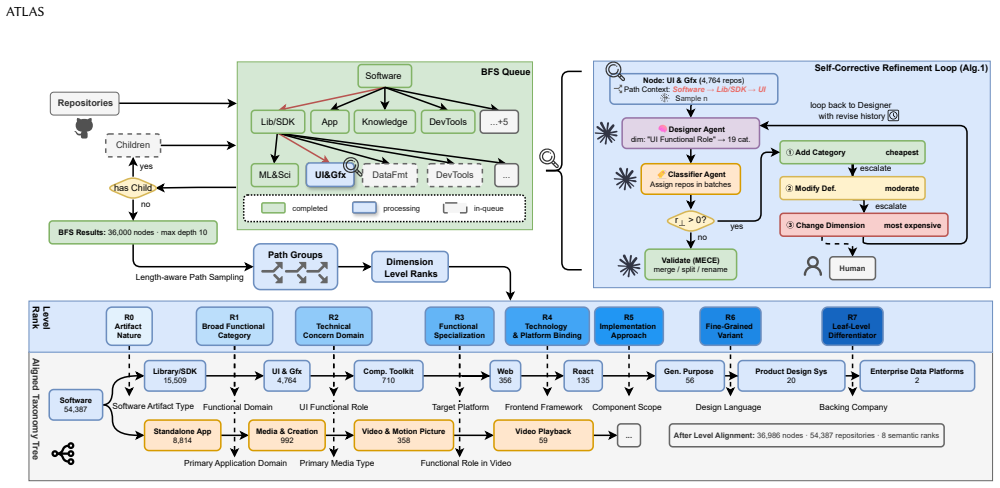
ATLAS is the first framework that automatically constructs a hierarchical taxonomy for software repositories and classifies projects into it end-to-end by combining LLM global knowledge with real repository distributions; a Designer Agent proposes splitting dimensions while a Classifier Agent assigns repositories, and a self-corrective refinement loop uses classification failures to drive dimension revision through escalating strategies.
Load-bearing premise
Classification failures can be translated into dimension revisions that improve coverage of real repositories without introducing systematic bias or instability across the full set of projects.
Editorial extensions
If this is right
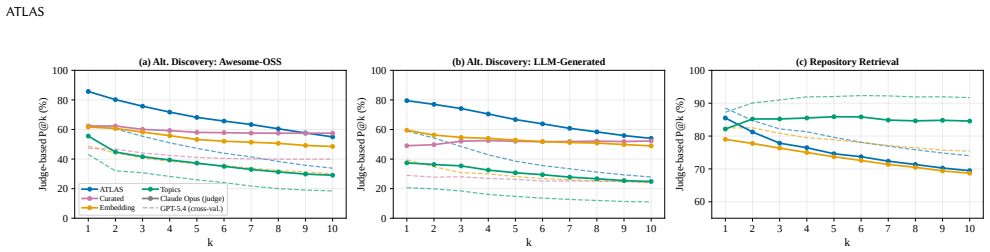
- The resulting taxonomy supports alternative project discovery at 85.71% P@1, exceeding human-curated lists at 62.34%.
- It achieves the highest P@1 among compared methods on repository retrieval tasks.
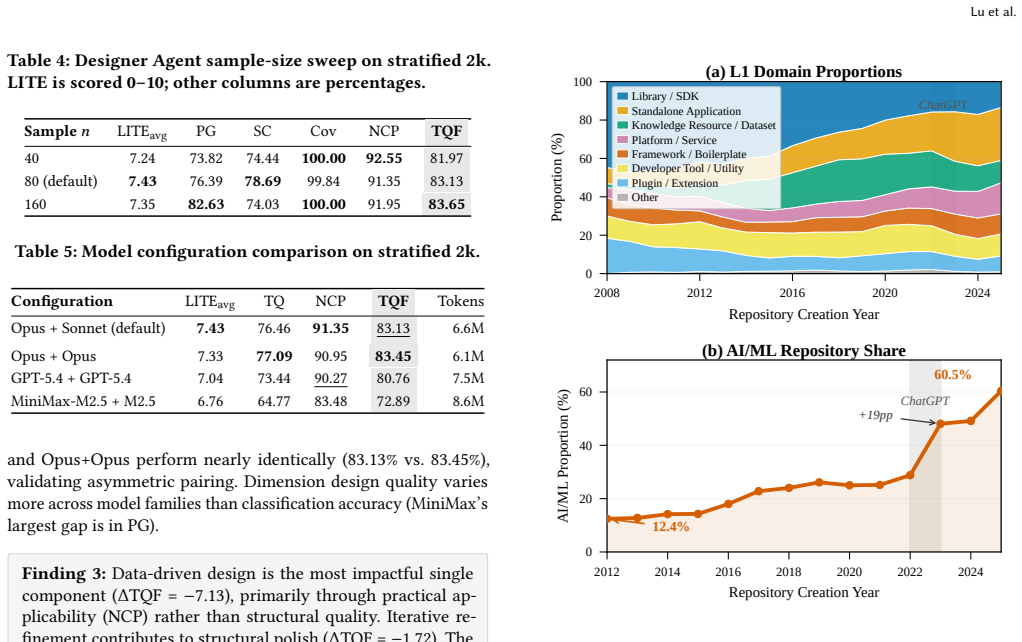
- Hierarchical, type-based categories make visible ecosystem trends such as AI/ML applications now accounting for 61% of newly adopted projects.
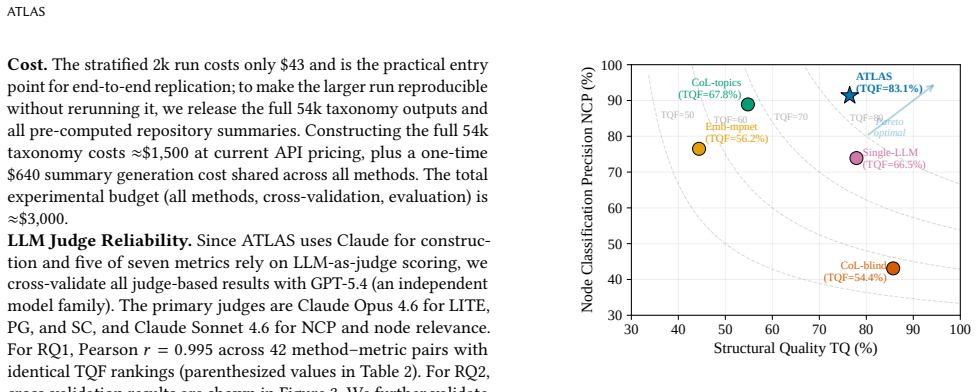
- The method reaches an 83.13% Taxonomy Quality F-score on a 2,001-repository benchmark, 15 points above the strongest baseline.
Reading between the lines
- The same agent loop could be tested on non-GitHub code hosting platforms to check whether the refinement process generalizes beyond one ecosystem.
- The produced hierarchies might serve as input features for automated tools that track dependency evolution or identify emerging category clusters.
- Periodic re-runs on updated repository snapshots could quantify how fast category boundaries shift over time.
Editorial analysis
A structured set of objections, weighed in public.
Referee Report
Summary. The paper introduces ATLAS, the first end-to-end agentic framework that uses LLM-powered Designer and Classifier agents plus a self-corrective refinement loop to automatically construct a hierarchical taxonomy of GitHub software repositories and classify projects into it. It evaluates the approach on 54,387 repositories against six baselines, reporting a Taxonomy Quality F-score (TQF) of 83.13% on a stratified 2,001-repository benchmark (15pp above the best baseline), superior P@1 on alternative discovery (85.71%) and repository retrieval, and the ability to surface ecosystem trends such as the shift toward AI/ML applications. The work claims to be the only method achieving both high structural quality and practical applicability.
Significance. If the performance claims hold after addressing the evaluation gaps, ATLAS would represent a substantive advance in organizing large-scale open-source ecosystems beyond flat tags or similarity-based methods, with direct utility for discovery, retrieval, and trend analysis. The provision of an interactive explorer strengthens the practical contribution. The absence of ablations on the core self-corrective loop and missing metric definitions currently limit the strength of the superiority claim.
major comments (3)
- [Abstract / Evaluation] Abstract and evaluation section: The TQF metric is referenced with concrete numbers (83.13% on the 2,001-repo benchmark) but is never defined; the note that the full-corpus drop to ~73% is an artifact of Path Granularity scoring rather than accuracy requires an explicit formula or pseudocode for TQF to allow reproduction and to confirm it is not circular with the agent outputs.
- [Abstract / Method (self-corrective refinement loop)] Abstract and § on self-corrective refinement: The central claim that ATLAS is the only method achieving both high structural quality and applicability rests on the Designer+Classifier agents plus the self-corrective refinement loop; no ablation removing the loop, no multi-run stability metrics on dimension proposals, and no analysis of whether escalated revisions introduce bias toward certain repository types or LLM priors are provided, leaving the 15pp TQF gain and "only method" assertion dependent on an unverified mechanism.
- [Evaluation] Evaluation section: No statistical significance tests, confidence intervals, or details on how the six baselines were re-implemented (including prompt templates or hyper-parameters) are reported, making it impossible to assess whether the reported P@1 gains (85.71% vs. 62.34% human-curated) are robust or sensitive to implementation choices.
minor comments (2)
- [Evaluation] The construction criteria for the stratified 2,001-repository benchmark are not specified, which could mask any distributional bias introduced by the refinement loop.
- [Abstract] The abstract states the taxonomy "reveals structural ecosystem trends" but provides only one example (AI/ML shift); additional quantitative trend results or a table would strengthen the claim.
Simulated Author's Rebuttal
We thank the referee for the constructive feedback highlighting gaps in metric definition, ablation analysis, and statistical reporting. We address each major comment below and commit to revisions that strengthen reproducibility and the claims without overstating current results.
read point-by-point responses
-
Referee: [Abstract / Evaluation] Abstract and evaluation section: The TQF metric is referenced with concrete numbers (83.13% on the 2,001-repo benchmark) but is never defined; the note that the full-corpus drop to ~73% is an artifact of Path Granularity scoring rather than accuracy requires an explicit formula or pseudocode for TQF to allow reproduction and to confirm it is not circular with the agent outputs.
Authors: We agree the TQF definition and computation details are insufficiently explicit. The manuscript introduces TQF but does not provide the formula or pseudocode. We will add a dedicated subsection with the precise definition (harmonic mean of taxonomy structure quality and classification accuracy, incorporating path-granularity penalties), the scoring procedure, and pseudocode in the revised evaluation section. revision: yes
-
Referee: [Abstract / Method (self-corrective refinement loop)] Abstract and § on self-corrective refinement: The central claim that ATLAS is the only method achieving both high structural quality and applicability rests on the Designer+Classifier agents plus the self-corrective refinement loop; no ablation removing the loop, no multi-run stability metrics on dimension proposals, and no analysis of whether escalated revisions introduce bias toward certain repository types or LLM priors are provided, leaving the 15pp TQF gain and "only method" assertion dependent on an unverified mechanism.
Authors: The manuscript presents the self-corrective loop as a core component but does not include ablations isolating its contribution, stability metrics across runs, or bias analysis. We acknowledge this limits the strength of the mechanistic claim. We will add a new ablation subsection comparing performance with and without the refinement loop on the benchmark, plus a brief discussion of observed stability and potential bias sources, while noting that exhaustive multi-run experiments were constrained by compute. revision: partial
-
Referee: [Evaluation] Evaluation section: No statistical significance tests, confidence intervals, or details on how the six baselines were re-implemented (including prompt templates or hyper-parameters) are reported, making it impossible to assess whether the reported P@1 gains (85.71% vs. 62.34% human-curated) are robust or sensitive to implementation choices.
Authors: We agree that statistical tests, confidence intervals, and baseline re-implementation details are missing. We will add McNemar or paired t-tests with p-values and 95% CIs for the key metrics, plus an appendix with the exact prompt templates, hyper-parameters, and re-implementation notes used for all six baselines to enable reproduction. revision: yes
Circularity Check
No significant circularity in derivation chain
full rationale
The paper presents an empirical agentic framework evaluated on an external stratified benchmark of 2,001 repositories against six baselines spanning multiple paradigms. Reported metrics (TQF 83.13%, P@1 scores) are computed from held-out data and comparative performance, with no equations, fitted parameters, or self-citations that reduce these quantities to the method's own inputs by construction. The self-corrective refinement loop is described as a procedural component whose outputs are validated externally rather than defined tautologically. No load-bearing steps match the enumerated patterns of self-definitional, fitted-input, or self-citation circularity.
Assumptions & free parameters
assumptions (1)
- domain assumption Large language models possess sufficient global knowledge of software domains to propose meaningful hierarchical splitting dimensions that can be iteratively corrected against real repository distributions.
Cite this review
Pith. "Pith review of ATLAS: Agentic Taxonomy of Large-Scale Software Ecosystems." pith.science (2026). https://pith.science/paper/C723WH52
@misc{pith2026260621597,
  author       = {Pith},
  title        = {Pith review of: ATLAS: Agentic Taxonomy of Large-Scale Software Ecosystems},
  year         = {2026},
  howpublished = {\url{https://pith.science/paper/C723WH52}},
  note         = {Machine review of arXiv:2606.21597}
}
read the original abstract
The open-source ecosystem on GitHub lacks a systematic hierarchical taxonomy of software repositories. GitHub Topics, the dominant organizational mechanism, is flat, inconsistent, and covers only 67% of projects. We present ATLAS, the first framework that automatically constructs a hierarchical taxonomy for software repositories and classifies projects into it end-to-end. By combining LLM global knowledge with real repository distributions, ATLAS proposes meaningful splitting dimensions and iteratively corrects those that fail to accommodate real projects. A Designer Agent proposes splitting dimensions while a Classifier Agent assigns repositories; a self-corrective refinement loop uses classification failures to drive dimension revision through escalating strategies. We evaluate ATLAS on 54,387 GitHub repositories against six baselines spanning four paradigms, two downstream tasks, and three model families. On a stratified 2,001-repository benchmark, ATLAS achieves a Taxonomy Quality F-score (TQF) of 83.13%, outperforming the best baseline by 15 percentage points (on the full 54k corpus the approximate TQF is 73.0%, a gap driven by Path Granularity's all-or-nothing scoring on longer paths rather than lower classification accuracy). It is the only method to simultaneously achieve high structural quality and high practical applicability. On downstream tasks, ATLAS enables alternative discovery with P@1 = 85.71%, surpassing even human-curated lists (62.34%), and achieves the highest P@1 for repository retrieval. The taxonomy further reveals structural ecosystem trends that are difficult to obtain from flat tags or similarity methods: the shift from libraries to AI/ML applications (now 61% of newly community-adopted projects) becomes visible only through hierarchical, type-based categorization. An interactive taxonomy explorer is available at https://atlas-taxonomy.netlify.app/
Figures
Figures from the paper (1 more)
Reviewed June 26, 2026 · model on record in the stance chip above.
Discussion (0). Continue with ORCID to comment.