On-orbit Calibration of the Carruthers GCI: Instrument Effect Correction
Pith reviewed 2026-06-26 12:54 UTC · model grok-4.3
The pith
Algorithms correct bias, dark current, radiation hits, flat-field, and distortion in the Carruthers GCI raw telemetry.
A machine-rendered reading of the paper's core claim, the machinery that carries it, and where it could break.
Core claim
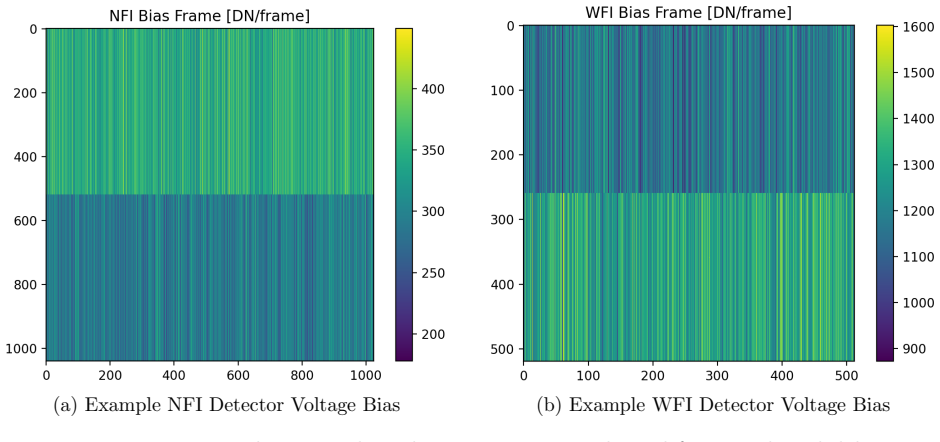
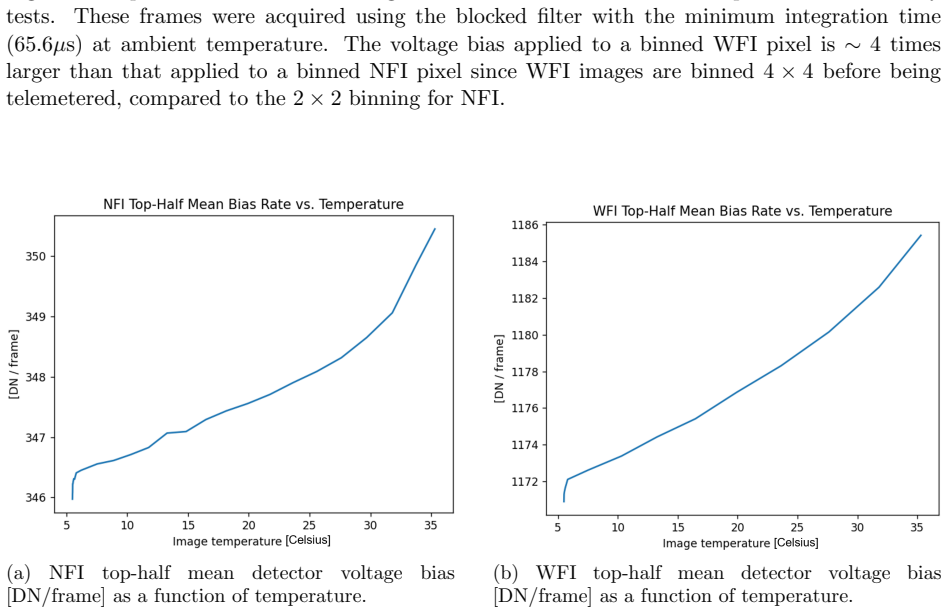
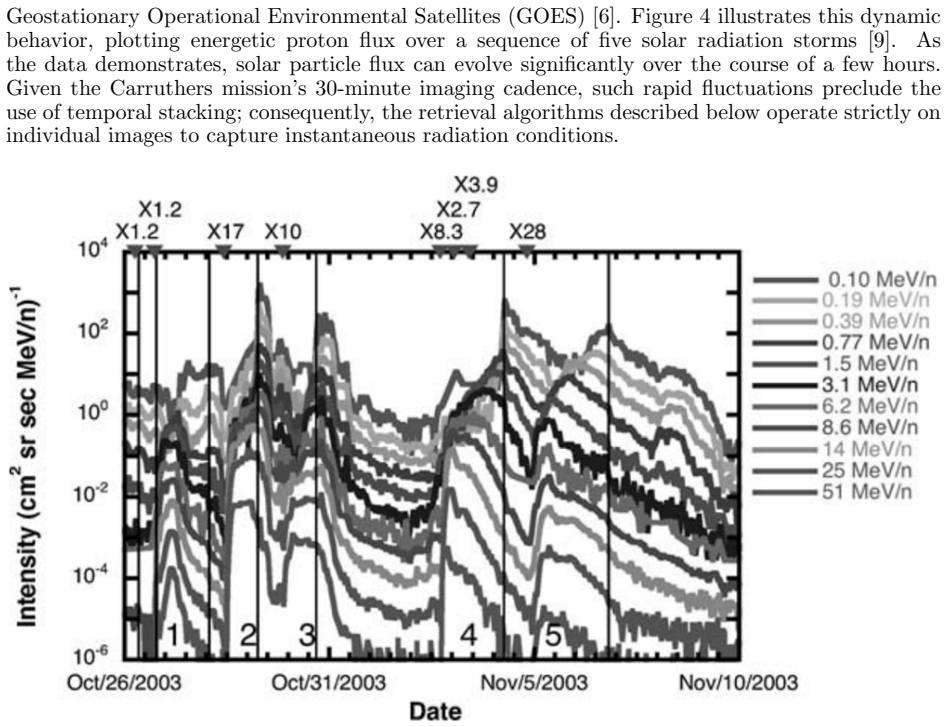
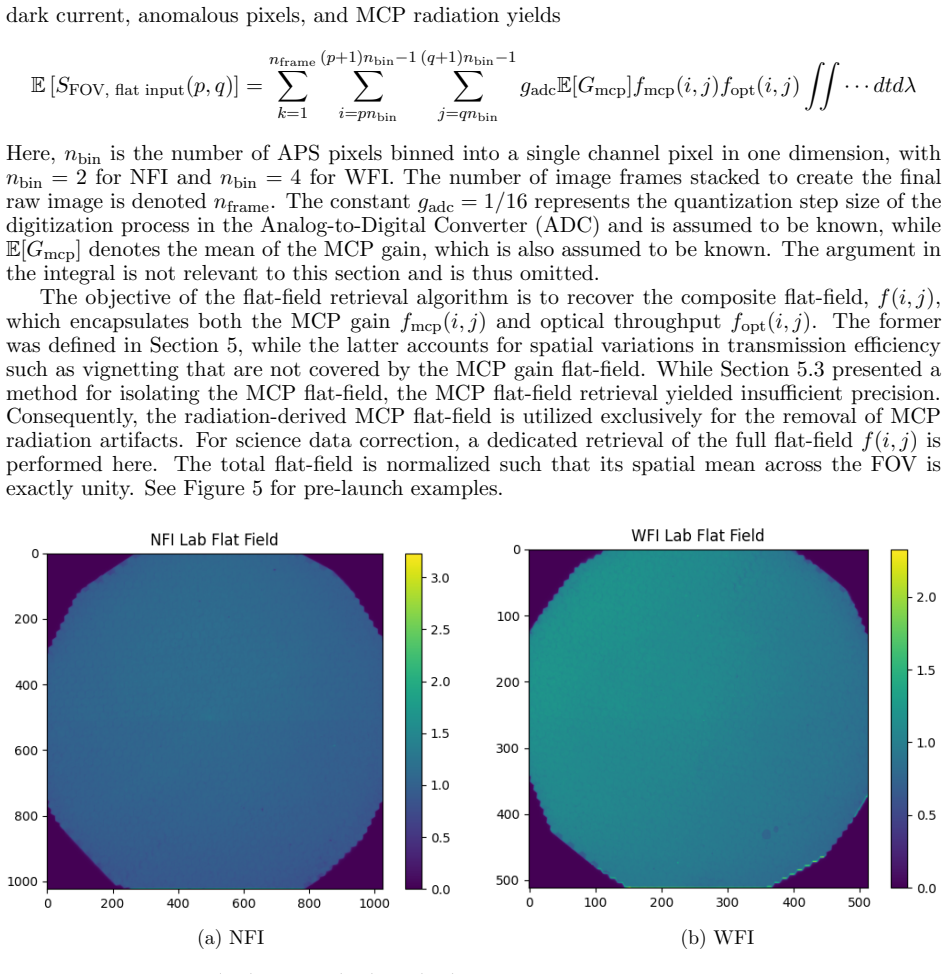
The paper establishes that detector voltage bias, thermal dark current, particle radiation events, flat-field response, and geometric distortion can each be measured or modeled from on-orbit telemetry and then removed through a defined sequence of corrections, yielding instrument-effect-corrected images; performance of the corrections is assessed with a synthetic numerical image generator and pre-launch laboratory data.
What carries the argument
The sequence of per-effect correction algorithms applied to MCP-intensified CMOS detector telemetry within the science data processing pipeline.
If this is right
- Raw telemetry can be transformed into science-ready images that support quantitative exosphere studies.
- Each listed instrument effect is treated as a separable, retrievable term that can be subtracted without destroying the underlying Lyman-alpha signal.
- The pipeline provides a repeatable, documented path from spacecraft data to corrected images.
- Validation via synthetic images supplies a quantitative metric for residual error after correction.
Where Pith is reading between the lines
- Similar correction steps could be reused on other missions that fly the same detector technology, provided the synthetic generator is re-tuned to the new environment.
- If the synthetic generator matches flight data well, it offers a way to test future algorithm changes without waiting for additional on-orbit time.
- The pipeline's modularity implies that individual corrections could be updated independently if new on-orbit diagnostics become available.
Load-bearing premise
The assumption that a synthetic numerical image generator and pre-launch experiments accurately reproduce the instrument effects that actually appear in on-orbit MCP detector data.
What would settle it
A mismatch between the radiance values in corrected images and independent, simultaneous measurements of the same exospheric Lyman-alpha features obtained by another calibrated instrument would show that at least one correction step fails under flight conditions.
Figures
read the original abstract
The Carruthers Geocorona Observatory -- launched in September 2025 -- is NASA's first mission devoted to investigating the fundamental nature of Earth's exosphere from its distant vantage in halo orbit around the Earth-Sun L1 Lagrange point. Its primary payload, the GeoCoronal Imager, consists of two coaligned photometric imagers that measure ultraviolet Lyman-alpha emission radiance from exospheric hydrogen simultaneously at wide- and narrow- fields of view. The imagers use Micro Channel Plate intensified Complimentary Metal Oxide Semiconductor detectors, which are known to add various artifacts to the final image telemetered from the spacecraft, hereby known as instrument effects. This paper details the algorithms used to retrieve and remove instrument effects from raw telemetry on-orbit, including detector voltage bias, thermal dark current, particle radiation, flat-field, and distortion. Finally, the science data processing pipeline from raw telemetry to instrument-effect corrected images is detailed. Algorithm performance is measured via a synthetic numerical image generator or validated on pre-launch experiments.
Editorial analysis
A structured set of objections, weighed in public.
Referee Report
Summary. The manuscript details algorithms to retrieve and remove instrument effects (detector voltage bias, thermal dark current, particle radiation, flat-field, and distortion) from raw telemetry of the Carruthers GCI's MCP-intensified CMOS detectors. It also describes the full science data processing pipeline from raw data to corrected images, with performance assessed via a synthetic numerical image generator or pre-launch experiments.
Significance. If the algorithms are robust, this work would support accurate processing of Lyman-alpha exosphere data from the first dedicated geocorona mission at L1. The explicit pipeline description and use of a synthetic generator for testing are strengths that aid reproducibility and could inform similar UV imager calibrations.
major comments (1)
- [Abstract] Abstract: The claim to detail on-orbit calibration algorithms is undermined because performance is measured only via synthetic generator or pre-launch experiments; no quantitative results, error bars, or tests on actual L1 flight telemetry (e.g., variable radiation or thermal conditions) are shown to validate the corrections under flight conditions.
minor comments (2)
- [Abstract] The sentence 'hereby known as instrument effects' is awkward; rephrase for clarity.
- [Abstract] Spelling: 'Complimentary Metal Oxide Semiconductor' should be 'Complementary'.
Simulated Author's Rebuttal
We thank the referee for their careful review. We address the single major comment below and agree that the abstract requires revision for accuracy.
read point-by-point responses
-
Referee: [Abstract] Abstract: The claim to detail on-orbit calibration algorithms is undermined because performance is measured only via synthetic generator or pre-launch experiments; no quantitative results, error bars, or tests on actual L1 flight telemetry (e.g., variable radiation or thermal conditions) are shown to validate the corrections under flight conditions.
Authors: We agree with the referee that the current abstract overstates the validation scope. The manuscript describes algorithms developed for on-orbit use and assesses their performance exclusively through a synthetic image generator and pre-launch experiments that simulate expected conditions. No actual L1 flight telemetry results are included because the paper focuses on algorithm development and pipeline description prior to comprehensive on-orbit analysis. We will revise the abstract to state that performance is evaluated via synthetic and pre-launch methods, while clarifying that the algorithms are intended for on-orbit application. Quantitative flight-data validation with error bars will be reserved for subsequent work. revision: yes
Circularity Check
No significant circularity; purely descriptive account with no derivation chain
full rationale
The paper provides a descriptive account of correction algorithms for detector voltage bias, thermal dark current, particle radiation, flat-field, and distortion, with the science pipeline from raw telemetry to corrected images. No equations, parameter fits, predictions, or self-citations are described in the abstract or provided text. Algorithm performance is explicitly measured via synthetic numerical image generator or pre-launch experiments, but this does not constitute a derivation that reduces to its own inputs by construction. No load-bearing steps match any of the enumerated circularity patterns. This is the expected honest non-finding for a methods-description paper without mathematical derivations.
Axiom & Free-Parameter Ledger
axioms (1)
- domain assumption Standard models for MCP detector effects such as dark current and flat-field variations are applicable and correctable on-orbit using the listed algorithms.
Reference graph
Works this paper leans on
-
[1]
CR `EME: The 2011 revision of the cosmic ray effects on micro-electronics code
JH Adams et al. “CR `EME: The 2011 revision of the cosmic ray effects on micro-electronics code”. In:IEEE Transactions on Nuclear Science59.6 (2013), pp. 3141–3147
2011
-
[2]
Performance results of the ICON FUV sealed tube converters
NT Darling et al. “Performance results of the ICON FUV sealed tube converters”. In:UV, X-Ray, and Gamma-Ray Space Instrumentation for Astronomy XIX. Vol. 9601. SPIE. 2015, pp. 166–173
2015
-
[3]
Numerical Model Simulation of the Carruthurs Geocoronal Observatory
H. Filippini et al. “Numerical Model Simulation of the Carruthurs Geocoronal Observatory”. In: 99999.99999 (Feb. 2026), pp. 0-0.doi:0.0
arXiv 2026
-
[4]
A comprehensive tool for modeling CMOS image-sensor-noise perfor- mance
Ryan D Gow et al. “A comprehensive tool for modeling CMOS image-sensor-noise perfor- mance”. In:IEEE Transactions on Electron Devices54.6 (2007), pp. 1321–1329
2007
-
[5]
Jeffrey W. Kruk et al. “Radiation-induced Backgrounds in Astronomical Instruments: Consid- erations for Geosynchronous Orbit and Implications for the Design of the WFIRST Wide-field Instrument”. In:Publications of the Astronomical Society of the Pacific128.961 (Feb. 2016), p. 035005.doi:10.1088/1538- 3873/128/961/035005.url:https://dx.doi.org/10. 1088/153...
-
[6]
A space weather index for the radiation field at aviation altitudes
Matthias M Meier and Daniel Matthi¨ a. “A space weather index for the radiation field at aviation altitudes”. In:Journal of Space Weather and Space Climate4 (2014), A13
2014
-
[7]
Ultraviolet spectroscopy and remote sensing of the upper atmosphere
R.R. Meier. “Ultraviolet spectroscopy and remote sensing of the upper atmosphere”. In:Space Science Reviews58.2 (Dec. 1991).doi:https://doi.org/10.1007/BF01206000
-
[8]
The far ultra-violet imager on the ICON mission
SB Mende et al. “The far ultra-violet imager on the ICON mission”. In:Space Science Reviews 212.1 (2017), pp. 655–696
2017
-
[9]
Solar energetic particle composition, energy spectra, and space weather
RA Mewaldt. “Solar energetic particle composition, energy spectra, and space weather”. In: Space Science Reviews124 (2006), pp. 303–316
2006
-
[10]
Wayne R. Pryor et al. “Lyman-αModels for LRO LAMP from MESSENGER MASCS and SOHO SWAN Data”. In:Cross-Calibration of Far UV Spectra of Solar System Objects and the Heliosphere. Ed. by Eric Qu´ emerais, Martin Snow, and Roger-Maurice Bonnet. New York, NY: Springer New York, 2013, pp. 163–175.isbn: 978-1-4614-6384-9.doi:10.1007/978-1- 4614-6384-9_5.url:https...
-
[11]
Alignment and ground calibration of the Carruthers GeoCoronal Imager
K. Rider et al. “Alignment and ground calibration of the Carruthers GeoCoronal Imager”. In:Proceedings Volume 13093, Space Telescopes and Instrumentation 2024: Ultraviolet to Gamma Ray, SPIE; 1309339. 2024.doi:10.1117/12.3018528
-
[12]
Design and Performance of the Carruthers Geocoronal Imager
Martin M. Sirk et al. “Design and Performance of the Carruthers Geocoronal Imager”. To be submitted to Space Science Reviews. 2025
2025
-
[13]
On-orbit Calibration of the Carruthers GCI: Photon Background Re- moval
A. M. Zhang et al. “On-orbit Calibration of the Carruthers GCI: Photon Background Re- moval”. In: (2026)
2026
-
[14]
On-orbit Calibration of the Carruthers GCI: Radiometric Sensitivity
A. M. Zhang et al. “On-orbit Calibration of the Carruthers GCI: Radiometric Sensitivity”. In: (2026). 15
2026
discussion (0)
Sign in with ORCID, Apple, or X to comment. Anyone can read and Pith papers without signing in.