REVIEW 4 major objections 4 minor 2 references
SEF quantifies support versus opposition behind a prediction, and cross-fitted tests show conflict adds error-ranking information on some data sets while a permutation gate decides when that direction supports review.
Reviewed by Pith at T0; open to challenge. T0 means a machine referee read the full paper against a public rubric. the ladder, T0–T4 →
T0 review · deepseek-v4-flash
2026-08-02 10:34 UTC pith:TMFTL36Y
load-bearing objection SEF is a genuinely useful packaging of signed attributions into conflict/stability scores with a clean theory and an honest empirical design; the black-box section slightly overreaches but the core is solid. the 4 major comments →
Signed Evidence Flow: Conflict-Aware and Stability-Calibrated Data Analysis
The pith
A machine-rendered reading of the paper's core claim, the machinery that carries it, and where it could break.
The paper's main theoretical result is that reported confidence determines the conflict score exactly when it also determines the total amount of evidence mass. In a logistic model, conflict can differ between two predictions with the same confidence only if the total evidence mass differs. SEF therefore exposes structure that confidence alone can hide.
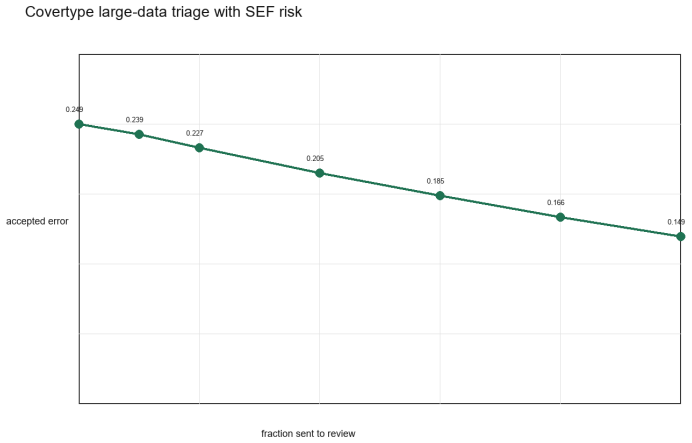
Empirically, the authors test SEF on healthcare, finance, Covertype, and ten external data sets. In some tasks, notably diabetes, heart disease, and Covertype, high-conflict, high-confidence predictions are indeed riskier. In two large finance tasks, the direction reverses: low-conflict cases are riskier. Because of this, the paper introduces ScopeGate, a permutation test on held-out data that checks the direction before SEF is used for review triage. SEF is thus presented as an evidence-audit tool whose deployment must be calibrated per population, not as a universal risk score.
Core claim
The central assertion, stated in the abstract, is: 'We prove that confidence determines conflict exactly when it also determines total evidence mass, derive the remaining conditional variance, and state when conflict can improve loss prediction beyond confidence and other audit variables.' SEF's empirical claim is that conflict sometimes separates risk among predictions that already appear confident, with the direction task-dependent and testable via ScopeGate. If correct, SEF provides a model-agnostic evidence-audit layer that, after held-out calibration, can rank errors within confident predictions in some populations and identifies populations where using conflict for review would be harmful.
Load-bearing premise
All theoretical identification results require decision-aligned evidence: f(x)-τ = Σ_j E_j(x) = N(x) (Definition 3, Section 5). For model-agnostic feature-replacement contrasts (Section 4.1), exact additivity fails unless the residual is spread evenly across features, so the clean 'conflict determined iff mass determined' theorem does not directly apply to the raw black-box construction used in Section 18. The full theory also depends on choosing a reference distribution and an attribution rule, since different signed evidence decompositions produce different conflict values.
Editorial analysis
A structured set of objections, weighed in public.
Referee Report
Summary. The paper introduces Signed Evidence Flow (SEF), a post-hoc evidence-audit layer for fitted prediction models. Given a signed feature-attribution decomposition, SEF computes support, opposition, conflict, stability, and a reliable evidence score. The central theoretical results are: conflict is determined by confidence iff normalized net evidence is determined by confidence; for decision-aligned evidence with logistic confidence, this reduces to conflict being determined iff total evidence mass is determined; an exact identity for the conditional variance; and an exact decomposition for when conflict improves loss prediction. The paper also proves flip-margin, multi-class robustness, stability concentration, and a conformal screening statement. Empirically, SEF is evaluated on healthcare, finance, Covertype, black-box, and ten external data sets, with cross-fitted error-risk models and a held-out permutation diagnostic (ScopeGate) to check whether high conflict is positively associated with error. The direction is found to be task-dependent, and the paper is careful to frame SEF as an audit tool rather than a universal risk score.
Significance. If the empirical claims hold, SEF provides a simple, model-agnostic method for exposing internal evidence conflict that confidence alone can hide. The theoretical component is elementary but correct, and the paper is unusually careful about scope: the identification theorems are explicitly conditional on a chosen attribution rule and decision-aligned evidence, and the ScopeGate diagnostic directly addresses the fact that conflict direction is not universal. The reproducible scripted pipeline and clear data identifiers are strengths. The main limitation is that the strongest empirical claims (especially the model-agnostic black-box results and the ten-data-set external replication) rely on constructions and uncertainty summaries that are not fully aligned with, or not fully supported by, the theory as stated. The paper is a useful contribution to the explainability/uncertainty literature but needs additional sensitivity and inferential work before its broadest claims can be accepted.
major comments (4)
- [§4.1, §5, §18] Theorems 1 and Corollary 2 apply to decision-aligned evidence (Definition 3), where N(x)=f(x)-τ. Section 18 computes E_j(x)=f(x)-f(x_{-j}, med_j) and explicitly uses the raw contrasts directly. These contrasts do not generally sum to f(x)-τ, so |N| is not the model margin and the logistic confidence Q does not determine |N|. The identification theorem's conclusion therefore does not transfer to the black-box experiments. The paper acknowledges the additivity issue in §4.1 but does not test the residual-spread complete decomposition or compare conflict values under alternative allocations. Since §18 is the model-agnostic evidence for the abstract's empirical claim, this is a load-bearing gap.
- [§25, Table 14] The external replication reports mean ΔAUC values from only 10 splits without confidence intervals or p-values. The abstract's broad claim of added error-ranking information over ten external data sets rests substantially on this table. Differences such as +0.001 (KC1) or -0.000 (Electricity) are not distinguishable from chance, and even larger differences such as +0.035 (PC1) need split-level variability to be interpretable. Please report per-split distributions, bootstrap CIs, or paired tests for all ten data sets, not only for the smaller ScopeGate table.
- [§3, §30, Figure 20] SEF conflict and the resulting triage frontiers depend on the chosen signed evidence decomposition and reference distribution. The paper correctly lists this as a limitation, but the experiments use only one implementation per setting (linear coefficients, median replacement, or interventional linear-SHAP). No experiment varies the decomposition, the residual-allocation rule, or the reference distribution to show that the reported separations are stable across reasonable choices. Because the central practical quantity is non-unique by construction, a sensitivity analysis is necessary before claiming that 'conflict sometimes separates risk' as a property of the method rather than of one particular attribution convention.
- [§15-24, Definition 3] In the linear logistic studies, E_j(x)=β_j(x_j-\bar{x}_j), so Σ_j E_j(x)=f(x)-μ_0, not f(x)-τ unless μ_0=τ. The paper notes in Definition 3 that decision alignment can be restored by adding μ_0-τ as an extra evidence coordinate, but the experimental sections do not state whether this offset was added. If it was not, the conflict scores are reference-centered rather than decision-centered, and the flip-margin interpretation (Theorem 4) and the Corollary 2 identification statement do not apply to those scores. Please clarify, and if the offset was omitted, either re-run the relevant analyses or explicitly restrict the interpretation to reference-centered evidence.
minor comments (4)
- [§25 title] The section is titled 'Independent External Replication,' but the replication is performed by the same authors on data sets not used in the initial examples. I suggest renaming it 'External Data Replication' to avoid implying a separate research group.
- [Table 14] The table would benefit from a column reporting the number of eligible splits and the mean (or median) split-level ΔAUC in addition to the aggregate mean, since 10 splits is small.
- [§4.1] The residual-spread version can produce qualitatively different evidence terms when p is small and the residual is large; this is not an error, but a brief comment on when the raw versus residual-spread versions are preferred would help practitioners.
- [§28] The reproducibility section is excellent. It would be even stronger if the archive also included the exact version numbers of all Python dependencies, not only the dependency list.
Circularity Check
No significant circularity: SEF's theoretical statements are explicit algebra from stated definitions, and its empirical value claims are evaluated on held-out outcomes via cross-fitting and a held-out permutation diagnostic.
full rationale
The paper's central theoretical results (Theorem 1, Corollary 2, Propositions 1-2, Theorems 3-6) are algebraic consequences of the definitions of support, opposition, evidence mass, net evidence, and conflict. They are not empirical predictions fitted to data, and they are not used to claim that conflict predicts error; rather, they state when conflict can or cannot be determined by confidence under the paper's explicit decision-aligned assumption. The empirical claims of added error-ranking value are evaluated on held-out labels: conflict is computed from the fitted predictor and chosen attribution rule without using outcomes, the error-risk models are cross-fitted, and ScopeGate is a held-out permutation diagnostic checking direction before deployment. There are no self-citations used as load-bearing evidence, no uniqueness theorem imported from the authors' prior work, and no fitted parameter renamed as a prediction. The acknowledged limitation that the raw black-box feature-replacement contrasts do not always satisfy the decision-aligned additivity condition is a scope restriction, not a circularity, and the paper states the condition under which the proof applies. Therefore no specific circular reduction can be exhibited from the paper's own equations or citations.
Axiom & Free-Parameter Ledger
free parameters (4)
- epsilon (numerical stabilizer) =
1e-12
- perturbation count B =
40 (150 in synthetic demonstration)
- ScopeGate eligibility thresholds =
>=20 errors, >=20 non-errors, >=25 per conflict quartile
- review budget beta =
0.30 and 0.50 in experiments
axioms (6)
- domain assumption Complete, decision-aligned signed evidence decomposition: f(x)-tau = sum_j E_j(x) = N(x).
- domain assumption Reference distribution P0 is fixed and defines baseline evidence; in experiments it is the training empirical mean/median.
- standard math Calibration and test points are exchangeable for the evidence-unreliability score.
- domain assumption Perturbation indicators are independent conditional on the fitted procedure and audited point.
- domain assumption Monotone evidence-risk condition: eta(r) is nondecreasing in SEF risk.
- standard math Under the null of the permutation diagnostic, calibration losses are exchangeable conditional on observed scores.
read the original abstract
Modern data analysis usually gives a prediction without showing whether the evidence behind it is clear, conflicting, or stable. Two cases can have the same fitted confidence even when one has mostly agreeing evidence and the other has strong support and strong opposition. We propose Signed Evidence Flow (SEF), which combines a fitted prediction rule with signed feature attributions to measure support, opposition, conflict, and perturbation stability. We prove that confidence determines conflict exactly when it also determines total evidence mass, derive the remaining conditional variance, and state when conflict can improve loss prediction beyond confidence and other audit variables. We also connect conflict to geometric decision fragility. Across healthcare, Covertype, black-box, finance, and ten external data sets, conflict sometimes separates risk among predictions that already appear confident. Cross-fitted tests show added error-ranking information beyond confidence and attribution entropy on several data sets, including two large finance tasks. The direction is not universal: in some tasks, lowconflict cases are riskier. We therefore introduce ScopeGate, a held-out permutation diagnostic that checks the direction before SEF is used for review triage. SEF is consequently an audit tool rather than a universal risk score: it describes evidence structure, while an independent calibration sample determines whether that structure is useful in the target population.
Figures




Reference graph
Works this paper leans on
-
[1]
Angelopoulos and Stephen Bates
Anastasios N. Angelopoulos and Stephen Bates. A gentle introduction to conformal prediction and distribution-free uncertainty quantification.arXiv preprint arXiv:2107.07511,
-
[2001]
Towards a rigorous science of interpretable machine learning
Finale Doshi-Velez and Been Kim. Towards a rigorous science of interpretable machine learning. arXiv preprint arXiv:1702.08608,
discussion (0)
Sign in with ORCID, Apple, or X to comment. Anyone can read and Pith papers without signing in.