The Market Crystal: A Spin-Lattice Model for Collective Cryptocurrency States
Pith reviewed 2026-06-26 11:18 UTC · model grok-4.3
The pith
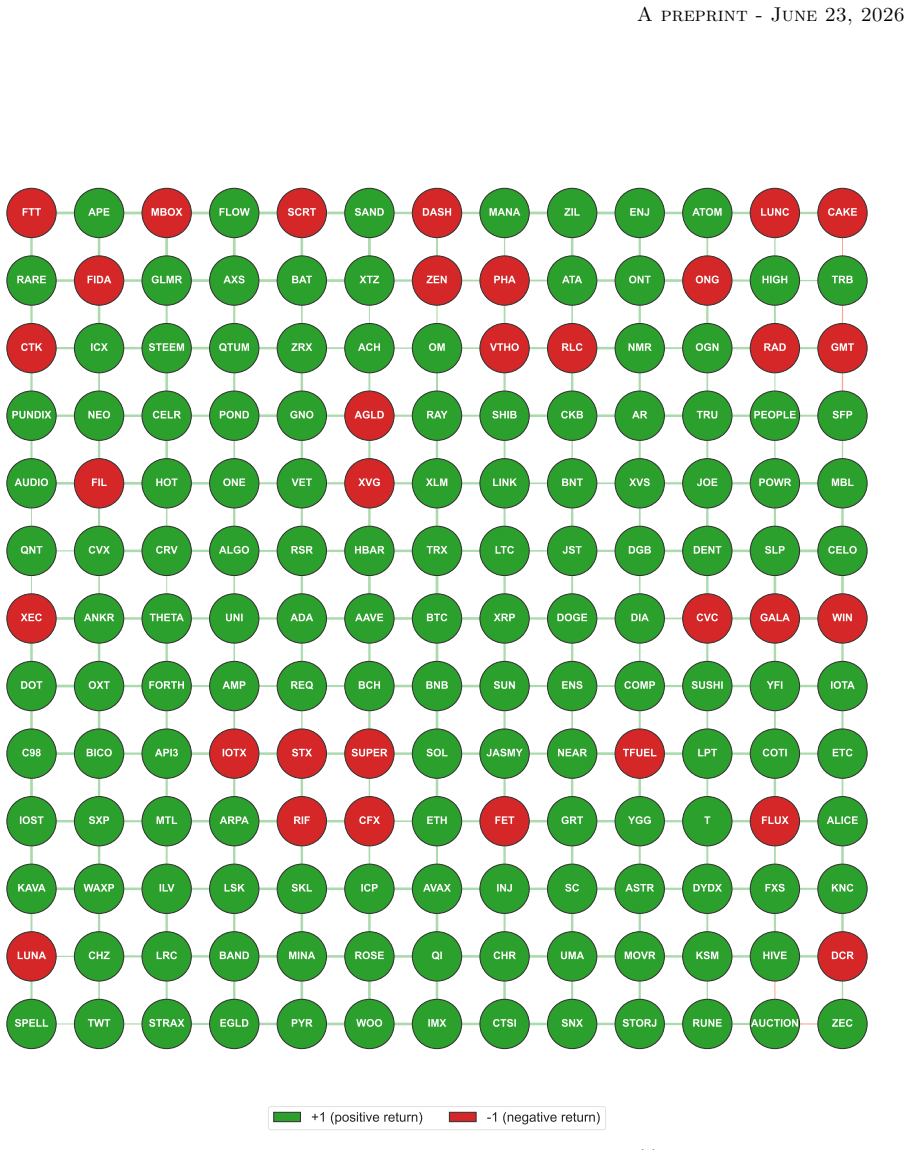
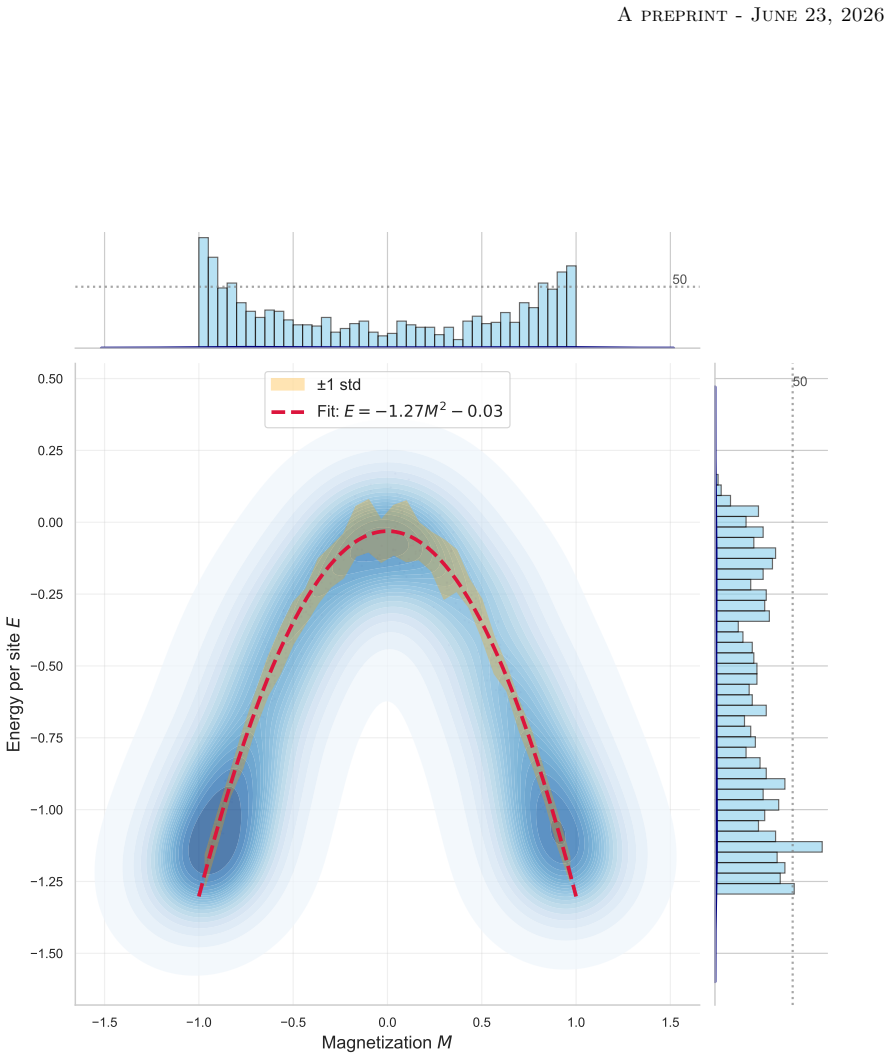
Cryptocurrency returns are encoded as spins on a 13x13 lattice whose Ising Hamiltonian produces an energy-magnetization diagram consistent with predominantly ferromagnetic interactions.
A machine-rendered reading of the paper's core claim, the machinery that carries it, and where it could break.
Core claim
By mapping asset returns to spins and embedding the assets via correlation-guided breadth-first search into a 13x13 lattice, the authors construct an Ising Hamiltonian (the Market Crystal) whose phase-space structure exhibits regimes of high magnetization and an energy-magnetization pattern suggestive of net ferromagnetic interactions among the cryptocurrencies.
What carries the argument
The Market Crystal, the Ising-like Hamiltonian obtained after correlation-based breadth-first search embedding of 169 cryptocurrency return signs into a 13x13 lattice.
If this is right
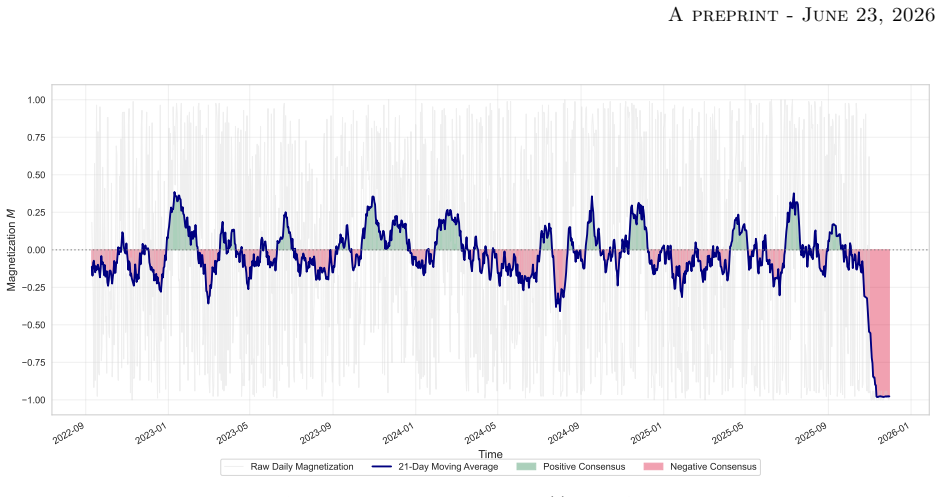
- Market states can be tracked in real time by computing the instantaneous magnetization of the lattice.
- Periods of high magnetization correspond to synchronized price movements across many assets.
- The predominance of ferromagnetic couplings implies that positive return correlations outweigh negative ones in the collective dynamics.
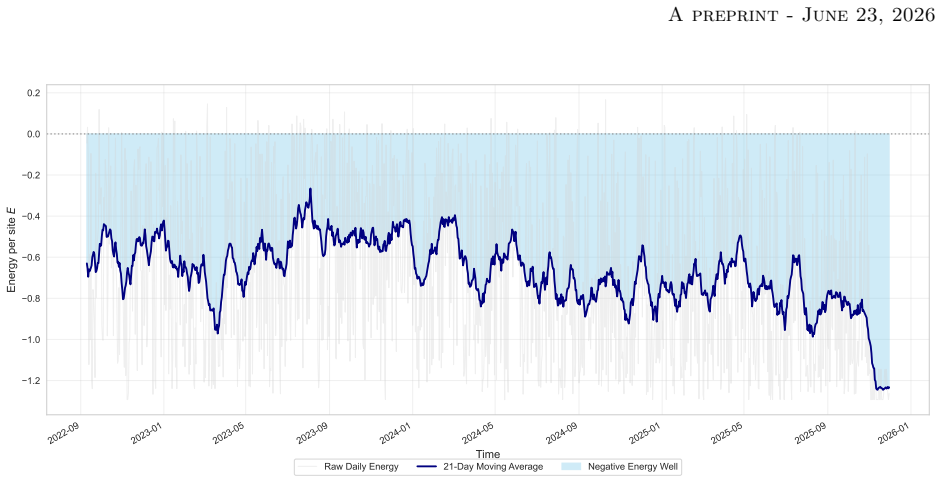
- Fragmented states appear as low-magnetization, high-energy configurations in the same diagram.
Where Pith is reading between the lines
- The lattice representation could be used to define quantitative early-warning signals when magnetization begins to drop rapidly.
- The same embedding method might be applied to equity or commodity markets to test whether ferromagnetic patterns appear outside cryptocurrencies.
- If the ferromagnetic character persists, interventions that break positive feedback loops would be required to reduce systemic synchronization.
Load-bearing premise
The correlation-based breadth-first search procedure produces an interaction graph whose Ising Hamiltonian faithfully reproduces the collective dynamics of the original market data.
What would settle it
Out-of-sample cryptocurrency price series whose observed pairwise co-movements deviate systematically from the spin configurations that minimize or maximize the Market Crystal Hamiltonian.
Figures
read the original abstract
Collective dynamics in financial markets can emerge through synchronized movements of large groups of assets. Motivated by analogies with interacting many-body systems, we introduce a spin-lattice representation for analyzing collective states in cryptocurrency markets. In this framework, assets are encoded as binary spin variables according to the sign of their returns, while correlations between assets determine effective interaction strengths. A correlation-based breadth-first search (CBFS) procedure embeds 169 cryptocurrencies into a $13 \times 13$ lattice, enabling the construction of an Ising-like Hamiltonian describing the market configuration, which we call the \emph{Market Crystal}. Macroscopic observables such as magnetization and energy provide a statistical-mechanical characterization of collective market states. The resulting phase-space structure highlights regimes of strong alignment and fragmentation among assets, with an energy--magnetization pattern suggestive of predominantly ferromagnetic interactions. This framework offers a statistical-mechanical viewpoint for studying collective behavior in financial systems.
Editorial analysis
A structured set of objections, weighed in public.
Referee Report
Summary. The manuscript proposes modeling collective cryptocurrency dynamics using a spin-lattice representation. 169 assets are mapped to a 13×13 lattice via a correlation-based breadth-first search (CBFS) embedding, with correlations determining Ising-like interaction strengths. The resulting Hamiltonian is analyzed through magnetization and energy observables to identify regimes of alignment and fragmentation, with the energy-magnetization pattern interpreted as evidence for predominantly ferromagnetic interactions.
Significance. If the CBFS embedding is shown to preserve key correlation features and the observables are not circular, this framework could provide a useful statistical-mechanical lens for studying market synchronization. The approach is novel in its application but currently lacks the empirical validation needed to establish its utility.
major comments (2)
- Abstract, CBFS procedure paragraph: The central assumption that the CBFS embedding produces a lattice whose nearest-neighbor couplings dominate the collective behavior is not validated; no evidence is provided that the lattice Hamiltonian reproduces the original correlation matrix's eigenvalues, connected components, or time-series synchronization statistics.
- Abstract: The energy-magnetization pattern is presented as suggestive of ferromagnetic interactions, but since both the lattice structure and couplings are derived from the correlation matrix, and observables are computed from the same data, the pattern may be an artifact of the embedding rather than an independent characterization of market states.
minor comments (1)
- Abstract: The abstract mentions no numerical results, error bars, or comparisons to shuffled data, which would strengthen the claims even if presented in the main text.
Simulated Author's Rebuttal
We thank the referee for their constructive comments, which identify key areas for strengthening the validation and interpretation of the Market Crystal framework. We respond to each major comment below.
read point-by-point responses
-
Referee: Abstract, CBFS procedure paragraph: The central assumption that the CBFS embedding produces a lattice whose nearest-neighbor couplings dominate the collective behavior is not validated; no evidence is provided that the lattice Hamiltonian reproduces the original correlation matrix's eigenvalues, connected components, or time-series synchronization statistics.
Authors: We agree that explicit validation of the CBFS embedding's fidelity is required. In the revised manuscript we will add a dedicated section (or appendix) that compares the eigenvalue spectrum of the original correlation matrix with that of the lattice interaction matrix, verifies preservation of connected components, and reports synchronization statistics (e.g., average pairwise correlation and collective mode amplitudes) computed from the original time series versus those implied by the embedded Hamiltonian. These additions will directly test whether nearest-neighbor couplings capture the dominant collective features. revision: yes
-
Referee: Abstract: The energy-magnetization pattern is presented as suggestive of ferromagnetic interactions, but since both the lattice structure and couplings are derived from the correlation matrix, and observables are computed from the same data, the pattern may be an artifact of the embedding rather than an independent characterization of market states.
Authors: The lattice geometry and coupling signs are indeed derived from correlations, yet the spin variables themselves are the signs of individual asset returns, which are statistically independent of the pairwise correlation values used for embedding. The energy and magnetization are therefore evaluated on configurations that are not directly dictated by the embedding procedure. The resulting E-M pattern therefore reflects the market's realized collective states. We will revise the abstract and main text to make this distinction explicit and to discuss the degree to which the observed ferromagnetic-like structure follows from the predominantly positive correlations present in the data. revision: partial
Circularity Check
No significant circularity detected in derivation chain
full rationale
The paper constructs a descriptive mapping: correlations determine both the CBFS lattice embedding and the effective J couplings in an Ising-like Hamiltonian, after which magnetization and energy are evaluated on spin configurations (signs of returns). This is a re-expression of the input data in new coordinates rather than a derivation claiming independent predictions or first-principles results that reduce to the inputs by construction. No equations are shown that equate an output observable to a fitted parameter or input correlation by definition. No self-citation load-bearing steps, uniqueness theorems, or ansatzes smuggled via citation appear in the provided text. The energy-magnetization pattern is presented as an observed characterization of the market states under the model, not as a forced or tautological result. The framework remains self-contained as a modeling tool without violating the enumerated circularity patterns.
Axiom & Free-Parameter Ledger
free parameters (1)
- lattice dimension 13x13
axioms (2)
- domain assumption Pairwise return correlations can be interpreted as effective spin-spin interaction strengths without further renormalization or sign checks.
- ad hoc to paper The CBFS embedding produces a lattice whose nearest-neighbor couplings dominate the collective behavior.
invented entities (1)
-
Market Crystal
no independent evidence
Reference graph
Works this paper leans on
-
[1]
An introduction to the Ising model.The American Mathematical Monthly, 94(10), pp.937–959
Cipra, B.A., 1987. An introduction to the Ising model.The American Mathematical Monthly, 94(10), pp.937–959
1987
-
[2]
and Marchesi, M., 1999
Lux, T. and Marchesi, M., 1999. Scaling and criticality in a stochastic multi-agent model of a financial market.Nature, 397(6719), pp.498–500
1999
-
[3]
Hierarchical structure in financial markets.The European Physical Journal B, 11(1), pp.193–197
Mantegna, R.N., 1999. Hierarchical structure in financial markets.The European Physical Journal B, 11(1), pp.193–197
1999
-
[4]
and Bouchaud, J.P., 2000
Cont, R. and Bouchaud, J.P., 2000. Herd behavior and aggregate fluctuations in financial markets. Macroeconomic Dynamics, 4(2), pp.170–196
2000
-
[5]
and Bouchaud, J.P., 2000
Laloux, L., Cizeau, P., Potters, M. and Bouchaud, J.P., 2000. Random matrix theory and financial correlations.International Journal of Theoretical and Applied Finance, 3(3), pp.391–397
2000
-
[6]
and Aizawa, Y., 2000
Ponzi, A. and Aizawa, Y., 2000. Criticality and punctuated equilibrium in a spin system model of a financial market.Chaos, Solitons & Fractals, 11(11), pp.1739–1746
2000
-
[7]
and Stanley, H.E., 2001
Gopikrishnan, P., Rosenow, B., Plerou, V. and Stanley, H.E., 2001. Quantifying and interpreting collective behavior in financial markets.Physical Review E, 64(3), p.035106
2001
-
[8]
and Stanley, H.E., 2002
Plerou, V., Gopikrishnan, P., Rosenow, B., Amaral, L.A.N., Guhr, T. and Stanley, H.E., 2002. Random matrix approach to cross correlations in financial data.Physical Review E, 65(6), p.066126
2002
-
[9]
and Fujiwara, Y., 2002
Kaizoji, T., Bornholdt, S. and Fujiwara, Y., 2002. Dynamics of price and trading volume in a spin model of stock markets with heterogeneous agents.Physica A, 316(1–4), pp.441–452
2002
-
[10]
and Kanto, A., 2003
Onnela, J.P., Chakraborti, A., Kaski, K., Kertész, J. and Kanto, A., 2003. Asset trees and asset graphs in financial markets.Physica Scripta, T106, pp.48–54
2003
-
[11]
and Kertész, J., 2003
Onnela, J.P., Chakraborti, A., Kaski, K. and Kertész, J., 2003. Dynamic asset trees and Black Monday. Physica A, 324(1–2), pp.247–252
2003
-
[12]
Cambridge University Press
McCauley, J.L., 2004.Dynamics of Markets: Econophysics and Finance. Cambridge University Press
2004
-
[13]
Microscopic spin model for the stock market with attractor bubbling and heteroge- neous agents.International Journal of Modern Physics C, 16(4), pp.549–559
Krawiecki, A., 2005. Microscopic spin model for the stock market with attractor bubbling and heteroge- neous agents.International Journal of Modern Physics C, 16(4), pp.549–559
2005
-
[14]
Berlin, Heidelberg: Springer
Voit, J., 2005.The Statistical Mechanics of Financial Markets. Berlin, Heidelberg: Springer
2005
-
[15]
and Sinha, S., 2007
Pan, R.K. and Sinha, S., 2007. Collective behavior of stock price movements in an emerging market. Physical Review E, 76(4), p.046116
2007
-
[16]
and Mantegna, R.N., 2007
Tumminello, M., Di Matteo, T., Aste, T. and Mantegna, R.N., 2007. Correlation based networks of equity returns sampled at different time horizons.The European Physical Journal B, 55(2), pp.209–217
2007
-
[17]
and Sornette, D., 2007
Zhou, W.X. and Sornette, D., 2007. Self-organizing Ising model of financial markets.The European Physical Journal B, 55(2), pp.175–181
2007
-
[18]
and Gabaix, X., 2008
Stanley, H.E., Plerou, V. and Gabaix, X., 2008. A statistical physics view of financial fluctuations: Evidence for scaling and universality.Physica A, 387(15), pp.3967–3981
2008
-
[19]
Bouchaud, J.P. and Potters, M., 2009. Financial applications of random matrix theory: a short review. arXiv:0910.1205
Pith/arXiv arXiv 2009
-
[20]
and Chakrabarti, B.K., 2010.Econophysics: An Introduction
Sinha, S., Chatterjee, A., Chakraborti, A. and Chakrabarti, B.K., 2010.Econophysics: An Introduction. John Wiley & Sons
2010
-
[21]
and Abergel, F., 2011
Chakraborti, A., Toke, I.M., Patriarca, M. and Abergel, F., 2011. Econophysics review: I. Empirical facts.Quantitative Finance, 11(7), pp.991–1012
2011
-
[22]
and Jones, N.S., 2011
Fenn, D.J., Porter, M.A., Williams, S., McDonald, M., Johnson, N.F. and Jones, N.S., 2011. Temporal evolution of financial-market correlations.Physical Review E, 84(2), p.026109
2011
-
[23]
and Stanley, H.E., 2012
Münnix, M.C., Shimada, T., Schäfer, R., Leyvraz, F., Seligman, T.H., Guhr, T. and Stanley, H.E., 2012. Identifying states of a financial market.Scientific Reports, 2, p.644
2012
-
[24]
and Bornholdt, S., 2013
Krause, S.M. and Bornholdt, S., 2013. Spin models as microfoundation of macroscopic market models. Physica A, 392(18), pp.4048–4054
2013
-
[25]
and Balatsky, A.V., 2015
Borysov, S.S., Roudi, Y. and Balatsky, A.V., 2015. US stock market interaction network as learned by the Boltzmann machine.The European Physical Journal B, 88(12), p.321. x A preprint - June 23, 2026
2015
-
[26]
and Morgenstern, I., 2016
Eckrot, A., Jurczyk, J. and Morgenstern, I., 2016. Ising model of financial markets with many assets. Physica A, 462, pp.250–254
2016
-
[27]
Modeling of the financial market using the two-dimensional anisotropic Ising model
Lima, L.S., 2017. Modeling of the financial market using the two-dimensional anisotropic Ising model. Physica A, 482, pp.544–551
2017
-
[28]
and Martínez-Ibañez, O., 2019
Aslanidis, N., Bariviera, A.F. and Martínez-Ibañez, O., 2019. An analysis of cryptocurrencies conditional cross correlations.Finance Research Letters, 31, pp.130–137
2019
-
[29]
The Ising model: Brief introduction and its application
Singh, S.P., 2020. The Ising model: Brief introduction and its application. In:Solid State Physics – Metastable, Spintronics Materials and Mechanics of Deformable Bodies – Recent Progress. IntechOpen
2020
-
[30]
and Donnat, P., 2021
Marti, G., Nielsen, F., Bińkowski, M. and Donnat, P., 2021. A review of two decades of correlations, hierarchies, networks and clustering in financial markets.Progress in Information Geometry, pp.245–274
2021
-
[31]
and Stanuszek, M., 2021
Wątorek, M., Drożdż, S., Kwapień, J., Minati, L., Oświęcimka, P. and Stanuszek, M., 2021. Multiscale characteristics of the emerging global cryptocurrency market.Physics Reports, 901, pp.1–82
2021
-
[32]
and Shakhnov, K., 2022
Borri, N. and Shakhnov, K., 2022. The cross-section of cryptocurrency returns.Review of Asset Pricing Studies, 12(3), pp.667–705
2022
-
[33]
Ising model: Recent developments and exotic applications.Entropy, 24(12), p.1834
Lipowski, A., 2022. Ising model: Recent developments and exotic applications.Entropy, 24(12), p.1834
2022
-
[34]
and Sornette, D., 2023
Cividino, D., Westphal, R. and Sornette, D., 2023. Multiasset financial bubbles in an agent-based model with noise traders’ herding described by an n-vector Ising model.Physical Review Research, 5(1), p.013009
2023
-
[35]
and Hosseini-Farzad, M., 2023
Oliaei-Moghadam, H., Moodley, C. and Hosseini-Farzad, M., 2023. Patterns for all-digital quantum ghost imaging generated by the Ising model.Optics & Laser Technology, 163, p.109392
2023
-
[36]
and TabeBordbar, N., 2025
Oliaei-Moghadam, H., Hosseini-Farzad, M. and TabeBordbar, N., 2025. Single-pixel quantum ghost imaging using generalized Ising model.Scientific Reports, 15(1), p.22677. xi
2025
discussion (0)
Sign in with ORCID, Apple, or X to comment. Anyone can read and Pith papers without signing in.