A correlation of structural changes with nanomechanical properties in TiN-AlN multilayer films
Pith reviewed 2026-06-26 11:29 UTC · model grok-4.3
The pith
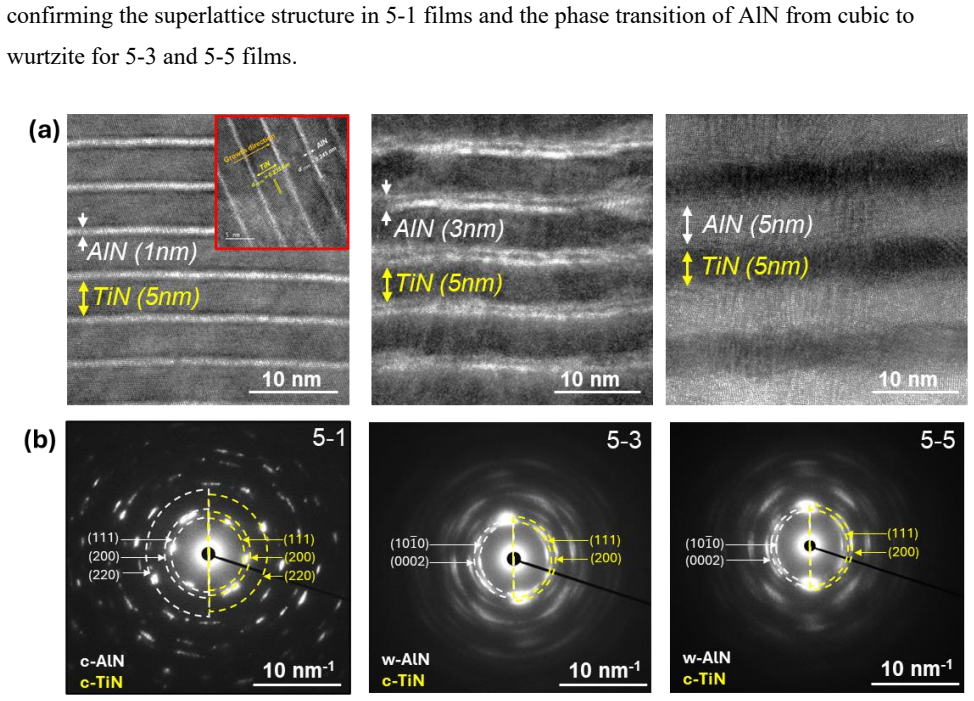
The cubic-to-hexagonal phase change in AlN above 3 nm thickness stabilizes hardness and raises damage tolerance in TiN-AlN multilayers.
A machine-rendered reading of the paper's core claim, the machinery that carries it, and where it could break.
Core claim
The central claim is that the phase transformation of AlN from cubic rock salt to hexagonal wurtzite above 3 nm thickness, driven by lattice strains, produces stabilization of hardness and indentation modulus, superior nanoindentation scratch resistance at 3 nm, and a transition from columnar brittle to partially ductile failure accompanied by crack deflection, thereby improving the damage tolerance of the overall TiN-AlN multilayer system.
What carries the argument
The thickness-dependent phase transition of AlN layers from cubic rock salt to hexagonal wurtzite structure, which changes the mechanical interaction with the fixed 5 nm TiN layers.
If this is right
- Hardness and modulus decrease with AlN thickness up to 3 nm then remain constant for 4 nm and 5 nm films.
- Micropillar compression changes from columnar brittle failure to partially ductile failure with crack deflection as AlN thickness increases.
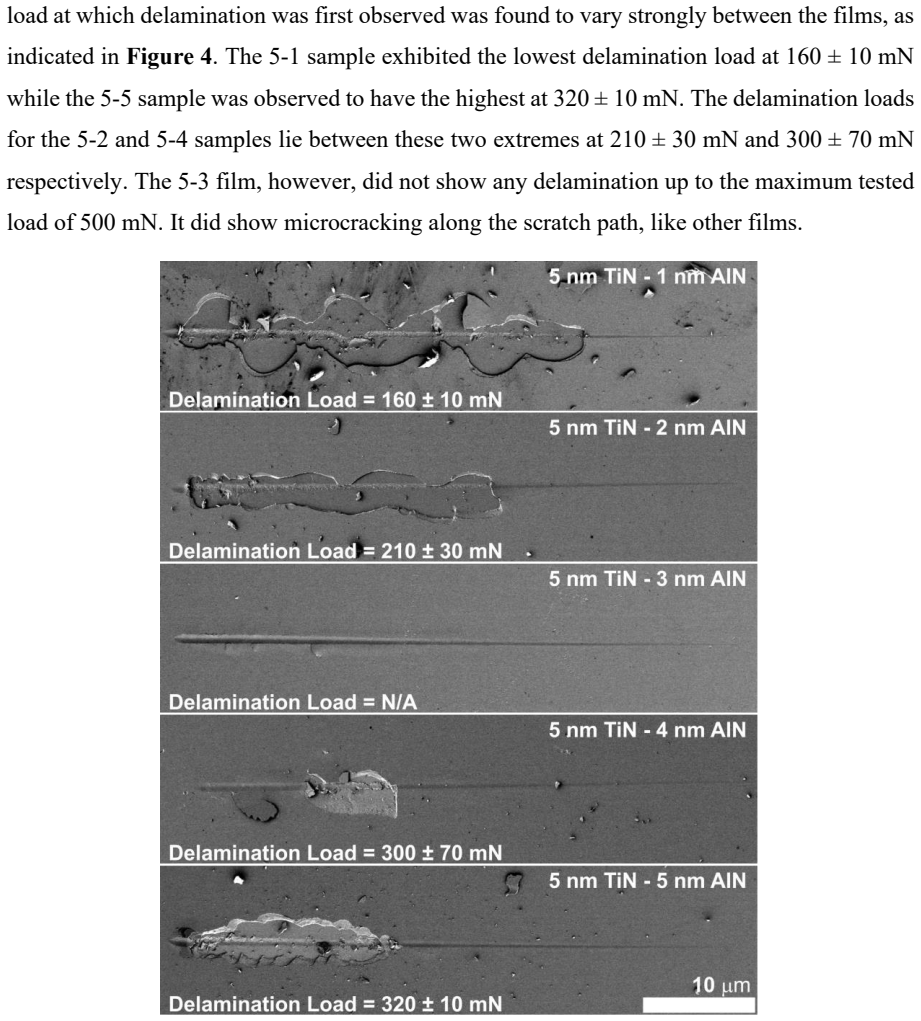
- Scratch resistance measured by nanoindentation reaches its maximum at 3 nm AlN thickness.
- Microcracking during scratching becomes more pronounced at larger AlN thicknesses.
- The cubic-to-hexagonal AlN transformation improves overall damage tolerance of the multilayer.
Where Pith is reading between the lines
- Layer-thickness control that triggers the AlN phase change could be used to balance hardness against toughness in other transition-metal nitride multilayers.
- The 3 nm AlN thickness that maximizes scratch resistance while enabling the phase switch offers a practical target for coating process development.
- The same strain-driven phase mechanism might appear in related systems such as CrN-AlN or TiN-AlN with different fixed-layer thicknesses, providing a route to test generality.
Load-bearing premise
The cubic-to-hexagonal phase change in AlN is the main cause of the observed hardness stabilization, peak scratch resistance at 3 nm, and shift to ductile failure rather than interface density or other thickness effects alone.
What would settle it
Fabricating otherwise identical TiN-AlN multilayers in which AlN is held in the cubic phase even above 3 nm thickness (for example by altering deposition temperature or substrate) and checking whether hardness stabilization, scratch superiority at 3 nm, and ductile transition still occur would test the claim.
Figures
read the original abstract
The present work investigates the changes in overall nanomechanical properties of reactively sputtered TiN-AlN multilayer films arising due to phase transformation in the AlN layers. Multilayered TiN-AlN films were sputter deposited with constant TiN layer thickness of 5 nm while the AlN layer thickness varied between 1-5 nm. The AlN underwent a phase transition from cubic rock salt to hexagonal wurtzite above 3 nm thickness due to the lattice strains. The hardness and indentation modulus of the multilayers decreased with increasing AlN film thickness, up to 3 nm, due to increased volume fraction of softer AlN layer and then stabilized for 4 nm and 5 nm thickness films. Micropillar compression of these multilayers showed a transition from columnar brittle to partially ductile failure associated with crack deflection with increasing AlN film thickness. Interestingly, nanoindentation scratch resistance of 3 nm AlN multilayer was observed to be superior compared to all other films. The crack propagation behavior in scratching showed increased microcracking tendency towards higher AlN film thickness. This shows that cubic to hexagonal transformation in AlN is beneficial for improving the damage tolerance of the multilayer system.
Editorial analysis
A structured set of objections, weighed in public.
Referee Report
Summary. The manuscript examines reactively sputtered TiN-AlN multilayer films with fixed 5 nm TiN layers and AlN layers of 1–5 nm thickness. It reports a cubic rock-salt to hexagonal wurtzite phase transition in AlN above 3 nm due to lattice strain. Hardness and indentation modulus decrease with AlN thickness up to 3 nm then stabilize; micropillar compression shows a shift from columnar brittle to partially ductile failure with crack deflection as AlN thickness increases; scratch resistance peaks at 3 nm AlN with rising microcracking at 4–5 nm. The authors conclude that the cubic-to-hexagonal AlN transformation improves damage tolerance of the multilayer system.
Significance. If the causal attribution to the phase transition holds after addressing confounding factors, the work would provide a concrete example of using layer-thickness-induced phase changes to tune ductility and crack behavior in hard-coating multilayers, with potential implications for tool and wear-resistant applications.
major comments (2)
- [Abstract] Abstract: the conclusion that the cubic-to-hexagonal transformation improves damage tolerance is not supported by the reported scratch data, where resistance is superior at 3 nm (cubic AlN) while microcracking increases at 4–5 nm (hexagonal AlN).
- [Results / Discussion] Results and discussion sections: the phase transition is varied simultaneously with AlN layer thickness (1–5 nm) without control series that stabilize cubic AlN at thicknesses >3 nm (e.g., via substrate or deposition-parameter changes), so the data cannot isolate whether hardness stabilization, ductility shift, or scratch behavior arise from the structural change or from the geometric increase in AlN volume fraction.
minor comments (1)
- [Abstract] The abstract and summary omit error bars, number of replicates, and statistical assessment of the hardness stabilization and scratch-resistance trends.
Simulated Author's Rebuttal
We thank the referee for the constructive feedback. We address the major comments point-by-point below, with revisions where the concerns are valid.
read point-by-point responses
-
Referee: [Abstract] Abstract: the conclusion that the cubic-to-hexagonal transformation improves damage tolerance is not supported by the reported scratch data, where resistance is superior at 3 nm (cubic AlN) while microcracking increases at 4–5 nm (hexagonal AlN).
Authors: We agree the scratch data show peak resistance at 3 nm (cubic) and rising microcracking at 4–5 nm (hexagonal). The original abstract conclusion drew primarily from micropillar results (ductile shift and crack deflection with thickness). To correct the overstatement, we will revise the abstract to state that the phase transition correlates with property stabilization and improved compressive ductility, while noting the scratch optimum occurs at the transition thickness. This change will be implemented. revision: yes
-
Referee: [Results / Discussion] Results and discussion sections: the phase transition is varied simultaneously with AlN layer thickness (1–5 nm) without control series that stabilize cubic AlN at thicknesses >3 nm (e.g., via substrate or deposition-parameter changes), so the data cannot isolate whether hardness stabilization, ductility shift, or scratch behavior arise from the structural change or from the geometric increase in AlN volume fraction.
Authors: The referee correctly identifies the confounding of thickness and phase. Hardness stabilizes precisely at the known transition thickness, consistent with literature on strain-stabilized cubic AlN, but we lack control samples holding cubic AlN above 3 nm. We will add an explicit limitations paragraph in the discussion noting that geometric volume-fraction effects cannot be fully decoupled from the structural change without such controls, while retaining the correlative interpretation. This constitutes a partial revision. revision: partial
Circularity Check
Experimental observations only; no derivations, predictions, or self-referential logic
full rationale
The manuscript is a purely experimental study reporting sputter deposition parameters, observed phase transition (cubic to hexagonal AlN above 3 nm thickness), and direct measurements of hardness, indentation modulus, micropillar compression failure modes, and scratch resistance. No equations, fitted parameters, theoretical derivations, or predictions are presented. The central claim links the observed phase change to improved damage tolerance via measured property trends; this is an empirical correlation, not a derivation that reduces to its own inputs by construction. No self-citations or ansatzes are invoked as load-bearing steps. The skeptic concern about confounding thickness with phase is a question of experimental design and causal isolation, not circularity in any claimed derivation chain.
Axiom & Free-Parameter Ledger
axioms (1)
- domain assumption AlN undergoes a phase transition from cubic rock salt to hexagonal wurtzite above 3 nm thickness due to lattice strains from the TiN layers.
Reference graph
Works this paper leans on
-
[1]
U. Helmersson, S. Todorova, S.A. Barnett, J. ‐E. Sundgren, L.C. Markert, J.E. Greene, Growth of single‐crystal TiN/VN strained‐layer superlattices with extremely high mechanical hardness, Journal of Applied Physics 62 (1987) 481–484. https://doi.org/10.1063/1.339770
-
[2]
P.B. Mirkarimi, L. Hultman, S.A. Barnett, Enhanced hardness in lattice‐matched single‐ crystal TiN/V0.6Nb0.4N superlattices, Applied Physics Letters 57 (1990) 2654–2656. https://doi.org/10.1063/1.104189
-
[3]
M. Shinn, L. Hultman, S.A. Barnett, Growth, structure, and microhardness of epitaxial TiN/NbN superlattices, Journal of Materials Research 7 (1992) 901–911. https://doi.org/10.1557/JMR.1992.0901
-
[4]
D. Li, X. Lin, S. Cheng, V.P. Dravid, Y. Chung, M. Wong, W.D. Sproul, Structure and hardness studies of CNx/TiN nanocomposite coatings, Applied Physics Letters 68 (1996) 1211–1213. https://doi.org/10.1063/1.115972
-
[5]
S. Vepřek, The search for novel, superhard materials, Journal of Vacuum Science & Technology A 17 (1999) 2401–2420. https://doi.org/10.1116/1.581977. 18
-
[6]
L. Geyang, H. Zenghu, T. Jiawan, X. Junhua, G. Mingyuan, Alternating stress field and superhardness effect in TiN/NbN superlattice films, Journal of Vacuum Science & Technology A 20 (2002) 674–677. https://doi.org/10.1116/1.1460887
-
[7]
Thobor, C
A. Thobor, C. Rousselot, C. Clement, J. Takadoum, N. Martin, R. Sanjines, F. Levy, Enhancement of mechanical properties of TiN/AlN multilayers by modifying the number and the quality of interfaces, Surface and Coatings Technology 124 (2000) 210–
2000
-
[8]
https://doi.org/10.1016/S0257-8972(99)00655-6
-
[9]
Setoyama, A
M. Setoyama, A. Nakayama, M. Tanaka, N. Kitagawa, T. Nomura, Formation of cubic- AIN in TiN/AIN superlattice, (n.d.)
-
[10]
Y.Y. Wang, M.S. Wong, W.J. Chia, J. Rechner, W.D. Sproul, Synthesis and characterization of highly textured polycrystalline AlN/TiN superlattice coatings, Journal of Vacuum Science & Technology A 16 (1998) 3341–3347. https://doi.org/10.1116/1.581542
-
[11]
H. Holleck, Material selection for hard coatings, Journal of Vacuum Science & Technology A 4 (1986) 2661–2669. https://doi.org/10.1116/1.573700
-
[12]
D.-G. Kim, T.-Y. Seong, Y.-J. Baik, Effects of annealing on the microstructures and mechanical properties of TiN/AlN nano-multilayer films prepared by ion-beam assisted deposition, Surface and Coatings Technology 153 (2002) 79–83. https://doi.org/10.1016/S0257-8972(01)01543-2
-
[13]
M.A. Auger, O. Sanchez, C. Ballesteros, M. Jergel, M. Aguilar-Frutis, C. Falcony, TiN/AlN bilayers and multilayers grown by magnetron co-sputtering, Thin Solid Films 433 (2003) 211–216. https://doi.org/10.1016/S0040-6090(03)00321-3
-
[14]
V.P. Godbole, K. Dovidenko, A.K. Sharma, J. Narayan, Thermal reactions and micro- structure of TiN–AlN layered nano-composites, Materials Science and Engineering: B 68 (1999) 85–90. https://doi.org/10.1016/S0921-5107(99)00154-3
-
[15]
V. Pankov, M. Evstigneev, R.H. Prince, Room-temperature fabrication of hard AlN/TiN superlattice coatings by pulsed laser deposition, Journal of Vacuum Science & Technology A 20 (2002) 430–436. https://doi.org/10.1116/1.1448511
-
[16]
A. Madan, I.W. Kim, S.C. Cheng, P. Yashar, V.P. Dravid, S.A. Barnett, Stabilization of Cubic AlN in Epitaxial AlN/TiN Superlattices, Phys. Rev. Lett. 78 (1997) 1743–1746. https://doi.org/10.1103/PhysRevLett.78.1743
-
[17]
B.M. Clemens, H. Kung, S.A. Barnett, Structure and Strength of Multilayers, MRS Bulletin 24 (1999) 20–26. https://doi.org/10.1557/S0883769400051502. 19
-
[18]
H. Geisler, K.O. Schweitz, J. Chevallier, J. B⊘ttiger, K. Samwer, Hardness enhancement and elastic modulus behaviour in sputtered Ag/Ni multilayers with different modulation wavelengths, Philosophical Magazine A 79 (1999) 485–500. https://doi.org/10.1080/01418619908210311
-
[19]
F.H. Mei, N. Shao, J.W. Dai, G.Y. Li, Coherent growth and superhardness effect of AlN/TiN nanomultilayers, Materials Letters 58 (2004) 3477–3480. https://doi.org/10.1016/j.matlet.2004.07.005
-
[20]
T. Vasco Boutos, R. Sanjinés, A. Karimi, Effects of deposition temperature and bilayer thickness on the mechanical properties of AlN/TiN multilayer thin films, Surface and Coatings Technology 188–189 (2004) 409–414. https://doi.org/10.1016/j.surfcoat.2004.08.039
-
[21]
J.R. Goldberg, J.L. Gilbert, In vitro corrosion testing of modular hip tapers, Journal of Biomedical Materials Research Part B: Applied Biomaterials 64B (2003) 78–93. https://doi.org/10.1002/jbm.b.10526
-
[22]
H. Jensen, J. Sobota, G. Sorensen, Film growth of nanostructured C–N/TiNx multilayers reactively sputtered in pure nitrogen, Journal of Vacuum Science & Technology A 16 (1998) 1880–1884. https://doi.org/10.1116/1.581122
-
[23]
I. Manika, F. Muktepavela, H. Jensen, J. Sobota, G. Sorensen, Microhardness and adhesion measurements of reactively sputtered TiN/AlN multilayer coatings deposited as function of mass-flow of nitrogen, Surface and Coatings Technology 100–101 (1998) 333–337. https://doi.org/10.1016/S0257-8972(97)00644-0
-
[24]
S.H. Yao, W.H. Kao, Y.L. Su, T.H. Liu, Effect of periods on wear performance of TiN/AlN superlattice films, Materials Science and Engineering: A 392 (2005) 380–385. https://doi.org/10.1016/j.msea.2004.10.017
-
[25]
S.H. Yao, Y.L. Su, W.H. Kao, T.H. Liu, Tribology and oxidation behavior of TiN/AlN nano-multilayer films, Tribology International 39 (2006) 332–341. https://doi.org/10.1016/j.triboint.2005.02.015
-
[26]
S.H. Yao, W.H. Kao, Y.L. Su, T.H. Liu, On the tribology and micro-drilling performance of TiN/AlN nanolayer coatings, Materials Science and Engineering: A 386 (2004) 149–155. https://doi.org/10.1016/j.msea.2004.07.009
-
[27]
R. Saha, W.D. Nix, Effects of the substrate on the determination of thin film mechanical properties by nanoindentation, Acta Materialia 50 (2002) 23–38. https://doi.org/10.1016/S1359-6454(01)00328-7. 20
-
[28]
W.C. Oliver, G.M. Pharr, Measurement of hardness and elastic modulus by instrumented indentation: Advances in understanding and refinements to methodology, Journal of Materials Research 19 (2004) 3–20. https://doi.org/10.1557/jmr.2004.19.1.3
-
[29]
J.M. Wheeler, J. Michler, Elevated temperature, nano-mechanical testing in situ in the scanning electron microscope, Review of Scientific Instruments 84 (2013) 045103. https://doi.org/10.1063/1.4795829
-
[30]
L. Zhang, H. Yang, X. Pang, K. Gao, A.A. Volinsky, Microstructure, residual stress, and fracture of sputtered TiN films, Surface and Coatings Technology 224 (2013) 120–125. https://doi.org/10.1016/j.surfcoat.2013.03.009
-
[31]
V. Pankov, M. Evstigneev, R.H. Prince, Role of substrate in the pseudomorphic stabilization of rocksalt-type AlN phase in AlN/TiN superlattices, Applied Physics Letters 80 (2002) 4142–4144. https://doi.org/10.1063/1.1482798
-
[32]
I.W. Kim, Q. Li, L.D. Marks, S.A. Barnett, Critical thickness for transformation of epitaxially stabilized cubic AlN in superlattices, Applied Physics Letters 78 (2001) 892–
2001
-
[33]
https://doi.org/10.1063/1.1345831
-
[34]
V. Talyansky, R.D. Vispute, R. Ramesh, R.P. Sharma, T. Venkatesan, Y.X. Li, L.G. Salamanca-Riba, M.C. Wood, R.T. Lareau, K.A. Jones, A.A. Iliadis, Fabrication and characterization of epitaxial AlN/TiN bilayers on sapphire, Thin Solid Films 323 (1998) 37–41. https://doi.org/10.1016/S0040-6090(97)00902-4
-
[35]
A.J. Wang, S.L. Shang, Y. Du, Y. Kong, L.J. Zhang, L. Chen, D.D. Zhao, Z.K. Liu, Structural and elastic properties of cubic and hexagonal TiN and AlN from first- principles calculations, Computational Materials Science 48 (2010) 705–709. https://doi.org/10.1016/j.commatsci.2010.03.014
-
[36]
V. Chawla, D. Holec, P.H. Mayrhofer, Stabilization criteria for cubic AlN in TiN/AlN and CrN/AlN bi-layer systems, J. Phys. D: Appl. Phys. 46 (2012) 045305. https://doi.org/10.1088/0022-3727/46/4/045305
-
[37]
Koehler, Attempt to Design a Strong Solid, Phys
J.S. Koehler, Attempt to Design a Strong Solid, Phys. Rev. B 2 (1970) 547–551. https://doi.org/10.1103/PhysRevB.2.547
-
[38]
M. Kato, T. Mori, L.H. Schwartz, Hardening by spinodal modulated structure, Acta Metallurgica 28 (1980) 285–290. https://doi.org/10.1016/0001-6160(80)90163-7
-
[39]
M. Shinn, S.A. Barnett, Effect of superlattice layer elastic moduli on hardness, Applied Physics Letters 64 (1994) 61–63. https://doi.org/10.1063/1.110922. 21
-
[40]
P.B. Mirkarimi, S.A. Barnett, K.M. Hubbard, T.R. Jervis, L. Hultman, Structure and mechanical properties of epitaxial TiN/V0.3Nb0.7N(100) superlattices, Journal of Materials Research 9 (1994) 1456–1467. https://doi.org/10.1557/JMR.1994.1456
-
[41]
H.C. Barshilia, B. Deepthi, K.S. Rajam, Growth and characterization of aluminum nitride coatings prepared by pulsed-direct current reactive unbalanced magnetron sputtering, Thin Solid Films 516 (2008) 4168–4174. https://doi.org/10.1016/j.tsf.2007.10.129
-
[42]
V. Mortet, M. Nesladek, K. Haenen, A. Morel, M. D’Olieslaeger, M. Vanecek, Physical properties of polycrystalline aluminium nitride films deposited by magnetron sputtering, Diamond and Related Materials 13 (2004) 1120–1124. https://doi.org/10.1016/j.diamond.2003.10.082
-
[43]
Pătru, L
M. Pătru, L. Isac, L. Cunha, P. Martins, S. Lanceros-Mendez, G. Oncioiu, D. Cristea, D. Munteanu, Structural, mechanical and piezoelectric properties of polycrystalline AlN films sputtered on titanium bottom electrodes, Applied Surface Science 354 (2015) 267–
2015
-
[44]
https://doi.org/10.1016/j.apsusc.2015.07.022
-
[45]
M. Reusch, S. Cherneva, Y. Lu, A. Žukauskaitė, L. Kirste, K. Holc, M. Datcheva, D. Stoychev, V. Lebedev, O. Ambacher, Microstructure and mechanical properties of stress-tailored piezoelectric AlN thin films for electro-acoustic devices, Applied Surface Science 407 (2017) 307–314. https://doi.org/10.1016/j.apsusc.2017.02.147
-
[46]
E. Österlund, J. Kinnunen, V. Rontu, A. Torkkeli, M. Paulasto-Kröckel, Mechanical properties and reliability of aluminum nitride thin films, Journal of Alloys and Compounds 772 (2019) 306–313. https://doi.org/10.1016/j.jallcom.2018.09.062
-
[47]
T.A. Rawdanowicz, V. Godbole, J. Narayan, J. Sankar, A. Sharma, The hardnesses and elastic moduli of pulsed laser deposited multilayer AlN/TiN thin films, Composites Part B: Engineering 30 (1999) 657–665. https://doi.org/10.1016/S1359-8368(99)00038-4
-
[48]
P. Patsalas, C. Charitidis, S. Logothetidis, The effect of substrate temperature and biasing on the mechanical properties and structure of sputtered titanium nitride thin films, Surface and Coatings Technology 125 (2000) 335–340. https://doi.org/10.1016/S0257-8972(99)00606-4
-
[49]
V. Chawla, R. Jayaganthan, R. Chandra, Microstructural characteristics and mechanical properties of magnetron sputtered nanocrystalline TiN films on glass substrate, Bull Mater Sci 32 (2009) 117–123. https://doi.org/10.1007/s12034-009-0018-8. 22
-
[50]
R. Konetschnik, R. Daniel, R. Brunner, D. Kiener, Selective interface toughness measurements of layered thin films, AIP Advances 7 (2017) 035307. https://doi.org/10.1063/1.4978337
-
[51]
M. Burtscher, M. Alfreider, K. Schmuck, H. Clemens, S. Mayer, D. Kiener, In situ fracture observations of distinct interface types within a fully lamellar intermetallic TiAl alloy, Journal of Materials Research 36 (2021) 2465–2478. https://doi.org/10.1557/s43578-020-00088-z
discussion (0)
Sign in with ORCID, Apple, or X to comment. Anyone can read and Pith papers without signing in.