Fine-Tuned Machine-Learned Interatomic Potentials for Structural and Vibrational Properties of Twisted 2D Materials
Pith reviewed 2026-06-26 11:24 UTC · model grok-4.3
The pith
Fine-tuning universal atomistic models is required to reach DFT accuracy for the interlayer energetics in twisted 2D materials.
A machine-rendered reading of the paper's core claim, the machinery that carries it, and where it could break.
Core claim
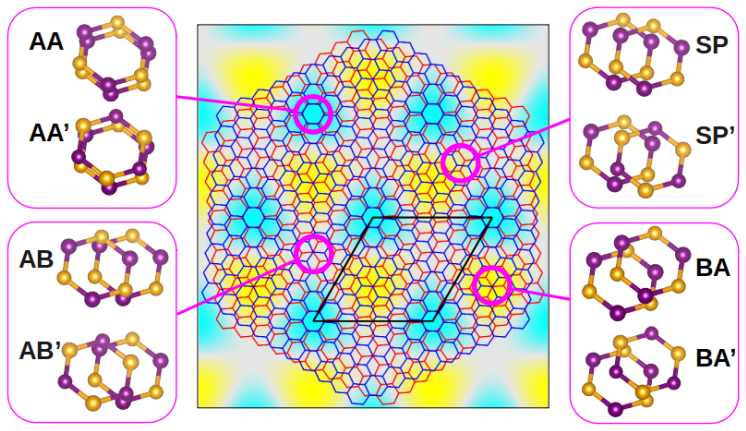
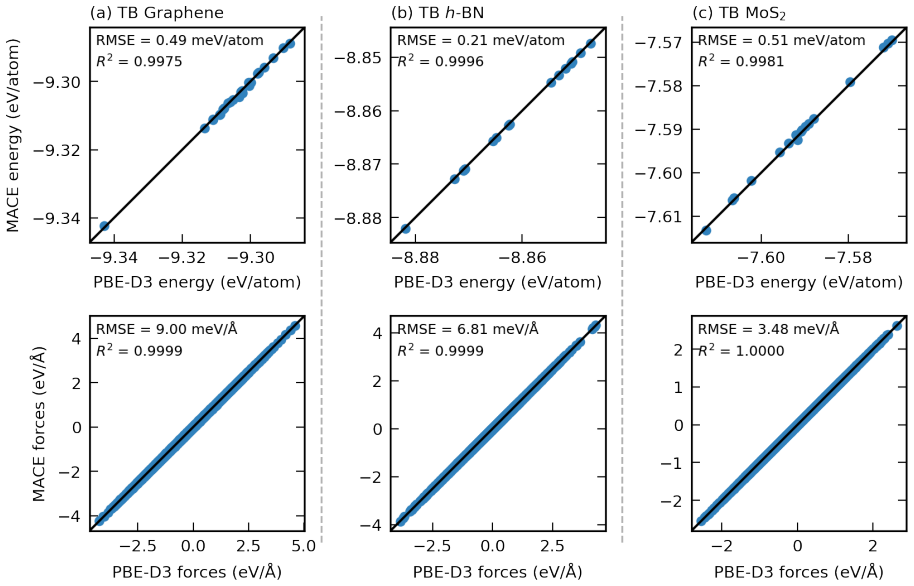
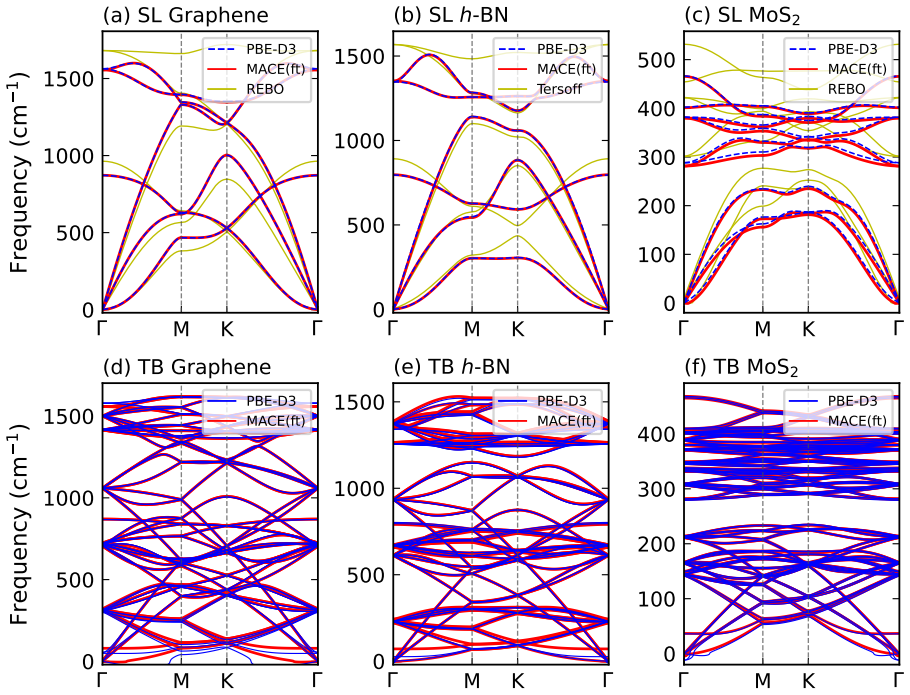
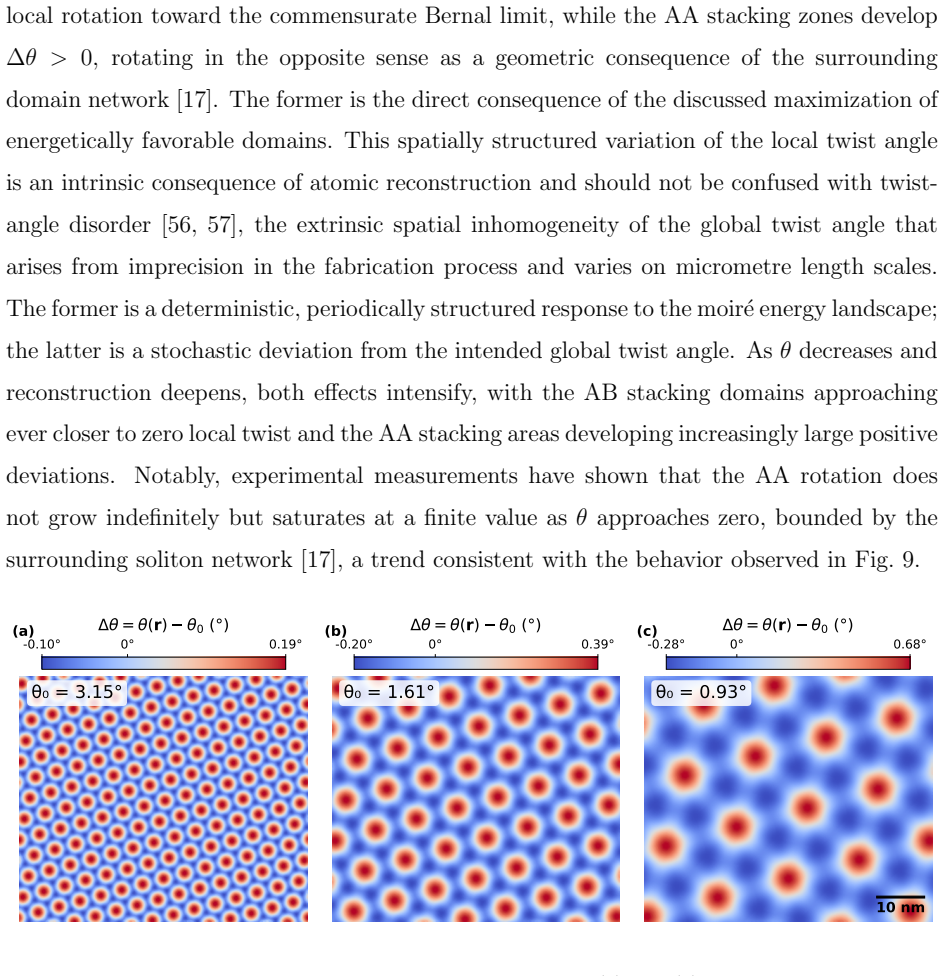
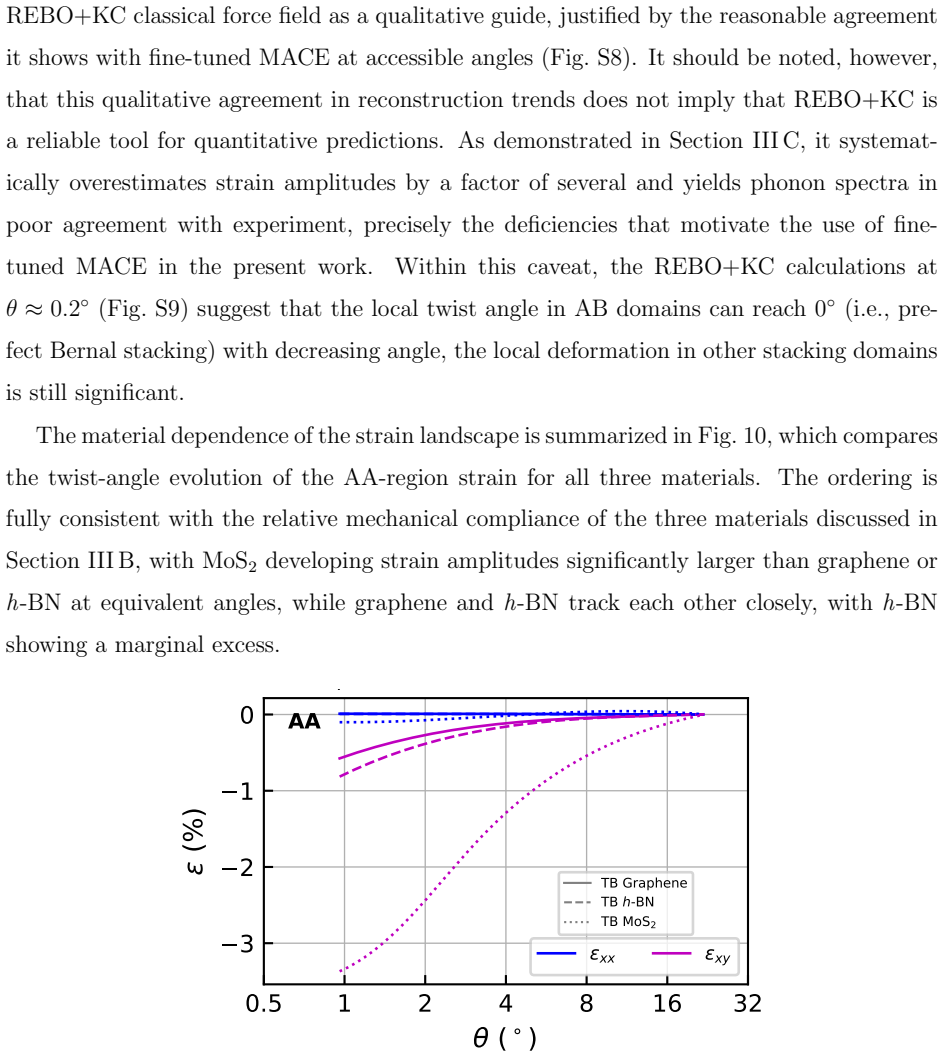
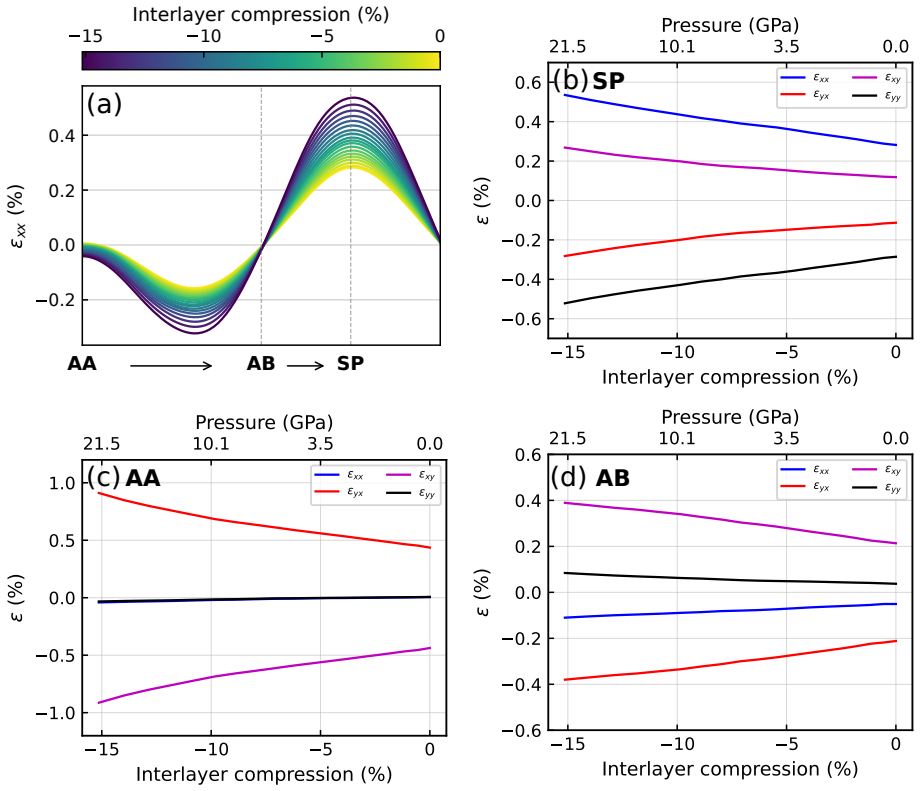
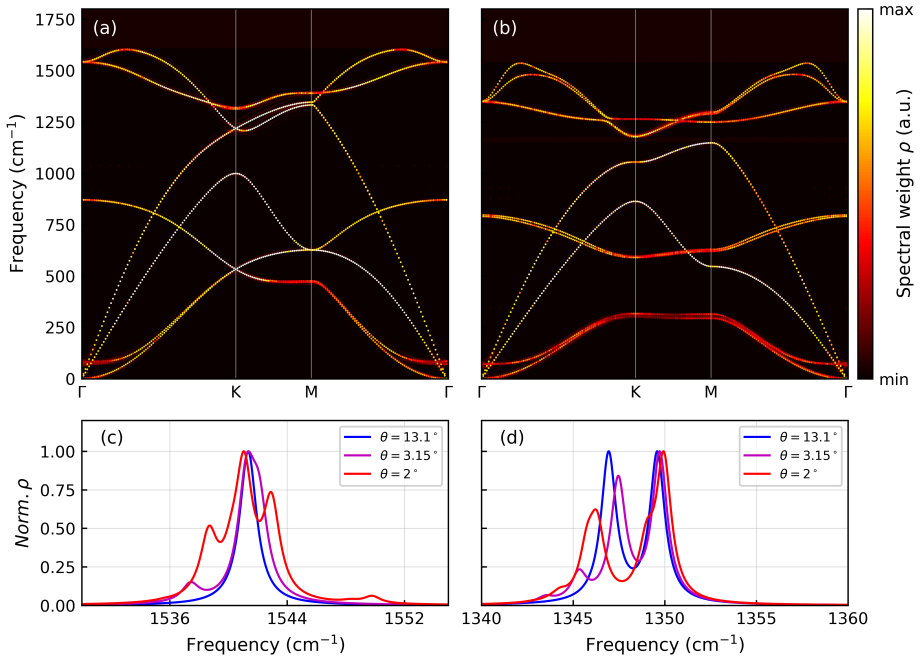
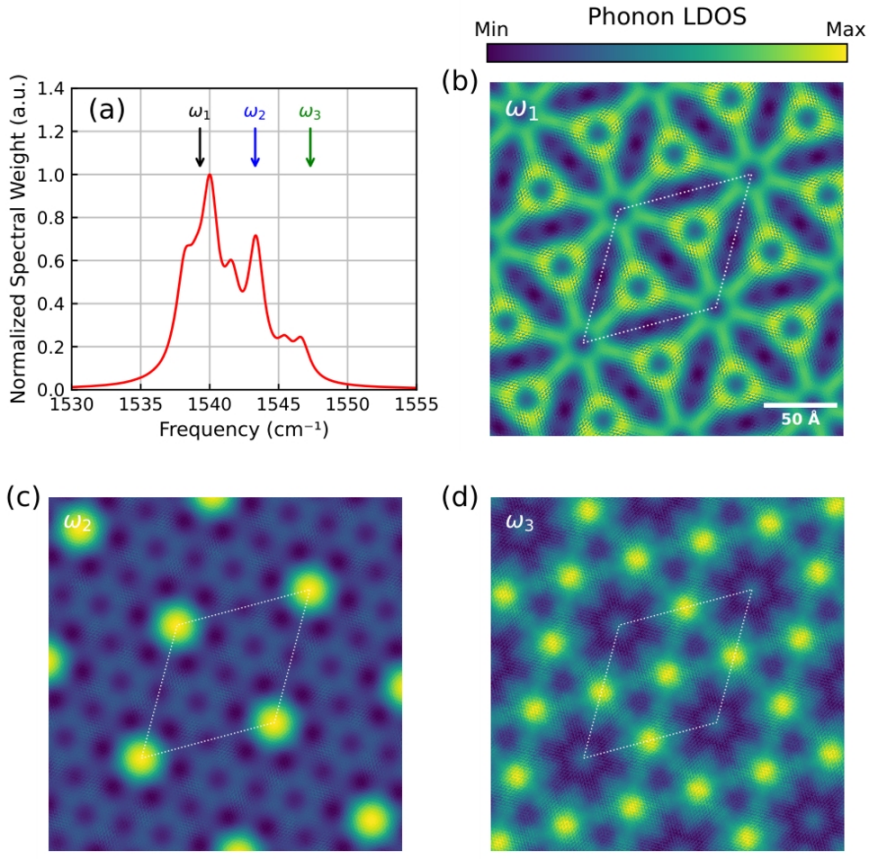
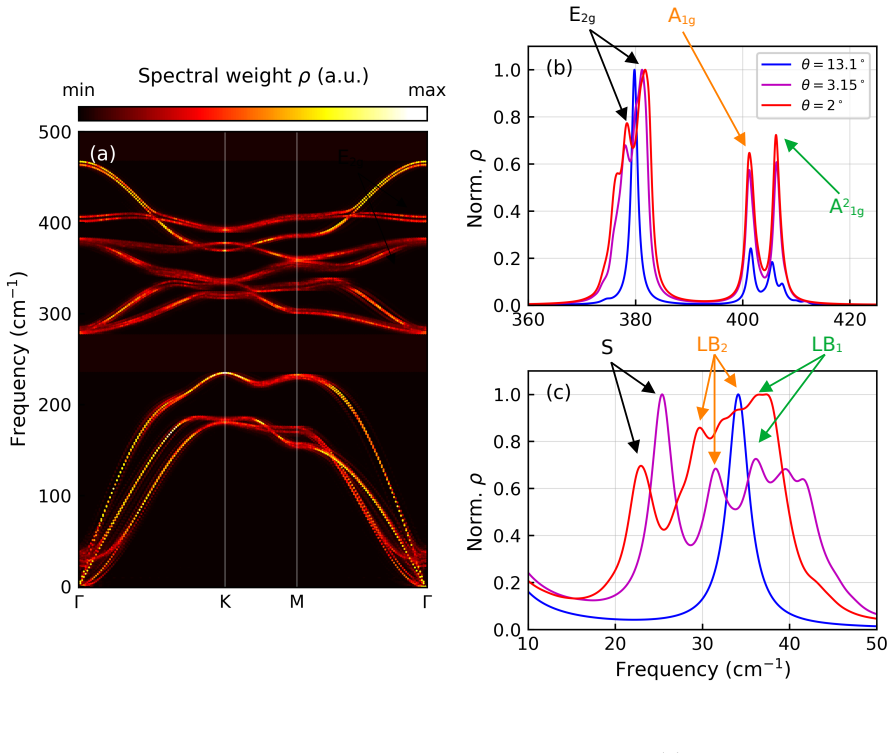
Fine-tuning universal atomistic foundation models is essential to achieve DFT accuracy for layered materials, as broadly trained foundation models prove insufficient for resolving the subtle interlayer energetics that govern atomic reconstruction. Through local strain tensor analysis and the phonon band unfolding technique, the fine-tuned MACE model reveals a consistent reconstruction-induced strain landscape in all three materials, with extended low-energy stacking domains separated by narrow soliton lines where deformation concentrates, and the deformation amplitude scales with mechanical compliance.
What carries the argument
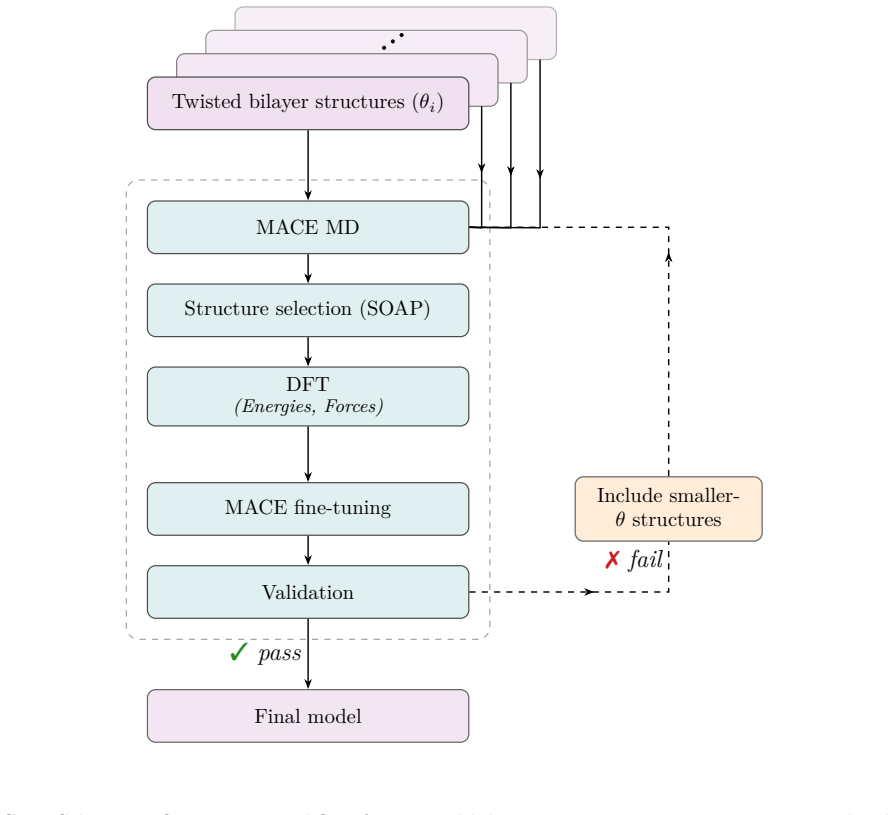
The fine-tuned MACE machine-learned interatomic potential, adjusted on limited DFT data for specific twisted bilayers to resolve subtle interlayer energetics.
Load-bearing premise
The fine-tuned MACE model accurately captures the subtle interlayer energetics and generalizes to the full range of local stacking registries without significant overfitting.
What would settle it
A mismatch between the model's predicted atomic positions in reconstructed domains or its unfolded phonon spectra and experimental measurements for a new twist angle or material not used in fine-tuning would falsify the central claim.
Figures
read the original abstract
Twisted van der Waals bilayers form moir\'e superlattices whose structural and vibrational properties are highly sensitive to variations in local stacking registry and the degree of atomic reconstruction, yet accurate atomistic modeling of these systems at the DFT level remains computationally prohibitive at small twist angles. We investigate machine-learned interatomic potentials for moir\'e systems, using twisted bilayer graphene, \textit{h}-BN, and MoS$_2$ as representative materials spanning a broad spectrum of mechanical compliance and atomic reconstruction behavior. We show that fine-tuning universal atomistic foundation models is essential to achieve DFT accuracy for layered materials, as broadly trained foundation models prove insufficient for resolving the subtle interlayer energetics that govern atomic reconstruction. Through local strain tensor analysis and the phonon band unfolding technique, our fine-tuned MACE model reveals a consistent reconstruction-induced strain landscape in all three materials, with extended low-energy stacking domains separated by narrow soliton lines where deformation concentrates. The system progressively optimizes the local stacking registry within each domain, giving rise to a spatially structured deformation field whose amplitude scales with the mechanical compliance of the material and can be further tuned by external perturbation. The obtained results of both atomic reconstructed structures and moir\'e phonon spectra present a good agreement with the reported experiments, thereby demonstrating the accuracy and efficiency of our methodology in modeling of these large scale nanomaterials.
Editorial analysis
A structured set of objections, weighed in public.
Referee Report
Summary. The paper claims that fine-tuning universal atomistic foundation models such as MACE is essential to achieve DFT-level accuracy for the structural reconstruction and vibrational properties of twisted bilayer graphene, h-BN, and MoS2, because broadly trained models cannot resolve the subtle interlayer energetics. Using the fine-tuned potentials, the authors perform local strain tensor analysis and phonon band unfolding to identify extended low-energy stacking domains separated by narrow solitons, report that deformation amplitude scales with material compliance, and state that the resulting structures and moiré phonon spectra agree with experiment.
Significance. If the fine-tuned MACE potentials demonstrably generalize across continuous stacking registries without overfitting and match independent benchmarks, the work would provide a practical route to atomistic modeling of large moiré superlattices that is currently inaccessible to direct DFT. The absence of quantitative validation metrics, however, prevents a firm assessment of this potential impact.
major comments (2)
- [Abstract] Abstract: the central claim that 'fine-tuning ... is essential to achieve DFT accuracy' and that the fine-tuned model yields 'good agreement with the reported experiments' is unsupported by any quantitative error metrics (energy/force RMSE, validation-set performance), training-set composition, or held-out tests on intermediate stacking registries; this directly bears on whether the reported reconstruction and phonon results are reliable or merely interpolations within the fitted data.
- [Methods/Results] Methods/Results (reconstruction and phonon sections): the reported domain sizes, soliton widths, and strain landscapes presuppose that the fine-tuned potential correctly interpolates the continuous, low-energy interlayer energy surface between discrete high-symmetry training configurations; no tests on off-training-registry configurations or independent external benchmarks are described, undermining the assertion that the model resolves the full reconstruction behavior.
minor comments (1)
- [Abstract] Abstract: the phrases 'local strain tensor analysis' and 'phonon band unfolding technique' are introduced without reference to the specific implementation or any validation against direct DFT on small cells.
Simulated Author's Rebuttal
We thank the referee for the detailed review and for highlighting the need for stronger quantitative support of the fine-tuned MACE models. We address each major comment below and will revise the manuscript accordingly to include the requested validation details.
read point-by-point responses
-
Referee: [Abstract] Abstract: the central claim that 'fine-tuning ... is essential to achieve DFT accuracy' and that the fine-tuned model yields 'good agreement with the reported experiments' is unsupported by any quantitative error metrics (energy/force RMSE, validation-set performance), training-set composition, or held-out tests on intermediate stacking registries; this directly bears on whether the reported reconstruction and phonon results are reliable or merely interpolations within the fitted data.
Authors: We agree that the abstract would be strengthened by explicit quantitative metrics. The full manuscript already contains energy and force RMSE values for the fine-tuned versus base MACE models on the training and validation sets, as well as a description of the training configurations (high-symmetry stackings plus sampled intermediate registries for each material). In revision we will move these numbers into the abstract and add a short statement on held-out performance for a subset of intermediate registries. The experimental agreement refers to quantitative matches in domain sizes, soliton widths, and phonon frequencies within reported experimental ranges; we will add explicit numerical comparisons to make this clearer. revision: yes
-
Referee: [Methods/Results] Methods/Results (reconstruction and phonon sections): the reported domain sizes, soliton widths, and strain landscapes presuppose that the fine-tuned potential correctly interpolates the continuous, low-energy interlayer energy surface between discrete high-symmetry training configurations; no tests on off-training-registry configurations or independent external benchmarks are described, undermining the assertion that the model resolves the full reconstruction behavior.
Authors: The training procedure sampled a dense grid of local stacking registries around the high-symmetry points to capture the low-energy surface, and the reconstruction results are consistent with independent experimental measurements. However, we acknowledge that explicit interpolation tests on continuously varied, held-out registries were not presented as a dedicated figure or table. In the revised manuscript we will add such a validation: DFT calculations on a set of off-training-registry configurations will be compared directly to the fine-tuned potential, together with an external benchmark against an independent DFT dataset for twisted bilayer graphene. This will directly demonstrate the interpolation quality underlying the reported domain and soliton structures. revision: yes
Circularity Check
No significant circularity; external experimental benchmarks and DFT comparisons provide independent validation
full rationale
The paper trains a fine-tuned MACE potential on DFT data for specific twisted bilayer systems and reports agreement of reconstructed structures and phonon spectra with published experiments. This constitutes standard supervised ML modeling validated externally rather than any self-definitional derivation, fitted input renamed as prediction, or load-bearing self-citation chain. No equations or claims in the provided text reduce the reported results to the training inputs by construction; the workflow remains self-contained against external benchmarks.
Axiom & Free-Parameter Ledger
Reference graph
Works this paper leans on
-
[1]
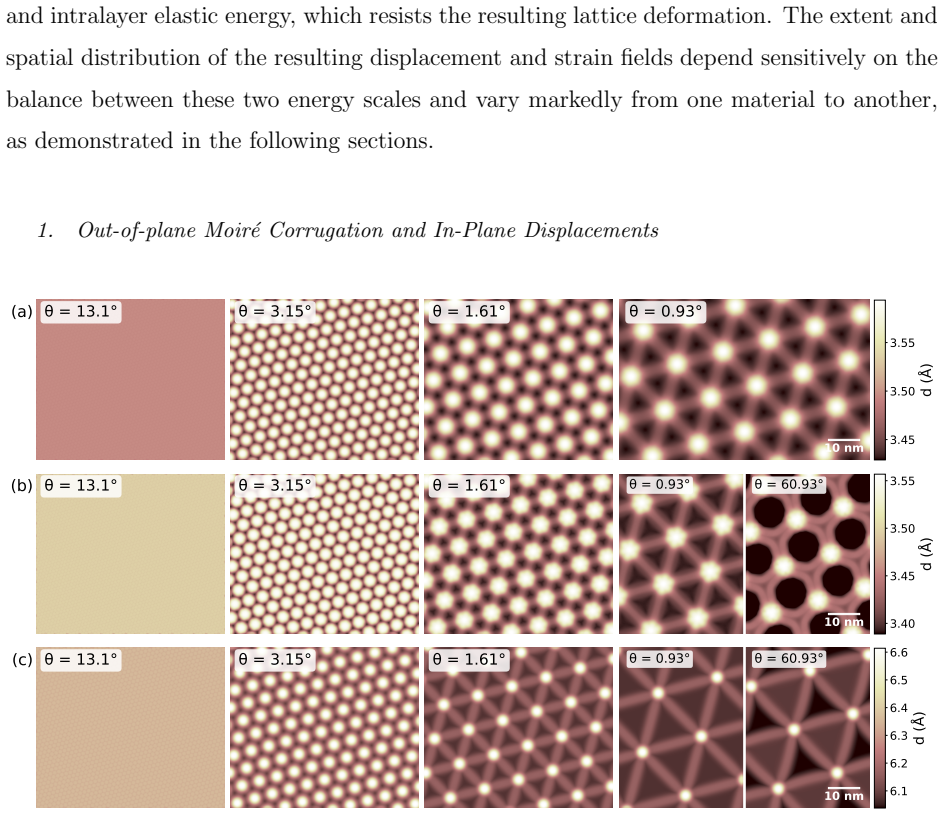
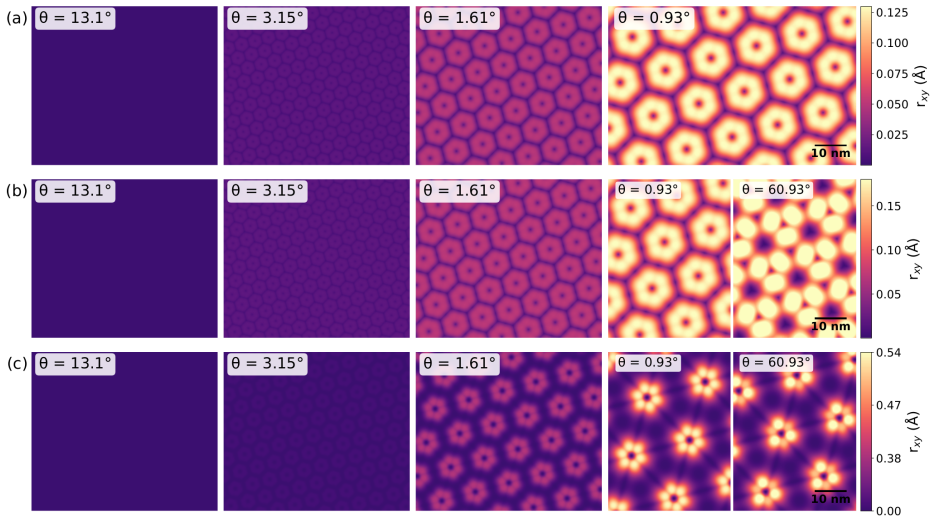
Out-of-plane Moir´ e Corrugation and In-Plane Displacements = 13.1° (a) = 3.15° = 1.61° = 0.93° 10 nm = 13.1° (b) = 3.15° = 1.61° = 0.93° = 60.93° 10 nm = 13.1° (c) = 3.15° = 1.61° = 0.93° = 60.93° 10 nm 3.45 3.50 3.55 d (Å) 3.40 3.45 3.50 3.55 d (Å) 6.1 6.2 6.3 6.4 6.5 6.6 d (Å) FIG. 5. Interlayer distance maps across the moir´ e unit cell for twisted bi...
-
[2]
DREAMS” (No. 21/26-116), from the EOS project “CON- NECT
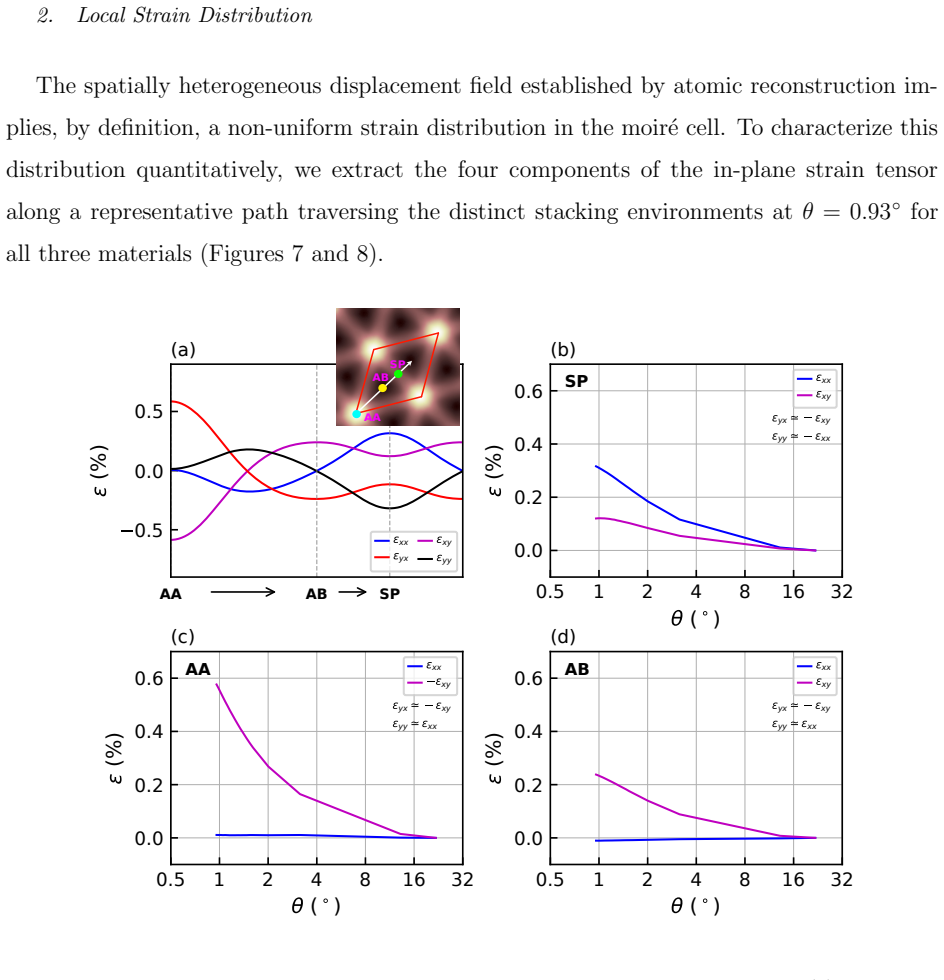
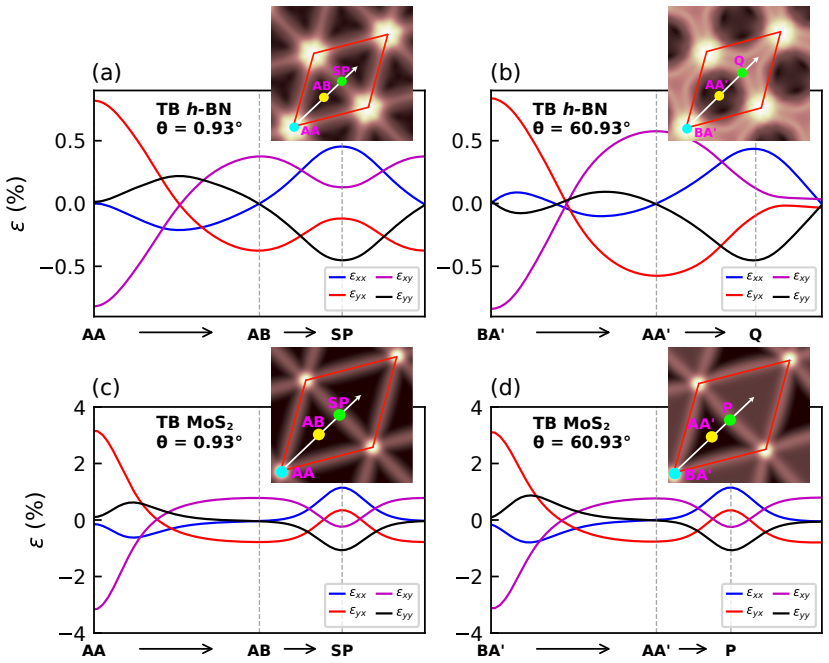
Local Strain Distribution The spatially heterogeneous displacement field established by atomic reconstruction im- plies, by definition, a non-uniform strain distribution in the moir´ e cell. To characterize this distribution quantitatively, we extract the four components of the in-plane strain tensor along a representative path traversing the distinct sta...
-
[3]
Electric field effect in atomi- cally thin carbon films.science, 306(5696):666–669, 2004
Kostya S Novoselov, Andre K Geim, Sergei V Morozov, De-eng Jiang, Yanshui Zhang, Sergey V Dubonos, Irina V Grigorieva, and Alexandr A Firsov. Electric field effect in atomi- cally thin carbon films.science, 306(5696):666–669, 2004
2004
-
[4]
Van der waals heterostructures.Nature, 499(7459):419– 425, 2013
Andre K Geim and Irina V Grigorieva. Van der waals heterostructures.Nature, 499(7459):419– 425, 2013. 29
2013
-
[5]
2d transition metal dichalcogenides.Nature Reviews Materials, 2(8):17033, 2017
Sajedeh Manzeli, Dmitry Ovchinnikov, Diego Pasquier, Oleg V Yazyev, and Andras Kis. 2d transition metal dichalcogenides.Nature Reviews Materials, 2(8):17033, 2017
2017
-
[6]
2d materials and van der waals heterostructures.Science, 353(6298):aac9439, 2016
K S Novoselov, Artem Mishchenko, Alexandra Carvalho, and AH Castro Neto. 2d materials and van der waals heterostructures.Science, 353(6298):aac9439, 2016
2016
-
[7]
Relaxation and domain formation in incommensurate two-dimensional heterostruc- tures.Physical Review B, 98(22):224102, 2018
Stephen Carr, Daniel Massatt, Steven B Torrisi, Paul Cazeaux, Mitchell Luskin, and Efthimios Kaxiras. Relaxation and domain formation in incommensurate two-dimensional heterostruc- tures.Physical Review B, 98(22):224102, 2018
2018
-
[8]
Atomic reconstruction in twisted bilayers of transition metal dichalcogenides.Nature Nanotechnology, 15(7):592–597, 2020
Astrid Weston, Yichao Zou, Vladimir Enaldiev, et al. Atomic reconstruction in twisted bilayers of transition metal dichalcogenides.Nature Nanotechnology, 15(7):592–597, 2020
2020
-
[9]
MacDonald
Rafi Bistritzer and Allan H. MacDonald. Moir´ e bands in twisted double-layer graphene. Proceedings of the National Academy of Sciences, 108(30):12233–12237, 2011
2011
-
[10]
A microscopic perspective on moir´ e materials.Nature Reviews Materials, 9(7):460–480, 2024
Kevin P Nuckolls and Ali Yazdani. A microscopic perspective on moir´ e materials.Nature Reviews Materials, 9(7):460–480, 2024
2024
-
[11]
Correlated insulator behaviour at half-filling in magic-angle graphene superlattices.Nature, 556(7699):80–84, 2018
Yuan Cao, Valla Fatemi, Shiang Fang, Kenji Watanabe, Takashi Taniguchi, Efthimios Kaxi- ras, and Pablo Jarillo-Herrero. Correlated insulator behaviour at half-filling in magic-angle graphene superlattices.Nature, 556(7699):80–84, 2018
2018
-
[12]
Tomarken, Jason Y
Yuan Cao, Valla Fatemi, Ahmet Demir, Shiang Fang, Spencer L. Tomarken, Jason Y. Luo, J. D. Sanchez-Yamagishi, Kenji Watanabe, Takashi Taniguchi, Efthimios Kaxiras, Ray- mond C. Ashoori, and Pablo Jarillo-Herrero. Unconventional superconductivity in magic-angle graphene superlattices.Nature, 556(7699):43–50, 2018
2018
-
[13]
Magic angle hierarchy in twisted graphene multilayers.Physical Review B, 100(8):085109, 2019
Eslam Khalaf, Alex J Kruchkov, Grigory Tarnopolsky, and Ashvin Vishwanath. Magic angle hierarchy in twisted graphene multilayers.Physical Review B, 100(8):085109, 2019
2019
-
[14]
Magic in twisted transition metal dichalcogenide bilayers.Nature communications, 12(1):6730, 2021
Trithep Devakul, Valentin Cr´ epel, Yang Zhang, and Liang Fu. Magic in twisted transition metal dichalcogenide bilayers.Nature communications, 12(1):6730, 2021
2021
-
[15]
Su (4) chiral spin liquid, exciton super- solid, and electric detection in moir´ e bilayers.Physical review letters, 127(24):247701, 2021
Ya-Hui Zhang, DN Sheng, and Ashvin Vishwanath. Su (4) chiral spin liquid, exciton super- solid, and electric detection in moir´ e bilayers.Physical review letters, 127(24):247701, 2021
2021
-
[16]
Rhodes, Chaowei Tan, Martin Claassen, Dante M
Lei Wang, En-Min Shih, Alessio Ghiotto, Lede Xian, Daniel A. Rhodes, Chaowei Tan, Martin Claassen, Dante M. Kennes, Yujie Bai, Bumho Kim, Kenji Watanabe, Takashi Taniguchi, Xiaodong Zhu, James Hone, Angel Rubio, Abhay N. Pasupathy, and Cory R. Dean. Corre- lated electronic phases in twisted bilayer transition metal dichalcogenides.Nature Materials, 19(8):...
2020
-
[17]
Signatures of fractional quantum anomalous Hall states in twisted MoTe 2.Nature, 622(7981):63–68, 2023
Jiaqi Cai, Ethan Anderson, Chenyu Wang, et al. Signatures of fractional quantum anomalous Hall states in twisted MoTe 2.Nature, 622(7981):63–68, 2023
2023
-
[18]
Tsen, Takashi Taniguchi, Kenji Watanabe, Gyu- Chul Yi, Miyoung Kim, Mitchell Luskin, Ellad B
Hyobin Yoo, Rebecca Engelke, Stephen Carr, Shiang Fang, Kuan Zhang, Paul Cazeaux, Suk Hyun Sung, Robert Hovden, Adam W. Tsen, Takashi Taniguchi, Kenji Watanabe, Gyu- Chul Yi, Miyoung Kim, Mitchell Luskin, Ellad B. Tadmor, Efthimios Kaxiras, and Philip Kim. Atomic and electronic reconstruction at the van der Waals interface in twisted bilayer graphene.Natu...
2019
-
[19]
Kazmierczak, Madeline Van Winkle, Colin Ophus, Karen C
Nathanael P. Kazmierczak, Madeline Van Winkle, Colin Ophus, Karen C. Bustillo, Hamish G. Brown, Jim Ciston, Takashi Taniguchi, Kenji Watanabe, and D. Kwabena Bediako. Strain fields in twisted bilayer graphene.Nature Materials, 20(7):956–963, 2021
2021
-
[20]
Magorrian, and Nicholas D
Anas Siddiqui, Chung Xu, Samuel J. Magorrian, and Nicholas D. M. Hine. Understanding domain reconstruction of twisted transition metal dichalcogenide bilayers through machine learned interatomic potentials.2D Materials, 12(4):045016, 2025
2025
-
[21]
MacDonald, Ping-Heng Tan, Florian Libisch, and Xiaoqin Li
Jiamin Quan, Lukas Linhart, Miao-Ling Lin, Daehun Lee, Jihang Zhu, Chun-Yuan Wang, Wei-Ting Hsu, Junho Choi, Jacob Embley, Carter Young, Takashi Taniguchi, Kenji Watanabe, Chih-Kang Shih, Keji Lai, Allan H. MacDonald, Ping-Heng Tan, Florian Libisch, and Xiaoqin Li. Phonon renormalization in reconstructed MoS 2 moir´ e superlattices.Nature Materials, 20(8)...
2021
-
[22]
Gadelha, Douglas A
Andreij C. Gadelha, Douglas A. A. Ohlberg, Cassiano Rabelo, Eliel G. S. Neto, Thiago L. Vasconcelos, Jo˜ ao L. Campos, Jessica S. Lemos, Vin´ ıcius Ornelas, Daniel Miranda, Rafael Nadas, et al. Localization of lattice dynamics in low-angle twisted bilayer graphene.Nature, 590(7846):405–409, 2021
2021
-
[23]
Darshit Solanki, Kenji Watanabe, Takashi Taniguchi, A. K. Sood, and Anindya Das. Anoma- lies in G and 2D Raman modes of twisted bilayer graphene near the magic angle.Physical Review B, 112(4):045412, 2025
2025
-
[24]
Electronic-structure methods for twisted moir´ e layers.Nature Reviews Materials, 5(10):748–763, 2020
Stephen Carr, Shiang Fang, and Efthimios Kaxiras. Electronic-structure methods for twisted moir´ e layers.Nature Reviews Materials, 5(10):748–763, 2020
2020
-
[25]
Stillinger-weber parametrization, mechan- ical properties, and thermal conductivity of single-layer MoS 2.Journal of Applied Physics, 114(6):064307, 2013
Jin-Wu Jiang, Harold S Park, and Timon Rabczuk. Stillinger-weber parametrization, mechan- ical properties, and thermal conductivity of single-layer MoS 2.Journal of Applied Physics, 114(6):064307, 2013. 31
2013
-
[26]
Stillinger–weber potential for elastic and frac- ture properties in graphene and carbon nanotubes.Journal of Physics: Condensed Matter, 30(5):055001, 2018
M Z Hossain, T Hao, and B Silverman. Stillinger–weber potential for elastic and frac- ture properties in graphene and carbon nanotubes.Journal of Physics: Condensed Matter, 30(5):055001, 2018
2018
-
[27]
Donald W Brenner, Olga A Shenderova, Judith A Harrison, Steven J Stuart, Boris Ni, and Susan B Sinnott. A second-generation reactive empirical bond order (REBO) potential energy expression for solid carbon and hydrocarbon molecules.Journal of Physics: Condensed Matter, 14(4):783, 2002
2002
-
[28]
Empirical interatomic potentials for carbon, with applications to amorphous states.Physical Review B, 37(12):6991, 1988
Jerry Tersoff. Empirical interatomic potentials for carbon, with applications to amorphous states.Physical Review B, 37(12):6991, 1988
1988
-
[29]
Kolmogorov and Vincent H
Aleksey N. Kolmogorov and Vincent H. Crespi. Registry-dependent interlayer potential for graphitic systems.Physical Review B, 71(23):235415, 2005
2005
-
[30]
Naik, Indrajit Maity, Prabal K
Mit H. Naik, Indrajit Maity, Prabal K. Maiti, and Manish Jain. Kolmogorov–Crespi potential for multilayer transition-metal dichalcogenides: Capturing structural transformations in moir´ e superlattices.The Journal of Physical Chemistry C, 123(15):9770–9778, 2019
2019
-
[31]
Dihedral- angle-corrected registry-dependent interlayer potential for multilayer graphene structures
Mingjian Wen, Stephen Carr, Shiang Fang, Efthimios Kaxiras, and Ellad B Tadmor. Dihedral- angle-corrected registry-dependent interlayer potential for multilayer graphene structures. Physical Review B, 98(23):235404, 2018
2018
-
[32]
Owen, Mordechai Kornbluth, and Boris Kozinsky
Albert Musaelian, Simon Batzner, Anders Johansson, Lixin Sun, Cameron J. Owen, Mordechai Kornbluth, and Boris Kozinsky. Learning local equivariant representations for large-scale atomistic dynamics.Nature Communications, 14:579, 2023
2023
-
[33]
Mailoa, Mordechai Kornbluth, Nicola Molinari, Tess E
Simon Batzner, Albert Musaelian, Lixin Sun, Mario Geiger, Jonathan P. Mailoa, Mordechai Kornbluth, Nicola Molinari, Tess E. Smidt, and Boris Kozinsky. E(3)-equivariant graph neu- ral networks for data-efficient and accurate interatomic potentials.Nature Communications, 13:2453, 2022
2022
-
[34]
Ilyes Batatia, D´ avid P´ eter Kov´ acs, Gregor N. C. Simm, Christoph Ortner, and G´ abor Cs´ anyi. MACE: Higher order equivariant message passing neural networks for fast and accurate force fields. InAdvances in Neural Information Processing Systems, volume 35, 2022
2022
-
[35]
A foundation model for atomistic materials chemistry.The Journal of chemical physics, 163(18), 2025
Ilyes Batatia, Philipp Benner, Yuan Chiang, Alin M Elena, D´ avid P Kov´ acs, Janosh Riebesell, Xavier R Advincula, Mark Asta, Matthew Avaylon, William J Baldwin, et al. A foundation model for atomistic materials chemistry.The Journal of chemical physics, 163(18), 2025. 32
2025
-
[36]
CHGNet as a pretrained universal neu- ral network potential for charge-informed atomistic modelling.Nature Machine Intelligence, 5:1031–1041, 2023
Bowen Deng, Peichen Zhong, Kiyoon Jun, et al. CHGNet as a pretrained universal neu- ral network potential for charge-informed atomistic modelling.Nature Machine Intelligence, 5:1031–1041, 2023
2023
-
[37]
Machine-learned interatomic potentials for transi- tion metal dichalcogenide Mo1−xWxS2−2ySe2y alloys.npj Computational Materials, 10(1):169, 2024
Anas Siddiqui and Nicholas D M Hine. Machine-learned interatomic potentials for transi- tion metal dichalcogenide Mo1−xWxS2−2ySe2y alloys.npj Computational Materials, 10(1):169, 2024
2024
-
[38]
Quantum monte carlo calculation of the binding energy of bilayer graphene.Physical review letters, 115(11):115501, 2015
E Mostaani, ND Drummond, and VI Fal’Ko. Quantum monte carlo calculation of the binding energy of bilayer graphene.Physical review letters, 115(11):115501, 2015
2015
-
[39]
Alternative stacking sequences in hexagonal boron nitride
S Matt Gilbert, Thang Pham, Mehmet Dogan, Sehoon Oh, Brian Shevitski, Gabe Schumm, Stanley Liu, Peter Ercius, Shaul Aloni, Marvin L Cohen, et al. Alternative stacking sequences in hexagonal boron nitride. 2d mater. 2019
2019
-
[40]
Relaxation effects in twisted bilayer molybdenum disulfide: structure, stability, and electronic properties.2D Materials, 10(4):045010, 2023
Florian M Arnold, Alireza Ghasemifard, Agnieszka Kuc, Jens Kunstmann, and Thomas Heine. Relaxation effects in twisted bilayer molybdenum disulfide: structure, stability, and electronic properties.2D Materials, 10(4):045010, 2023
2023
-
[42]
Bart´ ok, Risi Kondor, and G´ abor Cs´ anyi
Albert P. Bart´ ok, Risi Kondor, and G´ abor Cs´ anyi. On representing chemical environments. Physical Review B, 87(18):184115, 2013
2013
-
[43]
Kresse and J
G. Kresse and J. Furthm¨ uller. Efficient iterative schemes forab initiototal-energy calculations using a plane-wave basis set.Physical Review B, 54(16):11169–11186, 1996
1996
-
[44]
A consistent and accurateab initioparametrization of density functional dispersion correction (DFT-D) for the 94 elements H–Pu.The Journal of Chemical Physics, 132(15):154104, 2010
Stefan Grimme, Jens Antony, Stephan Ehrlich, and Helge Krieg. A consistent and accurateab initioparametrization of density functional dispersion correction (DFT-D) for the 94 elements H–Pu.The Journal of Chemical Physics, 132(15):154104, 2010
2010
-
[45]
Wood, Misko Dzamba, Meng Gao, Ammar Rizvi, C
Muhammed Shuaibi, Xiang Fu, Brandon M. Wood, Misko Dzamba, Meng Gao, Ammar Rizvi, C. Lawrence Zitnick, and Zachary W. Ulissi. Open materials 2024 (OMat24) inorganic mate- rials dataset and models.arXiv preprint arXiv:2410.12771, 2024
Pith/arXiv arXiv 2024
-
[46]
The atomic simulation environment — a Python library for working with atoms.Journal of Physics: Condensed Matter, 29(27):273002, 2017
Ask Hjorth Larsen, Jens Jørgen Mortensen, Jakob Blomqvist, et al. The atomic simulation environment — a Python library for working with atoms.Journal of Physics: Condensed Matter, 29(27):273002, 2017. 33
2017
-
[47]
First principles phonon calculations in materials science
Atsushi Togo and Isao Tanaka. First principles phonon calculations in materials science. Scripta Materialia, 108:1–5, 2015
2015
-
[48]
V. H. Nguyen and J. C. Charlier. Recursive Green’s functions optimized for atomistic mod- elling of large superlattice-based devices.Journal of Computational Electronics, 22:1215–1230, 2023
2023
-
[49]
Ioannis Deretzis, Gaetano Calogero, G. G. N. Angilella, and Antonino La Magna. Role of basis sets on the unfolding of supercell band structures: From tight-binding to density functional theory.Europhysics Letters, 107(2):27006, 2014
2014
-
[50]
Soliton signature in the phonon spectrum of twisted bilayer graphene.2D Materials, 7(2):025050, 2020
Michael Lamparski, Benoit Van Troeye, and Vincent Meunier. Soliton signature in the phonon spectrum of twisted bilayer graphene.2D Materials, 7(2):025050, 2020
2020
-
[51]
Low-frequency shear and layer-breathing modes in raman scattering of two- dimensional materials.ACS nano, 11(12):11777–11802, 2017
Liangbo Liang, Jun Zhang, Bobby G Sumpter, Qing-Hai Tan, Ping-Heng Tan, and Vin- cent Meunier. Low-frequency shear and layer-breathing modes in raman scattering of two- dimensional materials.ACS nano, 11(12):11777–11802, 2017
2017
-
[52]
Low-frequency interlayer Raman modes to probe interface of twisted bilayer MoS 2.Nano Letters, 16(2):1435–1444, 2016
Shanshan Huang, Liangbo Liang, Ling-mian Ling, Hao Xu, Bobby G Sumpter, Vincent Me- unier, and Mildred S Dresselhaus. Low-frequency interlayer Raman modes to probe interface of twisted bilayer MoS 2.Nano Letters, 16(2):1435–1444, 2016
2016
-
[53]
Johnathan D Georgaras, Akash Ramdas, Chung Hsuan Shan, Elena Halsted, Tianshu Li, Felipe H da Jornada, et al. Accurate, transferable, and verifiable machine-learned interatomic potentials for layered materials.arXiv preprint arXiv:2503.15432, 2025
arXiv 2025
-
[54]
Kysar, and James Hone
Changgu Lee, Xiaoding Wei, Jeffrey W. Kysar, and James Hone. Measurement of the elastic properties and intrinsic strength of monolayer graphene.Science, 321(5887):385–388, 2008
2008
-
[55]
Aleksey Falin, Qiran Cai, Elton J. G. Santos, Declan Scullion, Dong Qian, Rui Zhang, Zheng- wei Yang, Shaoming Huang, Kenji Watanabe, Takashi Taniguchi, Matthew R. Barnett, Ying Chen, Rodney S. Ruoff, and Lu Hua Li. Mechanical properties of atomically thin boron nitride and the role of interlayer interactions.Nature Communications, 8:15815, 2017
2017
-
[56]
Stretching and breaking of ultrathin MoS 2
Simone Bertolazzi, Jacopo Brivio, and Andras Kis. Stretching and breaking of ultrathin MoS 2. ACS Nano, 5(12):9703–9709, 2011
2011
-
[57]
Electronic localization in small-angle twisted bilayer graphene.2D Materials, 8(3):035046, 2021
V Hung Nguyen, David Paszko, M Lamparski, Benoit Van Troeye, V Meunier, and Jean- Christophe Charlier. Electronic localization in small-angle twisted bilayer graphene.2D Materials, 8(3):035046, 2021. 34
2021
-
[58]
Rotational disorder in twisted bilayer graphene.ACS nano, 8(2):1655–1663, 2014
Thomas E Beechem, Taisuke Ohta, Bogdan Diaconescu, and Jeremy T Robinson. Rotational disorder in twisted bilayer graphene.ACS nano, 8(2):1655–1663, 2014
2014
-
[59]
Disorder in twisted bilayer graphene
Justin H Wilson, Yixing Fu, S Das Sarma, and JH Pixley. Disorder in twisted bilayer graphene. Physical Review Research, 2(2):023325, 2020
2020
-
[60]
Tuning superconductivity in twisted bilayer graphene.Science, 363(6431):1059–1064, 2019
Matthew Yankowitz, Shaowen Chen, Hryhoriy Polshyn, Yuxuan Zhang, Kenji Watanabe, Takashi Taniguchi, David Graf, Andrea F Young, and Cory R Dean. Tuning superconductivity in twisted bilayer graphene.Science, 363(6431):1059–1064, 2019
2019
-
[61]
Pressure depen- dence of the magic twist angle in graphene superlattices.Physical Review B, 98(8):085144, 2018
Stephen Carr, Shiang Fang, Pablo Jarillo-Herrero, and Efthimios Kaxiras. Pressure depen- dence of the magic twist angle in graphene superlattices.Physical Review B, 98(8):085144, 2018
2018
-
[62]
T. M. G. Mohiuddin, Antonio Lombardo, R. R. Nair, A. Bonetti, G. Savini, R. Jalil, Nicola Bonini, D. M. Basko, C. Galiotis, Nicola Marzari, K. S. Novoselov, A. K. Geim, and A. C. Ferrari. Uniaxial strain in graphene by Raman spectroscopy: G peak splitting, Gr¨ uneisen parameters, and sample orientation.Physical Review B, 79(20):205433, 2009
2009
-
[63]
Heinz, and James Hone
Mingyuan Huang, Hugen Yan, Changyao Chen, Daohua Song, Tony F. Heinz, and James Hone. Phonon softening and crystallographic orientation of strained graphene studied by Raman spectroscopy.Proceedings of the National Academy of Sciences, 106(18):7304–7308, 2009
2009
-
[64]
Androulidakis, E
Ch. Androulidakis, E. N. Koukaras, M. Poss, K. Papagelis, C. Galiotis, and S. Tawfick. Strained hexagonal boron nitride: Phonon shift and Gr¨ uneisen parameter.Physical Review B, 97(24):241414, 2018
2018
-
[65]
Conley, Bin Wang, Jed I
Hiram J. Conley, Bin Wang, Jed I. Ziegler, Richard F. Haglund, Sokrates T. Pantelides, and Kirill I. Bolotin. Bandgap engineering of strained monolayer and bilayer MoS 2.Nano Letters, 13(8):3626–3630, 2013
2013
-
[66]
Breakdown of optical phonons’ splitting in two-dimensional materials.Nano Letters, 17(6):3758–3763, 2017
Thibault Sohier, Marco Gibertini, Matteo Calandra, Francesco Mauri, and Nicola Marzari. Breakdown of optical phonons’ splitting in two-dimensional materials.Nano Letters, 17(6):3758–3763, 2017
2017
-
[67]
Anomalous lattice vibrations of single-and few-layer mos2.ACS nano, 4(5):2695–2700, 2010
Changgu Lee, Hugen Yan, Louis E Brus, Tony F Heinz, James Hone, and Sunmin Ryu. Anomalous lattice vibrations of single-and few-layer mos2.ACS nano, 4(5):2695–2700, 2010. 35 Supplementary Materials: A. Model Validation A.1. Pristine Systems TABLE S1. Relative stacking energies ∆E(meV/atom) for pristine bilayer graphene,h-BN, and MoS2 at high-symmetry stack...
2010
discussion (0)
Sign in with ORCID, Apple, or X to comment. Anyone can read and Pith papers without signing in.