Non-equilibrium angular momentum selectivity and filtering in chiral carbon nanotubes
Pith reviewed 2026-06-26 11:14 UTC · model grok-4.3
The pith
Chiral carbon nanotubes can filter orbital angular momentum when angular correlations are added to metallic contacts.
A machine-rendered reading of the paper's core claim, the machinery that carries it, and where it could break.
Core claim
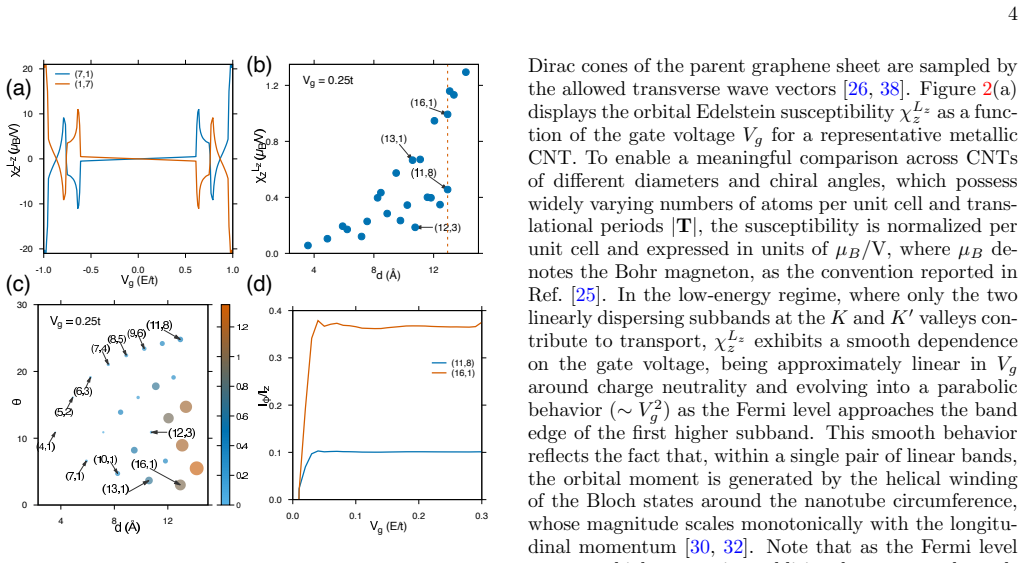
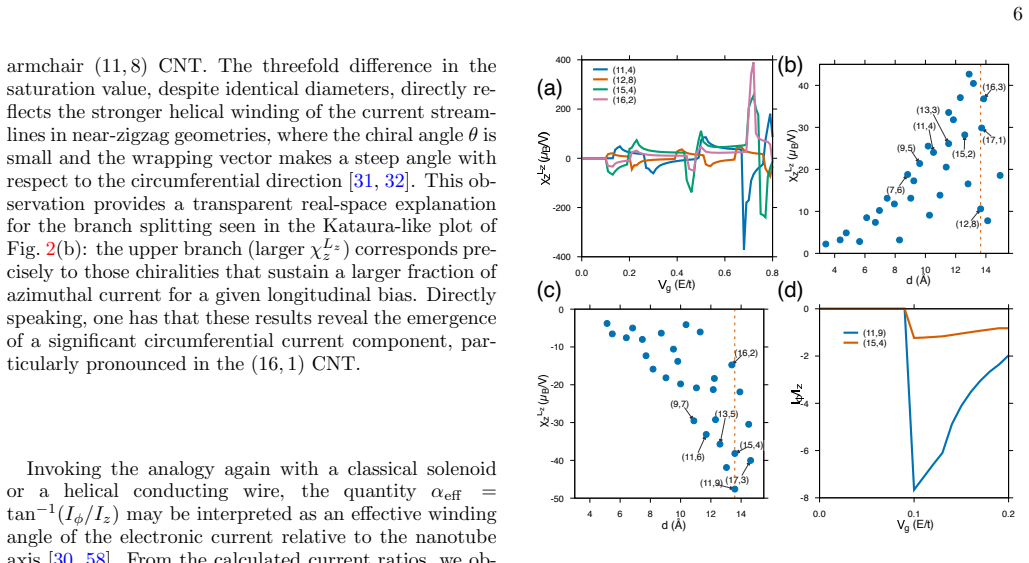
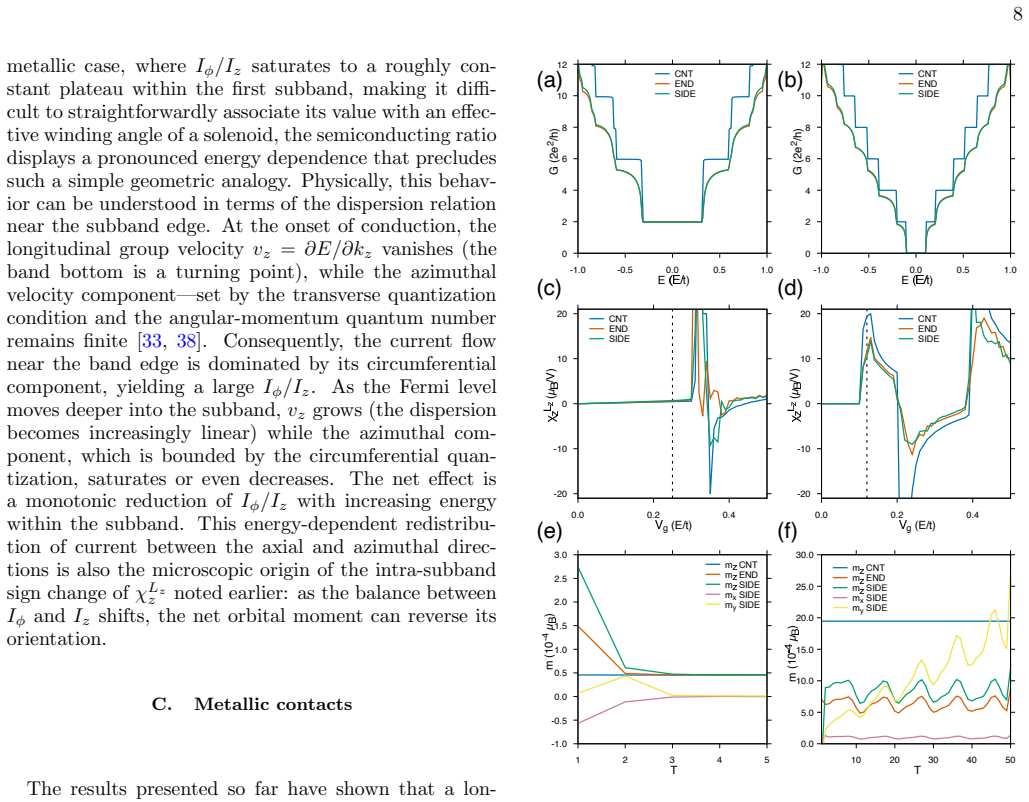
Chiral CNTs exhibit chirality- and diameter-dependent orbital Edelstein susceptibility forming distinct families based on the wrapping vector. Metallic CNTs recover intrinsic orbital response away from contacts, while semiconducting ones show oscillations from angular momentum interference. Incorporating angular correlations in the contact self-energy enables chiral CNTs to function as orbital-angular-momentum filters that transmit orbitally textured states according to propagating band angular momenta.
What carries the argument
Angular-correlated contact self-energy enabling selective transmission of states with matching crystal angular momentum.
If this is right
- Orbital Edelstein susceptibility forms distinct branches for different chiral families.
- Semiconducting CNTs exhibit oscillatory orbital response due to interference.
- Chiral CNTs act as efficient orbital-angular-momentum filters with correlated contacts.
- Metallic CNTs rapidly recover intrinsic orbital response away from contacts.
Where Pith is reading between the lines
- This filtering mechanism could be used to design devices for orbital information processing in one-dimensional systems.
- Similar angular selectivity might be explored in other chiral quasi-one-dimensional materials.
- The dependence on specific chiral vectors suggests selecting particular nanotube types for desired orbital responses.
Load-bearing premise
The wide-band metallic contact model with added angular correlations accurately represents real-device injection of transport channels without unaccounted interference or scattering effects.
What would settle it
Direct measurement of transmitted orbital current in a chiral CNT junction with and without angular correlations in the contact self-energy, checking for selectivity according to band angular momentum.
Figures
read the original abstract
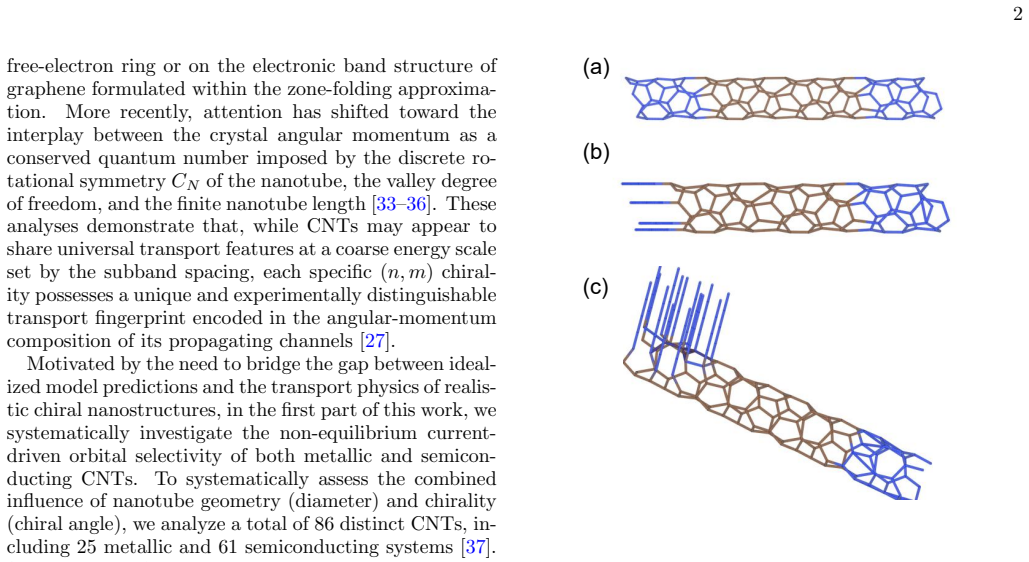
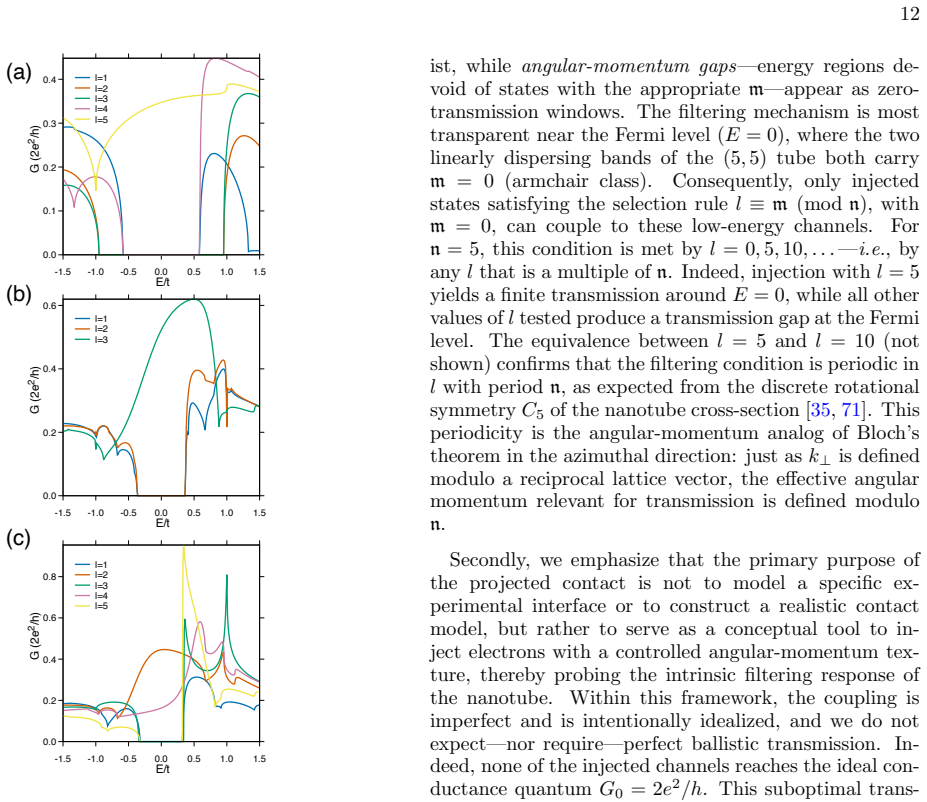
Carbon nanotubes (CNTs) constitute a highly tunable platform for probing the interplay between structural chirality and quantum transport in quasi-one-dimensional systems. Here, we perform a systematic study of the non-equilibrium orbital response across a broad set of metallic and semiconducting chiral CNTs. We find that the orbital Edelstein susceptibility depends strongly on both chirality and nanotube diameter, revealing that the orbital response cannot be captured by a universal scaling law. Instead, distinct families of CNTs emerge, forming characteristic orbital-response branches uniquely determined by the chiral wrapping vector. We further investigate the role of metallic contacts on orbital-current generation and orbital selectivity. While metallic CNTs rapidly recover their intrinsic orbital response away from the contact region, semiconducting CNTs display pronounced oscillatory behavior arising from interference between transport channels carrying different angular momenta injected by wide-band metallic contacts. Finally, by incorporating angular correlations into the contact self-energy, we demonstrate that chiral CNTs can operate as efficient orbital-angular-momentum filters, selectively transmitting orbitally textured electronic states in accordance with the crystal angular momentum of the propagating bands.
Editorial analysis
A structured set of objections, weighed in public.
Referee Report
Summary. The manuscript performs a systematic NEGF study of the non-equilibrium orbital Edelstein susceptibility across metallic and semiconducting chiral carbon nanotubes. It reports that the susceptibility depends strongly on chirality and diameter, forming distinct orbital-response branches fixed by the chiral wrapping vector rather than obeying a universal scaling law. Metallic contacts allow rapid recovery of the intrinsic response in metallic tubes but induce oscillatory interference in semiconducting tubes; adding angular correlations to the wide-band contact self-energy is shown to enable efficient orbital-angular-momentum filtering that transmits states matching the crystal angular momentum of the propagating bands.
Significance. If the NEGF results hold, the work establishes chiral CNTs as a platform for orbital-current selectivity and filtering, with chirality-specific branches providing a structural handle on orbital response. The explicit construction of an angular-momentum-selective contact self-energy and the resulting filtering demonstration constitute a concrete, falsifiable prediction for orbitronic devices. The absence of free parameters in the core model and the systematic coverage of many chiral vectors are strengths that strengthen the central claims.
minor comments (2)
- The wide-band contact model with added angular correlations is central to the filtering result; a brief comparison to alternative contact models (e.g., tight-binding leads) would strengthen the claim that the selectivity is robust rather than model-specific.
- Notation for crystal angular momentum and orbital Edelstein susceptibility should be defined explicitly on first use, with a short table or appendix listing the chiral indices examined.
Simulated Author's Rebuttal
We thank the referee for the positive and accurate summary of our manuscript, the assessment of its significance, and the recommendation for minor revision. No specific major comments were provided in the report.
Circularity Check
No significant circularity; derivation self-contained in NEGF model
full rationale
The paper's central results on orbital Edelstein susceptibility, contact effects, and OAM filtering are obtained from explicit NEGF transport calculations on chiral CNTs. The abstract and methodology describe computing responses across metallic/semiconducting tubes, observing chirality-dependent branches, and adding angular correlations to the wide-band self-energy to produce selectivity. These outcomes follow directly from the stated model equations and numerical implementation without any reduction to self-definitional quantities, fitted parameters renamed as predictions, or load-bearing self-citations. The wide-band assumption and angular-correlation form are modeling choices whose consequences are computed, not presupposed by definition. No uniqueness theorems, ansatzes smuggled via citation, or renaming of known results are invoked as load-bearing steps. The derivation chain is therefore independent of its inputs.
Axiom & Free-Parameter Ledger
Reference graph
Works this paper leans on
-
[1]
Yan, Structural chirality and electronic chirality in quantum materials, Annual Review of Materials Re- search54, 97 (2024)
B. Yan, Structural chirality and electronic chirality in quantum materials, Annual Review of Materials Re- search54, 97 (2024)
2024
-
[2]
C. D. Aiello, J. M. Abendroth, M. Abbas, A. Afana- sev, S. Agarwal, A. S. Banerjee, D. N. Beratan, J. N. Belling, B. Berche, A. Botana, J. R. Caram, G. L. Celardo, G. Cuniberti, A. Garcia-Etxarri, A. Dianat, I. Diez-Perez, Y. Guo, R. Gutierrez, C. Herrmann, J. Hi- hath, S. Kale, P. Kurian, Y.-C. Lai, T. Liu, A. Lopez, E. Medina, V. Mujica, R. Naaman, M. N...
2022
-
[3]
B. P. Bloom, Y. Paltiel, R. Naaman, and D. H. Waldeck, Chiral induced spin selectivity, Chemical Reviews124, 1950 (2024)
1950
-
[4]
Tokura and N
Y. Tokura and N. Nagaosa, Nonreciprocal responses from non-centrosymmetric quantum materials, Nature Com- munications9, 3740 (2018)
2018
-
[5]
G. L. J. A. Rikken and N. Avarvari, Comparing electrical magnetochiral anisotropy and chirality-induced spin se- lectivity, The Journal of Physical Chemistry Letters14, 9727 (2023)
2023
-
[6]
Naaman, Y
R. Naaman, Y. Paltiel, and D. H. Waldeck, Chiral molecules and the electron spin, Nature Reviews Chem- istry3, 250 (2019)
2019
-
[7]
Evers, A
F. Evers, A. Aharony, N. Bar-Gill, O. Entin-Wohlman, P. Hedeg˚ ard, O. Hod, P. Jelinek, G. Kamieniarz, M. Lemeshko, K. Michaeli, V. Mujica, R. Naaman, Y. Paltiel, S. Refaely-Abramson, O. Tal, J. Thijssen, M. Thoss, J. M. van Ruitenbeek, L. Venkataraman, D. H. Waldeck, B. Yan, and L. Kronik, Theory of chirality induced spin selectivity: Progress and challe...
2022
-
[8]
Y. Liu, J. Xiao, J. Koo, and B. Yan, Chirality-driven topological electronic structure of DNA-like materials, Nature Materials20, 638 (2021)
2021
-
[9]
G. L. J. A. Rikken, J. F¨ olling, and P. Wyder, Electrical magnetochiral anisotropy, Physical Review Letters87, 236602 (2001)
2001
-
[10]
F. Pop, P. Auban-Senzier, E. Canadell, G. L. J. A. Rikken, and N. Avarvari, Electrical magnetochiral anisotropy in a bulk chiral molecular conductor, Nature Communications5, 3757 (2014)
2014
-
[11]
Yokouchi, N
T. Yokouchi, N. Kanazawa, A. Kikkawa, D. Morikawa, K. Shibata, T.-h. Arima, Y. Taguchi, F. Kagawa, and Y. Tokura, Electrical magnetochiral effect induced by chiral spin fluctuations, Nature Communications8, 866 (2017)
2017
-
[12]
Ideue, K
T. Ideue, K. Hamamoto, S. Koshikawa, M. Ezawa, S. Shimizu, Y. Kaneko, Y. Tokura, N. Nagaosa, and Y. Iwasa, Bulk rectification effect in a polar semicon- ductor, Nature Physics13, 578 (2017)
2017
-
[13]
D. A. Bahamon, G. G´ omez-Santos, D. K. Efetov, and T. Stauber, Chirality probe of twisted bilayer graphene in the linear transport regime, Nano Letters24, 4478 (2024)
2024
-
[14]
M. H. G. Kuhn, L. A. Silva, and D. A. Bahamon, Layer- resolved quantum transport in twisted bilayer graphene: Counterflow and machine learning predictions, Physical Review B111, 235425 (2025)
2025
-
[15]
A. Inui, R. Aoki, Y. Nishiue, K. Shiota, Y. Kousaka, H. Shishido, D. Hirobe, M. Suda, J.-i. Ohe, J.-i. Kishine, H. M. Yamamoto, and Y. Togawa, Chirality-induced spin-polarized state of a chiral crystal crnb 3s6, Physical Review Letters124, 166602 (2020)
2020
-
[16]
D. Jo, D. Go, G.-M. Choi, and H.-W. Lee, Spintronics meets orbitronics: Emergence of orbital angular momen- tum in solids, npj Spintronics2, 19 (2024)
2024
-
[17]
D. Go, D. Jo, H.-W. Lee, M. Kl¨ aui, and Y. Mokrousov, Orbitronics: Orbital currents in solids, Europhysics Let- ters135, 37001 (2021)
2021
-
[18]
T. Yoda, T. Yokoyama, and S. Murakami, Orbital edel- stein effect as a condensed-matter analog of solenoids, Nano Letters18, 916 (2018)
2018
-
[19]
Y. Liu, J. Xiao, J. Koo, and B. Yan, Chirality-driven topological electronic structure of dna-like materials, Na- ture Materials20, 638 (2021)
2021
-
[20]
B. Kim, D. Shin, S. Namgung, N. Park, K.-W. Kim, and J. Kim, Optoelectronic manifestation of orbital angular momentum driven by chiral hopping in helical se chains, ACS Nano17, 18873 (2023)
2023
-
[21]
Hagiwara, Y.-J
K. Hagiwara, Y.-J. Chen, D. Go, X. L. Tan, S. Gryt- siuk, K.-H. O. Yang, G.-J. Shu, J. Chien, Y.-H. Shen, X.-L. Huang, I. Cojocariu, V. Feyer, M.-T. Lin, S. Bl¨ ugel, C. M. Schneider, Y. Mokrousov, and C. Tusche, Orbital topology of chiral crystals for orbitronics, Advanced Ma- terials37, 2418040 (2025)
2025
-
[22]
Bhowal and G
S. Bhowal and G. Vignale, Orbital hall effect as an alter- native to valley hall effect in gapped graphene, Physical Review B103, 195309 (2021). 15
2021
-
[23]
G¨ obel, L
B. G¨ obel, L. Schimpf, and I. Mertig, Chirality-induced orbital edelstein effect in an analytically solvable model, Phys. Rev. Res.7, 033180 (2025)
2025
-
[24]
Salemi, M
L. Salemi, M. Berritta, and P. M. Oppeneer, Quantita- tive comparison of electrically induced spin and orbital polarizations in heavy-metal/3d-metal bilayers, Physical Review Materials5, 074407 (2021)
2021
-
[25]
G¨ obel, I
B. G¨ obel, I. Mertig, and S. Lounis, Chirality-induced se- lectivity of angular momentum by orbital edelstein ef- fect in carbon nanotubes, Communications Physics8, 395 (2025)
2025
-
[26]
Charlier, X
J.-C. Charlier, X. Blase, and S. Roche, Electronic and transport properties of nanotubes, Reviews of Modern Physics79, 677 (2007)
2007
-
[27]
E. A. Laird, F. Kuemmeth, G. A. Steele, K. Grove- Rasmussen, J. Nyg˚ ard, K. Flensberg, and L. P. Kouwen- hoven, Quantum transport in carbon nanotubes, Reviews of Modern Physics87, 703 (2015)
2015
-
[29]
Jarillo-Herrero, J
P. Jarillo-Herrero, J. Kong, H. S. J. van der Zant, C. Dekker, L. P. Kouwenhoven, and S. De Franceschi, Orbital kondo effect in carbon nanotubes, Nature434, 484 (2005)
2005
-
[30]
Miyamoto, S
Y. Miyamoto, S. G. Louie, and M. L. Cohen, Chiral conductivities of nanotubes, Physical Review Letters76, 2121 (1996)
1996
-
[31]
Miyamoto, A
Y. Miyamoto, A. Rubio, S. G. Louie, and M. L. Cohen, Self-inductance of chiral conducting nanotubes, Physical Review B60, 13885 (1999)
1999
-
[32]
C. J. Lambert, S. W. D. Bailey, and J. Cserti, Oscillating chiral currents in nanotubes: A route to nanoscale mag- netic test tubes, Physical Review B78, 233405 (2008)
2008
-
[33]
Marganska, P
M. Marganska, P. Chudzinski, and M. Grifoni, The two classes of low-energy spectra in finite carbon nanotubes, Physical Review B92, 075433 (2015)
2015
-
[34]
Izumida, R
W. Izumida, R. Okuyama, and R. Saito, Valley coupling in finite-length metallic single-wall carbon nanotubes, Physical Review B91, 235442 (2015)
2015
-
[35]
Izumida, R
W. Izumida, R. Okuyama, A. Yamakage, and R. Saito, Angular momentum and topology in semiconducting single-wall carbon nanotubes, Physical Review B93, 195442 (2016)
2016
-
[36]
Marga´ nska, D
M. Marga´ nska, D. R. Schmid, A. Dirnaichner, P. L. Stiller, C. Strunk, M. Grifoni, and A. K. H¨ uttel, Shap- ing electron wave functions in a carbon nanotube with a parallel magnetic field, Physical Review Letters122, 086802 (2019)
2019
-
[37]
J. T. Frey and D. J. Doren, Tubegen 3.4,http: //turin.nss.udel.edu/research/tubegenonline.html (2011), web interface, University of Delaware, Newark, DE
2011
-
[38]
Saito, G
R. Saito, G. Dresselhaus, and M. S. Dresselhaus,Physical Properties of Carbon Nanotubes(Imperial College Press, London, 1998)
1998
-
[39]
M. S. Dresselhaus, G. Dresselhaus, R. Saito, and A. Jorio, Group Theory: Application to the Physics of Condensed Matter(Springer-Verlag, Berlin Heidelberg, 2008)
2008
-
[40]
C. T. White and J. W. Mintmire, Fundamental properties of single-wall carbon nanotubes, The Journal of Physical Chemistry B109, 52 (2005)
2005
-
[41]
Reich, C
S. Reich, C. Thomsen, and J. Maultzsch,Carbon Nanotubes: Basic Concepts and Physical Properties (WILEY-VCH Verlag GmbH & Co. KGaA, Weinheim, Germany, 2004)
2004
-
[42]
Datta,Electronic Transport in Mesoscopic Systems (Cambridge University Press, Cambridge, 1995)
S. Datta,Electronic Transport in Mesoscopic Systems (Cambridge University Press, Cambridge, 1995)
1995
-
[43]
D. A. Bahamon, G. G´ omez-Santos, and T. Stauber, Emergent magnetic texture in driven twisted bilayer graphene, Nanoscale12, 15383 (2020)
2020
-
[44]
Haug and A.-P
H. Haug and A.-P. Jauho,Quantum Kinetics in Trans- port and Optics of Semiconductors, 2nd ed. (Springer- Verlag, Berlin Heidelberg, 2008)
2008
-
[45]
Peierls, Zur Theorie des Diamagnetismus von Leitungselektronen, Zeitschrift f¨ ur Physik80, 763 (1933)
R. Peierls, Zur Theorie des Diamagnetismus von Leitungselektronen, Zeitschrift f¨ ur Physik80, 763 (1933)
1933
-
[46]
D. A. Bahamon, A. H. Castro Neto, and V. M. Pereira, Effective contact model for geometry-independent con- ductance calculations in graphene, Physical Review B88, 235433 (2013)
2013
-
[47]
Nemec, D
N. Nemec, D. Tom´ anek, and G. Cuniberti, Contact de- pendence of carrier injection in carbon nanotubes: An ab initio study, Physical Review Letters96, 076802 (2006)
2006
-
[48]
Tersoff, Contact resistance of carbon nanotubes, Ap- plied Physics Letters74, 2122 (1999)
J. Tersoff, Contact resistance of carbon nanotubes, Ap- plied Physics Letters74, 2122 (1999)
1999
-
[49]
Z. Chen, J. Appenzeller, J. Knoch, Y.-m. Lin, and P. Avouris, The role of metal–nanotube contact in the performance of carbon nanotube field-effect transistors, Nano Letters5, 1497 (2005)
2005
-
[50]
Zhang, L
S. Zhang, L. Kang, X. Wang, L. Tong, L. Yang, Z. Wang, K. Qi, S. Deng, Q. Li, X. Bai, F. Ding, and J. Zhang, Arrays of horizontal carbon nanotubes of controlled chi- rality grown using designed catalysts, Nature543, 234 (2017)
2017
-
[51]
Blase, L
X. Blase, L. X. Benedict, E. L. Shirley, and S. G. Louie, Hybridization effects and metallicity in small radius car- bon nanotubes, Physical Review Letters72, 1878 (1994)
1994
-
[52]
Salemi and P
L. Salemi and P. M. Oppeneer, First-principles theory of intrinsic spin and orbital hall and nernst effects in metallic monoatomic crystals, Physical Review Materials 6, 095001 (2022)
2022
-
[53]
Kataura, Y
H. Kataura, Y. Kumazawa, Y. Maniwa, I. Umezu, S. Suzuki, Y. Ohtsuka, and Y. Achiba, Optical proper- ties of single-wall carbon nanotubes, Synthetic Metals 103, 2555 (1999), international Conference on Science and Technology of Synthetic Metals
1999
-
[54]
Reich, C
S. Reich, C. Thomsen, and J. Maultzsch,Carbon Nan- otubes: Basic Concepts and Physical Properties(John Wiley & Sons, Ltd, Weinheim, Germany, 2004) Chap. 4, pp. 67–83
2004
-
[55]
E. D. Minot, Y. Yaish, V. Sazonova, and P. L. McEuen, Determination of electron orbital magnetic moments in carbon nanotubes, Nature428, 536 (2004)
2004
-
[56]
Ajiki and T
H. Ajiki and T. Ando, Magnetic properties of carbon nan- otubes, Journal of the Physical Society of Japan62, 2470 (1993)
1993
-
[57]
S. M. Bachilo, M. S. Strano, C. Kittrell, R. H. Hauge, R. E. Smalley, and R. B. Weisman, Structure-assigned optical spectra of single-walled carbon nanotubes, Sci- ence298, 2361 (2002)
2002
-
[58]
G. Y. Slepyan, S. A. Maksimenko, A. Lakhtakia, O. M. Yevtushenko, and A. V. Gusakov, Electronic and elec- tromagnetic properties of nanotubes, Physical Review B 57, 9485 (1998)
1998
-
[59]
B. Wang, R. Chu, J. Wang, and H. Guo, First-principles calculation of chiral current and quantum self-inductance of carbon nanotubes, Physical Review B80, 235430 (2009). 16
2009
-
[60]
J. W. Mintmire and C. T. White, Universal density of states for carbon nanotubes, Physical Review Letters81, 2506 (1998)
1998
-
[61]
J. J. Palacios, A. J. P´ erez-Jim´ enez, E. Louis, E. San- Fabi´ an, and J. A. Verg´ es, First-principles phase-coherent transport in metallic nanotubes with realistic contacts, Physical Review Letters90, 106801 (2003)
2003
-
[62]
Nemec, D
N. Nemec, D. Tom´ anek, and G. Cuniberti, Modeling extended contacts for nanotube and graphene devices, Physical Review B77, 125420 (2008)
2008
-
[63]
Y. Chen, O. Hod, J. Gersten, and A. Nitzan, Chirality- induced orbital-angular-momentum selectivity in elec- tron transmission and scattering, Journal of Chemical Theory and Computation22, 20 (2026)
2026
-
[64]
Chen and O
Y. Chen and O. Hod, Chirality induced spin selectiv- ity: A classical spin-off, The Journal of Chemical Physics 158, 244102 (2023)
2023
-
[65]
Trocha, Beating in electronic transport through quan- tum dot based devices, Physical Review B82, 115320 (2010)
P. Trocha, Beating in electronic transport through quan- tum dot based devices, Physical Review B82, 115320 (2010)
2010
-
[66]
F. M. Souza, Spin-dependent ringing and beats in a quan- tum dot system, Physical Review B76, 205315 (2007)
2007
-
[67]
E. B. Barros, A. Jorio, G. G. Samsonidze, R. B. Ca- paz, A. G. Souza Filho, J. Mendes Filho, G. Dressel- haus, and M. S. Dresselhaus, Review on the symmetry- related properties of carbon nanotubes, Physics Reports 431, 261 (2006)
2006
-
[68]
Streib, Difference between angular momentum and pseudoangular momentum, Physical Review B103, L100409 (2021)
S. Streib, Difference between angular momentum and pseudoangular momentum, Physical Review B103, L100409 (2021)
2021
-
[69]
C. T. White, D. H. Robertson, and J. W. Mintmire, Helical and rotational symmetries of nanoscale graphitic tubules, Physical Review B47, 5485(R) (1993)
1993
-
[70]
Mintmire and C
J. Mintmire and C. White, Electronic and structural properties of carbon nanotubes, Carbon33, 893 (1995), nanotubes
1995
-
[71]
A. M. Lunde, K. Flensberg, and A.-P. Jauho, Intershell resistance in multiwall carbon nanotubes: A coulomb drag study, Physical Review B71, 125408 (2005)
2005
-
[72]
Allen, M
L. Allen, M. W. Beijersbergen, R. J. C. Spreeuw, and J. P. Woerdman, Orbital angular momentum of light and the transformation of laguerre-gaussian laser modes, Physical Review A45, 8185 (1992)
1992
discussion (0)
Sign in with ORCID, Apple, or X to comment. Anyone can read and Pith papers without signing in.