Structural and physical properties of gyromorphs and disordered stealthy hyperuniform media
Pith reviewed 2026-06-26 10:24 UTC · model grok-4.3
The pith
Gyromorphs are hyperuniform but belong only to the weakest Class III form, yielding degraded physical properties relative to Class I stealthy hyperuniform media.
A machine-rendered reading of the paper's core claim, the machinery that carries it, and where it could break.
Core claim
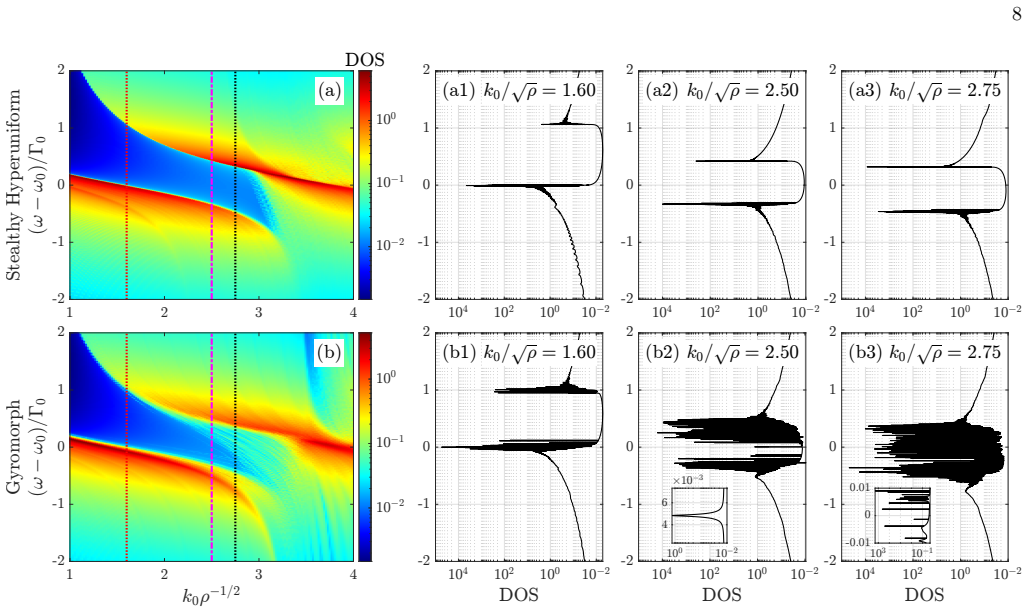
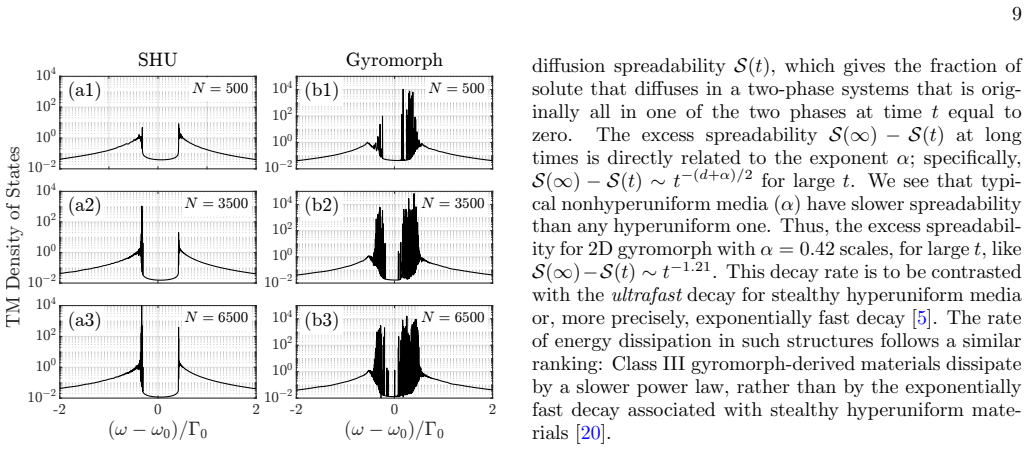
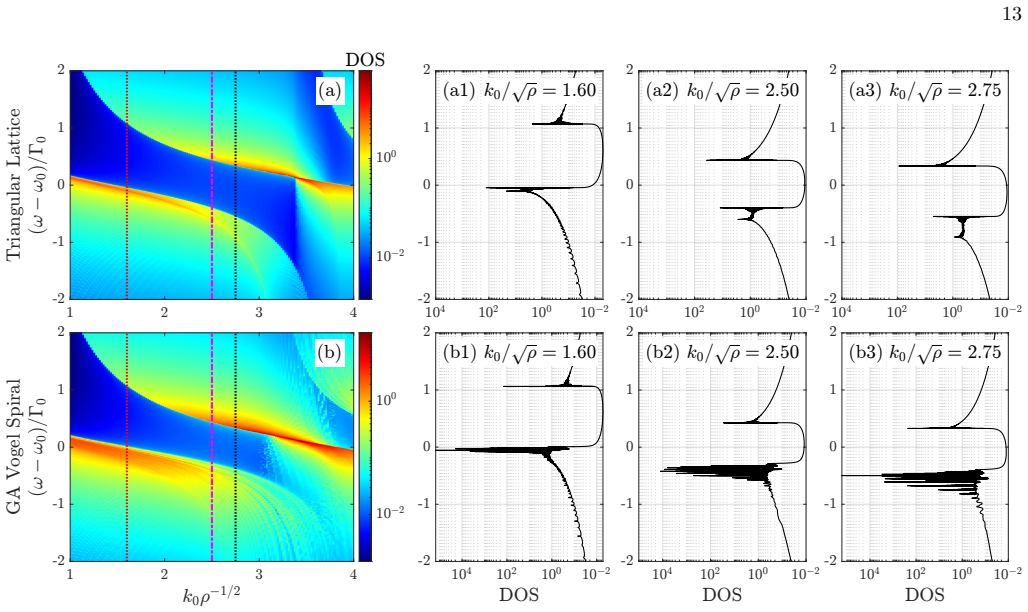
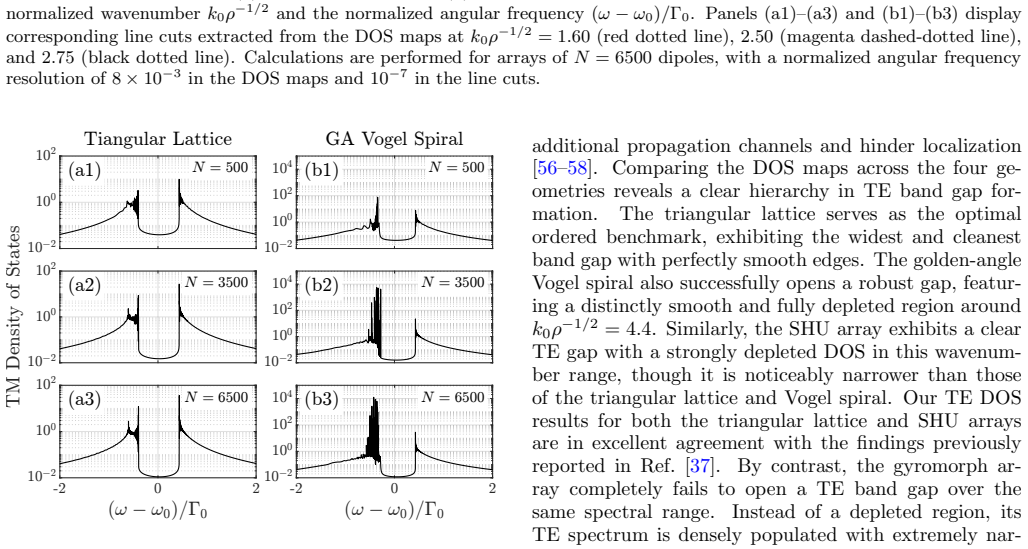
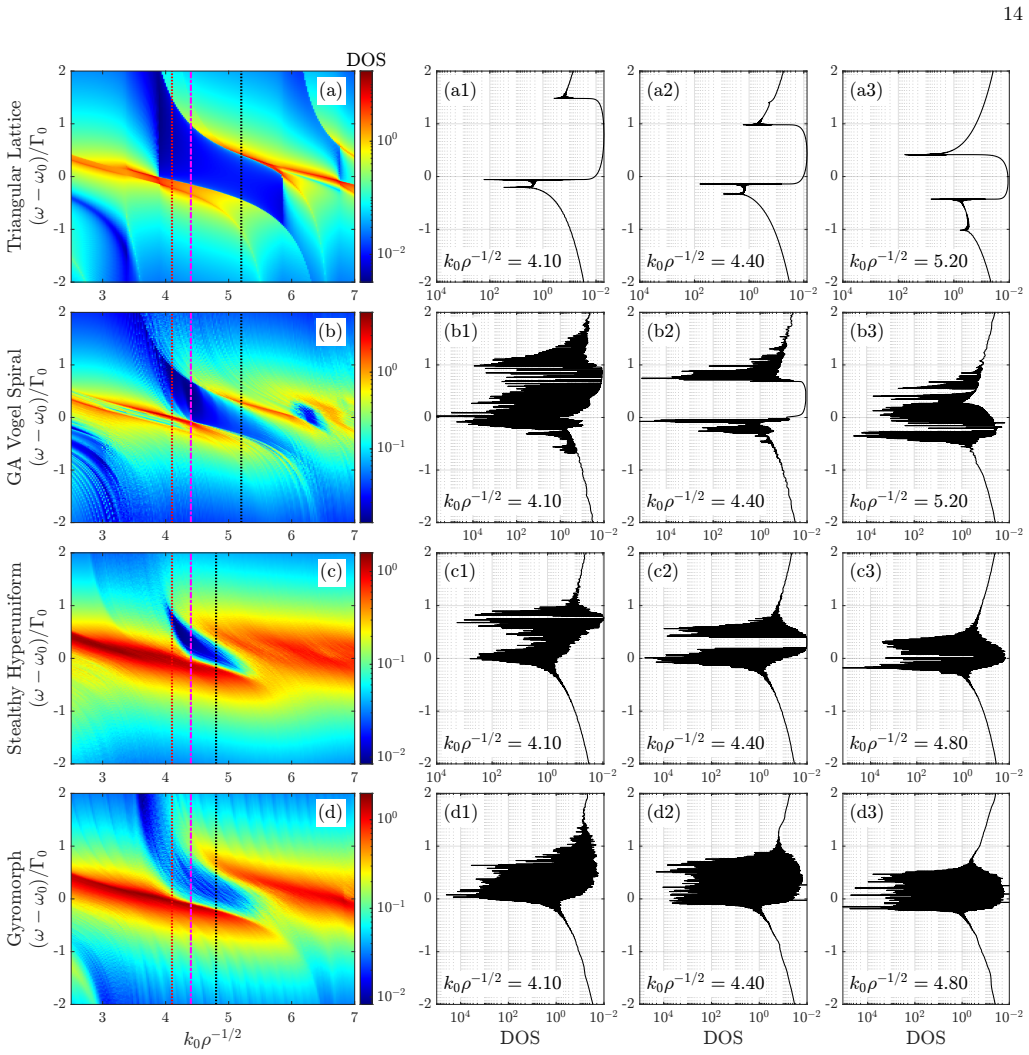
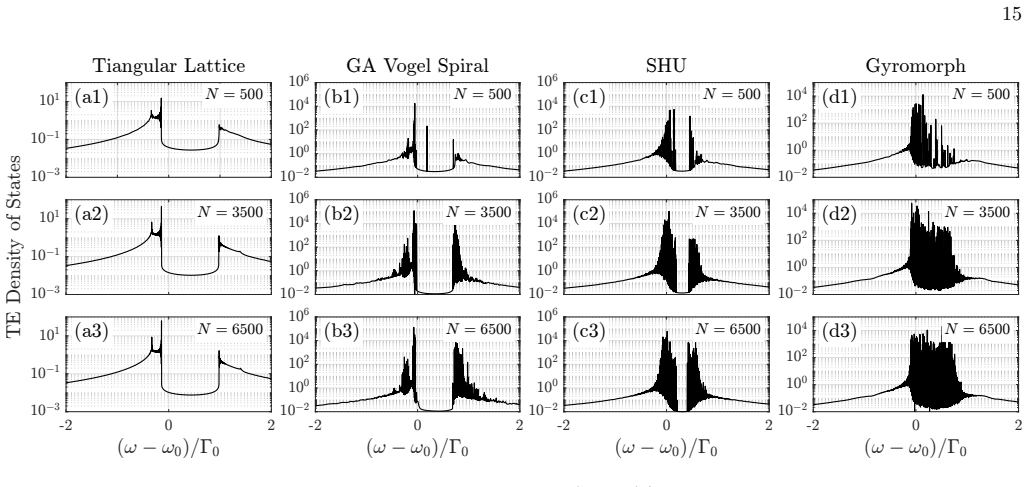
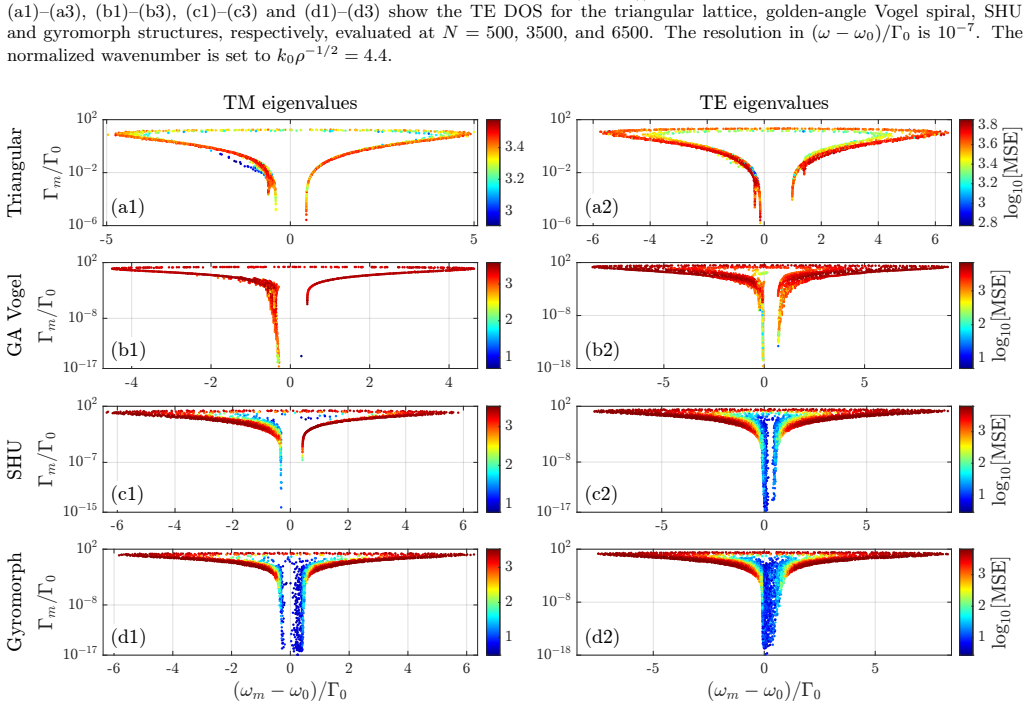
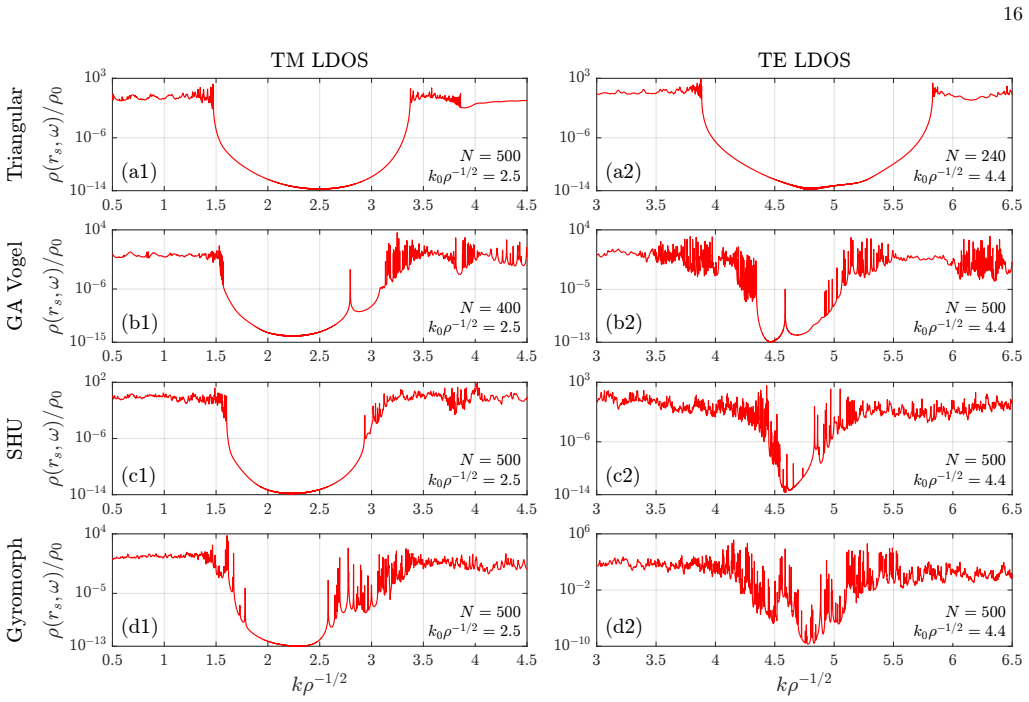
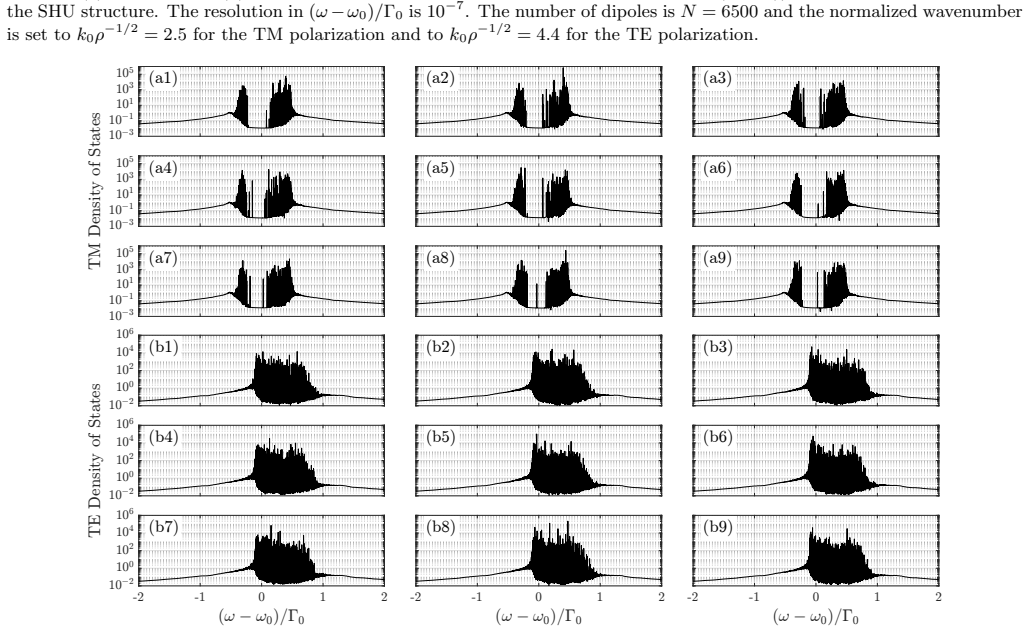
Gyromorphs are actually hyperuniform and, in the large-G limit, belong to Class III hyperuniformity. Consequently they display comparatively degraded physical properties, verified through spectral Green's matrix computations that reveal size-dependent pseudogaps richly populated by localized states in the density of states and Purcell factors, in contrast to the smooth band gaps of highly stealthy Class I hyperuniform media or deterministic lattices; similar degradation appears in transparency, spreadability, and diffusion.
What carries the argument
Structure-factor analysis that assigns gyromorphs to Class III hyperuniformity, combined with the spectral Green's matrix method for density-of-states and Purcell-factor calculations.
If this is right
- Gyromorphs produce size-dependent pseudogaps populated by localized states rather than clean bandgaps.
- Optical transparency, spreadability, and diffusion are reduced compared with Class I stealthy hyperuniform media.
- Physical performance lies below that of deterministic structures such as Vogel spirals and triangular lattices.
Where Pith is reading between the lines
- Hyperuniformity class may serve as a general predictor of performance across disordered optical media.
- Design efforts for isotropic photonic properties in disordered systems may need to target Class I rather than Class III statistics.
Load-bearing premise
The structure factor analysis correctly places gyromorphs in Class III hyperuniformity in the large-G limit and the spectral calculations are free from dominant finite-size artifacts.
What would settle it
Observation of size-independent smooth bandgaps and transparency levels matching those of Class I stealthy hyperuniform media in gyromorphs would falsify the claim of Class III classification and resulting degradation.
Figures
read the original abstract
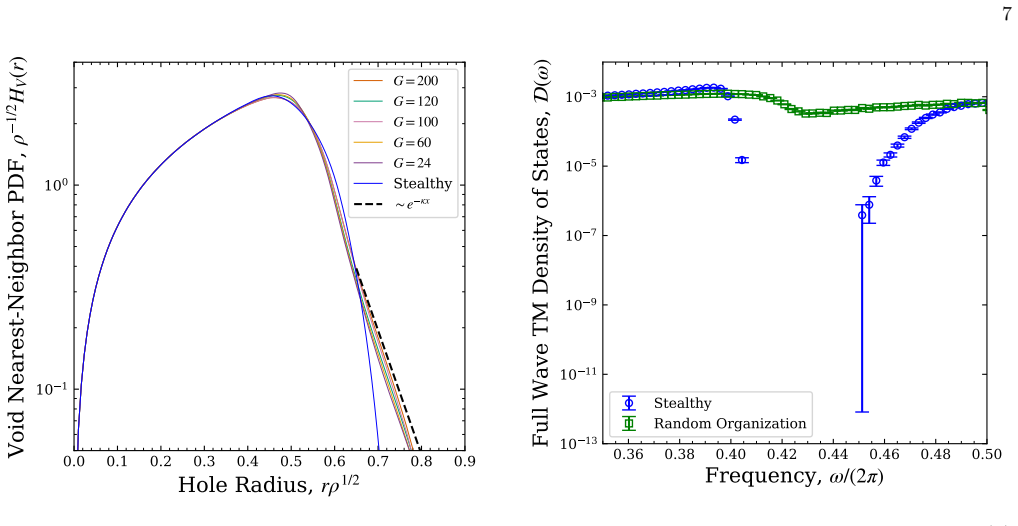
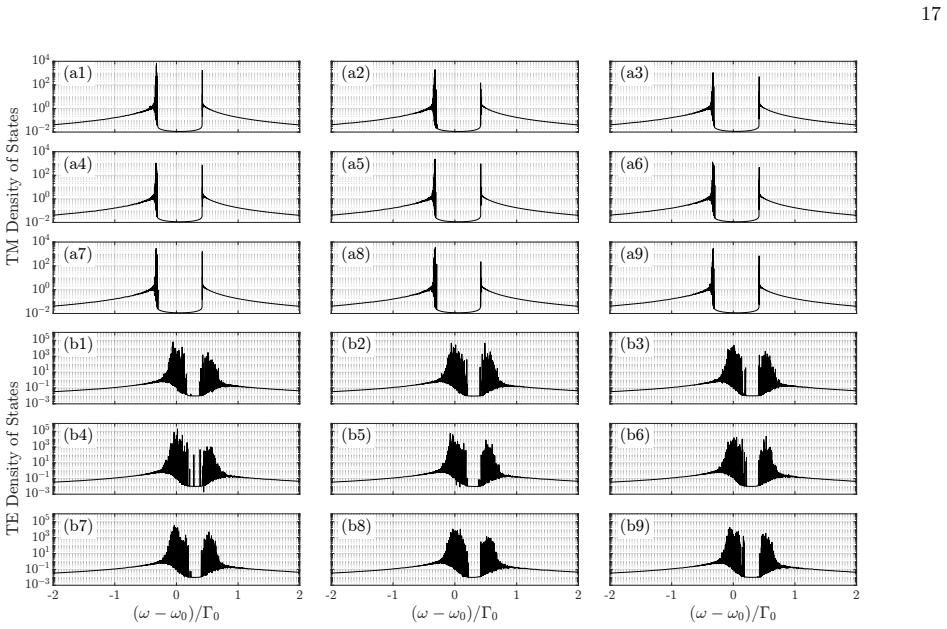
Disordered stealthy hyperuniform materials combine liquid-like statistical isotropy with crystal-like homogeneity, suppressed density fluctuations at large length scales, bounded holes, and an isotropic structure factor that vanishes for a finite range of wavevectors. This combination yields unusual physical properties, including optical transparency, effective delocalization, ultrafast spreadability, optimal conductivity, and complete isotropic photonic bandgaps. Gyromorphs, point patterns whose structure factor includes rings of Bragg-like peaks arranged with discrete $G$-fold rotational symmetry, were recently introduced as counterexamples: disordered media that can somehow achieve the same physical properties, in some cases with higher performance, without stealthiness or hyperuniformity. In this paper, we resolve the puzzle of how gyromorphs fit consistently with the stealthy hyperuniform studies. We first show that gyromorphs are actually hyperuniform and, in the large-$G$ limit where they become nearly isotropic, belong to the weakest form of hyperuniformity, known as Class III. Thus, gyromorphs should have comparatively degraded physical properties compared to stealthy hyperuniform media, which belong to the strongest form of hyperuniformity, known as Class I. We verify this expectation using the rigorous spectral Green's matrix method for the calculation of the density of states (DOS) and Purcell factors in large arrays of electric dipoles. We find that gyromorphs display size-dependent pseudogaps richly populated by localized states rather than smooth band gaps like those found for highly stealthy hyperuniform materials or in deterministic structures such as Vogel spiral and triangular lattices. Furthermore, we predict similar disorder-induced degradation relative to stealthy hyperuniformity with regard to transparency, spreadability and diffusion properties.
Editorial analysis
A structured set of objections, weighed in public.
Referee Report
Summary. The manuscript claims that gyromorphs are hyperuniform and, in the large-G limit where they become nearly isotropic, belong to Class III hyperuniformity (weakest suppression of S(k) as k→0). This places them below Class I stealthy hyperuniform media in the classification scheme, implying degraded physical properties; the expectation is verified via spectral Green's matrix calculations showing size-dependent pseudogaps populated by localized states in DOS and Purcell factors, with similar predictions made for transparency, spreadability, and diffusion.
Significance. If the hyperuniformity classification holds, the work integrates gyromorphs into the established hyperuniform framework, resolving their apparent status as counterexamples to stealthy hyperuniform studies and linking hyperuniformity class directly to optical properties. The use of the rigorous spectral Green's matrix method for verification of DOS/Purcell factors is a methodological strength.
major comments (2)
- [Structure-factor analysis] Structure-factor section: the claim that gyromorphs belong to Class III in the large-G limit rests on structure-factor extrapolation to S(k)→0; robustness of this extrapolation to finite system size N and the precise large-G procedure is not independently verified, which is load-bearing for the central classification and the predicted degradation of physical properties relative to Class I media.
- [Numerical verification] Spectral Green's matrix calculations (DOS and Purcell factor sections): without explicit details on error control, system sizes, and exclusion rules, it is not possible to confirm that the reported size-dependent pseudogaps and localized states are free from dominant finite-size artifacts that could alter the observed contrast with Class I stealthy media.
minor comments (1)
- Clarify notation for the structure factor S(k) and the precise definition of the large-G limit to avoid ambiguity in the classification procedure.
Simulated Author's Rebuttal
We thank the referee for their careful review and positive assessment of the work's significance in integrating gyromorphs into the hyperuniform classification framework. We address the two major comments below and will revise the manuscript to strengthen the supporting evidence.
read point-by-point responses
-
Referee: [Structure-factor analysis] Structure-factor section: the claim that gyromorphs belong to Class III in the large-G limit rests on structure-factor extrapolation to S(k)→0; robustness of this extrapolation to finite system size N and the precise large-G procedure is not independently verified, which is load-bearing for the central classification and the predicted degradation of physical properties relative to Class I media.
Authors: We agree that independent verification of the extrapolation procedure is important for the central claim. The manuscript employs the standard finite-size scaling and extrapolation protocols from the hyperuniformity literature (e.g., fitting S(k) ~ k^α with α>0 for Class III), applied to multiple realizations at increasing N. However, to make the robustness explicit, we will add a dedicated subsection or appendix in the revision that reports (i) results for several system sizes with explicit N values, (ii) the precise large-G construction algorithm, and (iii) sensitivity checks under small variations of the fitting window. This will directly address the load-bearing nature of the classification. revision: yes
-
Referee: [Numerical verification] Spectral Green's matrix calculations (DOS and Purcell factor sections): without explicit details on error control, system sizes, and exclusion rules, it is not possible to confirm that the reported size-dependent pseudogaps and localized states are free from dominant finite-size artifacts that could alter the observed contrast with Class I stealthy media.
Authors: We acknowledge that the current manuscript provides insufficient methodological detail for independent assessment of finite-size effects. The calculations were performed with the spectral Green's matrix method on dipole arrays of varying sizes, using standard exclusion of near-field singularities and convergence checks on the eigenvalue spectrum. In the revision we will expand the relevant sections (and add a methods appendix) to include: explicit system sizes N, error-control procedures (e.g., ensemble averaging and convergence thresholds), and the precise exclusion rules applied. These additions will allow readers to verify that the observed size-dependent pseudogaps and localized states are not dominated by artifacts and that the contrast with Class I media remains robust. revision: yes
Circularity Check
No circularity detected in derivation chain
full rationale
The paper's core steps consist of (1) computing the structure factor to classify gyromorphs as hyperuniform and Class III in the large-G limit using standard definitions from the hyperuniformity literature, and (2) independent numerical verification via the spectral Green's matrix method for DOS/Purcell factors. Neither step reduces to a self-definitional equivalence, a fitted parameter renamed as a prediction, or a load-bearing self-citation whose validity is assumed without external support. The classification and physical-property calculations are presented as separate, falsifiable numerical results rather than tautological restatements of inputs.
Axiom & Free-Parameter Ledger
axioms (1)
- domain assumption Hyperuniformity classes (I, II, III) are defined by the small-k behavior of the structure factor S(k).
Reference graph
Works this paper leans on
-
[1]
In this scheme, we employ a limited-memory Broyden-Fletcher-Goldfarb-Shanno (L-BFGS) optimiza- tion algorithm
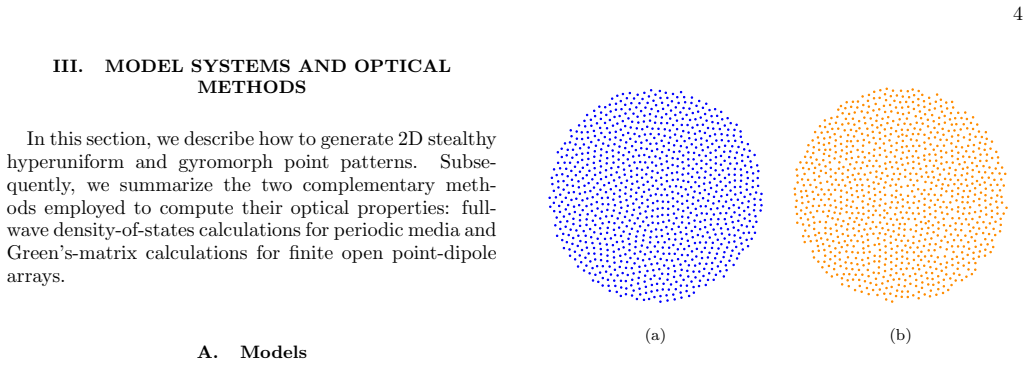
Disordered Stealthy Hyperuniform Systems We generate disordered stealthy hyperuniform point patterns via the collective coordinates optimization tech- nique using Poisson distribution initial conditions [17– 19]. In this scheme, we employ a limited-memory Broyden-Fletcher-Goldfarb-Shanno (L-BFGS) optimiza- tion algorithm. The fidelity of our stealthy hype...
-
[2]
gyromorphic
Gyromorphs We generate gyromorph point patterns using the FReSCo algorithm [34] following the procedure described in Ref. [23]. Gyromorphs are defined by imposing intense Bragg-like peaks on a ring of radiusKin reciprocal space, with the peaks arranged according to a prescribed ro- tational orderG. For the optical calculations, we use the same structural ...
-
[3]
ultradense
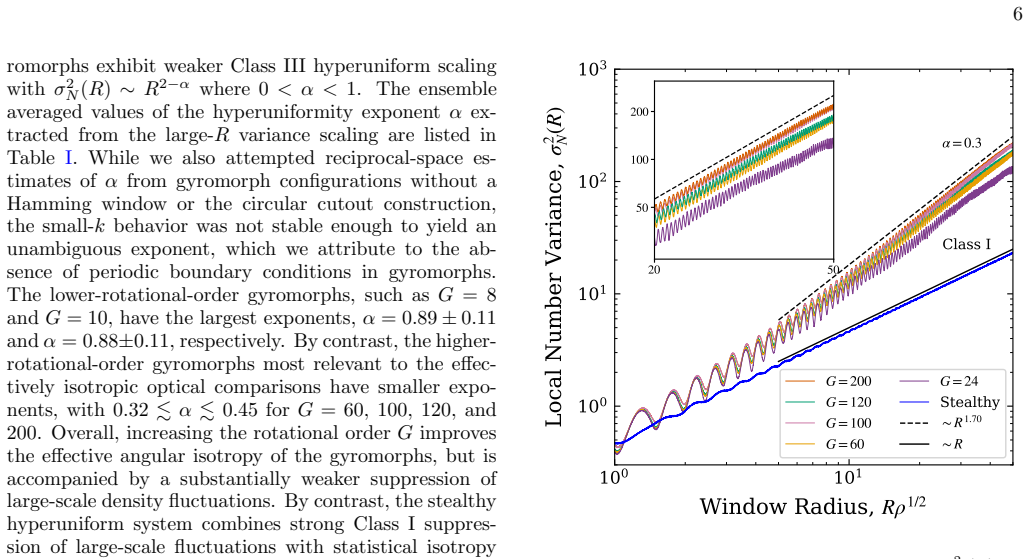
Overall, increasing the rotational orderGimproves the effective angular isotropy of the gyromorphs, but is accompanied by a substantially weaker suppression of large-scale density fluctuations. By contrast, the stealthy hyperuniform system combines strong Class I suppres- sion of large-scale fluctuations with statistical isotropy controlled independently ...
-
[4]
This method allows us to extract the collective scattering modes (quasimodes) and their re- spective lifetimes by solving an eigenvalue problem
Theoretical F ramework To compute the Density of States (DOS) for open sys- tems ofNpoint scatterers, we employ an effective non- Hermitian Hamiltonian approach based on the Green’s matrix formalism. This method allows us to extract the collective scattering modes (quasimodes) and their re- spective lifetimes by solving an eigenvalue problem. The system i...
-
[5]
The system is thus fully described by anN×Nnon-Hermitian matrix ˆGTM
T ransverse Magnetic Polarization For Transverse Magnetic (TM) polarized light, where the electric field is strictly out-of-plane, the wave propa- gation is treated as a 2D scalar problem. The system is thus fully described by anN×Nnon-Hermitian matrix ˆGTM. The off-diagonal elements govern the propagation of scalar waves between scattereriand scattererji...
-
[6]
The system is therefore de- scribed by a larger 2N×2Ndyadic Green’s matrix ˆGTE, which accounts for the coupled in-plane field components (e.g.,xandy)
T ransverse Electric Polarization For Transverse Electric (TE) polarized light, the elec- tric field lies in the plane of the scatterers, necessitating a fully vectorial treatment. The system is therefore de- scribed by a larger 2N×2Ndyadic Green’s matrix ˆGTE, which accounts for the coupled in-plane field components (e.g.,xandy). The interaction between ...
-
[7]
These eigen- values encode both the resonance frequenciesω m and the decay rates Γ m of the system’s quasimodes
Spectral Analysis and DOS Normalization The complex eigenvalues Λm are obtained by diagonal- izing the corresponding Green’s matrix: ˆGψm = Λmψm,(A7) where the total number of modes isM=Nfor TM po- larization andM= 2Nfor TE polarization. These eigen- values encode both the resonance frequenciesω m and the decay rates Γ m of the system’s quasimodes. Follow...
-
[8]
Theoretical F ramework and Scatterer Properties To calculate the Local Density of States (LDOS) at a specific source positionr S within a two-dimensional open array ofNpoint scatterers, we evaluate the inter- action between a source dipoleplocated atr S and the surrounding scattering environment. Within the Foldy- Lax multiple scattering framework, each d...
-
[9]
T ransverse Magnetic Polarization For TM-polarized light, the electric field is treated as a scalar quantity oscillating perpendicular to the 2D plane. The propagation of this scalar field in free space is governed by the physical 2D vacuum Green’s function [37, 44]: GTM 0 (ri,r j, ω) = i 4 H (1) 0 (k0|ri −r j|).(B2) 12 Note that this physical propagator ...
-
[10]
The scalar Green’s function is systemati- cally replaced by the 2×2 dyadic vacuum Green’s tensor GTE 0 (ri,r j, ω)
T ransverse Electric Polarization In the TE polarization case, the electric dipoles oscil- late within the scattering plane, requiring a fully vecto- rial treatment. The scalar Green’s function is systemati- cally replaced by the 2×2 dyadic vacuum Green’s tensor GTE 0 (ri,r j, ω). The spatial coupling between a scatterer atr i and one atr j is given by: G...
-
[11]
complex eigenvalue distributions in Fig
The resolution inkρ −1/2 is 4×10 −5. complex eigenvalue distributions in Fig. 11. The eigen- values directly map the normalized decay rates Γ m/Γ0 (imaginary part) and detuned frequencies (ω m −ω 0)/Γ0 (real part) of the system’s quasimodes. For both TM and TE polarizations, the triangular lattice, golden-angle Vogel spiral, and SHU arrays exhibit well-de...
-
[12]
Torquato and F
S. Torquato and F. H. Stillinger, Phys. Rev. E68, 041113 (2003)
2003
-
[13]
Torquato, Physics Reports745, 1 (2018)
S. Torquato, Physics Reports745, 1 (2018)
2018
-
[14]
Leseur, R
O. Leseur, R. Pierrat, and R. Carminati, Optica3, 763 (2016)
2016
-
[15]
L. S. Froufe-P´ erez, M. Engel, J. J. S´ aenz, and F. Schef- fold, Proc. Natl. Acad. Sci. USA114, 9570 (2017)
2017
-
[16]
Torquato and J
S. Torquato and J. Kim, Phys. Rev. X11, 021002 (2021)
2021
-
[17]
Kim and S
J. Kim and S. Torquato, Optica10, 965 (2023)
2023
-
[18]
Kim and S
J. Kim and S. Torquato, Opt. Mater. Express14, 194 (2024)
2024
-
[19]
Riganti, Y
R. Riganti, Y. Zhu, W. Cai, S. Torquato, and L. Dal Ne- gro, Adv. Opt. Mater.13, 2403304 (2025)
2025
-
[20]
M. A. Klatt, P. J. Steinhardt, and S. Torquato, Opt. Mater. Exp. (2026)
2026
-
[21]
Vanoni, J
C. Vanoni, J. Karcher, M. C. Rechtsman, B. L. Altshuler, P. J. Steinhardt, and S. Torquato, Physical review letters 136, 150404 (2026)
2026
-
[22]
Torquato, Phys
S. Torquato, Phys. Rev. E104, 054102 (2021)
2021
-
[23]
Zhang, F
G. Zhang, F. H. Stillinger, and S. Torquato, J. Chem. Phys145, 244109 (2016)
2016
-
[24]
Torquato and D
S. Torquato and D. Chen, Multifunctional Materials1, 015001 (2018)
2018
-
[25]
Florescu, S
M. Florescu, S. Torquato, and P. J. Steinhardt, Proc. Nat. Acad. Sci.106, 20658 (2009)
2009
-
[26]
Klatt, P
M. Klatt, P. Steinhardt, and S. Torquato, Proceedings of the National Academy of Sciences119, e2213633119 (2022)
2022
-
[27]
Torquato, Phys
S. Torquato, Phys. Rev. E103, 052126 (2021)
2021
-
[28]
O. U. Uche, F. H. Stillinger, and S. Torquato, Phys. Rev. E70, 046122 (2004)
2004
-
[29]
R. D. Batten, F. H. Stillinger, and S. Torquato, J. Appl. Phys.104, 033504 (2008)
2008
-
[30]
Torquato, G
S. Torquato, G. Zhang, and F. H. Stillinger, Phys. Rev. X5, 021020 (2015)
2015
-
[31]
Skolnick and S
M. Skolnick and S. Torquato, Acta Materialia250, 118857 (2023)
2023
-
[32]
Skolnick and S
M. Skolnick and S. Torquato, Acta Materialia290, 120921 (2025)
2025
-
[33]
Vanoni, J
C. Vanoni, J. Kim, P. J. Steinhardt, and S. Torquato, Phys. Rev. E112, 015406 (2025)
2025
-
[34]
Casiulis, A
M. Casiulis, A. Shih, and S. Martiniani, Phys. Rev. Lett. 135, 196101 (2025)
2025
-
[35]
S. G. Johnson and J. D. Joannopoulos, Opt. Express8, 173 (2001)
2001
-
[36]
Laurent, P
C. Laurent, P. M. Chaikin, J. P. Gollub, and D. J. Pine, Nature Phys.4, 420 (2008)
2008
-
[37]
Hexner and D
D. Hexner and D. Levine, Phys. Rev. Lett.114, 110602 (2015)
2015
-
[38]
Ma and S
Z. Ma and S. Torquato, Phys. Rev. E99, 022115 (2019)
2019
-
[39]
Torquato,Random Heterogeneous Materials: Mi- crostructure and Macroscopic Properties(Springer- Verlag, New York, 2002)
S. Torquato,Random Heterogeneous Materials: Mi- crostructure and Macroscopic Properties(Springer- Verlag, New York, 2002)
2002
-
[40]
Torquato, Phys
S. Torquato, Phys. Rev. E82, 056109 (2010)
2010
-
[41]
Kim and S
J. Kim and S. Torquato, Phys. Rev. E99, 052141 (2019)
2019
-
[42]
Zhang, F
G. Zhang, F. H. Stillinger, and S. Torquato, Soft Matter 13, 6197 (2017)
2017
-
[43]
Ghosh and J
S. Ghosh and J. L. Lebowitz, Comm. Math. Phys.363, 97 (2018)
2018
-
[44]
Zhang, F
G. Zhang, F. Stillinger, and S. Torquato, Phys. Rev. E 92, 022119 (2015)
2015
-
[45]
A. Shih, M. Casiulis, and S. Martiniani, Phys. Rev. E 110, 034122 (2024)
2024
-
[46]
S. E. Skipetrov, Physical Review B94, 064202 (2016)
2016
-
[47]
S. E. Skipetrov, The European Physical Journal B93, 70 (2020)
2020
-
[48]
Monsarrat, R
R. Monsarrat, R. Pierrat, A. Tourin, and A. Goetschy, Physical Review Research4, 033246 (2022)
2022
-
[49]
Dal Negro, R
L. Dal Negro, R. Wang, and F. A. Pinheiro, Crystals6, 161 (2016)
2016
-
[50]
Sgrignuoli and L
F. Sgrignuoli and L. Dal Negro, Phys. Rev. B101, 214204 (2020)
2020
-
[51]
Sgrignuoli, S
F. Sgrignuoli, S. Torquato, and L. Dal Negro, Phys. Rev. B105, 064204 (2022)
2022
-
[52]
Sgrignuoli and L
F. Sgrignuoli and L. Dal Negro, Phys. Rev. B103, 224202 (2021)
2021
-
[53]
Sgrignuoli, R
F. Sgrignuoli, R. Wang, F. A. Pinheiro, and L. Dal Negro, Phys. Rev. B99, 104202 (2019)
2019
-
[54]
Dal Negro,Waves in Complex Media(Cambridge Uni- versity Press, Cambridge, UK, 2022)
L. Dal Negro,Waves in Complex Media(Cambridge Uni- versity Press, Cambridge, UK, 2022)
2022
-
[55]
Caz´ e, R
A. Caz´ e, R. Pierrat, and R. Carminati, Physical Review Letters111, 053901 (2013)
2013
-
[56]
X.-F. Li, X. Ni, L. Feng, M.-H. Lu, C. He, and Y.-F. Chen, Physical Review Letters106, 084301 (2011)
2011
-
[57]
Trevino, S
J. Trevino, S. F. Liew, H. Noh, H. Cao, and L. Dal Negro, Optics Express20, 3015 (2012)
2012
-
[58]
Monsarrat, R
R. Monsarrat, R. Pierrat, A. Tourin, and A. Goetschy, Phys. Rev. Res.4, 033246 (2022)
2022
-
[59]
Indeed, even a nonhyperuniform Poisson distribution of points (which possess arbitrarily large holes in the ther- modynamic limit) must necessarily have bounded holes in simulations of 10 5 particles. One can infer that from such finite simulations that Poisson point processes can- not support arbitrarily large holes in the thermodynamic limit due to larg...
-
[60]
Torquato and J
S. Torquato and J. Kim, Soft Matter21, 4898 (2025)
2025
-
[61]
Kim and S
J. Kim and S. Torquato, The Journal of Chemical Physics 163, 024902 (2025)
2025
-
[62]
J. A. Adam,A Mathematical Nature Walk(Princeton University Press, Princeton, NJ, 2011)
2011
-
[63]
M. E. Pollard and G. J. Parker, Optics letters34, 2805 (2009)
2009
-
[64]
S. F. Liew, H. Noh, J. Trevino, L. D. Negro, and H. Cao, Opt. Express19, 23631 (2011)
2011
-
[65]
Trevino, H
J. Trevino, H. Cao, and L. Dal Negro, Nano letters11, 19 2008 (2011)
2008
-
[66]
Dal Negro, N
L. Dal Negro, N. Lawrence, and J. Trevino, Optics ex- press20, 18209 (2012)
2012
-
[67]
S. E. Skipetrov and I. M. Sokolov, Phys. Rev. Lett.112, 023905 (2014)
2014
-
[68]
S. E. Skipetrov and J. H. Page, New Journal of Physics 18, 021001 (2016)
2016
-
[69]
Structural and physical properties of gyromorphs and disordered stealthy hyperuniform media
C. E. M´ aximo, N. Piovella, P. W. Courteille, R. Kaiser, and R. Bachelard, arXiv preprint arXiv:1509.00815 (2015). Supporting Information for “Structural and physical properties of gyromorphs and disordered stealthy hyperuniform media” Murray Skolnick,1 Riccardo Franchi,2 Luca Dal Negro, 2, 3, 4,∗ Paul J. Steinhardt, 5 and Salvatore Torquato6, 5, 1, 7,† ...
Pith/arXiv arXiv 2015
-
[70]
Casiulis, A
M. Casiulis, A. Shih, and S. Martiniani, Phys. Rev. Lett.135, 196101 (2025)
2025
-
[71]
Casiulis, A
M. Casiulis, A. Shih, and S. Martiniani, MAGreeTe,https://github.com/martiniani-lab/MAGreeTe(2024), materials Analysis through Green’s Tensor. 7 20 25 30 35 40 45 50 55 60 k0L/(2 ) 1.0 0.5 0.0 0.5 1.0 1.5 2.0 (a) 20 25 30 35 40 45 50 55 60 k0L/(2 ) 1.0 0.5 0.0 0.5 1.0 1.5 2.0 (b) 20 25 30 35 40 45 50 55 60 k0L/(2 ) 1.0 0.5 0.0 0.5 1.0 1.5 2.0 (c) 20 25 30...
2024
discussion (0)
Sign in with ORCID, Apple, or X to comment. Anyone can read and Pith papers without signing in.