Flow Annealing Posterior Sampling for Function-Space Regression and Inverse Problems
Pith reviewed 2026-06-26 09:55 UTC · model grok-4.3
The pith
FAPS unifies function-space posterior sampling for regression and PDE inverse problems from pretrained flow-matching priors.
A machine-rendered reading of the paper's core claim, the machinery that carries it, and where it could break.
Core claim
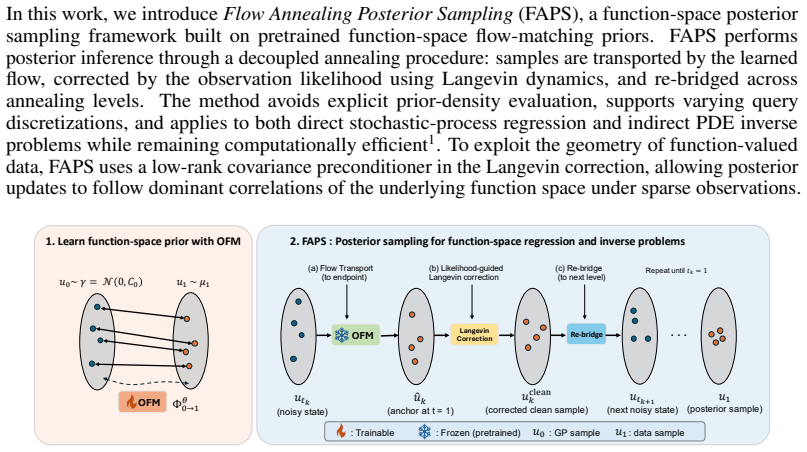
FAPS is the first function-space posterior sampling framework that unifies stochastic-process regression and PDE inverse problems. Built on pretrained function-space flow-matching priors, it enables likelihood-guided posterior inference from sparse and noisy observations, supports variable query discretizations, and avoids explicit prior-density evaluation. Its Langevin correction uses a low-rank covariance preconditioner to exploit dominant function-space correlations across discretizations.
What carries the argument
Flow Annealing Posterior Sampling (FAPS), which anneals from a flow-matching prior to the target posterior via preconditioned Langevin dynamics without evaluating prior densities.
If this is right
- Posterior samples remain coherent when the observation grid changes after training.
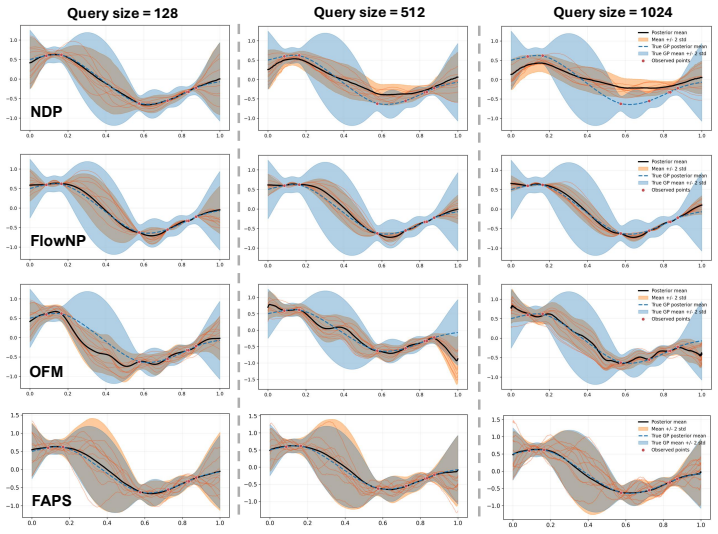
- Uncertainty estimates are accurate for both Gaussian and non-Gaussian stochastic-process regression tasks.
- Test-time sampling requires fewer steps than diffusion-based posterior samplers on PDE inverse problems.
- The low-rank preconditioner exploits function-space correlations that are stable across discretizations.
- No explicit prior density is needed, removing a common computational bottleneck.
Where Pith is reading between the lines
- If flow-matching priors become widely available, FAPS-style annealing could become a standard tool for scientific inverse problems that require function-valued outputs.
- The variable-discretization support suggests the method could be paired with adaptive mesh refinement during inference.
- Low-rank covariance preconditioning may generalize to other function-space sampling tasks where dominant modes of variation are low-dimensional.
- The unification of regression and PDE settings implies a single codebase could handle both data-driven and physics-constrained function inference.
Load-bearing premise
The method assumes pretrained function-space flow-matching priors already exist and are flexible enough to serve as starting points for the targeted regression and inverse-problem settings.
What would settle it
Run FAPS on a held-out benchmark with known ground-truth posterior and check whether the generated samples produce uncertainty bands that systematically fail to cover the true function values at the reported credible levels.
Figures
read the original abstract
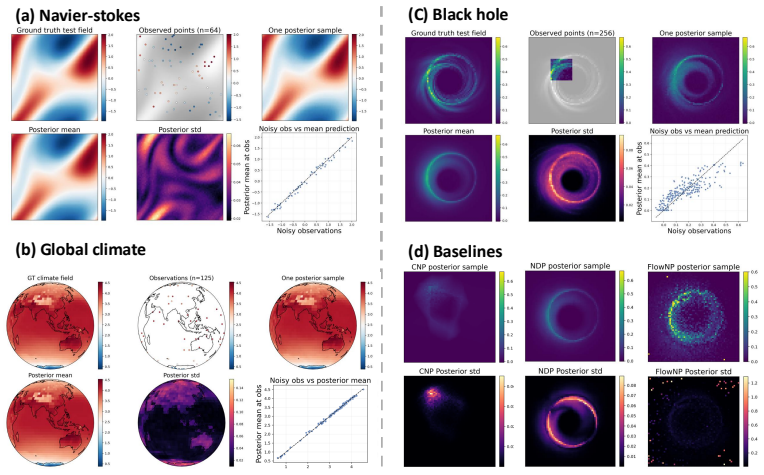
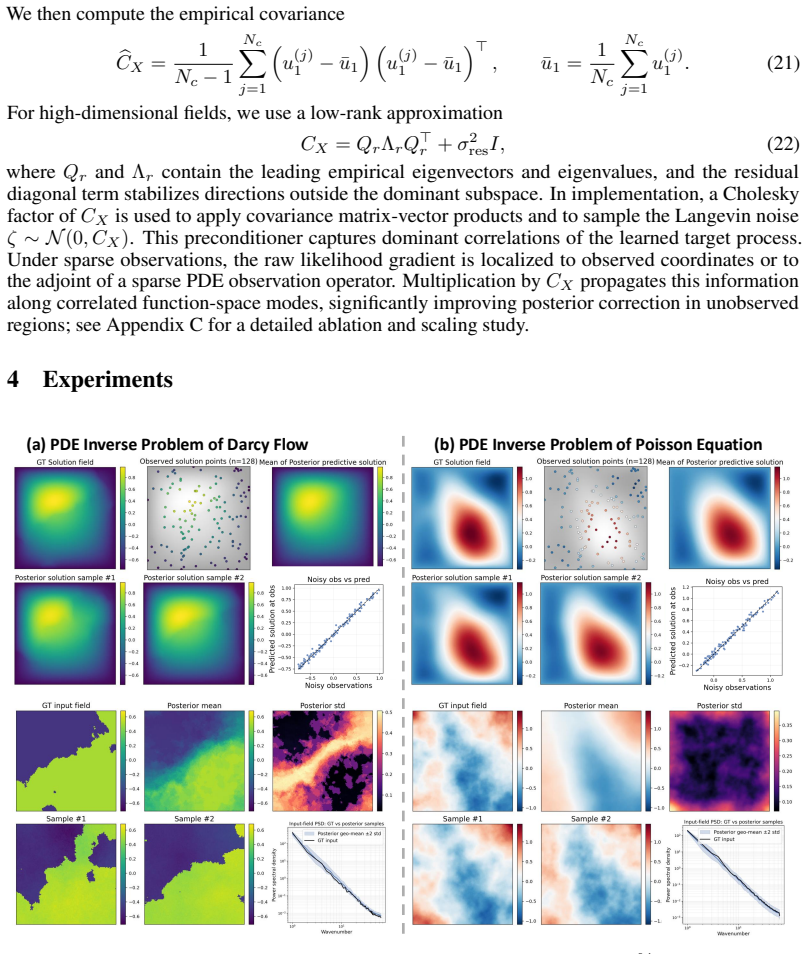
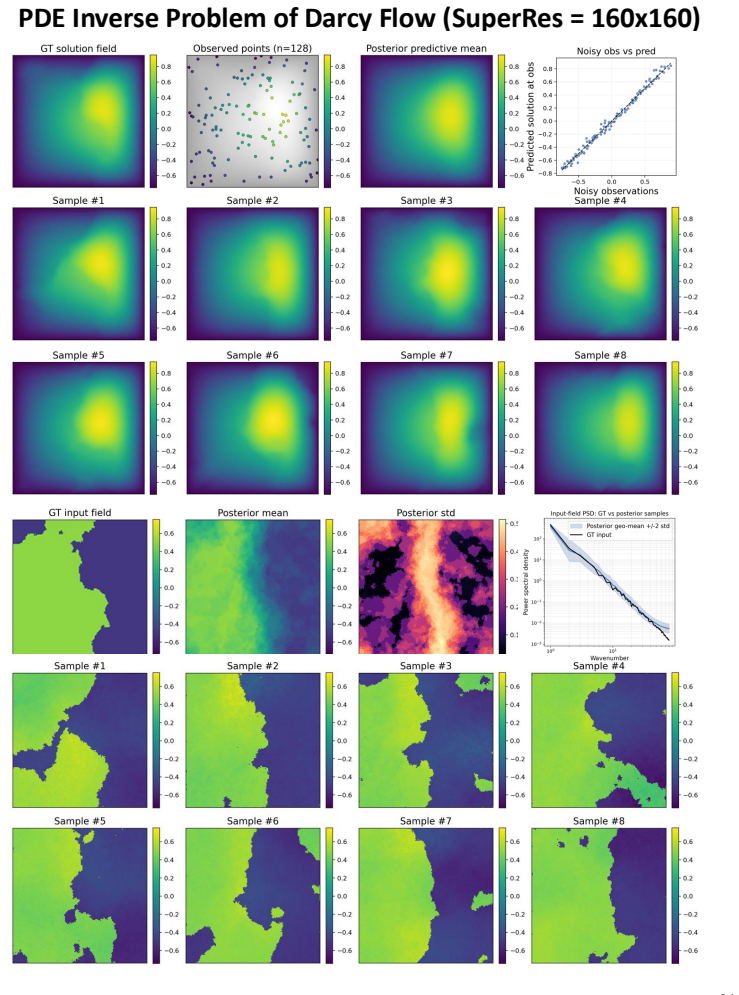
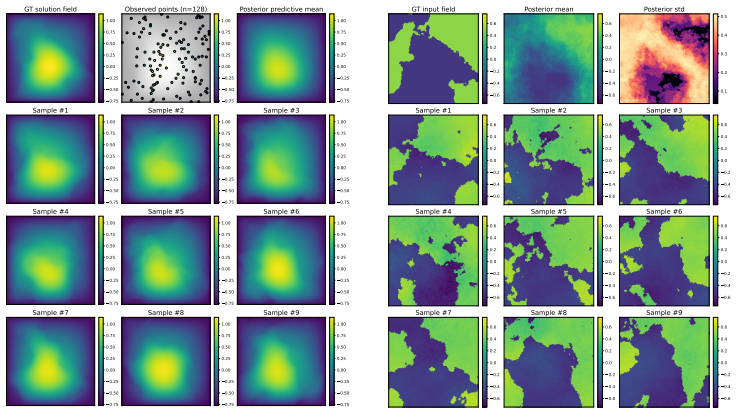
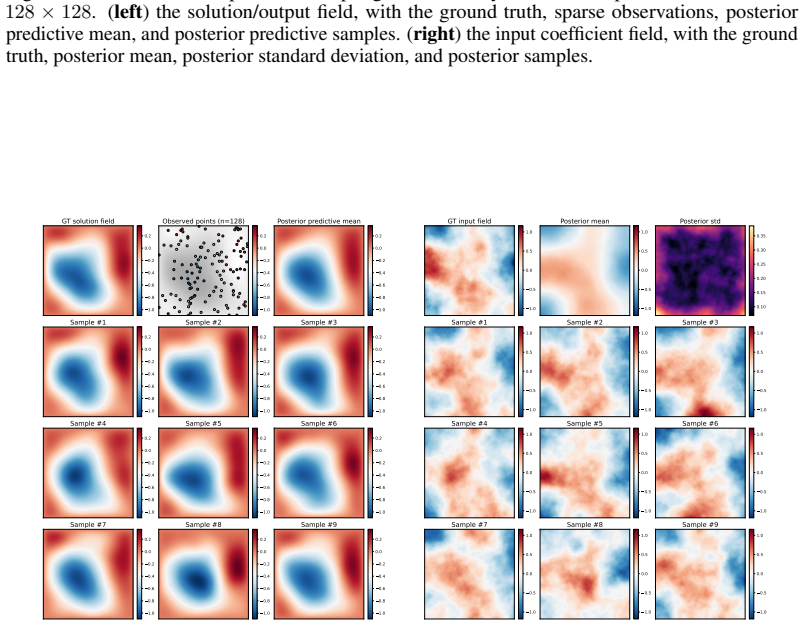
Principled regression for stochastic processes is a long-standing challenge with deep connections to scientific inverse problems. We introduce Flow Annealing Posterior Sampling (FAPS), to our knowledge the first function-space posterior sampling framework that unifies stochastic-process regression and PDE inverse problems. Built on pretrained function-space flow-matching priors, FAPS enables likelihood-guided posterior inference from sparse and noisy observations, supports variable query discretizations, and avoids explicit prior-density evaluation. Its Langevin correction uses a low-rank covariance preconditioner to exploit dominant function-space correlations across discretizations. Across Gaussian and non-Gaussian stochastic-process regression benchmarks and diverse PDE inverse problems, FAPS produces coherent posterior samples with accurate uncertainty quantification, significantly outperforming existing functional regression baselines and achieving competitive or better PDE noisy inverse performance than diffusion-based posterior samplers while reducing test-time sampling cost.
Editorial analysis
A structured set of objections, weighed in public.
Referee Report
Summary. The paper introduces Flow Annealing Posterior Sampling (FAPS), a function-space posterior sampling framework that unifies stochastic-process regression and PDE inverse problems. Built on pretrained function-space flow-matching priors, it performs likelihood-guided inference from sparse noisy observations via a low-rank-preconditioned Langevin correction, supports variable discretizations, and avoids explicit prior-density evaluation. The annealing schedule is derived from the flow-matching objective. Experiments on Gaussian/non-Gaussian process regression benchmarks and PDE inverse problems report coherent samples, accurate uncertainty quantification, outperformance over functional regression baselines, and competitive or better performance than diffusion-based samplers at reduced test-time cost, with ablations on preconditioner rank.
Significance. If the empirical claims hold, the work provides a new, flexible approach to principled regression for stochastic processes with direct ties to scientific inverse problems. Strengths include the construction that avoids explicit density evaluation, the derivation of the annealing schedule directly from the flow-matching objective, the exploitation of low-rank covariance structure across discretizations, and the inclusion of quantitative ablations on preconditioner rank that test the design choices.
minor comments (2)
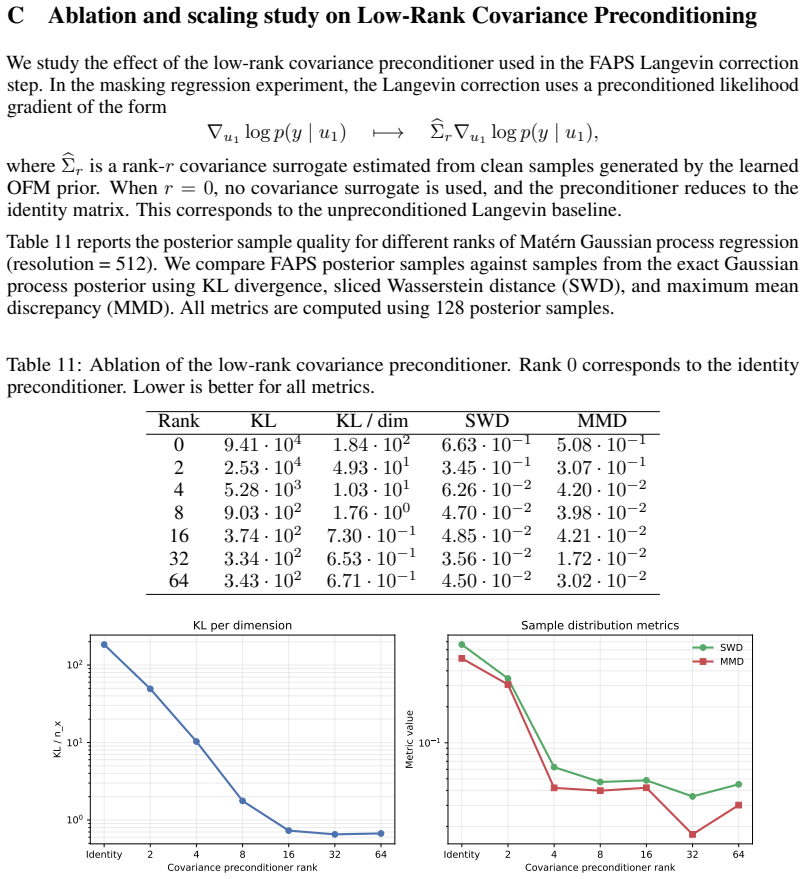
- [§4] §4 (Experiments): the reported quantitative improvements and ablation results on preconditioner rank would benefit from explicit numerical tables in the main text (rather than only supplementary material) to allow direct comparison of effect sizes.
- [§3.2] §3.2 (Preconditioner): while the low-rank exploitation of the covariance operator is described, an additional figure illustrating the dominant eigenstructure across different discretizations would improve clarity for readers unfamiliar with the operator setting.
Simulated Author's Rebuttal
We thank the referee for their positive summary of our work on Flow Annealing Posterior Sampling (FAPS) and for recommending minor revision. We appreciate the recognition of the method's unification of stochastic-process regression and PDE inverse problems, the avoidance of explicit prior-density evaluation, and the empirical results. Since no specific major comments were raised, we have no points requiring rebuttal at this stage and will proceed with any minor editorial adjustments as needed.
Circularity Check
No significant circularity
full rationale
The central derivation relies on external pretrained function-space flow-matching priors and derives the annealing schedule and low-rank preconditioner from the standard flow-matching objective and covariance structure, without reducing any performance claim or uniqueness result to quantities fitted inside this paper. Experiments on regression and PDE tasks provide independent empirical validation rather than self-referential fits. No self-citation load-bearing steps or self-definitional reductions are present in the provided derivation chain.
Axiom & Free-Parameter Ledger
Reference graph
Works this paper leans on
-
[1]
MIT press Cambridge, MA, 2006
Christopher KI Williams and Carl Edward Rasmussen.Gaussian processes for machine learning, volume 2. MIT press Cambridge, MA, 2006. Issue: 3
2006
-
[2]
Universal Func- tional Regression with Neural Operator Flows.Transactions on Machine Learning Research,
Yaozhong Shi, Angela F Gao, Zachary E Ross, and Kamyar Azizzadenesheli. Universal Func- tional Regression with Neural Operator Flows.Transactions on Machine Learning Research,
-
[3]
A. M. Stuart. Inverse problems: A Bayesian perspective.Acta Numerica, 19:451–559, May
-
[4]
Inverse problems: A Bayesian perspective
ISSN 1474-0508, 0962-4929. doi: 10.1017/S0962492910000061
-
[5]
Flow Matching Neural Processes.Advances in Neural Information Processing Systems, 38:116498–116521, 2026
Hussen Abu Hamad and Dan Rosenbaum. Flow Matching Neural Processes.Advances in Neural Information Processing Systems, 38:116498–116521, 2026
2026
-
[6]
Fourier Neural Operator for Parametric Partial Differential Equations
Zongyi Li, Nikola Borislavov Kovachki, Kamyar Azizzadenesheli, Kaushik Bhattacharya, Andrew Stuart, and Anima Anandkumar. Fourier Neural Operator for Parametric Partial Differential Equations. International Conference on Learning Representations, 2021
2021
-
[7]
Stochastic process learning via operator flow matching.Advances in Neural Information Processing Systems, 38:38186–38226, 2026
Yaozhong Shi, Zachary Ross, Domniki Asimaki, and Kamyar Azizzadenesheli. Stochastic process learning via operator flow matching.Advances in Neural Information Processing Systems, 38:38186–38226, 2026
2026
-
[8]
Neural operator: Learning maps between function spaces with applications to pdes.Journal of Machine Learning Research, 24(89):1–97, 2023
Nikola Kovachki, Zongyi Li, Burigede Liu, Kamyar Azizzadenesheli, Kaushik Bhattacharya, Andrew Stuart, and Anima Anandkumar. Neural operator: Learning maps between function spaces with applications to pdes.Journal of Machine Learning Research, 24(89):1–97, 2023. ISSN 1533-7928
2023
-
[9]
Flow Matching for Generative Modeling
Yaron Lipman, Ricky TQ Chen, Heli Ben-Hamu, Maximilian Nickel, and Matthew Le. Flow Matching for Generative Modeling. The Eleventh International Conference on Learning Representations, 2023
2023
-
[10]
Stochastic interpolants: A unifying framework for flows and diffusions.Journal of Machine Learning Research, 26(209): 1–80, 2025
Michael Albergo, Nicholas M Boffi, and Eric Vanden-Eijnden. Stochastic interpolants: A unifying framework for flows and diffusions.Journal of Machine Learning Research, 26(209): 1–80, 2025. ISSN 1533-7928
2025
-
[11]
Flow Straight and Fast: Learning to Generate and Transfer Data with Rectified Flow, September 2022
Xingchao Liu, Chengyue Gong, and Qiang Liu. Flow Straight and Fast: Learning to Generate and Transfer Data with Rectified Flow, September 2022. URL http://arxiv.org/abs/ 2209.03003. arXiv:2209.03003 [cs.LG]
Pith/arXiv arXiv 2022
-
[12]
Improving and generalizing flow-based genera- tive models with minibatch optimal transport.Transactions on Machine Learning Research,
Alexander Tong, Kilian FATRAS, Nikolay Malkin, Guillaume Huguet, Yanlei Zhang, Jarrid Rector-Brooks, Guy Wolf, and Yoshua Bengio. Improving and generalizing flow-based genera- tive models with minibatch optimal transport.Transactions on Machine Learning Research,
-
[13]
Functional Flow Matching
Gavin Kerrigan, Giosue Migliorini, and Padhraic Smyth. Functional Flow Matching. pages 3934–3942. PMLR, 2024. ISBN 2640-3498
2024
-
[14]
Mesh- Informed Neural Operator: A Transformer Generative Approach.Transactions on Machine Learning Research, 2025
Yaozhong Shi, Zachary E Ross, Domniki Asimaki, and Kamyar Azizzadenesheli. Mesh- Informed Neural Operator: A Transformer Generative Approach.Transactions on Machine Learning Research, 2025. ISSN 2835-8856
2025
-
[15]
Conditional neural processes
Marta Garnelo, Dan Rosenbaum, Christopher Maddison, Tiago Ramalho, David Saxton, Murray Shanahan, Yee Whye Teh, Danilo Rezende, and SM Ali Eslami. Conditional neural processes. pages 1704–1713. International conference on machine learning, 2018. ISBN 2640-3498
2018
-
[16]
Attentive Neural Processes, July 2019
Hyunjik Kim, Andriy Mnih, Jonathan Schwarz, Marta Garnelo, Ali Eslami, Dan Rosenbaum, Oriol Vinyals, and Yee Whye Teh. Attentive Neural Processes, July 2019. URL http: //arxiv.org/abs/1901.05761. arXiv:1901.05761 [cs]
Pith/arXiv arXiv 2019
-
[17]
Convolutional conditional neural processes.arXiv preprint arXiv:1910.13556, 2019
Jonathan Gordon, Wessel P Bruinsma, Andrew YK Foong, James Requeima, Yann Dubois, and Richard E Turner. Convolutional conditional neural processes.arXiv preprint arXiv:1910.13556, 2019. 11
arXiv 1910
-
[18]
Neural diffusion processes
Vincent Dutordoir, Alan Saul, Zoubin Ghahramani, and Fergus Simpson. Neural diffusion processes. pages 8990–9012. International Conference on Machine Learning, 2023. ISBN 2640-3498
2023
-
[19]
Improving diffusion inverse problem solving with decoupled noise annealing
Bingliang Zhang, Wenda Chu, Julius Berner, Chenlin Meng, Anima Anandkumar, and Yang Song. Improving diffusion inverse problem solving with decoupled noise annealing. pages 20895–20905. Proceedings of the Computer Vision and Pattern Recognition Conference, 2025
2025
-
[20]
Guided diffusion sampling on function spaces with applications to pdes.Advances in Neural Information Processing Systems, 38:127057–127094, 2026
Jiachen Yao, Abbas Mammadov, Julius Berner, Gavin Kerrigan, Jong Chul Ye, Kamyar Aziz- zadenesheli, and Animashree Anandkumar. Guided diffusion sampling on function spaces with applications to pdes.Advances in Neural Information Processing Systems, 38:127057–127094, 2026
2026
-
[21]
Thomas Y . L. Lin, Jiachen Yao, Lufang Chiang, Julius Berner, and Anima Anandkumar. Decoupled Diffusion Sampling for Inverse Problems on Function Spaces, January 2026. URL https://arxiv.org/abs/2601.23280v3
arXiv 2026
-
[22]
Blade: A Derivative-free Bayesian Inversion Method using Diffusion Priors, January 2026
Hongkai Zheng, Austin Wang, Zihui Wu, Zhengyu Huang, Ricardo Baptista, and Yisong Yue. Blade: A Derivative-free Bayesian Inversion Method using Diffusion Priors, January 2026. URLhttp://arxiv.org/abs/2510.10968. arXiv:2510.10968 [cs]
Pith/arXiv arXiv 2026
-
[23]
Inversebench: Benchmarking plug-and-play diffusion priors for inverse problems in physical sciences
Hongkai Zheng, Wenda Chu, Bingliang Zhang, Zihui Wu, Austin Wang, Berthy Feng, Caifeng Zou, Yu Sun, Nikola Kovachki, and Zachary Ross. Inversebench: Benchmarking plug-and-play diffusion priors for inverse problems in physical sciences. volume 2025, pages 90912–90940. International Conference on Learning Representations, 2025
2025
-
[24]
Generative Models as Distributions of Functions
Emilien Dupont, Yee Whye Teh, and Arnaud Doucet. Generative Models as Distributions of Functions. pages 2989–3015. International Conference on Artificial Intelligence and Statistics,
-
[25]
DiffusionPDE: Generative PDE-solving under partial observation.Advances in Neural Information Processing Systems, 37:130291–130323, 2024
Jiahe Huang, Guandao Yang, Zichen Wang, and Jeong Joon Park. DiffusionPDE: Generative PDE-solving under partial observation.Advances in Neural Information Processing Systems, 37:130291–130323, 2024
2024
-
[26]
Strictly proper scoring rules, prediction, and estimation
Tilmann Gneiting and Adrian E Raftery. Strictly proper scoring rules, prediction, and estimation. Journal of the American statistical Association, 102(477):359–378, 2007. ISSN 0162-1459
2007
-
[27]
Why should ensemble spread match the RMSE of the ensemble mean?Journal of Hydrometeorology, 15(4):1708– 1713, 2014
Vincent Fortin, Mabrouk Abaza, Francois Anctil, and Raphael Turcotte. Why should ensemble spread match the RMSE of the ensemble mean?Journal of Hydrometeorology, 15(4):1708– 1713, 2014. ISSN 1525-755X
2014
-
[28]
Image quality assessment: from error visibility to structural similarity.IEEE transactions on image processing, 13(4): 600–612, 2004
Zhou Wang, Alan C Bovik, Hamid R Sheikh, and Eero P Simoncelli. Image quality assessment: from error visibility to structural similarity.IEEE transactions on image processing, 13(4): 600–612, 2004. ISSN 1057-7149
2004
-
[29]
prior sampling steps
Tongda Xu, Xiyan Cai, Xinjie Zhang, Xingtong Ge, Dailan He, Ming Sun, Jingjing Liu, Ya-Qin Zhang, Jian Li, and Yan Wang. Rethinking Diffusion Posterior Sampling: From Conditional Score Estimator to Maximizing a Posterior. International Conference on Learning Representations, 2025. 12 A Proof and Algorithm for FAPS A.1 Proof of Proposition 1 For completene...
2025
discussion (0)
Sign in with ORCID, Apple, or X to comment. Anyone can read and Pith papers without signing in.