Perturbative Renormalization and Universality Diagram for Long-Range Quantum Criticality
Pith reviewed 2026-06-26 09:56 UTC · model grok-4.3
The pith
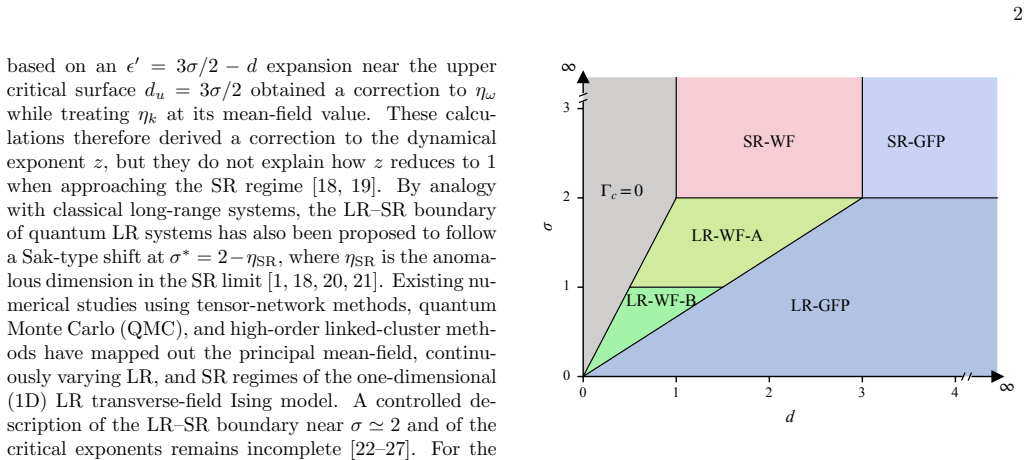
A two-loop renormalization-group expansion around the long-range to short-range boundary produces explicit expressions for the critical exponents of long-range quantum O(n) models.
A machine-rendered reading of the paper's core claim, the machinery that carries it, and where it could break.
Core claim
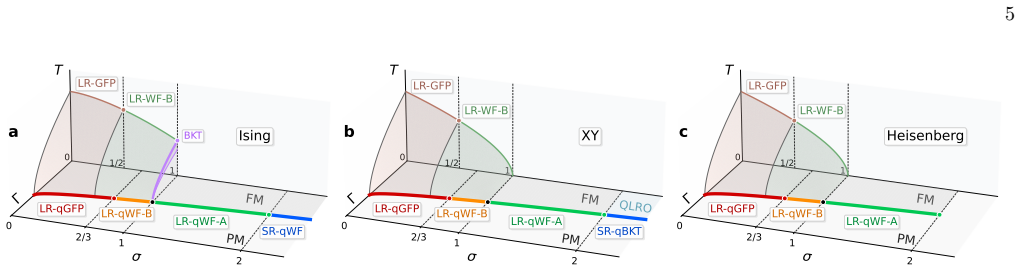
By parametrizing the renormalization-group flow with d = 3 − ε and σ = 2 − δ, the interacting long-range regime 2d/3 < σ < 2 becomes perturbatively controlled, allowing a two-loop calculation that furnishes explicit expressions for the correlation-length exponent ν and the anomalous dimensions η_ω and η_k as functions of ε, δ, and n. These expressions reduce to long-range Gaussian values at σ = 2d/3 and to short-range quantum Wilson-Fisher values as σ → 2, establishing σ_* = 2 as the long-range to short-range boundary inside the controlled 3−ε expansion. The renormalization-group results are combined with scaling boundaries and classical long-range analogies to construct a (d, σ) universalit
What carries the argument
The two-loop perturbative renormalization-group expansion in the (ε, δ) plane around the long-range to short-range boundary.
If this is right
- The explicit formulas for ν, η_ω, and η_k supply quantitative predictions that can be tested against simulations or experiments inside the long-range window.
- The (d, σ) universality diagram organizes the phase structure of long-range quantum spin chains as an organizing framework.
- The boundary identification σ_* = 2 holds inside the controlled 3−ε expansion and separates long-range from short-range quantum criticality.
- The expressions recover the long-range Gaussian and short-range Wilson-Fisher limits, confirming internal consistency of the expansion.
Where Pith is reading between the lines
- Higher-loop terms could be computed to test whether accuracy persists deeper into the long-range window.
- The diagram may help interpret data from quantum simulators whose interaction range can be tuned across the σ = 2 boundary.
- Analogous boundary expansions might control crossover regimes in other long-range quantum field theories.
- The classical long-range analogies used in the diagram suggest possible mappings that could be explored for antiferromagnetic cases.
Load-bearing premise
The two-loop truncation remains quantitatively accurate throughout the interacting long-range window without higher-order corrections or non-perturbative effects becoming dominant.
What would settle it
A numerical simulation or experiment that extracts the correlation-length exponent ν for a concrete choice of d, σ, and n inside the window 2d/3 < σ < 2 and finds a value inconsistent with the two-loop formula beyond expected truncation error would falsify the central quantitative claim.
Figures

read the original abstract
Experimental progress in quantum simulators highlights the role of long-range (LR) interactions in reshaping quantum criticality and stabilizing exotic phases beyond the short-range (SR) paradigm. We study ferromagnetic long-range quantum $O(n)$ models with interactions decaying as $1/r^{d+\sigma}$ and develop a perturbative renormalization-group expansion around the LR--SR boundary by setting $d=3-\epsilon$ and $\sigma=2-\delta$. In this parametrization, the full interacting LR window $2d/3<\sigma<2$ becomes $0<\delta<2\epsilon/3$, and is therefore perturbatively controlled. A two-loop calculation yields explicit expressions, in terms of $\epsilon$, $\delta$, and $n$, for the correlation-length exponent $\nu$ and for the frequency and momentum anomalous dimensions $\eta_\omega$ and $\eta_k$. The resulting exponents reduce to long-range Gaussian scaling at $\sigma=2d/3$ and to SR quantum Wilson-Fisher scaling in the $\sigma \to 2$ limit, thereby identifying $\sigma_*=2$ as the LR--SR boundary within the controlled $3-\epsilon$ expansion. Combining the RG results with scaling boundaries and classical LR analogies, we propose a $(d,\sigma)$ universality diagram for ferromagnetic long-range quantum $O(n)$ criticality and use it as an organizing framework for the phase diagram of long-range quantum spin chains.
Editorial analysis
A structured set of objections, weighed in public.
Referee Report
Summary. The manuscript develops a perturbative RG expansion for long-range quantum O(n) models by parametrizing d=3-ε and σ=2-δ around the LR-SR boundary. This maps the interacting LR window 2d/3 < σ < 2 onto the perturbatively controlled region 0 < δ < 2ε/3. A two-loop calculation is reported to produce explicit expressions (in ε, δ, n) for the correlation-length exponent ν and the anomalous dimensions η_ω and η_k. These expressions are stated to recover long-range Gaussian scaling at δ=2ε/3 and short-range quantum Wilson-Fisher scaling at δ=0, thereby identifying σ_*=2 as the LR-SR boundary. The RG results are combined with scaling arguments and classical LR analogies to propose a (d,σ) universality diagram for ferromagnetic long-range quantum O(n) criticality.
Significance. If the two-loop expressions are correct, the work supplies a controlled perturbative window for computing exponents in the long-range quantum regime and furnishes an organizing framework for the phase diagram of long-range quantum spin chains. The explicit dependence on ε, δ, and n, together with the demonstrated reduction to independently known limits at the boundaries, constitutes a concrete, falsifiable output that can be tested against quantum-simulator data.
major comments (1)
- The central claim that the two-loop truncation remains quantitatively reliable throughout the entire window 0 < δ < 2ε/3 rests on the assumption that O(ε², δ², εδ) terms dominate and that no non-perturbative effects intervene. Analogous ε-expansions routinely receive 10-30 % corrections at three loops even inside the nominal perturbative regime; the same risk applies here near δ=2ε/3 or for small n. A concrete test (e.g., three-loop estimate or comparison with known limits at higher order) is needed to secure the quantitative validity of the proposed universality diagram.
minor comments (2)
- All Feynman diagrams, symmetry factors, and regularization prescriptions used in the two-loop calculation should be displayed explicitly (with equation numbers) so that the reported expressions for ν, η_ω, and η_k can be reproduced.
- The manuscript should state the numerical values of the exponents at representative points inside the window (e.g., ε=0.1, δ=0.05, n=3) to allow immediate comparison with future numerical or experimental work.
Simulated Author's Rebuttal
We thank the referee for the careful reading and for highlighting both the potential utility and the limitations of our two-loop analysis. We address the major comment below.
read point-by-point responses
-
Referee: The central claim that the two-loop truncation remains quantitatively reliable throughout the entire window 0 < δ < 2ε/3 rests on the assumption that O(ε², δ², εδ) terms dominate and that no non-perturbative effects intervene. Analogous ε-expansions routinely receive 10-30 % corrections at three loops even inside the nominal perturbative regime; the same risk applies here near δ=2ε/3 or for small n. A concrete test (e.g., three-loop estimate or comparison with known limits at higher order) is needed to secure the quantitative validity of the proposed universality diagram.
Authors: We agree that two-loop results are subject to the usual higher-order corrections familiar from ε-expansions and that quantitative reliability cannot be guaranteed throughout the window without further checks. The manuscript establishes a controlled perturbative regime and shows that the expressions recover the expected Gaussian and Wilson-Fisher limits at the boundaries; these limits serve as partial consistency tests. A three-loop computation lies outside the scope of the present work. In the revised version we have added an explicit paragraph in Sec. V cautioning that the universality diagram should be viewed as qualitative away from the boundaries and for small n, and that higher-order or non-perturbative effects may modify the precise location of crossover lines. revision: partial
- Provision of a three-loop estimate or direct higher-order comparison to quantitatively validate the two-loop truncation throughout the window.
Circularity Check
No circularity: standard two-loop perturbative RG derivation from first principles
full rationale
The paper performs an explicit two-loop renormalization-group calculation in the controlled ε-δ expansion around the LR-SR boundary, deriving closed-form expressions for ν, η_ω and η_k directly from the beta functions and anomalous-dimension integrals. These expressions are shown to recover the independently known long-range Gaussian and short-range Wilson-Fisher limits at the boundaries δ=2ε/3 and δ=0; such boundary consistency is a verification, not a definitional input. No parameters are fitted to data, no self-citations supply load-bearing uniqueness theorems or ansätze, and the derivation chain remains internal to the perturbative expansion without reduction to its own outputs. The universality diagram is constructed by combining these RG results with scaling arguments and classical analogies, none of which collapse by construction.
Axiom & Free-Parameter Ledger
axioms (1)
- domain assumption The long-range interacting window 2d/3 < σ < 2 can be accessed by a perturbative expansion in ε and δ around the LR-SR boundary.
Reference graph
Works this paper leans on
-
[1]
The LR–SR boundary atσ= 2 is fixed by the competition between the LR and SR kinetic terms and is supported by the 3−ϵRG analysis
Combining the two sides givesd ℓ = min(σ/2,1), be- low which no finite-field quantum phase transition is ex- pected, andd u = min(3σ/2,3), above which the quartic interaction becomes irrelevant and the transition is gov- erned by the corresponding Gaussian fixed point. The LR–SR boundary atσ= 2 is fixed by the competition between the LR and SR kinetic ter...
-
[2]
Defenu, T
N. Defenu, T. Donner, T. Macr` ı, G. Pagano, S. Ruffo, and A. Trombettoni, Rev. Mod. Phys.95, 035002 (2023)
2023
-
[3]
Hauke and L
P. Hauke and L. Tagliacozzo, Phys. Rev. Lett.111, 207202 (2013)
2013
-
[4]
Schachenmayer, B
J. Schachenmayer, B. P. Lanyon, C. F. Roos, and A. J. Daley, Phys. Rev. X3, 031015 (2013)
2013
-
[5]
Eisert, M
J. Eisert, M. van den Worm, S. R. Manmana, and M. Kastner, Phys. Rev. Lett.111, 260401 (2013)
2013
-
[7]
Jurcevic, B
P. Jurcevic, B. P. Lanyon, P. Hauke, C. Hempel, P. Zoller, R. Blatt, and C. F. Roos, Nature511, 202 (2014)
2014
-
[8]
Vodola, L
D. Vodola, L. Lepori, E. Ercolessi, A. V. Gorshkov, and G. Pupillo, Phys. Rev. Lett.113, 156402 (2014)
2014
-
[9]
Lepori, D
L. Lepori, D. Vodola, G. Pupillo, G. Gori, and A. Trom- bettoni, Ann. Phys. (N.Y.)374, 35 (2016)
2016
-
[10]
Z. Gong, T. Guaita, and J. I. Cirac, Phys. Rev. Lett. 130, 070401 (2023)
2023
-
[11]
Lepori and L
L. Lepori and L. Dell’Anna, New J. Phys.19, 103030 (2017)
2017
-
[12]
Lahaye, C
T. Lahaye, C. Menotti, L. Santos, M. Lewenstein, and T. Pfau, Rep. Prog. Phys.72, 126401 (2009)
2009
-
[13]
J. W. Britton, B. C. Sawyer, A. C. Keith, C.-C. J. Wang, J. K. Freericks, H. Uys, M. J. Biercuk, and J. J. Bollinger, Nature484, 489 (2012)
2012
-
[14]
Barredo, S
D. Barredo, S. de L´ es´ eleuc, V. Lienhard, T. Lahaye, and A. Browaeys, Nature534, 667 (2016)
2016
-
[15]
Bernien, S
H. Bernien, S. Schwartz, A. Keesling, H. Levine, A. Om- ran, H. Pichler, S. Choi, A. S. Zibrov, M. Endres, M. Greiner, V. Vuleti´ c, and M. D. Lukin, Nature551, 579 (2017)
2017
-
[16]
Browaeys and T
A. Browaeys and T. Lahaye, Nat. Phys.16, 132 (2020)
2020
-
[17]
Nijboer and F
B. Nijboer and F. De Wette, Physica23, 309 (1957)
1957
-
[18]
Dutta and J
A. Dutta and J. K. Bhattacharjee, Phys. Rev. B64, 184106 (2001)
2001
-
[19]
M. F. Maghrebi, Z.-X. Gong, M. Foss-Feig, and A. V. Gorshkov, Phys. Rev. B93, 125128 (2016)
2016
-
[20]
D. Benedetti, R. Gurau, and D. Lettera, Phys. Rev. B 110, 104102 (2024), arXiv:2404.13963
-
[21]
Sak, Phys
J. Sak, Phys. Rev. B8, 281 (1973)
1973
-
[22]
Defenu, A
N. Defenu, A. Trombettoni, and S. Ruffo, Phys. Rev. B 96, 104432 (2017)
2017
-
[23]
Koffel, M
T. Koffel, M. Lewenstein, and L. Tagliacozzo, Phys. Rev. Lett.109, 267203 (2012)
2012
-
[24]
Jaschke, K
D. Jaschke, K. Maeda, J. D. Whalen, M. L. Wall, and L. D. Carr, New J. Phys.19, 033032 (2017)
2017
-
[25]
Z. Zhu, G. Sun, W.-L. You, and D.-N. Shi, Phys. Rev. A 98, 023607 (2018), arXiv:1805.04408
work page internal anchor Pith review Pith/arXiv arXiv 2018
-
[26]
J. A. Koziol, A. Langheld, S. C. Kapfer, and K. P. Schmidt, Phys. Rev. B103, 245135 (2021)
2021
-
[27]
Fey and K
S. Fey and K. P. Schmidt, Phys. Rev. B94, 075156 (2016)
2016
-
[28]
S. Fey, S. C. Kapfer, and K. P. Schmidt, Phys. Rev. Lett. 122, 017203 (2019)
2019
- [29]
- [30]
- [31]
- [32]
- [33]
-
[34]
T. Xiao, D. Yao, L. Polle, Z. Fan, and Y. Deng, Spon- taneous symmetry breaking in two-dimensional long- range heisenberg model (2026), arXiv:2512.01956 [cond- mat.stat-mech]
work page internal anchor Pith review Pith/arXiv arXiv 2026
- [35]
-
[36]
Bergersen and Z
B. Bergersen and Z. R´ acz, Phys. Rev. Lett.67, 3047 (1991)
1991
-
[37]
H. K. Janssen, K. Oerding, F. van Wijland, and H. J. Hilhorst, Eur. Phys. J. B7, 137 (1999)
1999
-
[38]
T. Hutchcroft, Dimension dependence of critical phenom- ena in long-range percolation (2025), arXiv:2510.03951 [math-ph]
-
[39]
Hutchcroft, Critical long-range percolation i: High ef- fective dimension (2025), arXiv:2508.18807
T. Hutchcroft, Critical long-range percolation i: High ef- fective dimension (2025), arXiv:2508.18807
-
[40]
Hutchcroft, Critical long-range percolation ii: Low effective dimension (2025), arXiv:2508.18808
T. Hutchcroft, Critical long-range percolation ii: Low effective dimension (2025), arXiv:2508.18808
-
[41]
T. Hutchcroft, Critical long-range percolation iii: The upper critical dimension (2025), arXiv:2508.18809
-
[42]
Z. Liu, T. Xiao, Z. Fan, and Y. Deng (2026), unpublished manuscript
2026
-
[43]
Richerme, Z.-X
P. Richerme, Z.-X. Gong, A. Lee, C. Senko, J. Smith, M. Foss-Feig, S. Michalakis, A. V. Gorshkov, and C. Monroe, Nature511, 198 (2014)
2014
-
[44]
Lagoin, C
C. Lagoin, C. Morin, K. Baldwin, L. Pfeiffer, and F. Du- bin, Nature Physics22, 566 (2026)
2026
-
[45]
Morin, C
C. Morin, C. Lagoin, T. Gupta, N. Reinic, K. Baldwin, L. Pfeiffer, G. Pupillo, and F. Dubin, arXiv.org (2025)
2025
-
[46]
N. M. Sundaresan, R. Lundgren, G. Zhu, A. V. Gorshkov, and A. A. Houck, Physical Review X9, 011021 (2019)
2019
-
[47]
Zhang, E
X. Zhang, E. Kim, D. K. Mark, S. Choi, and O. Painter, Science379, 278 (2023)
2023
-
[48]
F. J. Dyson, Commun. Math. Phys.12, 91 (1969)
1969
-
[49]
D. J. Thouless, Phys. Rev.187, 732 (1969)
1969
-
[50]
J. M. Kosterlitz, Phys. Rev. Lett.37, 1577 (1976)
1976
-
[51]
Luijten and H
E. Luijten and H. Meßingfeld, Phys. Rev. Lett.86, 5305 (2001)
2001
-
[52]
Fukui and S
K. Fukui and S. Todo, J. Comput. Phys.228, 2629 (2009)
2009
-
[53]
Humeniuk, J
S. Humeniuk, J. Stat. Mech.2020, 063105 (2020)
2020
-
[54]
Perturbative Renormalization and Universality Diagram for Long-Range Quantum Criticality
M. Knap, A. Kantian, T. Giamarchi, I. Bloch, M. D. Lukin, and E. Demler, Physical Review Letters111, 147205 (2013). Supplemental Material for “Perturbative Renormalization and Universality Diagram for Long-Range Quantum Criticality” Zhiyi Li, 1, 2 Zhijie Fan,2, 3, 4 Kun Chen, 5,∗ and Youjin Deng 1, 2, 4,† 1Department of Modern Physics, University of Scien...
2013
discussion (0)
Sign in with ORCID, Apple, or X to comment. Anyone can read and Pith papers without signing in.