Migration Traps as Variability Attractors: Optical/UV Signatures of Embedded Stellar-Mass Black Holes in Active Galactic Nucleus Disks
Pith reviewed 2026-06-26 10:10 UTC · model grok-4.3
The pith
Embedded stellar-mass black holes in AGN disks pile up at migration traps and drive excess short-timescale optical/UV variability through stochastic reconnection heating.
A machine-rendered reading of the paper's core claim, the machinery that carries it, and where it could break.
Core claim
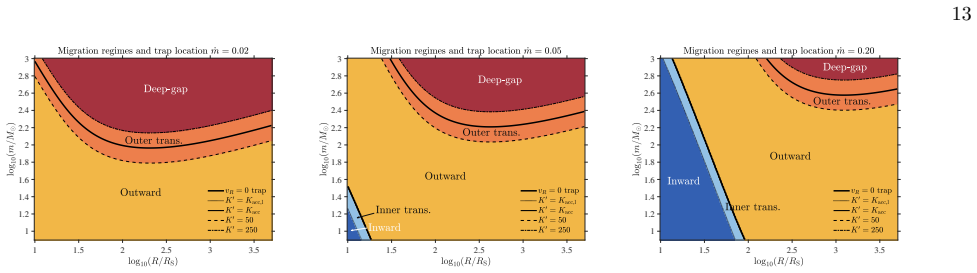
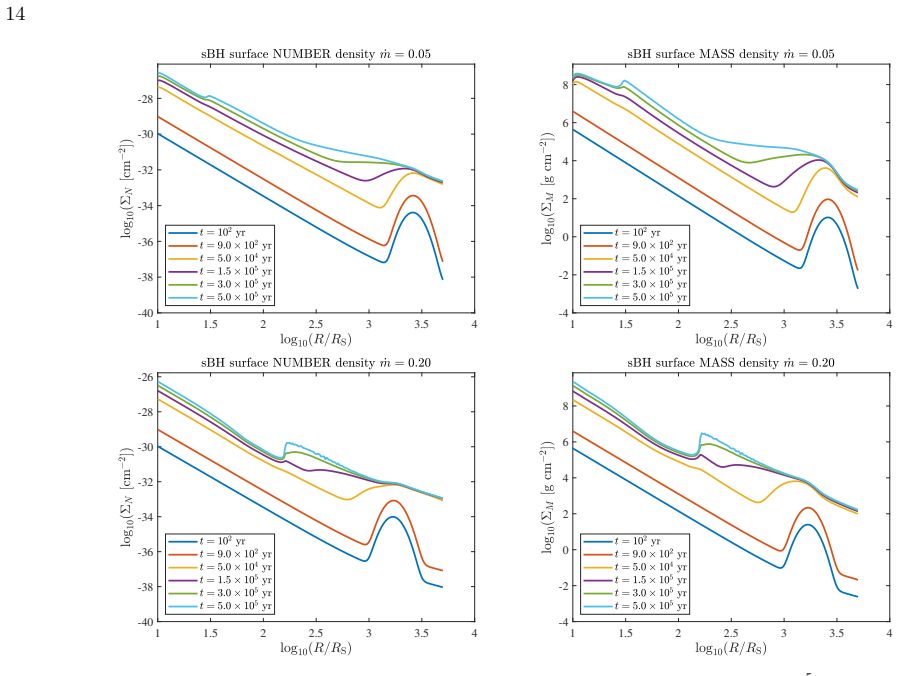
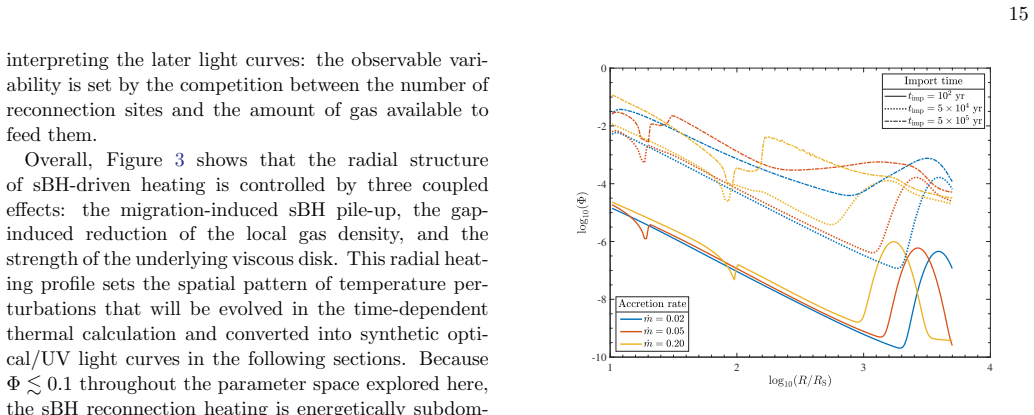
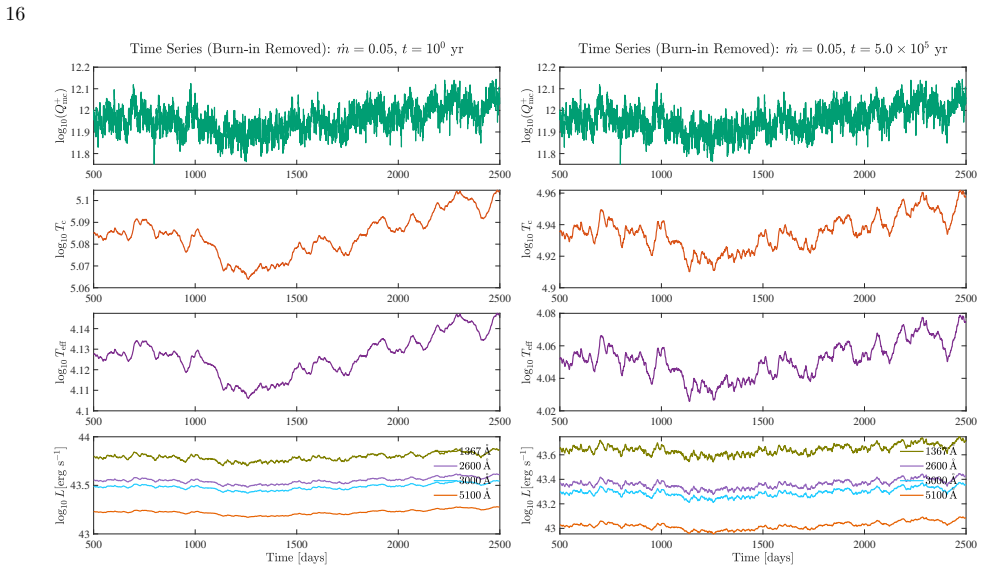
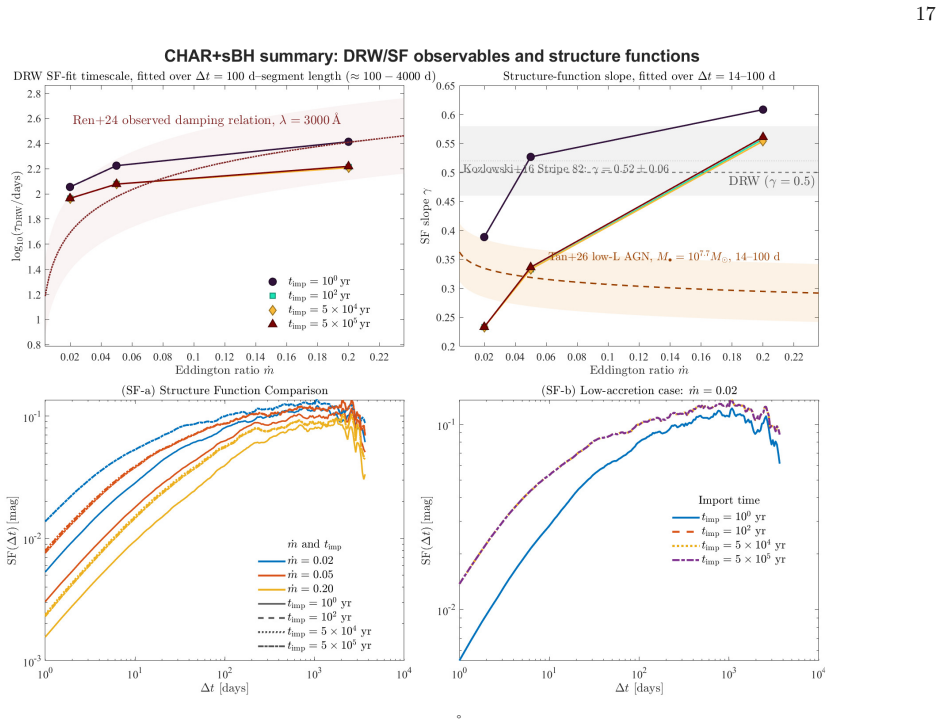
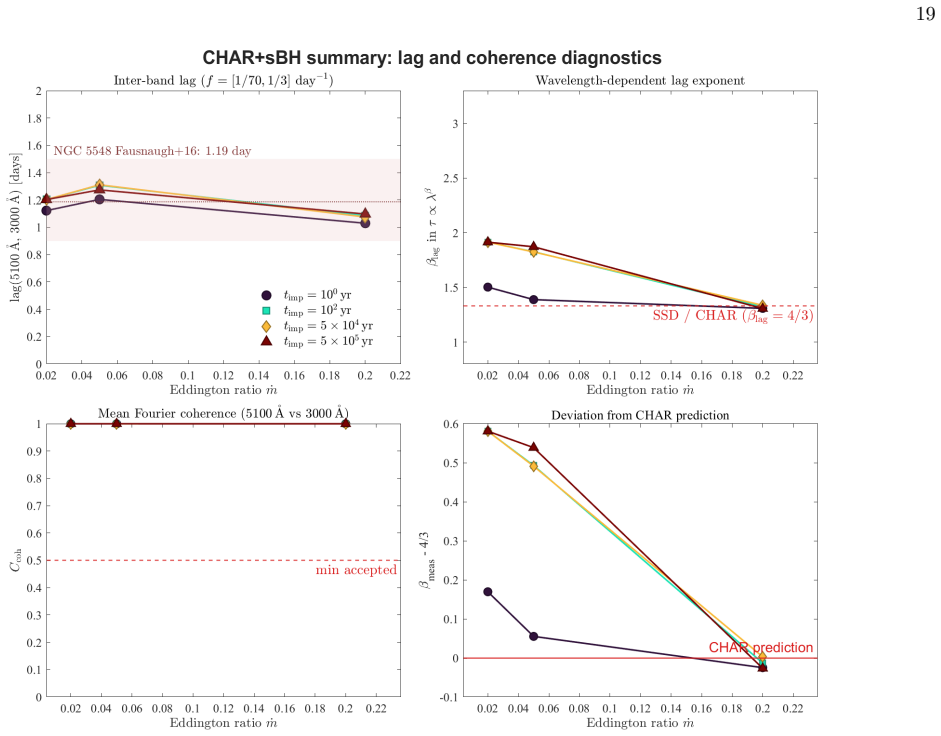
By coupling a one-dimensional sBH population synthesis model with a corona-heated accretion-disk reprocessing variability framework, migration traps concentrate sBHs at preferred radii and generate localized, stochastic reconnection heating. The resulting heating is self-regulated: sBH pile-ups enhance the reconnection rate, while gap opening reduces the local gas density and partially suppresses the reconnection power. This heating produces excess short-timescale optical/UV variability, flattened short-term structure functions, and deviations from the standard τ∝λ^{4/3} lag-wavelength relation. These signatures are strongest at low-to-moderate Eddington ratios.
What carries the argument
Migration traps (torque-balance radii) that concentrate sBHs and drive localized stochastic magnetic reconnection heating, implemented via the coupling of a 1D population synthesis model to a corona-heated reprocessing framework.
If this is right
- Excess short-timescale optical/UV variability appears in AGN disks.
- Short-term structure functions become flattened.
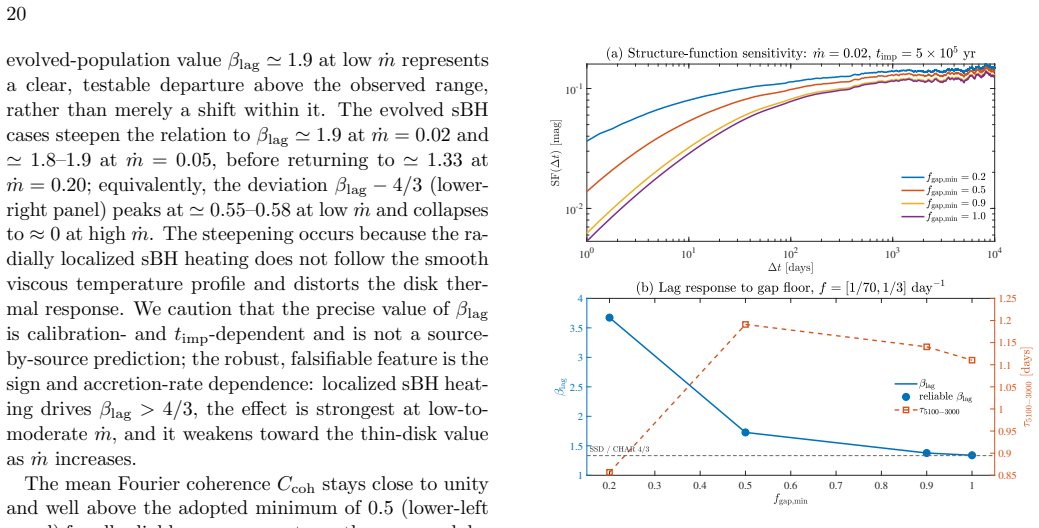
- The lag-wavelength relation deviates from τ∝λ^{4/3}.
- Signatures reach maximum strength at low-to-moderate Eddington ratios and supply indirect evidence for embedded sBH populations.
Where Pith is reading between the lines
- Existing long-term AGN light-curve archives could be re-analyzed for the predicted short-timescale excess and lag deviations to test the mechanism directly.
- The self-regulated heating sets an upper limit on local sBH density once gap opening becomes important, offering a way to constrain compact-object populations without resolving individual objects.
- If the variability channel operates, it could contribute to the observed diversity of AGN continuum behavior at wavelengths where coronal reprocessing alone under-predicts the amplitude.
Load-bearing premise
The assumption that sBHs migrate efficiently toward torque-balance radii and accumulate at migration traps in numbers large enough to produce observable reconnection heating, without gap opening fully suppressing the local gas density and reconnection power.
What would settle it
Multi-wavelength monitoring campaigns of AGN at low-to-moderate Eddington ratios that show neither excess short-timescale optical/UV variability nor deviations from the standard τ∝λ^{4/3} lag-wavelength relation would falsify the predicted signatures of sBH-driven reconnection heating.
Figures
read the original abstract
We investigate whether embedded stellar-mass black holes (sBHs) in active galactic nucleus (AGN) disks can leave observable optical/UV variability signatures through migration-trap-driven magnetic heating. This mechanism operates when sBHs migrating toward torque-balance radii pile up near migration traps, triggering localized, stochastic magnetic reconnection that heats the disk atmosphere. It is potentially important because it provides a physical source of non-coronal disk heating and directly links optical/UV continuum variability to otherwise hidden compact-object populations. By coupling a one-dimensional sBH population synthesis model with a corona-heated accretion-disk reprocessing variability framework, we show that migration traps concentrate sBHs at preferred radii and generate localized, stochastic reconnection heating. The resulting heating is self-regulated: sBH pile-ups enhance the reconnection rate, while gap opening reduces the local gas density and partially suppresses the reconnection power. This heating produces excess short-timescale optical/UV variability, flattened short-term structure functions, and deviations from the standard $\tau\propto\lambda^{4/3}$ lag-wavelength relation, which describes the time delay between variability at different wavelengths for a standard thin accretion disk. These signatures are strongest at low-to-moderate Eddington ratios, and related observations could provide indirect evidence for embedded compact-object populations in AGN disks.
Editorial analysis
A structured set of objections, weighed in public.
Referee Report
Summary. The manuscript investigates whether embedded stellar-mass black holes (sBHs) in AGN disks produce observable optical/UV variability signatures via migration-trap-driven magnetic reconnection heating. It couples a one-dimensional sBH population synthesis model with a corona-heated accretion-disk reprocessing variability framework to argue that sBH pile-ups at torque-balance radii generate localized, stochastic reconnection heating that is self-regulated by gap opening; this is claimed to yield excess short-timescale variability, flattened short-term structure functions, and deviations from the standard τ∝λ^{4/3} lag-wavelength relation, with the effects strongest at low-to-moderate Eddington ratios.
Significance. If the quantitative outputs of the coupled model confirm that net reconnection heating after gap-opening suppression exceeds background coronal levels sufficiently to drive the claimed variability signatures, the work would link otherwise hidden compact-object populations to AGN continuum variability and provide falsifiable predictions for structure functions and lag relations.
major comments (2)
- [Results (coupling of population synthesis and reprocessing framework)] The central claim requires that the 1D population synthesis produces net reconnection heating (after self-regulation by gap opening) that exceeds background levels enough to generate observable excess variability and lag deviations. The manuscript states this outcome but supplies no numerical results from the synthesis, such as trapped sBH column, reconnection luminosity relative to coronal heating, or surface-density thresholds at low-to-moderate Eddington ratios, preventing verification that the signatures are actually produced.
- [Methods (population synthesis and reprocessing coupling)] The self-regulated heating description is presented as an independent output that produces flattened structure functions and deviations from τ∝λ^{4/3}. Without explicit equations or parameter values for the reconnection rate, the gap-opening suppression factor, or the resulting heating profile in the reprocessing framework, it is unclear whether these deviations are robust predictions or shaped by choices in the population synthesis.
minor comments (2)
- The abstract and text use standard notation for the lag-wavelength relation but would benefit from a one-sentence reminder of its thin-disk origin for broader accessibility.
- A table listing the key parameters of the 1D population synthesis model (e.g., migration rates, trap radii, Eddington ratio ranges) would improve reproducibility.
Simulated Author's Rebuttal
We thank the referee for the constructive report and for highlighting the need for more explicit quantitative support. We agree that the central claims would be strengthened by additional numerical outputs and model equations, and we will revise the manuscript to incorporate these elements.
read point-by-point responses
-
Referee: [Results (coupling of population synthesis and reprocessing framework)] The central claim requires that the 1D population synthesis produces net reconnection heating (after self-regulation by gap opening) that exceeds background levels enough to generate observable excess variability and lag deviations. The manuscript states this outcome but supplies no numerical results from the synthesis, such as trapped sBH column, reconnection luminosity relative to coronal heating, or surface-density thresholds at low-to-moderate Eddington ratios, preventing verification that the signatures are actually produced.
Authors: We agree that the manuscript would be improved by supplying these numerical results to allow verification. In the revised version we will add a dedicated results subsection (or appendix) that reports the outputs of the 1D population synthesis, including trapped sBH column densities at the migration traps, the ratio of reconnection luminosity to background coronal heating across the explored Eddington-ratio range, and the local surface-density thresholds after gap-opening suppression. These quantities will be shown to exceed the levels needed to produce the reported excess short-timescale variability, flattened structure functions, and lag deviations. revision: yes
-
Referee: [Methods (population synthesis and reprocessing coupling)] The self-regulated heating description is presented as an independent output that produces flattened structure functions and deviations from τ∝λ^{4/3}. Without explicit equations or parameter values for the reconnection rate, the gap-opening suppression factor, or the resulting heating profile in the reprocessing framework, it is unclear whether these deviations are robust predictions or shaped by choices in the population synthesis.
Authors: We acknowledge that the absence of the explicit equations leaves the robustness of the predictions less transparent. We will expand the methods section to include the full expressions for the reconnection rate (based on local magnetic-field strength and plasma-β), the analytic form of the gap-opening suppression factor, and the procedure by which the localized heating profile is injected into the corona-heated reprocessing variability code. A table of all adopted parameter values will also be added so that readers can reproduce and assess the sensitivity of the structure-function and lag results. revision: yes
Circularity Check
No significant circularity; derivation is self-contained via model coupling
full rationale
The paper couples a 1D sBH population synthesis model to a corona-heated reprocessing framework and presents the resulting variability signatures (excess short-timescale variability, flattened structure functions, lag deviations) as outputs of that coupling, including the described self-regulation by pile-up enhancement and gap-opening suppression. No equations, fitted parameters renamed as predictions, or load-bearing self-citations are quoted that would make any claimed prediction equivalent to its inputs by construction. The central claim therefore retains independent content from the synthesis-reprocessing link and does not reduce to self-definition or renaming.
Axiom & Free-Parameter Ledger
axioms (2)
- domain assumption Standard thin accretion disk with τ∝λ^{4/3} lag-wavelength relation as baseline
- domain assumption Stellar-mass black holes migrate efficiently and pile up at migration traps in AGN disks
Reference graph
Works this paper leans on
-
[1]
Abramowicz, M. A., Czerny, B., Lasota, J. P., et al.\ 1988, , 332, 646. doi:10.1086/166683
-
[2]
J.\ 2010, Astrophysics of Planet Formation (Cambridge: Cambridge Univ
Armitage, P. J.\ 2010, Astrophysics of Planet Formation (Cambridge: Cambridge Univ. Press)
2010
-
[3]
doi:10.3847/1538-4357/835/2/165
Bartos, I., Kocsis, B., Haiman, Z., et al.\ 2017, , 835, 2, 165. doi:10.3847/1538-4357/835/2/165
-
[4]
M., Mac Low, M.-M., McKernan, B., et al.\ 2016, , 819, 2, L17
Bellovary, J. M., Mac Low, M.-M., McKernan, B., et al.\ 2016, , 819, 2, L17. doi:10.3847/2041-8205/819/2/L17
-
[5]
Ben \' tez-Llambay, P., Masset, F., Koenigsberger, G., et al.\ 2015, , 520, 7545, 63. doi:10.1038/nature14277
-
[6]
Blandford, R. D. & McKee, C. F.\ 1982, , 255, 419. doi:10.1086/159843
-
[7]
Bondi, H.\ 1952, , 112, 195. doi:10.1093/mnras/112.2.195
-
[8]
J., Shen, Y., Blaes, O., et al.\ 2021, Science, 373, 6556, 789
Burke, C. J., Shen, Y., Blaes, O., et al.\ 2021, Science, 373, 6556, 789. doi:10.1126/science.abg9933
-
[9]
Cackett, E. M., Bentz, M. C., & Kara, E.\ 2021, iScience, 24, 6, 102557. doi:10.1016/j.isci.2021.102557
-
[10]
Cai, Z.-Y., Wang, J.-X., Zhu, F.-F., et al.\ 2018, , 855, 2, 117. doi:10.3847/1538-4357/aab091
-
[11]
Cao, Z., Li, Y.-P., Lin, D. N. C., et al.\ 2026, , 999, 1, 55. doi:10.3847/1538-4357/ae4029
-
[12]
Chen, J., Sun, M., & Zhang, Z.-X.\ 2024, , 962, 2, 134. doi:10.3847/1538-4357/ad16ea
-
[13]
Chen, K., Ren, J., & Dai, Z.-G.\ 2023, , 948, 2, 136. doi:10.3847/1538-4357/acc45f
-
[14]
Choksi, N., Chiang, E., Fung, J., et al.\ 2023, , 525, 2, 2806. doi:10.1093/mnras/stad2269
-
[15]
Collin-Souffrin, S.\ 1991, , 249, 344
1991
-
[16]
M., Horne, K., et al.\ 2015, , 806, 1, 129
Edelson, R., Gelbord, J. M., Horne, K., et al.\ 2015, , 806, 1, 129. doi:10.1088/0004-637X/806/1/129
-
[17]
doi:10.1051/0004-6361/202346781
El Mellah, I., Cerutti, B., & Crinquand, B.\ 2023, , 677, A67. doi:10.1051/0004-6361/202346781
-
[18]
Epstein-Martin, M., Tagawa, H., Haiman, Z., et al.\ 2025, , 537, 4, 3396. doi:10.1093/mnras/staf237
-
[19]
Fausnaugh, M. M., Denney, K. D., Barth, A. J., et al.\ 2016, , 821, 1, 56. doi:10.3847/0004-637X/821/1/56
-
[20]
Gammie, C. F.\ 2001, , 553, 1, 174. doi:10.1086/320631
-
[21]
Generozov, A., Stone, N. C., Metzger, B. D., et al.\ 2018, , 478, 3, 4030. doi:10.1093/mnras/sty1262
-
[22]
Giannios, D.\ 2013, , 431, 1, 355. doi:10.1093/mnras/stt167
-
[23]
Gilbaum, S. & Stone, N. C.\ 2022, , 928, 2, 191. doi:10.3847/1538-4357/ac4ded
-
[24]
2003, MNRAS, 340, 227, doi: 10.1046/j.1365-8711.2003.06286.x
Goodman, J.\ 2003, , 339, 4, 937. doi:10.1046/j.1365-8711.2003.06241.x
-
[25]
Hesse, M. & Cassak, P. A.\ 2020, Journal of Geophysical Research (Space Physics), 125, 2, e25935. doi:10.1029/2018JA025935
-
[26]
Magnetically Driven Accretion Flows in the Kerr Metric
Hirose, S., Krolik, J. H., De Villiers, J.-P., et al.\ 2004, , 606, 2, 1083. doi:10.1086/383184
-
[27]
Ida, S., Li, Y.-P., Pan, J.-P., et al.\ 2026, , 997, 2, 160. doi:10.3847/1538-4357/ae2612
-
[28]
Ivanov, P. B., Papaloizou, J. C. B., & Polnarev, A. G.\ 1999, , 307, 1, 79. doi:10.1046/j.1365-8711.1999.02623.x
-
[29]
M., et al.\ 2019, , 885, 2, 144
Jiang, Y.-F., Blaes, O., Stone, J. M., et al.\ 2019, , 885, 2, 144. doi:10.3847/1538-4357/ab4a00
-
[30]
S., Dov c iak, M., Papadakis, I
Kammoun, E. S., Dov c iak, M., Papadakis, I. E., et al.\ 2021, , 907, 1, 20. doi:10.3847/1538-4357/abcb93
-
[31]
D., Tanaka, H., Muto, T., et al.\ 2015, , 448, 1, 994
Kanagawa, K. D., Tanaka, H., Muto, T., et al.\ 2015, , 448, 1, 994. doi:10.1093/mnras/stv025
-
[32]
D., Tanaka, H., & Szuszkiewicz, E.\ 2018, , 861, 2, 140
Kanagawa, K. D., Tanaka, H., & Szuszkiewicz, E.\ 2018, , 861, 2, 140. doi:10.3847/1538-4357/aac8d9
-
[33]
Kato, S., Fukue, J., & Mineshige, S.\ 2008, Black-Hole Accretion Disks: Toward a New Paradigm (Kyoto: Kyoto Univ. Press)
2008
-
[34]
2004, MNRAS, 350, 1301, doi: 10.1111/j.1365-2966.2004.07713.x
King, A. R., Pringle, J. E., West, R. G., et al.\ 2004, , 348, 1, 111. doi:10.1111/j.1365-2966.2004.07322.x
-
[35]
doi:10.3847/0004-637X/826/2/118
Koz owski, S.\ 2016, , 826, 2, 118. doi:10.3847/0004-637X/826/2/118
-
[36]
Krolik, J. H., Horne, K., Kallman, T. R., et al.\ 1991, , 371, 541. doi:10.1086/169918
-
[37]
Laune, J., Li, R., & Lai, D.\ 2024, , 975, 2, 296. doi:10.3847/1538-4357/ad7117
-
[38]
Lawrence, A.\ 2018, Nature Astronomy, 2, 102. doi:10.1038/s41550-017-0372-1
-
[39]
J., et al.\ 2024, , 974, 2, 271
Lewin, C., Kara, E., Barth, A. J., et al.\ 2024, , 974, 2, 271. doi:10.3847/1538-4357/ad6b08
-
[40]
Levin, Y.\ 2007, , 374, 2, 515. doi:10.1111/j.1365-2966.2006.11155.x
-
[41]
Li, S.-L. & Cao, X.\ 2008, , 387, 1, L41. doi:10.1111/j.1745-3933.2008.00480.x
-
[42]
Li, Y.-P., Chen, Y.-X., & Lin, D. N. C.\ 2023, , 526, 4, 5346. doi:10.1093/mnras/stad3049
-
[43]
Li, Y.-P., Chen, Y.-X., & Lin, D. N. C.\ 2024, , 971, 2, 130. doi:10.3847/1538-4357/ad5a06
-
[44]
Li, Y.-P., Chen, Y.-X., Lin, D. N. C., et al.\ 2021, , 906, 1, 52. doi:10.3847/1538-4357/abc883
-
[45]
Loureiro, N. F., Schekochihin, A. A., & Cowley, S. C.\ 2007, Physics of Plasmas, 14, 10, 100703. doi:10.1063/1.2783986
-
[46]
Lyubarskii, Y. E.\ 1997, , 292, 3, 679. doi:10.1093/mnras/292.3.679
-
[47]
Masset, F. S.\ 2017, , 472, 4, 4204. doi:10.1093/mnras/stx2271
-
[48]
McHardy, I. M.\ 2013, , 430, L49. doi:10.1093/mnrasl/sls048
-
[49]
McHardy, I. M., Cameron, D. T., Dwelly, T., et al.\ 2014, , 444, 2, 1469. doi:10.1093/mnras/stu1636
-
[50]
McKernan, B., Ford, K. E. S., Kocsis, B., et al.\ 2014, , 441, 1, 900. doi:10.1093/mnras/stu553
-
[51]
McKernan, B., Ford, K. E. S., Lyra, W., et al.\ 2012, , 425, 1, 460. doi:10.1111/j.1365-2966.2012.21486.x
-
[52]
McLaughlin, S. A. J., Mullaney, J. R., & Littlefair, S. P.\ 2024, , 529, 3, 2877. doi:10.1093/mnras/stae721
-
[53]
Plasmoid formation in global GRMHD simulations and AGN flares[J/OL]
Nathanail, A., Fromm, C. M., Porth, O., et al.\ 2020, , 495, 2, 1549. doi:10.1093/mnras/staa1165
-
[54]
Nathanail, A., Mpisketzis, V., Porth, O., et al.\ 2022, , 513, 3, 4267. doi:10.1093/mnras/stac1118
-
[55]
Ni, L., Lukin, V. S., Murphy, N. A., et al.\ 2018, , 852, 2, 95. doi:10.3847/1538-4357/aa9edb
-
[56]
Noble, S. C. & Krolik, J. H.\ 2009, , 703, 1, 964. doi:10.1088/0004-637X/703/1/964
-
[57]
Paardekooper, S.-J. & Papaloizou, J. C. B.\ 2009, , 394, 4, 2297. doi:10.1111/j.1365-2966.2009.14512.x
-
[58]
Pan, J., Li, Y.-P., Chen, Y.-X., et al.\ 2026, , 997, 2, 161. doi:10.3847/1538-4357/ae261a
-
[59]
B., Hubickyj, O., Bodenheimer, P., et al
Pollack, J. B., Hubickyj, O., Bodenheimer, P., et al.\ 1996, , 124, 1, 62. doi:10.1006/icar.1996.0190
-
[60]
Ren, G., Zhou, S., Sun, M., et al.\ 2024, , 975, 2, 160. doi:10.3847/1538-4357/ad7b2a
-
[61]
Ripperda, B., Liska, M., Chatterjee, K., et al.\ 2022, , 924, 2, L32. doi:10.3847/2041-8213/ac46a1
-
[62]
Ripperda, B., Mahlmann, J. F., Chernoglazov, A., et al.\ 2021, Journal of Plasma Physics, 87, 5, 905870512. doi:10.1017/S0022377821000957
-
[63]
Rosenthal, M. M., Chiang, E. I., Ginzburg, S., et al.\ 2020, , 498, 2, 2054. doi:10.1093/mnras/staa1721
-
[64]
Secunda, A., Bellovary, J., Mac Low, M.-M., et al.\ 2019, , 878, 2, 85. doi:10.3847/1538-4357/ab20ca
-
[65]
Shakura, N. I. & Sunyaev, R. A.\ 1973, , 24, 337
1973
-
[66]
Shen, Y., Richards, G. T., Strauss, M. A., et al.\ 2011, , 194, 2, 45. doi:10.1088/0067-0049/194/2/45
-
[67]
Sikora, M. & Begelman, M. C.\ 2013, , 764, 2, L24. doi:10.1088/2041-8205/764/2/L24
-
[68]
2003, MNRAS, 340, 227, doi: 10.1046/j.1365-8711.2003.06286.x
Sirko, E. & Goodman, J.\ 2003, , 341, 2, 501. doi:10.1046/j.1365-8711.2003.06431.x
-
[69]
Son, S., Kim, M., & Ho, L. C.\ 2025, , 695, A268. doi:10.1051/0004-6361/202452467
-
[70]
Stone, N. C., Metzger, B. D., & Haiman, Z.\ 2017, , 464, 1, 946. doi:10.1093/mnras/stw2260
-
[71]
Su, Z.-B., Cai, Z.-Y., Guo, H., et al.\ 2025, , 990, 1, 10. doi:10.3847/1538-4357/adef13
-
[72]
N., et al.\ 2020a, , 891, 2, 178
Sun, M., Xue, Y., Brandt, W. N., et al.\ 2020a, , 891, 2, 178. doi:10.3847/1538-4357/ab789e
-
[73]
Sun, M., Xue, Y., Guo, H., et al.\ 2020b, , 902, 1, 7. doi:10.3847/1538-4357/abb1c4
-
[74]
Tagawa, H., Haiman, Z., & Kocsis, B.\ 2020, , 898, 1, 25. doi:10.3847/1538-4357/ab9b8c
-
[75]
S., Haiman, Z., et al.\ 2022, , 927, 1, 41
Tagawa, H., Kimura, S. S., Haiman, Z., et al.\ 2022, , 927, 1, 41. doi:10.3847/1538-4357/ac45f8
-
[76]
S., Haiman, Z., et al.\ 2023, , 946, 1, L3
Tagawa, H., Kimura, S. S., Haiman, Z., et al.\ 2023, , 946, 1, L3. doi:10.3847/2041-8213/acc103
-
[77]
Tanaka, H., Murase, K., & Tanigawa, T.\ 2020, , 891, 2, 143. doi:10.3847/1538-4357/ab77af
-
[78]
Tanaka, H., Takeuchi, T., & Ward, W. R.\ 2002, , 565, 2, 1257. doi:10.1086/324713
-
[79]
& Tanaka, H.\ 2016, , 823, 1, 48
Tanigawa, T. & Tanaka, H.\ 2016, , 823, 1, 48. doi:10.3847/0004-637X/823/1/48
-
[80]
Tan, A. H. T., Wolf, C., Amrutha, N., et al.\ 2026, . doi:10.1093/mnras/stag1052
discussion (0)
Sign in with ORCID, Apple, or X to comment. Anyone can read and Pith papers without signing in.