Radiative Lifting of mathbb{Z}₃ Domain-Wall Degeneracy in a Type-III Seesaw Model: Implications for Leptogenesis and Gravitational Waves
Pith reviewed 2026-06-26 09:54 UTC · model grok-4.3
The pith
Radiative corrections lift degeneracy among Z3 vacua in a type-III seesaw model, causing domain walls to annihilate.
A machine-rendered reading of the paper's core claim, the machinery that carries it, and where it could break.
Core claim
The Yukawa interactions between the SU(2)_L fermion triplets and the complex scalar singlet χ induce radiative corrections that generate a Coleman-Weinberg effective potential. This potential creates a dynamical bias term lifting the degeneracy among the three Z3 vacua, which triggers the annihilation of unstable domain walls. The framework simultaneously explains neutrino masses, produces the observed baryon asymmetry via leptogenesis, and yields a gravitational-wave spectrum within reach of future detectors.
What carries the argument
The Coleman-Weinberg effective potential generated by the Yukawa couplings between the fermion triplets and the scalar singlet, which supplies the vacuum bias term that destabilizes the domain walls.
If this is right
- Domain walls annihilate before dominating the energy density of the universe.
- The baryon asymmetry arises from thermal leptogenesis via decays of the lightest fermion triplet at O(10^9) GeV.
- The gravitational-wave spectrum from domain-wall annihilation or the associated phase transition falls within reach of space-based and ground-based detectors for suitable parameter choices.
- Viable regions of parameter space exist that reproduce current neutrino masses and mixing angles.
Where Pith is reading between the lines
- The same radiative-bias mechanism could resolve domain-wall issues in other beyond-Standard-Model constructions that employ discrete symmetries.
- Future gravitational-wave observations in specific frequency windows could indirectly constrain the Yukawa couplings and the mass of the lightest triplet.
- The setup links the scale of neutrino mass generation directly to early-universe dynamics through the size of the bias term.
Load-bearing premise
The Yukawa interactions and parameter choices must produce a Coleman-Weinberg bias large enough to trigger domain wall annihilation on cosmologically relevant timescales while fitting neutrino data and leptogenesis requirements.
What would settle it
Cosmological evidence for long-lived stable domain walls persisting to late times, or non-observation of the predicted gravitational-wave spectrum in the bands accessible to future detectors, or inability to match the baryon asymmetry with triplet masses near 10^9 GeV under the required Yukawa couplings.
Figures
read the original abstract
In this work, we study a $\mathbb{Z}_3$-symmetric extension of the Standard Model with three hyperchargeless $SU(2)_L$ fermion triplets responsible for neutrino mass generation $\textit{via}$ the Type-III seesaw mechanism together with a complex scalar singlet $\chi$ whose vacuum expectation value spontaneously breaks the $\mathbb{Z}_3$ symmetry. Radiative corrections induced by the Yukawa interactions between the $SU(2)_L$ fermion triplets and the complex scalar singlet $\chi$ generate a Coleman-Weinberg vacuum bias that lifts the degeneracy among the $\mathbb{Z}_3$ vacua, leading to the annihilation of unstable domain-walls. Consequently, the degeneracy among the $\mathbb{Z}_3$ vacua is lifted radiatively through the Coleman-Weinberg effective potential, generating a dynamical bias term that triggers the annihilation of unstable domain walls. We perform a numerical analysis consistent with current neutrino oscillation data and identify viable regions of parameter space accommodating the observed neutrino masses and leptonic mixing parameters. The observed baryon asymmetry of the Universe is generated through thermal leptogenesis $\textit{via}$ the out-of-equilibrium decay of the lightest fermion triplet for masses around $\mathcal{O}(10^{9})\,\mathrm{GeV}$, consistent with the Type-III seesaw framework. Depending on the choice of model parameters, the predicted gravitational-wave spectrum can fall within the sensitivity reach of future space-based and ground-based gravitational-wave detectors. Our framework therefore establishes a correlation between neutrino mass generation, leptogenesis, radiative domain-wall instability, and gravitational-wave phenomenology.
Editorial analysis
A structured set of objections, weighed in public.
Referee Report
Summary. The manuscript proposes a Z_3-symmetric Type-III seesaw model with three hypercharge-less SU(2)_L fermion triplets and a complex scalar singlet χ whose VEV breaks Z_3. It claims that Yukawa-induced one-loop Coleman-Weinberg corrections generate a vacuum bias lifting the exact degeneracy among the three Z_3 vacua, triggering domain-wall annihilation. Viable parameter regions are identified that reproduce neutrino oscillation data; thermal leptogenesis proceeds via out-of-equilibrium decays of the lightest triplet at O(10^9) GeV, and the resulting gravitational-wave spectrum may be detectable by future interferometers.
Significance. If the central claim holds, the work would establish a concrete link between radiative lifting of discrete symmetry vacua, domain-wall cosmology, Type-III leptogenesis, and observable gravitational waves within a single renormalizable framework. The approach is standard in its use of Coleman-Weinberg potentials, but its impact hinges on whether the generated bias is demonstrably sufficient for cosmologically timely annihilation while remaining consistent with neutrino data and leptogenesis requirements.
major comments (2)
- [Abstract and radiative-corrections paragraph] The abstract and the paragraph describing the radiative corrections assert that the Coleman-Weinberg bias term is large enough to annihilate unstable domain walls on relevant timescales, yet the explicit one-loop effective potential, the resulting bias expression, and the numerical evaluation of its magnitude relative to the wall tension are not supplied. This calculation is load-bearing for the domain-wall instability claim and for the subsequent gravitational-wave prediction.
- [Numerical analysis section] The numerical analysis is stated to be consistent with neutrino oscillation data and to yield viable leptogenesis regions, but the scan procedure, the treatment of the free parameters (Yukawa couplings, triplet masses, scalar potential parameters), and any checks against over-tuning or post-hoc selection are not detailed. This directly affects the robustness of the claimed viable parameter space.
Simulated Author's Rebuttal
We thank the referee for the careful reading of the manuscript and the constructive comments. We address each major point below and will revise the manuscript to incorporate the requested details and clarifications.
read point-by-point responses
-
Referee: [Abstract and radiative-corrections paragraph] The abstract and the paragraph describing the radiative corrections assert that the Coleman-Weinberg bias term is large enough to annihilate unstable domain walls on relevant timescales, yet the explicit one-loop effective potential, the resulting bias expression, and the numerical evaluation of its magnitude relative to the wall tension are not supplied. This calculation is load-bearing for the domain-wall instability claim and for the subsequent gravitational-wave prediction.
Authors: We agree that the explicit one-loop Coleman-Weinberg effective potential, the derived bias term, and its numerical comparison to the domain-wall tension were not presented with sufficient detail in the current version. In the revised manuscript we will add the full analytic expression for the one-loop potential induced by the Yukawa interactions, the resulting bias ΔV, and a quantitative estimate showing that the bias is sufficient to trigger annihilation on cosmologically relevant timescales while remaining consistent with the gravitational-wave predictions. revision: yes
-
Referee: [Numerical analysis section] The numerical analysis is stated to be consistent with neutrino oscillation data and to yield viable leptogenesis regions, but the scan procedure, the treatment of the free parameters (Yukawa couplings, triplet masses, scalar potential parameters), and any checks against over-tuning or post-hoc selection are not detailed. This directly affects the robustness of the claimed viable parameter space.
Authors: We acknowledge that the description of the numerical scan is incomplete. In the revised version we will expand the numerical analysis section to specify the scan method (e.g., random or grid sampling), the ranges and priors assigned to the Yukawa couplings, triplet masses, and scalar potential parameters, and any explicit checks performed for fine-tuning or selection bias. This will strengthen the robustness of the reported viable regions. revision: yes
Circularity Check
No significant circularity; derivation remains self-contained
full rationale
The supplied abstract and description outline a standard model construction: Z3 symmetry broken by a scalar singlet, with one-loop Coleman-Weinberg corrections from Yukawa couplings to fermion triplets generating a vacuum bias that lifts domain-wall degeneracy. Viable parameter regions are identified by scanning against neutrino oscillation data and requiring successful thermal leptogenesis, which is ordinary model-building practice rather than a reduction of any claimed prediction to its own inputs. No equations are quoted that equate a derived quantity to a fitted input by construction, no self-citation is invoked as a uniqueness theorem, and no ansatz is smuggled via prior work. The bias term is generated by explicit loop integrals whose magnitude depends on the same Yukawas constrained by data, but this dependence is physical and falsifiable rather than tautological. The framework therefore contains independent content linking neutrino masses, leptogenesis, domain-wall dynamics, and gravitational waves.
Axiom & Free-Parameter Ledger
free parameters (3)
- lightest triplet mass
- Yukawa couplings between triplets and scalar
- scalar potential parameters
axioms (3)
- domain assumption The Type-III seesaw mechanism with three hyperchargeless SU(2)_L triplets generates the observed neutrino masses and mixings.
- domain assumption Thermal leptogenesis via out-of-equilibrium decay of the lightest triplet produces the observed baryon asymmetry.
- standard math Standard quantum field theory loop corrections produce the Coleman-Weinberg effective potential.
invented entities (3)
-
three hyperchargeless SU(2)_L fermion triplets
no independent evidence
-
complex scalar singlet χ
no independent evidence
-
Z3 discrete symmetry
no independent evidence
Reference graph
Works this paper leans on
-
[1]
INTRODUCTION The Standard Model (SM) of particle physics successfully describes the known elementary particles and their interactions, where neutrinos are treated as massless left-handed Weyl fermions. However, results from neutrino oscillation experiments such as Super-Kamiokande [1], the Sudbury Neutrino Observatory (SNO) [2] and KamLAND [3] established...
Pith/arXiv arXiv 2026
-
[2]
To restrict the Yukawa and mass structures, we impose a discreteZ 3 symmetry under which the triplet fermions transform as 1
MODEL AND FORMALISM In our framework, we consider a Type-III seesaw scenario containing three heavy fermionic triplets, denoted by Σ1, Σ2, and Σ 3. To restrict the Yukawa and mass structures, we impose a discreteZ 3 symmetry under which the triplet fermions transform as 1. In addition to the Standard Model (SM) particle content, we introduce a complex gau...
-
[3]
(5) is diagonalized using the relationU T ν MνUν = diag(mν1, mν2, mν3)
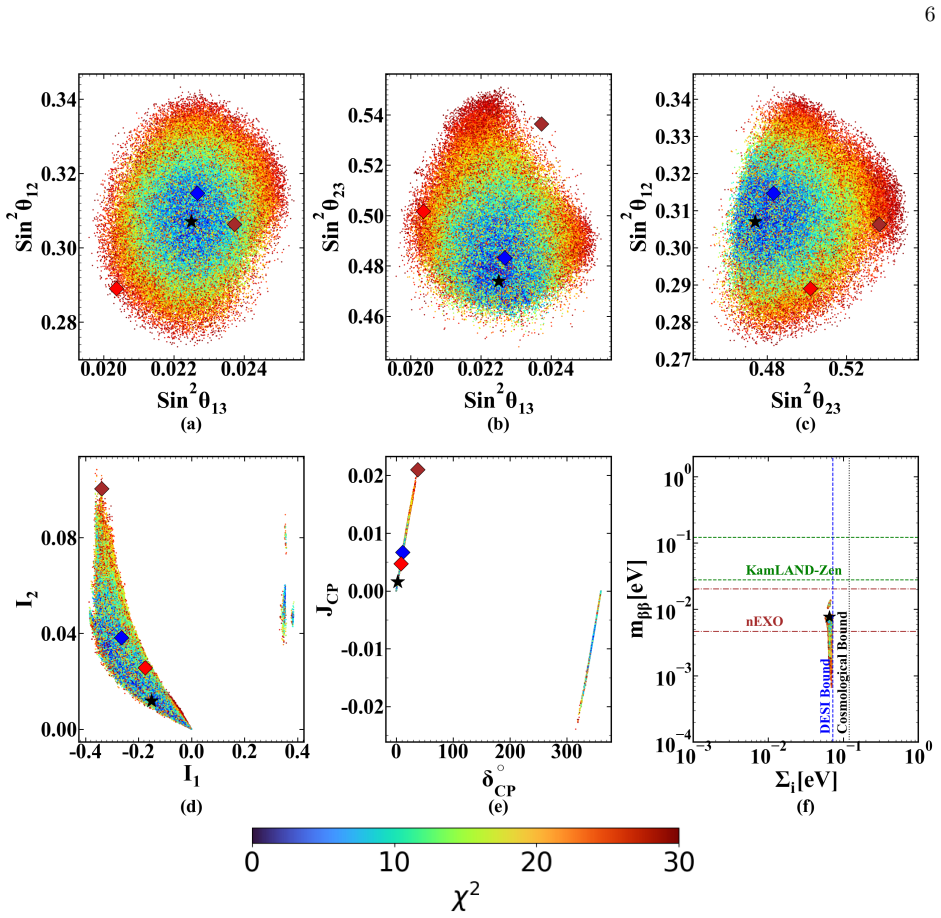
NEUTRINO MASS AND MIXING The neutrino mass matrix given by Eqn. (5) is diagonalized using the relationU T ν MνUν = diag(mν1, mν2, mν3). Now, the mixing angle can be extracted fromU PMNS as sin2 θ13 =|U 13|2,sin 2 θ12 = |U12|2 1− |U 13|2 ,sin 2 θ23 = |U23|2 1− |U 13|2 .(6) The DiracCP-violating phase(δ CP ) can be determined from the PMNS matrix elements t...
-
[4]
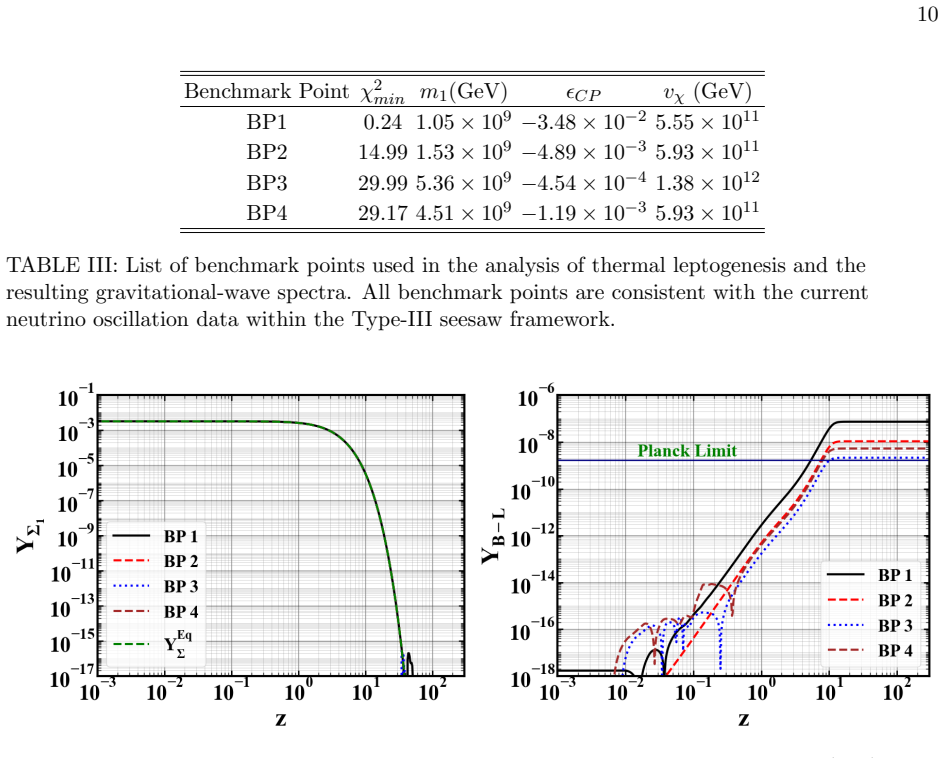
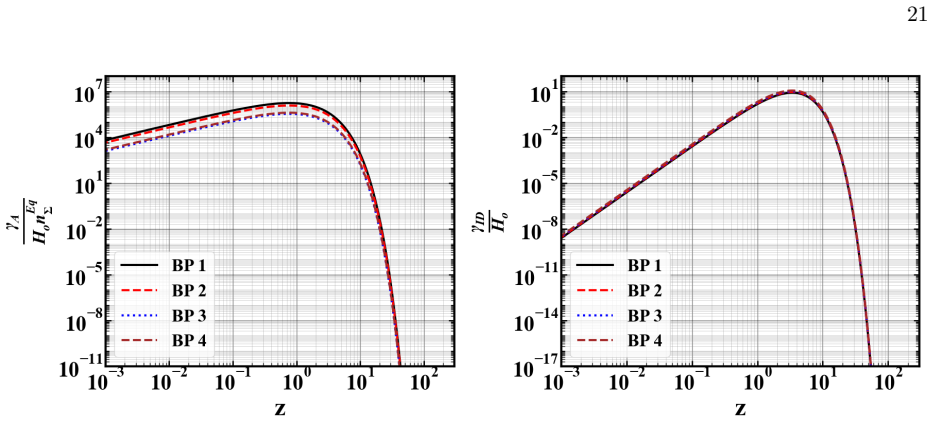
BAR YOGENESIS FROM THE LEPTOGENESIS Leptogenesis provides a compelling framework for addressing one of the most fundamental questions in particle physics and cosmology: the origin of the observed matter–antimatter asymmetry of the Universe [83–86]. The generation of baryon asymmetry through leptogenesis requires the fulfillment of the three Sakharov condi...
-
[5]
In particular, the spontaneous breaking of a discrete symmetry leads to the formation of two- dimensional, surface-like defects known as domain-walls
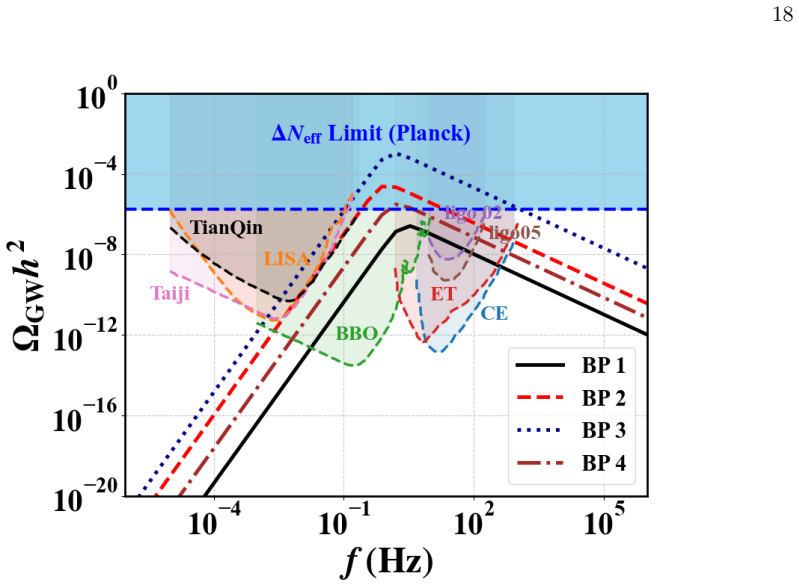
DOMAIN-W ALLS INDUCED GRA VIT A TIONAL W A VES The spontaneous breaking of symmetries in the early Universe can give rise to primordial phase transitions, which may be accompanied by the formation of topological defects [15, 19, 27, 59, 60]. In particular, the spontaneous breaking of a discrete symmetry leads to the formation of two- dimensional, surface-...
-
[6]
Workshop on High Energy Physics Phenomenology 2025 (WHEPP-2025)
CONCLUSIONS In this work, we have investigated aZ 3-symmetric extension of the Type-III seesaw framework containing three hyperchargelessSU(2) L fermion triplets and a complex scalar singletχ. After the spontaneous breaking of the discreteZ 3 symmetry, the scalar singlet develops three degenerate vacua, leading to the formation of domain-walls in the earl...
Pith/arXiv arXiv 2024
-
[7]
Minkowski,µ→eγat a Rate of One Out of10 9 Muon Decays?,Phys
P. Minkowski,µ→eγat a Rate of One Out of10 9 Muon Decays?,Phys. Lett. B67(1977) 421
1977
-
[8]
Mohapatra and G
R.N. Mohapatra and G. Senjanovic,Neutrino Mass and Spontaneous Parity Nonconservation,Phys. Rev. Lett.44(1980) 912
1980
-
[9]
R. Foot, H. Lew, X.G. He and G.C. Joshi,Seesaw Neutrino Masses Induced by a Triplet of Leptons, Z. Phys. C44(1989) 441
1989
-
[10]
Kuzmin, V.A
V.A. Kuzmin, V.A. Rubakov and M.E. Shaposhnikov,On the Anomalous Electroweak Baryon Number Nonconservation in the Early Universe,Phys. Lett. B155(1985) 36
1985
-
[11]
Tapender, S. Kumar and S. Verma,Neutrino phenomenology in a model with generalized CP symmetry within type-I seesaw framework,Phys. Rev. D109(2024) 015004 [2309.04242]
arXiv 2024
-
[12]
G. Chauhan, P.S.B. Dev, I. Dubovyk, B. Dziewit, W. Flieger, K. Grzanka et al.,Phenomenology of lepton masses and mixing with discrete flavor symmetries,Prog. Part. Nucl. Phys.138(2024) 104126 [2310.20681]
arXiv 2024
-
[13]
Barman,Phenomenology of Neutrino Masses and Mixing with Discrete Flavour Symmetry in the context of the latest neutrino oscillation data,
A. Barman,Phenomenology of Neutrino Masses and Mixing with Discrete Flavour Symmetry in the context of the latest neutrino oscillation data,
-
[14]
Priya, S. Arora and B.C. Chauhan,On the Generalized CP Symmetry, One Zero Texture in Neutrino Mass Matrix and Neutrinoless Double Beta Decay,2501.00776
-
[15]
Palavri´ c,Discrete leptonic flavor symmetries: UV mediators and phenomenology,Phys
A. Palavri´ c,Discrete leptonic flavor symmetries: UV mediators and phenomenology,Phys. Rev. D 110(2024) 115025 [2408.16044]. [13]LIGO Scientific, Virgocollaboration,Observation of Gravitational Waves from a Binary Black Hole Merger,Phys. Rev. Lett.116(2016) 061102 [1602.03837]. [14]LIGO Scientific, Virgocollaboration,GW170817: Observation of Gravitationa...
arXiv 2024
-
[16]
Vilenkin,Cosmic Strings and Domain Walls,Phys
A. Vilenkin,Cosmic Strings and Domain Walls,Phys. Rept.121(1985) 263
1985
-
[17]
T. Hiramatsu, M. Kawasaki and K. Saikawa,Gravitational Waves from Collapsing Domain Walls, JCAP05(2010) 032 [1002.1555]
Pith/arXiv arXiv 2010
-
[18]
T. Hiramatsu, M. Kawasaki and K. Saikawa,On the estimation of gravitational wave spectrum from cosmic domain walls,JCAP02(2014) 031 [1309.5001]
Pith/arXiv arXiv 2014
-
[19]
N. Kitajima and F. Takahashi,Gravitational waves from Higgs domain walls,Phys. Lett. B745 (2015) 112 [1502.03725]
Pith/arXiv arXiv 2015
-
[20]
Saikawa,A review of gravitational waves from cosmic domain walls,Universe3(2017) 40 [1703.02576]
K. Saikawa,A review of gravitational waves from cosmic domain walls,Universe3(2017) 40 [1703.02576]. 23
Pith/arXiv arXiv 2017
-
[21]
T. Krajewski, Z. Lalak, M. Lewicki and P. Olszewski,Domain walls in the extensions of the Standard Model,JCAP05(2018) 007 [1709.10100]
Pith/arXiv arXiv 2018
-
[22]
N. Chen, T. Li and Y. Wu,The gravitational waves from the collapsing domain walls in the complex singlet model,JHEP08(2020) 117 [2004.10148]
arXiv 2020
-
[23]
D. Borah, P.K. Paul and N. Sahu,Can Dirac neutrinos destabilizeZ 2 domain wall network?, 2602.07380
-
[24]
E. Ma, P.K. Paul and N. Sahu,Lepton parity dark matter and naturally unstable domain walls,Phys. Rev. D112(2025) 095020 [2508.02642]
Pith/arXiv arXiv 2025
-
[25]
P.K. Paul, N. Sahu and P. Shukla,Thermal leptogenesis, dark matter, and gravitational waves from an extended canonical seesaw scenario,Phys. Rev. D112(2025) 015032 [2409.08828]
arXiv 2025
-
[26]
U.K. Dey, S.K. Manna, P.K. Paul, S.K. Sahoo and N. Sahu,Gravitational Wave Probe of Singlet-Doublet Dark Matter Induced Radiative Neutrino Mass,2511.19386
-
[27]
A. Biswas and S. Ganguly,Probing low scale leptogenesis through gravitational wave,Phys. Rev. D 113(2026) 035028 [2505.01820]
arXiv 2026
-
[28]
Roshan,Imprint of domain wall annihilation on induced gravitational waves,2604.25726
R. Roshan,Imprint of domain wall annihilation on induced gravitational waves,2604.25726
-
[29]
Y. Gouttenoire, S.F. King, R. Roshan, X. Wang, G. White and M. Yamazaki,Cosmological consequences of domain walls biased by quantum gravity,Phys. Rev. D112(2025) 075007 [2501.16414]
arXiv 2025
-
[30]
R. Roshan and G. White,Using gravitational waves to see the first second of the Universe,Rev. Mod. Phys.97(2025) 015001 [2401.04388]
arXiv 2025
-
[31]
S. Bhattacharya, N. Mondal, R. Roshan and D. Vatsyayan,Leptogenesis, dark matter and gravitational waves from discrete symmetry breaking,JCAP06(2024) 029 [2312.15053]
arXiv 2024
- [32]
-
[33]
G. Barreto, I. de Medeiros Varzielas and Y.-L. Zhou,Domain Walls fromΣ(36×3),∆(54)and ∆(27)potentials,2603.04496
-
[34]
Y.-J. Li, J. Liu and Z.-K. Guo,Dynamics of ZN domain walls with bias directions,Phys. Rev. D 112(2025) 103510 [2502.13644]
arXiv 2025
-
[35]
B. Fu, S.F. King, L. Marsili, S. Pascoli, J. Turner and Y.-L. Zhou,Non-Abelian domain walls and gravitational waves,JHEP04(2025) 142 [2409.16359]
arXiv 2025
- [36]
- [37]
-
[38]
S. Jana, S. Manna and V.P. K,Gravitational Wave Signature and the Nature of Neutrino Masses: Majorana, Dirac, or Pseudo-Dirac?,Phys. Lett. B877(2026) 140476 [2509.10456]
Pith/arXiv arXiv 2026
- [39]
-
[40]
D. Bhandari, D. Borah and I. Saha,Imprint of matter-antimatter asymmetry on collapsing domain walls,2604.02421
-
[41]
D. Borah and I. Saha,Gravitational waves from seesaw assisted collapsing domain walls, 2512.22339
-
[42]
J.A. Dror, T. Hiramatsu, K. Kohri, H. Murayama and G. White,Testing the Seesaw Mechanism and Leptogenesis with Gravitational Waves,Phys. Rev. Lett.124(2020) 041804 [1908.03227]
arXiv 2020
- [43]
-
[44]
B. Fornal and B. Shams Es Haghi,Baryon and Lepton Number Violation from Gravitational Waves, Phys. Rev. D102(2020) 115037 [2008.05111]
arXiv 2020
-
[45]
R. Samanta and S. Datta,Gravitational wave complementarity and impact of NANOGrav data on gravitational leptogenesis,JHEP05(2021) 211 [2009.13452]
arXiv 2021
- [46]
-
[47]
P. Huang and K.-P. Xie,Leptogenesis triggered by a first-order phase transition,JHEP09(2022) 052 [2206.04691]
arXiv 2022
-
[48]
A. Dasgupta, P.S.B. Dev, A. Ghoshal and A. Mazumdar,Gravitational wave pathway to testable leptogenesis,Phys. Rev. D106(2022) 075027 [2206.07032]
arXiv 2022
-
[49]
N. Okada and O. Seto,Probing the seesaw scale with gravitational waves,Phys. Rev. D98(2018) 063532 [1807.00336]
Pith/arXiv arXiv 2018
-
[50]
T. Hasegawa, N. Okada and O. Seto,Gravitational waves from the minimal gaugedU(1) B−L model, Phys. Rev. D99(2019) 095039 [1904.03020]
Pith/arXiv arXiv 2019
- [51]
- [52]
- [53]
- [54]
- [55]
-
[56]
S.F. King, X. Wang and Y.-L. Zhou,Modular domain walls and gravitational waves,JCAP07 (2025) 011 [2411.04900]
arXiv 2025
-
[57]
Barreto, I
G. Barreto, I. de Medeiros Varzielas and Y.-L. Zhou,Domain walls from P(36×3),∆(54)and ∆(27)potentials,Phys. Rev. D113(2026) 115019
2026
-
[58]
C. Winckler, P.P. Avelino and L. Sousa,Biased domain walls and the origin of early massive structures,Phys. Rev. D112(2025) 123506 [2507.22812]
arXiv 2025
-
[59]
Q.-Q. Zeng, X. He, Z.-H. Yu and J. Zheng,Collapsing domain walls with Z2-violating coupling to thermalized fermions and their impact on gravitational wave detections,Phys. Rev. D111(2025) 115017 [2501.10059]
arXiv 2025
-
[60]
Kibble,Topology of Cosmic Domains and Strings,J
T.W.B. Kibble,Topology of Cosmic Domains and Strings,J. Phys. A9(1976) 1387
1976
-
[61]
Y.B. Zeldovich, I.Y. Kobzarev and L.B. Okun,Cosmological Consequences of the Spontaneous Breakdown of Discrete Symmetry,Zh. Eksp. Teor. Fiz.67(1974) 3. [61]TianQincollaboration,TianQin: a space-borne gravitational wave detector,Class. Quant. Grav.33 (2016) 035010 [1512.02076]. [62]TianQincollaboration,The TianQin project: current progress on science and t...
Pith/arXiv arXiv 1974
-
[62]
Hu and Y.-L
W.-R. Hu and Y.-L. Wu,The Taiji Program in Space for gravitational wave physics and the nature of gravity,Natl. Sci. Rev.4(2017) 685
2017
-
[63]
W.-H. Ruan, Z.-K. Guo, R.-G. Cai and Y.-Z. Zhang,Taiji program: Gravitational-wave sources,Int. J. Mod. Phys. A35(2020) 2050075 [1807.09495]. [65]LISAcollaboration,Laser Interferometer Space Antenna,1702.00786. 25
arXiv 2020
-
[64]
J. Crowder and N.J. Cornish,Beyond LISA: Exploring future gravitational wave missions,Phys. Rev. D72(2005) 083005 [gr-qc/0506015]
Pith/arXiv arXiv 2005
-
[65]
Punturo et al.,The Einstein Telescope: A third-generation gravitational wave observatory,Class
M. Punturo et al.,The Einstein Telescope: A third-generation gravitational wave observatory,Class. Quant. Grav.27(2010) 194002
2010
-
[66]
Hild et al.,Sensitivity Studies for Third-Generation Gravitational Wave Observatories,Class
S. Hild et al.,Sensitivity Studies for Third-Generation Gravitational Wave Observatories,Class. Quant. Grav.28(2011) 094013 [1012.0908]
Pith/arXiv arXiv 2011
-
[67]
Sathyaprakash et al.,Scientific Objectives of Einstein Telescope,Class
B. Sathyaprakash et al.,Scientific Objectives of Einstein Telescope,Class. Quant. Grav.29(2012) 124013 [1206.0331]. [70]LIGO Scientific, VIRGOcollaboration,Characterization of the LIGO detectors during their sixth science run,Class. Quant. Grav.32(2015) 115012 [1410.7764]. [71]LIGO Scientificcollaboration,Exploring the Sensitivity of Next Generation Gravi...
Pith/arXiv arXiv 2012
-
[68]
Reitze et al.,Cosmic Explorer: The U.S
D. Reitze et al.,Cosmic Explorer: The U.S. Contribution to Gravitational-Wave Astronomy beyond LIGO,Bull. Am. Astron. Soc.51(2019) 035 [1907.04833]
Pith/arXiv arXiv 2019
-
[69]
I. Esteban, M.C. Gonzalez-Garcia, M. Maltoni, I. Martinez-Soler, J.P. Pinheiro and T. Schwetz, NuFit-6.0: updated global analysis of three-flavor neutrino oscillations,JHEP12(2024) 216 [2410.05380]. [74]Particle Data Groupcollaboration,Review of particle physics,Phys. Rev. D110(2024) 030001. [75]v6.1: Three-neutrino fit based on data available in November...
Pith/arXiv arXiv 2024
-
[70]
Z.-z. Xing, H. Zhang and S. Zhou,Updated Values of Running Quark and Lepton Masses,Phys. Rev. D77(2008) 113016 [0712.1419]. [77]NOvAcollaboration,Latest Three-Flavor Neutrino Oscillation Results from NOvA, . [78]DUNEcollaboration,Prospects for beyond the Standard Model physics searches at the Deep Underground Neutrino Experiment,Eur. Phys. J. C81(2021) 32...
Pith/arXiv arXiv 2008
-
[71]
Fukugita and T
M. Fukugita and T. Yanagida,Baryogenesis Without Grand Unification,Phys. Lett. B174(1986) 45
1986
-
[72]
L. Covi, E. Roulet and F. Vissani,CP violating decays in leptogenesis scenarios,Phys. Lett. B384 (1996) 169 [hep-ph/9605319]
Pith/arXiv arXiv 1996
-
[73]
W. Buchmuller, R.D. Peccei and T. Yanagida,Leptogenesis as the origin of matter,Ann. Rev. Nucl. Part. Sci.55(2005) 311 [hep-ph/0502169]
Pith/arXiv arXiv 2005
-
[74]
W. Buchmuller, P. Di Bari and M. Plumacher,Leptogenesis for pedestrians,Annals Phys.315 (2005) 305 [hep-ph/0401240]
Pith/arXiv arXiv 2005
-
[75]
Sakharov,Violation of CP Invariance, C asymmetry, and baryon asymmetry of the universe, Pisma Zh
A.D. Sakharov,Violation of CP Invariance, C asymmetry, and baryon asymmetry of the universe, Pisma Zh. Eksp. Teor. Fiz.5(1967) 32
1967
-
[76]
D. Aristizabal Sierra, J.F. Kamenik and M. Nemevsek,Implications of Flavor Dynamics for Fermion Triplet Leptogenesis,JHEP10(2010) 036 [1007.1907]
Pith/arXiv arXiv 2010
-
[77]
P. Mishra, M.K. Behera, P. Panda and R. Mohanta,Type III seesaw underA 4 modular symmetry with leptogenesis,Eur. Phys. J. C82(2022) 1115 [2204.08338]. 26
arXiv 2022
-
[78]
D. Vatsyayan and S. Goswami,Lowering the scale of fermion triplet leptogenesis with two Higgs doublets,Phys. Rev. D107(2023) 035014 [2208.12011]
arXiv 2023
-
[79]
A. Chaudhuri,Resonant Leptogenesis in a Two-Triplet Type-II Seesaw: A Dynamical Origin of Suppressed Lepton Flavor Violation,2604.11002
- [80]
discussion (0)
Sign in with ORCID, Apple, or X to comment. Anyone can read and Pith papers without signing in.