Coherent seeding and control of dynamical ferroelectricity by phonon anharmonicity
Pith reviewed 2026-06-26 07:42 UTC · model grok-4.3
The pith
Intense terahertz excitation induces a ferroelectric state in centrosymmetric PbTe through anharmonic phonon coupling up to 100 K.
A machine-rendered reading of the paper's core claim, the machinery that carries it, and where it could break.
Core claim
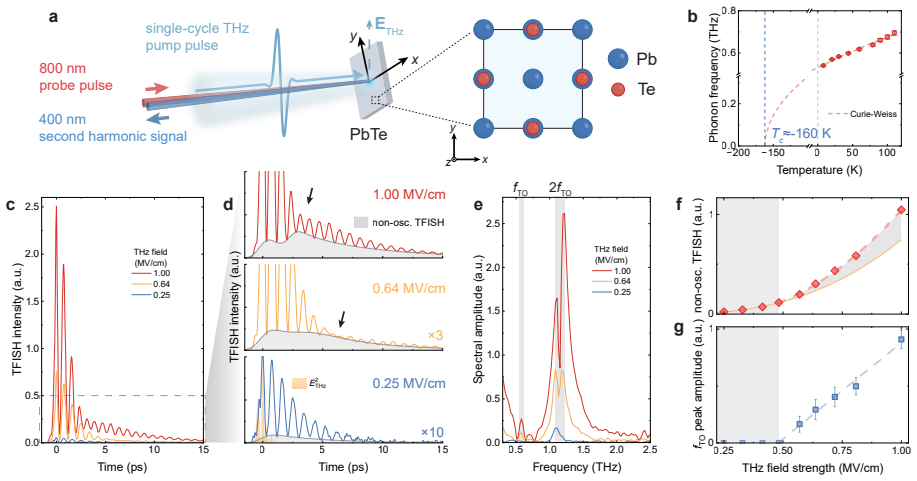
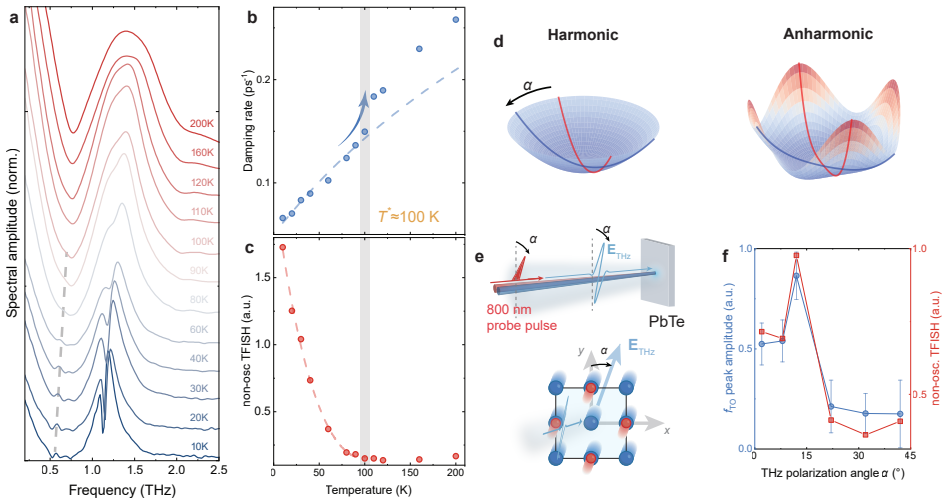
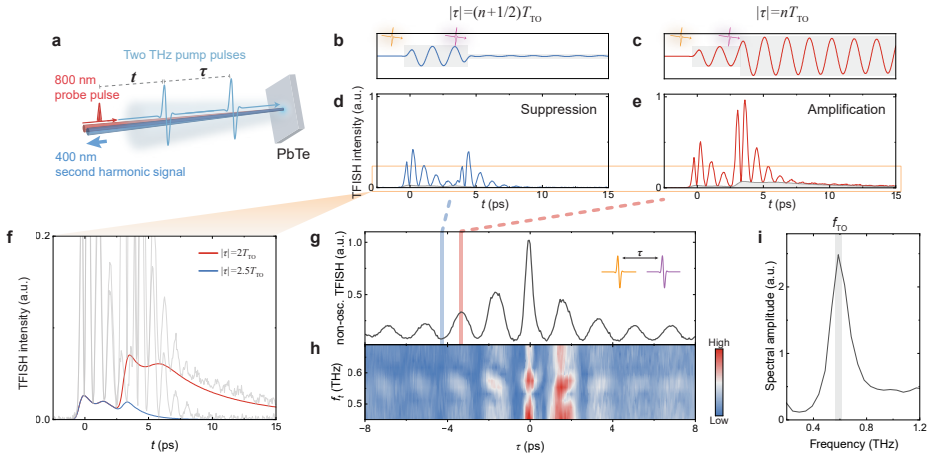
Intense terahertz excitation of a soft phonon mode induces a ferroelectric state in centrosymmetric PbTe. The light-induced symmetry-broken state can be realized up to about 100 K without relying on local dipolar fluctuations. Terahertz-driven anharmonic coupling between degenerate transverse optical phonons underlies this ferroelectric induction, and a double-pulse-excitation protocol allows coherent amplification and suppression of the induced polarization.
What carries the argument
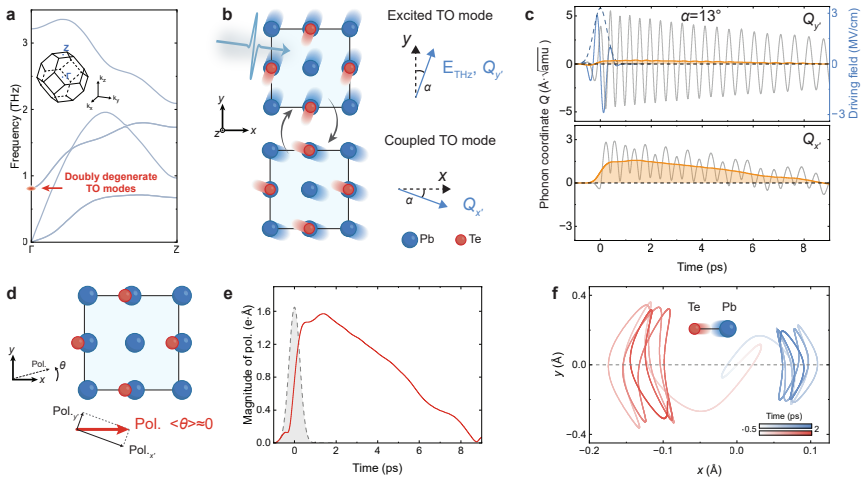
Terahertz-driven anharmonic coupling between degenerate transverse optical phonons, which generates macroscopic polarization by breaking inversion symmetry.
If this is right
- The induced ferroelectric state can be coherently amplified or suppressed with a second terahertz pulse.
- The approach does not require proximity to an equilibrium ferroelectric instability.
- Terahertz-driven anharmonic mode coupling provides a route to control mode-mediated functionalities in other quantum materials.
- Ultrafast information processing becomes possible through light-controlled polarization in materials without equilibrium order.
Where Pith is reading between the lines
- Similar anharmonic driving could induce other ordered phases such as magnetism or charge density waves in materials with strong lattice nonlinearity but no equilibrium transition.
- The 100 K temperature ceiling suggests testing whether stronger fields or different materials could extend the effect to room temperature.
- Device concepts might include light-triggered ferroelectric switches whose state is set and read on picosecond timescales.
Load-bearing premise
That the observed symmetry breaking arises specifically from the anharmonic coupling of the degenerate transverse optical phonons rather than from heating, defects, or other mechanisms.
What would settle it
A measurement showing that the induced polarization persists when the terahertz drive is detuned from the soft phonon resonance or when anharmonic coupling is suppressed by isotopic substitution would falsify the proposed mechanism.
Figures
read the original abstract
Optical control of quantum materials has progressed along two separate directions: creating non-equilibrium states inaccessible at equilibrium, and coherently controlling ultrafast dynamics with multi-pulse protocols. Ferroelectricity is especially attractive in this context because its order parameter, macroscopic polarization, directly links inversion-symmetry breaking to functional response. Yet light-induced ferroelectricity has so far been confined to quantum paraelectrics near the ferroelectric instability, where critical fluctuations obscure the formation of a homogeneous ferroelectric state and complicate its deterministic coherent control. Unifying these capabilities -- preparing a symmetry-broken state and then coherently steering its functionality -- remains a central challenge. Here we show that intense terahertz excitation of a soft phonon mode induces a ferroelectric state in centrosymmetric PbTe, a thermoelectric material with strong lattice anharmonicity but no ferroelectric transition at finite temperature. The light-induced symmetry-broken state can be realized up to about 100 K, without relying on local dipolar fluctuations. Experiment and theory together reveal that terahertz-driven anharmonic coupling between degenerate transverse optical phonons underlies this ferroelectric induction. Furthermore, we demonstrate coherent amplification and suppression of the induced polarization via a double-pulse-excitation protocol. These results establish terahertz-driven anharmonic mode coupling as a general strategy for controlling mode-mediated functionalities in quantum materials, opening a route to ultrafast information processing.
Editorial analysis
A structured set of objections, weighed in public.
Referee Report
Summary. The manuscript claims that intense terahertz excitation of a soft phonon mode in centrosymmetric PbTe induces a ferroelectric state up to ~100 K via anharmonic coupling between degenerate transverse optical phonons, without relying on local dipolar fluctuations; experiment and theory together identify this mechanism, and a double-pulse protocol enables coherent amplification or suppression of the induced polarization.
Significance. If substantiated, the result would establish THz-driven anharmonic mode coupling as a route to dynamical ferroelectricity in materials lacking an equilibrium transition, while adding coherent multi-pulse control; this could generalize to other anharmonic quantum materials for ultrafast functionality.
major comments (2)
- [theory section / abstract mechanism paragraph] Abstract and theory section: the central attribution of symmetry breaking to anharmonic coupling between the two degenerate TO phonons is asserted but requires explicit isolation; the manuscript must show the cubic or quartic terms in the phonon Hamiltonian (or derived effective potential) that produce a net macroscopic polarization, together with quantitative exclusion of heating or multi-phonon alternatives up to 100 K.
- [experimental results] Experimental controls: the claim that the light-induced state does not rely on local dipolar fluctuations needs direct comparison (e.g., temperature-jump estimates or fluence-dependent polarization onset) that rules out thermal or fluctuation-driven mechanisms at the reported temperatures.
minor comments (1)
- Notation for the soft phonon mode and the two degenerate TO branches should be defined consistently when first introduced.
Simulated Author's Rebuttal
We thank the referee for the constructive feedback and positive evaluation of the work's significance. Below we respond point-by-point to the major comments, indicating where revisions will be made to strengthen the manuscript.
read point-by-point responses
-
Referee: Abstract and theory section: the central attribution of symmetry breaking to anharmonic coupling between the two degenerate TO phonons is asserted but requires explicit isolation; the manuscript must show the cubic or quartic terms in the phonon Hamiltonian (or derived effective potential) that produce a net macroscopic polarization, together with quantitative exclusion of heating or multi-phonon alternatives up to 100 K.
Authors: We agree that the explicit anharmonic terms and their isolation require clearer presentation. The theory derives an effective potential from the quartic anharmonic interaction between the degenerate TO modes, yielding a term that stabilizes a finite macroscopic polarization; we will add the explicit phonon Hamiltonian terms and the resulting effective potential expression in the revised theory section. Quantitative estimates already in the supporting calculations show absorbed-energy heating below 5 K and suppression of multi-phonon channels up to 100 K due to energy mismatch; these will be moved into the main text with additional plots. revision: yes
-
Referee: Experimental controls: the claim that the light-induced state does not rely on local dipolar fluctuations needs direct comparison (e.g., temperature-jump estimates or fluence-dependent polarization onset) that rules out thermal or fluctuation-driven mechanisms at the reported temperatures.
Authors: The fluence-dependent polarization data already exhibit a sharp onset threshold inconsistent with thermal activation or fluctuation-driven processes. We will add explicit temperature-jump calculations based on the measured absorption coefficient, confirming the lattice temperature rise remains well below 10 K at all reported fluences and temperatures up to 100 K. These additions will directly compare against the expected thermal and fluctuation scales. revision: partial
Circularity Check
No significant circularity detected; derivation remains self-contained.
full rationale
The paper frames its central claim as the joint outcome of independent experiment and theory, with the anharmonic coupling mechanism presented as revealed rather than presupposed. No equations, fitted parameters renamed as predictions, or load-bearing self-citations appear in the provided text that would reduce any result to a definitional input or prior ansatz by construction. The derivation chain does not exhibit any of the enumerated circular patterns and stands as externally falsifiable via the described THz excitation and double-pulse protocols.
Axiom & Free-Parameter Ledger
axioms (1)
- domain assumption PbTe possesses strong lattice anharmonicity
Reference graph
Works this paper leans on
-
[1]
& Moore, J
Keimer, B. & Moore, J. E. The physics of quantum materials.Nat. Phys.13,1045–1055 (2017)
2017
-
[2]
& Zhou, S
Bao, C., Tang, P., Sun, D. & Zhou, S. Light-induced emergent phenomena in 2D materials and topological materials.Nat. Rev. Phys.4,33–48 (2022)
2022
-
[3]
Phys.16,159–163 (2020)
Kogar, A.et al.Light-induced charge density wave in LaTe 3.Nat. Phys.16,159–163 (2020)
2020
-
[4]
Zong, A.et al.Role of equilibrium fluctuations in light-induced order.Phys. Rev. Lett.127,227401 (2021)
2021
-
[5]
S.et al.Photo-induced high-temperature ferromagnetism in YTiO 3.Nature617,73–78 (2023)
Disa, A. S.et al.Photo-induced high-temperature ferromagnetism in YTiO 3.Nature617,73–78 (2023)
2023
-
[6]
S.et al.Polarizing an antiferromagnet by optical engineering of the crystal field.Nat
Disa, A. S.et al.Polarizing an antiferromagnet by optical engineering of the crystal field.Nat. Phys. 16,937–941 (2020)
2020
-
[7]
Ilyas, B.et al.Terahertz field-induced metastable magnetization near criticality in FePS 3.Nature636, 609–614 (2024)
2024
-
[8]
Photonics5, 31–34 (2011)
Kampfrath, T.et al.Coherent terahertz control of antiferromagnetic spin waves.Nat. Photonics5, 31–34 (2011)
2011
-
[9]
G.et al.Coherent control of a surface structural phase transition.Nature583,232–236 (2020)
Horstmann, J. G.et al.Coherent control of a surface structural phase transition.Nature583,232–236 (2020)
2020
-
[10]
& Ron, A
Scharf, G., Hasharoni, T., Donval, L., Ben Gur, L. & Ron, A. Coherent control through phonon anharmonicity.Nat. Commun.(2026)
2026
-
[11]
Blank, T. G. H.et al.Empowering control of antiferromagnets by THz-induced spin coherence.Phys. Rev. Lett.131,096701 (2023)
2023
-
[12]
Adv.9,eadi4661 (2023)
Maklar, J.et al.Coherent light control of a metastable hidden state.Sci. Adv.9,eadi4661 (2023)
2023
-
[13]
Li, X.et al.Terahertz field-induced ferroelectricity in quantum paraelectric SrTiO3.Science364, 1079–1082 (2019)
2019
-
[14]
F., Disa, A
Nova, T. F., Disa, A. S., Fechner, M. & Cavalleri, A. Metastable ferroelectricity in optically strained SrTiO3.Science364,1075–1079 (2019)
2019
-
[15]
Li, W.et al.A hidden quantum paraelectric phase in SrTiO 3 induced by terahertz field.arXiv,preprint at arXiv:2412.20887 (2024)
arXiv 2024
-
[16]
L., Shen, Z
Cheng, B., Kramer, P. L., Shen, Z. -X. & Hoffmann, M. C. Terahertz-driven local dipolar correlation in a quantum paraelectric.Phys. Rev. Lett.130,126902 (2023)
2023
-
[17]
Shin, D.et al.Simulating terahertz field-induced ferroelectricity in quantum paraelectric SrTiO3.Phys. Rev. Lett.129,167401 (2022)
2022
-
[18]
Qi, T., Shin, Y.-H., Yeh, K.-L., Nelson, K. A. & Rappe, A. M. Collective coherent control: synchronization of polarization in ferroelectric PbTiO 3 by shaped THz fields.Phys. Rev. Lett.102,247603 (2009)
2009
-
[19]
& Cavalleri, A
Mankowsky, R., von Hoegen, A., F¨ orst, M. & Cavalleri, A. Ultrafast reversal of the ferroelectric polarization.Phys. Rev. Lett.118,197601 (2017). 16
2017
-
[20]
Itoh, M.et al.Ferroelectricity induced by oxygen isotope exchange in strontium titanate perovskite. Phys. Rev. Lett.82,3540–3543 (1999)
1999
-
[21]
Phys.21,961–965 (2025)
Orenstein, G.et al.Observation of polarization density waves in SrTiO 3.Nat. Phys.21,961–965 (2025)
2025
-
[22]
S.et al.All-optical seeding of a light-induced phase transition with correlated disorder
Johnson, A. S.et al.All-optical seeding of a light-induced phase transition with correlated disorder. Nat. Phys.20,970–975 (2024)
2024
-
[23]
& Minkiewicz, V
Alperin, H., Pickart, S., Rhyne, J. & Minkiewicz, V. Softening of the transverse-optic mode in PbTe. Phys. Lett. A40,295–296 (1972)
1972
-
[24]
Jensen, K. M. Ø.et al.Lattice dynamics reveals a local symmetry breaking in the emergent dipole phase of PbTe.Phys. Rev. B86,085313 (2012)
2012
-
[25]
& Marianetti, C
Chen, Y., Ai, X. & Marianetti, C. A. First-principles approach to nonlinear lattice dynamics: anomalous spectra in PbTe.Phys. Rev. Lett.113,105501 (2014)
2014
-
[26]
Mater.10,614–619 (2011)
Delaire, O.et al.Giant anharmonic phonon scattering in PbTe.Nat. Mater.10,614–619 (2011)
2011
-
[27]
Xia, Y.et al.High-throughput study of lattice thermal conductivity in binary rocksalt and zinc blende compounds including higher-order anharmonicity.Phys. Rev. X10,041029 (2020)
2020
-
[28]
S.et al.Entropically stabilized local dipole formation in lead chalcogenides.Science330, 1660–1663 (2010)
Boˇ zin, E. S.et al.Entropically stabilized local dipole formation in lead chalcogenides.Science330, 1660–1663 (2010)
2010
-
[29]
Sangiorgio, B.et al.Correlated local dipoles in PbTe.Phys. Rev. Mater.2,085402 (2018)
2018
-
[30]
V., Rønnow, H
Aeppli, G., Balatsky, A. V., Rønnow, H. M. & Spaldin, N. A. Hidden, entangled and resonating order. Nat. Rev. Mater.5,477–479 (2020)
2020
-
[31]
Von Hoegen, A.et al.Amplification of superconducting fluctuations in driven YBa2Cu3O6+x.Phys. Rev. X12,031008 (2022)
2022
-
[32]
Taherian, N.et al.Probing amplified Josephson plasmons in YBa2Cu3O6+x by multidimensional spectroscopy.npj Quantum Mater.10,54 (2025)
2025
-
[33]
& Prato, D.Nonlinear Optics(Academic Press, 2008)
Boyd, R. & Prato, D.Nonlinear Optics(Academic Press, 2008)
2008
-
[34]
Schlauderer, S.et al.Temporal and spectral fingerprints of ultrafast all-coherent spin switching.Nature 569,383–387 (2019)
2019
-
[35]
Rohrbach, D., Zhang, Z., Kurihara, T. & Nelson, K. A. Discovery of magnon self-interaction in a strongly driven antiferromagnet.arXiv,preprint at arXiv:2506.19040 (2025)
arXiv 2025
-
[36]
Phys.20, 788–793 (2024)
Zhang, Z.et al.Terahertz-field-driven magnon upconversion in an antiferromagnet.Nat. Phys.20, 788–793 (2024)
2024
-
[37]
Zhang, Z.et al.Terahertz field-induced nonlinear coupling of two magnon modes in an antiferromagnet. Nat. Phys.20,801–806 (2024)
2024
-
[38]
A.et al.Terahertz light-driven coupling of antiferromagnetic spins to lattice.Science 374,1608–1611 (2021)
Mashkovich, E. A.et al.Terahertz light-driven coupling of antiferromagnetic spins to lattice.Science 374,1608–1611 (2021). 17
2021
-
[39]
Huang, C., Mootz, M., Luo, L., Perakis, I. E. & Wang, J. Terahertz 2D coherent spectroscopy for probing and controlling multicorrelations in quantum matter.Nat. Rev. Phys.8,171–185 (2026)
2026
-
[40]
Radaelli, P. G. Breaking symmetry with light: ultrafast ferroelectricity and magnetism from three-phonon coupling.Phys. Rev. B97,085145 (2018)
2018
-
[41]
& Georges, A
Subedi, A., Cavalleri, A. & Georges, A. Theory of nonlinear phononics for coherent light control of solids.Phys. Rev. B89,220301 (2014)
2014
-
[42]
Mankowsky, R.et al.Nonlinear lattice dynamics as a basis for enhanced superconductivity in YBa2Cu3O6.5.Nature516,71–73 (2014)
2014
-
[43]
Boolakee, T.et al.Light-field control of real and virtual charge carriers.Nature605,251–255 (2022)
2022
-
[44]
Gucci, F.et al.Encoding and manipulating ultrafast coherent valleytronic information with lightwaves. Nat. Photonics20,266–272 (2026)
2026
-
[45]
E., Williams, J
Cole, B. E., Williams, J. B., King, B. T., Sherwin, M. S. & Stanley, C. R. Coherent manipulation of semiconductor quantum bits with terahertz radiation.Nature410,60–63 (2001)
2001
-
[46]
M.et al.Chiral phonons.Nat
Juraschek, D. M.et al.Chiral phonons.Nat. Phys.21,1532–1540 (2025)
2025
-
[47]
Baydin, A.et al.Magnetic control of soft chiral phonons in PbTe.Phys. Rev. Lett.128,075901 (2022)
2022
-
[48]
Luo, J.et al.Large effective magnetic fields from chiral phonons in rare-earth halides.Science382, 698–702 (2023)
2023
-
[49]
Basini, M.et al.Terahertz electric-field-driven dynamical multiferroicity in SrTiO 3.Nature628,534–539 (2024)
2024
-
[50]
S.et al.Phononic switching of magnetization by the ultrafast Barnett effect.Nature628, 540–544 (2024)
Davies, C. S.et al.Phononic switching of magnetization by the ultrafast Barnett effect.Nature628, 540–544 (2024)
2024
-
[51]
& Juraschek, D
Paiva, C., Fechner, M. & Juraschek, D. M. Dynamically induced multiferroic polarization.Phys. Rev. Lett.135,066702 (2025)
2025
-
[52]
arXiv,preprint at arXiv:2501.10856 (2025)
Baydin, A.et al.Terahertz cavity phonon polaritons in lead telluride in the deep-strong coupling regime. arXiv,preprint at arXiv:2501.10856 (2025)
arXiv 2025
-
[53]
Yaniv, O. & Juraschek, D. M. Phonon polariton Hall effect.arXiv,preprint at arXiv:2509.16100 (2025)
arXiv 2025
-
[54]
Latini, S.et al.The ferroelectric photo ground state of SrTiO 3: cavity materials engineering.Proc. Natl. Acad. Sci.118,e2105618118 (2021)
2021
-
[55]
Phys.21,1926–1933 (2025)
Kipp, G.et al.Cavity electrodynamics of van der Waals heterostructures.Nat. Phys.21,1926–1933 (2025)
1926
-
[56]
Commun.16,3603 (2025)
Tay, F.et al.Multimode ultrastrong coupling in three-dimensional photonic-crystal cavities.Nat. Commun.16,3603 (2025)
2025
-
[57]
C., Hebling, J
Yeh, K.-L., Hoffmann, M. C., Hebling, J. & Nelson, K. A. Generation of 10 µJ ultrashort terahertz pulses by optical rectification.Appl. Phys. Lett.90,171121 (2007)
2007
-
[58]
Phys.21,1965–1972 (2025)
Li, W.et al.Terahertz excitation of collective dynamics of polar skyrmions over a broad temperature range.Nat. Phys.21,1965–1972 (2025). 18
1965
-
[59]
B.et al.A versatile two-dimensional terahertz spectroscopy platform with dual independently controlled intense pulses.Rev
Wang, X. B.et al.A versatile two-dimensional terahertz spectroscopy platform with dual independently controlled intense pulses.Rev. Sci. Instrum.97,033001 (2026)
2026
-
[60]
& Furthm¨ uller, J
Kresse, G. & Furthm¨ uller, J. Efficiency of ab-initio total energy calculations for metals and semiconduc- tors using a plane-wave basis set.Comput. Mater. Sci.6,15–50 (1996)
1996
-
[61]
& Furthm¨ uller, J
Kresse, G. & Furthm¨ uller, J. Efficient iterative schemes for ab initio total-energy calculations using a plane-wave basis set.Phys. Rev. B54,11169–11186 (1996)
1996
-
[62]
Bl¨ ochl, P. E. Projector augmented-wave method.Phys. Rev. B50,17953–17979 (1994)
1994
-
[63]
P., Burke, K
Perdew, J. P., Burke, K. & Ernzerhof, M. Generalized gradient approximation made simple.Phys. Rev. Lett.77,3865–3868 (1996)
1996
-
[64]
Monkhorst, H. J. & Pack, J. D. Special points for Brillouin-zone integrations.Phys. Rev. B13, 5188–5192 (1976)
1976
-
[65]
& Giannozzi, P
Baroni, S., de Gironcoli, S., Dal Corso, A. & Giannozzi, P. Phonons and related crystal properties from density-functional perturbation theory.Rev. Mod. Phys.73,515–562 (2001)
2001
-
[66]
& Tanaka, I
Togo, A., Chaput, L., Tadano, T. & Tanaka, I. Implementation strategies in Phonopy and Phono3py. J. Phys. Condens. Matter35,353001 (2023)
2023
-
[67]
& Lee, C
Gonze, X. & Lee, C. Dynamical matrices, Born effective charges, dielectric permittivity tensors, and interatomic force constants from density-functional perturbation theory.Phys. Rev. B55,10355–10368 (1997)
1997
-
[68]
Rodriguez-Vega, M.et al.Light-driven topological and magnetic phase transitions in thin layer antifer- romagnets.The J. Phys. Chem. Lett.13,4152–4158 (2022). AcknowledgmentsThis work was supported by the National Natural Science Foundation of China (Grant Nos. 12488201 to N.-L.W., 12250008 to T.D., 12574349 to X.W., and 12234011 and 12374053 to P.T.); and...
2022
discussion (0)
Sign in with ORCID, Apple, or X to comment. Anyone can read and Pith papers without signing in.