REVIEW 3 major objections 2 minor 38 references
From Fragments to Paths: Task-Level Context Recovery for Large Industrial Codebases
T0 review · 3 major / 2 minor · reviewed 2026-06-26 · grok-4.3
Pith's one-line read DeepDiscovery recovers broader task-relevant context in large codebases by localizing anchors and inferring paths over multi-relational structures.
desk verdict DeepDiscovery's two-stage Location-Inference method reports usable gains on industrial tasks and SWE-bench Verified by pulling context from multi-relational repo graphs, but the abstract leaves the evaluation details thin. read the letter →
The pith
A machine-rendered reading of the paper's core claim, the machinery that carries it, and where it could break.
The reading
What carries the argument
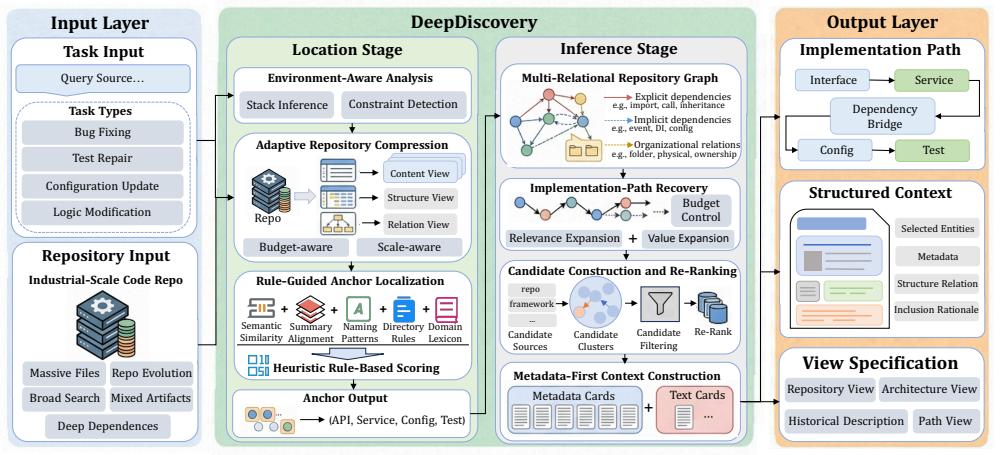
The two-stage Location--Inference framework that first localizes high-confidence task anchors and then recovers broader task-relevant context over the repository's multi-relational structure while respecting budget constraints.
What would settle it
An experiment on SWE-bench Verified or the industrial task set in which DeepDiscovery is used but the solve rate stays flat or drops and Full Recall Rate shows no improvement or declines.
Extended reading notes
Core claim
DeepDiscovery is a task-level repository-understanding method that employs a two-stage Location-Inference framework to localize high-confidence task anchors and recover broader task-relevant context over multi-relational repository structure under budget constraints. Across medium-scale tasks it produces the best file recovery quality among five baselines without offline preprocessing. On organization-internal industrial tasks it raises Full Recall Rate by 1.6 to 9.2 percentage points on large subprojects and 2.5 to 7.4 percentage points on medium-scale subprojects. In end-to-end evaluation on SWE-bench Verified a system using DeepDiscovery reaches a 78.6 percent Solve Rate, 8.2 points above
Load-bearing premise
The multi-relational repository structure supplies enough information to recover the needed broader context under budget limits without adding significant noise or omitting critical dependencies.
Editorial extensions
If this is right
- On 27 medium-scale tasks DeepDiscovery delivers the highest file recovery quality among five representative baselines without requiring offline preprocessing.
- In production-scale industrial settings it raises Full Recall Rate by absolute gains of 1.6 to 9.2 percentage points on large subprojects and 2.5 to 7.4 percentage points on medium-scale subprojects.
- Equipping an AI coding system with DeepDiscovery produces a 78.6 percent Solve Rate on SWE-bench Verified, an 8.2 percentage point gain over the baseline system.
- Stronger task-level repository understanding improves coding-agent performance on complex software engineering tasks.
Reading between the lines
- The same anchor-and-path recovery pattern could be tested on repositories outside the evaluated industrial ecosystem to check whether the gains hold when relational density differs.
- If the method is applied to multi-language or distributed codebases it might reveal whether the multi-relational assumption still supplies sufficient signals without extra preprocessing.
- Combining the recovered paths with existing fragment-based retrievers could produce a hybrid system that further reduces missing dependencies in agent workflows.
Editorial analysis
A structured set of objections, weighed in public.
Referee Report
Summary. The paper introduces DeepDiscovery, a two-stage Location-Inference framework for task-level context recovery in large industrial codebases. It localizes high-confidence task anchors and recovers broader task-relevant context over multi-relational repository structures under budget constraints. Evaluations on 27 medium-scale method-level tasks, 27+40 internal industrial tasks, and SWE-bench Verified report best-in-class file recovery quality, Full Recall Rate gains of 1.6-9.2 pp on large subprojects (2.5-7.4 pp on medium), and an 8.2 pp improvement to 78.6% solve rate over baseline.
Significance. If the empirical gains hold under the reported conditions, the work demonstrates that multi-relational path recovery can measurably improve repository understanding for coding agents without offline preprocessing, with results spanning controlled benchmarks, production-scale internal tasks, and end-to-end SWE-bench evaluation. This provides concrete evidence on a practical scaling challenge for LLM-based SE systems.
major comments (3)
- [§5.2] §5.2 (internal industrial tasks): The Full Recall Rate gains (1.6-9.2 pp on large subprojects) are attributed to the multi-relational structure and two-stage recovery, yet the section provides no ablation that isolates the inference stage or compares against single-relation baselines; without this, the load-bearing role of the multi-relational graph versus simpler retrieval remains unverified.
- [§4] §4 (Location-Inference framework): The description of path recovery under budget constraints does not include a formal characterization or guarantee of when the multi-relational graph contains the necessary task-relevant paths without omissions or noise; this directly bears on whether the reported recall and solve-rate improvements follow from the claimed mechanism.
- [§5.3] §5.3 (SWE-bench Verified): The 78.6% solve rate (+8.2 pp) is presented as end-to-end evidence, but the evaluation does not report whether the context-recovery component was ablated or whether gains persist when the underlying multi-relational graph is incomplete, leaving the central claim vulnerable to the skeptic concern.
minor comments (2)
- [Abstract] The abstract states '27 medium-scale tasks' in two separate sentences; clarify whether these refer to the same set or distinct evaluations.
- [§3] Notation for 'Full Recall Rate' is introduced without an explicit equation or definition in the early sections; add a precise definition before the results tables.
Simulated Author's Rebuttal
We thank the referee for the constructive feedback highlighting opportunities to strengthen the empirical claims. We address each major comment below, committing to revisions where the manuscript can be improved without misrepresenting the existing results.
read point-by-point responses
-
Referee: [§5.2] §5.2 (internal industrial tasks): The Full Recall Rate gains (1.6-9.2 pp on large subprojects) are attributed to the multi-relational structure and two-stage recovery, yet the section provides no ablation that isolates the inference stage or compares against single-relation baselines; without this, the load-bearing role of the multi-relational graph versus simpler retrieval remains unverified.
Authors: We agree that an explicit ablation isolating the two-stage inference and multi-relational components on the internal tasks would strengthen attribution. The current section relies on comparisons to external baselines, which provide supporting but indirect evidence. In the revised manuscript we will add a dedicated ablation subsection comparing the full framework against single-relation variants and a no-inference baseline on the 27+40 internal tasks. revision: yes
-
Referee: [§4] §4 (Location-Inference framework): The description of path recovery under budget constraints does not include a formal characterization or guarantee of when the multi-relational graph contains the necessary task-relevant paths without omissions or noise; this directly bears on whether the reported recall and solve-rate improvements follow from the claimed mechanism.
Authors: The manuscript presents Location-Inference as a practical, budget-constrained heuristic rather than a formally guaranteed procedure; no formal characterization or completeness guarantee is claimed. We will revise §4 to explicitly note the empirical, heuristic nature of the method and add a short discussion of observed conditions (based on the reported evaluations) under which path recovery succeeds or degrades. revision: yes
-
Referee: [§5.3] §5.3 (SWE-bench Verified): The 78.6% solve rate (+8.2 pp) is presented as end-to-end evidence, but the evaluation does not report whether the context-recovery component was ablated or whether gains persist when the underlying multi-relational graph is incomplete, leaving the central claim vulnerable to the skeptic concern.
Authors: We acknowledge that an ablation of the context-recovery component on SWE-bench Verified would directly address the concern. The current results are end-to-end; performing a full ablation requires additional controlled runs. We will add a limitations paragraph discussing this point and, where data permits, report a partial ablation using the existing graph-construction variants. revision: partial
Circularity Check
No circularity; empirical evaluation is self-contained
full rationale
The paper introduces DeepDiscovery as a two-stage Location-Inference method for repository context recovery and reports direct empirical gains on 27 medium-scale tasks, 40 large-scale industrial tasks, and SWE-bench Verified (78.6% solve rate, +8.2 pp). No equations, fitted parameters renamed as predictions, self-citations invoked as uniqueness theorems, or ansatzes appear in the provided text; the central claims rest on measured recall rates and end-to-end performance rather than any derivation that reduces to its own inputs by construction.
Assumptions & free parameters
Cite this review
Pith. "Pith review of From Fragments to Paths: Task-Level Context Recovery for Large Industrial Codebases." pith.science (2026). https://pith.science/paper/KGO5Y57I
@misc{pith2026260622906,
  author       = {Pith},
  title        = {Pith review of: From Fragments to Paths: Task-Level Context Recovery for Large Industrial Codebases},
  year         = {2026},
  howpublished = {\url{https://pith.science/paper/KGO5Y57I}},
  note         = {Machine review of arXiv:2606.22906}
}
read the original abstract
Large language models have shown strong performance on software engineering (SE) tasks, yet understanding large industrial repositories remains challenging. Existing methods often retrieve only local fragments and fail to recover the broader task-relevant context needed for complex repository-level tasks. We present DeepDiscovery, a task-level repository-understanding method for large industrial codebases. DeepDiscovery uses a two-stage \textit{Location--Inference} framework to localize high-confidence task anchors and recover broader task-relevant context over multi-relational repository structure under budget constraints. Across controlled method-level evaluation, organization-internal industrial repository-understanding scenarios, and end-to-end evaluation on SWE-bench Verified, DeepDiscovery consistently improves task-relevant file recovery and downstream SE performance. On 27 medium-scale tasks, DeepDiscovery achieves the best file recovery quality among five representative baselines without offline preprocessing. On organization-internal industrial tasks from a production-scale integrated codebase ecosystem, including 27 medium-scale tasks and 40 large-scale tasks, DeepDiscovery improves Full Recall Rate across multiple AI coding systems, with absolute gains ranging from 1.6 to 9.2 percentage points on large subprojects and from 2.5 to 7.4 percentage points on medium-scale subprojects. In a controlled end-to-end evaluation on SWE-bench Verified, a system equipped with DeepDiscovery achieves a 78.6\% Solve Rate, outperforming the corresponding baseline by 8.2 percentage points. These results suggest that stronger task-level repository understanding can improve coding-agent performance on complex SE tasks.
Figures


Reference graph
Works this paper leans on
-
[1]
Source code summarization in the era of large language models,
W. Sun, Y . Miao, Y . Li, H. Zhang, C. Fang, Y . Liu, G. Deng, Y . Liu, and Z. Chen, “Source code summarization in the era of large language models,” inProceedings of the 47th International Conference on Soft- ware Engineering, no. 1. Ottawa, Ontario, Canada: IEEE Computer Society, 27 April-3 May 2025, pp. 419–431
2025
-
[2]
Automatic code generation techniques: A systematic literature review,
M. Alharbi and M. Alshayeb, “Automatic code generation techniques: A systematic literature review,”Automated Software Engineering, vol. 33, no. 1, p. 4, 2026
2026
-
[3]
A systematic literature review on large language models for auto- mated program repair,
Q. Zhang, C. Fang, Y . Xie, Y . Ma, W. Sun, Y . Yang, and Z. Chen, “A systematic literature review on large language models for auto- mated program repair,”ACM Transactions on Software Engineering and Methodology
-
[4]
A survey of large language model agents for question answering,
M. Yue, “A survey of large language model agents for question answer- ing,”arXiv preprint arXiv:2503.19213, 2025
-
[5]
A review on edge large language models: Design, execution, and applications,
Y . Zheng, Y . Chen, B. Qian, X. Shi, Y . Shu, and J. Chen, “A review on edge large language models: Design, execution, and applications,”ACM Computing Surveys, vol. 57, no. 8, pp. 1–35, 2025
2025
-
[6]
Beyond Code Snippets: Benchmarking LLMs on Repository-Level Question Answering
Y . B. Alebachew, H. Leary, S. Vaishampayan, and C. Brown, “Beyond code snippets: Benchmarking llms on repository-level question answer- ing,”arXiv preprint arXiv:2603.26567, 2026
work page Pith review arXiv 2026
-
[7]
Archagent: Scalable legacy soft- ware architecture recovery with llms,
R. Pan, B. Mao, T. Ma, and Z. Ling, “Archagent: Scalable legacy soft- ware architecture recovery with llms,”arXiv preprint arXiv:2601.13007, 2026
-
[8]
Locobench-agent: An interactive benchmark for llm agents in long-context software engineering,
J. Qiu, Z. Liu, Z. Liu, R. Murthy, J. Zhang, H. Chen, S. Wang, M. Zhu, L. Yang, J. Tanet al., “Locobench-agent: An interactive benchmark for llm agents in long-context software engineering,”arXiv preprint arXiv:2511.13998, 2025
Show all 38 references
-
[9]
Logicscan: An llm-driven framework for detecting business logic vulnerabilities in smart contracts,
J. Gao, Z. Zhang, Y . Sun, Y . Liu, C. Liu, H. Liu, Y . Li, and Y . Liu, “Logicscan: An llm-driven framework for detecting business logic vulnerabilities in smart contracts,”arXiv preprint arXiv:2602.03271, 2026
2026
-
[10]
Missconf: Llm-enhanced reproduction of configuration- triggered bugs,
Y . Fu, T. Wang, S. Li, J. Ding, S. Zhou, Z. Jia, W. Li, Y . Jiang, and X. Liao, “Missconf: Llm-enhanced reproduction of configuration- triggered bugs,” inProceedings of the 2024 IEEE/ACM 46th Interna- tional Conference on Software Engineering: Companion Proceedings, 2024, pp. 484–495
2024
-
[11]
Make llm a testing expert: Bringing human-like interaction to mobile gui testing via functionality-aware decisions,
Z. Liu, C. Chen, J. Wang, M. Chen, B. Wu, X. Che, D. Wang, and Q. Wang, “Make llm a testing expert: Bringing human-like interaction to mobile gui testing via functionality-aware decisions,” inProceedings of the IEEE/ACM 46th International Conference on Software Engineering, 20...
2024
-
[12]
Loogle v2: Are llms ready for real world long dependency challenges?
Z. He, Y . Wang, J. Li, K. Liang, and M. Zhang, “Loogle v2: Are llms ready for real world long dependency challenges?”Advances in Neural Information Processing Systems, vol. 38, 2026
2026
-
[13]
Depen- deval: Benchmarking llms for repository dependency understanding,
J. Du, Y . Liu, H. Guo, J. Wang, H. Huang, Y . Ni, and Z. Li, “Depen- deval: Benchmarking llms for repository dependency understanding,” in Findings of the Association for Computational Linguistics: ACL 2025, 2025, pp. 7150–7179
2025
-
[14]
Repomaster: Autonomous exploration and understanding of github repositories for complex task solving,
H. Wang, Z. Ni, S. Zhang, S. Lu, S. Hu, Z. He, C. Hu, J. Lin, Y . Guo, Y . Duet al., “Repomaster: Autonomous exploration and understanding of github repositories for complex task solving,”Advances in Neural Information Processing Systems, vol. 38, pp. 106 320–106 359, 2026
2026
-
[15]
Dependency matters: Enhancing llm reasoning with explicit knowledge grounding,
X. Wen, M. Li, J. Huang, J. Zhong, Z. Xu, Z. Li, Y . Huang, M. Yuan, and Q. Xu, “Dependency matters: Enhancing llm reasoning with explicit knowledge grounding,”Advances in Neural Information Processing Systems, vol. 38, pp. 57 966–57 992, 2026
2026
-
[16]
Gfm-rag: graph foundation model for retrieval augmented generation,
L. Luo, Z. Zhao, R. Haffari, D. Phung, C. Gong, and S. Pan, “Gfm-rag: graph foundation model for retrieval augmented generation,”Advances in Neural Information Processing Systems, vol. 38, pp. 36 371–36 405, 2026
2026
-
[17]
Vector graph-based repository understand- ing for issue-driven file retrieval,
K. Bevziuk, A. Fatula, S. L. Y . Opanasenko, A. Tukhtarova, A. J. P. Sharma, and H. Shrivastava, “Vector graph-based repository understand- ing for issue-driven file retrieval,”arXiv preprint arXiv:2510.08876, 2025
2025
-
[18]
Alibaba lingmaagent: Improving automated issue resolution via comprehensive repository exploration,
Y . Ma, Q. Yang, R. Cao, B. Li, F. Huang, and Y . Li, “Alibaba lingmaagent: Improving automated issue resolution via comprehensive repository exploration,” inProceedings of the 33rd ACM International Conference on the Foundations of Software Engineering, 2025, pp. 238– 249
2025
-
[19]
Graphcodeagent: Dual graph-guided llm agent for retrieval-augmented repo-level code generation,
J. Li, X. Shi, K. Zhang, G. Li, Z. Jin, L. Li, H. Zhang, F. Liu, Y . Zhang, Z. Taoet al., “Graphcodeagent: Dual graph-guided llm agent for retrieval-augmented repo-level code generation,”arXiv preprint arXiv:2504.10046, 2025
2025
-
[20]
Multi-agent llms for autonomous workflow orchestration,
M. K. Patel, “Multi-agent llms for autonomous workflow orchestration,” International Journal of Research and Applied Innovations, vol. 8, no. 1, pp. 11 644–11 647, 2025
2025
-
[21]
Acebench: A comprehensive evaluation of llm tool usage,
C. Chen, X. Hao, W. Liu, X. Huang, X. Zeng, S. Yu, D. Li, Y . Huang, X. Liu, W. Xinzhiet al., “Acebench: A comprehensive evaluation of llm tool usage,”Findings of the Association for Computational Linguistics: EMNLP, vol. 2025, pp. 12 970–12 998, 2025
2025
-
[22]
Advancing llm reasoning generalists with pref- erence trees,
L. Yuan, G. Cui, H. Wang, N. Ding, X. Wang, B. Shan, Z. Liu, J. Deng, H. Chen, R. Xieet al., “Advancing llm reasoning generalists with pref- erence trees,” inInternational Conference on Learning Representations, vol. 2025, 2025, pp. 24 897–24 919
2025
-
[23]
Agentinit: Initializing llm-based multi-agent systems via diversity and expertise orchestration for effective and efficient collaboration,
C. Tian, Y . Wang, X. Liu, Z. Wang, L. Ding, M. Zhang, and M. Zhang, “Agentinit: Initializing llm-based multi-agent systems via diversity and expertise orchestration for effective and efficient collaboration,” in Findings of the Association for Computational Linguistics: EMNLP...
2025
-
[24]
Swe-bench: Can language models resolve real-world github issues?
C. E. Jimenez, J. Yang, A. Wettig, S. Yao, K. Pei, O. Press, and K. Narasimhan, “Swe-bench: Can language models resolve real-world github issues?” inInternational Conference on Learning Representa- tions, vol. 2024, 2024, pp. 54 107–54 157
2024
-
[25]
Terminal- bench: Benchmarking agents on hard, realistic tasks in command line interfaces,
M. A. Merrill, A. G. Shaw, N. Carlini, B. Li, H. Raj, I. Bercovich, L. Shi, J. Y . Shin, T. Walshe, E. K. Buchananet al., “Terminal- bench: Benchmarking agents on hard, realistic tasks in command line interfaces,”arXiv preprint arXiv:2601.11868, 2026
2026 arXiv
-
[26]
Procbench: Evaluating process-level defects and control preservation in llm coding agents,
J. He, J. Jia, C. Liu, C. Xue, Y . Song, X. Yang, and D. Sun, “Procbench: Evaluating process-level defects and control preservation in llm coding agents,”arXiv preprint arXiv:2605.20251, 2026
2026 arXiv
-
[27]
CodeAgent: Enhancing code generation with tool-integrated agent systems for real-world repo-level coding challenges,
K. Zhang, J. Li, G. Li, X. Shi, and Z. Jin, “CodeAgent: Enhancing code generation with tool-integrated agent systems for real-world repo-level coding challenges,” inProceedings of the 62nd Annual Meeting of the Association for Computational Linguistics (Volume 1: Long Papers),...
2024
-
[28]
An empirical study of retrieval-augmented code generation: Challenges and opportunities,
Z. Yang, S. Chen, C. Gao, Z. Li, X. Hu, K. Liu, and X. Xia, “An empirical study of retrieval-augmented code generation: Challenges and opportunities,”ACM Transactions on Software Engineering and Methodology, vol. 34, no. 7, pp. 1–28, 2025
2025
-
[29]
Vul-rag: Enhancing llm-based vulnerability detection via knowledge-level rag,
X. Du, G. Zheng, K. Wang, Y . Zou, Y . Wang, W. Deng, J. Feng, M. Liu, B. Chen, X. Penget al., “Vul-rag: Enhancing llm-based vulnerability detection via knowledge-level rag,”ACM Transactions on Software Engineering and Methodology
-
[30]
Empower- ing graphrag with knowledge filtering and integration,
K. Guo, H. Shomer, S. Zeng, H. Han, Y . Wang, and J. Tang, “Empower- ing graphrag with knowledge filtering and integration,” inProceedings of the 2025 Conference on Empirical Methods in Natural Language Processing, 2025, pp. 25 450–25 464
2025
-
[31]
From local to global: A graph rag approach to query-focused summarization,
D. Edge, H. Trinh, N. Cheng, J. Bradley, A. Chao, A. Mody, S. Truitt, D. Metropolitansky, R. O. Ness, and J. Larson, “From local to global: A graph rag approach to query-focused summarization,”arXiv preprint arXiv:2404.16130, 2024
2024 arXiv
-
[32]
Reliable graph-rag for codebases: Ast- derived graphs vs llm-extracted knowledge graphs,
M. R. Chinthareddy, “Reliable graph-rag for codebases: Ast- derived graphs vs llm-extracted knowledge graphs,”arXiv preprint arXiv:2601.08773, 2026
2026
-
[33]
Retrievalattention: Accelerating long-context llm inference via vector retrieval,
D. Liu, M. Chen, B. Lu, H. Jiang, Z. Han, Q. Zhang, Q. Chen, C. Zhang, B. Ding, K. Zhanget al., “Retrievalattention: Accelerating long-context llm inference via vector retrieval,”Advances in Neural Information Processing Systems, vol. 38, pp. 54 358–54 385, 2026
2026
-
[34]
Burstgpt: A real-world workload dataset to optimize llm serving systems,
Y . Wang, Y . Chen, Z. Li, X. Kang, Y . Fang, Y . Zhou, Y . Zheng, Z. Tang, X. He, R. Guoet al., “Burstgpt: A real-world workload dataset to optimize llm serving systems,” inProceedings of the 31st ACM SIGKDD Conference on Knowledge Discovery and Data Mining V . 2, 2025, pp. 5831–5841
2025
-
[35]
Ds-mhp: Improving chain-of-thought through dynamic subgraph-guided multi- hop path,
Y . Liu, Q. Peng, B. Liu, H. Liu, X. Li, and W. Wang, “Ds-mhp: Improving chain-of-thought through dynamic subgraph-guided multi- hop path,” inFindings of the Association for Computational Linguistics: EMNLP 2025, 2025, pp. 11 216–11 230
2025
-
[36]
Smooth reading: Bridging the gap of recurrent llm to self-attention llm on long- context understanding,
K. Liu, Z. Su, P. Dong, F. Mo, J. Gao, S. Zhang, and K. Chen, “Smooth reading: Bridging the gap of recurrent llm to self-attention llm on long- context understanding,” inThe Fourteenth International Conference on Learning Representations
-
[37]
Easytool: Enhancing llm-based agents with concise tool instruction,
S. Yuan, K. Song, J. Chen, X. Tan, Y . Shen, K. Ren, D. Li, and D. Yang, “Easytool: Enhancing llm-based agents with concise tool instruction,” inProceedings of the 2025 Conference of the Nations of the Americas Chapter of the Association for Computational Linguistics: Human La...
2025
-
[38]
Retrieve-plan-generation: An iterative planning and answering frame- work for knowledge-intensive llm generation,
Y . Lyu, Z. Niu, Z. Xie, C. Zhang, T. Xu, Y . Wang, and E. Chen, “Retrieve-plan-generation: An iterative planning and answering frame- work for knowledge-intensive llm generation,” inProceedings of the 2024 Conference on Empirical Methods in Natural Language Process- ing, 2024...
2024
Reviewed June 26, 2026 · model on record in the stance chip above.
Discussion (0). Continue with ORCID to comment.