Exploring Pion-Induced High-Momentum Components in Nuclei via (p,p'π) Reactions
Pith reviewed 2026-06-26 06:33 UTC · model grok-4.3
The pith
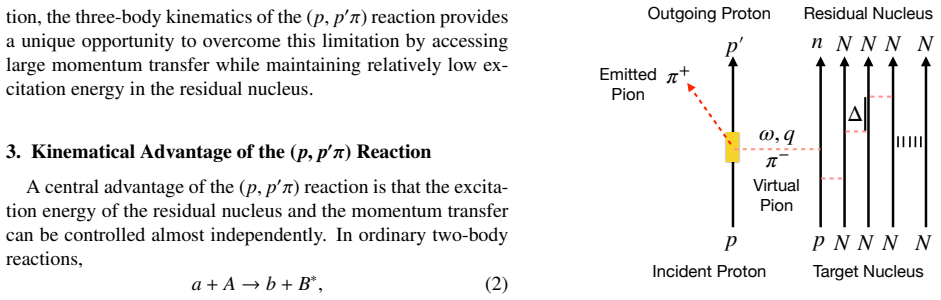
The (p,p'π) reaction kinematics allow large momentum transfer with low residual excitation, enabling studies of pion-induced high-momentum components.
A machine-rendered reading of the paper's core claim, the machinery that carries it, and where it could break.
Core claim
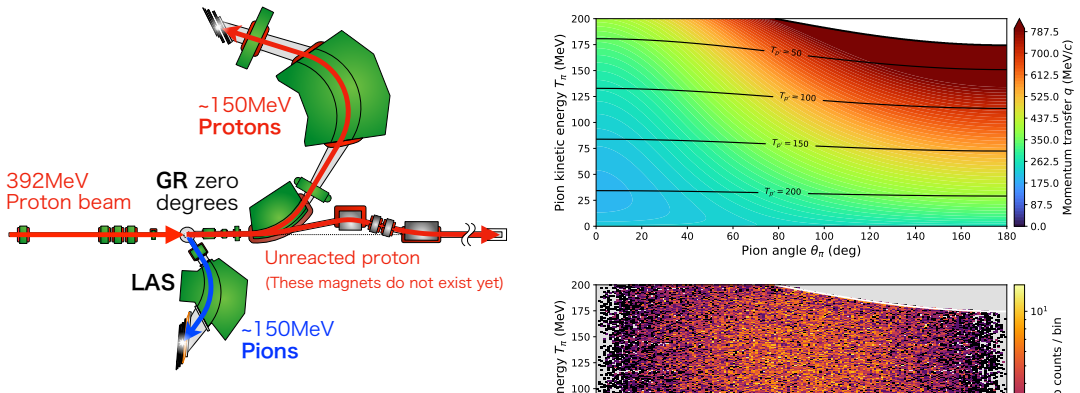
Lorentz-invariant three-body phase-space calculations for the 12C(p,p'π+)12B reaction at 392 MeV identify experimentally accessible regions of large momentum transfer while keeping the excitation energy of the residual nucleus low; these maps furnish a model-independent kinematical foundation for future experiments on pion-induced correlations and high-momentum components.
What carries the argument
Lorentz-invariant three-body phase-space calculation that traces momentum transfer across the reaction's kinematic variables under a constant transition amplitude.
If this is right
- Regions of large momentum transfer become experimentally accessible while residual excitation stays low.
- The maps supply direct guidance for optimizing detector acceptance in a double-arm spectrometer at RCNP.
- The same kinematic framework can be reused for other targets without introducing model dependence from the amplitude.
- Future data in the identified regions can be compared directly to the calculated phase-space density to isolate dynamical effects.
Where Pith is reading between the lines
- The same three-body kinematic approach could be applied to heavier nuclei to test whether high-momentum components scale with mass number.
- Combining the identified (p,p'π) kinematics with existing (e,e'p) data on the same nucleus would allow a cross-check of the momentum distribution extracted by two different probes.
- If the constant-amplitude regions prove experimentally clean, the reaction could serve as a calibration tool for other reactions that aim to isolate pion-exchange contributions.
Load-bearing premise
The transition amplitude remains constant and independent of kinematics throughout the explored phase space.
What would settle it
A measurement of the double-differential cross section that shows strong variation with kinematics where the phase-space calculation predicts uniform coverage would falsify the constant-amplitude premise used to locate the accessible regions.
Figures
read the original abstract
Pion exchange plays a fundamental role in nuclear structure and is responsible for tensor correlations and high-momentum components in nuclei. The $(p,p'\pi)$ reaction provides a unique opportunity to investigate pion dynamics under large-momentum-transfer conditions. Its three-body kinematics allows large momentum transfer to be achieved while keeping the excitation energy of the residual nucleus low. We investigate the kinematical properties of the $^{12}\mathrm{C}(p,p'\pi^+)^{12}\mathrm{B}$ reaction using Lorentz-invariant three-body phase-space calculations. The calculations were performed for a 392-MeV proton beam assuming a constant transition amplitude. The resulting momentum-transfer map and phase-space distribution identify experimentally accessible regions of large momentum transfer and provide guidance for optimizing a double-arm spectrometer experiment at RCNP. The present study establishes a model-independent kinematical foundation for future investigations of pion-induced correlations, high-momentum components, and pion dynamics in nuclei.
Editorial analysis
A structured set of objections, weighed in public.
Referee Report
Summary. The manuscript computes Lorentz-invariant three-body phase-space distributions for the ^{12}C(p,p'π⁺)^{12}B reaction at 392 MeV proton beam energy under the explicit assumption of a constant transition amplitude. It generates momentum-transfer maps and phase-space distributions to identify kinematically allowed regions of large momentum transfer at low residual excitation energy, with the goal of providing guidance for optimizing a double-arm spectrometer experiment at RCNP to study pion-induced high-momentum components.
Significance. The phase-space calculations supply a clear kinematical framework for experiment design in an area where direct access to high-momentum pion-exchange effects is otherwise difficult; if the constant-amplitude maps prove robust, they could usefully inform spectrometer acceptance choices and beam-energy selections for future (p,p'π) measurements.
major comments (2)
- [Abstract] Abstract: the central claim that the calculation supplies a 'model-independent kinematical foundation' for experimental guidance rests on the constant transition amplitude assumption, yet no variation of |M| with Q, angle, or invariant mass is performed or compared against expected pion-exchange or form-factor dependence; this directly affects the reliability of the flagged high-Q regions.
- [Results / Kinematics section] The phase-space maps are presented as identifying 'experimentally accessible regions,' but without quantifying how a realistic |M(Q)| would reshape the yield distribution the maps remain conditional; a sensitivity study (even with a simple parametrization) is required to support the optimization guidance for RCNP.
minor comments (1)
- [Kinematics] Notation for the three-body invariants and the definition of the momentum transfer Q should be stated explicitly in a dedicated equation early in the kinematics section to avoid ambiguity when readers compare to other (p,p'π) studies.
Simulated Author's Rebuttal
We thank the referee for the detailed and constructive report. The comments correctly highlight the implications of our constant-amplitude assumption. We respond to each major point below and indicate the revisions we will make.
read point-by-point responses
-
Referee: [Abstract] Abstract: the central claim that the calculation supplies a 'model-independent kinematical foundation' for experimental guidance rests on the constant transition amplitude assumption, yet no variation of |M| with Q, angle, or invariant mass is performed or compared against expected pion-exchange or form-factor dependence; this directly affects the reliability of the flagged high-Q regions.
Authors: We agree that the phrasing 'model-independent kinematical foundation' is imprecise given the constant-|M| assumption and could mislead readers about the robustness of the high-Q regions. The calculations are independent of nuclear-structure models but do rely on constant amplitude. We will revise the abstract to state that the maps provide a kinematical framework under the explicit assumption of constant transition amplitude, thereby clarifying the scope and addressing the concern about reliability. revision: yes
-
Referee: [Results / Kinematics section] The phase-space maps are presented as identifying 'experimentally accessible regions,' but without quantifying how a realistic |M(Q)| would reshape the yield distribution the maps remain conditional; a sensitivity study (even with a simple parametrization) is required to support the optimization guidance for RCNP.
Authors: The referee is correct that the distributions are conditional on constant |M| and that a sensitivity study would strengthen the experimental guidance. However, introducing any parametrization of |M(Q)| would necessarily add model dependence, which is outside the stated scope of mapping purely kinematic accessibility. We will add a concise paragraph in the discussion section noting this limitation, stating that the identified regions remain kinematically allowed provided |M| is non-vanishing, and suggesting that future work incorporate realistic amplitudes. This constitutes a partial revision. revision: partial
Circularity Check
No circularity: direct kinematic phase-space calculation with explicit assumption
full rationale
The paper performs Lorentz-invariant three-body phase-space calculations for the ¹²C(p,p'π⁺)¹²B reaction at fixed beam energy under the stated assumption of constant transition amplitude. The output (momentum-transfer map and phase-space distribution) is the direct numerical result of that computation and is presented as a kinematical foundation rather than a derived prediction from fitted parameters or prior self-referential results. No self-citations, uniqueness theorems, or reductions of the claimed result to its own inputs appear in the provided text. The constant-amplitude modeling choice is an explicit limitation, not a hidden circularity.
Axiom & Free-Parameter Ledger
free parameters (1)
- constant transition amplitude
axioms (1)
- standard math Three-body final state can be described by Lorentz-invariant phase space
Reference graph
Works this paper leans on
-
[1]
T. E. O. Ericson and W. Weise,Pions and Nuclei, Oxford University Press, Oxford (1988)
1988
-
[2]
T. Myo, K. Kato, H. Toki, and K. Ikeda, Prog. Theor. Phys. 119, 561 (2008)
2008
-
[3]
Toki and W
H. Toki and W. Weise, Phys. Rev. Lett.42, 1034 (1979)
1979
-
[4]
Fujiwara, H
M. Fujiwara, H. Akimune, I. Daito, H. Ejiri, K. Fujita, Y . Fujita, M. N. Harakeh, T. Hashimoto, K. Hatanaka, M. Hosaka, S. Kawakami, H. Kuboki, Y . Maeda, H. Miy- atake, M. Nakamura, T. Noro, A. Sakai, Y . Shimizu, Y . Tonegawa, H. Toyokawa, M. Yosoi, Nucl. Instrum. Methods Phys. Res. A422, 484 (1999)
1999
-
[5]
Matsuoka, T
N. Matsuoka, T. Noro, H. Sakaguchi, T. Yabe, Nucl. In- strum. Methods Phys. Res. A345, 1 (1994)
1994
-
[6]
T. Miyagawa, J. Tanaka, S. Ota, M. Dozono, N. Kobayashi, L. Wickremasinghe, F. Furukawa, D. Ishii, S. Nishioka, K. Takahashi, and E. Ukai, arXiv:2605.08127 (2026). 4
Pith/arXiv arXiv 2026
discussion (0)
Sign in with ORCID, Apple, or X to comment. Anyone can read and Pith papers without signing in.