Quantum Key Distribution Without Shared Reference Frame Under Unital Noise
Pith reviewed 2026-06-26 08:00 UTC · model grok-4.3
The pith
Optimizing local bases via the Pauli transfer matrix allows BB84 and six-state QKD to reach optimal rates over unital channels without a shared reference frame.
A machine-rendered reading of the paper's core claim, the machinery that carries it, and where it could break.
Core claim
By absorbing the absence of a shared reference frame into the definition of the unital qubit channel, the Pauli transfer matrix can be constructed without joint measurements. Its singular vectors then supply the optimal local bases; the resulting correlations are identical, up to outcome relabeling, to those of a Pauli channel. Consequently the BB84 and six-state protocols achieve the same secret-key rates they would under a known Pauli channel. The sequential basis-matching procedure identifies the same bases and delivers the identical key rate.
What carries the argument
The Pauli transfer matrix of the channel, built without a shared frame by folding the mismatch into the channel itself, whose singular vectors identify the optimal Bloch vectors for the signal states.
If this is right
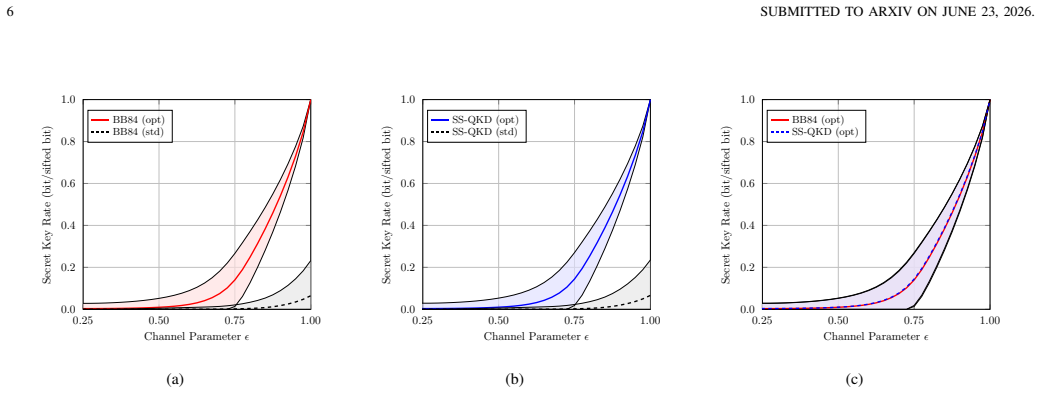
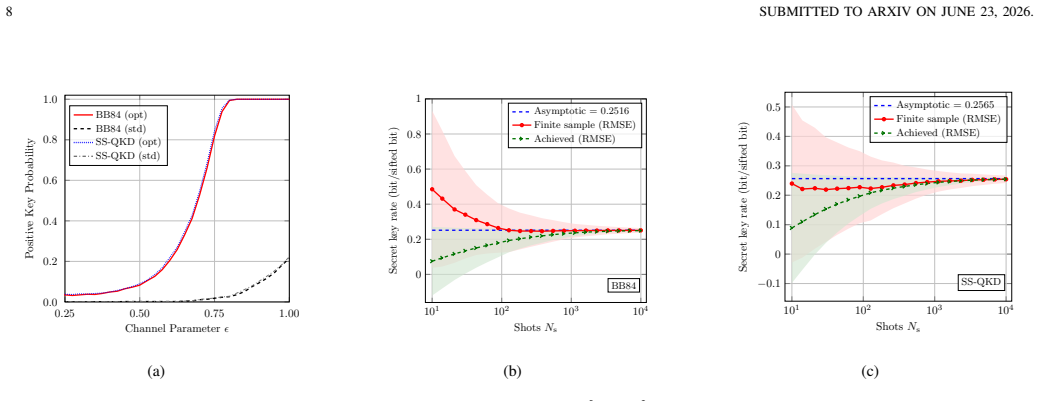
- Both the Pauli-transfer-matrix and sequential-basis-matching approaches produce the same effective key exchange rate.
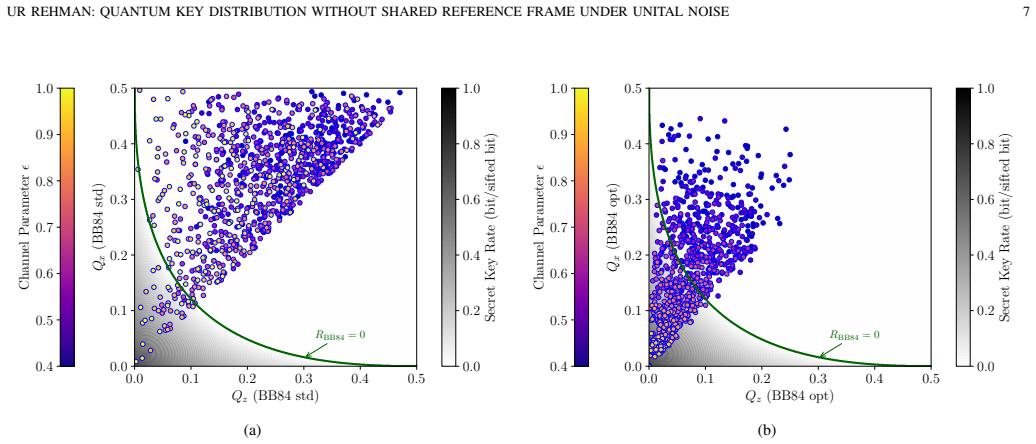
- In the optimized local bases the observed correlations are equivalent, up to outcome relabeling, to those of a Pauli channel.
- The BB84 and six-state protocols remain optimal under unital noise when a shared reference frame is unavailable.
- The lack of a shared reference frame can be absorbed into the channel description without changing the optimality result.
Where Pith is reading between the lines
- The construction applies directly to satellite QKD links where relative motion prevents a fixed frame.
- The same local-optimization logic may extend to other channel classes if an analogous matrix description exists.
- Hardware tests on deployed quantum channels could confirm whether the predicted rate equivalence holds under real noise.
Load-bearing premise
The channel is unital and stationary, so the reference-frame mismatch can be absorbed into the channel definition and the Pauli transfer matrix still possesses identifiable singular vectors.
What would settle it
An experiment that applies the identified optimal bases to a known unital channel, measures the resulting key rate, and finds it lower than the rate obtained from the equivalent Pauli channel.
Figures
read the original abstract
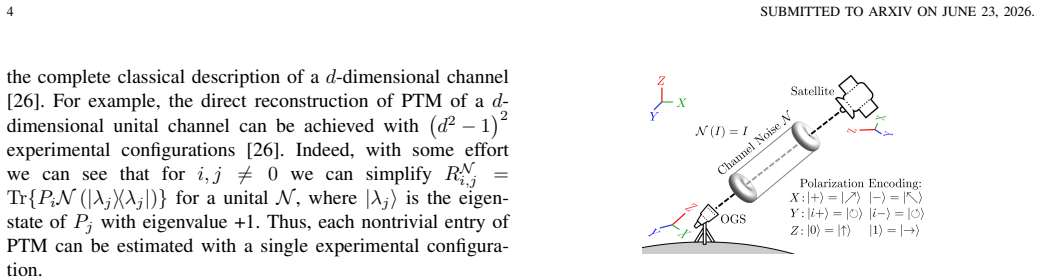
We consider a general and practical scenario of quantum key distribution (QKD) over an unknown, stationary, unital qubit channel. Furthermore, due to practical limitations, e.g., relative movement and rotation of communicating parties, a global shared reference frame cannot be established. This scenario can routinely appear in satellite QKD. We propose two methods to overcome the physical qubit noise and the lack of shared reference frame. The first proposed approach involves constructing the Pauli transfer matrix (PTM) description of the channel, which we achieve without requiring a shared reference frame, by absorbing the lack of shared reference frame in the channel definition. This is followed by the identification of singular vectors of PTM as the Bloch vectors for optimal signal states. In the optimized local bases, the resulting correlations are equivalent, up to outcome relabeling, to those of a Pauli channel, allowing us to show the optimality of the BB84 and six-state QKD protocols under these conditions. The second approach, called the sequential basis matching (SBM) involves sequentially identifying the channel-optimized local bases that enable QKD. We show that both of these approaches result in the same effective key exchange rate for QKD.
Editorial analysis
A structured set of objections, weighed in public.
Referee Report
Summary. The paper addresses QKD over an unknown stationary unital qubit channel without a shared reference frame (e.g., satellite scenarios). It proposes two methods: (1) constructing the Pauli transfer matrix (PTM) by absorbing frame misalignment into the channel, using SVD of the PTM to select optimal local Bloch vectors for signal states, showing that the resulting correlations are equivalent (up to relabeling) to a Pauli channel and hence that BB84 and six-state protocols are optimal; (2) sequential basis matching (SBM) to identify the same optimized bases. Both methods are shown to yield identical effective key rates.
Significance. If the PTM construction, SVD optimality argument, and equivalence to Pauli channels hold, the work provides a concrete, reference-frame-independent route to optimal QKD rates under unital noise. It directly extends the known optimality of BB84/six-state to a practically relevant class of channels and could be useful for mobile or satellite implementations where frame alignment is costly.
minor comments (3)
- The abstract states that the PTM is constructed 'without requiring a shared reference frame, by absorbing the lack of shared reference frame in the channel definition.' The manuscript should explicitly show the measurement and preparation statistics used to estimate the 3x3 PTM entries under this absorption (e.g., which local bases are initially used and how the resulting matrix remains unital).
- The claim that the SVD-selected bases render the effective map diagonal 'up to outcome relabeling' needs a short explicit verification that the sign flips correspond only to local Pauli corrections and do not alter the secure key rate formula.
- The equivalence of the two methods to the same key rate is asserted; a brief side-by-side comparison of the final Bloch-vector choices or the resulting correlation matrices would strengthen the presentation.
Simulated Author's Rebuttal
We thank the referee for their positive assessment of our work on reference-frame-independent QKD over unital channels and for recommending minor revision. No major comments were raised in the report.
Circularity Check
No significant circularity detected
full rationale
The paper constructs the PTM of an effective unital channel by absorbing frame misalignment into the channel definition, then applies the standard SVD to identify optimal local bases. The resulting diagonal form yields correlations equivalent (up to relabeling) to a Pauli channel, for which optimality of BB84 and six-state protocols is invoked as a known external result rather than re-derived. The two methods reaching identical rates follows directly from both producing the same effective Pauli channel. No step reduces by definition to its inputs, no fitted parameter is renamed as a prediction, and no load-bearing claim rests on a self-citation chain. The derivation is self-contained against the stated channel assumptions and linear-algebra operations.
Axiom & Free-Parameter Ledger
axioms (1)
- domain assumption The channel is unital and stationary.
Reference graph
Works this paper leans on
-
[1]
The security of practical quantum key distribution,
V . Scarani, H. Bechmann-Pasquinucci, N. J. Cerf, M. Du ˇsek, N. L ¨utkenhaus, and M. Peev, “The security of practical quantum key distribution,”Rev. Mod. Phys., vol. 81, no. 3, pp. 1301–1350, Sep. 2009. doi: 10.1103/RevModPhys.81.1301 . UR REHMAN: QUANTUM KEY DISTRIBUTION WITHOUT SHARED REFERENCE FRAME UNDER UNITAL NOISE 9
-
[2]
N. Gisin, G. Ribordy, W. Tittel, and H. Zbinden, “Quantum cryptog- raphy,”Rev. Mod. Phys., vol. 74, no. 1, pp. 145–195, Mar. 2002. doi: 10.1103/RevModPhys.74.145
-
[3]
Advances in quantum cryptography,
S. Pirandola, U. L. Andersen, L. Banchi, M. Berta, D. Bunandar, R. Colbeck, D. Englund, T. Gehring, C. Lupo, C. Ottaviani, J. L. Pereira, M. Razavi, J. S. Shaari, M. Tomamichel, V . C. Usenko, G. Vallone, P. Villoresi, and P. Wallden, “Advances in quantum cryptography,”Adv. Opt. Photon., AOP, vol. 12, no. 4, pp. 1012–1236, Dec. 2020. doi: 10.1364/AOP.361502
-
[4]
Active particles in complex and crowded environ- ments,
C. Portmann and R. Renner, “Security in quantum cryptography,”Rev. Mod. Phys., vol. 94, no. 2, p. 025008, Jun. 2022. doi: 10.1103/RevMod- Phys.94.025008
-
[5]
Theoreti- cal Computer Science 560, 7–11 (2014) https://doi.org/10.1016/j.tcs.2014.05.025
C. H. Bennett and G. Brassard, “Quantum cryptography: Public key distribution and coin tossing,”Theoretical Computer Science, vol. 560, pp. 7–11, Dec. 2014. doi: 10.1016/j.tcs.2014.05.025
-
[6]
Quantum cryptography: Public-key distribution and coin tossing,
——, “Quantum cryptography: Public-key distribution and coin tossing,” inProc IEEE Int Conf Comput. Syst. Signal Process.Bangalore, India: IEEE, 1984, pp. 175–179
1984
-
[7]
Optimal eavesdropping in quantum cryptography with six states,
D. Bruß, “Optimal eavesdropping in quantum cryptography with six states,”Phys. Rev. Lett., vol. 81, no. 14, pp. 3018–3021, Oct. 1998. doi: 10.1103/PhysRevLett.81.3018
-
[8]
Micius quantum experi- ments in space,
C.-Y . Lu, Y . Cao, C.-Z. Peng, and J.-W. Pan, “Micius quantum experi- ments in space,”Rev. Mod. Phys., vol. 94, no. 3, p. 035001, Jul. 2022. doi: 10.1103/RevModPhys.94.035001
-
[9]
Experi- mental quasi-single-photon transmission from satellite to Earth,
J. Yin, Y . Cao, S.-B. Liu, G.-S. Pan, J.-H. Wang, T. Yang, Z.-P. Zhang, F.-M. Yang, Y .-A. Chen, C.-Z. Peng, and J.-W. Pan, “Experi- mental quasi-single-photon transmission from satellite to Earth,”Opt. Express, OE, vol. 21, no. 17, pp. 20 032–20 040, Aug. 2013. doi: 10.1364/OE.21.020032
-
[10]
Practical challenges in quantum key distribution,
E. Diamanti, H.-K. Lo, B. Qi, and Z. Yuan, “Practical challenges in quantum key distribution,”npj Quantum Inf, vol. 2, no. 1, p. 16025, Nov. 2016. doi: 10.1038/npjqi.2016.25
-
[11]
Real-time polarization control for satellite QKD with liquid-crystal beacon stabilization,
O. Klicnik, A. Zannotti, Y . Folwill, O. de Vries, P. Munster, and T. Horvath, “Real-time polarization control for satellite QKD with liquid-crystal beacon stabilization,”Sci. Rep., Jun. 2026. doi: 10.1038/s41598-026-55812-2 . [Online]. Available: https://www.nature. com/articles/s41598-026-55812-2
-
[13]
Quantum communication, reference frames, and gauge theory,
S. J. van Enk, “Quantum communication, reference frames, and gauge theory,”Phys. Rev. A, vol. 73, no. 4, p. 042306, Apr. 2006. doi: 10.1103/PhysRevA.73.042306
-
[14]
Reference-frame- independent quantum key distribution,
A. Laing, V . Scarani, J. G. Rarity, and J. L. O’Brien, “Reference-frame- independent quantum key distribution,”Phys. Rev. A, vol. 82, no. 1, p. 012304, Jul. 2010. doi: 10.1103/PhysRevA.82.012304
-
[15]
K. Kraus, A. B ¨ohm, J. D. Dollard, and W. H. Wootters, Eds.,States, Effects, and Operations Fundamental Notions of Quantum Theory, ser. Lecture Notes in Physics. Berlin, Heidelberg: Springer Berlin Heidelberg, 1983, vol. 190. doi: 10.1007/3-540-12732-1
-
[16]
M. A. Nielsen and I. L. Chuang,Quantum Computation and Quantum Information, 10th ed. Cambridge: Cambridge university press, 2010. doi: 10.1017/CBO9780511976667
-
[17]
M. M. Wilde,Quantum Information Theory, 2nd ed. Cambridge: Cambridge University Press, 2017. doi: 10.1017/9781316809976
-
[18]
Entanglement-free parameter estimation of generalized Pauli channels,
J. ur Rehman and H. Shin, “Entanglement-free parameter estimation of generalized Pauli channels,”Quantum, vol. 5, p. 490, Jul. 2021. doi: 10.22331/q-2021-07-01-490
-
[20]
Tomography increases key rates of quantum-key-distribution protocols,
S. Watanabe, R. Matsumoto, and T. Uyematsu, “Tomography increases key rates of quantum-key-distribution protocols,”Phys. Rev. A, vol. 78, no. 4, p. 042316, Oct. 2008. doi: 10.1103/PhysRevA.78.042316
-
[22]
Adeet al., Physical Review Letters113, 10.1103/phys- revlett.113.021301 (2014)
J. M. Chow, J. M. Gambetta, A. D. C ´orcoles, S. T. Merkel, J. A. Smolin, C. Rigetti, S. Poletto, G. A. Keefe, M. B. Rothwell, J. R. Rozen, M. B. Ketchen, and M. Steffen, “Universal quantum gate set ap- proaching fault-tolerant thresholds with superconducting qubits,”Phys. Rev. Lett., vol. 109, no. 6, p. 060501, Aug. 2012. doi: 10.1103/Phys- RevLett.109.060501
-
[23]
Gate set tomography,
E. Nielsen, J. K. Gamble, K. Rudinger, T. Scholten, K. Young, and R. Blume-Kohout, “Gate set tomography,”Quantum, vol. 5, p. 557, Oct
-
[24]
doi: 10.22331/q-2021-10-05-557
-
[25]
Self-consistent quantum process tomography,
S. T. Merkel, J. M. Gambetta, J. A. Smolin, S. Poletto, A. D. C ´orcoles, B. R. Johnson, C. A. Ryan, and M. Steffen, “Self-consistent quantum process tomography,”Phys. Rev. A, vol. 87, no. 6, p. 062119, Jun. 2013. doi: 10.1103/PhysRevA.87.062119
-
[26]
Introduction to quantum gate set tomography,
D. Greenbaum, “Introduction to quantum gate set tomography,” Sep
-
[27]
doi: 10.48550/arXiv.1509.02921
work page internal anchor Pith review Pith/arXiv arXiv doi:10.48550/arxiv.1509.02921
-
[28]
S. Roncallo, L. Maccone, and C. Macchiavello, “Pauli transfer matrix direct reconstruction: Channel characterization without full process tomography,”Quantum Sci. Technol., vol. 9, no. 1, p. 015010, Jan. 2024. doi: 10.1088/2058-9565/ad04e7
-
[29]
Holevo capacity of discrete weyl channels,
J. ur Rehman, Y . Jeong, J. S. Kim, and H. Shin, “Holevo capacity of discrete weyl channels,”Sci Rep, vol. 8, no. 1, p. 17457, Nov. 2018. doi: 10.1038/s41598-018-35777-7
-
[30]
K. Siudzi ´nska and D. Chru ´sci´nski, “Quantum channels irreducibly covariant with respect to the finite group generated by the Weyl operators,”J. Math. Phys., vol. 59, no. 3, p. 033508, Mar. 2018. doi: 10.1063/1.5013604
-
[31]
Simple proof of security of the bb84 quantum key distribution protocol,
P. W. Shor and J. Preskill, “Simple proof of security of the bb84 quantum key distribution protocol,”Phys. Rev. Lett., vol. 85, no. 2, pp. 441–444, Jul. 2000. doi: 10.1103/PhysRevLett.85.441
-
[32]
Security of quantum key distribution,
R. Renner, “Security of quantum key distribution,”Int. J. Quan- tum Inform., vol. 06, no. 01, pp. 1–127, Feb. 2008. doi: 10.1142/S0219749908003256
-
[33]
Pauli semigroups and unistochastic quantum channels,
Z. Puchała, Ł. Rudnicki, and K. ˙Zyczkowski, “Pauli semigroups and unistochastic quantum channels,”Physics Letters A, vol. 383, no. 20, pp. 2376–2381, Jul. 2019. doi: 10.1016/j.physleta.2019.04.057
-
[34]
Key distillation from quantum channels using two- way communication protocols,
J. Bae and A. Ac ´ın, “Key distillation from quantum channels using two- way communication protocols,”Phys. Rev. A, vol. 75, no. 1, p. 012334, Jan. 2007. doi: 10.1103/PhysRevA.75.012334
discussion (0)
Sign in with ORCID, Apple, or X to comment. Anyone can read and Pith papers without signing in.