On the Effect of Segmentation Width and Cluster Size on Speech Resynthesis and Continuation in Generative Spoken Language Models
Pith reviewed 2026-06-26 08:19 UTC · model grok-4.3
The pith
Lower-bitrate discrete speech units enable intelligible synthesis and stable continuation in generative spoken language models.
A machine-rendered reading of the paper's core claim, the machinery that carries it, and where it could break.
Core claim
Varying segmentation widths and cluster sizes produces discrete speech representations at different bitrates. Training GSLMs on these shows that intelligible and natural speech can be synthesized at lower bitrates than the baseline, while speech continuation quality remains stable, suggesting the conventional setting may be redundant.
What carries the argument
Segmentation width and K-means cluster size, which together set the bitrate of discrete speech units supplied to the language model.
If this is right
- Speech resynthesis remains intelligible and natural at reduced bitrates.
- Speech continuation quality measured by multiple metrics does not degrade when bitrate is lowered.
- The conventional high-bitrate GSLM configuration appears unnecessary for effective generation.
- LLM-based metrics correlate more strongly with human scores than older metrics but still fall short of reliable evaluation.
Where Pith is reading between the lines
- Lower bitrates could reduce memory and compute demands during both training and inference of these models.
- Similar bitrate reductions may prove useful in other tasks that rely on discrete speech or audio tokens.
- The observed gap between automatic and human scores points to a need for evaluation methods that better track perceptual quality.
Load-bearing premise
The chosen automatic metrics, datasets, and model architectures are sufficient to support general claims that high-bitrate settings are redundant for speech generation.
What would settle it
Human listening tests showing a clear drop in intelligibility or naturalness for the lower-bitrate configurations compared with the baseline.
Figures


read the original abstract
Generative Spoken Language Modeling (GSLM) enables text-free speech modeling by training language models (LMs) using discrete speech representations instead of textual transcription. In this paper, we investigate the performance of GSLM on speech synthesis and continuation using discrete speech representations with varying bitrates. We segment speech representations with fixed widths and train K-means models in multiple cluster sizes, resulting in various bitrate settings. We demonstrate that intelligible and natural speech can be synthesized at lower bitrate settings than the baseline. Furthermore, speech continuation quality remains stable at lower bitrates across multiple metrics, suggesting that the conventional GSLM setting may be redundant for effective speech generation. Although LLM-based metrics show higher correlation with human subjective score than conventional metrics, it remains low, highlighting the need for more stable automatic evaluation methods.
Editorial analysis
A structured set of objections, weighed in public.
Referee Report
Summary. The manuscript investigates the effects of segmentation width and K-means cluster size on the bitrate of discrete speech units used in Generative Spoken Language Models (GSLM). Through resynthesis and continuation experiments, it reports that intelligible and natural speech remains achievable at lower bitrates than the conventional baseline, with continuation quality stable across multiple automatic metrics, suggesting the standard high-bitrate GSLM configuration may be redundant. The work additionally compares conventional and LLM-based metrics and notes that even the latter exhibit only low correlation with human judgments, underscoring the need for improved automatic evaluation methods.
Significance. If the empirical outcomes are robust, the results could enable more efficient GSLM pipelines by reducing bitrate (and thus model size and compute) without degrading generation quality. The paper explicitly credits its use of both conventional and LLM-based metrics for a more comprehensive evaluation than single-metric baselines.
major comments (2)
- [Abstract] Abstract: The central claim that 'intelligible and natural speech can be synthesized at lower bitrate settings' and that the conventional GSLM setting 'may be redundant' is inferred from stability in automatic metrics. The abstract itself states that LLM-based metrics have only low correlation with human subjective scores, yet no human listening tests are reported. This makes the perceptual and redundancy conclusions difficult to substantiate from the presented evidence.
- [§4] §4 (Results) and associated tables: The reported stability of continuation quality at lower bitrates is presented without statistical significance tests, confidence intervals, or multi-seed variance; it is therefore unclear whether observed differences (or lack thereof) across bitrate settings are reliable or could be affected by post-hoc hyperparameter choices.
minor comments (2)
- [§3] The bitrate formula (segmentation width imes log2(cluster size)) is used throughout but never written explicitly; adding it as an equation in §3 would improve reproducibility.
- [§4] Figure captions in §4 do not specify what error bars represent (standard deviation, standard error, or range across seeds).
Simulated Author's Rebuttal
We thank the referee for the constructive feedback. We address the major comments point by point below, proposing targeted revisions to improve clarity and rigor.
read point-by-point responses
-
Referee: [Abstract] Abstract: The central claim that 'intelligible and natural speech can be synthesized at lower bitrate settings' and that the conventional GSLM setting 'may be redundant' is inferred from stability in automatic metrics. The abstract itself states that LLM-based metrics have only low correlation with human subjective scores, yet no human listening tests are reported. This makes the perceptual and redundancy conclusions difficult to substantiate from the presented evidence.
Authors: We agree that the lack of human listening tests means perceptual claims rest on automatic metrics whose limitations are already noted in the abstract. To strengthen substantiation, we will revise the abstract to qualify the claims explicitly as metric-supported (e.g., replacing direct perceptual assertions with references to the automatic metrics used) while retaining the observation that lower-bitrate settings yield stable metric scores. This avoids overclaiming while preserving the core empirical finding. revision: yes
-
Referee: [§4] §4 (Results) and associated tables: The reported stability of continuation quality at lower bitrates is presented without statistical significance tests, confidence intervals, or multi-seed variance; it is therefore unclear whether observed differences (or lack thereof) across bitrate settings are reliable or could be affected by post-hoc hyperparameter choices.
Authors: We acknowledge that the absence of statistical tests and variance reporting weakens the reliability assessment. In the revised manuscript we will add appropriate statistical significance tests (e.g., paired t-tests or Wilcoxon signed-rank tests) and confidence intervals to the continuation metrics in §4 and the tables. We will also include a brief discussion of experimental variance and hyperparameter sensitivity based on the existing single-run results. revision: yes
Circularity Check
No circularity: empirical hyperparameter sweep with no derivations or self-referential predictions
full rationale
The paper reports results from an experimental study that varies segmentation widths and K-means cluster sizes to produce different bitrate discrete speech units, then measures resynthesis and continuation quality via automatic metrics. No equations, first-principles derivations, or predictions are presented that reduce to fitted parameters or self-citations by construction. All claims rest on direct experimental outcomes rather than any definitional or load-bearing self-reference. This is the expected non-finding for a pure empirical hyperparameter investigation.
Axiom & Free-Parameter Ledger
Reference graph
Works this paper leans on
-
[1]
discrete units
Introduction Recently, Generative Spoken Language Modeling (GSLM; [1]) has emerged as a new paradigm for spoken language processing. GSLM only requires speech resource for training, enabling lan- guage modeling without textual transcription. This is achieved by training LMs on top of discrete representations extracted from raw audio (hereafter referred to...
-
[2]
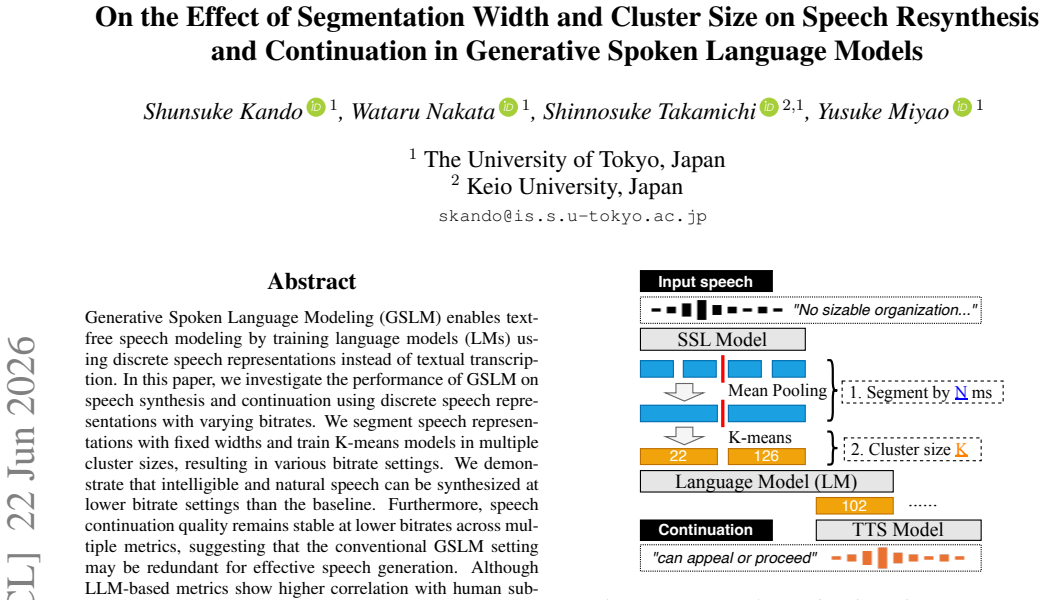
Cluster size K "No sizable organization..." "can appeal or proceed" Input speech Continuation Figure 1:Overview of GSLM-based speech continuation. It is achieved by synthesizing speech from discrete units predicted by the LM. We varied segmentation widthNand cluster sizeKat s2u step [22]. LargerNand smallerKyield a lower bitrate. under the training-free s...
work page internal anchor Pith review Pith/arXiv arXiv 2026
-
[3]
fin, fin, fin,
Background: GSLM and its Evaluation GSLM consists of the three components:(1) speech2unit (s2u)converts speech into discrete units;(2) unitLM (uLM) is trained on these discrete units; and(3) unit2speech (u2s) synthesizes speech from the discrete units. In this paper, we examine the performance of u2s that involves two tasks: speech resynthesis and speech ...
-
[4]
[22] explored the spoken language understanding capability of GSLM under different s2u methods
Background: Varying Segmentation Width and Cluster Size in s2u Kando et al. [22] explored the spoken language understanding capability of GSLM under different s2u methods. As illustrated in Figure 1, discrete units are obtained by segmenting continu- ous speech representations byNms, mean-pooling them, and then applying K-means clustering with cluster siz...
-
[5]
Follow- ing [22], we obtain discrete units with various bitrates at the s2u step
Experimental Setting Figure 1 displays the overview of our experiment. Follow- ing [22], we obtain discrete units with various bitrates at the s2u step. We investigate the impact of different s2u configurations on speech resynthesis and continuation. 4.1. Training For s2u, we employ HuBERT-base [14] as an SSL model and extracted representations from the 9...
-
[6]
Speech Resynthesis Figure 3 presents the speech resynthesis results
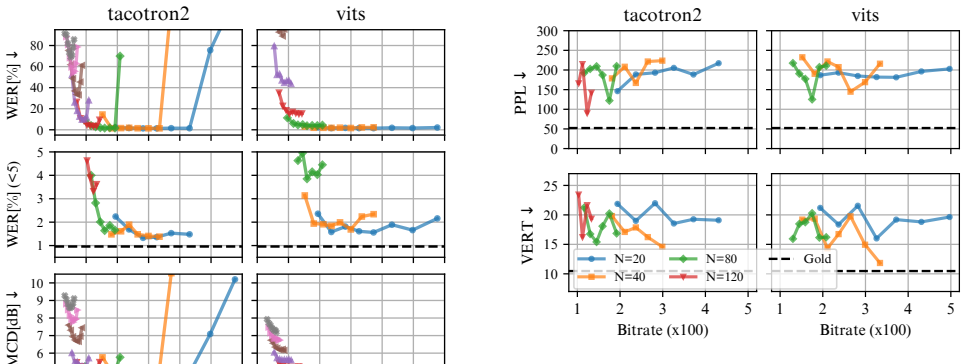
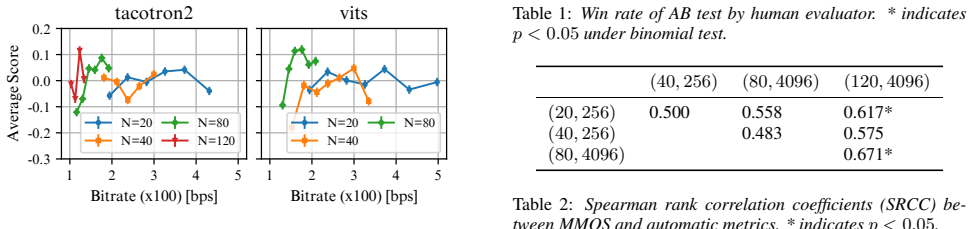
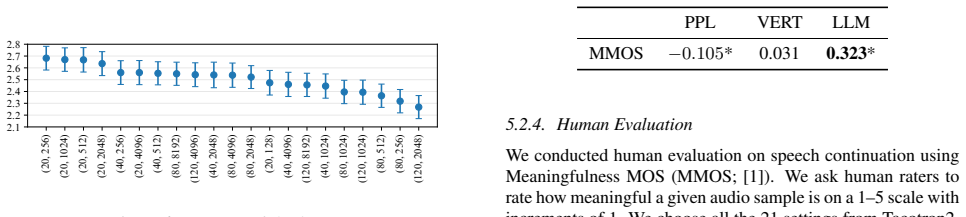
Results 5.1. Speech Resynthesis Figure 3 presents the speech resynthesis results. Overall, al- though largerNdegrades performance, moderately large val- ues such as 40 or 80 achieve performance comparable to the baseline setting (N= 20). This indicates that speech resyn- thesis quality can be preserved at lower bitrates. In terms of the selection of u2s m...
2048
-
[7]
By controlling segmentation width and K-means cluster size, we systematically analyzed the impact of bitrate on synthe- sis quality
Conclusion In this paper, we investigated GSLM-based speech resynthesis and continuation under discrete representations with varying bi- trates. By controlling segmentation width and K-means cluster size, we systematically analyzed the impact of bitrate on synthe- sis quality. Our results show that both intelligible speech resyn- thesis and high-quality c...
-
[8]
Acknowledgments This work was supported by JST ACT-X Grant Number JPM- JAX24C9 and JSPS KAKENHI Grant Number 26KJ0792
-
[9]
Generative AI use disclosure ChatGPT was used for language polishing
-
[10]
On Generative Spoken Language Modeling from Raw Audio,
K. Lakhotia, E. Kharitonov, W.-N. Hsu, Y . Adi, A. Polyak, B. Bolte, T.-A. Nguyen, J. Copet, A. Baevski, A. Mohamed, and E. Dupoux, “On Generative Spoken Language Modeling from Raw Audio,”TACL, vol. 9, pp. 1336–1354, 2021
2021
-
[11]
BabySLM: Language- acquisition-friendly benchmark of self-supervised spoken lan- guage models,
M. Lavechin, Y . Sy, H. Titeux, M. A. C. Bland ´on, O. R ¨as¨anen, H. Bredin, E. Dupoux, and A. Cristia, “BabySLM: Language- acquisition-friendly benchmark of self-supervised spoken lan- guage models,” inInterspeech, 2023, pp. 4588–4592
2023
-
[12]
Simulating Early Phonetic and Word Learning Without Linguistic Categories,
M. Lavechin, M. de Seyssel, H. Titeux, G. Wisniewski, H. Bredin, A. Cristia, and E. Dupoux, “Simulating Early Phonetic and Word Learning Without Linguistic Categories,”Developmental Science, vol. 28, no. 2, 2025
2025
-
[13]
Neural codec language models are zero-shot text to speech synthesizers,
S. Chen, C. Wang, Y . Wu, Z. Zhang, L. Zhou, S. Liu, Z. Chen, Y . Liu, H. Wang, J. Li, L. He, S. Zhao, and F. Wei, “Neural codec language models are zero-shot text to speech synthesizers,”IEEE Transactions on Audio, Speech and Language Processing, vol. 33, pp. 705–718, 2025
2025
-
[14]
Speechgpt-gen: Scaling chain-of-information speech genera- tion,
D. Zhang, X. Zhang, J. Zhan, S. Li, Y . Zhou, and X. Qiu, “Speechgpt-gen: Scaling chain-of-information speech genera- tion,”arXiv preprint arXiv:2401.13527, 2024
-
[15]
Moshi: a speech-text foundation model for real-time dialogue,
A. D ´efossez, L. Mazar´e, M. Orsini, A. Royer, P. P´erez, H. J´egou, E. Grave, and N. Zeghidour, “Moshi: a speech-text foundation model for real-time dialogue,” Tech. Rep., 2024
2024
-
[16]
LLaMA- omni 2: LLM-based real-time spoken chatbot with autoregressive streaming speech synthesis,
Q. Fang, Y . Zhou, S. Guo, S. Zhang, and Y . Feng, “LLaMA- omni 2: LLM-based real-time spoken chatbot with autoregressive streaming speech synthesis,” inACL (long), 2025, pp. 18 617– 18 629
2025
-
[17]
Textually Pretrained Speech Language Models,
M. Hassid, T. Remez, T. A. Nguyen, I. Gat, A. Conneau, F. Kreuk, J. Copet, A. Defossez, G. Synnaeve, E. Dupoux, R. Schwartz, and Y . Adi, “Textually Pretrained Speech Language Models,” in NeurIPS, 2023, pp. 63 483–63 501
2023
-
[18]
Long-Form Speech Generation with Spoken Lan- guage Models,
S. J. Park, J. Salazar, A. Jansen, K. Kinoshita, Y . M. Ro, and R. J. Skerry-Ryan, “Long-Form Speech Generation with Spoken Lan- guage Models,” inICML, 2025
2025
-
[19]
Align-SLM: Textless spoken language models with reinforcement learning from AI feedback,
G.-T. Lin, P. G. Shivakumar, A. Gourav, Y . Gu, A. Gandhe, H.- y. Lee, and I. Bulyko, “Align-SLM: Textless spoken language models with reinforcement learning from AI feedback,” inACL (main), 2025, pp. 20 395–20 411
2025
-
[20]
Scaling Properties of Speech Language Models,
S. Cuervo and R. Marxer, “Scaling Properties of Speech Language Models,” inEMNLP (main), 2024, pp. 351–361
2024
-
[21]
Representation Learning with Contrastive Predictive Coding
A. van den Oord, Y . Li, and O. Vinyals, “Representation Learning with Contrastive Predictive Coding,”arXiv preprint arXiv:1807.03748, 2019
work page internal anchor Pith review Pith/arXiv arXiv 2019
-
[22]
Wav2vec 2.0: A Framework for Self-Supervised Learning of Speech Represen- tations,
A. Baevski, Y . Zhou, A. Mohamed, and M. Auli, “Wav2vec 2.0: A Framework for Self-Supervised Learning of Speech Represen- tations,” inNeurIPS, 2020, pp. 12 449 – 12 460
2020
-
[23]
HuBERT: Self-Supervised Speech Rep- resentation Learning by Masked Prediction of Hidden Units,
W.-N. Hsu, B. Bolte, Y .-H. H. Tsai, K. Lakhotia, R. Salakhutdi- nov, and A. Mohamed, “HuBERT: Self-Supervised Speech Rep- resentation Learning by Masked Prediction of Hidden Units,” IEEE/ACM TASLP, vol. 29, 2021
2021
-
[24]
Attention is all you need,
A. Vaswani, N. Shazeer, N. Parmar, J. Uszkoreit, L. Jones, A. N. Gomez, L. Kaiser, and I. Polosukhin, “Attention is all you need,” inNeurIPS, 2017, pp. 6000 – 6010
2017
-
[25]
Generative Spoken Language Model based on continuous word-sized audio tokens,
R. Algayres, Y . Adi, T. Nguyen, J. Copet, G. Synnaeve, B. Sagot, and E. Dupoux, “Generative Spoken Language Model based on continuous word-sized audio tokens,” inEMNLP (main), 2023, pp. 3008–3028
2023
-
[26]
SyllableLM: Learning coarse semantic units for speech language models,
A. Baade, P. Peng, and D. Harwath, “SyllableLM: Learning coarse semantic units for speech language models,” inICLR, 2025
2025
-
[27]
Sylber: Syllabic embedding representation of speech from raw audio,
C. J. Cho, N. Lee, A. Gupta, D. Agarwal, E. Chen, A. Black, and G. Anumanchipalli, “Sylber: Syllabic embedding representation of speech from raw audio,” inICLR, 2025
2025
-
[28]
Exploring the Benefits of Tokeniza- tion of Discrete Acoustic Units,
A. Dekel and R. Fernandez, “Exploring the Benefits of Tokeniza- tion of Discrete Acoustic Units,” inInterspeech, 2024, pp. 2780– 2784
2024
-
[29]
Spoken Language Modeling with Duration-Penalized Self-Supervised Units,
N. Visser and H. Kamper, “Spoken Language Modeling with Duration-Penalized Self-Supervised Units,” inInterspeech, 2025, pp. 1968–1972
2025
-
[30]
Segmentation- Variant Codebooks for Preservation of Paralinguistic and Prosodic Information,
N. Sanders, Y . Li, K. Richmond, and S. King, “Segmentation- Variant Codebooks for Preservation of Paralinguistic and Prosodic Information,” inInterspeech, 2025, pp. 5403–5407
2025
-
[31]
Exploring the Effect of Segmentation and V ocabulary Size on Speech Tokenization for Speech Language Models,
S. Kando, Y . Miyao, and S. Takamichi, “Exploring the Effect of Segmentation and V ocabulary Size on Speech Tokenization for Speech Language Models,” inInterspeech, 2025, pp. 5728–5732
2025
-
[32]
UT- MOS: UTokyo-SaruLab System for V oiceMOS Challenge 2022,
Takaaki Saeki and Detai Xin and Wataru Nakata and Tomoki Ko- riyama and Shinnosuke Takamichi and Hiroshi Saruwatari, “UT- MOS: UTokyo-SaruLab System for V oiceMOS Challenge 2022,” inInterspeech, 2022, pp. 4521–4525
2022
-
[33]
Text-free prosody-aware generative spoken language mod- eling,
E. Kharitonov, A. Lee, A. Polyak, Y . Adi, J. Copet, K. Lakhotia, T. A. Nguyen, M. Riviere, A. Mohamed, E. Dupoux, and W.-N. Hsu, “Text-free prosody-aware generative spoken language mod- eling,” inACL (main), May 2022, pp. 8666–8681
2022
-
[34]
Lib- rispeech: An ASR corpus based on public domain audio books,
V . Panayotov, G. Chen, D. Povey, and S. Khudanpur, “Lib- rispeech: An ASR corpus based on public domain audio books,” inICASSP, 2015, pp. 5206–5210
2015
-
[35]
OPT: Open Pre-trained Transformer Language Models
S. Zhang, S. Roller, N. Goyal, M. Artetxe, M. Chen, S. Chen, C. Dewan, M. T. Diab, X. Li, X. V . Lin, T. Mihaylov, M. Ott, S. Shleifer, K. Shuster, D. Simig, P. S. Koura, A. Sridhar, T. Wang, and L. Zettlemoyer, “OPT: open pre-trained transformer language models,”arXiv preprint: arXiv:2205.01068, 2022
work page internal anchor Pith review Pith/arXiv arXiv 2022
-
[36]
Natural tts synthesis by con- ditioning wavenet on mel spectrogram predictions,
J. Shen, R. Pang, R. J. Weiss, M. Schuster, N. Jaitly, Z. Yang, Z. Chen, Y . Zhang, Y . Wang, R. Skerrv-Ryan, R. A. Saurous, Y . Agiomvrgiannakis, and Y . Wu, “Natural tts synthesis by con- ditioning wavenet on mel spectrogram predictions,” inICASSP, 2018, pp. 4779–4783
2018
-
[37]
Parallel wavegan: A fast waveform generation model based on generative adversarial net- works with multi-resolution spectrogram,
R. Yamamoto, E. Song, and J.-M. Kim, “Parallel wavegan: A fast waveform generation model based on generative adversarial net- works with multi-resolution spectrogram,” inICASSP, 2020, pp. 6199–6203
2020
-
[38]
Conditional variational autoencoder with adversarial learning for end-to-end text-to-speech,
J. Kim, J. Kong, and J. Son, “Conditional variational autoencoder with adversarial learning for end-to-end text-to-speech,” inICML, 2021
2021
-
[39]
The lj speech dataset,
K. Ito and L. Johnson, “The lj speech dataset,” https://keithito. com/LJ-Speech-Dataset/, 2017
2017
-
[40]
ESPnet: End-to-end speech processing toolkit,
S. Watanabe, T. Hori, S. Karita, T. Hayashi, J. Nishitoba, Y . Unno, N. Enrique Yalta Soplin, J. Heymann, M. Wiesner, N. Chen, A. Renduchintala, and T. Ochiai, “ESPnet: End-to-end speech processing toolkit,” inInterspeech, 2018, pp. 2207–2211
2018
-
[41]
The Zero Resource Speech Chal- lenge 2019: TTS Without T,
E. Dunbar, R. Algayres, J. Karadayi, M. Bernard, J. Benjumea, X.-N. Cao, L. Miskic, C. Dugrain, L. Ondel, A. W. Black, L. Be- sacier, S. Sakti, and E. Dupoux, “The Zero Resource Speech Chal- lenge 2019: TTS Without T,” inInterspeech, 2019, pp. 1088– 1092
2019
-
[42]
Judging LLM-as-a-judge with MT-bench and chatbot arena,
L. Zheng, W.-L. Chiang, Y . Sheng, S. Zhuang, Z. Wu, Y . Zhuang, Z. Lin, Z. Li, D. Li, E. Xing, H. Zhang, J. E. Gonzalez, and I. Sto- ica, “Judging LLM-as-a-judge with MT-bench and chatbot arena,” inNeurIPS Datasets and Benchmarks Track, 2023
2023
-
[43]
Bias and Statistical Sig- nificance in Evaluating Speech Synthesis with Mean Opinion Scores,
A. Rosenberg and B. Ramabhadran, “Bias and Statistical Sig- nificance in Evaluating Speech Synthesis with Mean Opinion Scores,” inInterspeech, 2017, pp. 3976–3980
2017
discussion (0)
Sign in with ORCID, Apple, or X to comment. Anyone can read and Pith papers without signing in.