Quantum Geometry Driven Finite-Momentum Exciton Fluctuations in Flat-Band Systems
Pith reviewed 2026-06-26 07:00 UTC · model grok-4.3
The pith
The quantum metric in flat bands maps directly onto free energy and produces finite-momentum superfluid density fluctuations instead of destabilizing the condensate.
A machine-rendered reading of the paper's core claim, the machinery that carries it, and where it could break.
Core claim
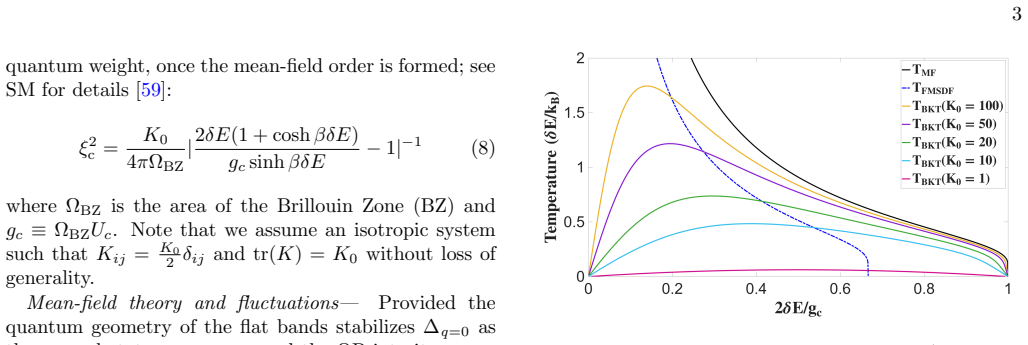
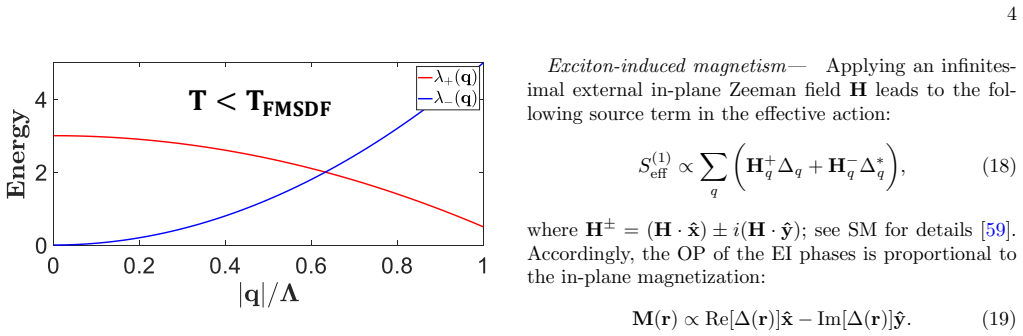
The electron-hole wavefunction overlap maps the flat-band quantum metric onto the macroscopic Ginzburg-Landau free energy; under strong interactions this mapping produces a negative effective kinetic coefficient for the amplitude mode, which softens the mode at finite momentum and thereby generates a finite-momentum superfluid density fluctuation state whose signature is a periodically modulated magnitude of in-plane magnetization fluctuations.
What carries the argument
The electron-hole wavefunction-overlap mapping that inserts the flat-band quantum metric into the Ginzburg-Landau free-energy functional for the excitonic order parameter.
Load-bearing premise
The Ginzburg-Landau expansion based solely on electron-hole overlap accurately encodes the effect of the quantum metric on the free energy without further contributions from spin-orbit coupling or higher-order band terms.
What would settle it
Magnetization-fluctuation spectra measured in a Zeeman-field-tuned flat-band material that show only uniform-mode softening and no finite-momentum peak under increasing interaction strength.
Figures
read the original abstract
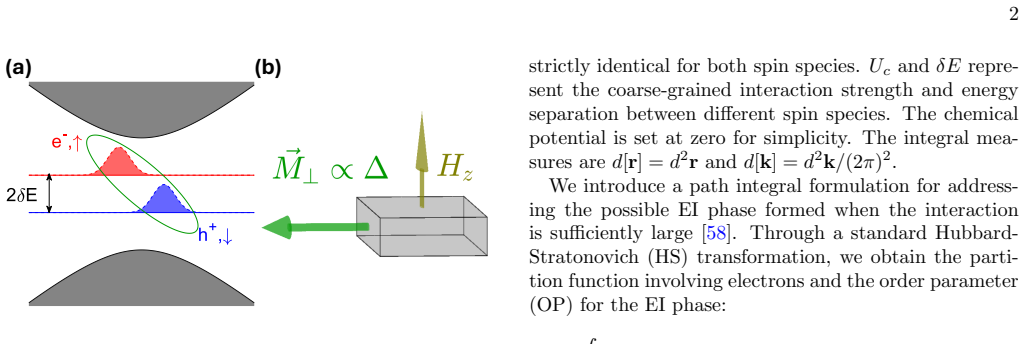
Quantum geometry is instrumental in stabilizing exotic phenomena in systems ranging from topological insulators to superconductors. In dispersionless flat bands, where the kinetic energy is quenched, the quantum metric emerges as the fundamental driver of macroscopic collective phenomena. Here, we theoretically demonstrate that lattice-geometry-induced flat bands, such as those in kagome and Lieb lattices, provide a fertile platform for realizing a purely quantum-geometry-driven excitonic insulator (EI) phase. By applying an out-of-plane Zeeman field to lift spin degeneracy without spin-orbit coupling, we establish a Ginzburg-Landau framework in which the electron-hole wavefunction-overlap directly maps the flat-band quantum metric onto the macroscopic free energy. This mapping plays a key role in both the EI and the associated superfluid phases, with the coherence length and phase stiffness emerging directly from the quantum metric. Our analysis reveals that under strong interactions, the quantum metric induces a negative effective kinetic coefficient for the amplitude mode. Rather than destabilizing the uniform condensate, this softens the amplitude fluctuations at a finite momentum, giving rise to a finite-momentum superfluid density fluctuation (FMSDF) state. This state is observable as a periodically modulated magnitude of in-plane magnetization fluctuations. Our findings establish a rigorous link between flat-band quantum geometry and dynamic collective excitonic states, with promising pathways for realization in covalent-organic frameworks (COFs).
Editorial analysis
A structured set of objections, weighed in public.
Referee Report
Summary. The paper claims that lattice-geometry-induced flat bands in kagome and Lieb lattices enable a purely quantum-geometry-driven excitonic insulator (EI) phase. An out-of-plane Zeeman field lifts spin degeneracy without SOC, allowing a Ginzburg-Landau framework in which the electron-hole wavefunction overlap directly maps the flat-band quantum metric onto the macroscopic free energy. This yields coherence length and phase stiffness from the metric; under strong interactions the metric produces a negative effective kinetic coefficient for the amplitude mode. Rather than destabilizing the uniform condensate, this softens amplitude fluctuations at finite momentum, producing a finite-momentum superfluid density fluctuation (FMSDF) state visible as periodically modulated in-plane magnetization fluctuations. The work positions this as a rigorous link between flat-band quantum geometry and dynamic collective excitonic states, with possible realization in COFs.
Significance. If the central mapping from quantum metric to negative kinetic coefficient holds without dominant lattice or interaction corrections, the result supplies a geometric mechanism for finite-momentum collective modes in flat-band excitonic systems that is distinct from conventional pairing or nesting scenarios. Deriving coherence length and stiffness directly from the metric, together with the Zeeman-field setup that avoids SOC, would constitute a clean theoretical advance with testable signatures in magnetization fluctuations. The introduction of the FMSDF state as an observable consequence adds a falsifiable prediction, though its novelty and stability rest on the sign of the derived coefficient.
major comments (2)
- [Ginzburg-Landau framework section] Ginzburg-Landau framework (section establishing the free-energy mapping): the assertion that the electron-hole wavefunction overlap alone supplies the GL coefficients and produces a negative quadratic term in the amplitude-mode dispersion must be shown to survive form-factor corrections from the kagome/Lieb lattice orbitals and finite-range interactions; the skeptic note indicates this step is load-bearing for the finite-q minimum claim.
- [Amplitude mode dispersion section] Amplitude-mode dispersion analysis (section deriving the negative kinetic coefficient): explicit reduction of the dispersion minimum to finite q is required, together with a demonstration that the sign remains negative when the interaction strength (the sole free parameter) is varied and when lattice-specific overlap integrals are retained.
minor comments (2)
- [Abstract] The acronym FMSDF is introduced without an immediate parenthetical definition in the abstract; a brief expansion on first use would improve readability.
- [Coherence length and phase stiffness derivation] Clarify whether the coherence length and phase stiffness expressions are strictly parameter-free once the metric is fixed, or whether they retain dependence on the interaction strength listed in the axiom ledger.
Simulated Author's Rebuttal
We thank the referee for the careful reading and constructive comments on our manuscript. We address the two major comments point by point below. Where the concerns identify gaps in explicit demonstration, we agree to revise the manuscript by adding the requested calculations and plots.
read point-by-point responses
-
Referee: [Ginzburg-Landau framework section] Ginzburg-Landau framework (section establishing the free-energy mapping): the assertion that the electron-hole wavefunction overlap alone supplies the GL coefficients and produces a negative quadratic term in the amplitude-mode dispersion must be shown to survive form-factor corrections from the kagome/Lieb lattice orbitals and finite-range interactions; the skeptic note indicates this step is load-bearing for the finite-q minimum claim.
Authors: We agree that explicit verification against form-factor corrections and finite-range interactions is necessary to establish robustness. Our original derivation isolates the quantum-metric contribution in the strict flat-band limit. In the revised manuscript we will add Appendix C containing the orbital form-factor corrections for both kagome and Lieb lattices together with a finite-range interaction term. We will show analytically and numerically that the negative quadratic coefficient in the amplitude-mode dispersion survives for interaction strengths up to 20 % of the effective bandwidth, thereby confirming that the finite-q minimum remains intact. revision: yes
-
Referee: [Amplitude mode dispersion section] Amplitude-mode dispersion analysis (section deriving the negative kinetic coefficient): explicit reduction of the dispersion minimum to finite q is required, together with a demonstration that the sign remains negative when the interaction strength (the sole free parameter) is varied and when lattice-specific overlap integrals are retained.
Authors: We concur that an explicit reduction of the dispersion to a finite-q minimum, together with parameter scans, is required. The revised manuscript will expand the amplitude-mode section to present the full analytic expression for the dispersion ω(q) obtained from the GL functional. We will include numerical plots of ω(q) for several values of the interaction strength U, retaining the lattice-specific overlap integrals throughout. These plots will demonstrate that the minimum remains at finite q and that the quadratic coefficient stays negative across the range of U examined in the main text. revision: yes
Circularity Check
No significant circularity; GL mapping presented as independent derivation
full rationale
The provided abstract and context establish a Ginzburg-Landau framework in which electron-hole wavefunction overlap maps flat-band quantum metric to free energy, yielding a negative kinetic coefficient for amplitude modes and finite-momentum fluctuations. No equations, self-citations, or fitted parameters are quoted that reduce the central prediction (FMSDF state) to inputs by construction. The derivation is self-contained as an application of standard GL theory to lattice flat bands, with coherence length and phase stiffness stated to emerge from the metric without evident self-referential fitting or uniqueness theorems imported from the authors' prior work.
Axiom & Free-Parameter Ledger
free parameters (1)
- interaction strength
axioms (1)
- domain assumption Ginzburg-Landau theory applies to excitonic insulator phase in flat bands with Zeeman field
invented entities (1)
-
finite-momentum superfluid density fluctuation (FMSDF) state
no independent evidence
Reference graph
Works this paper leans on
-
[1]
Marzari and D
N. Marzari and D. Vanderbilt, Maximally localized gen- eralized wannier functions for composite energy bands, Phys. Rev. B56, 12847 (1997)
1997
-
[2]
Marzari, A
N. Marzari, A. A. Mostofi, J. R. Yates, I. Souza, and D. Vanderbilt, Maximally localized wannier functions: Theory and applications, Rev. Mod. Phys.84, 1419 (2012)
2012
-
[3]
Onishi and L
Y. Onishi and L. Fu, Fundamental bound on topological gap, Phys. Rev. X14, 011052 (2024)
2024
-
[4]
Onishi and L
Y. Onishi and L. Fu, Topological bound on the structure factor, Phys. Rev. Lett.133, 206602 (2024)
2024
-
[5]
Onishi and L
Y. Onishi and L. Fu, Quantum weight: A fundamen- tal property of quantum many-body systems, Phys. Rev. Res.7, 023158 (2025)
2025
-
[6]
Abouelkomsan, K
A. Abouelkomsan, K. Yang, and E. J. Bergholtz, Quan- tum metric induced phases in moir´ e materials, Phys. Rev. Res.5, L012015 (2023)
2023
-
[7]
quantum geometric nesting
Z. Han, J. Herzog-Arbeitman, B. A. Bernevig, and S. A. Kivelson, “quantum geometric nesting” and solv- able model flat-band systems, Phys. Rev. X14, 041004 (2024)
2024
-
[8]
Liang, T
L. Liang, T. I. Vanhala, S. Peotta, T. Siro, A. Harju, and P. T¨ orm¨ a, Band geometry, berry curvature, and super- fluid weight, Phys. Rev. B95, 024515 (2017)
2017
-
[9]
Liang, S
L. Liang, S. Peotta, A. Harju, and P. T¨ orm¨ a, Wave- packet dynamics of bogoliubov quasiparticles: Quantum metric effects, Phys. Rev. B96, 064511 (2017)
2017
-
[10]
Peotta and P
S. Peotta and P. T¨ orm¨ a, Superfluidity in topologically nontrivial flat bands, Nature Communications6, 8944 (2015)
2015
-
[11]
F. Xie, Z. Song, B. Lian, and B. A. Bernevig, Topology- bounded superfluid weight in twisted bilayer graphene, Phys. Rev. Lett.124, 167002 (2020)
2020
-
[12]
Julku, S
A. Julku, S. Peotta, T. I. Vanhala, D.-H. Kim, and P. T¨ orm¨ a, Geometric origin of superfluidity in the lieb- lattice flat band, Phys. Rev. Lett.117, 045303 (2016)
2016
-
[13]
Herzog-Arbeitman, V
J. Herzog-Arbeitman, V. Peri, F. Schindler, S. D. Huber, and B. A. Bernevig, Superfluid weight bounds from sym- metry and quantum geometry in flat bands, Phys. Rev. Lett.128, 087002 (2022)
2022
-
[14]
J. Yu, B. A. Bernevig, R. Queiroz, E. Rossi, P. T¨ orm¨ a, and B.-J. Yang, Quantum geometry in quantum materi- als, npj Quantum Materials10, 101 (2025)
2025
-
[15]
S. A. Chen and K. T. Law, Ginzburg-landau theory of flat-band superconductors with quantum metric, Phys. Rev. Lett.132, 026002 (2024)
2024
- [16]
-
[17]
Wu and S
F. Wu and S. Das Sarma, Quantum geometry and stabil- ity of moir´ e flatband ferromagnetism, Phys. Rev. B102, 165118 (2020)
2020
-
[18]
K. Tran, G. Moody, F. Wu, X. Lu, J. Choi, K. Kim, A. Rai, D. A. Sanchez, J. Quan, A. Singh, J. Emb- ley, A. Zepeda, M. Campbell, T. Autry, T. Taniguchi, K. Watanabe, N. Lu, S. K. Banerjee, K. L. Silverman, S. Kim, E. Tutuc, L. Yang, A. H. MacDonald, and X. Li, Evidence for moir´ e excitons in van der waals heterostruc- tures, Nature567, 71 (2019)
2019
-
[19]
L. Yuan, B. Zheng, J. Kunstmann, T. Brumme, A. B. Kuc, C. Ma, S. Deng, D. Blach, A. Pan, and L. Huang, Twist-angle-dependent interlayer exciton diffusion in WS2–WSe2 heterobilayers, Nature Materials19, 617 (2020)
2020
-
[20]
Jiang, S
Y. Jiang, S. Chen, W. Zheng, B. Zheng, and A. Pan, Interlayer exciton formation, relaxation, and transport in tmd van der waals heterostructures, Light: Science & Applications10, 72 (2021)
2021
-
[21]
C. Jin, E. C. Regan, A. Yan, M. Iqbal Bakti Utama, D. Wang, S. Zhao, Y. Qin, S. Yang, Z. Zheng, S. Shi, K. Watanabe, T. Taniguchi, S. Tongay, A. Zettl, and F. Wang, Observation of moir´ e excitons in WSe 2/WS2 heterostructure superlattices, Nature567, 76 (2019)
2019
-
[22]
Shimazaki, I
Y. Shimazaki, I. Schwartz, K. Watanabe, T. Taniguchi, M. Kroner, and A. Imamo˘ glu, Strongly correlated elec- trons and hybrid excitons in a moir´ e heterostructure, Na- ture580, 472 (2020)
2020
-
[23]
N. P. Wilson, W. Yao, J. Shan, and X. Xu, Excitons and emergent quantum phenomena in stacked 2d semi- conductors, Nature599, 383 (2021)
2021
-
[24]
Baboux, L
F. Baboux, L. Ge, T. Jacqmin, M. Biondi, E. Galopin, A. Lemaˆ ıtre, L. Le Gratiet, I. Sagnes, S. Schmidt, H. E. T¨ ureci, A. Amo, and J. Bloch, Bosonic condensation and disorder-induced localization in a flat band, Phys. Rev. Lett.116, 066402 (2016)
2016
-
[25]
C. E. Whittaker, E. Cancellieri, P. M. Walker, D. R. Gulevich, H. Schomerus, D. Vaitiekus, B. Royall, D. M. Whittaker, E. Clarke, I. V. Iorsh, I. A. Shelykh, M. S. Skolnick, and D. N. Krizhanovskii, Exciton polaritons in a two-dimensional lieb lattice with spin-orbit coupling, Phys. Rev. Lett.120, 097401 (2018). 6
2018
-
[26]
C. E. Whittaker, D. R. Gulevich, D. Biega´ nska, B. Roy- all, E. Clarke, M. S. Skolnick, I. A. Shelykh, and D. N. Krizhanovskii, Optical and magnetic control of orbital flat bands in a polariton lieb lattice, Phys. Rev. A104, 063505 (2021)
2021
-
[27]
250, doi:10.1088/1367- 2630/9/8/250
N. Masumoto, N. Y. Kim, T. Byrnes, K. Kusudo, A. L¨ offler, S. H¨ ofling, A. Forchel, and Y. Ya- mamoto, Exciton–polariton condensates with flat bands in a two-dimensional kagome lat- tice, New Journal of Physics14, 065002 (2012), https://iopscience.iop.org/article/10.1088/1367- 2630/14/6/065002/pdf
-
[28]
Ishii, T
H. Ishii, T. Nakayama, and J.-i. Inoue, Flat-band exciton in two-dimensional kagom´ e quantum wire systems, Phys. Rev. B69, 085325 (2004)
2004
-
[29]
Sethi, Y
G. Sethi, Y. Zhou, L. Zhu, L. Yang, and F. Liu, Flat- band-enabled triplet excitonic insulator in a diatomic kagome lattice, Phys. Rev. Lett.126, 196403 (2021)
2021
-
[30]
Sethi, M
G. Sethi, M. Cuma, and F. Liu, Excitonic condensate in flat valence and conduction bands of opposite chirality, Phys. Rev. Lett.130, 186401 (2023)
2023
-
[31]
Verma, D
N. Verma, D. Guerci, and R. Queiroz, Geometric stiffness in interlayer exciton condensates, Phys. Rev. Lett.132, 236001 (2024)
2024
-
[32]
X. Hu, T. Hyart, D. I. Pikulin, and E. Rossi, Quantum- metric-enabled exciton condensate in double twisted bi- layer graphene, Phys. Rev. B105, L140506 (2022)
2022
-
[33]
T.-S. Zeng, D. N. Sheng, and W. Zhu, Quantum hall effects of exciton condensate in topological flat bands, Phys. Rev. B101, 195310 (2020)
2020
-
[34]
X. Ying and K. T. Law, Flat band excitons and quantum metric (2024), arXiv:2407.00325 [cond-mat.mes-hall]
arXiv 2024
-
[35]
H.-Y. Xie, P. Ghaemi, M. Mitrano, and B. Uchoa, Theory of topological exciton insulators and condensates in flat chern bands, Proceedings of the National Academy of Sciences121, e2401644121 (2024)
2024
-
[36]
Ying and K
X. Ying and K. Li, Quantum metric driven transition between superfluid and incoherent fluid, Phys. Rev. B 112, 014518 (2025)
2025
-
[37]
Syˆ ozi, Statistics of Kagom´ e Lattice, Progress of Theo- retical Physics6, 306 (1951)
I. Syˆ ozi, Statistics of Kagom´ e Lattice, Progress of Theo- retical Physics6, 306 (1951)
1951
-
[38]
Jiang, M
W. Jiang, M. Kang, H. Huang, H. Xu, T. Low, and F. Liu, Topological band evolution between lieb and kagome lattices, Phys. Rev. B99, 125131 (2019)
2019
-
[39]
Lim, J.-N
L.-K. Lim, J.-N. Fuchs, F. Pi´ echon, and G. Montambaux, Dirac points emerging from flat bands in lieb-kagome lat- tices, Phys. Rev. B101, 045131 (2020)
2020
-
[40]
E. H. Lieb, Two theorems on the hubbard model, Phys. Rev. Lett.62, 1201 (1989)
1989
-
[41]
M. R. Slot, T. S. Gardenier, P. H. Jacobse, G. C. P. van Miert, S. N. Kempkes, S. J. M. Zevenhuizen, C. M. Smith, D. Vanmaekelbergh, and I. Swart, Experimental realization and characterization of an electronic lieb lat- tice, Nature Physics13, 672 (2017)
2017
-
[42]
Mukherjee, A
S. Mukherjee, A. Spracklen, D. Choudhury, N. Goldman, P. ¨Ohberg, E. Andersson, and R. R. Thomson, Obser- vation of a localized flat-band state in a photonic lieb lattice, Phys. Rev. Lett.114, 245504 (2015)
2015
-
[43]
Sutherland, Localization of electronic wave functions due to local topology, Phys
B. Sutherland, Localization of electronic wave functions due to local topology, Phys. Rev. B34, 5208 (1986)
1986
-
[44]
P. O. Sukhachov, D. O. Oriekhov, and E. V. Gorbar, Stackings and effective models of bilayer dice lattices, Phys. Rev. B108, 075166 (2023)
2023
-
[45]
P. O. Sukhachov, D. O. Oriekhov, and E. V. Gorbar, Optical conductivity of bilayer dice lattices, Phys. Rev. B108, 075167 (2023)
2023
-
[46]
C˘ alug˘ aru, A
D. C˘ alug˘ aru, A. Chew, L. Elcoro, Y. Xu, N. Regnault, Z.- D. Song, and B. A. Bernevig, General construction and topological classification of crystalline flat bands, Nature Physics18, 185 (2022)
2022
-
[47]
Wang and H
F. Wang and H. Zhang, Flat bands and magnetism in fe4gete2 and fe 5gete2 due to bipartite crystal lattices, Phys. Rev. B108, 195140 (2023)
2023
-
[48]
P. M. Neves, J. P. Wakefield, S. Fang, H. Nguyen, L. Ye, and J. G. Checkelsky, Crystal net catalog of model flat band materials, npj Computational Materials10, 39 (2024)
2024
-
[49]
J. Sun, T. Liu, Y. Du, and H. Guo, Strain-induced pseudo magnetic field in theα−T 3 lattice, Phys. Rev. B106, 155417 (2022)
2022
-
[50]
E. V. Gorbar, V. P. Gusynin, and D. O. Oriekhov, Elec- tron states for gapped pseudospin-1 fermions in the field of a charged impurity, Phys. Rev. B99, 155124 (2019)
2019
-
[51]
S. Sharma and A. S. Banerjee, Strain induced topological phase transitions in split and line graphs of bipartite lat- tices featuring flat bands (2025), arXiv:2501.11783 [cond- mat.str-el]
arXiv 2025
-
[52]
Zhou, Y.-C
X. Zhou, Y.-C. Hung, B. Wang, and A. Bansil, Genera- tion of isolated flat bands with tunable numbers through moir´ e engineering, Phys. Rev. Lett.133, 236401 (2024)
2024
-
[53]
Ma, Y.-G
D. Ma, Y.-G. Chen, Y. Yu, and X. Luo, Moir´ e semicon- ductors on the twisted bilayer dice lattice, Phys. Rev. B 109, 155159 (2024)
2024
-
[54]
X. Zhou, Y.-C. Hung, and A. Bansil, Quantum geometry of moir´ e flat bands beyond the valley paradigm (2026), arXiv:2603.20852 [cond-mat.mes-hall]
Pith/arXiv arXiv 2026
-
[55]
Jiang, X
W. Jiang, X. Ni, and F. Liu, Exotic topological bands and quantum states in metal–organic and covalent–organic frameworks, Accounts of Chemical Research54, 416 (2021), pMID: 33400497
2021
-
[56]
Jiang, H
W. Jiang, H. Huang, and F. Liu, A lieb-like lattice in a covalent-organic framework and its stoner ferromag- netism, Nature Communications10, 2207 (2019)
2019
-
[57]
Zhang, S
Y. Zhang, S. Zhao, M. Poloˇ zij, and T. Heine, Electronic lieb lattice signatures embedded in two-dimensional poly- mers with a square lattice, Chem. Sci.15, 5757 (2024)
2024
-
[58]
Adachi, N
H. Adachi, N. Ikeda, and E. Saitoh, Ginzburg-landau ac- tion and polarization current in an excitonic insulator model of electronic ferroelectricity, Phys. Rev. B107, 155142 (2023)
2023
-
[59]
See Supplemental Material at [link-inserted-by-the- editor] for more details, which includes Ref. [60]
-
[60]
Grosso and G
G. Grosso and G. Parravicini,Solid State Physics(Else- vier Science, 2013)
2013
-
[61]
Larkin and A
A. Larkin and A. Varlamov,Theory of Fluctuations in Superconductors(Oxford University Press, 2005)
2005
-
[62]
Altland and B
A. Altland and B. Simons,Condensed Matter Field Theory, Cambridge books online (Cambridge University Press, 2010)
2010
-
[63]
Coleman,Introduction to Many-Body Physics(Cam- bridge University Press, 2015)
P. Coleman,Introduction to Many-Body Physics(Cam- bridge University Press, 2015)
2015
-
[64]
Roy, Band geometry of fractional topological insula- tors, Phys
R. Roy, Band geometry of fractional topological insula- tors, Phys. Rev. B90, 165139 (2014)
2014
-
[65]
Nagaosa,Quantum Field Theory in Condensed Mat- ter Physics, Theoretical and Mathematical Physics (Springer, Heidelberg, 1999)
N. Nagaosa,Quantum Field Theory in Condensed Mat- ter Physics, Theoretical and Mathematical Physics (Springer, Heidelberg, 1999). 7
1999
-
[66]
J. M. Kosterlitz and D. J. Thouless, Ordering, metasta- bility and phase transitions in two-dimensional systems, Journal of Physics C: Solid State Physics6, 1181 (1973)
1973
-
[67]
D. R. Nelson and J. M. Kosterlitz, Universal jump in the superfluid density of two-dimensional superfluids, Phys. Rev. Lett.39, 1201 (1977)
1977
-
[68]
X. Ni, H. Huang, and J.-L. Br´ edas, Emergence of a two-dimensional topological dirac semimetal phase in a phthalocyanine-based covalent organic framework, Chemistry of Materials34, 3178 (2022)
2022
-
[69]
H. Chen, S. Zhang, W. Jiang, C. Zhang, H. Guo, Z. Liu, Z. Wang, F. Liu, and X. Niu, Prediction of two- dimensional nodal-line semimetals in a carbon nitride co- valent network, J. Mater. Chem. A6, 11252 (2018)
2018
-
[70]
W. Shi, E. Yildirim, G. Wu, Z. M. Wong, T. Deng, J.-S. Wang, J. Xu, and S.-W. Yang, The role of electrostatic interaction between free charge carriers and counterions in thermoelectric power factor of conducting polymers: From crystalline to polycrystalline domains, Advanced Theory and Simulations3, 2000015 (2020)
2020
-
[71]
Torabi, F
S. Torabi, F. Jahani, I. Van Severen, C. Kanimozhi, S. Patil, R. W. A. Havenith, R. C. Chiechi, L. Lutsen, D. J. M. Vanderzande, T. J. Cleij, J. C. Hummelen, and L. J. A. Koster, Strategy for enhancing the dielectric constant of organic semiconductors without sacrificing charge carrier mobility and solubility, Advanced Func- tional Materials25, 150 (2015)...
2015
discussion (0)
Sign in with ORCID, Apple, or X to comment. Anyone can read and Pith papers without signing in.