Two-dimensional stealthy hyperuniform polycrystalline disk packings
Pith reviewed 2026-06-26 07:00 UTC · model grok-4.3
The pith
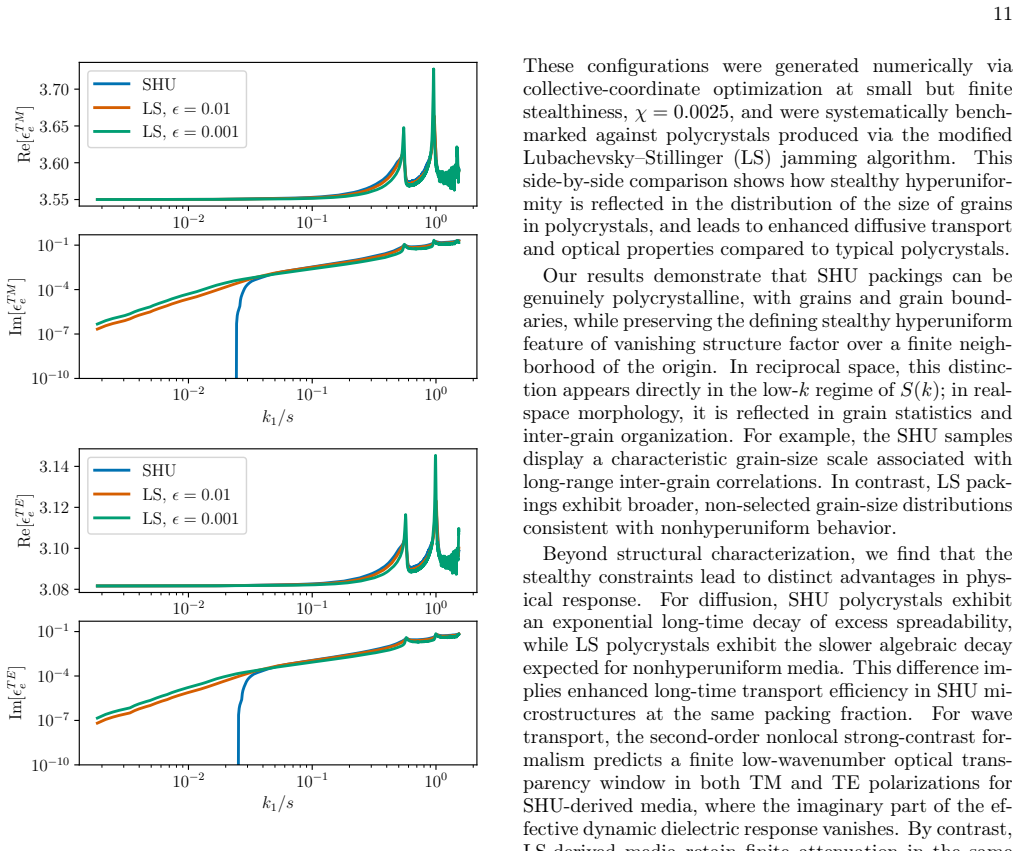
Stealthy hyperuniform polycrystalline disk packings transmit electromagnetic waves perfectly at small wave vectors unlike standard ones.
A machine-rendered reading of the paper's core claim, the machinery that carries it, and where it could break.
Core claim
Collective-coordinate optimization generates two-dimensional polycrystalline disk packings that are ultradense, stealthy, and hyperuniform. Within the nonlocal strong-contrast expansion these dielectric structures are perfectly transparent to electromagnetic waves at small wave vectors, in contrast to packings from the Lubachevsky-Stillinger algorithm. They also exhibit a distinctive grain-size distribution arising from long-range inter-grain correlations and enhanced diffusion spreadability.
What carries the argument
Collective-coordinate optimization procedure that enforces stealthiness and hyperuniformity throughout the polycrystalline grain structure.
If this is right
- Polycrystalline SHU packings possess a distinctive grain-size distribution caused by long-range correlations between grains.
- SHU packings made of dielectric material are perfectly transparent to electromagnetic waves at small wave vectors.
- Polycrystalline SHU packings exhibit enhanced diffusion spreadability relative to LS packings.
- The structures can be fabricated by nanolithography or 3D printing for metamaterial applications that exploit their optical and transport properties.
Where Pith is reading between the lines
- If fabrication methods can preserve the enforced long-range grain correlations, the transparency and spreadability advantages would survive in physical samples.
- The same optimization approach could be tested on three-dimensional systems or non-disk shapes to check whether the transparency result generalizes.
- Suppression of density fluctuations at long wavelengths may improve additional wave-transport or mechanical properties not examined in the paper.
Load-bearing premise
The collective-coordinate optimization actually produces packings whose long-wavelength density fluctuations are suppressed to the level required for hyperuniformity and stealthiness across the entire polycrystalline structure.
What would settle it
Computing or measuring a nonzero imaginary part of the effective dynamic dielectric constant for the SHU packings at small wave vectors would show that the perfect transparency does not hold.
Figures
read the original abstract
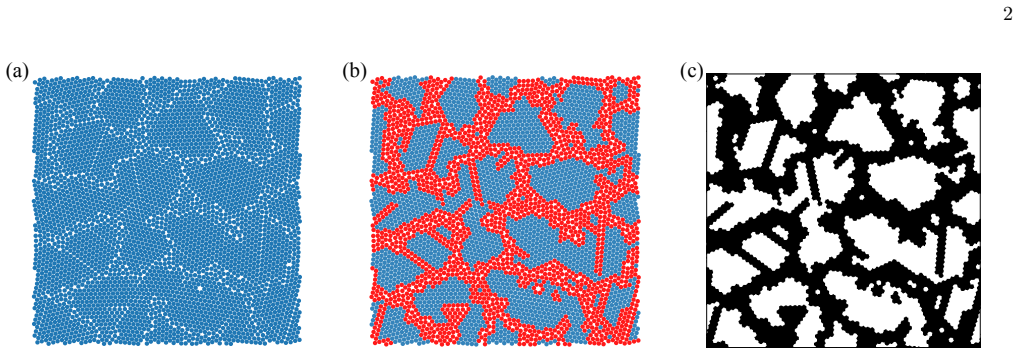
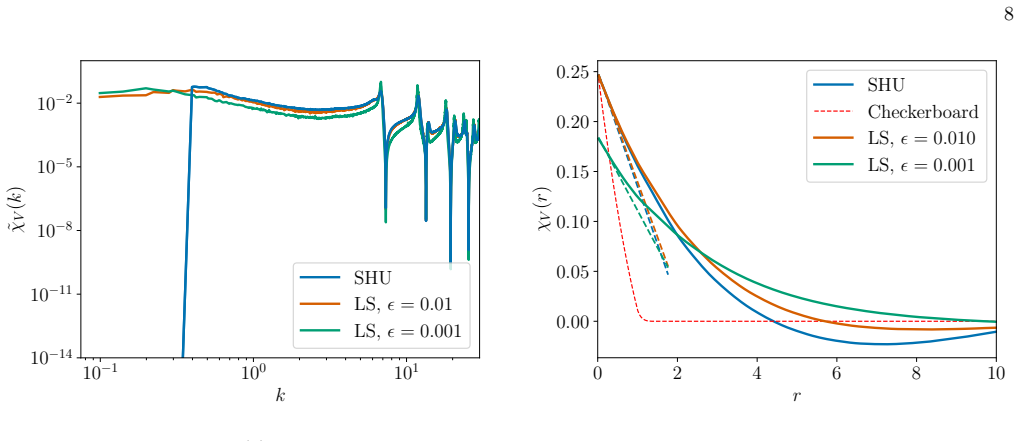
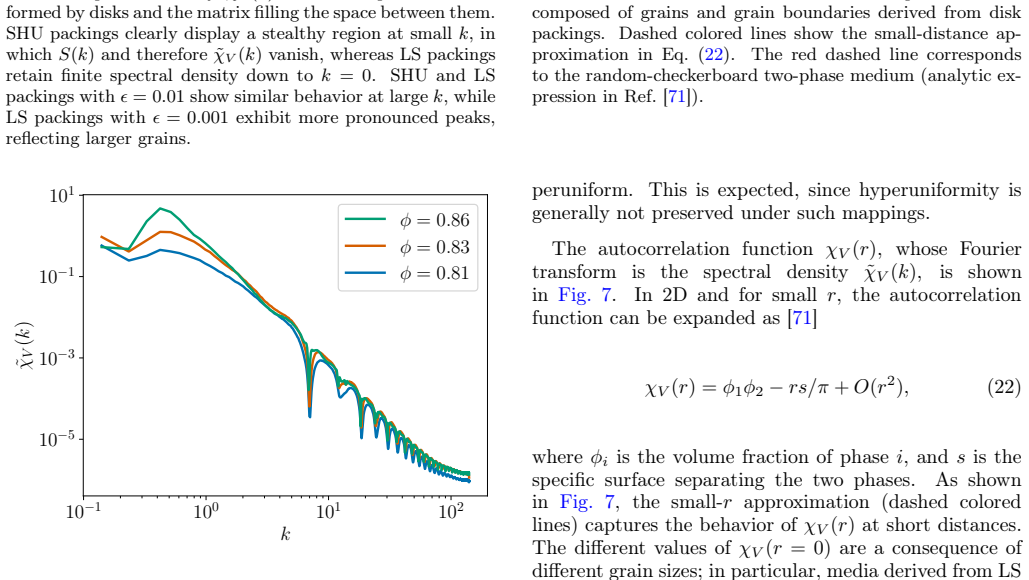
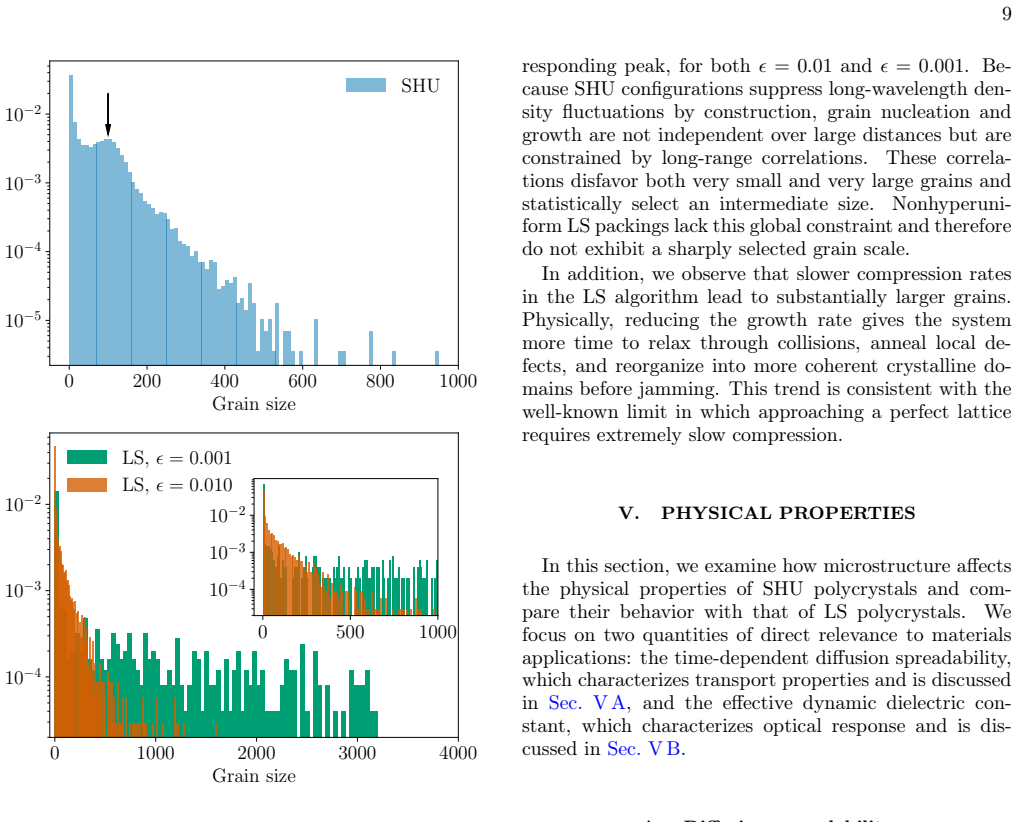
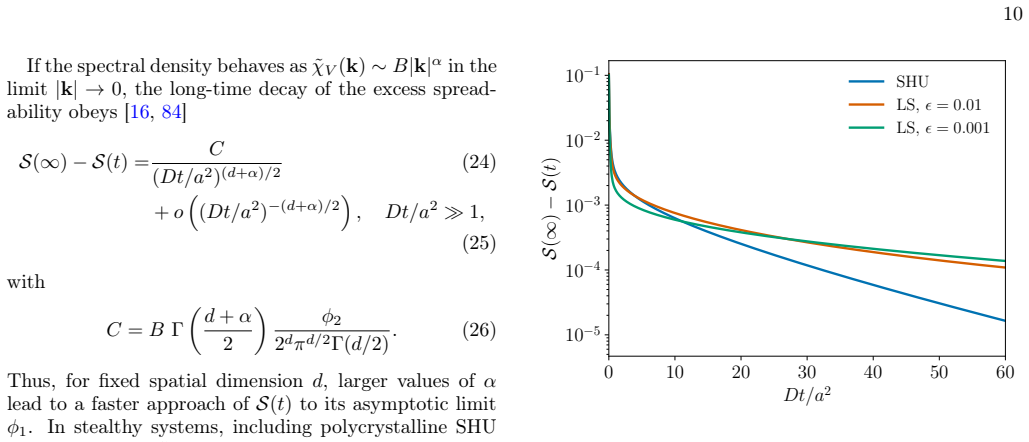
Polycrystals consist of grains of local crystalline order separated by grain boundaries. Their structure is not hyperuniform, even though perfect crystals are, because polycrystals consist of randomly sized and oriented grains that generate appreciable long-wavelength density fluctuations. In this paper, we use a collective-coordinate optimization procedure to generate two-dimensional polycrystalline packings composed of identical disks arranged in a pattern that is ultradense, stealthy, and hyperuniform (hereafter named SHU). We compare them with polycrystalline disk packings obtained via a modified Lubachevsky--Stillinger rapid compression algorithm (hereafter named LS), a molecular dynamics protocol that serves as a standard reference model describing realistic, nonhyperuniform polycrystalline microstructures. We carry out an extensive comparison of polycrystalline SHU and LS packings that includes differences in two-point statistics, grain size, specific surface area, diffusion spreadability, and optical response as quantified by the imaginary part of the effective dynamic dielectric constant. We find that the polycrystalline SHU packings exhibit a distinctive grain-size distribution, a consequence of long-range correlations between different grains that is absent in the nonhyperuniform case. Within the nonlocal strong-contrast expansion, we confirm that polycrystalline SHU packings made of dielectric material are perfectly transparent to electromagnetic waves at small wave vectors, in contrast to LS packings. Moreover, polycrystalline SHU packings offer enhanced diffusion spreadability. Although polycrystalline SHU packings are not expected to form spontaneously in nature, they may be created for applications as metamaterials via nanolithography or 3D printing that take advantage of their distinctive optical and transport properties.
Editorial analysis
A structured set of objections, weighed in public.
Referee Report
Summary. The manuscript claims that collective-coordinate optimization can produce two-dimensional polycrystalline disk packings that are simultaneously ultradense, stealthy, and hyperuniform (SHU), unlike standard nonhyperuniform polycrystalline packings generated by a modified Lubachevsky-Stillinger (LS) algorithm. The authors compare the two classes on two-point statistics, grain-size distributions, specific surface area, diffusion spreadability, and optical response (imaginary part of the effective dynamic dielectric constant via the nonlocal strong-contrast expansion), concluding that SHU polycrystals are perfectly transparent at small wave vectors and exhibit enhanced spreadability.
Significance. If the numerical results hold, the work establishes that long-range hyperuniformity can be imposed on polycrystalline microstructures, yielding metamaterial properties (vanishing long-wavelength scattering and improved transport) absent in conventional polycrystals. The quantitative comparisons via the strong-contrast expansion and spreadability calculations provide concrete, falsifiable predictions for fabricated samples.
major comments (1)
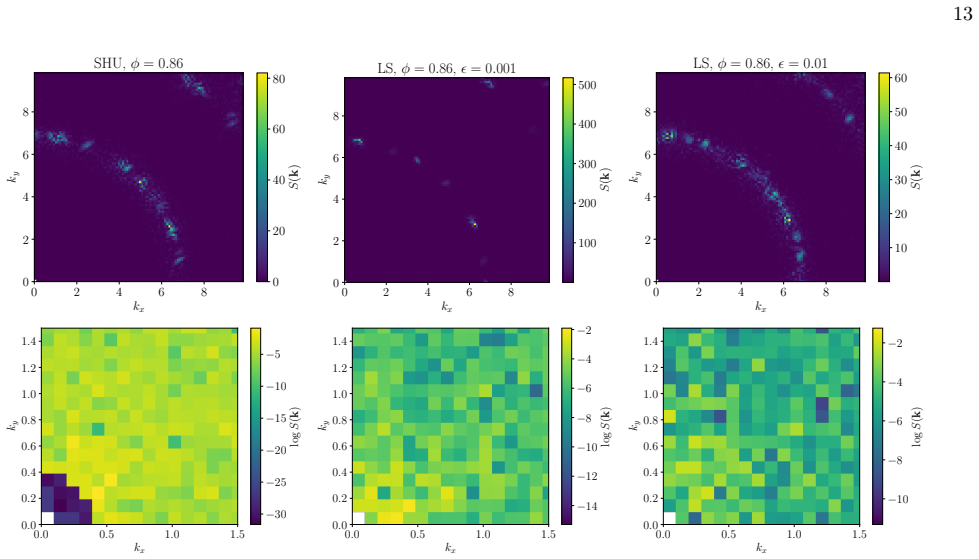
- [generation method] Section on generation of polycrystalline SHU packings (collective-coordinate optimization procedure): the manuscript does not explicitly verify that the target structure factor S(k)=0 for |k|<K_c holds for the full configuration including grain boundaries; if the optimization is performed only on intra-grain statistics before assembly, inter-grain density fluctuations would remain unsuppressed and the transparency claim in the nonlocal strong-contrast expansion would not follow.
minor comments (2)
- [Abstract] The abstract states that SHU packings are 'ultradense' but does not report the achieved packing fraction; this value should be stated explicitly when the LS and SHU protocols are first compared.
- [Results on grain size] Figure captions for the grain-size distributions should include the number of independent realizations used to compute the histograms, to allow assessment of statistical significance of the reported differences between SHU and LS cases.
Simulated Author's Rebuttal
We thank the referee for the careful reading and constructive comment. We address the major point below.
read point-by-point responses
-
Referee: Section on generation of polycrystalline SHU packings (collective-coordinate optimization procedure): the manuscript does not explicitly verify that the target structure factor S(k)=0 for |k|<K_c holds for the full configuration including grain boundaries; if the optimization is performed only on intra-grain statistics before assembly, inter-grain density fluctuations would remain unsuppressed and the transparency claim in the nonlocal strong-contrast expansion would not follow.
Authors: The collective-coordinate optimization is performed directly on the complete polycrystalline configuration, including grain boundaries, to enforce S(k)=0 for |k|<K_c on the full system. This global optimization suppresses inter-grain density fluctuations by construction. We will revise the manuscript to state this explicitly and include verification (e.g., computed S(k) plots for assembled packings) to eliminate ambiguity. revision: yes
Circularity Check
No significant circularity; optical confirmation follows from SHU definition via external expansion
full rationale
The paper generates polycrystalline SHU packings via collective-coordinate optimization targeting stealthiness and hyperuniformity, then applies the nonlocal strong-contrast expansion (an external cited method) to confirm transparency at small wave vectors for these packings versus LS ones. This is a direct consequence of the SHU definition (S(k)=0 at long wavelengths) but is not a fitted prediction or self-definitional reduction within the paper's own equations; the generation and optical steps remain distinct. No load-bearing self-citations, ansatz smuggling, or renaming of known results appear in the abstract or described chain. The derivation is self-contained against the external expansion benchmark.
Axiom & Free-Parameter Ledger
axioms (2)
- domain assumption Collective-coordinate optimization can produce polycrystalline configurations whose structure factor vanishes at small wave vectors while preserving grain boundaries.
- domain assumption The nonlocal strong-contrast expansion remains valid for the dielectric contrast and microstructure of the generated packings.
Reference graph
Works this paper leans on
-
[1]
N. W. Ashcroft and D. N. Mermin,Solid State Physics (Thomson Learning, Toronto, 1976)
1976
-
[2]
Kittel,Introduction to solid state physics, 8th ed
C. Kittel,Introduction to solid state physics, 8th ed. (Wi- ley, New York, 2005)
2005
-
[3]
P. M. Chaikin and T. C. Lubensky,Principles of Con- densed Matter Physics(Cambridge University Press, New York, 1995)
1995
-
[4]
A. P. Sutton,Physics of Elasticity and Crystal Defects (Oxford University Press, 2020)
2020
-
[5]
P. Scherrer, Bestimmung der größe und der inneren struktur von kolloidteilchen mittels röntgenstrahlen, Nachrichten von der Gesellschaft der Wissenschaften zu Göttingen, Mathematisch-Physikalische Klasse1918, 98 (1918)
1918
-
[6]
A. L. Patterson, The scherrer formula for x-ray particle size determination, Phys. Rev.56, 978 (1939)
1939
-
[7]
Hull and D
D. Hull and D. J. Bacon,Introduction to Dislocations (Elsevier, 2011)
2011
-
[8]
Scattering and diffraction by imperfect crystals, inX-ray Diffraction by Polycrystalline Materials(John Wiley & Sons, Ltd, 2007) Chap. 5, pp. 197–233
2007
-
[9]
Kim and S
J. Kim and S. Torquato, Ultradense sphere packings derived from disordered stealthy hyperuniform ground states, The Journal of Chemical Physics163, 024902 (2025)
2025
-
[10]
Torquato and F
S. Torquato and F. H. Stillinger, Local density fluctu- ations, hyperuniform systems, and order metrics, Phys. Rev. E68, 041113 (2003)
2003
-
[11]
Torquato, Hyperuniform states of matter, Phys
S. Torquato, Hyperuniform states of matter, Phys. Rep. 745, 1 (2018)
2018
-
[12]
O.U.Uche, F.H.Stillinger,andS.Torquato,Constraints on collective density variables: Two dimensions, Phys. Rev. E70, 046122 (2004)
2004
-
[13]
Batten, F
R. Batten, F. Stillinger, and S. Torquato, Classical dis- ordered ground states: Super-ideal gases and stealth and equi-luminous materials, J. Appl. Phys.104, 033504 (2008)
2008
-
[14]
Torquato, G
S. Torquato, G. Zhang, and F. H. Stillinger, Ensem- ble theory for stealthy hyperuniform disordered ground states, Phys. Rev. X5, 021020 (2015)
2015
-
[15]
Zhang, F
G. Zhang, F. Stillinger, and S. Torquato, Ground states of stealthy hyperuniform potentials: I. Entropically fa- vored configurations, Phys. Rev. E92, 022119 (2015)
2015
-
[16]
Torquato, Diffusion spreadability as a probe of the mi- crostructure of complex media across length scales, Phys
S. Torquato, Diffusion spreadability as a probe of the mi- crostructure of complex media across length scales, Phys. Rev. E104, 054102 (2021)
2021
-
[17]
J. KimandS. Torquato,Extraordinary opticalandtrans- port properties of disordered stealthy hyperuniform two- phase media, Journal of Physics: Condensed Matter36, 225701 (2024)
2024
-
[18]
Vanoni, J
C. Vanoni, J. Karcher, M. C. Rechtsman, B. L. Altshuler, P.J.Steinhardt,andS.Torquato,Effectivedelocalization in the one-dimensional anderson model with stealthy dis- order, Phys. Rev. Lett.136, 150404 (2026)
2026
-
[19]
Kim and S
J. Kim and S. Torquato, Effect of imperfections on the hyperuniformityofmany-bodysystems,Phys.Rev.B97, 054105 (2018)
2018
-
[20]
Torquato and J
S. Torquato and J. Kim, Existence of nonequilibrium glasses in the degenerate stealthy hyperuniform ground- state manifold, Soft Matter21, 4898 (2025). 13 0 2 4 6 8 kx 0 2 4 6 8ky SHU, φ = 0.86 0 20 40 60 80 S(k) 0 2 4 6 8 kx 0 2 4 6 8ky LS, φ = 0.86, ϵ = 0.001 100 200 300 400 500 S(k) 0 2 4 6 8 kx 0 2 4 6 8ky LS, φ = 0.86, ϵ = 0.01 10 20 30 40 50 60 S(k)...
2025
-
[21]
B. D. Lubachevsky and F. H. Stillinger, Geometric prop- erties of random disk packings, J. Stat. Phys.60, 561 (1990)
1990
-
[22]
Donev, S
A. Donev, S. Torquato, and F. H. Stillinger, Neighbor list collision-driven molecular dynamics for nonspherical hard particles: I. Algorithmic details, J. Comput. Phys. 202, 737 (2005)
2005
-
[23]
Skoge, A
M. Skoge, A. Donev, F. H. Stillinger, and S. Torquato, Packing hyperspheres in high-dimensional Euclidean spaces, Phys. Rev. E74, 041127 (2006)
2006
-
[24]
Donev, F
A. Donev, F. H. Stillinger, and S. Torquato, Unexpected density fluctuations in disordered jammed hard-sphere packings, Phys. Rev. Lett.95, 090604 (2005)
2005
-
[25]
C. E. Maher, Y. Jiao, and S. Torquato, Hyperunifor- mity of maximally random jammed packings of hyper- spheres across spatial dimensions, Phys. Rev. E108, 064602 (2023)
2023
-
[26]
Torquato and Y
S. Torquato and Y. Jiao, Robust algorithm to generate a diverseclassofdensedisorderedandorderedspherepack- ings via linear programming, Phys. Rev. E82, 061302 (2010)
2010
-
[27]
Charbonneau, E
P. Charbonneau, E. I. Corwin, G. Parisi, and F. Zam- poni, Universal microstructure and mechanical stabil- ity of jammed packings, Phys. Rev. Lett.109, 205501 (2012)
2012
-
[28]
C. S. O’Hern, S. A. Langer, A. J. Liu, and S. R. Nagel, Random packings of frictionless particles, Phys. Rev. Lett.88, 075507 (2002)
2002
-
[29]
Wilken, R
S. Wilken, R. E. Guerra, D. Levine, and P. M. Chaikin, Random close packing as a dynamical phase transition, Phys. Rev. Lett.127, 038002 (2021)
2021
-
[30]
Torquato and J
S. Torquato and J. Kim, Nonlocal effective electromag- netic wave characteristics of composite media: Beyond the quasistatic regime, Phys. Rev. X11, 021002 (2021)
2021
-
[31]
C. E. Zachary and S. Torquato, Hyperuniformity in point patterns and two-phase heterogeneous media, J. Stat. Mech.: Theory & Exp.2009, P12015 (2009)
2009
-
[32]
Zhang, F
G. Zhang, F. H. Stillinger, and S. Torquato, The perfect glass paradigm: Disordered hyperuniform glasses down to absolute zero, Sci. Rep.6, 36963 (2016)
2016
-
[33]
Levesque, J.-J
D. Levesque, J.-J. Weis, and J. Lebowitz, Charge fluctu- ations in the two-dimensional one-component plasma, J. Stat. Phys.100, 209 (2000)
2000
-
[34]
Hexner and D
D. Hexner and D. Levine, Hyperuniformity of critical ab- sorbing states, Phys. Rev. Lett.114, 110602 (2015)
2015
-
[35]
K. J. Wiese, Hyperuniformity in the manna model, con- served directed percolation and depinning, Phys. Rev. Lett.133, 067103 (2024)
2024
-
[36]
Ma and S
Z. Ma and S. Torquato, Hyperuniformity of generalized random organization models, Phys. Rev. E99, 022115 (2019)
2019
-
[37]
Torquato, T
S. Torquato, T. M. Truskett, and P. G. Debenedetti, Is random close packing of spheres well defined?, Phys. Rev. Lett.84, 2064 (2000)
2064
-
[38]
Torquato, A
S. Torquato, A. Scardicchio, and C. E. Zachary, Point processes in arbitrary dimension from fermionic gases, random matrix theory, and number theory, Journal of Statistical Mechanics: Theory and Experiment2008, P11019 (2008)
2008
-
[39]
H. L. Montgomery, The pair correlation of zeros of the 14 zeta function, Amer. Math. Soc. , 181 (1973)
1973
-
[40]
Lesanovsky and J
I. Lesanovsky and J. P. Garrahan, Out-of-equilibrium structures in strongly interacting Rydberg gases with dis- sipation, Phys. Rev. A90, 011603 (2014)
2014
-
[41]
Q.-L. Lei, M. P. Ciamarra, and R. Ni, Nonequilibrium stronglyhyperuniformfluidsofcircleactiveparticleswith large local density fluctuations, Sci. Adv.5(2019)
2019
-
[42]
Backofen, A
R. Backofen, A. Y. A. Altawil, M. Salvalaglio, and A. Voigt, Nonequilibrium hyperuniform states in ac- tive turbulence, Proc. Natl. Acad. Sci. U.S.A.121, e2320719121 (2024)
2024
-
[43]
Y. Jiao, T. Lau, H. Hatzikirou, M. Meyer-Hermann, J. C. Corbo, and S. Torquato, Avian photoreceptor patterns represent a disordered hyperuniform solution to a multi- scale packing problem, Phys. Rev. E89, 022721 (2014)
2014
-
[44]
Mayer, V
A. Mayer, V. Balasubramanian, T. Mora, and A. M. Wal- czak, How a well-adapted immune system is organized, Proc. Nat. Acad. Sci. U. S. A.112, 5950 (2015)
2015
-
[45]
Huang, W
M. Huang, W. Hu, S. Yang, Q. X. Liu, and H. P. Zhang, Circular swimming motility and disordered hyperuniform state in an algae system, Proc. Natl. Acad. Sci. U.S.A. 118, e2100493118 (2021)
2021
-
[46]
Ge, The hidden order of turing patterns in arid and semi-arid vegetation ecosystems, Proc
Z. Ge, The hidden order of turing patterns in arid and semi-arid vegetation ecosystems, Proc. Natl. Acad. Sci. U.S.A.120, e2306514120 (2023)
2023
-
[47]
Lomba, J.-J
E. Lomba, J.-J. Weis, and S. Torquato, Disordered multi- hyperuniformityderivedfrombinaryplasmas,Phys.Rev. E97, 010102(R) (2018)
2018
-
[48]
Christogeorgos, E
O. Christogeorgos, E. Okon, and Y. Hao, A computa- tional model for generating multihyperuniform distribu- tions for realistic antenna array and metasurface designs, EPJ Applied Metamaterials11, 5 (2024)
2024
-
[49]
stealthy
G. Zhang, F. H. Stillinger, and S. Torquato, Can exotic disordered “stealthy" particle configurations tolerate ar- bitrarily large holes?, Soft Matter13, 6197 (2017)
2017
-
[50]
Ghosh and J
S. Ghosh and J. L. Lebowitz, Generalized stealthy hy- peruniform processes: maximal rigidity and the bounded holes conjecture, Commun. Math. Phys.363, 97 (2018)
2018
-
[51]
Leseur, R
O. Leseur, R. Pierrat, and R. Carminati, High-density hyperuniformmaterialscanbetransparent,Optica3,763 (2016)
2016
-
[52]
L. S. Froufe-Pérez, M. Engel, J. José Sáenz, and F. Schef- fold, Band gap formation and Anderson localization in disordered photonic materials with structural correla- tionss, Proc. Nat. Acad. Sci.114, 9570– (2017)
2017
-
[53]
L. S. Froufe-Pérez, G. J. Aubry, F. Scheffold, and S. Magkiriadou, Bandgap fluctuations and robustness in two-dimensional hyperuniform dielectric materials, Opt. Express31, 18509 (2023)
2023
-
[54]
M. A. Klatt, P. J. Steinhardt, and S. Torquato, Wave propagationandbandtailsoftwo-dimensionaldisordered systems in the thermodynamic limit, Proc. Nat. Acad. Sci.119, e2213633119 (2022)
2022
-
[55]
Kim and S
J. Kim and S. Torquato, Effective electromagnetic wave properties of disordered stealthy hyperuniform layered media beyond the quasistatic regime, Optica10, 965 (2023)
2023
-
[56]
Alhaïtz, J.-M
L. Alhaïtz, J.-M. Conoir, and T. Valier-Brasier, Ex- perimental evidence of isotropic transparency and com- plete band gap formation for ultrasound propagation in stealthy hyperuniform media, Phys. Rev. E108, 065001 (2023)
2023
-
[57]
Bigourdan, R
F. Bigourdan, R. Pierrat, and R. Carminati, Enhanced absorption of waves in stealth hyperuniform disordered media, Optics Express27, 8666 (2019)
2019
-
[58]
Merkel, M
M. Merkel, M. Stappers, D. Ray, C. Denz, and J. Im- brock, Stealthy hyperuniform surface structures for effi- ciency enhancement of organic solar cells, Adv. Photonics Res.n/a, 2300256 (2023)
2023
-
[59]
Sgrignuoli, S
F. Sgrignuoli, S. Torquato, and L. Dal Negro, Subdiffu- sive wave transport and weak localization transition in three-dimensional stealthy hyperuniform disordered sys- tems, Phys. Rev. B105, 064204 (2022)
2022
-
[60]
Scheffold, J
F. Scheffold, J. Haberko, S. Magkiriadou, and L. S. Froufe-Pérez, Transport through amorphous photonic materials with localization and bandgap regimes, Phys. Rev. Lett.129, 157402 (2022)
2022
-
[61]
Gkantzounis, T
G. Gkantzounis, T. Amoah, and M. Florescu, Hyperuni- form disordered phononic structures, Phys. Rev. B95, 094120 (2017)
2017
-
[62]
Romero-García, N
V. Romero-García, N. Lamothe, G. Theocharis, O. Ri- choux, and L. M. García-Raffi, Stealth acoustic materi- als, Phys. Rev. Appl.11, 054076 (2019)
2019
-
[63]
Rohfritsch, J.-M
A. Rohfritsch, J.-M. Conoir, T. Valier-Brasier, and R. Marchiano, Impact of particle size and multiple scattering on the propagation of waves in stealthy- hyperuniform media, Phys. Rev. E102, 053001 (2020)
2020
-
[64]
Zhang, H
H. Zhang, H. Chu, H. Giddens, W. Wu, and Y. Hao, Experimental demonstration of luneburg lens based on hyperuniform disordered media, Appl. Phys. Lett.114, 053507 (2019)
2019
-
[65]
Christogeorgos, H
O. Christogeorgos, H. Zhang, Q. Cheng, and Y. Hao, Extraordinary Directive Emission and Scanning from an Array of Radiation Sources with Hyperuniform Disorder, Phys. Rev. Appl.15, 014062 (2021)
2021
-
[66]
K. Tang, Y. Wang, S. Wang, D. Gao, H. Li, X. Liang, P. Sebbah, Y. Li, J. Zhang, and J. Shi, Hyperuniform dis- ordered parametric loudspeaker array, Phys. Rev. Appl. 19, 054035 (2023)
2023
-
[67]
Tamraoui, E
M. Tamraoui, E. Roux, and H. Liebgott, Hyperuniform disordered sparse array for 3d ultrasound imaging, in 2023 IEEE International Ultrasonics Symposium (IUS) (2023) pp. 1–4
2023
-
[68]
Granchi, M
N. Granchi, M. Lodde, K. Stokkereit, R. Spalding, P. J. van Veldhoven, R. Sapienza, A. Fiore, M. Gurioli, M. Florescu, and F. Intonti, Near-field imaging of optical nanocavities in hyperuniform disordered materials, Phys. Rev. B107, 064204 (2023)
2023
-
[69]
Torquato and D
S. Torquato and D. Chen, Multifunctional hyperuniform cellular networks: optimality, anisotropy and disorder, Multifunct. Mater.1, 015001 (2018)
2018
-
[70]
Zhang, F
G. Zhang, F. Stillinger, and S. Torquato, Transport, ge- ometrical, and topological properties of stealthy disor- dered hyperuniform two-phase systems, J. Chem. Phys. 145, 244109 (2016)
2016
-
[71]
Torquato,Random Heterogeneous Materials: Mi- crostructure and Macroscopic Properties(Springer- Verlag, New York, 2002)
S. Torquato,Random Heterogeneous Materials: Mi- crostructure and Macroscopic Properties(Springer- Verlag, New York, 2002)
2002
-
[72]
Torquato, Disordered hyperuniform heterogeneous materials, J
S. Torquato, Disordered hyperuniform heterogeneous materials, J. Phys.: Cond. Mat28, 414012 (2016)
2016
-
[73]
D. A. G. Bruggeman, Berechnung verschiedener physikalischer konstanten von heterogenen substanzen. i. dielektrizitätskonstanten und leitfähigkeiten der mis- chkörper aus isotropen substanzen, Annalen der Physik 416, 636 (1935)
1935
-
[74]
Vanoni, J
C. Vanoni, J. Kim, P. J. Steinhardt, and S. Torquato, Dynamical properties of particulate composites derived from ultradense stealthy hyperuniform sphere packings, 15 Phys. Rev. E112, 015406 (2025)
2025
-
[75]
For a specific value ofχ,ϕcan be increased to its maxi- mum value,ϕ max, beyond which the ground state ceases toexist, whichcanbeviewedasasatisfiable–unsatisfiable (SAT-UNSAT) transition [9]. Interestingly, while the maximum achievable packing fractionϕ max decreases withχ, the typical packing fraction of packings gener- ated with the CCO without repulsiv...
-
[76]
D. C. Liu and J. Nocedal, On the limited memory BFGS method for large scale optimization, Math. Program.45, 503 (1989)
1989
-
[77]
S. J. Dawley and S. Torquato, Evolution of various ini- tial many-particle configurations to disordered stealthy hyperuniform ground states, Phys. Rev. E112, 045310 (2025)
2025
-
[78]
C. S. O’Hern, L. E. Silbert, A. J. Liu, and S. R. Nagel, Jamming at zero temperature and zero applied stress: The epitome of disorder, Phys. Rev. E68, 011306 (2003)
2003
-
[79]
S.TorquatoandY.Jiao,Densepolyhedralpackings: Pla- tonic and Archimedean solids, Phys. Rev. E80, 041104 (2009)
2009
-
[80]
Atkinson, F
S. Atkinson, F. H. Stillinger, and S. Torquato, Existence of isostatic, maximally random jammed monodisperse hard-disk packings, Proc. Nat. Acad. Sci.111, 18436 (2014)
2014
discussion (0)
Sign in with ORCID, Apple, or X to comment. Anyone can read and Pith papers without signing in.