REVIEW 3 minor 46 references
Optimal stopping for a Wiener process with hidden Bernoulli drift is solved by lifting the problem to two dimensions via foliation, then slicing back.
Reviewed by Pith at T0; open to challenge. T0 means a machine referee read the full paper against a public rubric. the ladder, T0–T4 →
T0 review · grok-4.3
2026-06-26 06:49 UTC pith:NM5EUBDE
load-bearing objection The paper uses a foliation by an auxiliary displacement y to reduce the filtered optimal stopping problem to a family of one-dimensional interval problems whose boundaries are set by balancing conditions, then glues them into a two-dimensional region with coupled ODE boundaries.
Optimal Stopping for a Diffusion with Unobserved Bernoulli Drift
The pith
A machine-rendered reading of the paper's core claim, the machinery that carries it, and where it could break.
Core claim
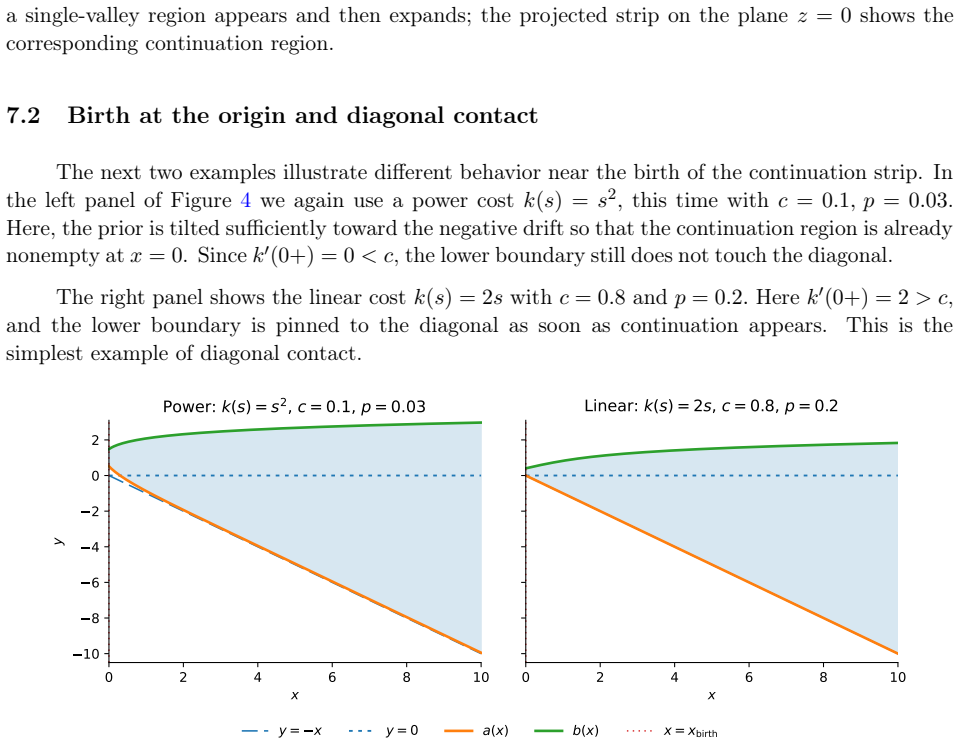
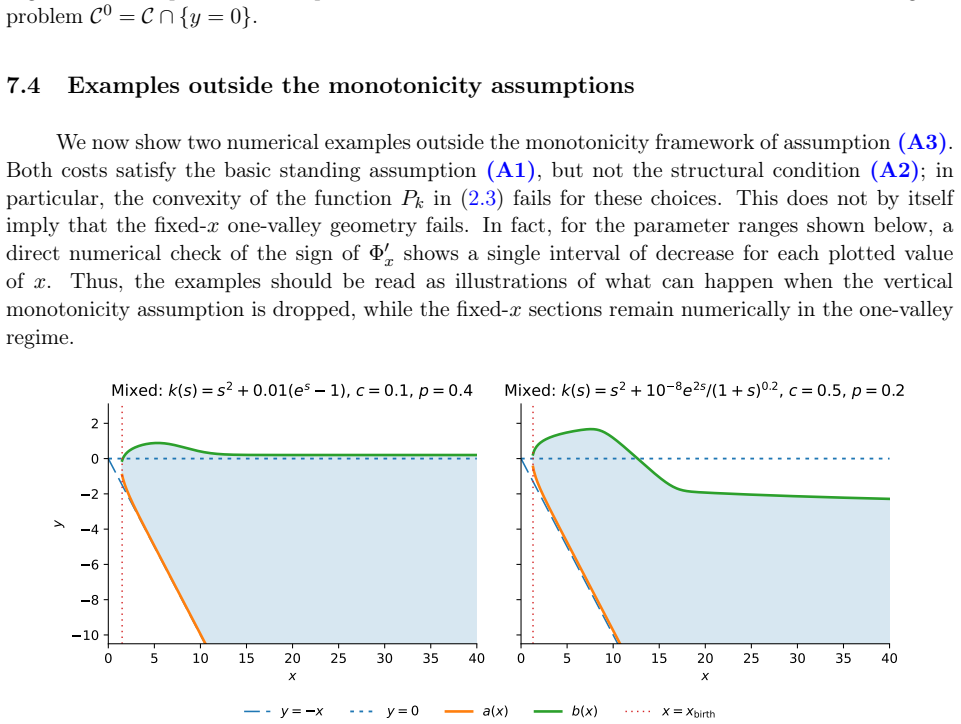
Under suitable structural assumptions on the terminal cost, each fixed-x continuation section is either empty or a single bounded interval whose endpoints are determined uniquely by a balancing condition; the value function is given in semi-explicit form, the two-dimensional continuation region is obtained by gluing, its free boundaries satisfy natural monotonicity and at regular points a coupled system of ODEs, and the original problem admits a threshold-type solution whenever the horizontal slice y=0 enters the two-dimensional continuation region.
What carries the argument
Foliation by the auxiliary displacement parameter y, which lifts the filtered one-dimensional problem to the plane so that fixed-x sections become intervals whose endpoints are fixed by a balancing condition before gluing produces the two-dimensional continuation region.
Load-bearing premise
The terminal cost must satisfy structural assumptions that force each fixed-x continuation section to be either empty or a single bounded interval with uniquely determined endpoints.
What would settle it
A concrete terminal cost obeying the stated structural assumptions for which the optimal continuation set at some fixed x consists of two disjoint intervals rather than one or none.
If this is right
- The two free boundaries of the two-dimensional continuation region are monotone and, at regular points, satisfy a coupled system of ordinary differential equations.
- Whenever the slice y=0 lies inside the two-dimensional continuation region, the original one-dimensional problem has a threshold-type solution.
- The value function of the lifted problem is given in semi-explicit form once the interval endpoints are known.
- The original problem is recovered by restricting the two-dimensional solution to the plane y=0.
Where Pith is reading between the lines
- The same foliation technique may apply to other optimal stopping problems with partial observations whose filtered state lives on the line but whose value depends on an auxiliary displacement variable.
- Numerical solution of the coupled ODE system for the free boundaries would yield computable approximations to the optimal stopping set for concrete terminal costs.
- If the structural assumptions on the terminal cost are dropped, the continuation sections may fragment into multiple intervals and the semi-explicit characterization would no longer hold.
Editorial analysis
A structured set of objections, weighed in public.
Referee Report
Summary. The manuscript solves an optimal stopping problem for a Wiener process with unobserved Bernoulli drift, subject to a symmetric terminal cost that increases with distance from the origin and a positive running cost c. After filtering, the problem is Markovian in the centered state x. The authors introduce an auxiliary parameter y representing displacement from initial position to foliate the problem, solve the augmented problem in the (x,y)-plane by characterizing fixed-x continuation sections as bounded intervals via balancing conditions, glue them to obtain the 2D continuation region whose free boundaries satisfy monotonicity and a coupled ODE system at regular points, and recover a threshold-type solution for the original problem on the y=0 slice under the structural assumptions on the terminal cost.
Significance. If the derivations hold, the paper offers a semi-explicit characterization of the value function and continuation region for this filtered optimal stopping problem, extending techniques like foliation and balancing conditions to this setting. This could be valuable for problems with partial observations in stochastic control, providing concrete structural results on the form of the solution. The direct derivation from filtered dynamics without fitted parameters is a strength.
minor comments (3)
- [Abstract] Abstract: the structural assumptions on the terminal cost are invoked to guarantee that fixed-x continuation sections are intervals with uniquely determined endpoints, but their precise form is not stated even at a high level; adding one sentence summarizing the key properties (e.g., convexity or growth conditions) would help readers evaluate the scope.
- The phrase 'semi-explicit form' for the value function is used repeatedly; specifying whether this means an integral representation, an explicit formula in terms of the boundaries, or a numerical ODE solution would clarify the degree of explicitness achieved.
- The description of the coupled ODE system for the free boundaries at regular points would benefit from a brief indication of the variables involved (e.g., which derivatives appear) to aid readability before the full derivation.
Simulated Author's Rebuttal
We thank the referee for the careful summary of our manuscript and the positive assessment of its contributions. The referee's description accurately reflects the filtering approach, the foliation by the auxiliary parameter y, the characterization of the continuation region via balancing conditions and gluing, and the recovery of the threshold solution on the y=0 slice. The recommendation for minor revision is noted; however, the major comments section contains no specific points.
Circularity Check
No significant circularity; derivation self-contained from dynamics and assumptions
full rationale
The paper derives the continuation region and value function via filtering to a Markov problem, foliation with auxiliary parameter y, section-wise solution of fixed-x intervals under explicit structural assumptions on the terminal cost (ensuring bounded intervals with unique balancing endpoints), gluing to a 2D region, and monotonicity/ODE characterization of boundaries. These steps follow directly from the stochastic dynamics and imposed assumptions without any quantity defined in terms of itself, without fitted parameters renamed as predictions, and without load-bearing self-citations or uniqueness theorems imported from prior author work. The resulting threshold solution on y=0 is a consequence of the construction rather than an input. This is the standard case of an internally consistent technical characterization.
Axiom & Free-Parameter Ledger
axioms (2)
- standard math The filtered belief process together with the displacement coordinate y forms a Markov process whose infinitesimal generator is known explicitly from the Wiener dynamics and the Bernoulli prior.
- domain assumption The terminal cost is symmetric, increases with distance from the origin, and satisfies additional structural conditions that force each fixed-x continuation set to be empty or a single bounded interval.
read the original abstract
We solve fairly explicitly an optimal stopping problem for a Wiener process with unobserved Bernoulli drift, in the presence of a cost on terminal position which is symmetric and increases with distance from the origin, and of a fixed positive cost per unit time \(c > 0\). After filtering, the problem reduces to Markovian optimal stopping with complete observations for the state process ``centered'' by its starting position $x \in \mathbb R$. However, the solution becomes possible only after foliating by an additional state-parameter \(y \in \mathbb{R}\), representing the displacement from the initial position; this foliation ``lifts'' the problem from the real line to the plane, solves the augmented problem for each fixed initial position \(x\), characterizes fairly explicitly the optimal stopping region in \((x,y)\)-space, and finally obtains the solution of the original problem by ``slicing'' along \(y=0\). Following this procedure, we show that, under suitable structural assumptions on the terminal cost, each fixed-\(x\) continuation section is either empty or a single bounded interval, whose endpoints are determined uniquely by a balancing condition; the corresponding value function is then given in semi-explicit form. The two-dimensional continuation region is obtained by gluing these fixed-\(x\) intervals over \(x\); its two free boundaries satisfy natural monotonicity properties and, at regular points, can be described by a coupled system of ordinary differential equations. The resulting description yields a threshold-type solution of the original one-dimensional problem whenever the horizontal slice \(y=0\) enters the two-dimensional continuation region.
Figures




Reference graph
Works this paper leans on
-
[1]
andCrisan, D
Bain, A. andCrisan, D. (2009).Fundamentals of Stochastic Filtering.Springer, New York
2009
-
[2]
andKra vitz, R
Bayraktar, E. andKra vitz, R. (2015). Quickest detection with discretely controlled obser- vations. Seq. Anal. 34 (1), pp. 77–133
2015
-
[3]
E., Gaitsgori, G., and Karatzas, I
Beneš, V. E., Gaitsgori, G., and Karatzas, I. (2025). Drift control with discretionary stopping for a diffusion.Ann. Appl. Probab.35 (3), pp. 2217–2237
2025
-
[4]
andLions, J.L
Bensoussan, A. andLions, J.L. (1982).Applications of Variational Inequalities in Stochastic Control. North-Holland, Amsterdam and American Elsevier, New York
1982
- [5]
-
[6]
Campbell, S. andZhang, Y. (2025). A Bayesian Sequential Soft Classification Problem for a Brownian Motion’s Drift.Preprint arXiv:2501.11314
-
[7]
andShiryaev, A.N
Dalang, R.C. andShiryaev, A.N. (2015). A quickest detection problem with an observation cost. Ann. Appl. Probab.25 (3), pp. 1475–1512
2015
-
[8]
andKaratzas, I
Dayanik, S. andKaratzas, I. (2003). On the Optimal Stopping Problem for One-Dimensional Diffusions. Stoch. Process. Their Appl.107 (2), pp. 173–212
2003
-
[9]
andSezer, S.O
Dayanik, S. andSezer, S.O. (2016). Sequential sensor installation for Wiener disorder detec- tion. Math. Oper. Res.41 (3), pp. 827–850
2016
-
[10]
and Ekström, E
De Angelis , T. and Ekström, E. (2020). Playing with ghosts in a Dynkin game.Stoch. Process. Their Appl.130 (10), pp. 6133–6156
2020
-
[11]
De Angelis, T., Ekström, E., andGlover, K. (2022). Dynkin games with incomplete and asymmetric information.Math. Oper. Res.47 (1), pp. 560–586
2022
-
[12]
De Angelis , T., Garg, J., and Zhou, Q. (2026). A quickest detection problem with false negatives. Stoch. Process. Their Appl.196, p. 104906
2026
-
[13]
De Angelis, T.,Gensbittel, F., andVilleneuve, S. (2021). A Dynkin game on assets with incomplete information on the return.Math. Oper. Res.46 (1), pp. 28–60
2021
-
[14]
De Angelis, T.,Merkulov, N., andPalczewski, J. (2022). On the value of non-Markovian Dynkin games with partial and asymmetric information.Ann. Appl. Probab.32 (3), pp. 1774– 1813
2022
-
[15]
Décamps, J.-P.,Mariotti, T., andVilleneuve, S. (2005). Investment timing under incom- plete information.Math. Oper. Res.30 (2), pp. 472–500. 45
2005
-
[16]
Dynkin, E. B. (1963). Optimal choice of the stopping moment of a Markov process.Dokl. Akad. Nauk SSSR150, pp. 238–240
1963
-
[17]
Dynkin, E. B. (1965).Markov Processes, Vol. II. Academic Press, New York
1965
-
[18]
Dynkin, E. B. andYushkevich, A. A. (1969).Markov Processes: Theorems and Problems. Plenum Press, New York
1969
-
[19]
and Karatzas, I
Ekström, E. and Karatzas, I. (2022). A sequential estimation problem with control and discretionary stopping.Probab. Uncertain. Quant. Risk7 (3), pp. 151–168
2022
-
[20]
Ekström, E.,Karatzas, I., andV aicena vicius, J. (2022). Bayesian sequential least-squares estimation for the drift of a Wiener process.Stoch. Process. Their Appl.,145, pp. 335–352
2022
-
[21]
and Lu, B
Ekström, E. and Lu, B. (2011). Optimal selling of an asset under incomplete information. Int. J. Stoch. Anal., Art. ID 543590, 17
2011
-
[22]
andMilazzo, A
Ekström, E. andMilazzo, A. (2024). A detection problem with a monotone observation rate. Stoch. Process. Their Appl.172, p. 104337
2024
-
[23]
and V aicena vicius, J
Ekström, E. and V aicena vicius, J. (2015). Bayesian sequential testing of the drift of a Brownian motion.ESAIM: Probability and Statistics,19, pp. 626–648
2015
-
[24]
andV aicena vicius, J
Ekström, E. andV aicena vicius, J. (2016). Optimal liquidation of an asset under drift un- certainty.SIAM J. Financial Math.7 (1), pp. 357–381
2016
-
[25]
andV aicena vicius, J
Ekström, E. andV aicena vicius, J. (2020). Optimal stopping of a Brownian bridge with an unknown pinning point.Stoch. Process. Their Appl.130 (2), pp. 806–823
2020
-
[26]
andV annestål, M
Ekström, E. andV annestål, M. (2019). American options and incomplete information.Int. J. Theor. Appl. Finance22 (6), pp. 1950035, 14
2019
-
[27]
and W ang, Y
Ekström, E. and W ang, Y. (2024). Stopping Problems with an Unknown State.J. Appl. Probab. 61 (2), pp. 515–528
2024
-
[28]
Ernst, P. A. and Peskir, G. (2024). The Gapeev-Shiryaev Conjecture.To appear in The Annals of Applied Probability
2024
-
[29]
A., Peskir, G., and Zhou, Q
Ernst, P. A., Peskir, G., and Zhou, Q. (2020). Optimal real-time detection of a drifting Brownian coordinate.Ann. Appl. Probab.,30 (3), pp. 1032–1065
2020
-
[30]
and Nisio, M
Fujita, Y. and Nisio, M. (1986). Nonlinear semigroups associated with optimal stopping of controlled diffusions under partial observation.Comput. Math. Appl.12 (6, Part A) , pp. 749– 760
1986
-
[31]
andGroenew ald, R
Gaitsgori, G. andGroenew ald, R. (2025). A Dynkin game with independent processes and private information.SIAM J. Control Optim.63 (4), pp. 2314–2337
2025
-
[32]
Gapeev, P. V. andPeskir, G (2004). The Wiener Sequential Testing Problem with Finite Horizon. Stochastics and Stochastic Reports,76 (1), pp. 59–75
2004
-
[33]
Gapeev, P. V. and Shiryaev, A. N. (2011). On the sequential testing problem for some diffusion processes.Stochastics, 83 (4-6), pp. 519–535
2011
-
[34]
Gapeev, P.V. (2012). Pricing of perpetual American options in a model with partial informa- tion. Int. J. Theor. Appl. Finance15 (1), pp. 1250010, 21
2012
-
[35]
Gapeev, P.V. (2022). Discounted optimal stopping problems in continuous hidden Markov models. Stochastics 94 (3), pp. 335–364
2022
-
[36]
andAl Motairi, H
Gapeev, P.V. andAl Motairi, H. (2018). Perpetual American defaultable options in models with random dividends and partial information.Risks 6 (4), pp. 127, 15
2018
-
[37]
Glover, K. (2022). Optimally stopping a Brownian bridge with an unknown pinning time: A Bayesian approach.Stoch. Process. Their Appl.150, pp. 919–937
2022
-
[38]
and Sunar, N
Harrison, J.M. and Sunar, N. (2015). Investment timing with incomplete information and multiple means of learning.Oper. Res.63 (2), pp. 442–457
2015
-
[39]
and Shreve, S
Karatzas, I. and Shreve, S. (1991). Brownian Motion and Stochastic Calculus, 2nd ed. Springer, New York. 46
1991
-
[40]
Peskir, G. (2012). Optimal detection of a hidden target: The median rule.Stoch. Process. Their Appl. 122 (5), pp. 2249–2263
2012
-
[41]
and Shiryaev, A
Peskir, G. and Shiryaev, A. N. (2000). Sequential testing problems for Poisson processes. Ann. Stat.,pp. 837–859
2000
-
[42]
andYor, M
Revuz, D. andYor, M. (1999).Continuous Martingales and Brownian Motion. 3rd ed.293. Grundlehren der Mathematischen Wissenschaften. Springer Berlin, Heidelberg
1999
-
[43]
Shiryaev, A. N. (1963). On optimum methods in quickest detection problems.Theory Probab. Appl. 8 (1), pp. 22–46
1963
-
[44]
Shiryaev, A. N. (1967). Two problems of sequential analysis.Cybernetics 3 (2), pp. 63–69
1967
-
[45]
Shiryaev, A. N. (1978).Optimal Stopping Rules. Springer, New York (Russian editions pub- lished by “Nauka”: 1969 (first ed.), 1976 (second ed.))
1978
-
[46]
andYao, Y.-C
Simons, G. andYao, Y.-C. (1989). Optimally stopping the sample mean of a Wiener process with an unknown drift.Stoch. Process. Their Appl.32 (2), pp. 347–354. 47
1989
discussion (0)
Sign in with ORCID, Apple, or X to comment. Anyone can read and Pith papers without signing in.