Accurate modeling for 3times2pt analyses in Roman and Rubin: a study of model approximations
Pith reviewed 2026-06-26 07:11 UTC · model grok-4.3
The pith
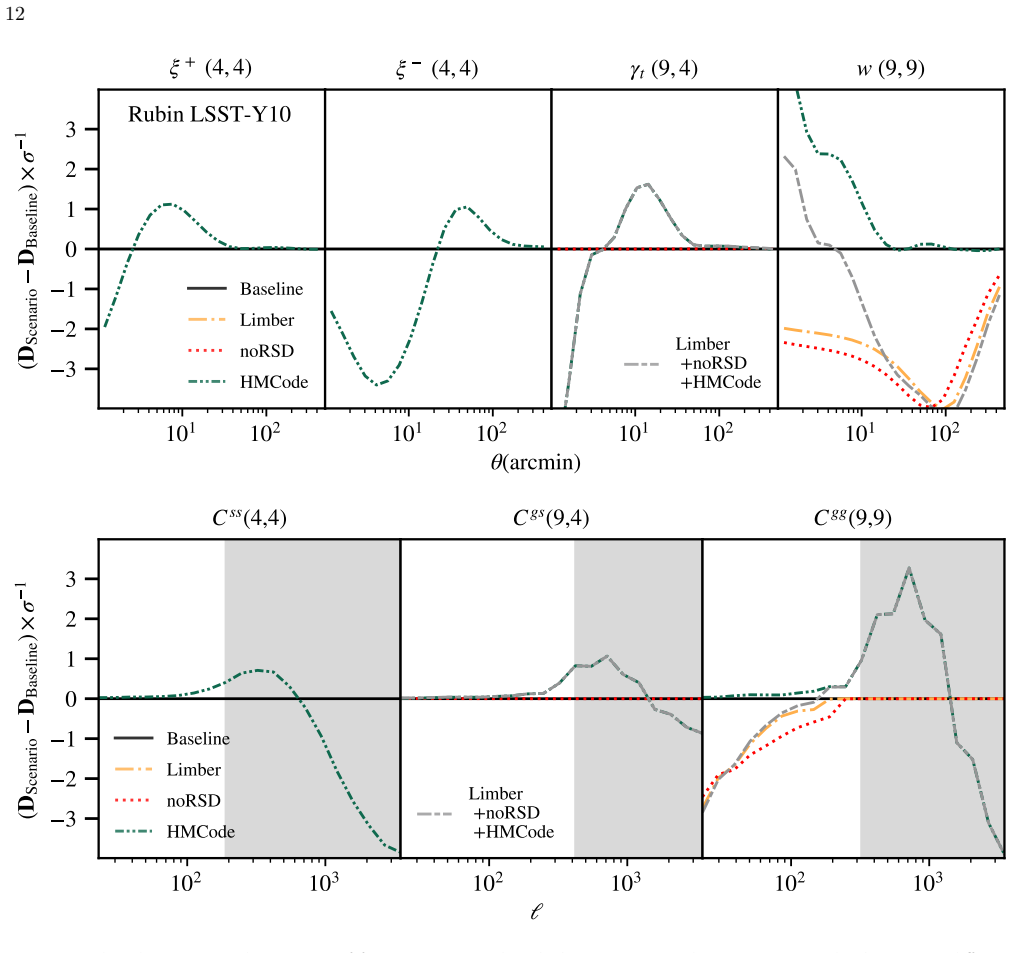
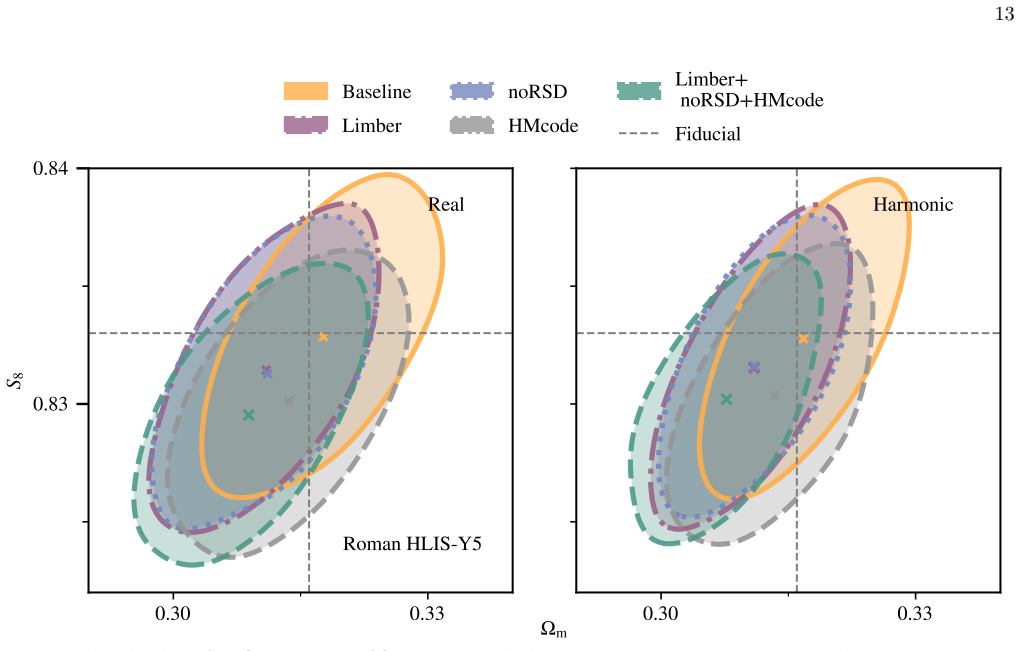
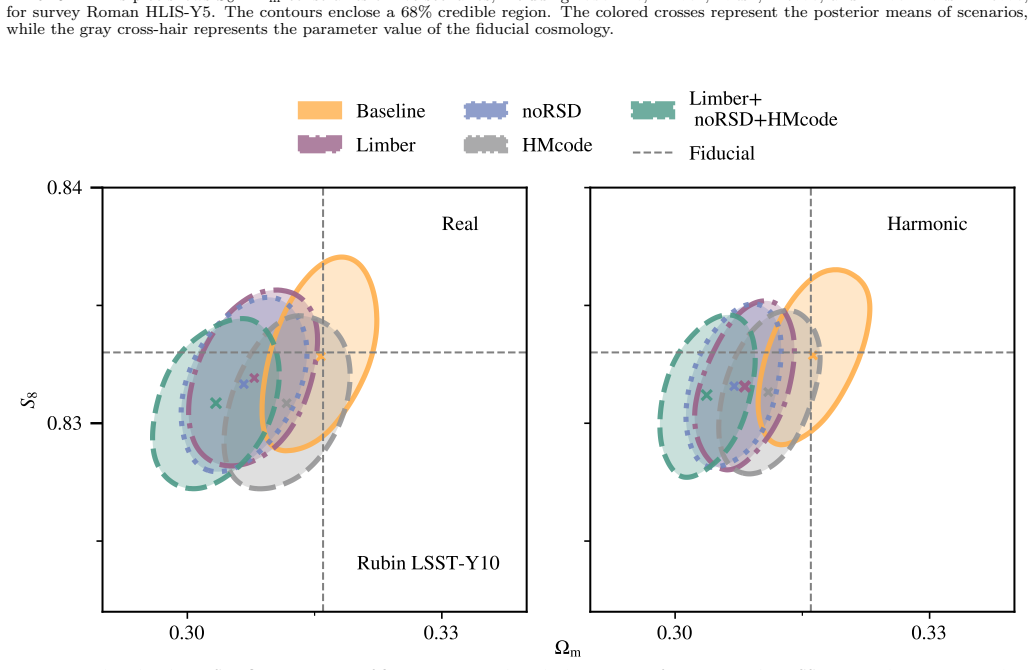
Neglecting Limber approximation, redshift-space distortions or nonlinear power spectrum models biases Roman and Rubin 3x2pt constraints by 1-2 sigma.
A machine-rendered reading of the paper's core claim, the machinery that carries it, and where it could break.
Core claim
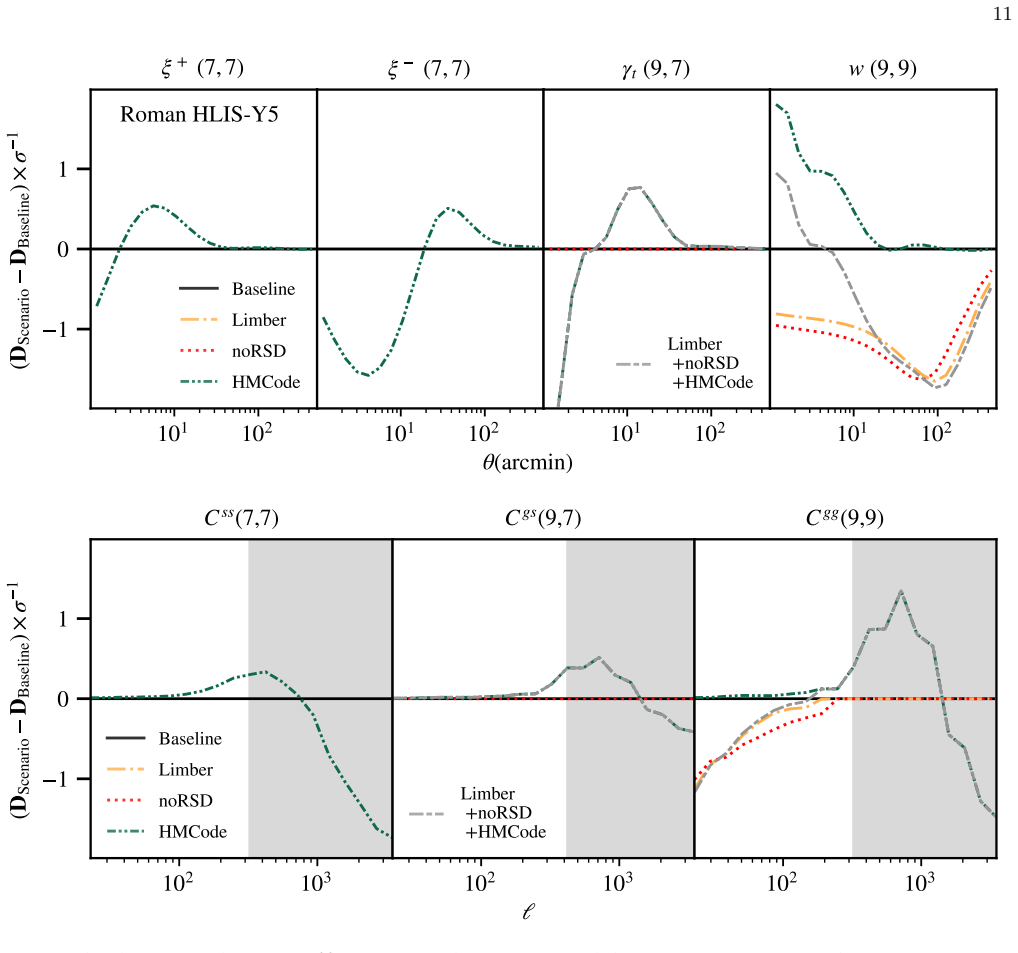
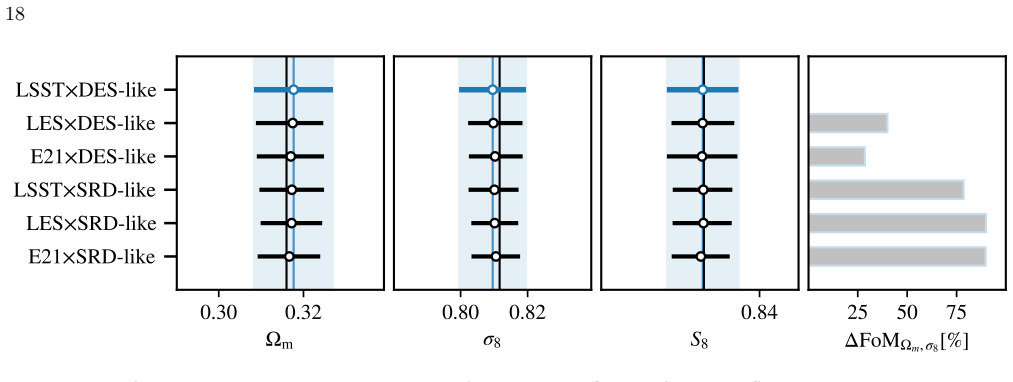
Neglecting any of the three approximations—Limber, redshift-space distortions, or less accurate nonlinear power spectrum—can induce biases in cosmological constraints approaching or exceeding 1σ, and exceeding 2σ for Rubin in several cases.
What carries the argument
Simulated likelihood analysis comparing full modeling to cases where one approximation is applied at a time, for 3x2pt correlations in Roman and Rubin surveys.
If this is right
- Biases from these approximations must be accounted for to achieve unbiased cosmology from Stage-IV surveys.
- Redshift-space distortions are particularly important to include for lens galaxy samples.
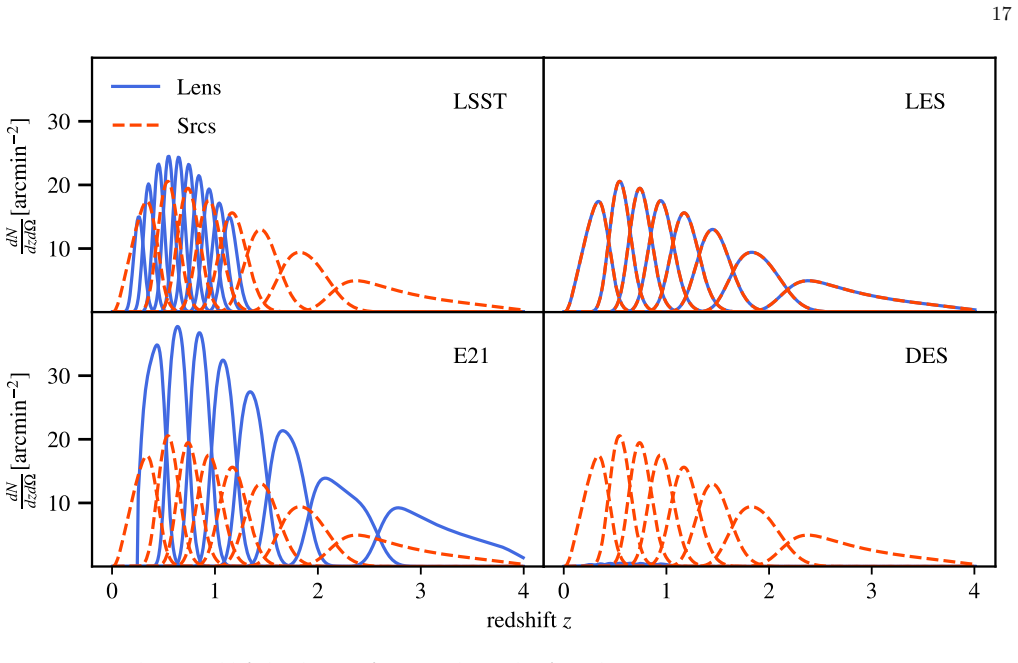
- Different scale cuts and lens sample choices can change the magnitude of the biases.
- The choice of nonlinear matter power spectrum model affects the accuracy of constraints.
Where Pith is reading between the lines
- If the biases are as large as simulated, survey teams will need to adopt full modeling without these approximations for final analyses.
- This may require more computational resources but could prevent misinterpretation of dark energy or other parameters.
- Similar effects might appear in other large-scale structure probes beyond 3x2pt.
Load-bearing premise
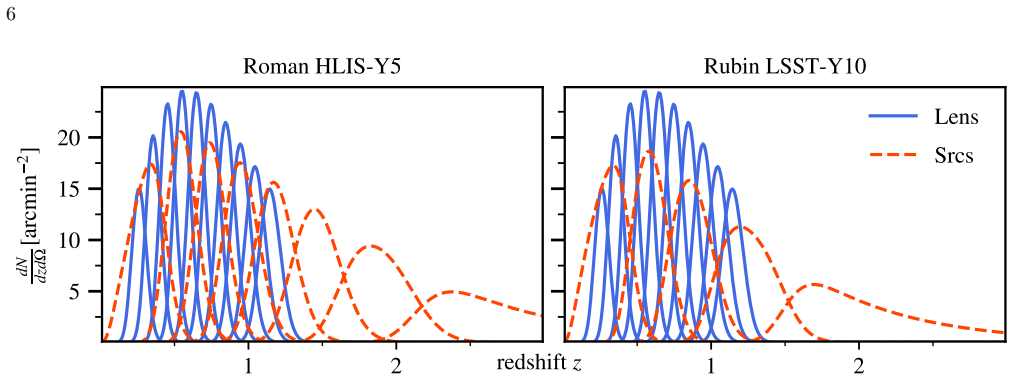
The simulated likelihood analysis and the specific lens-galaxy sample configurations accurately capture the biases that would appear in real data analyses for Roman and Rubin.
What would settle it
Comparing cosmological constraints from real Roman or Rubin data using both the approximated models and the full model without approximations to see if parameter shifts match the simulated ones.
Figures
read the original abstract
One of the pillars of modern cosmology is the use of galaxy imaging surveys to extract information from the large-scale structure. In recent surveys, this measurement is typically performed through a 3$\times$2pt analysis, which combines auto- and cross-correlations between galaxy density and galaxy weak lensing. In this paper, we carry out a systematic study of three modeling approximations commonly used in such analyses: 1) applying the Limber approximation, 2) neglecting redshift-space distortions, and 3) using less accurate models for the nonlinear matter power spectrum. We carry out the study in the context of the final data from two major Stage-IV galaxy imaging surveys: the Nancy Grace Roman Space Telescope's High Latitude Imaging Survey and the Vera C. Rubin Observatory's Legacy Survey of Space and Time. To do this, we first validate our modeling pipeline, implemented in the software package CoCoA, against an established code base, CCL. Next, we perform a simulated likelihood analysis to assess the impact of these approximations on the cosmological constraints. We find all three effects to be important; neglecting any of them can induce biases in cosmological constraints approaching or exceeding $1\sigma$, and exceeding $2\sigma$ for Rubin in several cases. Moreover, we explore how the lens-galaxy sample configuration and scale-cut choice can influence the constraints.
Editorial analysis
A structured set of objections, weighed in public.
Referee Report
Summary. The paper validates a 3×2pt modeling pipeline (CoCoA) against CCL and performs simulated likelihood analyses for Roman and Rubin surveys. It concludes that neglecting the Limber approximation, redshift-space distortions, or accurate nonlinear matter power spectrum modeling can induce biases in cosmological constraints of order 1σ or larger (exceeding 2σ for Rubin in several cases), with additional exploration of how lens-galaxy sample configuration and scale cuts affect the results.
Significance. If the central results hold, the work supplies concrete, survey-specific guidance on the modeling accuracy required for Stage-IV 3×2pt analyses, helping to avoid parameter biases in Roman and Rubin data. The explicit validation against CCL and the systematic variation of lens-sample and scale-cut choices are strengths that make the findings actionable for the community.
major comments (2)
- [Simulated likelihood analysis] Simulated likelihood section: the headline bias amplitudes (approaching or exceeding 1–2σ) are obtained from a specific choice of lens-galaxy redshift distributions, number densities, and scale cuts. Because the abstract itself states that these choices influence the constraints, the manuscript must show that the reported bias levels remain at the quoted magnitude for at least one additional set of configurations that bracket the expected final Roman and Rubin analysis choices; otherwise the quantitative claim is configuration-dependent rather than general.
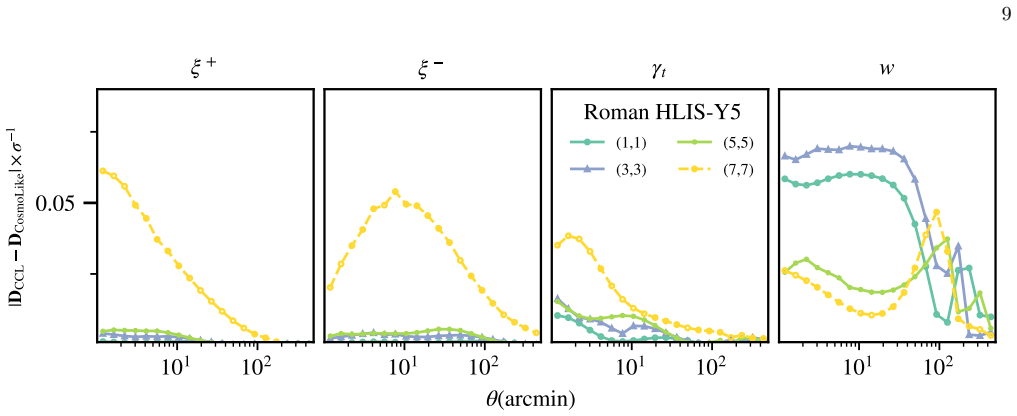
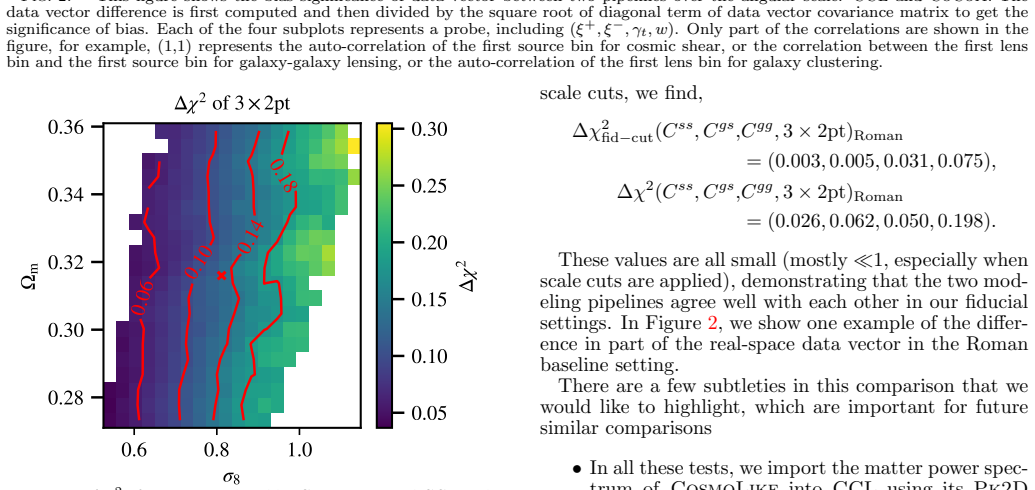
- [Validation section] Validation against CCL: the text states that the pipeline was validated, but does not report quantitative agreement metrics (e.g., fractional differences in C_ℓ or parameter shifts) for the exact modeling choices used in the bias study. This information is needed to confirm that the reported biases are not partly artifacts of residual discrepancies between CoCoA and CCL.
minor comments (2)
- [Tables] Table captions should explicitly state the cosmological parameters varied and the priors used in the simulated likelihood runs.
- [Introduction] The notation for the three approximations (Limber, RSD, nonlinear P(k)) should be introduced once with a consistent abbreviation list.
Simulated Author's Rebuttal
We thank the referee for their constructive comments on our manuscript. We address each major comment point by point below and outline the revisions we will make.
read point-by-point responses
-
Referee: [Simulated likelihood analysis] Simulated likelihood section: the headline bias amplitudes (approaching or exceeding 1–2σ) are obtained from a specific choice of lens-galaxy redshift distributions, number densities, and scale cuts. Because the abstract itself states that these choices influence the constraints, the manuscript must show that the reported bias levels remain at the quoted magnitude for at least one additional set of configurations that bracket the expected final Roman and Rubin analysis choices; otherwise the quantitative claim is configuration-dependent rather than general.
Authors: We agree that the quantitative bias levels are configuration-dependent and that the abstract highlights the influence of these choices. The manuscript already varies lens-galaxy sample configurations and scale cuts to demonstrate their effects. However, to strengthen the generality of the headline claims, we will add results for at least one additional set of configurations that bracket the expected final Roman and Rubin analysis choices. These will be presented in a revised version of the simulated likelihood section. revision: yes
-
Referee: [Validation section] Validation against CCL: the text states that the pipeline was validated, but does not report quantitative agreement metrics (e.g., fractional differences in C_ℓ or parameter shifts) for the exact modeling choices used in the bias study. This information is needed to confirm that the reported biases are not partly artifacts of residual discrepancies between CoCoA and CCL.
Authors: We agree that quantitative agreement metrics are necessary to substantiate the validation. While the manuscript states that CoCoA was validated against CCL, specific numerical metrics (such as fractional differences in C_ℓ or parameter shifts) for the exact modeling choices in the bias study were not reported. We will add these quantitative metrics to the validation section in the revised manuscript to confirm that residual discrepancies do not affect the reported biases. revision: yes
Circularity Check
No significant circularity; results from external validation and simulated likelihoods
full rationale
The paper validates its CoCoA pipeline against the independent external code CCL, then computes biases via simulated likelihoods on explicitly chosen lens samples and scale cuts. No equations reduce reported biases to parameters defined inside the paper, no predictions are statistically forced by fits, and no load-bearing self-citations or uniqueness theorems are invoked. The quantitative 1-2σ claims are direct outputs of the simulation pipeline rather than self-referential constructions, satisfying the criteria for a self-contained analysis against external benchmarks.
Axiom & Free-Parameter Ledger
Reference graph
Works this paper leans on
-
[1]
Joint Galaxy-Lensing Observables and the Dark Energy
Joint galaxy-lensing observables and the dark energy. , keywords =. doi:10.1103/PhysRevD.70.043009 , archivePrefix =. astro-ph/0312395 , primaryClass =
work page internal anchor Pith review Pith/arXiv arXiv doi:10.1103/physrevd.70.043009
-
[2]
2026 , eprint=
Dark Energy Survey Year 6 Results: Weak Lensing and Galaxy Clustering Cosmological Analysis Framework , author=. 2026 , eprint=
2026
-
[3]
Secco, L. F. and Samuroff, S. and Krause, E. and Jain, B. and Blazek, J. and Raveri, M. and Campos, A. and Amon, A. and Chen, A. and Doux, C. and Choi, A. and Gruen, D. and Bernstein, G. M. and Chang, C. and DeRose, J. and Myles, J. and Ferté, A. and Lemos, P. and Huterer, D. and Prat, J. and Troxel, M. A. and MacCrann, N. and Liddle, A. R. and Kacprzak, ...
-
[4]
The BACCO simulation project: a baryonification emulator with neural networks. , keywords =. doi:10.1093/mnras/stab1911 , archivePrefix =. 2011.15018 , primaryClass =
-
[5]
A new method to quantify the effects of baryons on the matter power spectrum
A new method to quantify the effects of baryons on the matter power spectrum. , keywords =. doi:10.1088/1475-7516/2015/12/049 , archivePrefix =. 1510.06034 , primaryClass =
work page internal anchor Pith review Pith/arXiv arXiv doi:10.1088/1475-7516/2015/12/049 2015
-
[6]
Impact of cosmology dependence of baryonic feedback in weak lensing. , keywords =. doi:10.1088/1475-7516/2025/03/041 , archivePrefix =. 2410.21980 , primaryClass =
-
[7]
Chisari, Nora Elisa and Richardson, Mark L. A. and Devriendt, Julien and Dubois, Yohan and Schneider, Aurel and Le Brun, Amandine M. C. and Beckmann, Ricarda S. and Peirani, Sebastien and Slyz, Adrianne and Pichon, Christophe , title =. Monthly Notices of the Royal Astronomical Society , year =. doi:10.1093/mnras/sty2093 , archivePrefix =. 1801.08559 , pr...
work page internal anchor Pith review Pith/arXiv arXiv doi:10.1093/mnras/sty2093
-
[8]
Fisher Forecasts for Cosmological Yields from 3\! \!2 pt Analysis of the Roman Space Telescope High Latitude Imaging Survey. arXiv e-prints , keywords =. doi:10.48550/arXiv.2601.00438 , archivePrefix =. 2601.00438 , primaryClass =
-
[9]
Revising the Halofit Model for the Nonlinear Matter Power Spectrum
Takahashi, Ryuichi and Sato, Masanori and Nishimichi, Takahiro and Taruya, Atsushi and Oguri, Masamune , title =. The Astrophysical Journal , year =. doi:10.1088/0004-637X/761/2/152 , archivePrefix =. 1208.2701 , primaryClass =
work page internal anchor Pith review Pith/arXiv arXiv doi:10.1088/0004-637x/761/2/152
-
[10]
doi:10.1093/mnras/stab1366 , archivePrefix =
Monthly Notices of the Royal Astronomical Society , year =. doi:10.1093/mnras/stab1366 , archivePrefix =. 2010.11288 , primaryClass =
-
[11]
CMB anisotropies from primordial inhomogeneous magnetic fields
Hirata, Christopher M. and Seljak, Uro. Intrinsic alignment-lensing interference as a contaminant of cosmic shear , journal =. 2004 , volume =. doi:10.1103/PhysRevD.70.063526 , archivePrefix =. astro-ph/0406096 , primaryClass =
work page internal anchor Pith review Pith/arXiv arXiv doi:10.1103/physrevd.70.063526 2004
-
[12]
Bridle, Sarah and King, Lindsay , title =. New Journal of Physics , year =. doi:10.1088/1367-2630/9/12/444 , archivePrefix =. 0705.0166 , primaryClass =
work page internal anchor Pith review Pith/arXiv arXiv doi:10.1088/1367-2630/9/12/444
-
[13]
Assessing theoretical uncertainties for cosmological constraints from weak lensing surveys , volume=
Tan, Ting and Zürcher, Dominik and Fluri, Janis and Refregier, Alexandre and Tarsitano, Federica and Kacprzak, Tomasz , year=. Assessing theoretical uncertainties for cosmological constraints from weak lensing surveys , volume=. Monthly Notices of the Royal Astronomical Society , publisher=. doi:10.1093/mnras/stad1142 , number=
-
[14]
Cosmology and source redshift constraints from galaxy clustering and tomographic weak lensing with HSC Y3 and SDSS using the point-mass correction model. , keywords =. doi:10.1103/hskc-8792 , archivePrefix =. 2507.01386 , primaryClass =
-
[15]
Astronomy & Astrophysics , volume =
Heymans, Catherine and Tr. Astronomy & Astrophysics , volume =. 2021 , doi =
2021
-
[16]
Dark Energy Survey Year 6 Results: Cosmological Constraints from Galaxy Clustering and Weak Lensing. arXiv e-prints , keywords =. doi:10.48550/arXiv.2601.14559 , archivePrefix =. 2601.14559 , primaryClass =
-
[17]
Prat, J. and Zuntz, J. and Chang, C. and Tröster, T. and Pedersen, E. and García-García, C. and Phillips-Longley, E. and Sanchez, J. and Alonso, David and Fang, X. and Gawiser, E. and Heitmann, K. and Ishak, M. and Jarvis, M. and Kovacs, E. and Larsen, P. and Mao, Y.-Y. and Medina Varela, L. and Paterno, M. and Vitenti, S.D. and Zhang, Z. , year=. The cat...
-
[18]
Dark Energy Survey Year 3 results: galaxy–halo connection from galaxy–galaxy lensing , volume=
Zacharegkas, G and Chang, C and Prat, J and Pandey, S and Ferrero, I and Blazek, J and Jain, B and Crocce, M and DeRose, J and Palmese, A and Seitz, S and Sheldon, E and Hartley, W G and Wechsler, R H and Dodelson, S and Fosalba, P and Krause, E and Park, Y and Sánchez, C and Alarcon, A and Amon, A and Bechtol, K and Becker, M R and Bernstein, G M and Cam...
-
[19]
2017 , eprint=
Dark Energy Survey Year 1 Results: Multi-Probe Methodology and Simulated Likelihood Analyses , author=. 2017 , eprint=
2017
-
[20]
Andrade-Oliveira, F and Camacho, H and Faga, L and Gomes, R and Rosenfeld, R and Troja, A and Alves, O and Doux, C and Elvin-Poole, J and Fang, X and Friedrich, O and Kokron, N and Lima, M and Miranda, V and Pandey, S and Porredon, A and Sanchez, J and Aguena, M and Allam, S and Annis, J and Avila, S and Bertin, E and Brooks, D and Burke, D L and Carrasco...
-
[21]
Precision calculations of the cosmic shear power spectrum projection , volume=
Kilbinger, Martin and Heymans, Catherine and Asgari, Marika and Joudaki, Shahab and Schneider, Peter and Simon, Patrick and Van Waerbeke, Ludovic and Harnois-Déraps, Joachim and Hildebrandt, Hendrik and Köhlinger, Fabian and Kuijken, Konrad and Viola, Massimo , year=. Precision calculations of the cosmic shear power spectrum projection , volume=. Monthly ...
-
[22]
Doux, C and Jain, B and Zeurcher, D and Lee, J and Fang, X and Rosenfeld, R and Amon, A and Camacho, H and Choi, A and Secco, L F and Blazek, J and Chang, C and Gatti, M and Gaztanaga, E and Jeffrey, N and Raveri, M and Samuroff, S and Alarcon, A and Alves, O and Andrade-Oliveira, F and Baxter, E and Bechtol, K and Becker, M R and Bernstein, G M and Campo...
-
[23]
Dark Energy Survey Year 3 results: Optimizing the lens sample in a combined galaxy clustering and galaxy-galaxy lensing analysis , author =. Phys. Rev. D , volume =. 2021 , month =. doi:10.1103/PhysRevD.103.043503 , url =
-
[24]
2025 , month = apr, date =
Roman Observations Time Allocation Committee: Final Report and Recommendations , author =. 2025 , month = apr, date =
2025
-
[25]
Cosmology with the <i>Roman Space Telescope</i> – multiprobe strategies , volume=
Eifler, Tim and Miyatake, Hironao and Krause, Elisabeth and Heinrich, Chen and Miranda, Vivian and Hirata, Christopher and Xu, Jiachuan and Hemmati, Shoubaneh and Simet, Melanie and Capak, Peter and Choi, Ami and Doré, Olivier and Doux, Cyrille and Fang, Xiao and Hounsell, Rebekah and Huff, Eric and Huang, Hung-Jin and Jarvis, Mike and Kruk, Jeffrey and M...
-
[26]
2024 , eprint=
Machine Learning LSST 3x2pt analyses -- forecasting the impact of systematics on cosmological constraints using neural networks , author=. 2024 , eprint=
2024
-
[27]
CosmoLike - Cosmological Likelihood Analyses for Photometric Galaxy Surveys
cosmolike - cosmological likelihood analyses for photometric galaxy surveys. , keywords =. doi:10.1093/mnras/stx1261 , archivePrefix =. 1601.05779 , primaryClass =
work page internal anchor Pith review Pith/arXiv arXiv doi:10.1093/mnras/stx1261
-
[28]
Cobaya: Code for Bayesian Analysis of hierarchical physical models
Cobaya: code for Bayesian analysis of hierarchical physical models. , keywords =. doi:10.1088/1475-7516/2021/05/057 , archivePrefix =. 2005.05290 , primaryClass =
work page internal anchor Pith review Pith/arXiv arXiv doi:10.1088/1475-7516/2021/05/057 2021
-
[29]
Leonard, C. Danielle and Ferreira, Tassia and Fang, Xiao and Reischke, Robert and Schoeneberg, Nils and Tröster, Tilman and Alonso, David and Campagne, Jean-Eric and Lanusse, François and Slosar, Anže and Ishak, Mustapha , year=. The N5K Challenge: Non-Limber Integration for LSST Cosmology , volume=. doi:10.21105/astro.2212.04291 , journal=
-
[30]
2021 , eprint=
The LSST Dark Energy Science Collaboration (DESC) Science Requirements Document , author=. 2021 , eprint=
2021
-
[31]
Fang, Xiao and Krause, Elisabeth and Eifler, Tim and MacCrann, Niall , year=. Beyond Limber: efficient computation of angular power spectra for galaxy clustering and weak lensing , volume=. Journal of Cosmology and Astroparticle Physics , publisher=. doi:10.1088/1475-7516/2020/05/010 , number=
-
[32]
Science-driven Optimization of the LSST Observing Strategy
Marshall, Phil and Clarkson, Will and Shemmer, Ohad and Biswas, Rahul and De Val-Borro, Miguel and. LSST Science Collaborations Observing Strategy White Paper: "Science-driven Optimization of the LSST Observing Strategy" , publisher =. 2017 , copyright =. doi:10.5281/ZENODO.842713 , url =
-
[33]
Chisari, Nora Elisa and Alonso, David and Krause, Elisabeth and Leonard, C. Danielle and Bull, Philip and Neveu, Jérémy and Villarreal, Antonio and Singh, Sukhdeep and McClintock, Thomas and Ellison, John and Du, Zilong and Zuntz, Joe and Mead, Alexander and Joudaki, Shahab and Lorenz, Christiane S. and Tröster, Tilman and Sanchez, Javier and Lanusse, Fra...
-
[34]
Fang, Xiao and Eifler, Tim and Schaan, Emmanuel and Huang, Hung-Jin and Krause, Elisabeth and Ferraro, Simone , year=. Cosmology from clustering, cosmic shear, CMB lensing, and cross correlations: combining Rubin observatory and Simons Observatory , volume=. Monthly Notices of the Royal Astronomical Society , publisher=. doi:10.1093/mnras/stab3410 , number=
-
[35]
Martinelli, M. and Tutusaus, I. and Archidiacono, M. and Camera, S. and Cardone, V. F. and Clesse, S. and Casas, S. and Casarini, L. and Mota, D. F. and Hoekstra, H. and Carbone, C. and Ilić, S. and Kitching, T. D. and Pettorino, V. and Pourtsidou, A. and Sakr, Z. and Sapone, D. and Auricchio, N. and Balestra, A. and Boucaud, A. and Branchini, E. and Bres...
-
[36]
Tanidis, K. and Cardone, V.F. and Martinelli, M. and Tutusaus, I. and Camera, S. and Aghanim, N. and Amara, A. and Andreon, S. and Auricchio, N. and Baldi, M. , year=. Euclid preparation. XXXIV. The effect of linear redshift-space distortions in photometric galaxy clustering and its cross-correlation with cosmic shear , ISSN=. doi:10.1051/0004-6361/202347...
-
[37]
Lewis, Antony and Challinor, Anthony and Lasenby, Anthony , year=. Efficient Computation of Cosmic Microwave Background Anisotropies in Closed Friedmann‐Robertson‐Walker Models , volume=. The Astrophysical Journal , publisher=. doi:10.1086/309179 , number=
-
[38]
Pandey, S. and Krause, E. and Jain, B. and MacCrann, N. and Blazek, J. and Crocce, M. and DeRose, J. and Fang, X. and Ferrero, I. and Friedrich, O. and Aguena, M. and Allam, S. and Annis, J. and Avila, S. and Bernstein, G. M. and Brooks, D. and Burke, D. L. and Carnero Rosell, A. and Carrasco Kind, M. and Carretero, J. and Costanzi, M. and da Costa, L. N....
-
[39]
Mead, A J and Brieden, S and Tröster, T and Heymans, C , year=. <scp>hmcode-2020</scp>: improved modelling of non-linear cosmological power spectra with baryonic feedback , volume=. Monthly Notices of the Royal Astronomical Society , publisher=. doi:10.1093/mnras/stab082 , number=
-
[40]
Smail, I. and Ellis, R. S. and Fitchett, M. J. , year=. Gravitational lensing of distant field galaxies by rich clusters - I. Faint galaxy redshift distributions , volume=. Monthly Notices of the Royal Astronomical Society , publisher=. doi:10.1093/mnras/270.2.245 , number=
-
[41]
2012 , eprint=
The WFIRST Galaxy Survey Exposure Time Calculator , author=. 2012 , eprint=
2012
-
[42]
Constraining baryonic feedback and cosmology from DES Y3 and Planck PR4 6 2pt data. I. CDM models , author=. 2026 , eprint=
2026
-
[43]
Monthly Notices of the Royal Astronomical Society , volume =
Wayland, Amy and Alonso, David and Zennaro, Matteo , title =. Monthly Notices of the Royal Astronomical Society , volume =. 2025 , month =. doi:10.1093/mnras/staf1541 , url =
-
[44]
Nelson, D. and Pillepich, A. and Genel, S. and Vogelsberger, M. and Springel, V. and Torrey, P. and Rodriguez-Gomez, V. and Sijacki, D. and Snyder, G.F. and Griffen, B. and Marinacci, F. and Blecha, L. and Sales, L. and Xu, D. and Hernquist, L. , year=. The illustris simulation: Public data release , volume=. doi:10.1016/j.ascom.2015.09.003 , journal=
-
[45]
Efficient sampling of fast and slow cosmological parameters
Lewis, Antony. Efficient sampling of fast and slow cosmological parameters. 2013. doi:10.1103/PhysRevD.87.103529. arXiv:1304.4473
work page internal anchor Pith review Pith/arXiv arXiv doi:10.1103/physrevd.87.103529 2013
-
[46]
Seljak, U. , year=. Analytic model for galaxy and dark matter clustering , volume=. Monthly Notices of the Royal Astronomical Society , publisher=. doi:10.1046/j.1365-8711.2000.03715.x , number=
-
[47]
Fisher, K. B. and Scharf, C. A. and Lahav, O. , year=. A spherical harmonic approach to redshift distortion and a measurement of Formula from the 1.2-Jy IRAS Redshift Survey , volume=. Monthly Notices of the Royal Astronomical Society , publisher=. doi:10.1093/mnras/266.1.219 , number=
-
[48]
Padmanabhan, Nikhil and Schlegel, David J. and Seljak, Uroš and Makarov, Alexey and Bahcall, Neta A. and Blanton, Michael R. and Brinkmann, Jonathan and Eisenstein, Daniel J. and Finkbeiner, Douglas P. and Gunn, James E. and Hogg, David W. and Ivezić, Željko and Knapp, Gillian R. and Loveday, Jon and Lupton, Robert H. and Nichol, Robert C. and Schneider, ...
-
[49]
Journal of Cosmology and Astroparticle Physics , abstract =
Schaan, Emmanuel and Ferraro, Simone and Seljak, Uros , title =. Journal of Cosmology and Astroparticle Physics , abstract =. 2020 , month =. doi:10.1088/1475-7516/2020/12/001 , url =
-
[50]
1995 , eprint=
Clustering of Faint Galaxies: ( ) , Induced by Weak Gravitational Lensing , author=. 1995 , eprint=
1995
-
[51]
Cross-correlation of the astrophysical gravitational-wave background with galaxy clustering , author =. Phys. Rev. D , volume =. 2020 , month =. doi:10.1103/PhysRevD.102.043513 , url =
-
[52]
Size Bias in Galaxy Surveys , volume=
Schmidt, Fabian and Rozo, Eduardo and Dodelson, Scott and Hui, Lam and Sheldon, Erin , year=. Size Bias in Galaxy Surveys , volume=. Physical Review Letters , publisher=. doi:10.1103/physrevlett.103.051301 , number=
-
[53]
Beyond linear galaxy alignments , author =. Phys. Rev. D , volume =. 2019 , month =. doi:10.1103/PhysRevD.100.103506 , url =
-
[54]
Catelan, P. and Kamionkowski, M. and Blandford, R. D. , year=. Intrinsic and extrinsic galaxy alignment , volume=. Monthly Notices of the Royal Astronomical Society , publisher=. doi:10.1046/j.1365-8711.2001.04105.x , number=
-
[55]
Joachimi, B. and Mandelbaum, R. and Abdalla, F. B. and Bridle, S. L. , year=. Constraints on intrinsic alignment contamination of weak lensing surveys using the MegaZ-LRG sample , volume=. doi:10.1051/0004-6361/201015621 , journal=
-
[56]
Intrinsic alignments of SDSS-III BOSS LOWZ sample galaxies , volume=
Singh, Sukhdeep and Mandelbaum, Rachel and More, Surhud , year=. Intrinsic alignments of SDSS-III BOSS LOWZ sample galaxies , volume=. Monthly Notices of the Royal Astronomical Society , publisher=. doi:10.1093/mnras/stv778 , number=
-
[57]
and Giavalisco, Mauro and Barro, Guillermo and Willner, S
Guo, Yicheng and Ferguson, Henry C. and Giavalisco, Mauro and Barro, Guillermo and Willner, S. P. and Ashby, Matthew L. N. and Dahlen, Tomas and Donley, Jennifer L. and Faber, Sandra M. and Fontana, Adriano and Galametz, Audrey and Grazian, Andrea and Huang, Kuang-Han and Kocevski, Dale D. and Koekemoer, Anton M. and Koo, David C. and McGrath, Elizabeth J...
-
[58]
Weak Lensing for Precision Cosmology , volume=
Mandelbaum, Rachel , year=. Weak Lensing for Precision Cosmology , volume=. Annual Review of Astronomy and Astrophysics , publisher=. doi:10.1146/annurev-astro-081817-051928 , number=
-
[59]
Weinberg, David H. and Mortonson, Michael J. and Eisenstein, Daniel J. and Hirata, Christopher and Riess, Adam G. and Rozo, Eduardo , year=. Observational probes of cosmic acceleration , volume=. Physics Reports , publisher=. doi:10.1016/j.physrep.2013.05.001 , number=
-
[60]
Euclid Collaboration and Blanchard, A. and Camera, S. and Carbone, C. and Cardone, V. F. and Casas, S. and Clesse, S. and Ilić, S. and Kilbinger, M. and Kitching, T. and Kunz, M. and Lacasa, F. and Linder, E. and Majerotto, E. and Markovič, K. and Martinelli, M. and Pettorino, V. and Pourtsidou, A. and Sakr, Z. and Sánchez, A. G. and Sapone, D. and Tutusa...
-
[61]
Fang, Xiao and Eifler, Tim and Krause, Elisabeth , year=. 2D-FFTLog: efficient computation of real-space covariance matrices for galaxy clustering and weak lensing , volume=. Monthly Notices of the Royal Astronomical Society , publisher=. doi:10.1093/mnras/staa1726 , number=
-
[62]
Charles R. Harris and K. Jarrod Millman and St. Array programming with. 2020 , month = sep, journal =. doi:10.1038/s41586-020-2649-2 , publisher =
-
[63]
and Haberland, Matt and Reddy, Tyler and Cournapeau, David and Burovski, Evgeni and Peterson, Pearu and Weckesser, Warren and Bright, Jonathan and
Virtanen, Pauli and Gommers, Ralf and Oliphant, Travis E. and Haberland, Matt and Reddy, Tyler and Cournapeau, David and Burovski, Evgeni and Peterson, Pearu and Weckesser, Warren and Bright, Jonathan and. Nature Methods , year =
-
[64]
Hunter, J. D. , Title =. Computing in Science & Engineering , Volume =
discussion (0)
Sign in with ORCID, Apple, or X to comment. Anyone can read and Pith papers without signing in.