Fermi surface change and d-wave superconductivity in the square lattice Kondo-Heisenberg model
Pith reviewed 2026-06-26 06:18 UTC · model grok-4.3
The pith
The square lattice Kondo-Heisenberg model changes its Fermi surface volume and develops d-wave superconductivity in the crossover between weak and strong Kondo coupling.
A machine-rendered reading of the paper's core claim, the machinery that carries it, and where it could break.
Core claim
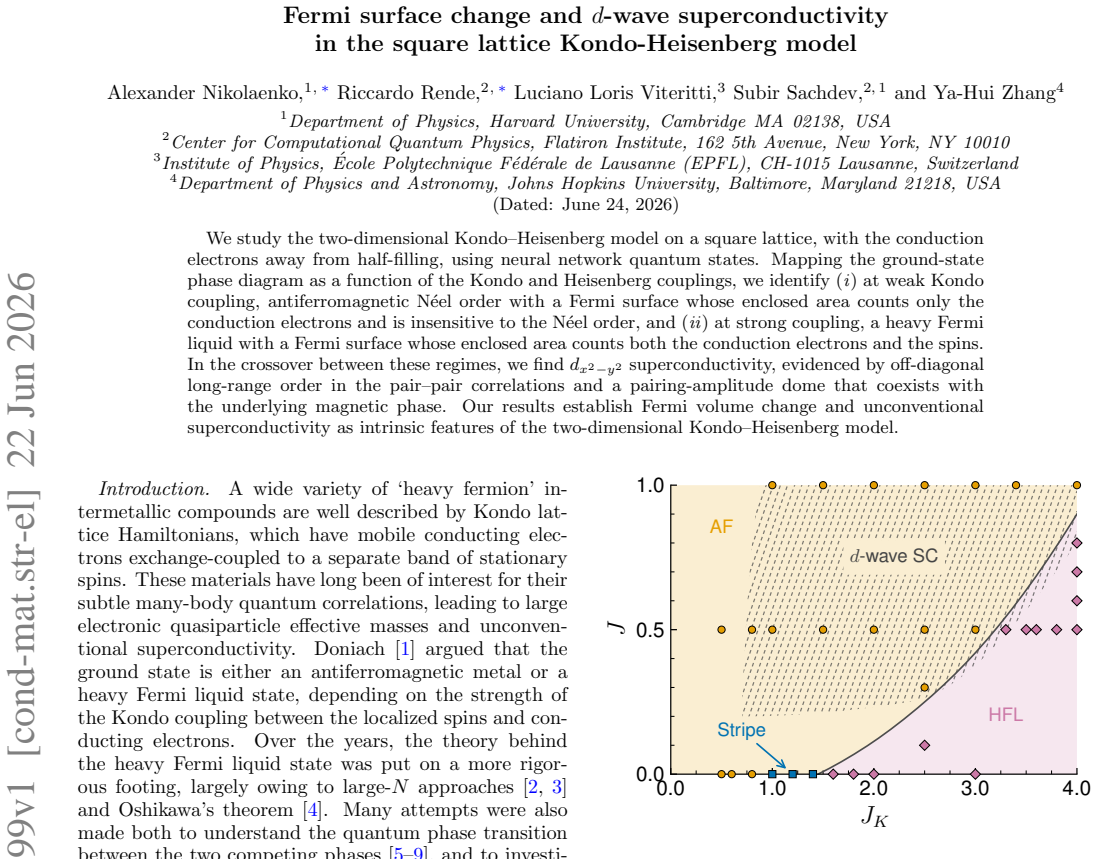
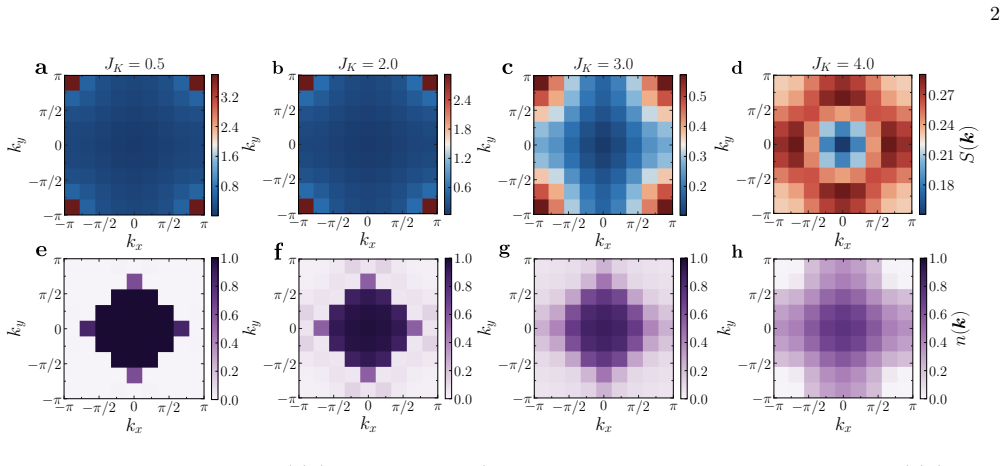
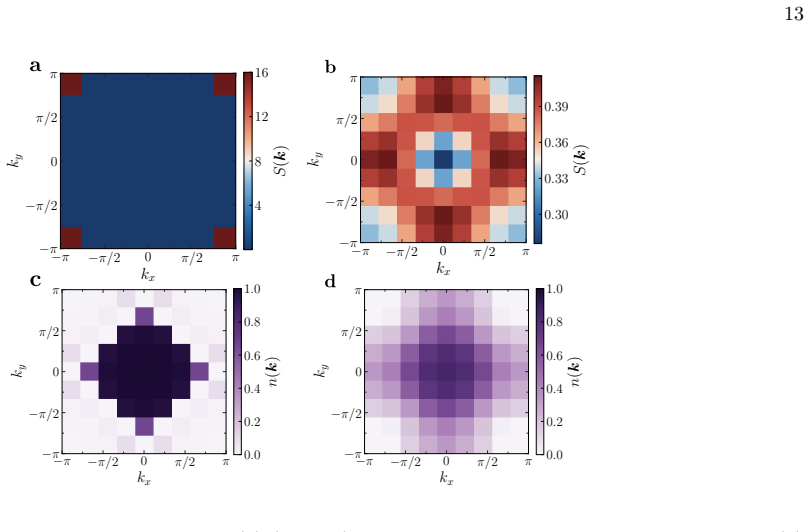
Fermi volume change from a small surface (counting conduction electrons only) to a large surface (counting both electrons and spins) and the appearance of d_{x^2-y^2} superconductivity are intrinsic features of the two-dimensional Kondo-Heisenberg model, established by neural-network variational calculations across the plane of Kondo and Heisenberg couplings.
What carries the argument
Neural network quantum states variational ansatz that computes ground-state correlations to detect Fermi surface volume via occupation numbers and to measure off-diagonal long-range order in pair-pair correlation functions.
If this is right
- The Fermi surface remains small and counts only conduction electrons inside the antiferromagnetic phase at weak Kondo coupling.
- The Fermi surface becomes large and counts both electrons and spins inside the heavy Fermi liquid at strong Kondo coupling.
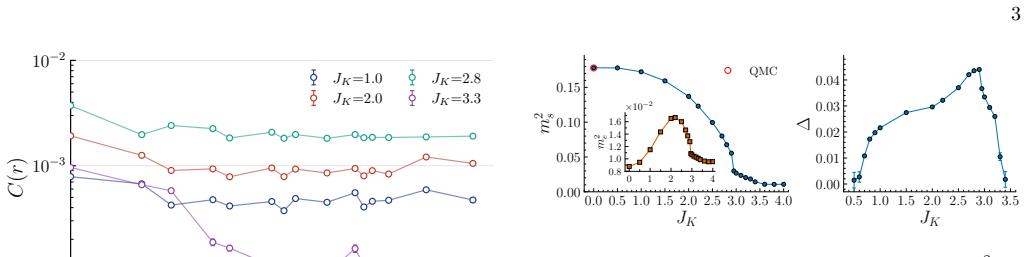
- d-wave superconductivity appears with a dome of pairing amplitude that overlaps the magnetic phase in the crossover window.
- Off-diagonal long-range order in the pair-pair correlations serves as the direct signature of the superconducting phase.
Where Pith is reading between the lines
- Similar small-to-large Fermi surface transitions and coexisting superconductivity might be testable in related Kondo lattice models by varying the conduction electron density.
- Quantum oscillation experiments that track Fermi surface area versus Kondo coupling strength could provide a direct experimental check on the volume change.
- The coexistence region suggests that magnetic fluctuations in the underlying Néel phase may help stabilize the d-wave pairing.
Load-bearing premise
The neural-network variational ansatz is sufficiently expressive and the optimization sufficiently converged to capture the correct ground-state Fermi surface volume and the presence or absence of long-range superconducting order across the parameter range studied.
What would settle it
An independent calculation that finds either a continuous Fermi surface volume without a jump or the absence of long-range d-wave pair correlations throughout the intermediate-coupling window would falsify the reported phase diagram.
Figures
read the original abstract
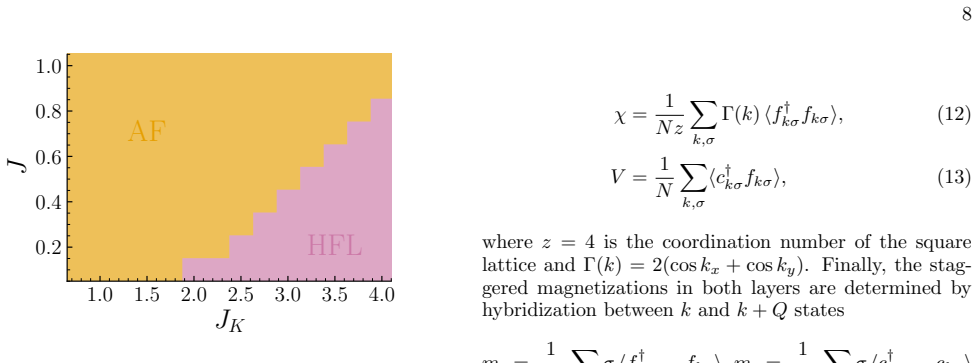
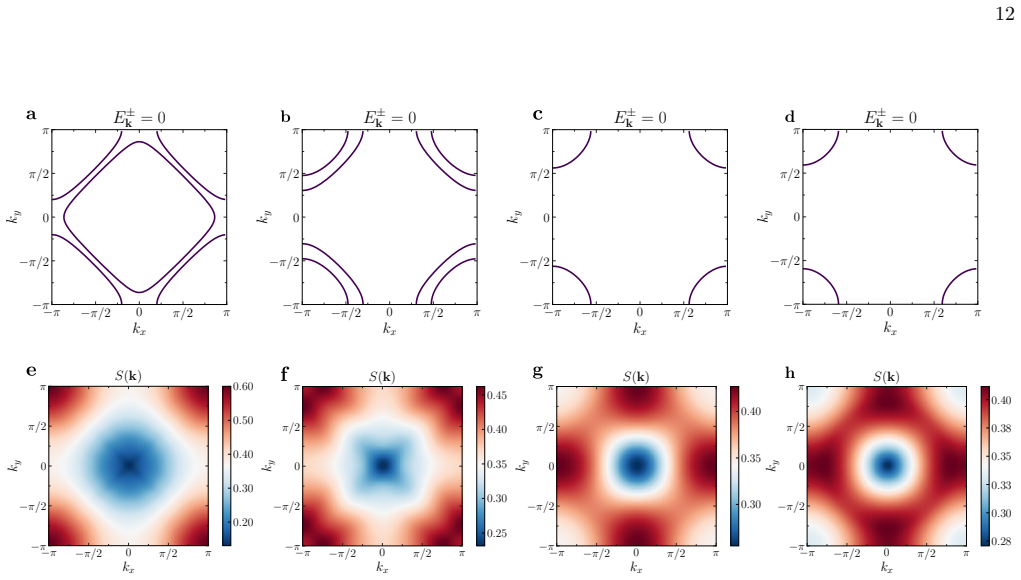
We study the two-dimensional Kondo-Heisenberg model on a square lattice, with the conduction electrons away from half-filling, using neural network quantum states. Mapping the ground-state phase diagram as a function of the Kondo and Heisenberg couplings, we identify (i) at weak Kondo coupling, antiferromagnetic N\'eel order with a Fermi surface whose enclosed area counts only the conduction electrons and is insensitive to the N\'eel order, and (ii) at strong coupling, a heavy Fermi liquid with a Fermi surface whose enclosed area counts both the conduction electrons and the spins. In the crossover between these regimes, we find $d_{x^2-y^2}$ superconductivity, evidenced by off-diagonal long-range order in the pair-pair correlations and a pairing-amplitude dome that coexists with the underlying magnetic phase. Our results establish Fermi volume change and unconventional superconductivity as intrinsic features of the two-dimensional Kondo-Heisenberg model.
Editorial analysis
A structured set of objections, weighed in public.
Referee Report
Summary. The paper employs neural-network quantum states to map the ground-state phase diagram of the square-lattice Kondo-Heisenberg model away from half-filling as a function of Kondo and Heisenberg couplings. It reports an antiferromagnetic Néel phase with a small Fermi surface (counting only conduction electrons) at weak Kondo coupling, a heavy Fermi liquid with a large Fermi surface (counting both electrons and spins) at strong coupling, and an intervening d_{x^2-y^2} superconducting phase in the crossover, evidenced by off-diagonal long-range order in pair-pair correlations together with a pairing-amplitude dome that coexists with residual magnetic order.
Significance. If the NQS variational results are shown to be converged and representative of the true ground state, the work would establish Fermi-volume reconstruction and intrinsic d-wave superconductivity as generic features of the two-dimensional Kondo-Heisenberg model, with direct relevance to heavy-fermion phenomenology. The use of NQS to access the relevant parameter regime and system sizes constitutes a methodological strength.
major comments (2)
- [Methods and Results sections] The central claims of Fermi-surface volume change and true ODLRO in the superconducting dome rest on the NQS ansatz correctly identifying the ground state. No quantitative benchmarks (energy vs. network depth/width, multiple random seeds, comparison to exact diagonalization on small clusters, or explicit extrapolation of pair correlations to infinite distance) are supplied to validate convergence for these observables.
- [Results section] The reported small-to-large Fermi-surface transition and the pairing dome are load-bearing for the phase-diagram conclusions, yet the manuscript provides no finite-size scaling analysis or error estimates on the extracted Fermi volumes and pairing amplitudes that would confirm the features survive the thermodynamic limit.
minor comments (1)
- [Methods] Notation for the neural-network architecture parameters and the precise definition of the pair-pair correlation function used to diagnose ODLRO should be stated explicitly in the methods.
Simulated Author's Rebuttal
We thank the referee for the careful reading and constructive comments. We address the two major points below and will revise the manuscript to incorporate additional convergence benchmarks and finite-size scaling analysis.
read point-by-point responses
-
Referee: [Methods and Results sections] The central claims of Fermi-surface volume change and true ODLRO in the superconducting dome rest on the NQS ansatz correctly identifying the ground state. No quantitative benchmarks (energy vs. network depth/width, multiple random seeds, comparison to exact diagonalization on small clusters, or explicit extrapolation of pair correlations to infinite distance) are supplied to validate convergence for these observables.
Authors: We agree that explicit convergence benchmarks would strengthen the presentation. In the revised manuscript we will add (i) variational energy versus network depth and width for representative points in each phase, (ii) statistics over multiple random seeds, (iii) direct comparisons with exact diagonalization on 4 imes4 and smaller clusters, and (iv) explicit extrapolations of the pair-pair correlation function versus distance (including to infinite separation) for the superconducting regime. These additions will be placed in an expanded Methods section and supplementary figures. revision: yes
-
Referee: [Results section] The reported small-to-large Fermi-surface transition and the pairing dome are load-bearing for the phase-diagram conclusions, yet the manuscript provides no finite-size scaling analysis or error estimates on the extracted Fermi volumes and pairing amplitudes that would confirm the features survive the thermodynamic limit.
Authors: We acknowledge the absence of systematic finite-size scaling. The revised version will include (i) Fermi-surface volumes extracted on multiple lattice sizes with error estimates obtained from multiple independent optimizations, and (ii) pairing amplitudes versus system size together with a scaling analysis (e.g., 1/L extrapolation) demonstrating that both the small-to-large Fermi-surface reconstruction and the superconducting dome remain finite in the thermodynamic limit. These data will be added to the Results section and a new supplementary figure. revision: yes
Circularity Check
No circularity: phases obtained from direct variational minimization
full rationale
The paper reports ground-state phases of the Kondo-Heisenberg model obtained by variational optimization of a neural-network ansatz. Fermi-surface volumes and d-wave pairing order are numerical outputs of energy minimization over the variational parameters for different values of the model couplings; they are not defined in terms of one another, not obtained by fitting a subset of data and then relabeling the fit as a prediction, and not justified by any self-citation chain. The central claim therefore does not reduce to its inputs by construction. The only potential concern is convergence of the optimizer, but that is an empirical question of correctness, not a circularity in the derivation.
Axiom & Free-Parameter Ledger
axioms (2)
- domain assumption The square-lattice Kondo-Heisenberg Hamiltonian with nearest-neighbor Heisenberg exchange and on-site Kondo coupling is a faithful minimal model for the physics under study.
- standard math Standard quantum many-body lattice methods apply without additional continuum or relativistic corrections.
Reference graph
Works this paper leans on
-
[1]
Doniach, The Kondo lattice and weak antiferromag- netism, Physica B+C91, 231 (1977)
S. Doniach, The Kondo lattice and weak antiferromag- netism, Physica B+C91, 231 (1977)
1977
-
[2]
Read and D
N. Read and D. M. Newns, On the solution of the Coqblin-Schreiffer Hamiltonian by the large-Nexpansion technique, Journal of Physics C: Solid State Physics16, 3273 (1983)
1983
-
[3]
Coleman, Mixed valence as an almost broken symme- try, Phys
P. Coleman, Mixed valence as an almost broken symme- try, Phys. Rev. B35, 5072 (1987)
1987
-
[4]
Oshikawa, Topological Approach to Luttinger’s The- orem and the Fermi Surface of a Kondo Lattice, Phys
M. Oshikawa, Topological Approach to Luttinger’s The- orem and the Fermi Surface of a Kondo Lattice, Phys. Rev. Lett.84, 3370 (2000)
2000
-
[5]
J. A. Hertz, Quantum critical phenomena, Phys. Rev. B 14, 1165 (1976)
1976
-
[6]
A. J. Millis, Effect of a nonzero temperature on quantum critical points in itinerant fermion systems, Phys. Rev. B 48, 7183 (1993)
1993
-
[7]
Q. Si, S. Rabello, K. Ingersent, and J. L. Smith, Lo- cally critical quantum phase transitions in strongly cor- related metals, Nature413, 804 (2001), arXiv:cond- mat/0011477 [cond-mat.str-el]
arXiv 2001
-
[8]
T. Senthil, S. Sachdev, and M. Vojta, Fractionalized Fermi Liquids, Phys. Rev. Lett.90, 216403 (2003), cond- mat/0209144
arXiv 2003
-
[9]
T. Senthil, M. Vojta, and S. Sachdev, Weak magnetism and non-Fermi liquids near heavy-fermion critical points, Phys. Rev. B69, 035111 (2004), cond-mat/0305193
Pith/arXiv arXiv 2004
-
[10]
Miyake, S
K. Miyake, S. Schmitt-Rink, and C. M. Varma, Spin-fluctuation-mediated even-parity pairing in heavy- fermion superconductors, Phys. Rev. B34, 6554(R) (1986)
1986
-
[11]
D. J. Scalapino, E. Loh, and J. E. Hirsch,d-wave pairing near a spin-density-wave instability, Phys. Rev. B34, 8190(R) (1986)
1986
-
[12]
M. T. B´ eal-Monod, C. Bourbonnais, and V. J. Emery, Possible superconductivity in nearly antiferromagnetic itinerant fermion systems, Phys. Rev. B34, 7716 (1986)
1986
-
[13]
Paschen, T
S. Paschen, T. L¨ uhmann, S. Wirth, P. Gegenwart, O. Trovarelli, C. Geibel, F. Steglich, P. Coleman, and Q. Si, Hall-effect evolution across a heavy-fermion quan- tum critical point, Nature432, 881 (2004)
2004
-
[14]
Friedemann, T
S. Friedemann, T. Westerkamp, M. Brando, N. Oeschler, S. Wirth, P. Gegenwart, C. Krellner, C. Geibel, and F. Steglich, Detaching the antiferromagnetic quantum critical point from the Fermi-surface reconstruction in YbRh2Si2, Nature Physics5, 465 (2009)
2009
-
[15]
L. Jiao, Y. Chen, Y. Kohama, D. Graf, E. D. Bauer, J. Singleton, J.-X. Zhu, Z. Weng, G. Pang, T. Shang, J. Zhang, H.-O. Lee, T. Park, M. Jaime, J. D. Thomp- son, F. Steglich, Q. Si, and H. Q. Yuan, Fermi surface reconstruction and multiple quantum phase transitions in the antiferromagnet CeRhIn 5, Proceedings of the Na- tional Academy of Sciences112, 673 (2015)
2015
-
[16]
Hegger, C
H. Hegger, C. Petrovic, E. G. Moshopoulou, M. F. Hund- ley, J. L. Sarrao, Z. Fisk, and J. D. Thompson, Pressure- Induced Superconductivity in Quasi-2D CeRhIn 5, Phys. Rev. Lett.84, 4986 (2000)
2000
-
[17]
T. Park, F. Ronning, H. Q. Yuan, M. B. Salamon, R. Movshovich, J. L. Sarrao, and J. D. Thompson, Hid- den magnetism and quantum criticality in the heavy fermion superconductor CeRhIn5, Nature440, 65 (2006)
2006
-
[18]
Pfleiderer, Superconducting phases off-electron com- pounds, Rev
C. Pfleiderer, Superconducting phases off-electron com- pounds, Rev. Mod. Phys.81, 1551 (2009)
2009
-
[19]
Petrovic, R
C. Petrovic, R. Movshovich, M. Jaime, P. G. Pagliuso, M. F. Hundley, J. L. Sarrao, Z. Fisk, and J. D. Thomp- son, A new heavy-fermion superconductor CeCoIn 5: A relative of the cuprates?, J. Phys.: Condens. Matter13, L337 (2001)
2001
-
[20]
Kohori, Y
Y. Kohori, Y. Yamato, Y. Iwamoto, T. Kohara, E. D. Bauer, M. B. Maple, and J. L. Sarrao, NMR and NQR studies of the heavy fermion superconductors CeTIn 5 (T = Co and Ir), Phys. Rev. B64, 134526 (2001)
2001
-
[21]
M. P. Allan, F. Massee, D. K. Morr, J. Van Dyke, A. W. Rost, A. P. Mackenzie, C. Petrovic, and J. C. Davis, Imaging Cooper pairing of heavy fermions in CeCoIn 5, Nature Physics9, 468 (2013), arXiv:1303.4416 [cond- mat.supr-con]
Pith/arXiv arXiv 2013
-
[22]
B. B. Zhou, S. Misra, E. H. da Silva Neto, P. Ayna- jian, R. E. Baumbach, J. D. Thompson, E. D. Bauer, and A. Yazdani, Visualizing nodal heavy fermion super- conductivity in CeCoIn 5, Nature Physics9, 474 (2013), arXiv:1307.3787 [cond-mat.supr-con]
Pith/arXiv arXiv 2013
-
[23]
J. S. Van Dyke, F. Massee, M. P. Allan, J. C. S. Davis, C. Petrovic, and D. K. Morr, Direct evidence for a mag- neticf-electron-mediated pairing mechanism of heavy- fermion superconductivity in CeCoIn 5, Proceedings of the National Academy of Science111, 11663 (2014), 6 arXiv:1405.5883 [cond-mat.supr-con]
Pith/arXiv arXiv 2014
-
[24]
Maksimovic, D
N. Maksimovic, D. H. Eilbott, T. Cookmeyer, F. Wan, J. Rusz, V. Nagarajan, S. C. Haley, E. Maniv, A. Gong, S. Faubel, I. M. Hayes, A. Bangura, J. Singleton, J. C. Palmstrom, L. Winter, R. McDonald, S. Jang, P. Ai, Y. Lin, S. Ciocys, J. Gobbo, Y. Werman, P. M. Oppeneer, E. Altman, A. Lanzara, and J. G. Analytis, Evidence for a delocalization quantum phase ...
2022
-
[25]
P. Park, S.-S. Zhang, P. M. Bonetti, A. A. Podlesnyak, D. M. Pajerowski, M. B. Stone, C. Petrovic, C. Stock, S. Sachdev, C. D. Batista, and A. D. Christianson, Su- perconductivity and fractionalized magnetic excitations in CeCoIn5 (2026), arXiv:2604.02481
Pith/arXiv arXiv 2026
-
[26]
F. F. Assaad, Quantum Monte Carlo Simulations of the Half-Filled Two-Dimensional Kondo Lattice Model, Phys. Rev. Lett.83, 796 (1999), arXiv:cond- mat/9904178 [cond-mat.str-el]
arXiv 1999
-
[27]
S. Capponi and F. F. Assaad, Spin and charge dy- namics of the ferromagnetic and antiferromagnetic two- dimensional half-filled Kondo lattice model, Phys. Rev. B63, 155114 (2001), arXiv:cond-mat/0010393 [cond- mat.str-el]
Pith/arXiv arXiv 2001
-
[28]
A. E. Sikkema, I. Affleck, and S. R. White, Spin Gap in a Doped Kondo Chain, Phys. Rev. Lett.79, 929 (1997)
1997
-
[29]
Khait, P
I. Khait, P. Azaria, C. Hubig, U. Schollw¨ ock, and A. Auerbach, Doped Kondo chain, a heavy Luttinger liq- uid, Proceedings of the National Academy of Sciences 115, 5140 (2018)
2018
-
[30]
Nikolaenko and Y.-H
A. Nikolaenko and Y.-H. Zhang, Numerical signatures of ultra-local criticality in a one dimensional Kondo lattice model, SciPost Phys.17, 034 (2024)
2024
-
[31]
J. C. Xavier and E. Dagotto, Robustd-Wave Pairing Cor- relations in the Heisenberg Kondo Lattice Model, Phys. Rev. Lett.100, 146403 (2008), arXiv:0803.1486 [cond- mat.str-el]
Pith/arXiv arXiv 2008
-
[32]
A. Gleis, J.-W. Li, and J. von Delft, Controlled Bond Expansion for Density Matrix Renormalization Group Ground State Search at Single-Site Costs, Phys. Rev. Lett.130, 246402 (2023), arXiv:2207.14712 [cond- mat.str-el]
arXiv 2023
-
[33]
Bodensiek, R
O. Bodensiek, R. ˇZitko, M. Vojta, M. Jarrell, and T. Pruschke, Unconventional superconductivity from lo- cal spin fluctuations in the kondo lattice, Phys. Rev. Lett. 110, 146406 (2013)
2013
-
[34]
Hoshino and Y
S. Hoshino and Y. Kuramoto, Superconductivity of com- posite particles in a two-channel kondo lattice, Phys. Rev. Lett.112, 167204 (2014)
2014
-
[35]
B. Lenz, R. Gezzi, and S. R. Manmana, Variational clus- ter approach to superconductivity and magnetism in the kondo lattice model, Phys. Rev. B96, 155119 (2017)
2017
-
[36]
L. Yu, Z. Guang-Ming, and Y. Lu, Pairing symmetry of heavy fermion superconductivity in the two-dimensional kondo–heisenberg lattice model, Chin. Phys. Lett.31, 087102 (2014)
2014
-
[37]
Liu and Z
F. Liu and Z. Han, Pair density wave ands±idsuper- conductivity in a strongly coupled lightly doped kondo insulator, Phys. Rev. B109, L121101 (2024)
2024
-
[38]
Carleo and M
G. Carleo and M. Troyer, Solving the quantum many- body problem with artificial neural networks, Science 355, 602–606 (2017)
2017
- [39]
-
[40]
Y. Gu, W. Li, H. Lin, B. Zhan, R. Li, Y. Huang, D. He, Y. Wu, T. Xiang, M. Qin, L. Wang, and D. Lv, Solving the Hubbard model with Neural Quantum States (2025), arXiv:2507.02644 [cond-mat.str-el]
arXiv 2025
-
[41]
L. L. Viteritti, R. Rende, C. Roth, A. Sengupta, G. Car- leo, and A. Georges, Beyond Variational Bias: Resolv- ing Intertwined Orders in the Hubbard Model (2026), arXiv:2604.21978 [cond-mat.str-el]
Pith/arXiv arXiv 2026
-
[42]
Kohn, Image of the Fermi Surface in the Vibration Spectrum of a Metal, Phys
W. Kohn, Image of the Fermi Surface in the Vibration Spectrum of a Metal, Phys. Rev. Lett.2, 393 (1959)
1959
-
[43]
A. W. Sandvik, Finite-size scaling of the ground-state pa- rameters of the two-dimensional Heisenberg model, Phys. Rev. B56, 11678 (1997)
1997
-
[44]
P. Coleman, Heavy Fermions: electrons at the edge of magnetism (2007), arXiv:cond-mat/0612006 [cond- mat.str-el]
Pith/arXiv arXiv 2007
-
[45]
Y. Liu, H. Li, G.-M. Zhang, and L. Yu,d-wave super- conductivity induced by short-range antiferromagnetic correlations in the two-dimensional Kondo lattice model, Phys. Rev. B86, 024526 (2012), arXiv:1204.1434 [cond- mat.str-el]
Pith/arXiv arXiv 2012
-
[46]
L. L. Viteritti, R. Rende, and F. Becca, Transformer vari- ational wave functions for frustrated quantum spin sys- tems, Phys. Rev. Lett.130, 236401 (2023)
2023
-
[47]
Rende and L
R. Rende and L. Loris Viteritti, Are queries and keys always relevant? A case study on transformer wave functions, Machine Learning: Science and Technology6, 010501 (2025)
2025
-
[48]
Rende, F
R. Rende, F. Gerace, A. Laio, and S. Goldt, Mapping of attention mechanisms to a generalized Potts model, Phys. Rev. Res.6, 023057 (2024)
2024
-
[49]
L. L. Viteritti, R. Rende, A. Parola, S. Goldt, and F. Becca, Transformer wave function for two dimensional frustrated magnets: Emergence of a spin-liquid phase in the Shastry-Sutherland model, Phys. Rev. B111, 134411 (2025)
2025
-
[50]
L. L. Viteritti, R. Rende, S. Sachdev, and G. Carleo, Approaching the Thermodynamic Limit with Neural- Network Quantum States (2026), arXiv:2602.02665 [cond-mat.str-el]
arXiv 2026
-
[51]
Sorella, Green Function Monte Carlo with Stochastic Reconfiguration, Phys
S. Sorella, Green Function Monte Carlo with Stochastic Reconfiguration, Phys. Rev. Lett.80, 4558 (1998)
1998
-
[52]
Rende, L
R. Rende, L. L. Viteritti, L. Bardone, F. Becca, and S. Goldt, A simple linear algebra identity to optimize large-scale neural network quantum states, Communica- tions Physics7, 260 (2024)
2024
-
[53]
Chen and M
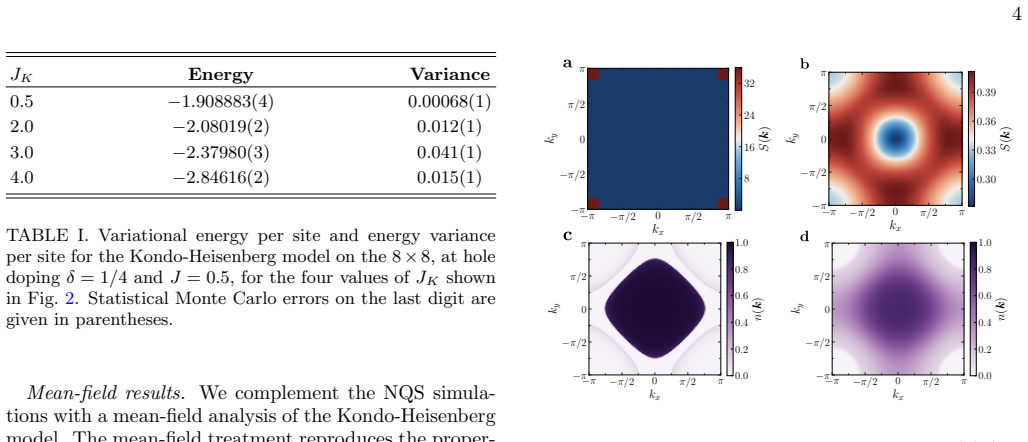
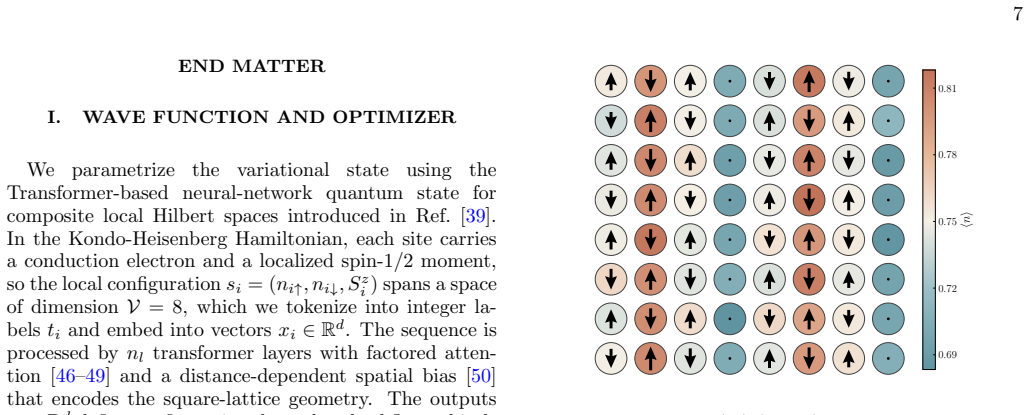
A. Chen and M. Heyl, Empowering deep neural quantum states through efficient optimization, Nature Physics20, 1476 (2024). 7 END MATTER I. WAVE FUNCTION AND OPTIMIZER We parametrize the variational state using the Transformer-based neural-network quantum state for composite local Hilbert spaces introduced in Ref. [39]. In the Kondo-Heisenberg Hamiltonian, ...
2024
-
[54]
The saddle-point pa- rameters (χ, V, λ, m s, me) are obtained by solving self- consistent equations
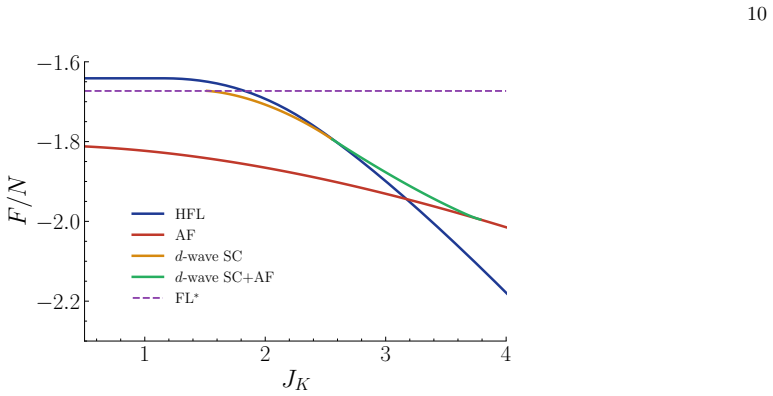
At the mean-field level, the dominant competing channels are described by the spinon hopping amplitude χij =⟨f † iσfjσ ⟩, the Kondo hybridizationV i =⟨c † iσfiσ⟩, and the staggered antiferromagnetic order parameters ⟨Sz i ⟩=m seiQ·Ri ,⟨s z i ⟩=m eeiQ·Ri ,(5) with ordering vectorQ= (π, π). The saddle-point pa- rameters (χ, V, λ, m s, me) are obtained by so...
discussion (0)
Sign in with ORCID, Apple, or X to comment. Anyone can read and Pith papers without signing in.