REVIEW 2 major objections 3 minor 34 references
Hessian-augmented Supervised Learning for Hamilton-Jacobi-Bellman PDEs
T0 review · 2 major / 3 minor · reviewed 2026-06-26 · grok-4.3
Pith's one-line read Hessian data from Riccati equations along PMP trajectories cuts the samples needed for accurate value-function approximation by up to an order of magnitude.
desk verdict Hessian data from the Riccati equation along PMP trajectories cuts the samples needed for accurate hyperbolic-cross polynomial approximation of HJB value functions by up to 10x on the control-affine examples. read the letter →
The pith
A machine-rendered reading of the paper's core claim, the machinery that carries it, and where it could break.
The reading
What carries the argument
Augmentation of the weighted least-squares system with gradient and Hessian rows derived from PMP trajectories and the associated Riccati equation, performed over sparse polynomial bases on hyperbolic cross index sets.
What would settle it
On a fixed high-dimensional test problem, run the regression with and without the Hessian equations using identical numbers of trajectories and measure whether the closed-loop cost and L2 error of the value function differ by more than the observed variance across random initial-condition sets.
Extended reading notes
Core claim
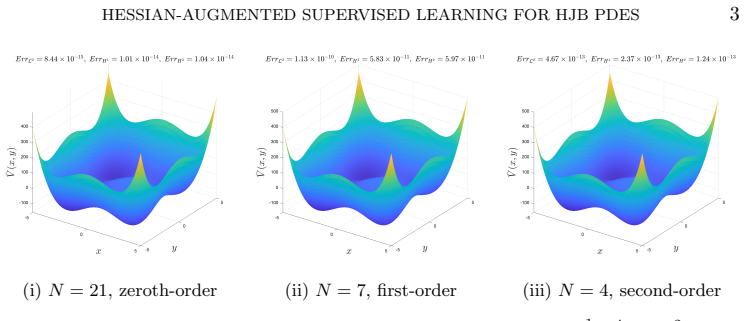
Incorporating Hessian information obtained from the matrix Riccati equation along optimal trajectories into a polynomial regression reduces the number of required training samples by up to an order of magnitude while improving both pointwise accuracy of the learned value function and the performance of the recovered feedback law.
Load-bearing premise
The matrix Riccati equation solved along PMP trajectories supplies accurate second derivatives of the true value function.
Editorial extensions
If this is right
- Feedback laws are recovered by direct differentiation of the learned polynomial without additional optimization.
- A partial Hessian strategy keeps data-generation cost manageable when the state dimension is large.
- Second-order augmentation yields measurable gains in both approximation accuracy and closed-loop performance on problems of increasing dimension.
- The method applies to deterministic control-affine dynamics and produces globally defined polynomial approximations.
Reading between the lines
- The same derivative-augmentation idea could be tested on other basis families that admit cheap evaluation of gradients and Hessians.
- If the Riccati-derived Hessians remain reliable under moderate noise, the approach might extend to nearby stochastic problems where a similar linearization exists.
- The reduction in sample count suggests that second-order information could be leveraged in other regression-based HJB solvers that currently rely only on value or gradient data.
Signed reviews
Editorial analysis
A structured set of objections, weighed in public.
Referee Report
Summary. The manuscript develops a data-driven method for approximating value functions of deterministic optimal control problems with nonlinear control-affine dynamics. It solves the Pontryagin Maximum Principle optimality system from multiple initial conditions to generate training data consisting of values, gradients, and Hessians of the value function (Hessians obtained via the matrix Riccati equation along optimal trajectories). These quantities augment a weighted least-squares regression over sparse polynomial bases on hyperbolic cross index sets, with gradients and Hessians supplying additional linear equations per sample. Feedback laws are recovered analytically from the learned value function. In high dimensions a partial Hessian strategy is used to control data-generation cost. The approach is validated on control-affine problems of increasing state dimension, where second-order augmentation is reported to improve accuracy and closed-loop performance with up to an order-of-magnitude reduction in required training samples relative to value-only regression.
Significance. If the reported empirical gains hold under broader testing, the method provides a concrete way to reduce sample complexity when learning HJB value functions by systematically incorporating second-order information generated from standard PMP+Riccati theory. This is potentially useful for moderate-to-high-dimensional deterministic control problems where trajectory data is expensive to obtain. The construction is parameter-free in the sense that no new constants are fitted to define the result, and the use of hyperbolic-cross polynomial bases together with the analytic feedback recovery are clear strengths.
major comments (2)
- [§5] §5 (numerical experiments): the reported order-of-magnitude sample-complexity reduction is shown only relative to value-only regression on the same polynomial basis; no comparison is supplied against other established HJB approximation techniques (e.g., deep neural network solvers or other sparse-grid methods), which limits assessment of whether the second-order augmentation yields a genuine advance beyond the immediate baseline.
- [§4.2] §4.2 (regression formulation): the weighting factors that balance the value, gradient, and Hessian equations in the least-squares objective are introduced without an explicit rule or sensitivity study; because the central claim rests on the benefit of the additional linear equations, the lack of justification for these weights is load-bearing for reproducibility of the reported gains.
minor comments (3)
- [Abstract] The abstract states quantitative gains but the main text should cross-reference the specific tables or figures that contain the error metrics and sample counts supporting those claims.
- [§3] Notation for the hyperbolic-cross index sets and the partial-Hessian selection mask could be introduced earlier (e.g., in §3) rather than only in the experimental section to improve readability.
- [Figures in §5] Figure captions should explicitly state the number of Monte-Carlo repetitions or random seeds used for each regression run so that variability of the reported accuracy improvements can be assessed.
Simulated Author's Rebuttal
We thank the referee for the careful reading, positive assessment of the contribution, and constructive comments. We address the two major comments point by point below.
read point-by-point responses
-
Referee: [§5] §5 (numerical experiments): the reported order-of-magnitude sample-complexity reduction is shown only relative to value-only regression on the same polynomial basis; no comparison is supplied against other established HJB approximation techniques (e.g., deep neural network solvers or other sparse-grid methods), which limits assessment of whether the second-order augmentation yields a genuine advance beyond the immediate baseline.
Authors: We agree that the experiments isolate the benefit of Hessian augmentation relative to value-only regression on the identical polynomial basis and hyperbolic-cross index set. This design choice was deliberate to highlight the effect of the additional linear equations supplied by gradients and Hessians. Broader benchmarking against deep neural network HJB solvers or other sparse-grid techniques would indeed provide a more complete picture of the method's standing, but would have required substantial extra implementation and compute that lay outside the scope of the present work. In the revision we will add an explicit limitations paragraph in §5 acknowledging this and identifying such comparisons as a natural direction for follow-up research. revision: partial
-
Referee: [§4.2] §4.2 (regression formulation): the weighting factors that balance the value, gradient, and Hessian equations in the least-squares objective are introduced without an explicit rule or sensitivity study; because the central claim rests on the benefit of the additional linear equations, the lack of justification for these weights is load-bearing for reproducibility of the reported gains.
Authors: The referee correctly notes that an explicit, reproducible rule for the weighting coefficients is needed. In the current manuscript the weights are chosen to normalize each residual type (value, gradient, Hessian) by its typical magnitude across the training set so that the three blocks contribute on comparable scales; however, this procedure is only described informally. We will revise §4.2 to state the normalization rule in full detail and will add a short sensitivity study (varying the relative weights by factors of 0.1–10) demonstrating that the reported accuracy gains remain stable within a reasonable range around the chosen values. revision: yes
Circularity Check
No significant circularity in derivation chain
full rationale
The paper generates training data for value, gradient, and Hessian of the value function by solving the PMP optimality system and the associated matrix Riccati equation along trajectories; these are standard results from optimal control theory and are used only to supply linear equations for a subsequent weighted least-squares regression over polynomial bases. The regression itself is a conventional fit with no parameters whose values are defined by the target result. The reported improvement in sample complexity is an empirical observation on benchmark problems rather than a mathematical identity obtained by construction. No self-definitional steps, fitted-input predictions, load-bearing self-citations, or ansatz smuggling appear in the derivation.
Assumptions & free parameters
assumptions (1)
- domain assumption Solutions to the PMP optimality system exist and are sufficiently smooth for the matrix Riccati equation to yield the exact Hessian of the value function along optimal trajectories.
Cite this review
Pith. "Pith review of Hessian-augmented Supervised Learning for Hamilton-Jacobi-Bellman PDEs." pith.science (2026). https://pith.science/paper/FQ5N3FGZ
@misc{pith2026260623827,
  author       = {Pith},
  title        = {Pith review of: Hessian-augmented Supervised Learning for Hamilton-Jacobi-Bellman PDEs},
  year         = {2026},
  howpublished = {\url{https://pith.science/paper/FQ5N3FGZ}},
  note         = {Machine review of arXiv:2606.23827}
}
read the original abstract
A data-driven method is developed for approximating value functions in deterministic optimal control problems with nonlinear control-affine dynamics. The Pontryagin Maximum Principle optimality system is solved from multiple initial conditions to generate training data consisting of values, gradients, and Hessians of the value function, where Hessian information is obtained from a matrix Riccati equation along optimal trajectories. These quantities augment a weighted least-squares regression over sparse polynomial bases on hyperbolic cross index sets, with gradients and Hessians contributing additional linear equations per sample and substantially reducing sample complexity compared to value-only regression. Feedback laws are recovered analytically from the learned value function. In high dimensions, a partial Hessian strategy controls the cost of data generation. The approach is validated on problems of increasing state dimension, where second-order data augmentation is shown to improve approximation accuracy and closed-loop performance, with up to an order-of-magnitude reduction in the number of training samples required relative to lower-order methods.
Figures


Figures from the paper (6 more)


Reference graph
Works this paper leans on
-
[1]
Adcock, S
B. Adcock, S. Brugiapaglia, and C. G. Webster,Sparse Polynomial Approximation of High- Dimensional Functions, Comput. Sci. Eng., SIAM, Philadelphia, PA, 2022
2022
-
[2]
Adcock and Y
B. Adcock and Y. Sui,Compressive Hermite interpolation: Sparse, high-dimensional approx- imation from gradient-augmented measurements, Constr. Approx., 50(1):167–207, 2019
2019
-
[3]
G. Albi, S. Bicego, and D. Kalise,Gradient-augmented supervised learning of optimal feedback laws using state-dependent Riccati equations, IEEE Control Syst. Lett., 6:836–841, 2022
2022
-
[4]
B. Azmi, D. Kalise, and K. Kunisch,Optimal feedback law recovery by gradient-augmented sparse polynomial regression, J. Mach. Learn. Res., 22(48):1–32, 2021
2021
-
[5]
Bardi and I
M. Bardi and I. Capuzzo-Dolcetta,Optimal Control and Viscosity Solutions of Hamilton– Jacobi–Bellman Equations, Systems Control Found. Appl., Birkh¨ auser, Boston, MA, 1997
1997
-
[6]
Breiten, K
T. Breiten, K. Kunisch, and J. Schr¨ oder,Numerical realization of the Mortensen observer via a Hessian-augmented polynomial approximation of the value function, SIAM J. Sci. Comput., 47(1), 2025
2025
-
[7]
Cannarsa and H
P. Cannarsa and H. Frankowska,From pointwise to local regularity for solutions of Hamilton– Jacobi equations, Calc. Var. Partial Differ. Equ., 49(3):1061–1074, 2014
2014
-
[8]
Cannarsa, H
P. Cannarsa, H. Frankowska, and T. Scarinci,Second-order sensitivity relations and regularity of the value function for Mayer’s problem in optimal control, SIAM J. Control Optim., 53(6):3642–3672, 2015
2015
Show all 34 references
-
[9]
Caroff and H
N. Caroff and H. Frankowska,Conjugate points and shocks in nonlinear optimal control, Trans. Amer. Math. Soc., 348:3133–3153, 1996
1996
-
[10]
Caroff and H
N. Caroff and H. Frankowska,Optimality and characteristics of Hamilton–Jacobi–Bellman equations, in Optim., Optim. Control Partial Differ. Equ., Internat. Ser. Numer. Math. 107, pp. 169–180, Birkh¨ auser, Basel, 1992
1992
-
[11]
F. H. Clarke and R. B. Vinter,Local optimality conditions and Lipschitzian solutions to the Hamilton–Jacobi equation, SIAM J. Control Optim., 21:856–870, 1983
1983
-
[12]
F. H. Clarke and R. B. Vinter,The relationship between the maximum principle and dynamic programming, SIAM J. Control Optim., 25(5):1291–1311, 1987. HESSIAN-AUGMENTED SUPERVISED LEARNING FOR HJB PDES21
1987
-
[13]
N. A. Corbin and B. Kramer,Scalable computation ofH ∞ energy functions for polynomial control-affine systems, IEEE Trans. Autom. Control, 70(5):3088–3100, 2025
2025
-
[14]
N. A. Corbin and B. Kramer,Computing solutions to the polynomial-polynomial regulator problem, inProc. 63rd IEEE Conf. Decis. Control, pp. 3073–3078, 2024
2024
-
[15]
W. M. Czarnecki, S. Osindero, M. Jaderberg, G. Swirszcz, and R. Pascanu,Sobolev training for neural networks, Adv. Neural Inf. Process. Syst., vol. 30, 2017
2017
-
[16]
Darbon and S
J. Darbon and S. Osher,Algorithms for overcoming the curse of dimensionality for certain Hamilton–Jacobi equations arising in control theory and elsewhere, Res. Math. Sci., 3:19, 2016
2016
-
[17]
Dolgov, D
S. Dolgov, D. Kalise, and K. Kunisch,Tensor decomposition methods for high-dimensional Hamilton–Jacobi–Bellman equations, SIAM J. Sci. Comput., 43(3):A1625–A1650, 2021
2021
-
[18]
Dolgov, D
S. Dolgov, D. Kalise, and L. Saluzzi,Data-driven tensor train gradient cross approximation for Hamilton–Jacobi–Bellman equations, SIAM J. Sci. Comput., 45(5):A2153–A2184, 2023
2023
-
[19]
Ehring, B
T. Ehring, B. Azmi, and B. Haasdonk,Recovery of the optimal control value function in reproducing kernel Hilbert spaces from verification conditions, arXiv:2512.07477, 2025
2025
-
[20]
Ehring and B
T. Ehring and B. Haasdonk,Hermite kernel surrogates for the value function of high- dimensional nonlinear optimal control problems, Adv. Comput. Math., 50(3):36, 2024
2024
-
[21]
Esteve-Yag¨ ue, R
C. Esteve-Yag¨ ue, R. Tsai, and A. Massucco,Finite-difference least square methods for solving Hamilton–Jacobi equations using neural networks, arXiv:2406.10758, 2024
2024
-
[22]
Gr¨ une and A
L. Gr¨ une and A. Rantzer,On the infinite horizon performance of receding horizon controllers, IEEE Trans. Autom. Control, 53(9):2100–2111, 2008
2008
-
[23]
J. Han, A. Jentzen, and W. E,Solving high-dimensional partial differential equations using deep learning, Proc. Natl. Acad. Sci. USA, 115(34):8505–8510, 2018
2018
-
[24]
Kalise and K
D. Kalise and K. Kunisch,Polynomial approximation of high-dimensional Hamilton–Jacobi– Bellman equations and applications to feedback control of semilinear parabolic PDEs, SIAM J. Sci. Comput., 40(2):A629–A652, 2018
2018
-
[25]
Kang and L
W. Kang and L. C. Wilcox,A causality free computational method for HJB equations with application to rigid body satellites, inAIAA Guid. Navig. Control Conf., pp. 1–10, 2015
2015
-
[26]
Kang and L
W. Kang and L. C. Wilcox,Mitigating the curse of dimensionality: Sparse grid characteristics method for optimal feedback control and HJB equations, Comput. Optim. Appl., 68:289– 315, 2017
2017
-
[27]
Kunisch and D
K. Kunisch and D. Walter,Semiglobal optimal feedback stabilization of autonomous systems via deep neural network approximation, ESAIM Control Optim. Calc. Var., 27:16, 2021
2021
-
[28]
T. Meng, Z. Zhang, J. Darbon, and G. Karniadakis,SympOCnet: Solving optimal control problems with applications to high-dimensional multiagent path planning problems, SIAM J. Sci. Comput., 44(6):B1341–B1368, 2022
2022
-
[29]
Nakamura-Zimmerer, Q
T. Nakamura-Zimmerer, Q. Gong, and W. Kang,Adaptive deep learning for high-dimensional Hamilton–Jacobi–Bellman equations, SIAM J. Sci. Comput., 43(2):A1221–A1247, 2021
2021
-
[30]
L. S. Pontryagin, V. G. Boltyanskii, R. V. Gamkrelidze, and E. F. Mishchenko,The Mathe- matical Theory of Optimal Processes, Interscience, Wiley, New York, 1962
1962
-
[31]
Sirignano and K
J. Sirignano and K. Spiliopoulos,DGM: A deep learning algorithm for solving partial differ- ential equations, J. Comput. Phys., 375:1339–1364, 2018
2018
-
[32]
Sperl, L
M. Sperl, L. Saluzzi, D. Kalise, and L. Gr¨ une,Separable approximations of optimal value functions and their representation by neural networks, arXiv:2502.08559, 2025
2025
-
[33]
N. N. Subbotina,The method of characteristics for Hamilton–Jacobi equations and applica- tions to dynamical optimization, J. Math. Sci., 135:2955–3091, 2006
2006
-
[34]
Yegorov and P
I. Yegorov and P. M. Dower,Perspectives on characteristics-based curse-of-dimensionality- free numerical approaches for solving Hamilton–Jacobi equations, Appl. Math. Optim., 81:1167–1218, 2021
2021
Reviewed June 26, 2026 · model on record in the stance chip above.
Discussion (0). Continue with ORCID to comment.