Dynamical implications of the recently detected feature around Quaoar and constraints on the presence of additional satellites
Pith reviewed 2026-06-26 06:50 UTC · model grok-4.3
The pith
The opaque feature near Quaoar is more consistent with a small satellite than with a dense arc confined at a triangular point.
A machine-rendered reading of the paper's core claim, the machinery that carries it, and where it could break.
Core claim
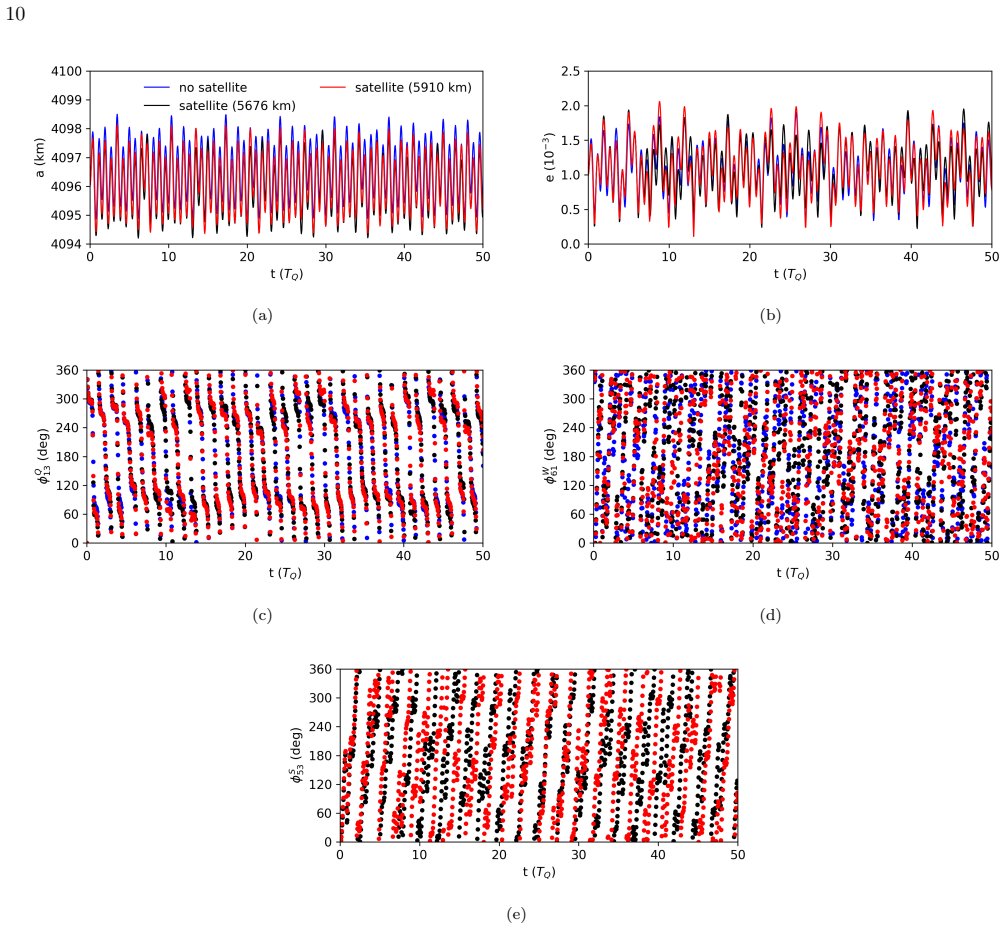
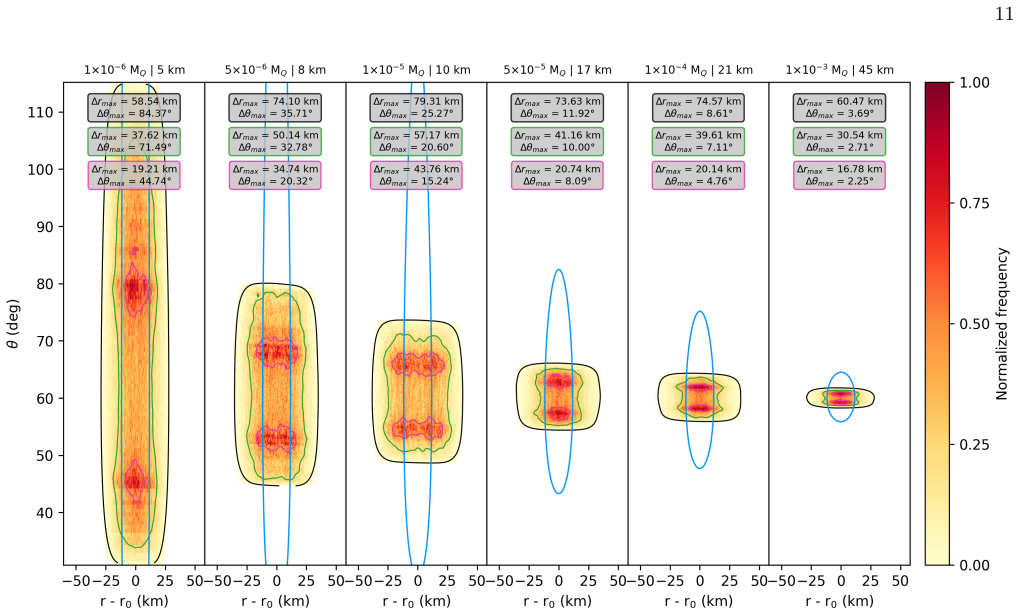
If the reported feature is treated as an arc, azimuthal confinement around the L4 or L5 point of an unseen coorbital satellite is possible for mass ratios up to 0.001, yet Weywot's secular forcing produces radial excursions too large to match the occultation data; only confiners comparable to or exceeding Weywot's mass supply sufficient radial confinement, but such bodies would be detectable by imaging. Treating the feature instead as a satellite yields stable orbits with forced eccentricity of order 0.002 and only local clearing of kilometre-scale test particles.
What carries the argument
N-body integrations that include Quaoar's triaxial figure, Weywot, and test particles or a putative satellite, used to map stability and to track radial and azimuthal excursions under secular perturbations.
If this is right
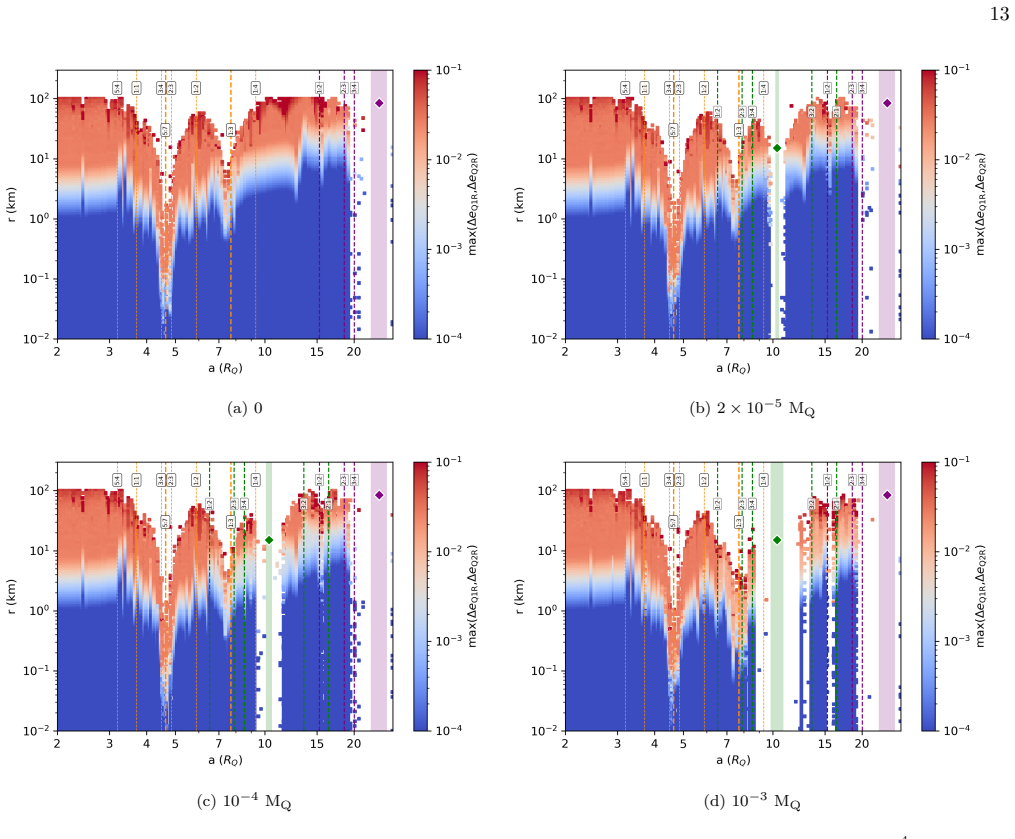
- Additional undetected moons can occupy broad stable regions, including near the Q1R and Q2R rings as possible shepherds.
- Quaoar's ellipticity alone supplies enough orbital excitation to prevent ring coagulation even without resonant shepherding.
- A satellite interpretation implies the feature clears only a narrow zone and has negligible long-term effect on the existing rings.
- Triangular-point arcs are ruled out for this system under the observed radial width once secular perturbations are accounted for.
Where Pith is reading between the lines
- The same secular-perturbation mechanism may limit the lifetime of narrow arcs in other trans-Neptunian systems that host known moons.
- If small moons near the rings are confirmed, they could provide an alternative or complementary explanation for ring confinement beyond the ellipticity effect.
- Future occultation campaigns could distinguish the two scenarios by searching for the predicted narrow cleared zone around the feature's orbit.
Load-bearing premise
That any radial confinement of an arc requires a coorbital satellite at least as massive as Weywot, which would be visible to direct imaging.
What would settle it
A non-detection of any body more massive than a few times 10^18 kg within a few hundred kilometres of the reported feature's orbit during future high-resolution imaging or occultations would falsify the arc-confiner scenario while remaining compatible with the satellite interpretation.
Figures
read the original abstract
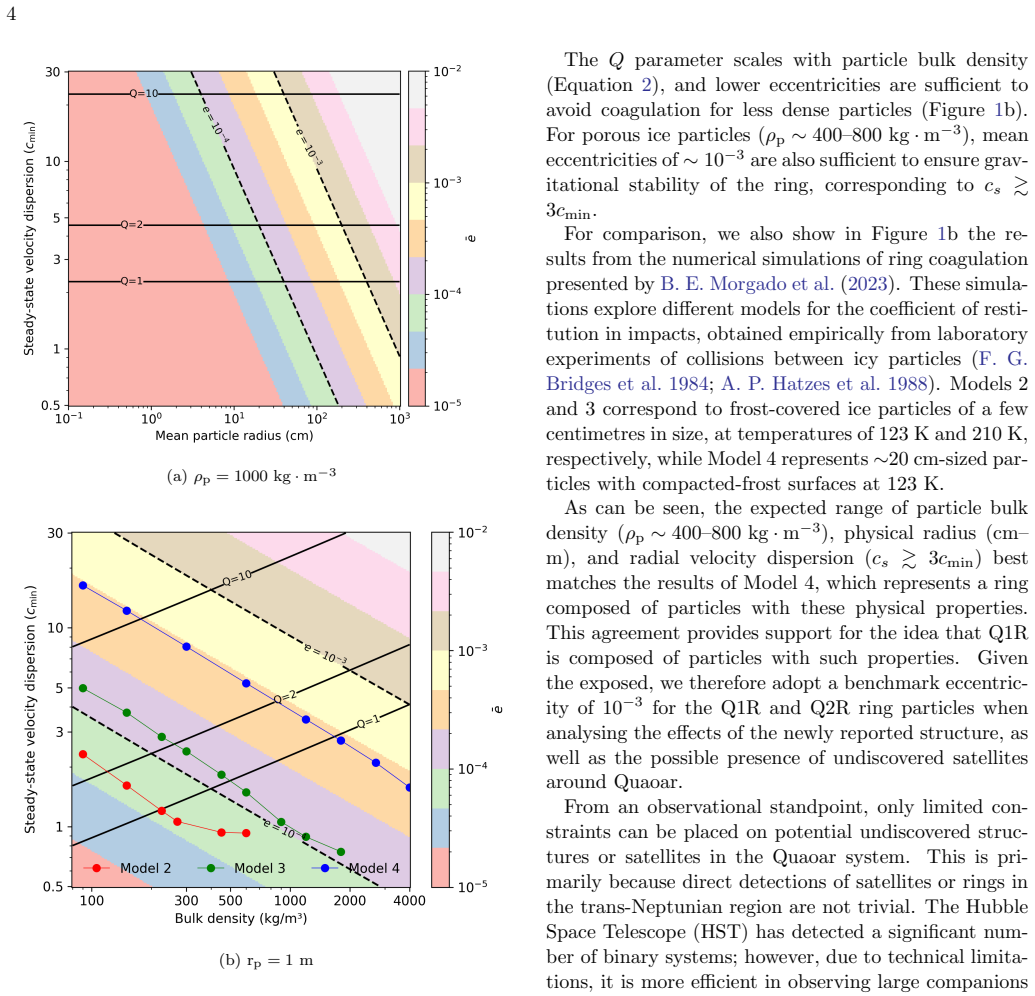
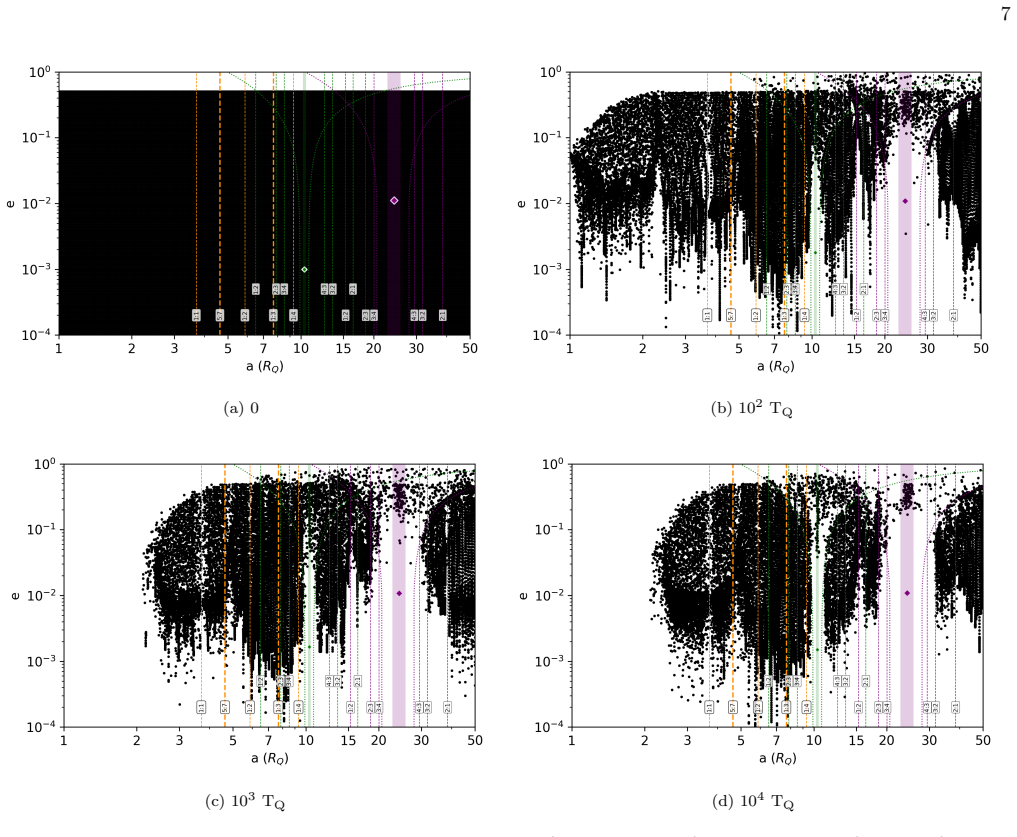
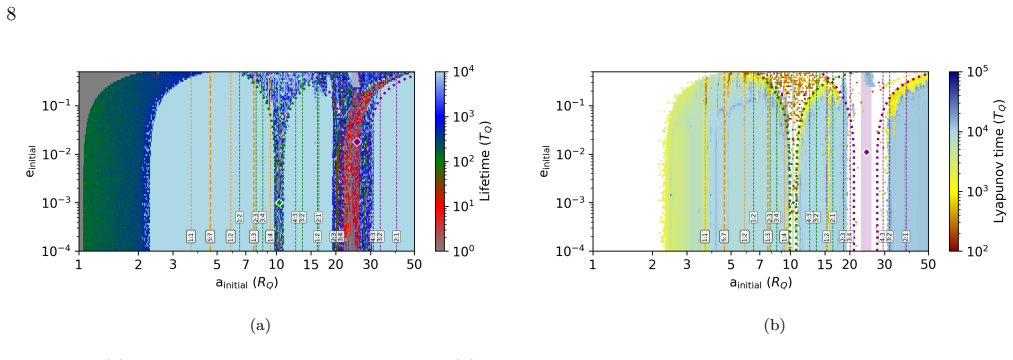
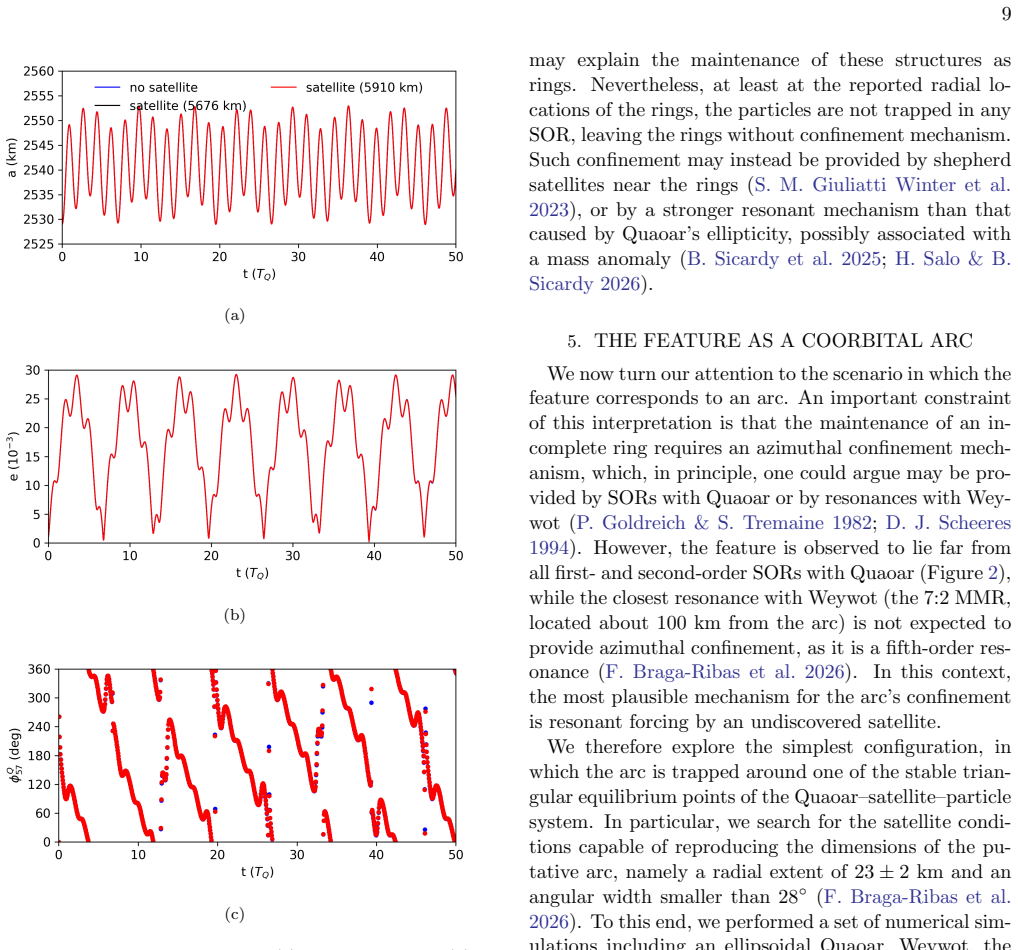
A recently reported opaque feature in the Quaoar system, detected during the 25 June 2025 stellar occultation, has been interpreted as either a 15 km-radius satellite or a dense, sharp-edged arc orbiting at about 5600-5900 km. Here, we investigate both scenarios through numerical integrations that include Quaoar, its triaxial shape, and Weywot. If the feature is a satellite, stability maps show that it acquires a forced eccentricity of about 0.002 and has only a minor dynamical effect on the Q1R and Q2R rings. Its main effect is to clear a narrow region around its orbit, associated with the overlap of mean-motion resonances, preventing the long-term survival of kilometre-scale moons within approximately one Quaoar radius of the satellite. If instead the feature is an arc, we test confinement around the triangular equilibrium point of an unseen coorbital satellite. While azimuthal confinement is readily obtained for satellites with satellite-to-primary mass ratios up to 0.001, Weywot's secular perturbation induces large radial excursions in the arc particles, preventing reproduction of the observed radial extent. The required radial confinement is achieved only for confiners comparable to or more massive than Weywot, which would likely be detectable by direct imaging. We therefore disfavour triangular-point confinement as an explanation for a long-lived dense arc and argue that the feature is more dynamically consistent with a satellite. We identify broad stable zones where additional undetected moons could reside, including near the rings as possible shepherd moons. Furthermore, Quaoar's ellipticity alone is sufficient to induce non-resonant orbital excitation capable of preventing ring coagulation, an effect that may be enhanced by small moons near the rings.
Editorial analysis
A structured set of objections, weighed in public.
Referee Report
Summary. The manuscript examines the dynamical implications of a recently detected opaque feature around Quaoar (interpreted as either a ~15 km satellite or a dense arc at 5600-5900 km) via N-body integrations that incorporate Quaoar's triaxial figure and the known satellite Weywot. For the satellite case, the feature acquires a forced eccentricity of ~0.002, clears a narrow resonant region, and has only minor effects on the Q1R/Q2R rings. For the arc case, azimuthal confinement at triangular points is possible for low mass ratios, but Weywot secular perturbations drive radial excursions that exceed the observed width unless the unseen coorbital mass ratio reaches ~Weywot's value; such a body would likely be detectable by imaging. The authors therefore disfavour the arc interpretation, favor the satellite, identify broad stable zones for additional moons, and note that Quaoar's ellipticity alone can excite non-resonant orbits sufficient to inhibit ring coagulation.
Significance. If the numerical results hold, the work supplies concrete dynamical constraints that tilt the interpretation toward a satellite while highlighting the role of known perturbers and shape-induced excitation in small-body ring systems. The explicit inclusion of triaxial figure and Weywot in the integrations, together with the mapping of stable zones for undetected moons, strengthens the analysis relative to simpler models.
major comments (2)
- [Arc confinement analysis (results on radial excursions vs. mass ratio)] The central disfavouring of the arc scenario rests on the claim that radial confinement matching the observed width requires a coorbital mass comparable to or exceeding Weywot's (which would be detectable by direct imaging). No quantitative imaging sensitivity limit, magnitude calculation, or reference to existing observational constraints is supplied to support the detectability threshold; this assumption is load-bearing for rejecting the arc.
- [Numerical results on triangular-point confinement] The reported radial-excursion threshold is stated qualitatively in the abstract and results; explicit values (e.g., rms radial width as a function of mass ratio, or comparison to the observed radial extent) from the integrations are needed to assess how sharply the confinement boundary occurs near the Weywot mass ratio.
minor comments (1)
- Ensure that the naming and prior literature references for the Q1R and Q2R rings are consistent between abstract and main text.
Simulated Author's Rebuttal
We thank the referee for their careful review and constructive comments, which help clarify the presentation of our results. We address each major comment below.
read point-by-point responses
-
Referee: [Arc confinement analysis (results on radial excursions vs. mass ratio)] The central disfavouring of the arc scenario rests on the claim that radial confinement matching the observed width requires a coorbital mass comparable to or exceeding Weywot's (which would be detectable by direct imaging). No quantitative imaging sensitivity limit, magnitude calculation, or reference to existing observational constraints is supplied to support the detectability threshold; this assumption is load-bearing for rejecting the arc.
Authors: We agree that the manuscript would benefit from quantitative support for the detectability statement. In the revised version we will add a brief discussion with approximate magnitude estimates for a Weywot-mass coorbital at 5600-5900 km, referencing the HST discovery observations of Weywot and published imaging limits on additional satellites in the Quaoar system. This will make the threshold more explicit while preserving the dynamical conclusion. revision: yes
-
Referee: [Numerical results on triangular-point confinement] The reported radial-excursion threshold is stated qualitatively in the abstract and results; explicit values (e.g., rms radial width as a function of mass ratio, or comparison to the observed radial extent) from the integrations are needed to assess how sharply the confinement boundary occurs near the Weywot mass ratio.
Authors: We concur that explicit numerical values would improve clarity. We will revise the results section to tabulate rms radial excursions versus mass ratio for the triangular-point integrations and directly compare these widths to the observed radial extent of the occultation feature. This addition will quantify the sharpness of the transition near the Weywot mass ratio. revision: yes
Circularity Check
No significant circularity in derivation chain
full rationale
The paper derives its main claims—that triangular-point confinement fails to reproduce the observed radial width while a satellite scenario is dynamically consistent—from independent N-body integrations that include Quaoar's triaxial figure, Weywot, and secular perturbations. These results are not obtained by fitting parameters to the target data and then relabeling them as predictions, nor do they rest on self-citations that themselves assume the conclusion. The radial-excursion threshold follows directly from the modeled dynamics rather than from any self-definitional loop or imported uniqueness theorem. The work is therefore self-contained against external benchmarks.
Axiom & Free-Parameter Ledger
axioms (3)
- standard math The gravitational interactions are governed by Newtonian mechanics in the N-body problem
- domain assumption Quaoar has a triaxial shape that contributes to its gravitational potential
- domain assumption Weywot is the only known significant perturber besides Quaoar
invented entities (1)
-
unseen coorbital satellite
no independent evidence
Reference graph
Works this paper leans on
-
[1]
1980, Meccanica, 15, 9, doi: 10.1007/BF02128236
Benettin, G., Galgani, L., Giorgilli, A., & Strelcyn, J.-M. 1980, Meccanica, 15, 9, doi: 10.1007/BF02128236
-
[2]
2026, ApJL, doi: 10.3847/2041-8213/ae4751
Braga-Ribas, F., Pereira, C., & et al. 2026, ApJL, doi: 10.3847/2041-8213/ae4751
-
[3]
Braga-Ribas, F., Sicardy, B., Ortiz, J. L., et al. 2014, Nature, 508, 72, doi: 10.1038/nature13155
-
[4]
Bridges, F. G., Hatzes, A., & Lin, D. N. C. 1984, Nature, 309, 333, doi: 10.1038/309333a0
-
[5]
Charnoz, S., Crida, A., Castillo-Rogez, J. C., et al. 2011, Icarus, 216, 535, doi: 10.1016/j.icarus.2011.09.017
-
[6]
Fraser, W. C., & Brown, M. E. 2010, ApJ, 714, 1547, doi: 10.1088/0004-637X/714/2/1547
-
[7]
French, R. G., Elliot, J. L., & Levine, S. E. 1986, Icarus, 67, 134, doi: 10.1016/0019-1035(86)90181-8 Giuliatti Winter, S. M., Madeira, G., Ribeiro, T., et al. 2023, A&A, 679, A62, doi: 10.1051/0004-6361/202345864
-
[8]
Goldreich, P., & Tremaine, S. 1982, ARA&A, 20, 249, doi: 10.1146/annurev.aa.20.090182.001341
-
[9]
Goldreich, P., & Tremaine, S. D. 1978, Icarus, 34, 227, doi: 10.1016/0019-1035(78)90164-1
-
[10]
Hatzes, A. P., Bridges, F. G., & Lin, D. N. C. 1988, MNRAS, 231, 1091, doi: 10.1093/mnras/231.4.1091
-
[11]
Hedman, M. M., Murray, C. D., Cooper, N. J., et al. 2009, Icarus, 199, 378, doi: 10.1016/j.icarus.2008.11.001
-
[12]
2015, ApJ, 799, 40, doi: 10.1088/0004-637X/799/1/40
Hyodo, R., Ohtsuki, K., & Takeda, T. 2015, ApJ, 799, 40, doi: 10.1088/0004-637X/799/1/40
-
[13]
Kiss, C., M¨ uller, T. G., Marton, G., et al. 2024, A&A, 684, A50, doi: 10.1051/0004-6361/202348054
-
[14]
Lages, J., Shepelyansky, D. L., & Shevchenko, I. I. 2017, AJ, 153, 272, doi: 10.3847/1538-3881/aa7203
-
[15]
Lissauer, J. J. 1985, Nature, 318, 544, doi: 10.1038/318544a0
-
[16]
Madeira, G., Esteves, L., & Pinheiro, T. F. L. L. 2025a, European Physical Journal Special Topics, doi: 10.1140/epjs/s11734-025-01985-2
-
[17]
Madeira, G., Esteves, L., Pinheiro, T. F. L. L., et al. 2025b, Planet. Space Sci., 266, 106168, doi: 10.1016/j.pss.2025.106168
-
[18]
Madeira, G., & Giuliatti Winter, S. M. 2020, European Physical Journal Special Topics, 229, 1527, doi: 10.1140/epjst/e2020-900129-5
-
[19]
Madeira, G., & Giuliatti Winter, S. M. 2022, MNRAS, 513, 297, doi: 10.1093/mnras/stac944
-
[20]
Winter, O. C. 2022, MNRAS, 510, 1450, doi: 10.1093/mnras/stab3552
-
[21]
Madeira, G., Morgado, B. E., Pereira, C. L., et al. 2025c, ApJ, 994, 268, doi: 10.3847/1538-4357/ae169e
-
[22]
2024, Master’s thesis, Universidade Tecnol´ ogica Federal do Paran´ a
Margoti, G., et al. 2024, Master’s thesis, Universidade Tecnol´ ogica Federal do Paran´ a
2024
-
[23]
E., Sicardy, B., Braga-Ribas, F., et al
Morgado, B. E., Sicardy, B., Braga-Ribas, F., et al. 2021, A&A, 652, A141, doi: 10.1051/0004-6361/202141543
-
[24]
, year = 2023, month = feb, volume =
Morgado, B. E., Sicardy, B., Braga-Ribas, F., et al. 2023, Nature, 614, 239, doi: 10.1038/s41586-022-05629-6
-
[25]
Nicholson, P. D., Persson, S. E., Matthews, K., Goldreich, P., & Neugebauer, G. 1978, AJ, 83, 1240, doi: 10.1086/112318
-
[26]
M., Nesvorn´ y, D., & Thirouin, A
Noll, K., Grundy, W. M., Nesvorn´ y, D., & Thirouin, A. 2020, in The Trans-Neptunian Solar System, ed. D. Prialnik, M. A. Barucci, & L. Young, 201–224, doi: 10.1016/B978-0-12-816490-7.00009-6
-
[27]
Nolthenius, R., Bender, K., Cotton, D. V., Proudfoot, B. C. N., & Irwin, J. 2025, Research Notes of the American Astronomical Society, 9, 226, doi: 10.3847/2515-5172/adfeda
-
[28]
Ortiz, J. L., Santos-Sanz, P., Sicardy, B., et al. 2017, Nature, 550, 219, doi: 10.1038/nature24051
-
[29]
Pereira, C. L., Sicardy, B., Morgado, B. E., et al. 2023, A&A, 673, L4, doi: 10.1051/0004-6361/202346365
-
[30]
L., Braga-Ribas, F., Sicardy, B., et al
Pereira, C. L., Braga-Ribas, F., Sicardy, B., et al. 2025, arXiv e-prints, arXiv:2510.12388. https://arxiv.org/abs/2510.12388
arXiv 2025
-
[31]
2025a, PSJ, 6, 285, doi: 10.3847/PSJ/ae18da
Proudfoot, B., Grundy, W., Ragozzine, D., & Fern´ andez-Valenzuela, E. 2025a, PSJ, 6, 285, doi: 10.3847/PSJ/ae18da
-
[32]
Proudfoot, B., Holler, B. J., Arimatsu, K., et al. 2025b, PSJ, 6, 146, doi: 10.3847/PSJ/addd02
-
[33]
Proudfoot, B., Nolthenius, R., Holler, B. J., et al. 2025c, ApJL, 993, L38, doi: 10.3847/2041-8213/ae1585
-
[34]
Rein, H., & Liu, S. F. 2012, A&A, 537, A128, doi: 10.1051/0004-6361/201118085
work page internal anchor Pith review doi:10.1051/0004-6361/201118085 2012
-
[35]
Rein, H., & Spiegel, D. S. 2015, MNRAS, 446, 1424, doi: 10.1093/mnras/stu2164
-
[36]
Renner, S., & Sicardy, B. 2004, Celestial Mechanics and Dynamical Astronomy, 88, 397, doi: 10.1023/B:CELE.0000023420.80881.67 17
-
[37]
2014, A&A, 563, A133, doi: 10.1051/0004-6361/201321910
Renner, S., Sicardy, B., Souami, D., Carry, B., & Dumas, C. 2014, A&A, 563, A133, doi: 10.1051/0004-6361/201321910
-
[38]
Winter, S. M. 2023, MNRAS, 525, 44, doi: 10.1093/mnras/stad2362
-
[39]
Ribeiro, T., Winter, O. C., Mour˜ ao, D., Boldrin, L. A. G., & Carvalho, J. P. S. 2021, MNRAS, 506, 3068, doi: 10.1093/mnras/stab1880 Rodr´ ıguez, A., Morgado, B. E., & Callegari, Jr., N. 2023, MNRAS, 525, 3376, doi: 10.1093/mnras/stad2413
-
[40]
2010, Icarus, 209, 771, doi: 10.1016/j.icarus.2010.05.030
Salmon, J., Charnoz, S., Crida, A., & Brahic, A. 2010, Icarus, 209, 771, doi: 10.1016/j.icarus.2010.05.030
-
[41]
2026, arXiv e-prints, arXiv:2601.06975, doi: 10.48550/arXiv.2601.06975
Salo, H., & Sicardy, B. 2026, arXiv e-prints, arXiv:2601.06975, doi: 10.48550/arXiv.2601.06975
-
[42]
Scheeres, D. J. 1994, Icarus, 110, 225, doi: 10.1006/icar.1994.1118
-
[43]
Shu, F. H., & Stewart, G. R. 1985, Icarus, 62, 360, doi: 10.1016/0019-1035(85)90181-2
-
[44]
2025, A&A, 704, A23, doi: 10.1051/0004-6361/202556950
Souami, D. 2025, A&A, 704, A23, doi: 10.1051/0004-6361/202556950
-
[45]
Sickafoose, A. A., & Lewis, M. C. 2024, PSJ, 5, 32, doi: 10.3847/PSJ/ad151c
-
[46]
Toomre, A. 1964, ApJ, 139, 1217, doi: 10.1086/147861
-
[47]
C., Borderes-Motta, G., & Ribeiro, T
Winter, O. C., Borderes-Motta, G., & Ribeiro, T. 2019, MNRAS, 484, 3765, doi: 10.1093/mnras/stz246
-
[48]
1980, AJ, 85, 1122, doi: 10.1086/112778
Wisdom, J. 1980, AJ, 85, 1122, doi: 10.1086/112778
-
[49]
Wolf, A., Swift, J. B., Swinney, H. L., & Vastano, J. A. 1985, Physica D Nonlinear Phenomena, 16, 285, doi: 10.1016/0167-2789(85)90011-9
discussion (0)
Sign in with ORCID, Apple, or X to comment. Anyone can read and Pith papers without signing in.