REVIEW 1 major objections 35 references
Stochastic Expectation Maximization for Robust State-Space Radio Interferometric Imaging
T0 review · 1 major / 0 minor · reviewed 2026-06-26 · grok-4.3
Pith's one-line read A stochastic approximation expectation-maximization algorithm models compound-Gaussian noise to improve radio interferometric imaging under radio-frequency interference.
desk verdict Applies SAEM with Gibbs sampling under compound-Gaussian noise to radio interferometry for RFI robustness, but the outperformance over an oracle RTS smoother lacks supporting details. read the letter →
The pith
A machine-rendered reading of the paper's core claim, the machinery that carries it, and where it could break.
The reading
What carries the argument
Stochastic Approximation Expectation-Maximization (SAEM) algorithm using closed-form Gibbs updates to sample latent states and noise texture.
What would settle it
A direct comparison on synthetic radio interferometry datasets with controlled RFI levels, measuring the reconstruction error of the proposed SAEM method against Gaussian EM and RTS smoother.
Extended reading notes
Core claim
The central claim is that a stochastic approximation expectation-maximization algorithm, with Monte Carlo sampling of latent states and noise texture via closed-form Gibbs updates, provides robust estimation for linear state-space models under compound-Gaussian noise, yielding better reconstruction in radio interferometry affected by RFI.
Load-bearing premise
The measurement noise must follow a compound-Gaussian distribution allowing closed-form Gibbs updates for the latent states and noise texture.
Editorial analysis
A structured set of objections, weighed in public.
Referee Report
Summary. The manuscript proposes a Stochastic Approximation Expectation-Maximization (SAEM) algorithm for linear state-space models subject to compound-Gaussian noise, with application to radio interferometric imaging in the presence of RFI. The standard E-step is replaced by Monte Carlo sampling of latent states and noise texture via closed-form Gibbs updates. Numerical experiments are claimed to show that the method improves reconstruction fidelity and robustness to RFI, outperforming both a Gaussian EM algorithm and an oracle RTS smoother.
Significance. If the experimental comparisons hold under clearly defined conditions, the work would demonstrate a practical benefit of heavy-tailed state-space modeling and SAEM inference for interference-dominated radio imaging scenarios, extending standard Gaussian assumptions in a tractable way.
major comments (1)
- [Abstract] Abstract: the central claim that the SAEM method outperforms an 'oracle RTS smoother' is load-bearing for the asserted superiority in reconstruction fidelity, yet the abstract supplies no definition of the oracle (e.g., whether it receives ground-truth states, parameters, or noise realizations) nor the precise fidelity metric. Without this information the comparison cannot be evaluated for fairness or informativeness.
Simulated Author's Rebuttal
We thank the referee for this constructive comment on the abstract. We agree that additional clarification is needed to make the comparison self-contained and will revise the abstract accordingly.
read point-by-point responses
-
Referee: [Abstract] Abstract: the central claim that the SAEM method outperforms an 'oracle RTS smoother' is load-bearing for the asserted superiority in reconstruction fidelity, yet the abstract supplies no definition of the oracle (e.g., whether it receives ground-truth states, parameters, or noise realizations) nor the precise fidelity metric. Without this information the comparison cannot be evaluated for fairness or informativeness.
Authors: We agree that the abstract should define the oracle RTS smoother and the fidelity metric. In the manuscript body (Section 4), the oracle RTS smoother is the standard Rauch-Tung-Striebel smoother supplied with the ground-truth state-transition and observation parameters together with the true noise realizations (i.e., an idealized, non-causal benchmark unavailable in practice). The reported fidelity metric is the normalized mean-squared error between the estimated and true latent states, averaged over Monte Carlo trials. We will add a concise parenthetical definition of both the oracle and the metric to the abstract in the revised version. revision: yes
Circularity Check
No significant circularity in SAEM derivation or claims
full rationale
The paper presents a standard SAEM extension to compound-Gaussian state-space models using closed-form Gibbs sampling for the E-step. No derivation step reduces a claimed prediction or result to a fitted parameter or self-citation by construction. The central algorithm is derived from established EM and Monte Carlo methods without self-referential definitions or load-bearing uniqueness theorems from the authors' prior work. Experimental comparisons (including to an oracle RTS smoother) are external validation steps, not part of any internal derivation chain. This is the common case of a self-contained methodological contribution.
Assumptions & free parameters
assumptions (2)
- domain assumption The measurement noise follows a compound-Gaussian distribution.
- domain assumption Closed-form Gibbs updates are available for sampling latent states and noise texture.
Cite this review
Pith. "Pith review of Stochastic Expectation Maximization for Robust State-Space Radio Interferometric Imaging." pith.science (2026). https://pith.science/paper/CPNQ2WKJ
@misc{pith2026260623944,
  author       = {Pith},
  title        = {Pith review of: Stochastic Expectation Maximization for Robust State-Space Radio Interferometric Imaging},
  year         = {2026},
  howpublished = {\url{https://pith.science/paper/CPNQ2WKJ}},
  note         = {Machine review of arXiv:2606.23944}
}
read the original abstract
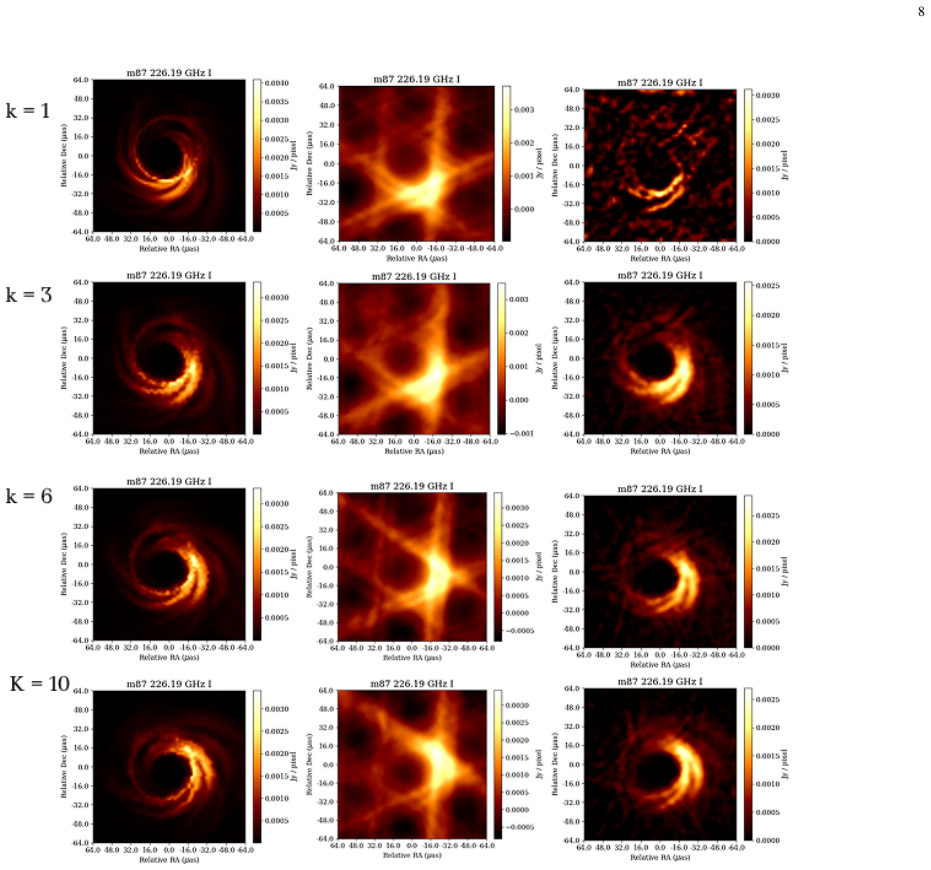
State--space models provide a flexible framework for analyzing dynamical systems, yet they often rely on Gaussian assumptions that fail to capture heavy-tailed or outlier-prone measurement noise. We propose a robust estimation scheme for linear state--space models subject to compound-Gaussian noise, as encountered for instance in radio interferometry affected by radio-frequency interference (RFI). The method relies on a Stochastic Approximation Expectation--Maximization (SAEM) algorithm in which the standard E-step is replaced by Monte Carlo sampling of the latent states and noise texture through closed-form Gibbs updates, enabling tractable inference despite the heavy-tailed likelihood. Numerical experiments show that the proposed method significantly improves reconstruction fidelity and robustness to RFI, outperforming a Gaussian EM algorithm and even an oracle RTS smoother. These results highlight the benefits of heavy-tailed state--space modeling and SAEM-based inference in interference-dominated imaging scenarios.
Figures
Reference graph
Works this paper leans on
-
[1]
Robust and trend-following Student’s t Kalman smoothers,
A. Y . Aravkin, J. V . Burke, and G. Pillonetto, “Robust and trend-following Student’s t Kalman smoothers,”SIAM Journal on Control and Optimization, vol. 52, no. 5, pp. 2891–2916, 2014
2014
-
[2]
Robust radio interferometric calibration using the t-distribution,
S. Kazemi and S. Yatawatta, “Robust radio interferometric calibration using the t-distribution,”Monthly Notices of the Royal Astronomical Society, vol. 435, no. 1, pp. 597–605, 2013
2013
-
[3]
State-space models,
J. D. Hamilton, “State-space models,” Handbook of Econometrics, vol. 4, pp. 3039–3080, 1994
1994
-
[4]
S ¨arkk¨a, Bayesian Filtering and Smoothing
S. S ¨arkk¨a, Bayesian Filtering and Smoothing. Cambridge University Press, 2013
2013
-
[5]
Leshem and A.-J
A. Leshem and A.-J. van der Veen, ”Radio astronomical imaging in the presence of strong radio interference,” in A.-J. van der Veen, in IEEE Transaction Information Theory, 2000
2000
-
[6]
Introduction to interference mitigation techniques in radio astronomy,
A. Leshem and A.-J. van der Veen, “Introduction to interference mitigation techniques in radio astronomy,” in Perspectives on Radio Astronomy: Technologies for Large Antenna Arrays, p. 201, 2000
2000
-
[7]
Wiaux, L
Y . Wiaux, L. Jacques, G. Puy, A. M. Scaife, and P. Vandergheynst, ”Compressed sensing imaging techniques for radio interferometry,” in Monthly Notices of the Royal Astronomical Society, vol. 395, no. 3, pp.1733-1742, 2009
2009
-
[8]
A tutorial on particle filtering and smoothing: Fifteen years later,
A. Doucet, A. M. Johansen et al., “A tutorial on particle filtering and smoothing: Fifteen years later,” Handbook of nonlinear filtering, vol. 12, no. 656-704, p. 3, 2009
2009
Show all 35 references
-
[9]
D. Xu, C. Shen and F. Shen, ”A Robust Particle Filtering Algorithm With Non-Gaussian Measurement Noise Using Student-t Distribution,” in IEEE Signal Processing Letters, vol. 21, no. 1, pp. 30-34, 2014
2014
-
[10]
Liu, ”Robust particle filter by dynamic averaging of multiple noise models,” 2017 IEEE International Conference on Acoustics, Speech and Signal Processing, pp
B. Liu, ”Robust particle filter by dynamic averaging of multiple noise models,” 2017 IEEE International Conference on Acoustics, Speech and Signal Processing, pp. 4034-4038, 2017
2017
-
[11]
Huang, Y
Y . Huang, Y . Zhang, N. Li and J. Chambers, ”A Robust Gaussian Approximate Fixed-Interval Smoother for Nonlinear Systems With Heavy-Tailed Process and Measurement Noises,” in IEEE Signal Processing Letters, vol. 23, no. 4, pp. 468-472, 2016
2016
-
[12]
A. K. Roonizi, ”Kalman Filtering in Non-Gaussian Model Errors: A New Perspective,” in IEEE Signal Processing Magazine, vol. 39, no. 3, pp. 105-114, May 2022
2022
-
[13]
Robust Kalman Filter Based on a Generalized Maximum-Likelihood-Type Estimator,
M. A. Gandhi and L. Mili, “Robust Kalman Filter Based on a Generalized Maximum-Likelihood-Type Estimator,” IEEE Trans. Signal Process., vol. 58, no. 5, pp. 2509–2520, 2010
2010
-
[14]
A Robust Iterated Extended Kalman Filter for Power System Dynamic State Estimation,
J. Zhao, M. Netto, and L. Mili, “A Robust Iterated Extended Kalman Filter for Power System Dynamic State Estimation,” IEEE Trans. Power Syst., vol. 32, no. 4, pp. 3205–3216, 2017
2017
-
[15]
X. Yu, Z. Qu and G. Jin, ”Robust Adaptive Filters and Smoothers for Linear Systems With Heavy-Tailed Multiplica- tive/Additive Noises,” in IEEE Transactions on Aerospace and Electronic Systems, vol. 60, no. 5, pp. 6717-6733, 2024
2024
-
[16]
A. R. Thompson, J. M. Moran, and G. W. Swenson, ”Interferometry and synthesis in radio astronomy,” Springer Nature, 2017
2017
-
[17]
Maximum likelihood from incomplete data via the em algorithm,
A. P. Dempster, N. M. Laird, and D. B. Rubin, “Maximum likelihood from incomplete data via the em algorithm,” Journal of the Royal Statistical Society. Series B (Methodological), vol. 39, no. 1, pp. 1–38, 1977
1977
-
[18]
The EM algorithm and extensions,
G. J. McLachlan and T. Krishnan, “The EM algorithm and extensions,” 2 ed., 2008. 10
2008
-
[19]
Matched and Mismatched Estimation of Kronecker Product of Linearly Structured Scatter Matrices Under Elliptical Distributions,
B. Meriaux, C. Ren, A. Breloy, M. N. El Korso, and P. Forster, “Matched and Mismatched Estimation of Kronecker Product of Linearly Structured Scatter Matrices Under Elliptical Distributions,”IEEE Transactions on Signal Processing, vol. 69, pp. 603– 616, 2020
2020
-
[20]
Convergence of a stochastic approximation version of the EM algorithm,
B. Delyon, M. Lavielle, and E. Moulines, “Convergence of a stochastic approximation version of the EM algorithm,” Annals of Statistics, vol. 27, no. 1, pp. 94–128, 1999
1999
-
[21]
Robust graphical modeling of gene networks using classical and alternative t-distributions,
M. Finegold and M. Drton, “Robust graphical modeling of gene networks using classical and alternative t-distributions,” Ann. Appl. Stat., vol. 5, no. 2, 2012
2012
-
[22]
ML estimation of the t distribution using EM and its extensions, ECM and ECME,
C. Liu and D. B. Rubin, “ML estimation of the t distribution using EM and its extensions, ECM and ECME,” Statistica Sinica, vol. 5, no. 1, pp. 19–39, 1995
1995
-
[23]
Approximate inference in state-space models with heavy-tailed noise,
G. Agamennoni, J. I. Nieto, and E. M. Nebot, “Approximate inference in state-space models with heavy-tailed noise,” IEEE Trans. Signal Process., vol. 60, no. 10, pp. 5024–5037, 2012
2012
-
[24]
Maximum Likelihood and Maximum a Posteriori Direction-of-Arrival Estimation in the Presence of SIRP Noise,
X. Zhang, M. N. El Korso, and M. Pesavento, “Maximum Likelihood and Maximum a Posteriori Direction-of-Arrival Estimation in the Presence of SIRP Noise,” inProc. IEEE International Conference on Acoustics, Speech and Signal Processing (ICASSP), pp. 3081–3085, 2016
2016
-
[25]
An approach to time series smoothing and forecasting using the EM algorithm,
R. H. Shumwayand and D.S. Stoffer,“An approach to time series smoothing and forecasting using the EM algorithm,” Journal of Time Series Analysis, vol. 3, no. 4, pp. 253–264, 1982
1982
-
[26]
Parameter estimation for linear dynamical systems,
Z. Ghahramani and G. E. Hinton, “Parameter estimation for linear dynamical systems,” 1996
1996
-
[27]
Derivation of the Kalman filter in a Bayesian filtering perspective,
R. Gurajala, P. B. Choppala, J. S. Meka, and P. D. Teal, “Derivation of the Kalman filter in a Bayesian filtering perspective,” in Proc. 2021 2nd Int. Conf. Range Technol. (ICORT), 2021
2021
-
[28]
Elliptically Symmetric Distributions in Signal Processing and Machine Learning,
J-P. Delmas, M. N. El Korso, F. Pascal, and S. Fortunati “Elliptically Symmetric Distributions in Signal Processing and Machine Learning,” Springer Nature, Dec 2024
2024
-
[29]
Trinh-Hoang, M
M. Trinh-Hoang, M. N. El Korso, M. Pesavento, ”A partially-relaxed robust DOA estimator under non-Gaussian low-rank interference and noise”, in Proc. of ICASSP, 2021
2021
-
[30]
Unrolled expectation maximization algorithm for radio interferometric imaging in presence of non gaussian interferences,
N. Arab, Y . Mhiri, I. Vin, M. N. El Korso, P. Larzabal, “Unrolled expectation maximization algorithm for radio interferometric imaging in presence of non gaussian interferences,” Signal Processing, 2025
2025
-
[31]
Sparsity Averaging Reweighted Analysis (SARA): A novel algorithm for radio interferometric imaging,
R. E. Carrillo, J. D. McEwen, and Y . Wiaux, “Sparsity Averaging Reweighted Analysis (SARA): A novel algorithm for radio interferometric imaging,” Monthly Notices of the Royal Astronomical Society, vol. 439, no. 4, pp. 3591–3604, 2013
2013
-
[32]
Bayesian Signal Subspace Estimation with Compound Gaussian Sources,
R. Ben Abdallah, A. Breloy, M. N. El Korso, and D. Lautru, “Bayesian Signal Subspace Estimation with Compound Gaussian Sources,”Signal Processing, vol. 167, p. 107310, 2020
2020
-
[33]
Scalable splitting algorithms for big-data interferometric imaging,
A. Onose, J. D. McEwen, F. Sureau, et al., “Scalable splitting algorithms for big-data interferometric imaging,” Monthly Notices of the Royal Astronomical Society, vol. 462, no. 4, pp. 4314–4335, 2016
2016
-
[34]
Missing Data in Signal Processing and Machine Learning: Models, Methods and Modern Approaches,
A. Hippert-Ferrer, A. Sportisse, A. Javaheri, M. N. El Korso, and D. P. Palomar, “Missing Data in Signal Processing and Machine Learning: Models, Methods and Modern Approaches,”arXiv preprint arXiv:2506.01696, 2025
2025
-
[35]
Robust sparse image reconstruction of radio interferometric observations,
L. Pratley, J. D. McEwen, P. d’Avezac, A. Eyers, B. T. Dulwich, and P. J. Elson, “Robust sparse image reconstruction of radio interferometric observations,” Monthly Notices of the Royal Astronomical Society, vol. 473, no. 1, pp. 1038–1058, 2018
2018
Reviewed June 26, 2026 · model on record in the stance chip above.
Discussion (0). Continue with ORCID to comment.