Suppressing Self-Discharging of Quantum Batteries by Cavity Interactions
Pith reviewed 2026-06-26 07:42 UTC · model grok-4.3
The pith
Coupling a lossy qubit cavity to an auxiliary cavity suppresses self-discharging in quantum batteries at finite temperature.
A machine-rendered reading of the paper's core claim, the machinery that carries it, and where it could break.
Core claim
In the resonant two-cavity architecture the coherent inter-cavity coupling enhances suppression of self-discharging for every initial preparation, battery size, and temperature examined, with the protection degrading smoothly as the mean thermal occupation increases; single-qubit energy-basis coherence outperforms the fully excited state, Bell preparations outperform it for two qubits, and normalized retained ergotropy increases monotonically with qubit number in the symmetric Dicke manifold.
What carries the argument
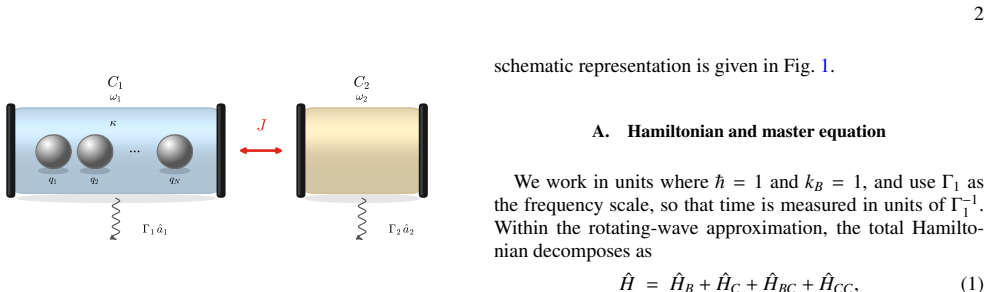
Two-cavity architecture in which a lossy cavity containing N qubits is coherently coupled to an auxiliary cavity, evolved under a local Lindblad master equation at resonance.
If this is right
- Normalized retained ergotropy increases monotonically with the number of qubits under collective coupling in the symmetric manifold.
- Energy-basis coherence in a pure superposition improves long-time energy retention relative to the fully excited state for a single qubit.
- Bell-state preparations yield higher long-time ergotropy retention than the fully excited state for two-qubit batteries.
- The protection persists across all examined initial preparations, battery sizes, and temperatures but weakens smoothly with rising mean thermal occupation.
Where Pith is reading between the lines
- The same auxiliary-cavity coupling could be tested in circuit-QED or trapped-ion platforms where the auxiliary mode is already present as a readout resonator.
- If the collective enhancement survives modest detuning, the scheme might extend to non-resonant operation without redesigning the hardware.
- The observed size dependence suggests that scaling to larger symmetric manifolds could further improve protection even at higher temperatures.
Load-bearing premise
The local Lindblad treatment in the resonant configuration accurately captures the system dynamics for the examined parameters and initial states.
What would settle it
Measure the long-time retained ergotropy of the same initial state with and without the auxiliary-cavity coupling; if the two curves coincide within experimental error across the explored temperature range, the claimed suppression is absent.
Figures
read the original abstract
We analyse a two-cavity architecture, in which a lossy cavity hosting $N$ qubits is coherently coupled to an auxiliary cavity, as a resource for the storage phase of an open quantum battery at non-zero temperature. Within a local Lindblad treatment in the resonant configuration, we find that the inter-cavity coupling enhances the suppression of self-discharging across every initial preparation, battery size, and temperature we examine, with the protection degrading smoothly as the mean thermal occupation increases. For a single qubit, the energy-basis coherence of a pure superposition leads to better long-time retention than fully excited state, highlighting the beneficial role of quantum coherence in protecting stored energy against thermal degradation. For two-qubit batteries, Bell-state preparations exhibit enhanced long-time ergotropy retention compared with the fully excited state, while the inclusion of qubit-qubit interactions produces only a weak dependence on the interaction type and strength within the parameter regime considered. Extending the analysis to multi-qubit GHZ-charged batteries with all-to-all Heisenberg interactions, we find that the normalized retained ergotropy increases monotonically with the number of qubits. This behavior is consistent with the collective enhancement of the qubit-cavity coupling in the symmetric Dicke manifold, indicating that larger quantum batteries can benefit from improved protection against self-discharge. These findings establish cavity-assisted protection as a promising strategy for mitigating self-discharging and realizing of long-lived quantum batteries in experimentally accessible platforms.
Editorial analysis
A structured set of objections, weighed in public.
Referee Report
Summary. The paper examines a two-cavity architecture for open quantum batteries at finite temperature, with N qubits in a lossy cavity coherently coupled to an auxiliary cavity. Within a local Lindblad master equation in the resonant regime, numerical results show that increasing the inter-cavity coupling strength improves long-time ergotropy retention for all examined initial states (energy-basis superpositions, Bell states, GHZ), battery sizes N, and temperatures, with the improvement degrading smoothly with mean thermal occupation. Coherence in initial states aids retention, qubit-qubit interactions have weak effect, and normalized retained ergotropy increases monotonically with N, attributed to collective coupling in the Dicke manifold.
Significance. If the local Lindblad approximation remains valid, the work identifies cavity-assisted coherent coupling as a concrete mechanism to mitigate self-discharge in thermal quantum batteries, with explicit scaling benefits for larger N and a role for initial-state coherence. The systematic numerical survey across preparations and parameters supplies falsifiable predictions for cavity-QED platforms.
major comments (2)
- [Methods] Methods (local Lindblad master equation, resonant case): The central claim that inter-cavity coupling monotonically enhances retention for every initial state, N, and temperature rests on the local jump operators remaining accurate when a coherent inter-cavity term is present. No validity bounds (e.g., g_cav / κ or thermal occupation thresholds) or comparison to a global master equation are supplied; if non-local dissipators become relevant, the reported protection could be an artifact of the chosen equation rather than a physical effect.
- [Results (multi-qubit GHZ)] Results, multi-qubit GHZ section: The monotonic increase of normalized retained ergotropy with N is attributed to collective enhancement in the symmetric Dicke manifold, yet the manuscript provides no explicit scaling of the effective decay rate or ergotropy formula with N that would make this claim parameter-free or analytically derivable; the numerical trend alone does not yet establish the collective mechanism as load-bearing.
minor comments (2)
- [Figures] Figure captions and axis labels should explicitly state the numerical values of all fixed parameters (κ, g, β, etc.) and the integration time used for “long-time” retention.
- [Notation] Notation for ergotropy and normalized retained ergotropy should be defined once in the main text with a clear equation reference rather than only in figure legends.
Simulated Author's Rebuttal
We thank the referee for their careful reading and constructive comments. We respond to each major comment below.
read point-by-point responses
-
Referee: [Methods] Methods (local Lindblad master equation, resonant case): The central claim that inter-cavity coupling monotonically enhances retention for every initial state, N, and temperature rests on the local jump operators remaining accurate when a coherent inter-cavity term is present. No validity bounds (e.g., g_cav / κ or thermal occupation thresholds) or comparison to a global master equation are supplied; if non-local dissipators become relevant, the reported protection could be an artifact of the chosen equation rather than a physical effect.
Authors: The local Lindblad master equation is a standard approximation employed in resonant cavity-QED systems when the coherent coupling remains perturbative relative to the cavity decay. We agree that explicit validity bounds would strengthen the presentation. In the revised manuscript we will add a dedicated paragraph specifying the parameter regime (including typical g_cav/κ ratios used in the numerics) and citing literature on the conditions under which the local versus global master equation is appropriate. A systematic comparison with the global master equation lies outside the present scope but is noted as a natural direction for follow-up work. revision: partial
-
Referee: [Results (multi-qubit GHZ)] Results, multi-qubit GHZ section: The monotonic increase of normalized retained ergotropy with N is attributed to collective enhancement in the symmetric Dicke manifold, yet the manuscript provides no explicit scaling of the effective decay rate or ergotropy formula with N that would make this claim parameter-free or analytically derivable; the numerical trend alone does not yet establish the collective mechanism as load-bearing.
Authors: The manuscript already qualifies the statement as 'consistent with' collective enhancement in the Dicke manifold rather than claiming an exact analytical derivation. The reported numerical survey shows a clear monotonic rise in normalized retained ergotropy with N, which matches the expected √N scaling of the collective qubit-cavity coupling in the fully symmetric subspace. While an explicit closed-form expression for the long-time ergotropy would be desirable, obtaining one for the full open-system dynamics is analytically intractable. We will revise the relevant paragraph to emphasize that the trend is a numerical observation supported by the standard collective-coupling argument, thereby clarifying the evidential basis without overstating the result. revision: partial
Circularity Check
No significant circularity; results follow from explicit Lindblad dynamics
full rationale
The paper solves the local Lindblad master equation for a two-cavity qubit system under resonant coupling and reports numerical outcomes for ergotropy retention as functions of coupling strength, N, temperature, and initial states. No parameter is fitted to data and then relabeled as a prediction, no result is defined in terms of itself, and no load-bearing premise reduces to a self-citation chain. The central findings (monotonic improvement with inter-cavity coupling, collective scaling with N) are direct consequences of the stated open-system evolution and therefore self-contained against external benchmarks.
Axiom & Free-Parameter Ledger
axioms (1)
- domain assumption Local Lindblad master equation applies in the resonant configuration
Reference graph
Works this paper leans on
-
[1]
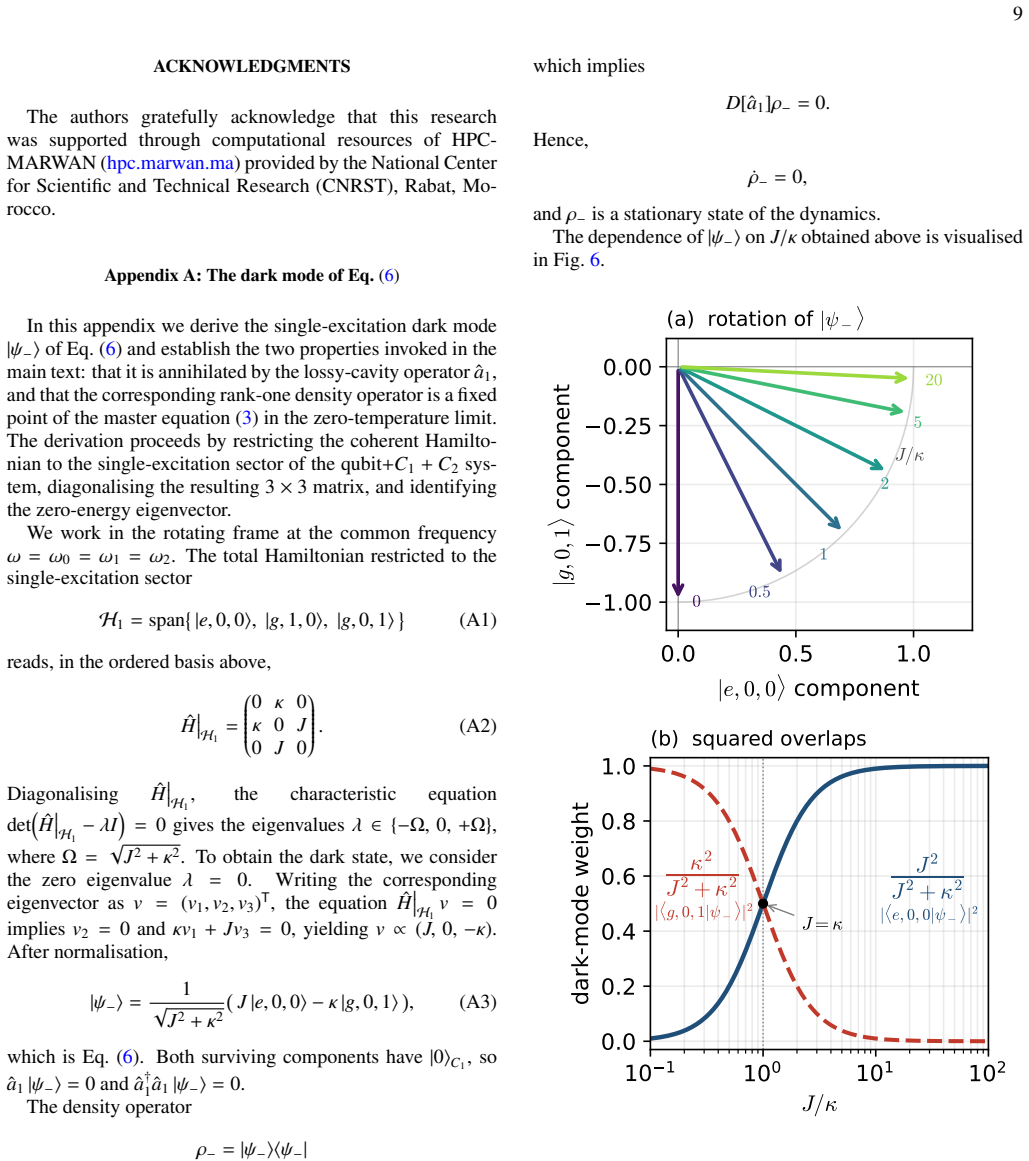
The preparationρ (2) B stores half its initial ergotropy as energy-basis coherence; the state |ψ+⟩|0,0 ⟩ has overlapJ/[ √ 2 √ J2 +κ 2] with the dark mode of Eq
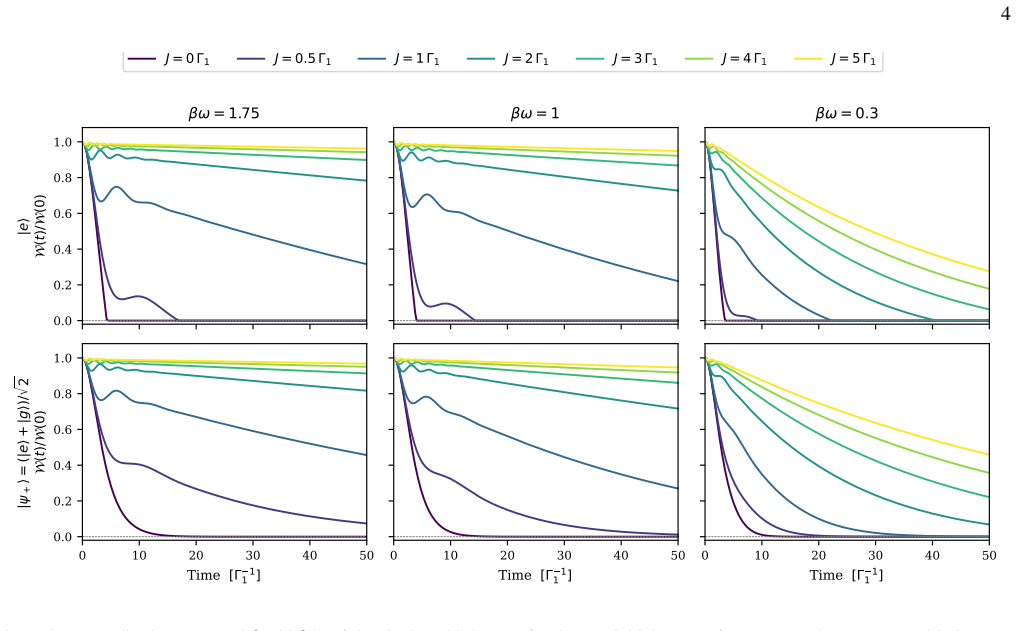
The preparationρ (1) B is fully excited, diagonal in the qubit energy eigenbasis, and stores its initial ergotropy entirely as a population imbalance. The preparationρ (2) B stores half its initial ergotropy as energy-basis coherence; the state |ψ+⟩|0,0 ⟩ has overlapJ/[ √ 2 √ J2 +κ 2] with the dark mode of Eq. (6). Figure 2 showsW(t)/W(0) across the three...
-
[2]
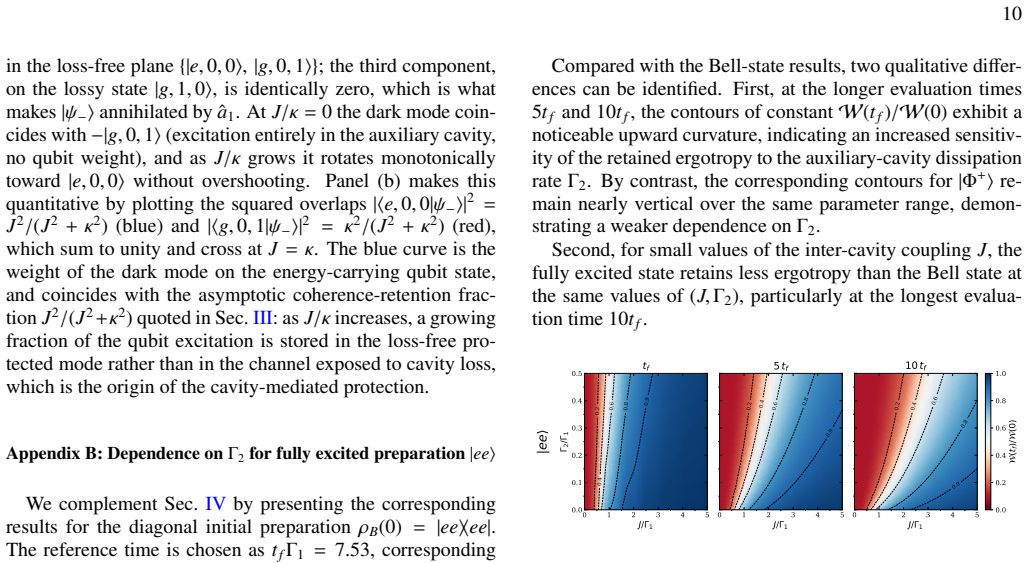
Parameters:ω 0 =ω 1 = ω2 =1,κ=0.24Γ 1,Γ 2 =0.1Γ 1, Heisenberg qubit–qubit couplingg=0.1Γ 1
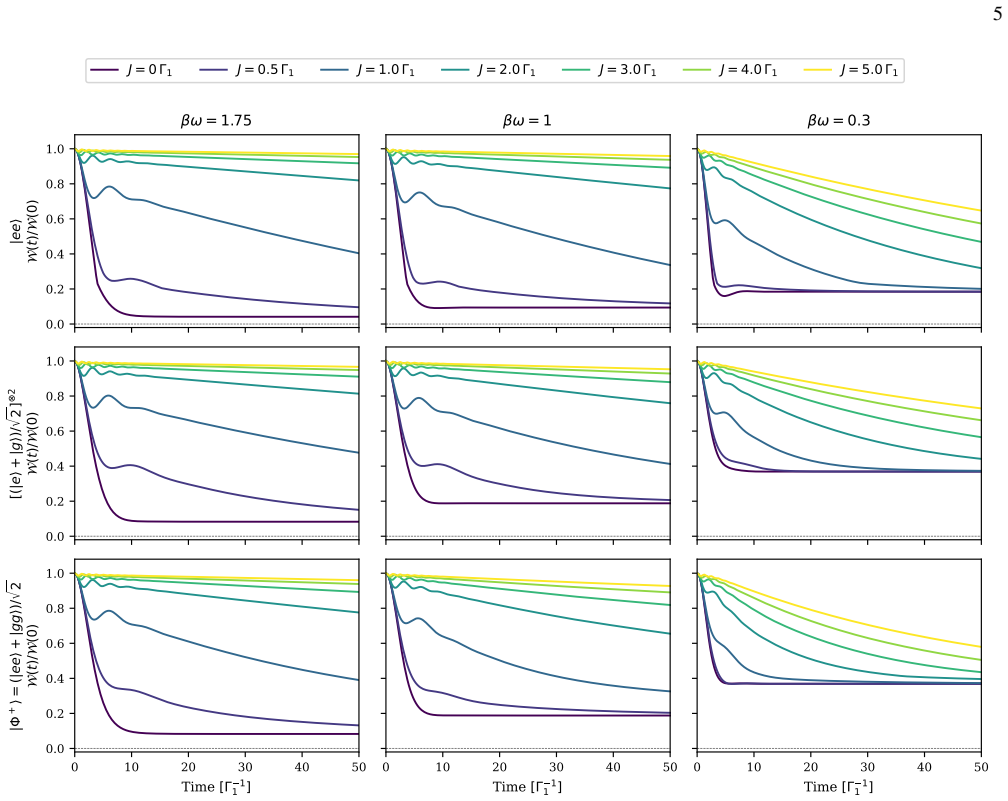
Curves correspond toJ/Γ 1 ∈ {0,0.5,1,2,3,4,5}from dark to light. Parameters:ω 0 =ω 1 = ω2 =1,κ=0.24Γ 1,Γ 2 =0.1Γ 1, Heisenberg qubit–qubit couplingg=0.1Γ 1. forβω∈ {1.75,1,0.3}respectively. As in the single-qubit case, the protection mechanism weakens gradually as the temperature increases. Forβω= 1.75, couplingsJ≳2Γ 1 retain more than 90% of the ini- tia...
-
[3]
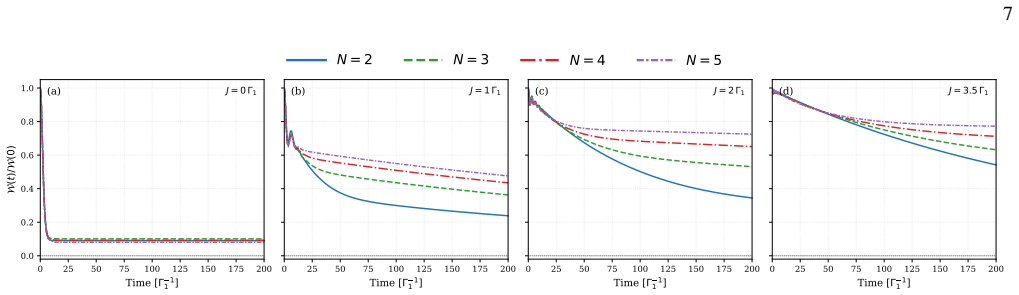
In particular,N=5 displays the highest long-time ergotropy, whereasN=2 exhibits the strongest degradation
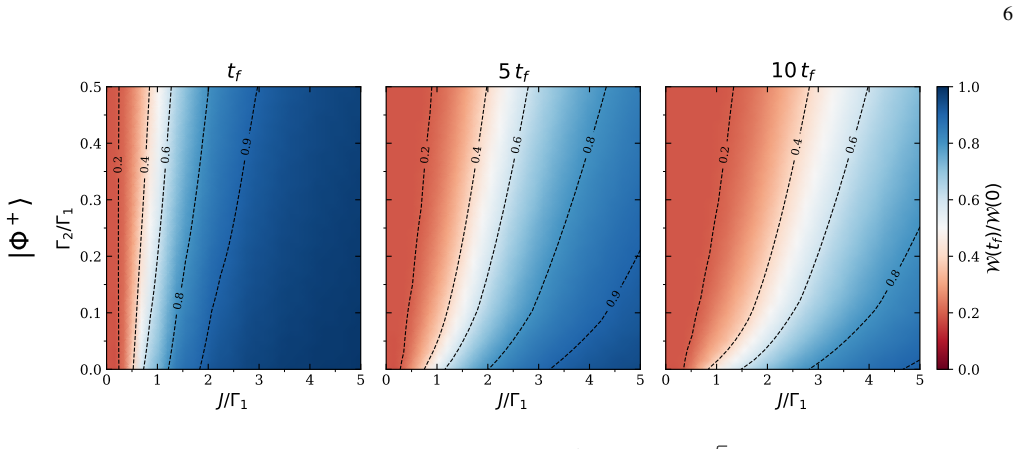
Following the initial transient oscillations, the ergotropy curves separate and remain ordered according to the number of qubits, with larger systems consistently retaining a greater fraction of their initial ergotropy. In particular,N=5 displays the highest long-time ergotropy, whereasN=2 exhibits the strongest degradation. This ordering persists through...
-
[4]
W. Pusz and S. L. Woronowicz,Passive states and KMS states for general quantum systems, Commun. Math. Phys.58, 273 (1978). doi:10.1007/BF01614224
-
[5]
Lenard,Thermodynamical proof of the Gibbs formula for elementary quantum systems, J
A. Lenard,Thermodynamical proof of the Gibbs formula for elementary quantum systems, J. Stat. Phys.19, 575 (1978). doi:10.1007/BF01011769
-
[6]
A. E. Allahverdyan, R. Balian, and Th. M. Nieuwenhuizen, Maximal work extraction from finite quantum systems, Euro- phys. Lett.67, 565 (2004). doi:10.1209/epl/i2004-10101-2
-
[7]
M. Carrega, A. Crescente, D. Ferraro, and M. Sassetti,Dissi- pative dynamics of an open quantum battery, New J. Phys.22, 083085 (2020). doi:10.1088/1367-2630/abaa01
-
[8]
A. C. Santos,Quantum advantage of two-level batteries in the self-discharging process, Phys. Rev. E103, 042118 (2021). doi:10.1103/PhysRevE.103.042118
-
[9]
L. P. Garc ´ıa-Pintos, A. Hamma, and A. del Campo,Fluc- tuations in Extractable Work Bound the Charging Power of Quantum Batteries, Phys. Rev. Lett.125, 040601 (2020). doi:10.1103/PhysRevLett.125.040601
-
[10]
F. H. Kamin, F. T. Tabesh, S. Salimi, F. Kheirandish, and A. C. Santos,Non-Markovian effects on charging and self- discharging process of quantum batteries, New J. Phys.22, 083007 (2020). doi:10.1088/1367-2630/aba29e
-
[11]
D. Farina, G. M. Andolina, A. Mari, M. Polini, and V . Gio- vannetti,Charger-mediated energy transfer for quantum batter- ies: An open-system approach, Phys. Rev. B99, 035421 (2019). doi:10.1103/PhysRevB.99.035421
-
[12]
M. B. Arjmandi, H. Mohammadi, and A. C. Santos, Enhancing self-discharging process with disordered quantum batteries, Phys. Rev. E105, 054115 (2022). doi:10.1103/PhysRevE.105.054115
-
[13]
R. Alicki and M. Fannes,Entanglement boost for extractable work from ensembles of quantum batteries, Phys. Rev. E87, 042123 (2013). doi:10.1103/PhysRevE.87.042123
-
[14]
S. Vinjanampathy and J. Anders,Quantum ther- modynamics, Contemp. Phys.57, 545 (2016). doi:10.1080/00107514.2016.1201896
-
[15]
F. Campaioli, F. A. Pollock, and S. Vinjanampathy,Quantum batteries, inThermodynamics in the Quantum Regime: Funda- mental Aspects and New Directions, Fundam. Theor. Phys.195, 207 (Springer, Cham, 2018). doi:10.1007/978-3-319-99046- 0 8
-
[16]
and Polini, Marco and Andolina, Gian Marcello , year = 2024, month = jul, journal =
F. Campaioli, S. Gherardini, J. Q. Quach, M. Polini, and G. M. Andolina,Colloquium: Quantum bat- teries, Rev. Mod. Phys.96, 031001 (2024). doi:10.1103/RevModPhys.96.031001
-
[17]
J. Q. Quach, G. Cerullo, and T. Virgili,Quantum batter- ies: The future of energy storage?, Joule7, 2195 (2023). doi:10.1016/j.joule.2023.09.003
-
[18]
S. Y . Bai and J. H. An,Floquet engineering to reactivate a dis- sipative quantum battery, Phys. Rev. A102, 060201(R) (2020). doi:10.1103/PhysRevA.102.060201
-
[19]
M. T. Mitchison, J. Goold, and J. Prior,Charging a quantum battery with linear feedback control, Quantum5, 500 (2021). doi:10.22331/q-2021-07-13-500
-
[20]
Y . Yao and X. Q. Shao,Optimal charging of open spin-chain quantum batteries via homodyne-based feedback control, Phys. Rev. E106, 014138 (2022). doi:10.1103/PhysRevE.106.014138
-
[21]
Barra,Dissipative Charging of a Quantum 11 Battery, Phys
F. Barra,Dissipative Charging of a Quantum 11 Battery, Phys. Rev. Lett.122, 210601 (2019). doi:10.1103/PhysRevLett.122.210601
-
[22]
A. Lemou, A. El Allati, K. El Anouz, A. Ali, S. Al-Kuwari, and A. Belfakir,Quantum speed limit time in thermodynamic contexts: Linking CPTP dynamics and repetitive interaction, A VS Quantum Sci.8, 022001 (2026). doi:10.1116/5.0322372
-
[23]
F. H. Kamin, S. Salimi, and M. B. Arjmandi,Steady- state charging of quantum batteries via dissipa- tive ancillas, Phys. Rev. A109, 022226 (2024). doi:10.1103/PhysRevA.109.022226
-
[24]
A. Khoudiri, A. Oularabi, K. El Anouz, ˙I. Demir, and A. El Allati,Coherence-driven quantum battery charging via autonomous thermal machines: Energy transfer, memory ef- fects, and ergotropy enhancement, Phys. Lett. A565, 131178 (2026). doi:10.1016/j.physleta.2025.131178
-
[25]
F. T. Tabesh, F. H. Kamin, and S. Salimi,Environment-mediated charging process of quantum batteries, Phys. Rev. A102, 052223 (2020). doi:10.1103/PhysRevA.102.052223
-
[26]
M. B. Arjmandi,Frozen and growing quantum work under noise: Coherence and correlations as key resources, Phys. Rev. A113, 032220 (2026). doi:10.1103/PhysRevA.113.032220
-
[27]
K. Xu, H.-G. Li, H.-J. Zhu, and W.-M. Liu,Inhibit- ing the self-discharging process of quantum batteries in non-Markovian noises, Phys. Rev. E109, 054132 (2024). doi:10.1103/PhysRevE.109.054132
-
[28]
Z. Imara, K. El Anouz, ˙I. Demir, and A. El Allati,Nonre- ciprocal macroscopic entanglement through magnon squeezing in cavity magnomechanics, Phys. Rev. A113, 053717 (2026). doi:10.1103/rl1p-vgj1
-
[29]
M. Hadipour, S. Haseli, D. Wang, and S. Haddadi,Proposed scheme for a cavity-based quantum battery, Adv. Quantum Technol.7, 2400115 (2024). doi:10.1002/qute.202400115
-
[30]
K. Xu, H.-J. Zhu, H. Zhu, G.-F. Zhang, and W.-M. Liu, Charging and self-discharging process of a quantum battery in composite environments, Front. Phys.18, 31301 (2023). doi:10.1007/s11467-022-1230-x
-
[31]
F. Cavaliere, G. Gemme, G. Benenti, D. Ferraro, and M. Sas- setti,Dynamical blockade of a reservoir for optimal perfor- mances of a quantum battery, Commun. Phys.8, 76 (2025). doi:10.1038/s42005-025-01993-7
-
[32]
Z.-X. Man, Y .-J. Xia, and R. Lo Franco,Cavity-based archi- tecture to preserve quantum coherence and entanglement, Sci. Rep.5, 13843 (2015). doi:10.1038/srep13843
-
[33]
A. Canzio, V . Cavina, M. Polini, and V . Giovannetti, Single-atom dissipation and dephasing in Dicke and Tavis– Cummings quantum batteries, Phys. Rev. A111, 022222 (2025). doi:10.1103/PhysRevA.111.022222
-
[34]
S. Pokhrel and J. Gea-Banacloche,Large collective power enhancement in dissipative charging of a quan- tum battery, Phys. Rev. Lett.134, 130401 (2025). doi:10.1103/PhysRevLett.134.130401
-
[35]
Reviews of Modern Physics , volume=
A. Blais, A. L. Grimsmo, S. M. Girvin, and A. Wallraff,Circuit quantum electrodynamics, Rev. Mod. Phys.93, 025005 (2021). doi:10.1103/RevModPhys.93.025005
-
[36]
D. Ferraro, M. Campisi, G. M. Andolina, V . Pellegrini, and M. Polini,High-Power Collective Charging of a Solid- State Quantum Battery, Phys. Rev. Lett.120, 117702 (2018). doi:10.1103/PhysRevLett.120.117702
-
[37]
Correlation Enhanced Autonomous Quantum Battery Charging via Structured Reservoirs
A. Khoudiri, A. El Allati, Y . Khlifi, K. El Anouz, and ¨O. E. M ¨ustecaplıo˘glu,Correlation enhanced autonomous quantum battery charging via structured reservoirs, arXiv:2508.18086 (2025). doi:10.48550/arXiv.2508.18086
work page internal anchor Pith review Pith/arXiv arXiv doi:10.48550/arxiv.2508.18086 2025
-
[38]
A. Crescente, M. Carrega, M. Sassetti, and D. Ferraro,Ultrafast charging in a two-photon Dicke quantum battery, Phys. Rev. B 102, 245407 (2020). doi:10.1103/PhysRevB.102.245407
-
[39]
F. Campaioli, F. A. Pollock, F. C. Binder, L. C ´eleri, J. Goold, S. Vinjanampathy, and K. Modi,Enhancing the Charging Power of Quantum Batteries, Phys. Rev. Lett.118, 150601 (2017). doi:10.1103/PhysRevLett.118.150601
-
[40]
A. Jad and A. El Allati,Quantum speed limit for ergotropy charging in the N-qubit Dicke battery, arXiv:2508.10415 (2026). doi:10.48550/arXiv.2603.10415
-
[41]
P. P. Hofer, M. Perarnau-Llobet, L. D. M. Miranda, G. Haack, R. Silva, J. B. Brask, and N. Brunner,Markovian master equa- tions for quantum thermal machines: local versus global ap- proach, New J. Phys.19, 123037 (2017). doi:10.1088/1367- 2630/aa964f
-
[42]
M. Cattaneo, G. L. Giorgi, S. Maniscalco, and R. Zam- brini,Local versus global master equation with common and separate baths: superiority of the global approach in par- tial secular approximation, New J. Phys.21, 113045 (2019). doi:10.1088/1367-2630/ab54ac
-
[43]
G. De Chiara, G. Landi, A. Hewgill, B. Reid, A. Ferraro, A. J. Roncaglia, and M. Antezza,Reconciliation of quantum local master equations with thermodynamics, New J. Phys.20, 113024 (2018). doi:10.1088/1367-2630/aaecee
-
[44]
M. Tavis and F. W. Cummings,Exact Solution for an N- Molecule–Radiation-Field Hamiltonian, Phys. Rev.170, 379 (1968). doi:10.1103/PhysRev.170.379
-
[45]
Parts and Wholes: Implicative Patterns in Inflectional Paradigms
H.-P. Breuer and F. Petruccione,The Theory of Open Quantum Systems(Oxford University Press, Oxford, 2002). doi:10.1093/acprof:oso/9780199213900.001.0001
work page doi:10.1093/acprof:oso/9780199213900.001.0001 2002
-
[46]
C. W. Gardiner and P. Zoller,Quantum Noise, 3rd ed. (Springer, Berlin, 2004)
2004
-
[47]
C. Luo, H. Zhang, A. Chu, C. Maruko, A. M. Rey, and J. K. Thompson,Hamiltonian engineering of collective XYZ spin models in an optical cavity, Nat. Phys.21, 916 (2025). doi:10.1038/s41567-025-02866-0
-
[48]
C.-K. Hu, J. Qiu, P. J. P. Souza, J. Yuan, Y . Zhou, L. Zhang, J. Chu, X. Pan, L. Hu, J. Li, Y . Xu, Y . Zhong, S. Liu, F. Yan, D. Tan, R. Bachelard, C. J. Villas-Boas, A. C. Santos, and D. Yu,Optimal charging of a superconducting quantum battery, Quantum Sci. Technol.7, 045018 (2022). doi:10.1088/2058- 9565/ac8444
-
[49]
J. Q. Quach, K. E. McGhee, L. Ganzer, D. M. Rouse, B. W. Lovett, E. M. Gauger, J. Keeling, G. Cerullo, D. G. Lidzey, and T. Virgili,Superabsorption in an organic mi- crocavity: Toward a quantum battery, Sci. Adv.8, eabk3160 (2022). doi:10.1126/sciadv.abk3160
-
[50]
J. Joshi and T. S. Mahesh,Experimental investigation of a quan- tum battery using star-topology NMR spin systems, Phys. Rev. A106, 042601 (2022). doi:10.1103/PhysRevA.106.042601
discussion (0)
Sign in with ORCID, Apple, or X to comment. Anyone can read and Pith papers without signing in.