REVIEW 3 minor 66 references
Zero-Shot Test-Time Canonicalization using Out-of-Distribution Scoring
T0 review · 0 major / 3 minor · reviewed 2026-06-26 · grok-4.3
Pith's one-line read Reframing test-time canonicalization as out-of-distribution scoring allows any OOD score to guide search for an affine transformation that aligns an input with the training distribution.
desk verdict Distance-based OOD scores with random search plus local refinement and a gate give the strongest test-time canonicalization results across the tested benchmarks. read the letter →
The pith
A machine-rendered reading of the paper's core claim, the machinery that carries it, and where it could break.
The reading
What carries the argument
Minimization of an out-of-distribution score over affine transformations of the input, using a gated threshold to decide whether to apply the result.
What would settle it
Finding a benchmark where the transformation that minimizes the chosen OOD score produces lower classification accuracy than the untransformed input would falsify the approach.
Extended reading notes
Core claim
By treating the search for a canonical form as minimization of an out-of-distribution score over candidate affine transformations, the method enables zero-shot robustness using unmodified pretrained classifiers. Systematic evaluation of around twenty scores and nine search procedures identifies distance-based scores with random search plus local refinement as the strongest combination across benchmarks, while a simple gate on the original input's score prevents harmful transformations on in-distribution data.
Load-bearing premise
A lower out-of-distribution score after transformation reliably signals a form that improves the downstream classifier's accuracy.
Editorial extensions
If this is right
- Any pretrained vision model gains robustness to affine transforms without retraining or architectural changes.
- The space of usable scoring functions expands to all existing OOD detectors rather than being limited to logit-based energies.
- A single gated mechanism preserves accuracy on aligned inputs while recovering performance on transformed ones.
- The same search procedure works across 2D images and 3D point clouds without domain-specific tuning.
Reading between the lines
- The approach could be tested on non-affine transforms such as perspective changes or elastic deformations if suitable OOD scores exist.
- It raises the possibility that OOD detection and geometric robustness share deeper structure than separate research lines suggest.
- Replacing random search with a learned optimizer might further reduce the number of forward passes needed per input.
Signed reviews
Editorial analysis
A structured set of objections, weighed in public.
Referee Report
Summary. The paper reframes test-time canonicalization of affine-transformed inputs (rotations, scales, shears) as minimization of an out-of-distribution (OOD) score, allowing any existing OOD detector to serve as the objective without modifying the downstream classifier. It reports a systematic comparison of approximately twenty OOD scores and nine search procedures across benchmarks from handwritten characters and sketches to natural images and 3D point clouds, concluding that distance-based scores combined with random search plus local refinement yield the highest downstream classification accuracy. A gated mechanism is added that applies the transformation only when the original input's OOD score indicates misalignment is present.
Significance. If the reported ordering of methods holds, the work supplies a practical, model-agnostic route to robustness that reuses off-the-shelf OOD detectors and requires no retraining or architectural changes. The systematic enumeration of the design space, the end-to-end measurement of classification accuracy rather than proxy OOD reduction alone, and the introduction of the gate to protect in-distribution performance are the primary contributions. Public code release aids verification and extension.
minor comments (3)
- [Abstract] Abstract states 'around twenty' OOD scores; the main experimental section should list the exact set of scores and the precise search algorithms evaluated so that the performance ordering can be reproduced without ambiguity.
- The description of the gated mechanism indicates that transformation occurs only when the OOD score 'indicates this is needed,' but the exact threshold selection procedure, its sensitivity analysis, and the fraction of inputs transformed on in-distribution data should be reported with quantitative detail.
- Benchmarks are summarized at a high level (handwritten characters, sketches, natural images, 3D point clouds); the manuscript should include a table or appendix specifying the exact datasets, the ranges and distributions of the applied affine transformations, and any exclusion criteria used for the reported results.
Simulated Author's Rebuttal
We thank the referee for the detailed summary of our work and the positive evaluation of its contributions, including the systematic comparison, end-to-end accuracy measurements, gated mechanism, and code release. The recommendation for minor revision is appreciated. No major comments were listed in the report, so we have no specific points requiring rebuttal or revision at this stage. We remain available to address any minor suggestions or clarifications that may arise.
Circularity Check
No significant circularity; empirical comparison of existing OOD scores
full rationale
The paper reframes test-time canonicalization as minimization of any off-the-shelf OOD score over candidate transformations, then reports end-to-end classification accuracy on transformed inputs across four benchmark domains. No equations derive a new quantity from a fitted parameter that is then re-used as a prediction; no uniqueness theorems or ansatzes are imported via self-citation; the gated mechanism is a simple threshold on the same OOD score already being evaluated. All performance numbers are measured directly on the downstream task rather than inferred from internal fits, rendering the derivation chain self-contained against external benchmarks.
Assumptions & free parameters
assumptions (1)
- domain assumption Minimizing an OOD score over geometric transformations produces a canonical input that improves classification accuracy for the original model.
Cite this review
Pith. "Pith review of Zero-Shot Test-Time Canonicalization using Out-of-Distribution Scoring." pith.science (2026). https://pith.science/paper/LWUMDRFO
@misc{pith2026260624178,
  author       = {Pith},
  title        = {Pith review of: Zero-Shot Test-Time Canonicalization using Out-of-Distribution Scoring},
  year         = {2026},
  howpublished = {\url{https://pith.science/paper/LWUMDRFO}},
  note         = {Machine review of arXiv:2606.24178}
}
read the original abstract
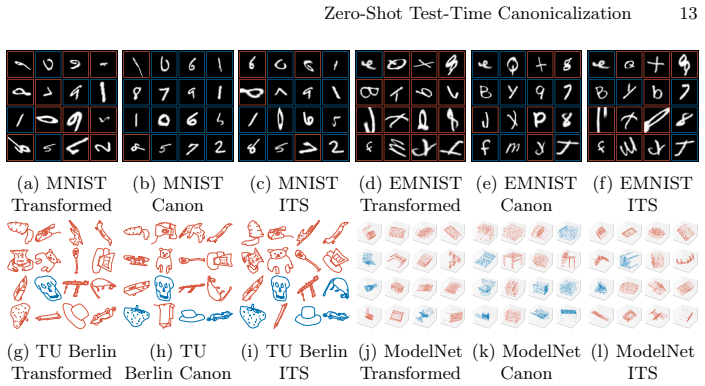
Pretrained vision models often misclassify inputs that are rotated, scaled, or sheared, even though these affine transformations leave the object class unchanged. Robustness is usually restored either by building equivariance into the architecture or by retraining with augmentation, both of which require changing or retraining the model. Test-time canonicalization instead leaves the classifier untouched. It undoes the transformation of each input, mapping it to a canonical form near the training distribution before classification. Existing canonicalizers, however, rely on a narrow set of logit-based energy scores and bespoke search procedures, leaving the design space of scoring functions and optimizers unexplored. We reframe canonicalization as out-of-distribution (OOD) detection, which lets any OOD score serve as the energy minimized over transformations. Across benchmarks ranging from handwritten characters and sketches to natural images and 3D point clouds, we systematically evaluate around twenty OOD scores and nine search algorithms, finding that distance-based scores paired with random search and local refinement perform best overall. Because canonicalizing an already-aligned input can hurt accuracy, we add a gated mechanism that transforms an input only when its OOD score indicates this is needed, preserving most in-distribution accuracy while retaining the robustness gains on transformed inputs. Code is available at github.com/johschm/its.
Figures


Figures from the paper (12 more)



Reference graph
Works this paper leans on
-
[1]
In: International Conference on Knowl- edge Discovery & Data Mining (ACM SIGKDD) (2019)
Akiba, T., Sano, S., Yanase, T., Ohta, T., Koyama, M.: Optuna: A next-generation hyperparameter optimization framework. In: International Conference on Knowl- edge Discovery & Data Mining (ACM SIGKDD) (2019)
2019
-
[2]
In: International Conference on Machine Learning (ICML) (2017)
Amos, B., Xu, L., Kolter, J.Z.: Input convex neural networks. In: International Conference on Machine Learning (ICML) (2017)
2017
-
[3]
In: IEEE/CVF Con- ference on Computer Vision and Pattern Recognition (CVPR) (2016)
Bendale, A., Boult, T.E.: Towards Open Set Deep Networks. In: IEEE/CVF Con- ference on Computer Vision and Pattern Recognition (CVPR) (2016)
2016
-
[4]
Geometric Deep Learning: Grids, Groups, Graphs, Geodesics, and Gauges
Bronstein, M.M., Bruna, J., Cohen, T., Veličković, P.: Geometric Deep Learning: Grids, Groups, Graphs, Geodesics, and Gauges. 2104.13478, arXiv (2021)
work page Pith review arXiv 2021
-
[5]
In: Conference on Neural Information Processing Systems (NeurIPS) (2022)
Chefer, H., Schwartz, I., Wolf, L.: Optimizing relevance maps of vision transformers improves robustness. In: Conference on Neural Information Processing Systems (NeurIPS) (2022)
2022
-
[6]
In: International Joint Conference on Neural Networks (IJCNN) (2017)
Cohen, G., Afshar, S., Tapson, J., André van Schaik: EMNIST: Extending MNIST to handwritten letters. In: International Joint Conference on Neural Networks (IJCNN) (2017)
2017
-
[7]
In: Interna- tional Conference on Machine Learning (ICML) (2016)
Cohen, T., Welling, M.: Group equivariant convolutional networks. In: Interna- tional Conference on Machine Learning (ICML) (2016)
2016
-
[8]
In: International Conference on Learn- ing Representations (ICLR) (2017)
Cohen, T.S., Welling, M.: Steerable CNNs. In: International Conference on Learn- ing Representations (ICLR) (2017)
2017
Show all 66 references
-
[9]
In: Conference on Neural Information Processing Systems (NeurIPS) (2021)
Daxberger, E., Kristiadi, A., Immer, A., Eschenhagen, R., Bauer, M., Hennig, P.: Laplace Redux - Effortless Bayesian Deep Learning. In: Conference on Neural Information Processing Systems (NeurIPS) (2021)
2021
-
[10]
In: International Conference on Computer Vision (ICCV) (2021)
Deng, C., Litany, O., Duan, Y., Poulenard, A., Tagliasacchi, A., Guibas, L.J.: Vec- tor neurons: A general framework for so(3)-equivariant networks. In: International Conference on Computer Vision (ICCV) (2021)
2021
-
[11]
In: IEEE/CVF Conference on Computer Vision and Pattern Recognition (CVPR) (2009) 16 D
Deng, J., Dong, W., Socher, R., Li, L.J., Li, K., Fei-Fei, L.: Imagenet: A large-scale hierarchical image database. In: IEEE/CVF Conference on Computer Vision and Pattern Recognition (CVPR) (2009) 16 D. Lindner et al
2009
-
[12]
In: International Conference on Learning Representations (ICLR) (2023)
Djurisic, A., Bozanic, N., Ashok, A., Liu, R.: Extremely Simple Activation Shap- ing for Out-of-Distribution Detection. In: International Conference on Learning Representations (ICLR) (2023)
2023
-
[13]
International Conference on Learning Representations (ICLR) (2021)
Dosovitskiy, A., Beyer, L., Kolesnikov, A., Weissenborn, D., Zhai, X., Unterthiner, T., Dehghani, M., Minderer, M., Heigold, G., Gelly, S., Uszkoreit, J., Houlsby, N.: An image is worth 16x16 words: Transformers for image recognition at scale. International Conference on Learn...
2021
-
[14]
IEEE Transactions on Big Data (2025)
Douze, M., Guzhva, A., Deng, C., Johnson, J., Szilvasy, G., Mazaré, P.E., Lomeli, M., Hosseini, L., Jégou, H.: The faiss library. IEEE Transactions on Big Data (2025)
2025
-
[15]
In: International Conference on Machine Learning (ICML) (2024)
Dym, N., Lawrence, H., Siegel, J.W.: Equivariant frames and the impossibility of continuous canonicalization. In: International Conference on Machine Learning (ICML) (2024)
2024
-
[16]
Eitz, M., Hays, J., Alexa, M.: How do humans sketch objects? ACM Transactions on Graphics (2012)
2012
-
[17]
In: International Conference on Machine Learning (ICML) (2019)
Engstrom, L., Tran, B., Tsipras, D., Schmidt, L., Madry, A.: Exploring the land- scape of spatial robustness. In: International Conference on Machine Learning (ICML) (2019)
2019
-
[18]
In: ICLR Workshop on Representation Learning on Graphs and Manifolds (2019)
Fey,M.,Lenssen,J.E.:FastgraphrepresentationlearningwithPyTorchGeometric. In: ICLR Workshop on Representation Learning on Graphs and Manifolds (2019)
2019
-
[19]
Gal, Y., Ghahramani, Z.: Dropout as a bayesian approximation: Representing modeluncertaintyindeeplearning.In:InternationalConferenceonMachineLearn- ing (ICML) (2016)
2016
-
[20]
Springer International Publishing (2015)
Hall, B.C.: Lie Groups, Lie Algebras, and Representations: An Elementary Intro- duction. Springer International Publishing (2015)
2015
-
[21]
In: IEEE/CVF Conference on Computer Vision and Pattern Recognition (CVPR) (2016)
He, K., Zhang, X., Ren, S., Sun, J.: Deep Residual Learning for Image Recognition. In: IEEE/CVF Conference on Computer Vision and Pattern Recognition (CVPR) (2016)
2016
-
[22]
In: International Conference on Machine Learning (ICML) (2022)
Hendrycks, D., Basart, S., Mazeika, M., Zou, A., Kwon, J., Mostajabi, M., Stein- hardt, J., Song, D.: Scaling Out-of-Distribution Detection for Real-World Settings. In: International Conference on Machine Learning (ICML) (2022)
2022
-
[23]
In: International Conference on Learn- ing Representations (ICLR) (2017)
Hendrycks, D., Gimpel, K.: A Baseline for Detecting Misclassified and Out-of- Distribution Examples in Neural Networks. In: International Conference on Learn- ing Representations (ICLR) (2017)
2017
-
[24]
Neural Computation (1997)
Hochreiter, S., Schmidhuber, J.: Long Short-Term Memory. Neural Computation (1997)
1997
-
[25]
ArXiv (2021)
Huang, T., Sankar, C., Amini, P., Kottur, S., Geramifard, A., Razaviyayn, M., Beirami, A.: Dair: Data augmented invariant regularization. ArXiv (2021)
2021
-
[26]
In: International Conference on Neural Information Processing Systems (NeurIPS) (2015)
Jaderberg, M., Simonyan, K., Zisserman, A., Kavukcuoglu, K.: Spatial transformer networks. In: International Conference on Neural Information Processing Systems (NeurIPS) (2015)
2015
-
[27]
Jang, H., Zaidi, S.S.A., Boix, X., Prasad, N., Gilad-Gutnick, S., Ben-Ami, S., Sinha, P.: Robustness to transformations across categories: Is robustness driven by invariant neural representations? Neural Computation (2023)
2023
-
[28]
In: Conference on Neural Information Processing Systems (NeurIPS) (2018)
Jiang, H., Kim, B., Guan, M., Gupta, M.: To trust or not to trust a classifier. In: Conference on Neural Information Processing Systems (NeurIPS) (2018)
2018
-
[29]
In: International Conference on Machine Learning (ICML) (2023)
Kaba, S.O., Mondal, A.K., Zhang, Y., Bengio, Y., Ravanbakhsh, S.: Equivariance with learned canonicalization functions. In: International Conference on Machine Learning (ICML) (2023)
2023
-
[30]
ArXiv (2026) Zero-Shot Test-Time Canonicalization 17
Kim, J., Kaba, S.O., Park, J., Hong, S., Ravanbakhsh, S.: Inverting Data Trans- formations via Diffusion Sampling. ArXiv (2026) Zero-Shot Test-Time Canonicalization 17
2026
-
[31]
In: Interna- tional Conference on Learning Representations (ICLR) (2015)
Kingma, D.P., Ba, J.: Adam: A method for stochastic optimization. In: Interna- tional Conference on Learning Representations (ICLR) (2015)
2015
-
[32]
Science (1983)
Kirkpatrick, S., Gelatt, C.D., Vecchi, M.P.: Optimization by Simulated Annealing. Science (1983)
1983
-
[33]
In: International Conference on Machine Learning (ICML) (2020)
Kristiadi, A., Hein, M., Hennig, P.: Being bayesian, even just a bit, fixes over- confidence in ReLU networks. In: International Conference on Machine Learning (ICML) (2020)
2020
-
[34]
In: NeurIPS Datasets and Bench- marks Track (2025)
Lafage, A., Laurent, O., Gabetni, F., Franchi, G.: Torch-uncertainty: A deep learn- ing framework for uncertainty quantification. In: NeurIPS Datasets and Bench- marks Track (2025)
2025
-
[35]
In: IEEE/CVF Conference on Computer Vision and Pattern Recognition (CVPR) (2016)
Laptev, D., Savinov, N., Buhmann, J.M., Pollefeys, M.: Ti-pooling: Transformation-invariant pooling for feature learning in convolutional neu- ral networks. In: IEEE/CVF Conference on Computer Vision and Pattern Recognition (CVPR) (2016)
2016
-
[36]
In: Conference on Neural Information Processing Systems (NeurIPS) (2018)
Lee, K., Lee, K., Lee, H., Shin, J.: A Simple Unified Framework for Detecting Out-of-Distribution Samples and Adversarial Attacks. In: Conference on Neural Information Processing Systems (NeurIPS) (2018)
2018
-
[37]
In: Conference on Neural Information Processing Systems (NeurIPS) (2020)
Liu, W., Wang, X., Owens, J., Li, Y.: Energy-based out-of-distribution detection. In: Conference on Neural Information Processing Systems (NeurIPS) (2020)
2020
-
[38]
In: IEEE/CVF Conference on Computer Vision and Pattern Recognition (CVPR) (2023)
Liu, X., Lochman, Y., Zach, C.: GEN: Pushing the Limits of Softmax-Based Out- of-Distribution Detection. In: IEEE/CVF Conference on Computer Vision and Pattern Recognition (CVPR) (2023)
2023
-
[39]
In: Conference on Neural Information Processing Systems (NeurIPS) (2024)
Ma, G., Wang, Y., Lim, D., Jegelka, S., Wang, Y.: A Canonicalization Perspec- tive on Invariant and Equivariant Learning. In: Conference on Neural Information Processing Systems (NeurIPS) (2024)
2024
-
[40]
Neural Computation (1992)
MacKay, D.J.C.: Bayesian Interpolation. Neural Computation (1992)
1992
-
[41]
In: Conference on Neural Information Processing Systems (NeurIPS) (2023)
Mondal, A.K., Panigrahi, S.S., Kaba, S.O., Rajeswar, S., Ravanbakhsh, S.: Equiv- ariant adaptation of large pretrained models. In: Conference on Neural Information Processing Systems (NeurIPS) (2023)
2023
-
[42]
In: CVPR 2024 Workshop on Equivariant Vision: From Theory to Practice (2024)
Panigrahi, S.S., Mondal, A.K.: Improved canonicalization for model agnostic equiv- ariance. In: CVPR 2024 Workshop on Equivariant Vision: From Theory to Practice (2024)
2024
-
[43]
In: International Conference on Learning Representations (ICLR) (2022)
Puny, O., Atzmon, M., Smith, E.J., Misra, I., Grover, A., Ben-Hamu, H., Lipman, Y.: Frame averaging for invariant and equivariant network design. In: International Conference on Learning Representations (ICLR) (2022)
2022
-
[44]
Qi, C.R., Yi, L., Su, H., Guibas, L.J.: PointNet++: Deep hierarchical feature learn- ingonpointsetsinametricspace.In:ConferenceonNeuralInformationProcessing Systems (NeurIPS) (2017)
2017
-
[45]
ArXiv (2021)
Ren, J., Fort, S., Liu, J., Roy, A.G., Padhy, S., Lakshminarayanan, B.: A Simple Fix to Mahalanobis Distance for Improving Near-OOD Detection. ArXiv (2021)
2021
-
[46]
McGraw-Hill (1976)
Rudin, W.: Principles of Mathematical Analysis. McGraw-Hill (1976)
1976
-
[47]
Hawaii International Conference on System Sciences (HICSS) (2024)
Schmidt, J., Köhler, B., Borstell, H.: Reviving simulated annealing lifting its de- generacies for real-time job scheduling. Hawaii International Conference on System Sciences (HICSS) (2024)
2024
-
[48]
ArXiv (2026)
Schmidt, J., Siegl, T., Becker, M., Stober, S.: Geometrically constrained and token- based probabilistic spatial transformers. ArXiv (2026)
2026
-
[49]
In: International Conference on Machine Learning (ICML) (2024)
Schmidt, J., Stober, S.: Tilt your Head: Activating the Hidden Spatial-Invariance of Classifiers. In: International Conference on Machine Learning (ICML) (2024)
2024
-
[50]
EurIPS: UPLB Workshop (2025) 18 D
Schmidt, J., Stober, S.: Robust canonicalization through bootstrapped data re- alignment. EurIPS: UPLB Workshop (2025) 18 D. Lindner et al
2025
-
[51]
ArXiv (2025)
Schmidt, J., Stober, S., Denzler, J., Bodesheim, P.: Saccadic vision for fine-grained visual classification. ArXiv (2025)
2025
-
[52]
In: International Conference on Learning Representations (ICLR) (2025)
Shumaylov, Z., Zaika, P., Rowbottom, J., Sherry, F., Weber, M., Schönlieb, C.B.: Lie algebra canonicalization: Equivariant neural operators under arbitrary lie groups. In: International Conference on Learning Representations (ICLR) (2025)
2025
-
[53]
In: International Conference on Machine Learning (ICML) (2025)
Singhal, U., Feng, R., Yu, S.X., Prakash, A.: Test-Time Canonicalization by Foun- dation Models for Robust Perception. In: International Conference on Machine Learning (ICML) (2025)
2025
-
[54]
USSR Computational Mathematics and Mathematical Physics (1967)
Sobol’, I.: On the distribution of points in a cube and the approximate evaluation of integrals. USSR Computational Mathematics and Mathematical Physics (1967)
1967
-
[55]
John Wiley & Sons, Inc
Spall, J.C.: Introduction to Stochastic Search and Optimization. John Wiley & Sons, Inc. (2003)
2003
-
[56]
In: Conference on Neural Information Processing Systems (NeurIPS) (2021)
Sun, Y., Guo, C., Li, Y.: ReAct: Out-of-distribution detection with rectified activa- tions. In: Conference on Neural Information Processing Systems (NeurIPS) (2021)
2021
-
[57]
In: European Conference on Computer Vision (ECCV) (2022)
Sun, Y., Li, Y.: DICE: Leveraging sparsification for out-of-distribution detection. In: European Conference on Computer Vision (ECCV) (2022)
2022
-
[58]
In: International Conference on Machine Learning (ICML) (2022)
Sun, Y., Ming, Y., Zhu, X., Li, Y.: Out-of-distribution detection with deep nearest neighbors. In: International Conference on Machine Learning (ICML) (2022)
2022
-
[59]
In: International Conference on Learning Representations (ICLR) (2025)
Tahmasebi, B., Jegelka, S.: Generalization bounds for canonicalization: A com- parative study with group averaging. In: International Conference on Learning Representations (ICLR) (2025)
2025
-
[60]
In: IEEE/CVF Conference on Computer Vision and Pattern Recogni- tion (CVPR) (2022)
Wang, H., Li, Z., Feng, L., Zhang, W.: ViM: Out-Of-Distribution with Virtual-logit Matching. In: IEEE/CVF Conference on Computer Vision and Pattern Recogni- tion (CVPR) (2022)
2022
-
[61]
In: Conference on Neural Information Processing Systems (NeurIPS) (2022)
Yang, J., Wang, P., Zou, D., Zhou, Z., Ding, K., PENG, WENXUAN., Wang, H., Chen, G., Li, B., Sun, Y., Du, X., Zhou, K., Zhang, W., Hendrycks, D., Li, Y., Liu, Z.: OpenOOD: Benchmarking generalized out-of-distribution detection. In: Conference on Neural Information Processing S...
2022
-
[62]
In: ICML Shift Happens Workshop (2022)
Yung, J., Romijnders, R., Kolesnikov, A., Beyer, L., Djolonga, J., Houlsby, N., Gelly,S.,Lucic,M.,Zhai,X.:SI-Score:Animagedatasetforfine-grainedanalysisof robustness to object location, rotation and size. In: ICML Shift Happens Workshop (2022)
2022
-
[63]
In: International Conference on Learning Represen- tations (ICLR) (2023)
Zhang, J., Fu, Q., Chen, X., Du, L., Li, Z., Wang, G., Liu, x., Han, S., Zhang, D.: Out-of-distribution detection based on in-distribution data patterns memorization with modern hopfield energy. In: International Conference on Learning Represen- tations (ICLR) (2023)
2023
-
[64]
In: IEEE/CVF Conference on Computer Vision and Pattern Recognition (CVPR) (2015)
Zhirong Wu, Song, S., Khosla, A., Fisher Yu, Linguang Zhang, Xiaoou Tang, Xiao, J.: 3D ShapeNets: A deep representation for volumetric shapes. In: IEEE/CVF Conference on Computer Vision and Pattern Recognition (CVPR) (2015)
2015
-
[65]
Zhou, Y., Barnes, C., Lu, J., Yang, J., Li, H.: On the Continuity of Rotation Representations in Neural Networks. ArXiv (2020) Zero-Shot Test-Time Canonicalization 19 A Preliminaries Extended A.1 Group Theory and Affine Transformations The affine transformations we consider ar...
2020
-
[66]
We use a variant that samples around the neighborhood of a point per iteration
but not tested. We use a variant that samples around the neighborhood of a point per iteration. Better values are always accepted, while worse values are accepted depending on the temperature, which is lowered over time. It can handle connected components by moving between the...
Reviewed June 26, 2026 · model on record in the stance chip above.
Discussion (0). Continue with ORCID to comment.