Late-Time Oscillating Quintessence in Light of DESI
Pith reviewed 2026-06-25 23:34 UTC · model grok-4.3
The pith
A quintessence field frozen until z≈0.1 and then oscillating fits recent DESI data better than a cosmological constant.
A machine-rendered reading of the paper's core claim, the machinery that carries it, and where it could break.
Core claim
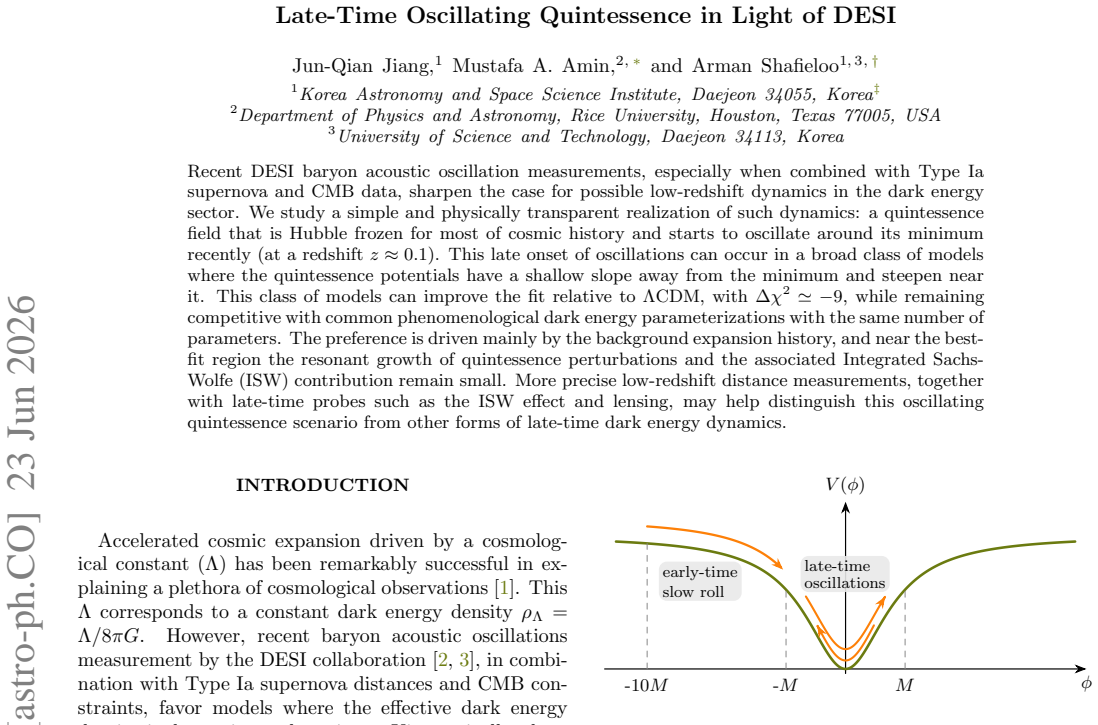
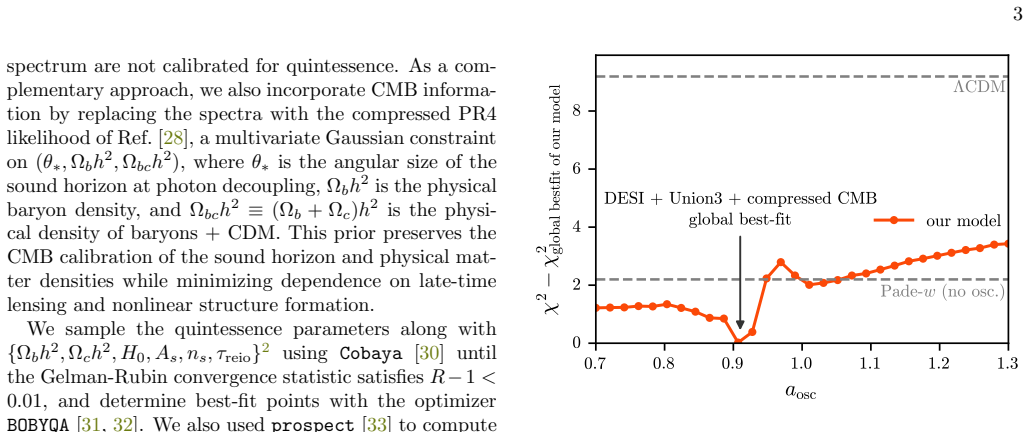
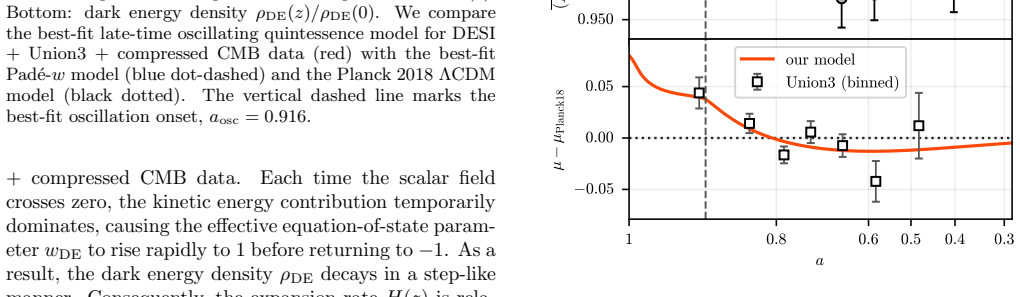
The central claim is that a broad class of quintessence potentials with shallow slopes away from the minimum and steepening near it allows the field to stay frozen until z≈0.1 before oscillations begin. This late-time dynamics improves the fit to the combined DESI, supernova, and CMB dataset relative to Lambda-CDM by Δχ²≃−9 and remains competitive with common phenomenological dark energy models of equal parameter count, with the preference arising primarily from the background expansion history.
What carries the argument
The central mechanism is a quintessence potential that has a shallow slope distant from the minimum and steepens near it, keeping the field Hubble-frozen until recent times before oscillations start.
If this is right
- The model improves the fit by Δχ²≃−9 relative to Lambda-CDM.
- It remains competitive with common phenomenological dark energy parameterizations using the same number of parameters.
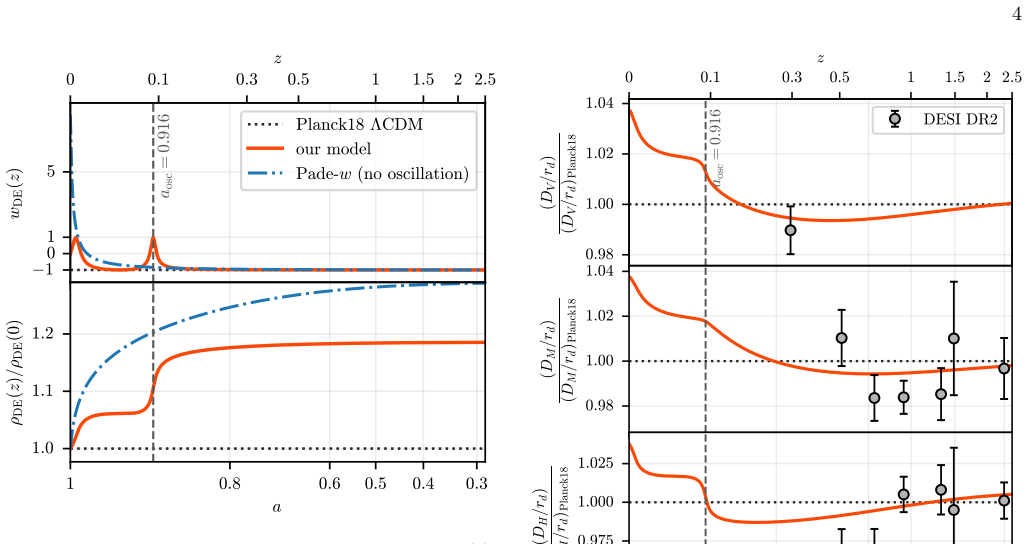
- The statistical preference is driven mainly by the background expansion history.
- Near the best-fit region the resonant growth of quintessence perturbations and the associated ISW contribution remain small.
Where Pith is reading between the lines
- More precise low-redshift distance measurements can further constrain or rule out the specific redshift of oscillation onset.
- Combined late-time observables such as weak lensing and the ISW effect can separate this oscillating scenario from other forms of late-time dark energy dynamics.
- The same potential shape that delays oscillations may appear in other scalar-field models outside quintessence.
Load-bearing premise
The quintessence potentials have a shallow slope away from the minimum and steepen near it.
What would settle it
A future dataset showing that the chi-squared for this model no longer improves over Lambda-CDM, or that detects an integrated Sachs-Wolfe signal larger than the small value predicted near the best-fit point.
Figures
read the original abstract
Recent DESI baryon acoustic oscillation measurements, especially when combined with Type Ia supernova and CMB data, sharpen the case for possible low-redshift dynamics in the dark energy sector. We study a simple and physically transparent realization of such dynamics: a quintessence field that is Hubble frozen for most of cosmic history and starts to oscillate around its minimum recently (at a redshift $z\approx 0.1$). This late onset of oscillations can occur in a broad class of models where the quintessence potentials have a shallow slope away from the minimum and steepen near it. This class of models can improve the fit relative to $\Lambda$CDM, with $\Delta\chi^2\simeq -9$, while remaining competitive with common phenomenological dark energy parameterizations with the same number of parameters. The preference is driven mainly by the background expansion history, and near the best-fit region the resonant growth of quintessence perturbations and the associated Integrated Sachs-Wolfe (ISW) contribution remain small. More precise low-redshift distance measurements, together with late-time probes such as the ISW effect and lensing, may help distinguish this oscillating quintessence scenario from other forms of late-time dark energy dynamics.
Editorial analysis
A structured set of objections, weighed in public.
Referee Report
Summary. The paper studies a broad class of quintessence potentials with shallow outer slopes that steepen near the minimum, allowing the scalar field to remain Hubble-frozen until z≈0.1 before oscillating. It reports that this late-onset oscillation improves the fit to DESI BAO + SN + CMB data by Δχ² ≃ −9 relative to ΛCDM while remaining competitive with two-parameter phenomenological dark-energy models; the improvement is stated to be driven by the background expansion history, with resonant perturbation growth and ISW effects remaining small near the best-fit region.
Significance. If the numerical results and potential-class assumptions hold, the work supplies a physically transparent dynamical dark-energy scenario that could explain low-redshift hints from DESI without large perturbation signatures. The emphasis on background-driven preference and the claim of competitiveness with equal-parameter models are useful for model comparison; however, the result's weight depends on explicit validation of the fit procedure and the absence of earlier dynamical effects.
major comments (3)
- [Abstract and results section] Abstract and results section: The headline Δχ² ≃ −9 improvement is reported without tabulated best-fit values, 1σ uncertainties, explicit priors on z_osc and the potential-shape parameters, or a statement of whether z_osc was varied freely versus fixed post-hoc. This information is required to assess whether the quoted improvement is reproducible and independent of data-driven tuning.
- [Section describing the potential class (near Eq. for V(φ))] Section describing the potential class (near Eq. for V(φ)): The requirement that the potential remain shallow far from the minimum yet steepen sufficiently to enforce oscillation onset only at z≈0.1 is stated qualitatively. No explicit functional example or numerical integration is shown confirming that the best-fit parameters produce no rolling or oscillations at z>1 that would alter H(z) or source observable perturbations at earlier times.
- [Comparison paragraph with phenomenological models] Comparison paragraph with phenomenological models: The statement that the model is competitive with other two-parameter dark-energy parameterizations assumes that the two free parameters (z_osc plus one shape parameter) are on equal footing; the manuscript does not demonstrate that realizing the required slope transition does not implicitly demand additional tuning parameters that would change the effective degrees of freedom.
minor comments (2)
- [Figure captions] Figure captions should explicitly state the data combination (DESI+SN+CMB) and the reference model (ΛCDM) used for the Δχ² values shown.
- [Main text first use of z_osc] Notation for the oscillation-onset redshift is introduced as z_osc in the abstract but should be defined at first use in the main text with a clear equation relating it to the potential parameters.
Simulated Author's Rebuttal
We thank the referee for the thoughtful and constructive report. The comments highlight important points on reproducibility, explicit validation of the model dynamics, and parameter counting. We address each major comment below and will revise the manuscript to incorporate the requested clarifications and examples.
read point-by-point responses
-
Referee: [Abstract and results section] Abstract and results section: The headline Δχ² ≃ −9 improvement is reported without tabulated best-fit values, 1σ uncertainties, explicit priors on z_osc and the potential-shape parameters, or a statement of whether z_osc was varied freely versus fixed post-hoc. This information is required to assess whether the quoted improvement is reproducible and independent of data-driven tuning.
Authors: We agree that the current presentation lacks sufficient detail for full reproducibility. In the revised manuscript we will add a dedicated table in the results section listing the best-fit values and 1σ uncertainties for z_osc, the shape parameter, and all other cosmological parameters. We will also state the priors adopted on these parameters and confirm that z_osc was varied freely within the MCMC analysis rather than fixed after the fact. These additions will allow readers to verify that the reported Δχ² improvement is not the result of post-hoc tuning. revision: yes
-
Referee: [Section describing the potential class (near Eq. for V(φ))] Section describing the potential class (near Eq. for V(φ)): The requirement that the potential remain shallow far from the minimum yet steepen sufficiently to enforce oscillation onset only at z≈0.1 is stated qualitatively. No explicit functional example or numerical integration is shown confirming that the best-fit parameters produce no rolling or oscillations at z>1 that would alter H(z) or source observable perturbations at earlier times.
Authors: We acknowledge that an explicit functional form and supporting numerical checks would strengthen the claim. We will introduce a concrete example potential (a smoothed transition between a shallow outer slope and a steeper inner region) together with plots of the background evolution and perturbation equations integrated from z=10 to z=0. These will demonstrate that, at the best-fit parameters, the field remains Hubble-frozen with negligible rolling or oscillation until z≈0.1, producing no measurable change in H(z) or perturbation sources at earlier times. revision: yes
-
Referee: [Comparison paragraph with phenomenological models] Comparison paragraph with phenomenological models: The statement that the model is competitive with other two-parameter dark-energy parameterizations assumes that the two free parameters (z_osc plus one shape parameter) are on equal footing; the manuscript does not demonstrate that realizing the required slope transition does not implicitly demand additional tuning parameters that would change the effective degrees of freedom.
Authors: The model is constructed with exactly two free parameters (z_osc and one shape parameter controlling the transition steepness); the functional class itself is fixed and does not introduce further tunable coefficients. We will expand the comparison paragraph to explicitly state that no additional parameters are required to realize the desired late-onset behavior and will note that the effective degrees of freedom therefore match those of the phenomenological models used for comparison. If the referee considers the choice of functional class to constitute an implicit prior, we are prepared to discuss this in the text. revision: partial
Circularity Check
No circularity: reported fit improvement is standard parameter optimization against external data
full rationale
The paper defines a class of quintessence potentials with shallow outer slope and inner steepening (an explicit modeling assumption), then optimizes the two free parameters against the DESI+SN+CMB dataset and reports the resulting Δχ² ≃ −9 relative to ΛCDM. This is ordinary model comparison; the improvement is not presented as an independent prediction or first-principles derivation. No equation reduces to its own input by construction, no self-citation is load-bearing for the central claim, and the potential shape is not smuggled via prior work. The derivation chain is self-contained against the supplied external benchmarks.
Axiom & Free-Parameter Ledger
free parameters (2)
- oscillation onset redshift z_osc
- potential shape parameters controlling slope and steepening
axioms (2)
- standard math Standard FLRW background cosmology and linear perturbation theory remain valid for the quintessence field.
- domain assumption The quintessence field is Hubble-frozen until z≈0.1 and then oscillates without earlier dynamical impact.
Reference graph
Works this paper leans on
-
[1]
Overall, we need the high energy theory to providemandMsuch thatV=m 2M2/2∼ m2 plH2 0, withm≫H 0, while the initial misalignment must satisfyϕ ini/M∼ p m/H0
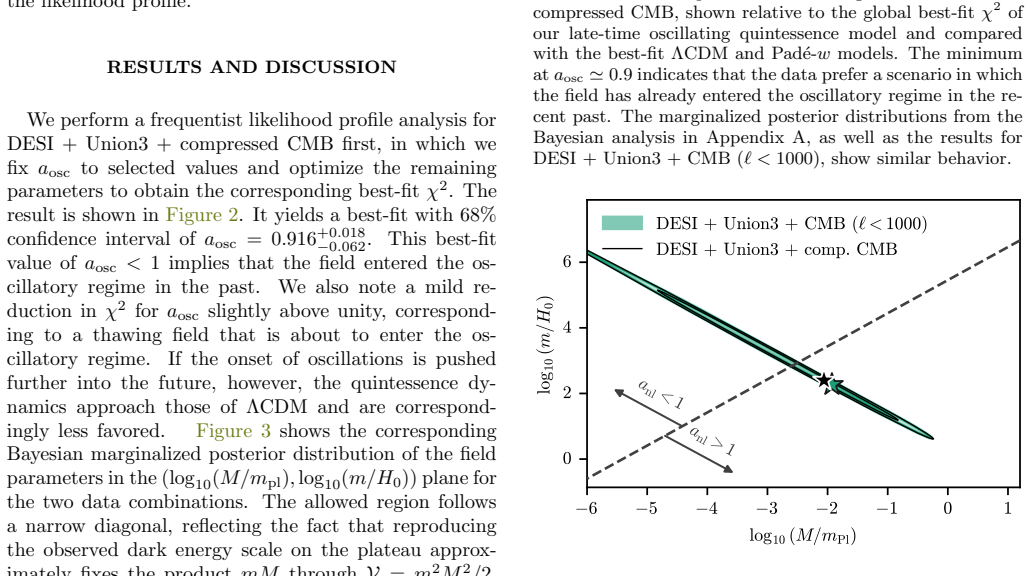
For the field to start entering the minimum region (ϕ/M∼1) close to today, we would need the initial displacement of the field ϕini/M∼ p mpl/M. Overall, we need the high energy theory to providemandMsuch thatV=m 2M2/2∼ m2 plH2 0, withm≫H 0, while the initial misalignment must satisfyϕ ini/M∼ p m/H0. We create a collection of model-realizations by spec- if...
2087
-
[2]
on the quintessence poten- tial plateau (V) approximately fixes the productm 2M2/2 = V ∼m 2 plH2
-
[3]
the boundary shown in the figure, where the field has not yet entered the nonlinear regime by today
Herea nl indicates the scalefactor where quintes- sance perturbations become nonlinear. the boundary shown in the figure, where the field has not yet entered the nonlinear regime by today. Nevertheless, regions witha nl <1 are still allowed. Figure 4 shows the late-time evolution of the back- ground quantities at the best-fit point for DESI + Union3 4 −1 ...
2018
-
[4]
N. Aghanim et al. (Planck), Planck 2018 results. VI. Cosmological parameters, Astron. Astrophys.641, A6 (2020), [Erratum: Astron.Astrophys. 652, C4 (2021)], arXiv:1807.06209 [astro-ph.CO]
Pith/arXiv arXiv 2018
-
[5]
A. G. Adame et al. (DESI), DESI 2024 VI: Cosmological Constraints from the Measurements of Baryon Acous- tic Oscillations, JCAP02, 021, arXiv:2404.03002 [astro- ph.CO]
Pith/arXiv arXiv 2024
-
[6]
M. Abdul Karim et al. (DESI), DESI DR2 results. II. Measurements of baryon acoustic oscillations and cos- mological constraints, Phys. Rev. D112, 083515 (2025), arXiv:2503.14738 [astro-ph.CO]
Pith/arXiv arXiv 2025
-
[7]
K. Lodha et al. (DESI), Extended dark energy analysis using DESI DR2 BAO measurements, Phys. Rev. D112, 083511 (2025), arXiv:2503.14743 [astro-ph.CO]
Pith/arXiv arXiv 2025
- [8]
-
[9]
Efstathiou, Evolving dark energy or supernovae sys- tematics?, Mon
G. Efstathiou, Evolving dark energy or supernovae sys- tematics?, Mon. Not. Roy. Astron. Soc.538, 875 (2025), arXiv:2408.07175 [astro-ph.CO]
arXiv 2025
-
[10]
Ratra and P
B. Ratra and P. J. E. Peebles, Cosmological consequences of a rolling homogeneous scalar field, Phys. Rev. D37, 3406 (1988)
1988
-
[11]
I. Zlatev, L. Wang, and P. J. Steinhardt, Quintessence, Cosmic Coincidence, and the Cosmological Constant, Phys. Rev. Lett.82, 896 (1999), arXiv:astro-ph/9807002
Pith/arXiv arXiv 1999
-
[12]
E. J. Copeland, M. Sami, and S. Tsujikawa, Dynamics of dark energy, Int. J. Mod. Phys. D15, 1753 (2006), arXiv:hep-th/0603057
Pith/arXiv arXiv 2006
-
[13]
R. R. Caldwell and E. V. Linder, The Limits of quintessence, Phys. Rev. Lett.95, 141301 (2005), arXiv:astro-ph/0505494
Pith/arXiv arXiv 2005
-
[14]
R. E. Keeley, A. Shafieloo, and W. L. Matthewson, Could We Be Fooled about Phantom Crossing?, (2025), arXiv:2506.15091 [astro-ph.CO]
arXiv 2025
-
[15]
S. S. Mishra, Effective Phantom Dark Energy: What Cosmological Reconstruction Does and Does Not Imply, (2026), arXiv:2605.27301 [astro-ph.CO]
Pith/arXiv arXiv 2026
-
[16]
M. A. Amin, P. Zukin, and E. Bertschinger, Scale- Dependent Growth from a Transition in Dark Energy Dy- namics, Phys. Rev. D85, 103510 (2012), arXiv:1108.1793 [astro-ph.CO]
Pith/arXiv arXiv 2012
-
[17]
M. C. Johnson and M. Kamionkowski, Dynamical and Gravitational Instability of Oscillating-Field Dark En- ergy and Dark Matter, Phys. Rev. D78, 063010 (2008), arXiv:0805.1748 [astro-ph]
Pith/arXiv arXiv 2008
-
[18]
M. A. Amin, R. Easther, H. Finkel, R. Flauger, and M. P. Hertzberg, Oscillons After Inflation, Phys. Rev. Lett.108, 241302 (2012), arXiv:1106.3335 [astro-ph.CO]
Pith/arXiv arXiv 2012
-
[19]
K. D. Lozanov and M. A. Amin, Self-resonance after in- flation: oscillons, transients and radiation domination, Phys. Rev. D97, 023533 (2018), arXiv:1710.06851 [astro- ph.CO]
Pith/arXiv arXiv 2018
-
[20]
V. Poulin, T. L. Smith, T. Karwal, and M. Kamionkowski, Early Dark Energy Can Resolve The Hubble Tension, Phys. Rev. Lett.122, 221301 (2019), arXiv:1811.04083 [astro-ph.CO]
Pith/arXiv arXiv 2019
-
[21]
T. L. Smith, V. Poulin, and M. A. Amin, Oscillat- ing scalar fields and the Hubble tension: a resolution with novel signatures, Phys. Rev. D101, 063523 (2020), arXiv:1908.06995 [astro-ph.CO]
arXiv 2020
-
[22]
S. Dodelson, M. Kaplinghat, and E. Stewart, Solving the Coincidence Problem : Tracking Oscillating En- ergy, Phys. Rev. Lett.85, 5276 (2000), arXiv:astro- ph/0002360
arXiv 2000
-
[23]
R. Kallosh, A. Linde, and D. Roest, Superconfor- mal Inflationaryα-Attractors, JHEP11(11), 198, arXiv:1311.0472 [hep-th]
-
[24]
E. Silverstein and A. Westphal, Monodromy in the CMB: Gravity Waves and String Inflation, Phys. Rev. D78, 106003 (2008), arXiv:0803.3085 [hep-th]
Pith/arXiv arXiv 2008
-
[25]
D. Andriot, Dark energy from string theory: an intro- ductory review, arXiv e-prints (2026), arXiv:2603.25797 [hep-th]
Pith/arXiv arXiv 2026
-
[26]
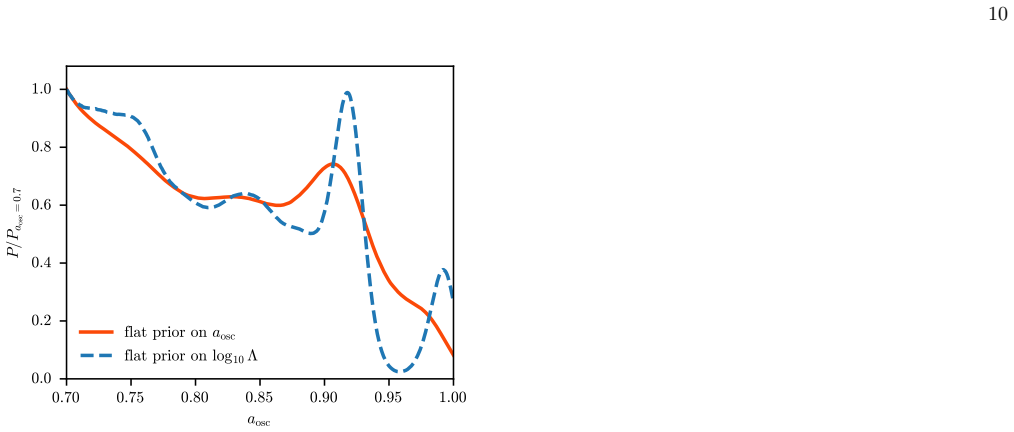
In Appendix B, we also present the results with a flat prior on the field parameters (log10(V/H 2 0 m2 pl),log 10(M/mPl))
-
[27]
D. Blas, J. Lesgourgues, and T. Tram, The Cosmic Linear Anisotropy Solving System (CLASS) II: Approximation schemes, JCAP07, 034, arXiv:1104.2933 [astro-ph.CO]
-
[28]
D. Rubin et al., Union Through UNITY: Cosmology with 2,000 SNe Using a Unified Bayesian Framework, Astrophys. J.986, 231 (2025), arXiv:2311.12098 [astro- ph.CO]
Pith/arXiv arXiv 2025
-
[29]
E. Rosenberg, S. Gratton, and G. Efstathiou, CMB power spectra and cosmological parameters from Planck PR4 with CamSpec, Mon. Not. Roy. Astron. Soc.517, 4620 (2022), arXiv:2205.10869 [astro-ph.CO]
Pith/arXiv arXiv 2022
-
[30]
N. Aghanim et al. (Planck), Planck 2018 results. V. CMB power spectra and likelihoods, Astron. Astrophys.641, A5 (2020), arXiv:1907.12875 [astro-ph.CO]
Pith/arXiv arXiv 2018
-
[31]
P. Lemos and A. Lewis, CMB constraints on the early Universe independent of late-time cosmology, Phys. Rev. D107, 103505 (2023), arXiv:2302.12911 [astro-ph.CO]
arXiv 2023
-
[32]
For the compressed CMB analysis,A s, ns, τreio are not sampled because the compressed likelihood only con- strains the geometric and physical density parameters
-
[33]
J. Torrado and A. Lewis, Cobaya: Code for Bayesian Analysis of hierarchical physical models, JCAP05, 057, arXiv:2005.05290 [astro-ph.IM]
Pith/arXiv arXiv 2005
-
[34]
C. Cartis, J. Fiala, B. Marteau, and L. Roberts, Improving the Flexibility and Robustness of Model- Based Derivative-Free Optimization Solvers, (2018), arXiv:1804.00154 [math.OC]
Pith/arXiv arXiv 2018
- [35]
-
[36]
E. B. Holm, A. Nygaard, J. Dakin, S. Hannestad, and T. Tram, PROSPECT: a profile likelihood code for fre- quentist cosmological parameter inference, Mon. Not. Roy. Astron. Soc.535, 3686 (2024), arXiv:2312.02972 [astro-ph.CO]
arXiv 2024
-
[37]
In that case, the motivation was a “what if” exploration of the observational consequences of such be- havior, rather than a response to DESI data
The best-fit values are within an order of magnitude of those considered in a related 2011 work by one of us [13]. In that case, the motivation was a “what if” exploration of the observational consequences of such be- havior, rather than a response to DESI data. Separately, it is interesting that Ref. [41], combining the requirement of evolving dark energ...
2011
-
[38]
Due to the non-Gaussian and multimodal posteriors, we use the definition DIC= ¯χ2 +p V withp V = Var[χ2]/2 [44]
-
[39]
M. Chevallier and D. Polarski, Accelerating universes with scaling dark matter, Int. J. Mod. Phys. D10, 213 (2001), arXiv:gr-qc/0009008
Pith/arXiv arXiv 2001
-
[40]
E. V. Linder, Exploring the expansion history of the uni- verse, Phys. Rev. Lett.90, 091301 (2003), arXiv:astro- ph/0208512
arXiv 2003
-
[41]
When the CMB information is replaced by a BBN prior, we find comparable preferences for our model and for the w0wa parameterization
-
[42]
However, since V ∼m 2 plH2 0 ≪H 4 inf ≪E 4 inf, one could argue the field could have started anywhere
Our quintessence field is effectively massless during in- flation, soϕ ini ∼H inf ≪Mif it started atϕ= 0 before∼60 e-folds of inflation began. However, since V ∼m 2 plH2 0 ≪H 4 inf ≪E 4 inf, one could argue the field could have started anywhere
-
[43]
R. Emami, D. Grin, J. Pradler, A. Raccanelli, and M. Kamionkowski, Cosmological tests of an axiverse- inspired quintessence field, Phys. Rev. D93, 123005 (2016), arXiv:1603.04851 [astro-ph.CO]
Pith/arXiv arXiv 2016
-
[44]
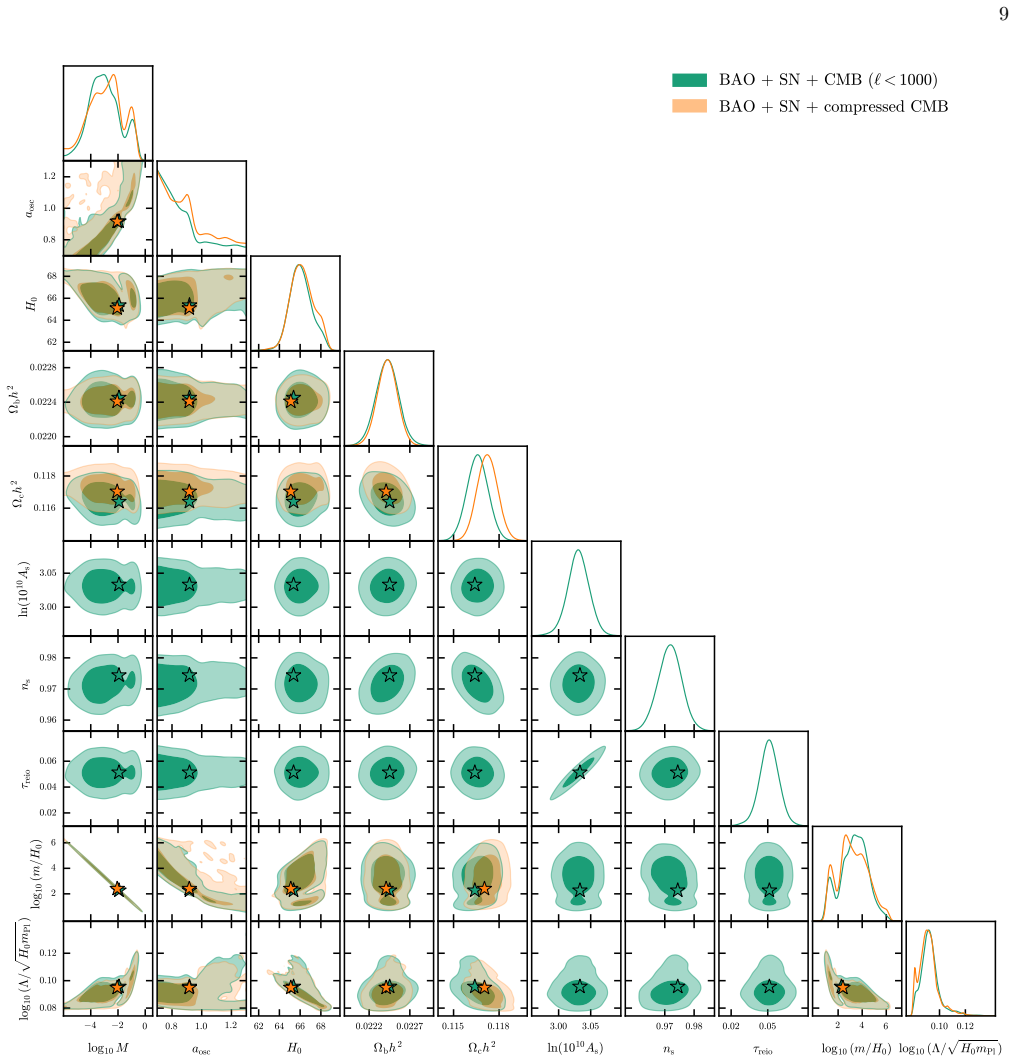
G. Shiu, F. Tonioni, and H. V. Tran, Bounding axion dark energy, (2026), arXiv:2604.09141 [astro-ph.CO]. 7 Parameter Prior log10(M/mPl) [−6,−1] aosc [0.7,1.3] ln(1010As) [1.61,3.91] ns [0.8,1.2] H0 [20,100] Ωbh2 [0.005,0.1] Ωch2 [0.001,0.99] τreio [0.01,0.8] TABLE I. Flat priors adopted for the sampled parameters in our analysis
Pith/arXiv arXiv 2026
-
[45]
T. L. Smith, J. T. Giblin, Jr., M. A. Amin, M. Ger- hardinger, E. Florio, M. Cerep, and S. Daniels, Novel in- tegrated Sachs-Wolfe effect from early dark energy, Phys. Rev. D108, 123534 (2023), arXiv:2304.02028 [astro- ph.CO]
arXiv 2023
-
[46]
B. Heidenreich, M. Reece, and T. Rudelius, Weak Grav- ity Strongly Constrains Large-Field Axion Inflation, JHEP12, 108, arXiv:1506.03447 [hep-th]
-
[47]
Gelman, J
A. Gelman, J. B. Carlin, H. S. Stern, and D. B. Ru- bin, Bayesian Data Analysis, 2nd ed. (Chapman and Hall/CRC, 2004)
2004
-
[48]
R. Kallosh and A. Linde, Universality Class in Conformal Inflation, JCAP07, 002, arXiv:1306.5220 [hep-th]
-
[49]
Scolnic et al., The Pantheon+ Analysis: The Full Data Set and Light-curve Release, Astrophys
D. Scolnic et al., The Pantheon+ Analysis: The Full Data Set and Light-curve Release, Astrophys. J.938, 113 (2022), arXiv:2112.03863 [astro-ph.CO]
Pith/arXiv arXiv 2022
-
[50]
Brout et al., The Pantheon+ Analysis: Cosmo- logical Constraints, Astrophys
D. Brout et al., The Pantheon+ Analysis: Cosmo- logical Constraints, Astrophys. J.938, 110 (2022), arXiv:2202.04077 [astro-ph.CO]
Pith/arXiv arXiv 2022
-
[51]
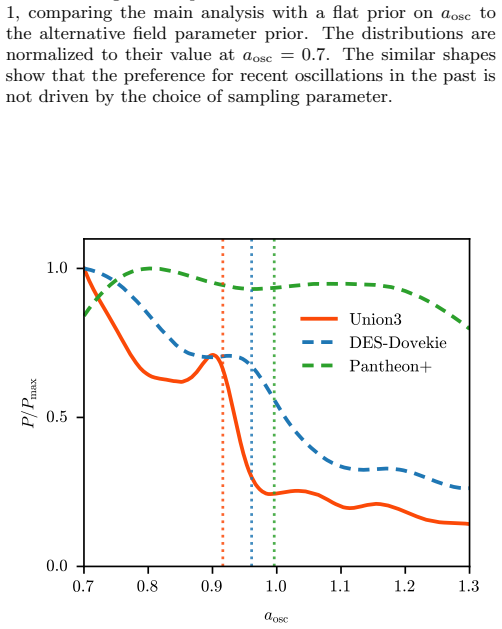
B. Popovic et al. (DES), The Dark Energy Survey Super- nova Program: A Reanalysis Of Cosmology Results And Evidence For Evolving Dark Energy With An Updated Type Ia Supernova Calibration 10.1093/mnras/stag632 (2025), arXiv:2511.07517 [astro-ph.CO]. Appendices A. Full posterior distribution This appendix summarizes the priors and posterior constraints used...
work page internal anchor Pith review Pith/arXiv arXiv doi:10.1093/mnras/stag632 2025
discussion (0)
Sign in with ORCID, Apple, or X to comment. Anyone can read and Pith papers without signing in.