Geometry-Instructed Video Editing
Pith reviewed 2026-06-26 00:41 UTC · model grok-4.3
The pith
GIVE uses depth-box and orientation-box streams to specify 3D object state changes for reliable video geometric edits.
A machine-rendered reading of the paper's core claim, the machinery that carries it, and where it could break.
Core claim
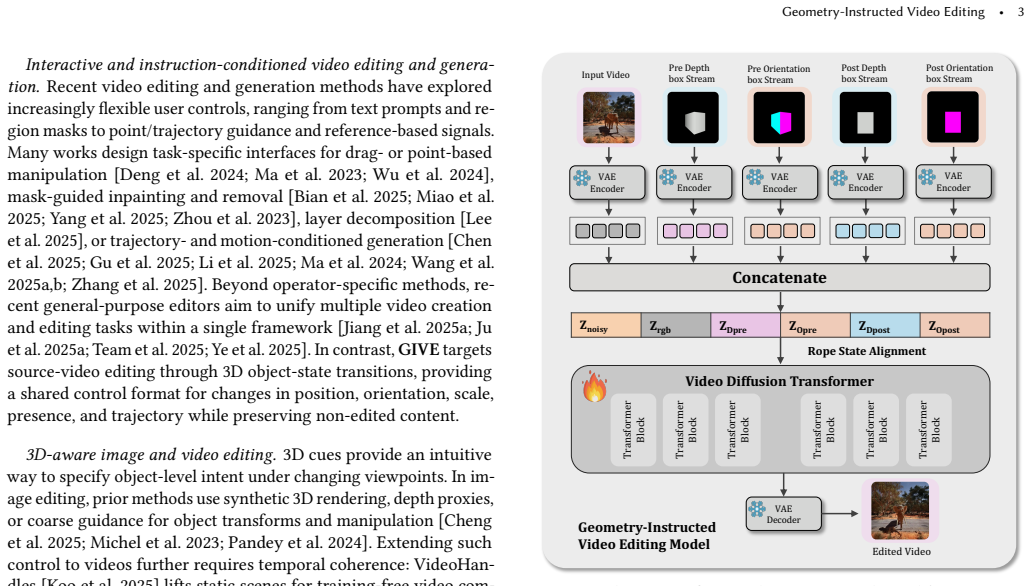
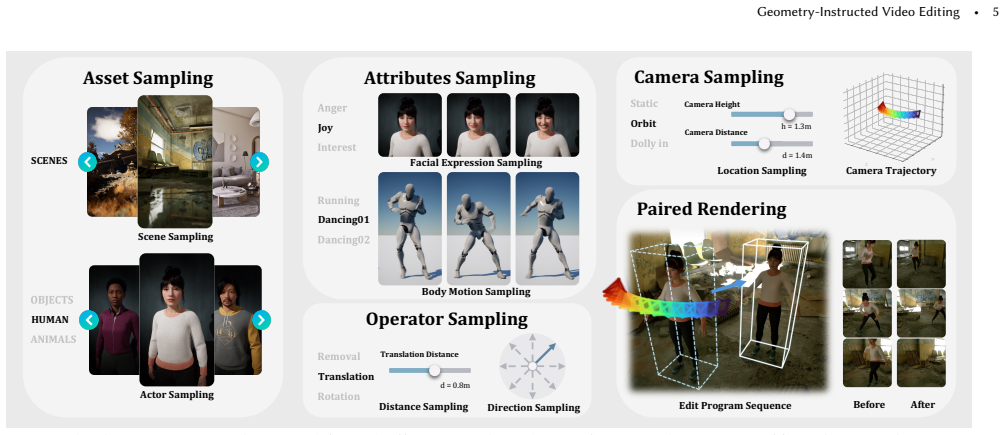
GIVE represents edits through a unified object-state formulation. Two video-aligned geometry streams describe the target object before and after editing: a depth-box encoding coarse 3D placement and extent, and an orientation-box providing an appearance-agnostic orientation cue. A scalable graphics-engine pipeline executes object-level edit programs and renders controlled before/after pairs to provide paired supervision.
What carries the argument
Unified object-state formulation using depth-box and orientation-box geometry streams for specifying pre and post edit states.
Load-bearing premise
The graphics-engine pipeline generates paired videos that isolate the intended geometric edit and keep secondary effects consistent, and that this synthetic data transfers to real videos.
What would settle it
Editing a real video with a known object movement such as a ball rolling and casting a shadow, then checking if the output matches the expected new position, orientation, and shadow placement without introducing artifacts.
Figures
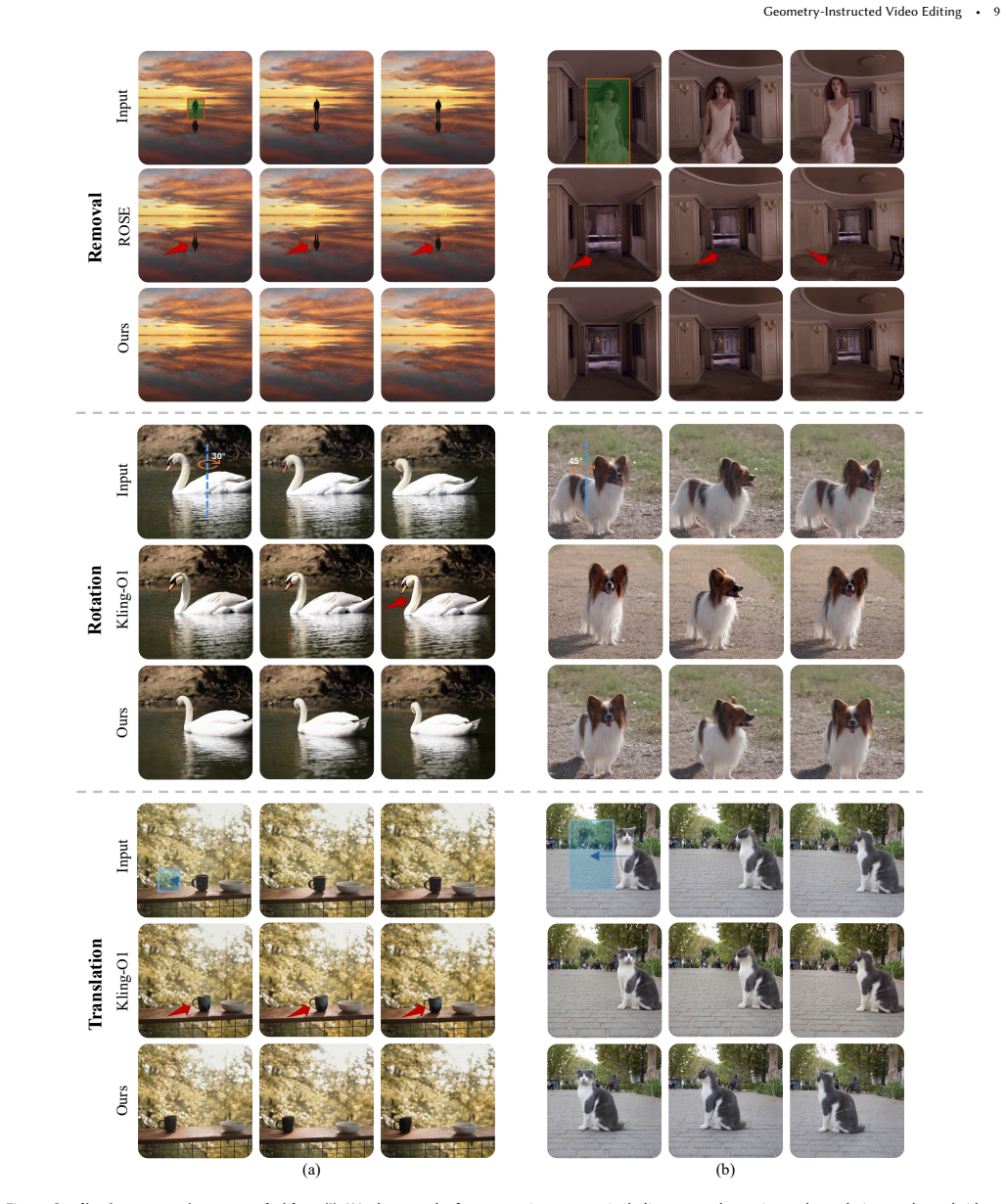
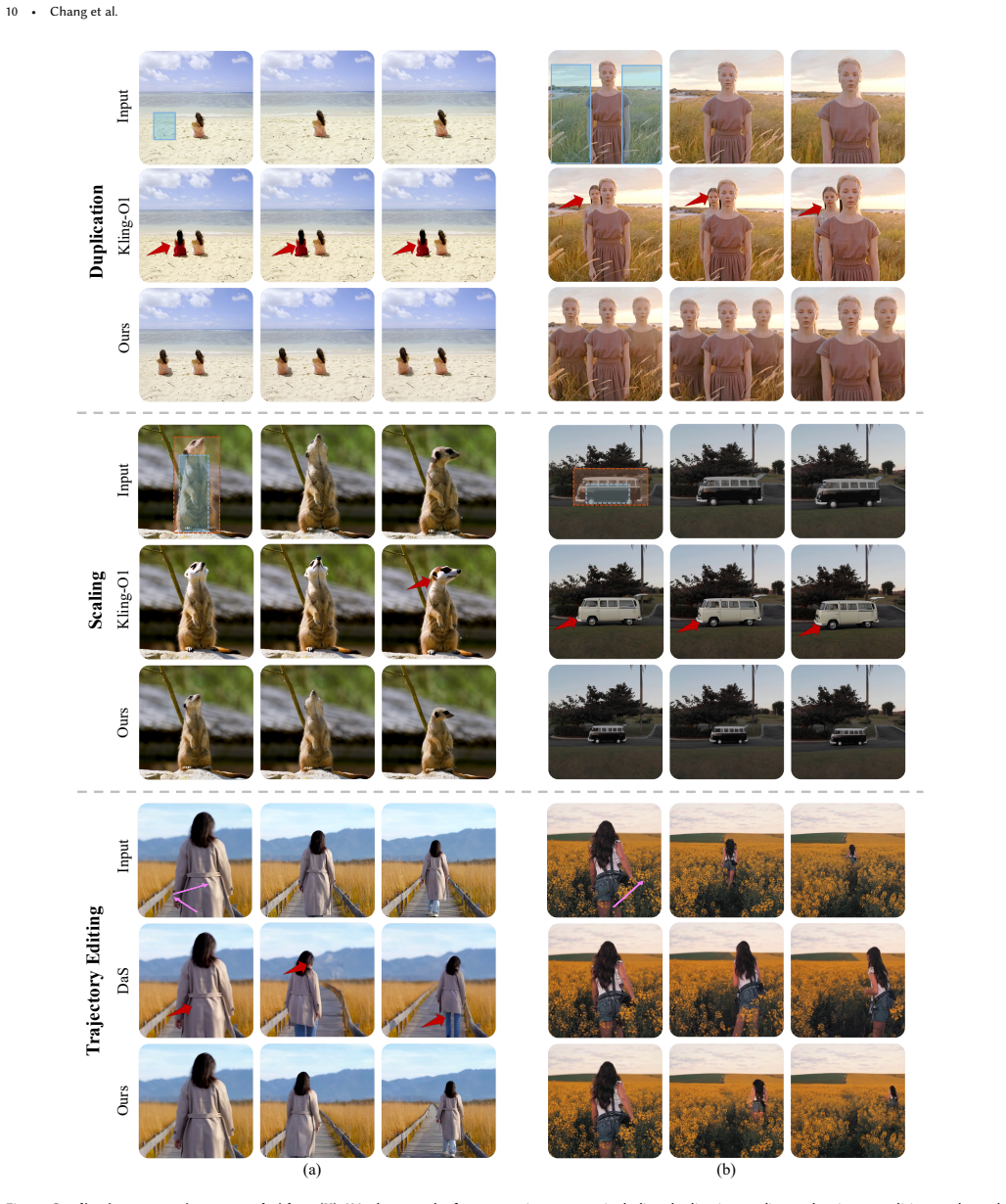
read the original abstract
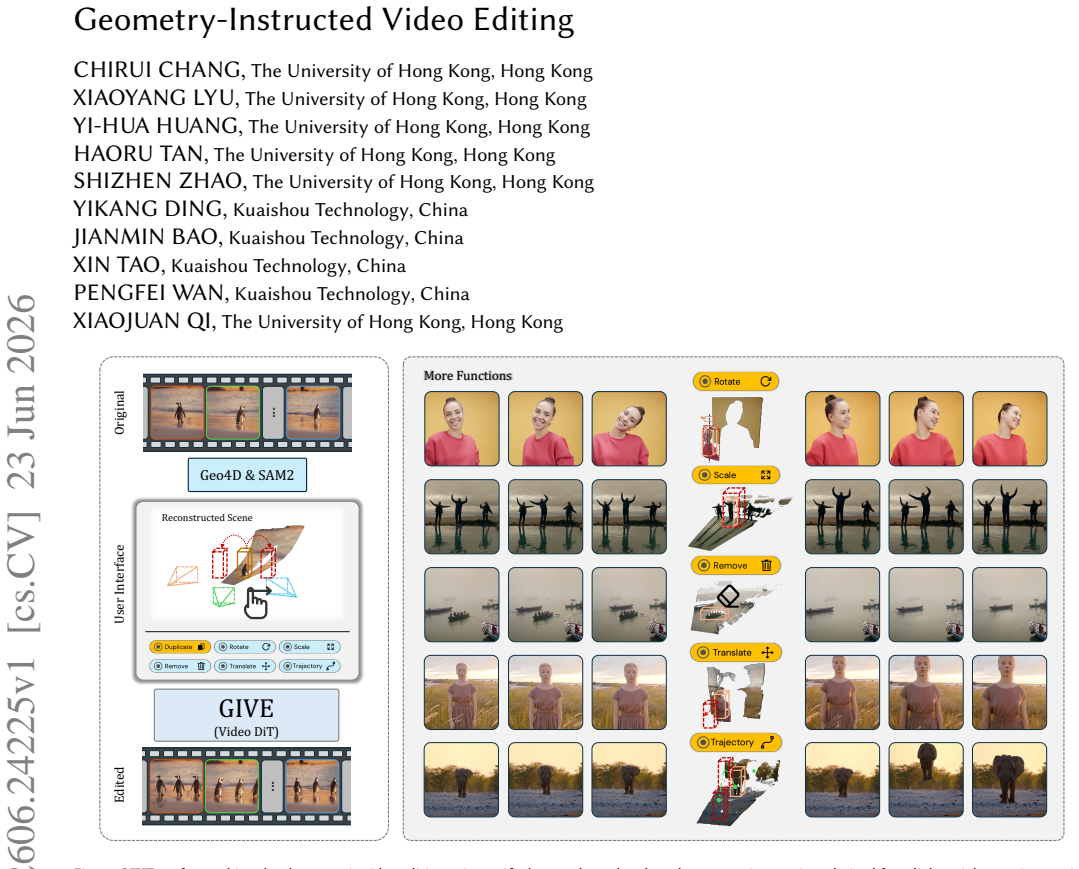
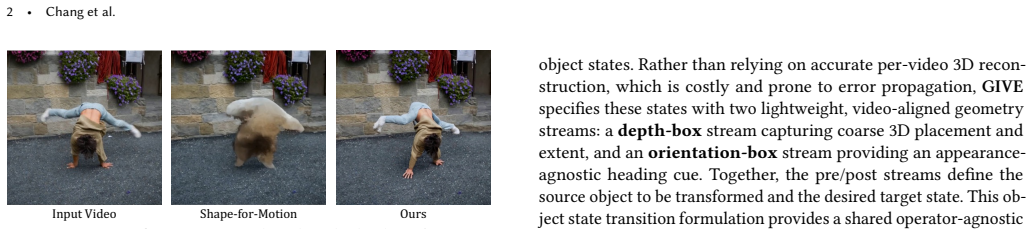
Object-level geometric edits, including translating, rotating, scaling, duplicating, or removing an object, are routine operations in digital content creation (DCC) workflows, yet they remain unreliable in generative video editing. The key challenge lies in specifying the target object's 3D state change unambiguously across viewpoint and time, while consistently updating geometry-dependent secondary effects such as shadows and reflections. We introduce GIVE, a geometry-instructed video editing framework that represents edits through a unified object-state formulation. Two video-aligned geometry streams describe the target object before and after editing: a depth-box encoding coarse 3D placement and extent, and an orientation-box providing an appearance-agnostic orientation cue. Together, these streams provide a compact pre/post geometric specification for object-state transitions. To provide paired supervision for learning these edits, we build a scalable graphics-engine pipeline that executes object-level edit programs and renders controlled before/after pairs, isolating the intended geometric edit while keeping secondary effects consistent with the transformation. Experimental results demonstrate that GIVE produces faithful geometric edits with temporal coherence and consistent secondary effects across operators in a unified framework, and shows promising transfer to in-the-wild videos. Project page: https://geometry-instructed-video-editing.github.io/give/
Editorial analysis
A structured set of objections, weighed in public.
Referee Report
Summary. The manuscript introduces GIVE, a geometry-instructed video editing framework that specifies object-level edits (translate, rotate, scale, duplicate, remove) via a unified object-state formulation. Two video-aligned geometry streams—a depth-box for coarse 3D placement/extent and an orientation-box for appearance-agnostic orientation—provide compact pre/post specifications. A graphics-engine pipeline generates paired before/after videos by executing edit programs while aiming to keep secondary effects (shadows, reflections) consistent. The central claim is that this yields faithful geometric edits with temporal coherence and consistent secondary effects in a single framework, plus promising transfer to in-the-wild videos.
Significance. If the synthetic-to-real transfer and coherence claims hold with supporting evidence, the work would address a practical gap in generative video editing by enabling explicit, controllable 3D geometric manipulations without per-operator retraining. The scalable synthetic supervision pipeline is a potential strength for avoiding the need for real paired data.
major comments (2)
- [Abstract] Abstract (pipeline paragraph): the assertion that the graphics-engine pipeline 'isolates the intended geometric edit while keeping secondary effects consistent' is load-bearing for the transfer claim, yet no details are given on randomization of lighting, materials, or camera parameters, nor any measure of resulting domain gap; this leaves the weakest assumption (synthetic pairs generalize without lighting correlations or artifacts) untested.
- [Experimental results] Experimental results section: the abstract states that results 'demonstrate' faithful edits, temporal coherence, and consistent secondary effects, but supplies no quantitative metrics, ablation tables, or comparisons; without these it is impossible to verify whether the unified framework actually outperforms operator-specific baselines or preserves secondary effects on real inputs.
minor comments (2)
- [Method] Clarify the precise encoding and alignment procedure for the depth-box and orientation-box streams when they are introduced in the method section.
- [Related work] Add a reference to prior synthetic-to-real video editing works that address domain gap (e.g., via domain randomization or style transfer) to contextualize the pipeline design.
Simulated Author's Rebuttal
We thank the referee for the constructive feedback on our manuscript. We address each major comment point-by-point below.
read point-by-point responses
-
Referee: [Abstract] Abstract (pipeline paragraph): the assertion that the graphics-engine pipeline 'isolates the intended geometric edit while keeping secondary effects consistent' is load-bearing for the transfer claim, yet no details are given on randomization of lighting, materials, or camera parameters, nor any measure of resulting domain gap; this leaves the weakest assumption (synthetic pairs generalize without lighting correlations or artifacts) untested.
Authors: The abstract summarizes the pipeline at a high level due to length constraints. The full manuscript (Section 3) details the graphics-engine pipeline, including randomization over lighting, materials, and camera parameters to isolate geometric edits and reduce domain gap. We will revise the abstract to briefly note the domain randomization strategy and add a short domain-gap analysis or reference in the revised version. revision: yes
-
Referee: [Experimental results] Experimental results section: the abstract states that results 'demonstrate' faithful edits, temporal coherence, and consistent secondary effects, but supplies no quantitative metrics, ablation tables, or comparisons; without these it is impossible to verify whether the unified framework actually outperforms operator-specific baselines or preserves secondary effects on real inputs.
Authors: The experimental section presents qualitative results and visual comparisons across edit operators and in-the-wild videos. We agree that quantitative metrics and ablations would strengthen verification. We will add ablation tables, temporal coherence metrics, and a user study on secondary effects in the revision; direct baseline comparisons will also be included where feasible. revision: partial
Circularity Check
No circularity: explicit geometry streams and separate rendering pipeline are independent of the learned editing model.
full rationale
The derivation introduces depth-box and orientation-box as a compact pre/post geometric specification, then builds an independent graphics-engine pipeline to generate paired supervision. The central claim (faithful geometric edits with temporal coherence) is evaluated on outputs of this pipeline and on in-the-wild transfer; nothing in the abstract or described chain reduces the model output to a quantity defined by the same inputs or by self-citation. The pipeline is presented as an external data-generation step rather than a fitted component renamed as prediction.
Axiom & Free-Parameter Ledger
Reference graph
Works this paper leans on
-
[1]
Yuxuan Bian, Zhaoyang Zhang, Xuan Ju, Mingdeng Cao, Liangbin Xie, Ying Shan, and Qiang Xu
Recammaster: Camera-controlled generative rendering from a single video.arXiv preprint arXiv:2503.11647(2025). Yuxuan Bian, Zhaoyang Zhang, Xuan Ju, Mingdeng Cao, Liangbin Xie, Ying Shan, and Qiang Xu
-
[2]
Stable video diffusion: Scaling latent video diffusion models to large datasets.arXiv preprint arXiv:2311.15127(2023). Blender
work page internal anchor Pith review Pith/arXiv arXiv 2023
-
[3]
Tim Brooks, Bill Peebles, Connor Holmes, Will DePue, Yufei Guo, Li Jing, David Schnurr, Joe Taylor, Troy Luhman, Eric Luhman, Clarence Ng, Ricky Wang, and Aditya Ramesh
Blender.https://docs.blender.org(2025). Tim Brooks, Bill Peebles, Connor Holmes, Will DePue, Yufei Guo, Li Jing, David Schnurr, Joe Taylor, Troy Luhman, Eric Luhman, Clarence Ng, Ricky Wang, and Aditya Ramesh
2025
-
[4]
Video generation models as world simulators. (2024). https: //openai.com/research/video-generation-models-as-world-simulators ByteDance Seed
2024
-
[5]
Gemini 2.5: Pushing the frontier with advanced reasoning, multimodality, long context, and next generation agentic capabilities.arXiv preprint arXiv:2507.06261 (2025). Google DeepMind. 2025a. Genie 3: A new frontier for world models. https://deepmind.google/blog/genie-3-a-new-frontier-for-world-models/(2025). Google DeepMind. 2025b. Veo 3 Model Card.https...
work page internal anchor Pith review Pith/arXiv arXiv 2025
-
[6]
Imagen Video: High Definition Video Generation with Diffusion Models
Imagen video: High definition video generation with diffusion models.arXiv preprint arXiv:2210.02303(2022). Jonathan Ho, Ajay Jain, and Pieter Abbeel
work page internal anchor Pith review Pith/arXiv arXiv 2022
-
[7]
Ziqi Huang, Yinan He, Jiashuo Yu, Fan Zhang, Chenyang Si, Yuming Jiang, Yuanhan Zhang, Tianxing Wu, Qingyang Jin, Nattapol Chanpaisit, et al
Denoising diffusion probabilistic models.Advances in neural information processing systems33 (2020), 6840–6851. Ziqi Huang, Yinan He, Jiashuo Yu, Fan Zhang, Chenyang Si, Yuming Jiang, Yuanhan Zhang, Tianxing Wu, Qingyang Jin, Nattapol Chanpaisit, et al
2020
-
[8]
Zeyinzi Jiang, Zhen Han, Chaojie Mao, Jingfeng Zhang, Yulin Pan, and Yu Liu
Vbench: Comprehensive benchmark suite for video generative models.arXiv preprint arXiv:2311.17982(2023). Zeyinzi Jiang, Zhen Han, Chaojie Mao, Jingfeng Zhang, Yulin Pan, and Yu Liu. 2025a. Vace: All-in-one video creation and editing. InProceedings of the IEEE/CVF Interna- tional Conference on Computer Vision. 17191–17202. Zeren Jiang, Chuanxia Zheng, Iro ...
-
[9]
Kuaishou
AnyV2V: A Tuning-Free Framework For Any Video-to-Video Editing Tasks.Transactions on Machine Learning Research(2024). Kuaishou
2024
-
[10]
Yao-Chih Lee, Erika Lu, Sarah Rumbley, Michal Geyer, Jia-Bin Huang, Tali Dekel, and Forrester Cole
Kling AI.https://klingai.kuaishou.com/(2025). Yao-Chih Lee, Erika Lu, Sarah Rumbley, Michal Geyer, Jia-Bin Huang, Tali Dekel, and Forrester Cole
2025
- [11]
-
[12]
Wan-Duo Kurt Ma, John P Lewis, and W Bastiaan Kleijn
Dream Machine.https://lumalabs.ai/dream-machine(2025). Wan-Duo Kurt Ma, John P Lewis, and W Bastiaan Kleijn
2025
-
[13]
InSIGGRAPH Asia 2024 Conference Papers
Trailblazer: Trajectory control for diffusion-based video generation. InSIGGRAPH Asia 2024 Conference Papers. 1–11. Yue Ma, Xiaodong Cun, Yingqing He, Chenyang Qi, Xintao Wang, Ying Shan, Xiu Li, and Qifeng Chen
2024
-
[14]
Magicstick: Controllable video editing via control handle transformations.arXiv preprint arXiv:2312.03047(2023). Chenxuan Miao, Yutong Feng, Jianshu Zeng, Zixiang Gao, Hantang Liu, Yunfeng Yan, Donglian Qi, Xi Chen, Bin Wang, and Hengshuang Zhao
-
[15]
Oscar Michel, Anand Bhattad, Eli VanderBilt, Ranjay Krishna, Aniruddha Kembhavi, and Tanmay Gupta
Rose: Remove objects with side effects in videos.arXiv preprint arXiv:2508.18633(2025). Oscar Michel, Anand Bhattad, Eli VanderBilt, Ranjay Krishna, Aniruddha Kembhavi, and Tanmay Gupta
-
[16]
Advances in Neural Information Processing Systems36 (2023), 3497–3516
Object 3dit: Language-guided 3d-aware image editing. Advances in Neural Information Processing Systems36 (2023), 3497–3516. MiniMax
2023
-
[17]
Hailuo AI.https://hailuoai.com/video(2025). OpenAI
2025
-
[18]
Wenqi Ouyang, Yi Dong, Lei Yang, Jianlou Si, and Xingang Pan
Sora 2.https://openai.com/index/sora-2/(2025). Wenqi Ouyang, Yi Dong, Lei Yang, Jianlou Si, and Xingang Pan
2025
-
[19]
InSIGGRAPH Asia 2024 Conference Papers
I2VEdit: First- Frame-Guided Video Editing via Image-to-Video Diffusion Models. InSIGGRAPH Asia 2024 Conference Papers. Karran Pandey, Paul Guerrero, Matheus Gadelha, Yannick Hold-Geoffroy, Karan Singh, and Niloy J Mitra
2024
-
[20]
SAM 2: Segment Anything in Images and Videos
Sam 2: Segment anything in images and videos.arXiv preprint arXiv:2408.00714(2024). Robin Rombach, Andreas Blattmann, Dominik Lorenz, Patrick Esser, and Björn Ommer
work page internal anchor Pith review Pith/arXiv arXiv 2024
-
[21]
Jiaming Song, Chenlin Meng, and Stefano Ermon
Gen-4.https://runwayml.com/(2025). Jiaming Song, Chenlin Meng, and Stefano Ermon
2025
-
[22]
Kling-Omni Technical Report.arXiv preprint arXiv:2512.16776(2025). Wan Video
work page internal anchor Pith review Pith/arXiv arXiv 2025
-
[23]
Wan: Open and advanced large-scale video generative models. https://github.com/Wan-Video/Wan2.1. Angtian Wang, Haibin Huang, Jacob Zhiyuan Fang, Yiding Yang, and Chongyang Ma. 2025a. Ati: Any trajectory instruction for controllable video generation.arXiv preprint arXiv:2505.22944(2025). Hanlin Wang, Hao Ouyang, Qiuyu Wang, Wen Wang, Ka Leong Cheng, Qifeng...
-
[24]
Weijia Wu, Zhuang Li, Yuchao Gu, Rui Zhao, Yefei He, David Junhao Zhang, Mike Zheng Shou, Yan Li, Tingting Gao, and Di Zhang
Image quality assessment: from error visibility to structural similarity.IEEE transactions on image processing13, 4 (2004), 600–612. Weijia Wu, Zhuang Li, Yuchao Gu, Rui Zhao, Yefei He, David Junhao Zhang, Mike Zheng Shou, Yan Li, Tingting Gao, and Di Zhang
2004
-
[25]
Mtv-inpaint: Multi-task long video inpainting.arXiv preprint arXiv:2503.11412(2025). Zixuan Ye, Xuanhua He, Quande Liu, Qiulin Wang, Xintao Wang, Pengfei Wan, Di Zhang, Kun Gai, Qifeng Chen, and Wenhan Luo
-
[26]
Lvmin Zhang, Anyi Rao, and Maneesh Agrawala
UNIC: Unified In-Context Video Editing.arXiv preprint arXiv:2506.04216(2025). Lvmin Zhang, Anyi Rao, and Maneesh Agrawala
-
[27]
InProceedings of the IEEE/CVF international conference on computer vision
Propainter: Improving propagation and transformer for video inpainting. InProceedings of the IEEE/CVF international conference on computer vision. 10477–10486. ACM Trans. Graph., Vol. 1, No. 1, Article . Publication date: June 2026
2026
discussion (0)
Sign in with ORCID, Apple, or X to comment. Anyone can read and Pith papers without signing in.