Monitoring Beam Splitter Entanglement using Quantumness
Pith reviewed 2026-06-26 00:25 UTC · model grok-4.3
The pith
Quantumness Ξ is conserved under ideal beam mixing, allowing pre- and post-mixing comparisons to benchmark entanglement experiments.
A machine-rendered reading of the paper's core claim, the machinery that carries it, and where it could break.
Core claim
Under ideal circumstances, Ξ is a conserved quantity under beam mixing. This allows us to benchmark the experiment's performance by comparing the states' quantumness Ξ after the beam splitter mixing with Ξ before. Such a comparison is not possible with entanglement witnesses, as the input states are unentangled. This highlights the main strength of our approach: its ability to generally quantify the quantumness of multi-mode continuous variable states and use this to probe different stages in an experiment.
What carries the argument
Quantumness Ξ, a measure for continuous-variable states that remains invariant under ideal beam mixing and thereby isolates the effects of imperfections.
If this is right
- Ξ supplies a benchmark for performance in beam-splitter entanglement generation.
- Direct comparison of pre- and post-mixing Ξ values quantifies the impact of mode-mismatch and detection imperfections.
- The same conserved measure can be applied to quantify quantumness in general multi-mode continuous-variable states.
- Different stages of an optical experiment can be checked separately using the invariance of Ξ.
Where Pith is reading between the lines
- If conservation holds, the same approach could diagnose specific loss channels in other linear optical circuits without assuming particular state forms.
- Intentional introduction of calibrated losses would provide a direct test of whether observed Ξ changes match the predicted degradation.
- Similar conserved quantities might be identified for discrete-variable systems or nonlinear operations to enable comparable benchmarking.
Load-bearing premise
Ξ is exactly conserved under ideal beam mixing for squeezed vacuum states, and pre- and post-mixing measurements isolate experimental imperfections without additional assumptions about the states or detection.
What would settle it
Measuring a change in Ξ after mixing two squeezed vacuum states on a beam splitter under conditions independently verified as ideal would falsify the conservation property.
Figures
read the original abstract
We report on an experiment in which two independent squeezed vacuum states get entangled by mixing them with a balanced beam splitter. We follow standard practice and use an inseparability criterion to quantify their entanglement. However, this only allows us to witness the entanglement, but not to determine the deleterious effects of experimental imperfections due to the beam splitter mixing and the associated mode-mismatch and detection imperfections. We therefore introduce an alternative framework suitable for continuous variable systems using the states' quantumness, $\Xi$. We show that, under ideal circumstances, $\Xi$ is a conserved quantity under beam mixing. This allows us to benchmark the experiment's performance by comparing the states' quantumness $\Xi$ after the beam splitter mixing with $\Xi$ before. Such a comparison is not possible with entanglement witnesses, as the input states are unentangled. This highlights the main strength of our approach: its ability to generally quantify the quantumness of multi-mode continuous variable states and use this to probe different stages in an experiment.
Editorial analysis
A structured set of objections, weighed in public.
Referee Report
Summary. The manuscript reports an experiment in which two independent squeezed vacuum states are mixed on a balanced beam splitter to generate entanglement, quantified via an inseparability criterion. It introduces a continuous-variable quantumness measure Ξ and states that Ξ is conserved under ideal beam mixing. This conservation is used to benchmark experimental imperfections (mode mismatch, detection losses) by direct pre/post comparison of Ξ, an approach unavailable to entanglement witnesses because the input states are unentangled. The central claim is that Ξ thereby provides a general tool for quantifying multi-mode CV quantumness at different experimental stages.
Significance. If the conservation of Ξ is rigorously derived and the pre/post comparison isolates imperfections without additional state assumptions, the framework supplies a practical benchmarking method for CV entanglement generation that complements standard witnesses. This could be useful for diagnosing losses in multi-mode setups where input states lack entanglement.
minor comments (2)
- [Abstract] The abstract states that conservation 'is shown' but does not reference the specific section or equation containing the derivation of Ξ or the proof of invariance under beam mixing; the full manuscript should make this explicit with numbered equations.
- Notation for the inseparability criterion and for Ξ should be introduced with a brief comparison table or paragraph to clarify how the two quantities differ in their applicability to unentangled inputs.
Simulated Author's Rebuttal
We thank the referee for their positive summary of our manuscript and for recommending minor revision. The referee correctly identifies the core contribution: using conservation of the quantumness measure Ξ under ideal beam-splitter mixing to benchmark experimental imperfections in continuous-variable entanglement generation, an approach unavailable to standard inseparability witnesses.
Circularity Check
No significant circularity identified
full rationale
The paper states that it shows Ξ is conserved under ideal beam mixing as a derived property, enabling pre/post benchmarking that entanglement witnesses cannot provide. No quoted equations or definitions indicate that conservation is built into Ξ by construction, that a fitted parameter is relabeled as prediction, or that the central result reduces to a self-citation chain. The derivation is presented as independent of the input states' unentangled character and is self-contained against the experimental description.
Axiom & Free-Parameter Ledger
axioms (1)
- domain assumption Ξ is a conserved quantity under beam mixing under ideal circumstances for the states considered
invented entities (1)
-
quantumness Ξ
no independent evidence
Reference graph
Works this paper leans on
-
[1]
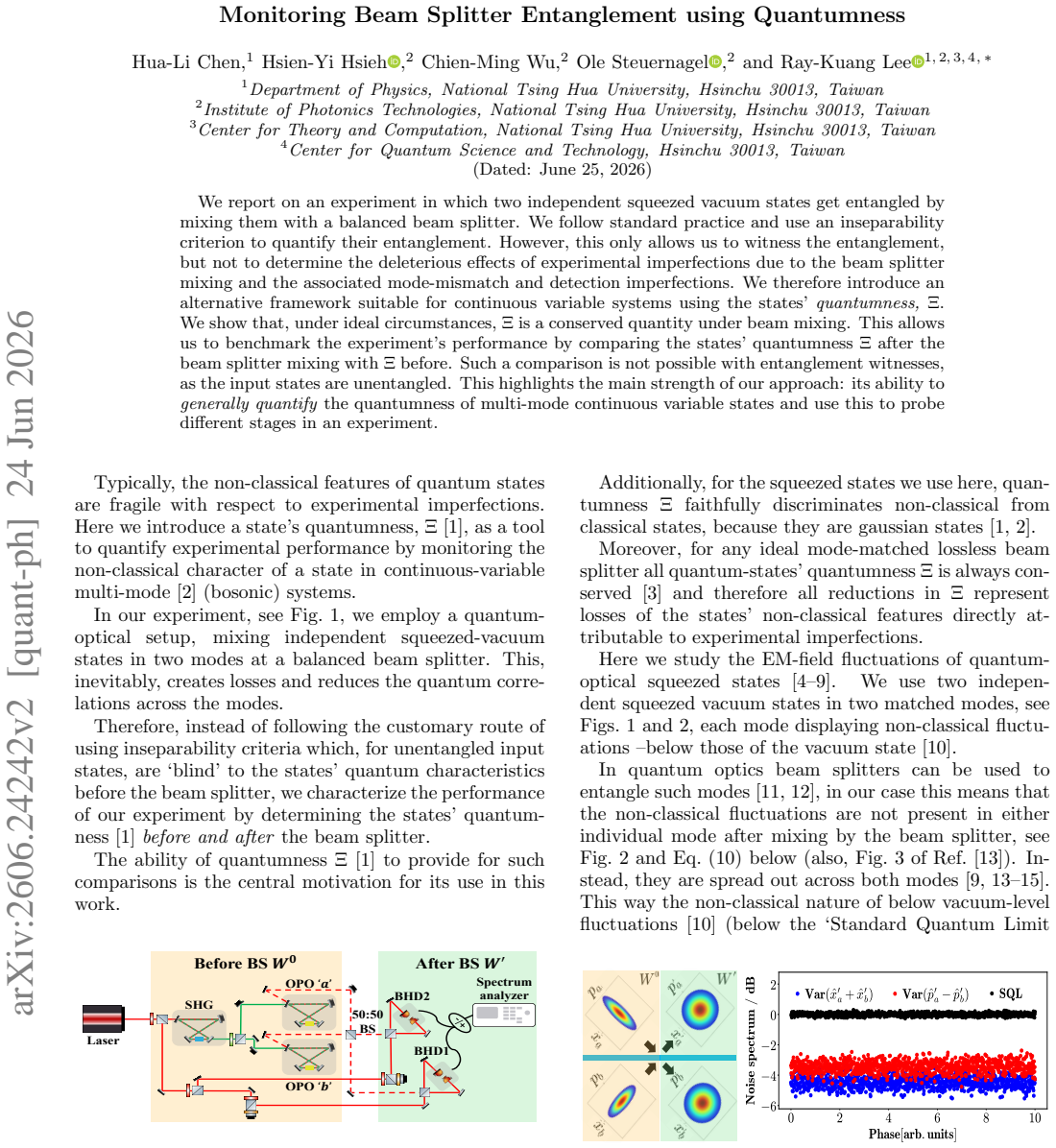
= x′a p′ a x′b p′ b = 1√ 2 xa +x b pa +p b xb −x a pb −p a ,(8) with reflectance and transmittancer=τ= 1
-
[2]
With the values ofµ, V≥1, the spreads theW ′ I have in both coordinates, (x ′, p′), are greater than unity, namely, larger than vacuum fluctuations, see Fig
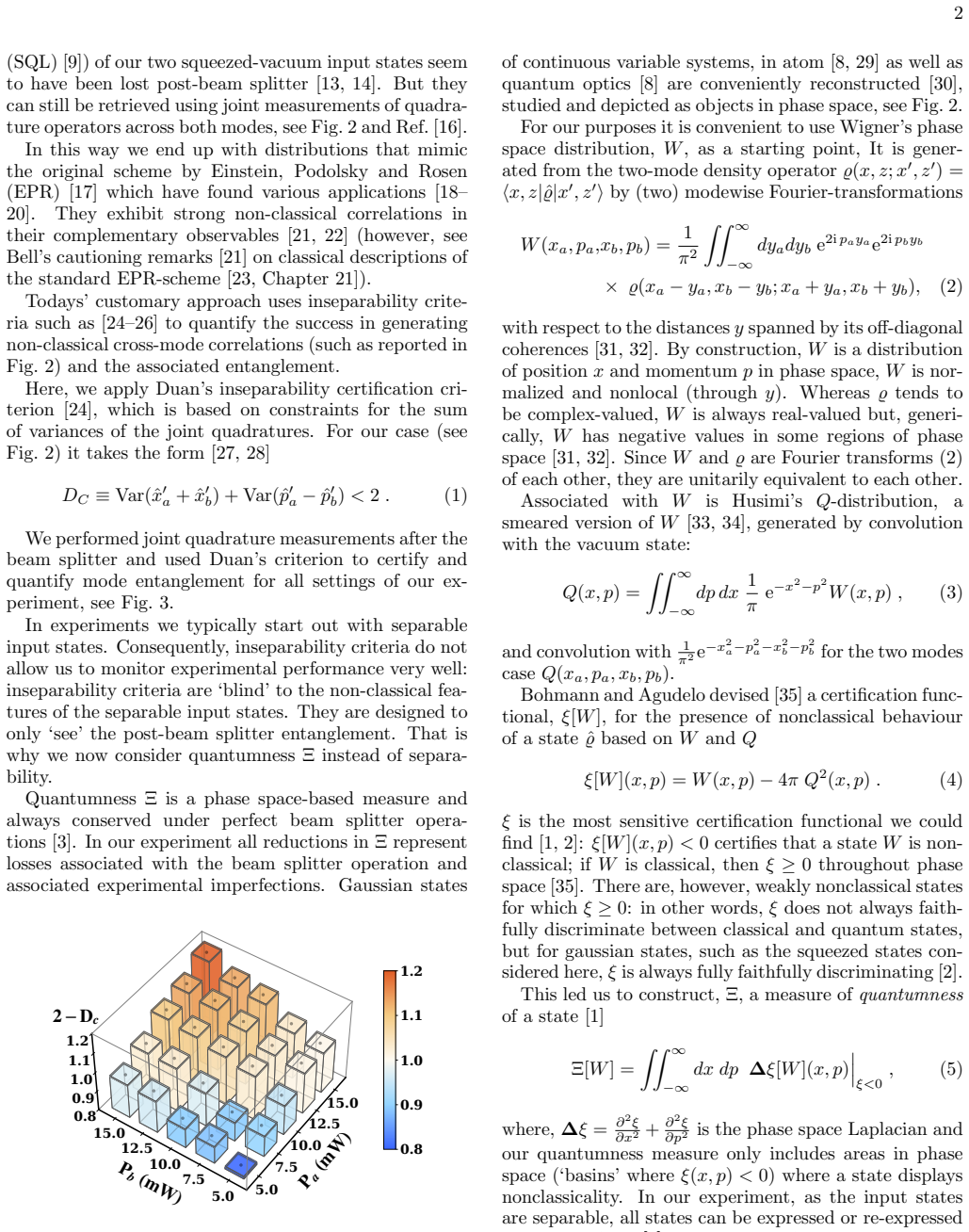
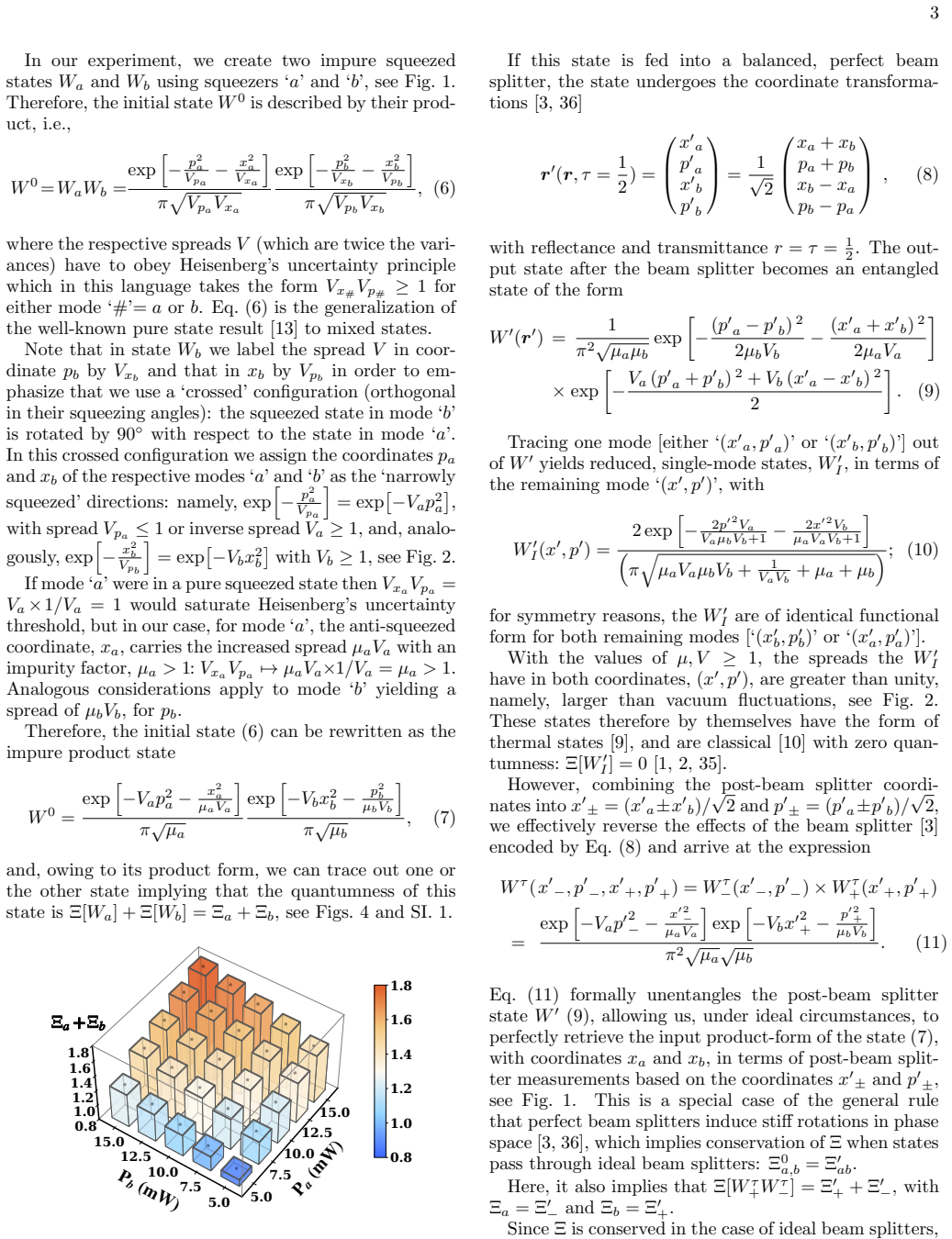
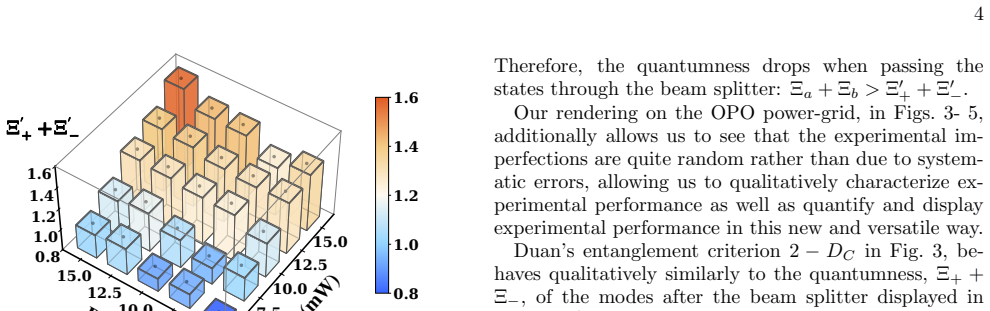
The out- put state after the beam splitter becomes an entangled state of the form W ′(r′) = 1 π2√µaµb exp −(p′ a −p ′ b) 2 2µbVb − (x′a +x ′b) 2 2µaVa ×exp − Va (p′ a +p ′ b) 2 +V b (x′a −x ′b) 2 2 .(9) Tracing one mode [either ‘(x ′a, p′ a)’ or ‘(x ′b, p′ b)’] out ofW ′ yields reduced, single-mode states,W ′ I, in terms of the remaining mode ‘(x ′, p′)’,...
-
[3]
O. Steuernagel and R.-K. Lee, A sensitive quantumness measure for one-dimensional continuous-variable systems (2025), 2311.17399
arXiv 2025
-
[4]
O. Steuernagel and R.-K. Lee, Towards a faithful quantumness certification functional for one-dimensional continuous-variable systems (2025), 2512.23299
arXiv 2025
-
[5]
O. Steuernagel, H.-Y. Hsieh, H.-L. Chen, and R.-K. Lee, Wigner’s phase space current for variable beam splitters 5 — phase space rotations and newtonian trajectories —, (2026), 2606.24334
Pith/arXiv arXiv 2026
-
[6]
R. E. Slusher, L. Hollberg, B. Yurke, J. Mertz, and J. Val- ley, Observation of squeezed states generated by four- wave mixing in an optical cavity, Phys. Rev. Lett.55, 2409 (1985)
1985
-
[7]
Levenson, R
M. Levenson, R. Shelby, M. Reid, and D. Walls, Quan- tum nondemolition detection of optical quadrature am- plitudes, Phys. Rev. Lett.57, 2473 (1986)
1986
-
[8]
Ou and L
Z.-Y. Ou and L. Mandel, Violation of bell’s inequality and classical probability in a two-photon correlation ex- periment, Phys. Rev. Lett.61, 50 (1988)
1988
-
[9]
Z. Ou, X. Zou, L. Wang, and L. Mandel, Observation of nonlocal interference in separated photon channels, Phys. Rev. Lett.65, 321 (1990)
1990
-
[10]
M. O. Scully and M. S. Zubairy,Quantum Optics(Cam- bridge University Press, 2001)
2001
-
[11]
A. I. Lvovsky, Squeezed light (2016), arXiv:1401.4118 [quant-ph]
Pith/arXiv arXiv 2016
-
[12]
W¨ unsche, About the nonclassicality of states defined by nonpositivity of the p-quasiprobability, J
A. W¨ unsche, About the nonclassicality of states defined by nonpositivity of the p-quasiprobability, J. Opt. B: Quant. Semiclass. Opt.6, 159 (2004)
2004
-
[13]
U. M. Titulaer and R. J. Glauber, Density operators for coherent fields, Phys. Rev.145, 1041 (1966)
1966
-
[14]
C. K. Hong, Z. Y. Ou, and L. Mandel, Measurement of subpicosecond time intervals between two photons by in- terference, Phys. Rev. Lett.59, 2044 (1987)
2044
-
[15]
A. K. Ekert and P. L. Knight, Correlations and squeezing of two-mode oscillations, Am. J. Phys.57, 692 (1989)
1989
-
[16]
Ekert and P
A. Ekert and P. L. Knight, Entangled quantum systems and the schmidt decomposition, AJP63, 415 (1995)
1995
-
[17]
S. L. Braunstein, Squeezing as an irreducible resource, Phys. Rev. A71, 055801 (2005), quant-ph/9904002
Pith/arXiv arXiv 2005
-
[18]
N. J. Cerf, G. Leuchs, and E. S. Polzik,Quantum Infor- mation With Continuous Variables of Atoms and Light (Imperial College Press, London, 2007)
2007
-
[19]
Einstein, B
A. Einstein, B. Podolsky, and N. Rosen, Can quantum- mechanical description of physical reality be considered complete?, Phys. Rev.47, 777 (1935)
1935
-
[20]
Y. Cai, Y. Xiang, Y. Liu, Q. He, and N. Treps, Ver- satile multipartite einstein-podolsky-rosen steering via a quantum frequency comb, Phys. Rev. Res.2, 032046(R) (2020)
2020
-
[21]
Tashima, T
T. Tashima, T. Wakatsuki, i. m. c. K. ¨Ozdemir, T. Ya- mamoto, M. Koashi, and N. Imoto, Local transformation of two einstein-podolsky-rosen photon pairs into a three- photonwstate, Phys. Rev. Lett.102, 130502 (2009)
2009
-
[22]
Colciaghi, Y
P. Colciaghi, Y. Li, P. Treutlein, and T. Zibold, Einstein- podolsky-rosen experiment with two bose-einstein con- densates, Phys. Rev. X13, 021031 (2023)
2023
-
[23]
Z. Y. Ou, S. F. Pereira, H. J. Kimble, and K. C. Peng, Re- alization of the einstein-podolsky-rosen paradox for con- tinuous variables, Phys. Rev. Lett.68, 3663 (1992)
1992
-
[24]
S. L. Braunstein and P. van Loock, Quantum informa- tion with continuous variables, Rev. Mod. Phys.77, 513 (2005)
2005
-
[25]
J. S. Bell,Speakable and Unspeakable in Quantum Mechanics: Collected Papers on Quantum Philosophy (Camb. Univ. Press, New York, 2004)
2004
-
[26]
L.-M. Duan, G. Giedke, J. I. Cirac, and P. Zoller, Insep- arability criterion for continuous variable systems, Phys. Rev. Lett.84, 2722 (2000)
2000
-
[27]
Laurat, G
J. Laurat, G. Keller, J. A. Oliveira-Huguenin, C. Fabre, T. Coudreau, A. Serafini, G. Adesso, and F. Illuminati, Entanglement of two-mode gaussian states: characteri- zation and experimental production and manipulation, Journal of Optics B: Quantum and Semiclassical Optics 7, S577 (2005)
2005
-
[28]
Andersen, G
U. Andersen, G. Leuchs, and C. Silberhorn, Continuous- variable quantum information processing, Laser & Phot. Rev.4, 337 (2010)
2010
-
[29]
Eberle, V
T. Eberle, V. H¨ andchen, and R. Schnabel, Stable control of 10 db two-mode squeezed vacuum states of light, Opt. Express21, 11546 (2013)
2013
-
[30]
X. Yu, W. Li, Y. Jin, and J. Zhang, Experimental mea- surement of covariance matrix of two-mode entangled state, Sci. China Phys. Mech. Astron.57, 875 (2014)
2014
-
[31]
Kurtsiefer, T
C. Kurtsiefer, T. Pfau, and J. Mlynek, Measurement of the wigner function of an ensemble of helium atoms, Na- ture386, 150 (1997)
1997
-
[32]
Hsieh, Y.-R
H.-Y. Hsieh, Y.-R. Chen, H.-C. Wu, H.-L. Chen, J. Ning, Y.-C. Huang, C.-M. Wu, and R.-K. Lee, Extract the degradation information in squeezed states with machine learning, Phys. Rev. Lett.128, 073604 (2022)
2022
-
[33]
Wigner, On the Quantum Correction For Thermody- namic Equilibrium, Phys
E. Wigner, On the Quantum Correction For Thermody- namic Equilibrium, Phys. Rev.40, 749 (1932)
1932
-
[34]
Hillery, R
M. Hillery, R. F. O’Connell, M. O. Scully, and E. P. Wigner, Distribution functions in physics: Fundamen- tals, Phys. Rep.106, 121 (1984)
1984
-
[35]
K. E. Cahill and R. J. Glauber, Density operators and quasiprobability distributions, Phys. Rev.177, 1882 (1969)
1969
-
[36]
W. P. Schleich,Quantum Optics in Phase Space(Wiley- VCH, 2001)
2001
-
[37]
Bohmann and E
M. Bohmann and E. Agudelo, Phase-space inequalities beyond negativities, Phys. Rev. Lett.124, 133601 (2020)
2020
-
[38]
Leonhardt and H
U. Leonhardt and H. Paul, Realistic optical homodyne measurements and quasiprobability distributions, Phys. Rev. A48, 4598 (1993)
1993
-
[39]
Bloomer, M
R. Bloomer, M. Pysher, and O. Pfister, Nonlocal restora- tion of two-mode squeezing in the presence of strong op- tical loss, New J. Phys.13, 063014 (2011)
2011
-
[40]
Hirota, T
K. Hirota, T. Kashiwazaki, G. Ha, T. Yamashima, P. Jat- uraphagorn, T. Suzuki, K. Takahashi, A. Kawasaki, A. Inoue, W. Asavanant, M. Endo, T. Umeki, and A. Fu- rusawa, Generation of 10-db squeezed light from a broad- band waveguide optical parametric amplifier with im- proved phase locking method, Opt. Express34, 7958 (2026)
2026
-
[41]
Wang, L.-L
S. Wang, L.-L. Hou, X.-F. Chen, and X.-F. Xu, Continuous-variable quantum teleportation with non- gaussian entangled states generated via multiple-photon subtraction and addition, Phys. Rev. A91, 063832 (2015)
2015
-
[42]
Takahashi, J
H. Takahashi, J. S. Neergaard-Nielsen, M. Takeuchi, M. Takeoka, K. Hayasaka, A. Furusawa, and M. Sasaki, Entanglement distillation from gaussian input states, Nat. Phot.4, 178 (2010). 6 – Supplementary Information – Monitoring Beam Splitter Entanglement using Quantumness Hua-Li Chen, Hsien-Yi Hsieh , Chien-Ming Wu, Ole Steuernagel , and Ray-Kuang Lee
2010
-
[43]
7.5 10. 12.5 15. Pump Power (mW) 0.0 0.2 0.4 0.6 0.8 1.0 1.2Quantumness a (Expt.) a ( =1) b (Expt.) b ( =1) FIG. SI. 1. Quantumness for input modes: Ξ a and Ξ b of experimentally reconstructed impure input modes (solid curves) compared to their quantumness if all input statesW a andW b were pure, i.e., assuming that in Eq. (7)µ a =µ b ≡µ= 1 (dashed curves...
2035
discussion (0)
Sign in with ORCID, Apple, or X to comment. Anyone can read and Pith papers without signing in.