REVIEW 3 major objections 1 minor 20 references
Reviewed by Pith at T0; open to challenge.
T0 means a machine referee read the full paper against a public rubric. The mark states how deep the mechanical check went, never who wrote it. the ladder, T0–T4 →
T0 review · grok-4.3
A training-free framework using DINOv3 and three modules achieves state-of-the-art cross-domain few-shot segmentation.
2026-06-26 00:58 UTC pith:7MR5OIVV
load-bearing objection The paper's core idea is a training-free CD-FSS pipeline on frozen DINOv3 features with three new modules, but the abstract supplies no numbers or protocol so the SOTA claim stays uncheckable. the 3 major comments →
Training-free Cross-domain Few-shot Segmentation via Robust Semantic Representation and Matching
The pith
A machine-rendered reading of the paper's core claim, the machinery that carries it, and where it could break.
Core claim
The training-free framework built on the self-supervised DINOv3 encoder addresses cross-domain challenges through Semantic-aware Feature Re-fusion to generate representations with enhanced semantic discriminability, Adaptive Support Enhancement to narrow semantic gaps between support and query, and Hybrid Prototype Matching to integrate results from diverse prototypes, delivering state-of-the-art performance in CD-FSS without training.
What carries the argument
The three modules—Semantic-aware Feature Re-fusion (SAFR), Adaptive Support Enhancement (ASE), and Hybrid Prototype Matching (HPM)—that process DINOv3 features to produce robust semantic representations and matching without any trainable parameters.
Load-bearing premise
The self-supervised DINOv3 encoder supplies features whose semantic gaps between source and target domains can be closed sufficiently by the three proposed modules without any parameter updates or domain-specific training.
What would settle it
A comparison on a new target domain with larger semantic shifts where the modules no longer outperform trained baselines would falsify the central claim.
If this is right
- State-of-the-art CD-FSS results are obtained without training overhead or overfitting.
- General-purpose vision encoders can be applied directly to cross-domain tasks through feature processing alone.
- Unseen target classes can be segmented from only a few annotated samples across distinct domains.
- Performance does not degrade when strong foundation models are incorporated without fine-tuning.
Where Pith is reading between the lines
- The same training-free modules could be tested on other few-shot vision tasks such as detection.
- Feature-level adaptation may reduce the need for domain-specific labeled data in segmentation.
- Extending the approach to additional foundation models could broaden its domain coverage.
Editorial analysis
A structured set of objections, weighed in public.
Referee Report
Summary. The manuscript proposes a training-free framework for cross-domain few-shot segmentation (CD-FSS) that builds on a frozen DINOv3 encoder and introduces three modules—Semantic-aware Feature Re-fusion (SAFR), Adaptive Support Enhancement (ASE), and Hybrid Prototype Matching (HPM)—to produce domain-robust representations; the central claim is that this approach attains state-of-the-art results on four target-domain datasets without any training or fine-tuning.
Significance. If the empirical claims and the strictly parameter-free character of the modules are substantiated, the work would be significant for showing that heuristic post-processing of self-supervised foundation-model features can close cross-domain gaps in CD-FSS, thereby removing training overhead and overfitting risks that affect existing methods.
major comments (3)
- [Abstract / §3] Abstract and method description: the claim that SAFR, ASE and HPM are strictly parameter-free and domain-agnostic is asserted at a high level but is not accompanied by equations, pseudocode or explicit statements showing that none of the modules compute statistics from the target support set or introduce tunable hyperparameters; without this, the training-free guarantee cannot be verified.
- [Abstract] Abstract: the assertion of state-of-the-art performance on four datasets is made without any numerical results, baseline comparisons, error bars or dataset specifications, rendering the central empirical claim impossible to assess from the supplied text.
- [§3] Method: the description of ASE states that it 'narrows semantic gaps between support and query through robust query information aggregation' but supplies no formal definition of the aggregation operator or proof that it remains domain-agnostic when the query distribution differs substantially from the source.
minor comments (1)
- [Abstract] The abstract refers to 'four target domain datasets' without naming them or citing the corresponding papers; this information should appear in the abstract or the first paragraph of the introduction.
Simulated Author's Rebuttal
We thank the referee for the constructive comments, which help clarify key aspects of our training-free CD-FSS framework. We address each major comment point-by-point below, proposing targeted revisions to improve verifiability while preserving the manuscript's core contributions.
read point-by-point responses
-
Referee: [Abstract / §3] Abstract and method description: the claim that SAFR, ASE and HPM are strictly parameter-free and domain-agnostic is asserted at a high level but is not accompanied by equations, pseudocode or explicit statements showing that none of the modules compute statistics from the target support set or introduce tunable hyperparameters; without this, the training-free guarantee cannot be verified.
Authors: We agree that explicit verification is needed. In the revision we will insert pseudocode for SAFR, ASE and HPM together with equations that demonstrate (i) zero trainable parameters, (ii) no tunable hyperparameters, and (iii) that the only statistics derived from the target support set are the standard class prototypes required by any few-shot method; all other operations are fixed, domain-independent heuristics applied to frozen DINOv3 features. This will make the training-free claim directly verifiable. revision: yes
-
Referee: [Abstract] Abstract: the assertion of state-of-the-art performance on four datasets is made without any numerical results, baseline comparisons, error bars or dataset specifications, rendering the central empirical claim impossible to assess from the supplied text.
Authors: While abstracts conventionally remain high-level, we will revise the abstract to report the key quantitative results (mIoU on each of the four target datasets together with the margin over the strongest baseline) and name the datasets. The main text already contains the full tables with standard deviations; adding the headline numbers to the abstract will satisfy the request without altering its length constraints. revision: yes
-
Referee: [§3] Method: the description of ASE states that it 'narrows semantic gaps between support and query through robust query information aggregation' but supplies no formal definition of the aggregation operator or proof that it remains domain-agnostic when the query distribution differs substantially from the source.
Authors: We will add a precise mathematical definition of the aggregation operator (including the similarity-weighted summation formula) in the revised §3. We will also expand the accompanying text to explain why the operator inherits domain robustness from DINOv3's self-supervised features and does not rely on source-domain assumptions. A general mathematical proof for arbitrary distribution shifts lies outside the scope of an empirical methods paper; we therefore strengthen the justification with additional ablation analysis rather than a formal proof. revision: partial
- A formal mathematical proof that the ASE aggregation operator is domain-agnostic for every conceivable query distribution shift.
Circularity Check
No circularity: empirical training-free method with no derivations or fitted parameters
full rationale
The paper describes a training-free CD-FSS framework built on frozen DINOv3 features plus three high-level modules (SAFR, ASE, HPM). No equations, parameter fitting, self-citations, uniqueness theorems, or ansatzes appear in the abstract or summary. The central claim is supported by reported empirical results on four target datasets rather than any self-referential construction. This matches the common honest case of a purely empirical contribution whose performance is externally falsifiable and not forced by definition or prior self-work.
Axiom & Free-Parameter Ledger
read the original abstract
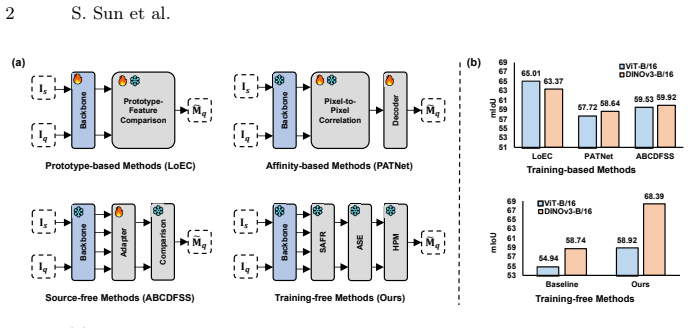
Cross-domain Few-shot Segmentation (CD-FSS) aims to transfer knowledge learned from source domain to distinct target domains, segmenting unseen target classes with only a few annotated samples. Although existing methods have made significant progress, they still rely on training or fine-tuning processes, which incur high computational costs and risk overfitting. We observe that when powerful and general-purpose vision foundation models are incorporated into these methods, their performance shows only marginal improvement or even degrades due to overfitting. To address this, we eliminate trainable parameters and propose a training-free framework to avoid both training overhead and overfitting. Built upon the self-supervised vision encoder DINOv3, our framework addresses cross-domain challenges through three core modules. First, the Semantic-aware Feature Re-fusion (SAFR) module identifies and re-fuses features that emphasize semantic patterns, generating representations with enhanced semantic discriminability. Additionally, the Adaptive Support Enhancement (ASE) module narrows semantic gaps between support and query through robust query information aggregation. Finally, the Hybrid Prototype Matching (HPM) module integrates matching results from diverse prototypes to adapt to varying semantic complexity across domains. Extensive experiments on four target domain datasets demonstrate that our method achieves state-of-the-art performance in CD-FSS without any training.
Figures



Reference graph
Works this paper leans on
-
[1]
IEEE trans- actions on medical imaging33(2), 577–590 (2013)
Candemir, S., Jaeger, S., Palaniappan, K., Musco, J.P., Singh, R.K., Xue, Z., Karargyris, A., Antani, S., Thoma, G., McDonald, C.J.: Lung segmentation in chest radiographs using anatomical atlases with nonrigid registration. IEEE trans- actions on medical imaging33(2), 577–590 (2013)
2013
-
[2]
Codella, N., Rotemberg, V., Tschandl, P., Celebi, M.E., Dusza, S., Gutman, D., Helba,B.,Kalloo,A.,Liopyris,K.,Marchetti,M.,etal.:Skinlesionanalysistoward melanoma detection 2018: A challenge hosted by the international skin imaging collaboration (isic). arXiv preprint arXiv:1902.03368 (2019)
work page internal anchor Pith review Pith/arXiv arXiv 2018
-
[3]
In: Proceedings of the IEEE conference on computer vision and pattern recognition workshops
Demir, I., Koperski, K., Lindenbaum, D., Pang, G., Huang, J., Basu, S., Hughes, F., Tuia, D., Raskar, R.: Deepglobe 2018: A challenge to parse the earth through satellite images. In: Proceedings of the IEEE conference on computer vision and pattern recognition workshops. pp. 172–181 (2018)
2018
-
[4]
An Image is Worth 16x16 Words: Transformers for Image Recognition at Scale
Dosovitskiy, A., Beyer, L., Kolesnikov, A., Weissenborn, D., Zhai, X., Unterthiner, T., Dehghani, M., Minderer, M., Heigold, G., Gelly, S., et al.: An image is worth 16x16 words: Transformers for image recognition at scale. arXiv preprint arXiv:2010.11929 (2020)
work page internal anchor Pith review Pith/arXiv arXiv 2010
-
[5]
In: European conference on computer vision
Fan, Q., Pei, W., Tai, Y.W., Tang, C.K.: Self-support few-shot semantic segmen- tation. In: European conference on computer vision. pp. 701–719. Springer (2022)
2022
-
[6]
IEEE transactions on medical imaging33(2), 233–245 (2013) Training-free CD-FSS via Robust Semantic Representation and Matching 9
Jaeger, S., Karargyris, A., Candemir, S., Folio, L., Siegelman, J., Callaghan, F., Xue, Z., Palaniappan, K., Singh, R.K., Antani, S., et al.: Automatic tuberculosis screening using chest radiographs. IEEE transactions on medical imaging33(2), 233–245 (2013) Training-free CD-FSS via Robust Semantic Representation and Matching 9
2013
-
[7]
In:ProceedingsoftheIEEEconferenceoncomputervisionandpatternrecognition
Kan, M., Shan, S., Chen, X.: Multi-view deep network for cross-view classification. In:ProceedingsoftheIEEEconferenceoncomputervisionandpatternrecognition. pp. 4847–4855 (2016)
2016
-
[8]
In: Proceedings of the IEEE/CVF international conference on computer vision
Kirillov, A., Mintun, E., Ravi, N., Mao, H., Rolland, C., Gustafson, L., Xiao, T., Whitehead, S., Berg, A.C., Lo, W.Y., et al.: Segment anything. In: Proceedings of the IEEE/CVF international conference on computer vision. pp. 4015–4026 (2023)
2023
-
[9]
In: European conference on computer vision
Lei, S., Zhang, X., He, J., Chen, F., Du, B., Lu, C.T.: Cross-domain few-shot semantic segmentation. In: European conference on computer vision. pp. 73–90. Springer (2022)
2022
-
[10]
In: Proceedings of the IEEE/CVF conference on com- puter vision and pattern recognition
Li, X., Wei, T., Chen, Y.P., Tai, Y.W., Tang, C.K.: Fss-1000: A 1000-class dataset for few-shot segmentation. In: Proceedings of the IEEE/CVF conference on com- puter vision and pattern recognition. pp. 2869–2878 (2020)
2020
-
[11]
Matcher: Segment Anything with One Shot Using All-Purpose Feature Matching
Liu, Y., Zhu, M., Li, H., Chen, H., Wang, X., Shen, C.: Matcher: Segment anything with one shot using all-purpose feature matching. arXiv preprint arXiv:2305.13310 (2023)
work page Pith review arXiv 2023
-
[12]
In: Proceedings of the IEEE/CVF Conference on Computer Vision and Pattern Recognition
Nie, J., Xing, Y., Zhang, G., Yan, P., Xiao, A., Tan, Y.P., Kot, A.C., Lu, S.: Cross- domain few-shot segmentation via iterative support-query correspondence mining. In: Proceedings of the IEEE/CVF Conference on Computer Vision and Pattern Recognition. pp. 3380–3390 (2024)
2024
-
[13]
DINOv2: Learning Robust Visual Features without Supervision
Oquab, M., Darcet, T., Moutakanni, T., Vo, H., Szafraniec, M., Khalidov, V., Fernandez, P., Haziza, D., Massa, F., El-Nouby, A., et al.: Dinov2: Learning robust visual features without supervision. arXiv preprint arXiv:2304.07193 (2023)
work page internal anchor Pith review Pith/arXiv arXiv 2023
-
[14]
SAM 2: Segment Anything in Images and Videos
Ravi, N., Gabeur, V., Hu, Y.T., Hu, R., Ryali, C., Ma, T., Khedr, H., Rädle, R., Rolland, C., Gustafson, L., et al.: Sam 2: Segment anything in images and videos. arXiv preprint arXiv:2408.00714 (2024)
work page internal anchor Pith review Pith/arXiv arXiv 2024
-
[15]
International journal of computer vision115(3), 211–252 (2015)
Russakovsky, O., Deng, J., Su, H., Krause, J., Satheesh, S., Ma, S., Huang, Z., Karpathy, A., Khosla, A., Bernstein, M., et al.: Imagenet large scale visual recog- nition challenge. International journal of computer vision115(3), 211–252 (2015)
2015
-
[16]
In: Procedings of the British Machine Vision Conference 2017
Shaban, A., Bansal, S., Liu, Z., Essa, I., Boots, B.: One-shot learning for seman- tic segmentation. In: Procedings of the British Machine Vision Conference 2017. British Machine Vision Association (2017)
2017
-
[17]
Siméoni, O., Vo, H.V., Seitzer, M., Baldassarre, F., Oquab, M., Jose, C., Khali- dov, V., Szafraniec, M., Yi, S., Ramamonjisoa, M., et al.: Dinov3. arXiv preprint arXiv:2508.10104 (2025)
work page internal anchor Pith review Pith/arXiv arXiv 2025
-
[18]
Scientific data5(1), 1–9 (2018)
Tschandl, P., Rosendahl, C., Kittler, H.: The ham10000 dataset, a large collection of multi-source dermatoscopic images of common pigmented skin lesions. Scientific data5(1), 1–9 (2018)
2018
-
[19]
Advances in Neural Information Processing Systems37, 33232–33261 (2024)
Zhang, A., Gao, G., Jiao, J., Liu, C., Wei, Y.: Bridge the points: Graph-based few- shot segment anything semantically. Advances in Neural Information Processing Systems37, 33232–33261 (2024)
2024
-
[20]
Personalize Segment Anything Model with One Shot
Zhang, R., Jiang, Z., Guo, Z., Yan, S., Pan, J., Ma, X., Dong, H., Gao, P., Li, H.: Personalize segment anything model with one shot. arXiv preprint arXiv:2305.03048 (2023)
work page Pith review arXiv 2023
discussion (0)
Sign in with ORCID, Apple, or X to comment. Anyone can read and Pith papers without signing in.