Obstructions for Minor-Closed Classes of limiting Densities Below 3/2
Pith reviewed 2026-06-25 23:51 UTC · model grok-4.3
The pith
For every density threshold below 3/2, only finitely many minimal minor-closed graph classes exceed it, and they can all be listed explicitly.
A machine-rendered reading of the paper's core claim, the machinery that carries it, and where it could break.
Core claim
For every δ in [0, 3/2), the collection of ⊆-minimal minor-closed graph classes whose limiting density exceeds δ is finite, and this collection is completely determined.
What carries the argument
The rationality of limiting density for minor-closed classes, which partitions the possible densities into intervals separated by rationals and thereby bounds the number of minimal classes that can cross any given threshold below 3/2.
If this is right
- Given any finite set Z of graphs whose total size is n, there is a 2^{poly(n)}-time procedure that outputs δ(excl(Z)) or reports that the value is at least 3/2.
- All minor-closed classes with limiting density below 3/2 can be classified by successively listing the minimal ones that cross each successive rational threshold.
- The same finiteness statement supplies a finite list of candidate obstructions for every density value in [0, 3/2).
Where Pith is reading between the lines
- Above 3/2 the number of minimal classes may become infinite, suggesting a phase transition in the structure of minor-closed families at that value.
- The explicit identification of minimal classes supplies a concrete catalogue that can be used to test conjectures about which densities are achievable by minor-closed classes.
- The algorithmic consequence extends naturally to the problem of approximating the limiting density when the exact value is not required.
Load-bearing premise
The limiting density of any minor-closed graph class is always a rational number.
What would settle it
A single minor-closed class whose limiting density is less than 3/2 yet possesses infinitely many distinct inclusion-minimal subclasses with strictly higher density.
Figures
read the original abstract
Given a graph class $\mathcal{G}$, the limiting density of $\mathcal{G}$ is defined as $\delta(\mathcal{G})=\lim_{n\to\infty} \mathsf{ex}(\mathcal{G},n)/n$ where $\mathsf{ex}(\mathcal{G},n)$ is the maximum number of edges of a graph in $\mathcal{G}$ on $n$ vertices. The limiting density $\delta(\mathcal{G})$ is known to be a rational number when $\mathcal{G}$ is a minor-closed graph class. For every $\delta\in[0,\frac{3}{2})$, we prove that the set of $\subseteq$-minimal minor-closed graph classes with densities $>\delta$ is finite and we identify it completely. A consequence of our results is an algorithm that, given a finite set of graphs $\mathcal{Z}$, of total size $n$, either outputs the value of $\delta(\mathsf{excl}(\mathcal{Z}))$ or reports that $\delta(\mathsf{excl}(\mathcal{Z}))\geq \frac{3}{2}$, where $\mathsf{excl}(\mathcal{Z})$ is the class of graphs excluding the graphs in $\mathcal{Z}$ as minors. The algorithm runs in $2^{\mathsf{poly}(n)}$ time.
Editorial analysis
A structured set of objections, weighed in public.
Referee Report
Summary. The paper proves that for every δ ∈ [0, 3/2), the collection of ⊆-minimal minor-closed graph classes G with limiting density δ(G) > δ is finite, and provides a complete explicit identification of these classes. It further derives a 2^{poly(n)}-time algorithm that, given a finite set Z of graphs with total size n, either computes δ(excl(Z)) exactly or certifies that δ(excl(Z)) ≥ 3/2. The argument relies on the known rationality of limiting densities for minor-closed classes.
Significance. If the classification holds, the result supplies the first complete structural description of all minimal minor-closed classes below the 3/2 density threshold together with an explicit algorithm for density computation on minor-closed classes. The finiteness statement and the algorithmic consequence are both new and directly usable; the explicit list of minimal classes constitutes a concrete, checkable output rather than an existence proof.
minor comments (3)
- The statement of the main theorem (presumably Theorem 1 or the result in §3) should include an explicit reference to the background rationality theorem being invoked, so that the dependence on prior work is visible at a glance.
- In the description of the algorithm, the running-time exponent is stated as poly(n); a short remark clarifying whether the degree is independent of the input graphs or depends on |Z| would improve readability.
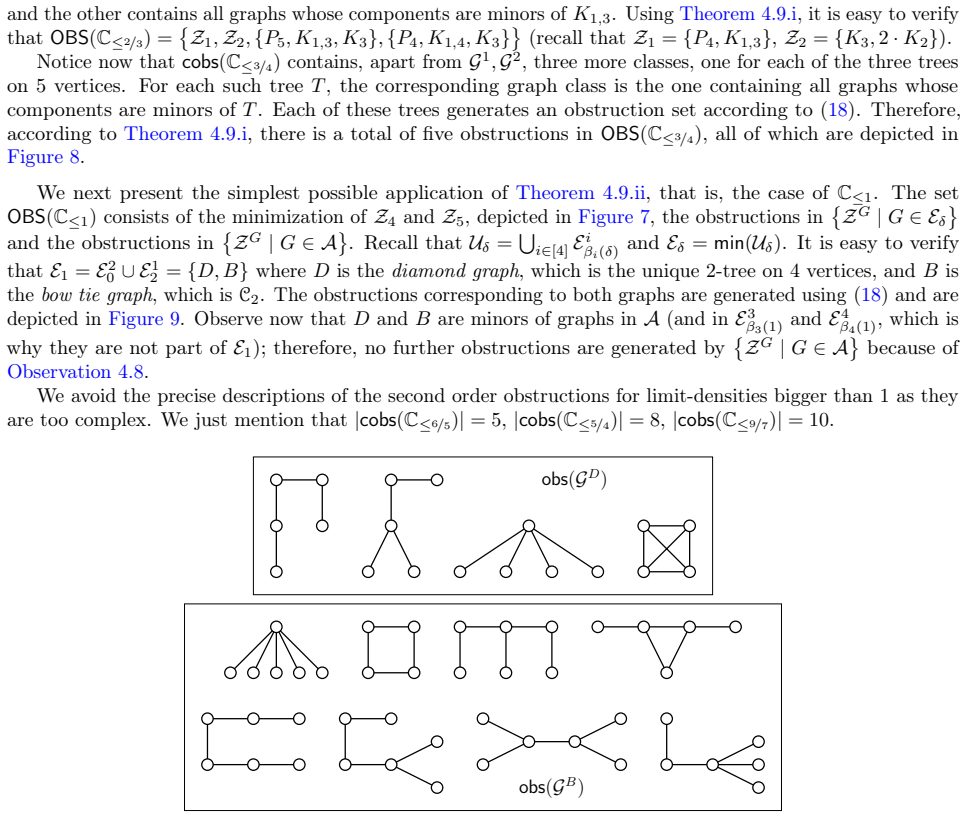
- The paper would benefit from a small table or diagram in the introduction that lists the identified minimal classes for a few sample values of δ (e.g., δ = 1 and δ = 1.4) to illustrate the classification.
Simulated Author's Rebuttal
We thank the referee for their positive assessment and recommendation to accept the manuscript. The report accurately captures the main contributions: the finiteness and explicit classification of minimal minor-closed classes with density exceeding any fixed δ < 3/2, together with the resulting 2^{poly(n)}-time algorithm for computing δ(excl(Z)).
Circularity Check
No significant circularity identified
full rationale
The paper's central result establishes finiteness and explicit identification of minimal minor-closed classes with limiting density >δ for δ<3/2, resting on the independently known background fact (stated in the abstract) that δ(G) is rational for minor-closed G. No equations, definitions, or self-citations in the provided text reduce the claimed finiteness or algorithmic consequence to a fitted parameter, self-referential quantity, or load-bearing self-citation chain. The derivation is self-contained against external benchmarks.
Axiom & Free-Parameter Ledger
axioms (1)
- domain assumption The limiting density δ(G) is a rational number whenever G is minor-closed.
Reference graph
Works this paper leans on
-
[1]
Fomin, Ignasi Sau, and Dimitrios M
Isolde Adler, Frederic Dorn, Fedor V. Fomin, Ignasi Sau, and Dimitrios M. Thilikos. Faster parameterized algorithms for minor containment.Theoretical Computer Science, 412(50):7018–7028, 2011.doi:10.1016/ j.tcs.2011.09.015. 26
2011
-
[2]
Daniel Bienstock, Neil Robertson, Paul D. Seymour, and Robin Thomas. Quickly excluding a forest.J. Comb. Theory B, 52(2):274–283, 1991.doi:10.1016/0095-8956(91)90068-U. 3
-
[3]
Bodlaender
Hans L. Bodlaender. A linear-time algorithm for finding tree-decompositions of small treewidth.SIAM Journal on Computing Computing, 25(6):1305–1317, 1996. 26
1996
-
[4]
Jannis Bulian and Anuj Dawar. Fixed-parameter tractable distances to sparse graph classes.Algorithmica, 79(1):139–158, 2017.doi:10.1007/s00453-016-0235-7. 21
-
[5]
Towards tight(er) bounds for the excluded grid theorem.J
Julia Chuzhoy and Zihan Tan. Towards tight(er) bounds for the excluded grid theorem.J. Combin. Theory Ser. B, 146:219–265, 2021.doi:10.1016/j.jctb.2020.09.010. 26
-
[6]
Springer, Heidelberg, fourth edition, 2010.doi:10.1007/978-3-642-14279-6
Reinhard Diestel.Graph theory, volume 173 ofGraduate Texts in Mathematics. Springer, Heidelberg, fourth edition, 2010.doi:10.1007/978-3-642-14279-6. 5 29
-
[7]
Asymptotic study of subcritical graph classes.SIAM J
Michael Drmota, Éric Fusy, Mihyun Kang, Veronika Kraus, and Juanjo Rué. Asymptotic study of subcritical graph classes.SIAM J. Discret. Math., 25(4):1615–1651, 2011.doi:10.1137/100790161. 23
-
[8]
Densities of minor-closed graph families.Electron
David Eppstein. Densities of minor-closed graph families.Electron. J. Comb., 17(1), 2010.doi:10.37236/
2010
-
[9]
P. Erdős and L. Pósa. On independent circuits contained in a graph.Canadian J. Math., 17:347–352, 1965.doi:10.4153/CJM-1965-035-8. 7
-
[10]
The metamathematics of the graph minor theorem
Harvey Friedman, Neil Robertson, and Paul Seymour. The metamathematics of the graph minor theorem. InLogic and combinatorics (Arcata, Calif., 1985), volume 65 ofContemp. Math., pages 229–261. Amer. Math. Soc., Providence, RI, 1987.doi:10.1090/conm/065/891251. 29
-
[11]
The disjoint paths problem in quadratic time.J
Ken ichi Kawarabayashi, Yusuke Kobayashi, and Bruce Reed. The disjoint paths problem in quadratic time.J. Combin. Theory Ser. B, 102(2):424–435, 2012.doi:10.1016/j.jctb.2011.07.004. 4
-
[12]
A note on well quasi-orderings for powersets.Inf
Petr Jancar. A note on well quasi-orderings for powersets.Inf. Process. Lett., 72(5–6):155–160, 1999. doi:10.1016/S0020-0190(99)00149-0. 4, 6
-
[13]
Densities of minor-closed graph classes are rational, 2020
Rohan Kapadia and Sergey Norin. Densities of minor-closed graph classes are rational, 2020. URL: https://arxiv.org/abs/2009.13482,arXiv:2009.13482. 3, 29
arXiv 2020
-
[14]
Tuukka Korhonen, Michal Pilipczuk, and Giannos Stamoulis. Minor containment and disjoint paths in almost-linear time. In65th IEEE Annual Symposium on Foundations of Computer Science, FOCS 2024, Chicago, IL, USA, October 27-30, 2024, pages 53–61. IEEE, 2024.doi:10.1109/FOCS61266.2024.00014. 4
-
[15]
Alexandr V. Kostochka. Lower bound of the hadwiger number of graphs by their average degree.Comb., 4(4):307–316, 1984.doi:10.1007/BF02579141. 3
-
[16]
Upper bounds on the graph minor theorem
Martin Krombholz and Michael Rathjen. Upper bounds on the graph minor theorem. InWell-quasi orders in computation, logic, language and reasoning—a unifying concept of proof theory, automata theory, formal languages and descriptive set theory, volume 53 ofTrends Log. Stud. Log. Libr., pages 145–159. Springer, Cham, 2020. [2020]©2020. URL:https://doi.org/10...
-
[17]
Wolfgang K.W. Mader. Homomorphieeigenschaften und mittlere Kantendichte von Graphen.Math. Ann., 174:265–268, 1967. 3
1967
-
[18]
Fine analysis of the quasi-orderings on the power set.Order, 18(4):339–347, 2001
Alberto Marcone. Fine analysis of the quasi-orderings on the power set.Order, 18(4):339–347, 2001. doi:10.1023/A:1013952225669. 4, 6
-
[19]
On the critical densities of minor-closed classes.Eur
Colin McDiarmid and Michal Przykucki. On the critical densities of minor-closed classes.Eur. J. Comb., 75:66–91, 2019. URL:https://doi.org/10.1016/j.ejc.2018.08.002, doi:10.1016/J.EJC.2018.08
- [20]
-
[21]
Christophe Paul, Evangelos Protopapas, and Dimitrios M. Thilikos. Universal obstructions of graph parameters, 2023. URL:https://arxiv.org/abs/2304.14121,arXiv:2304.14121. 4, 6, 21
Pith/arXiv arXiv 2023
-
[22]
Towards better: a motivated introduction to better-quasi-orders.EMS Surv
Yann Pequignot. Towards better: a motivated introduction to better-quasi-orders.EMS Surv. Math. Sci., 4(2):185–218, 2017.doi:10.4171/EMSS/4-2-2. 6
-
[23]
Pu Qiao and Xingzhi Zhan. Relation between the number of leaves of a tree and its diameter.Czechoslovak Mathematical Journal, 72(147):365–369, 2022. URL: https://arxiv.org/abs/1904.12150, doi:10. 21136/CMJ.2021.0149-20. 7 30
Pith/arXiv arXiv 2022
-
[24]
Neil Robertson and Paul D. Seymour. Graph minors. I. excluding a forest.J. Comb. Theory B, 35(1):39–61, 1983.doi:10.1016/0095-8956(83)90079-5. 3
-
[25]
Neil Robertson and Paul D. Seymour. Graph minors. V. Excluding a planar graph.J. Combin. Theory Ser. B, 41(1):92–114, 1986.doi:10.1016/0095-8956(86)90030-4. 7
-
[26]
Neil Robertson and Paul D. Seymour. Graph minors. XIII. The disjoint paths problem.J. Combin. Theory Ser. B, 63(1):65–110, 1995.doi:10.1006/jctb.1995.1006. 4
-
[27]
Neil Robertson and Paul D. Seymour. Graph minors. XX. Wagner’s conjecture.J. Comb. Theory B, 92(2):325–357, 2004. URL:https://doi.org/10.1016/j.jctb.2004.08.001, doi:10.1016/J.JCTB. 2004.08.001. 4, 5, 6
-
[28]
Well-quasi-ordering infinite graphs with forbidden finite planar minor.Trans
Robin Thomas. Well-quasi-ordering infinite graphs with forbidden finite planar minor.Trans. Amer. Math. Soc., 312(1):279–313, 1989.doi:10.2307/2001217. 6
-
[29]
An extremal function for contractions of graphs.Mathematical Proceedings of the Cambridge Philosophical Society, 95(2):261–265, 1984
Andrew Thomason. An extremal function for contractions of graphs.Mathematical Proceedings of the Cambridge Philosophical Society, 95(2):261–265, 1984. 3
1984
-
[30]
Andrew Thomason. The extremal function for complete minors.Journal of Combinatorial Theory, Series B, 81(2):318–338, 2001.doi:10.1006/jctb.2000.2013. 3
-
[31]
Extremal functions for graph minors
Andrew Thomason. Extremal functions for graph minors. In B. S. Webb, editor,Topics in Discrete Mathematics, volume 26 ofAlgorithms and Combinatorics, pages 359–380. Springer Berlin Heidelberg, Berlin, Heidelberg, 2006.doi:10.1007/978-3-540-32439-3_17. 3
-
[32]
On the extremal function for graph minors.J
Andrew Thomason and Matthew Wales. On the extremal function for graph minors.J. Graph Theory, 101(1):66–78, 2022. URL:https://doi.org/10.1002/jgt.22811,doi:10.1002/JGT.22811. 3
-
[33]
A tight Erdős- Pósa function for planar minors.Adv
Wouter Cames van Batenburg, Tony Huynh, Gwenaël Joret, and Jean-Florent Raymond. A tight Erdős- Pósa function for planar minors.Adv. Comb., pages Paper No. 2, 33, 2019.doi:10.19086/aic.10807. 7 31
discussion (0)
Sign in with ORCID, Apple, or X to comment. Anyone can read and Pith papers without signing in.