ComputeFHE: A Privacy-Preserving General-Purpose Computation Library
Pith reviewed 2026-06-25 23:27 UTC · model grok-4.3
The pith
ComputeFHE supplies C++ encrypted data types and operations on TFHE that cut bootstrapping steps and reach up to 3.9x speedup on selected operations.
A machine-rendered reading of the paper's core claim, the machinery that carries it, and where it could break.
Core claim
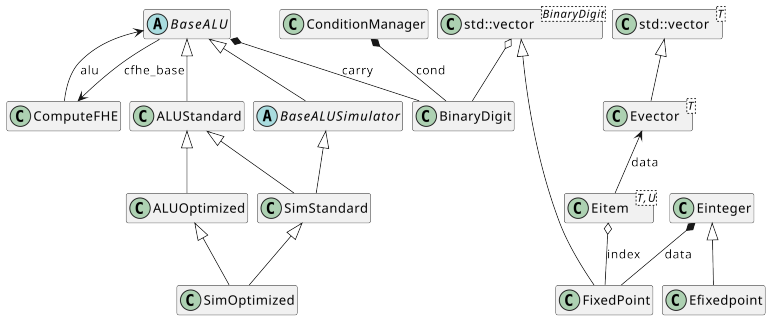
ComputeFHE is a library that enables general-purpose computation on encrypted data by providing encrypted integer and fixed-point types together with a full set of arithmetic, logical, comparison, conditional, and oblivious array-access operations, implemented both through conventional two-input TFHE gates and through an optimized ALU architecture that uses FHE-friendly logic primitives to reduce the number of bootstrapping operations.
What carries the argument
The optimized Arithmetic Logic Unit (ALU) architecture utilizing FHE-friendly logic primitives, which replaces standard two-input gate circuits to lower the bootstrapping count for arithmetic and logical operations.
If this is right
- Developers can express algorithms in ordinary imperative style while operating directly on encrypted data.
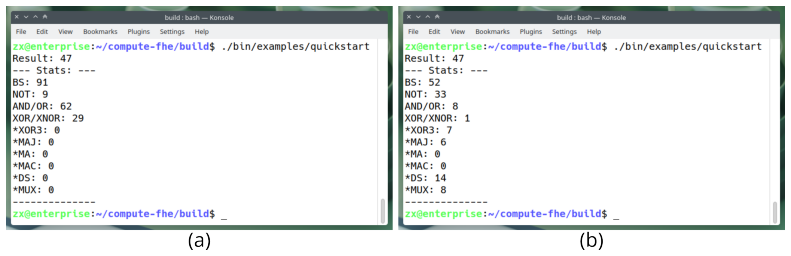
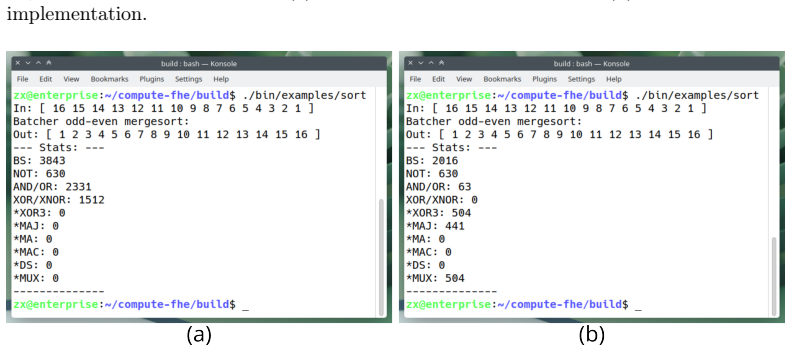
- Selected arithmetic and logical operations require fewer bootstrapping steps than standard TFHE gate circuits.
- A simulation mode supplies circuit-complexity and bootstrapping-cost estimates without executing cryptographic primitives.
- Both the conventional gate-based path and the optimized ALU path can be used within the same library.
Where Pith is reading between the lines
- The simulation mode could support automated tools that rewrite circuits to further reduce bootstrapping before any encrypted execution occurs.
- The library's C++ interface may allow direct reuse of existing non-encrypted codebases with minimal changes when privacy requirements arise.
- Wider availability of such a library could shift experimental privacy-preserving work from specialized research groups toward ordinary software teams.
Load-bearing premise
The reported reductions in bootstrapping operations and the 3.9x performance gains depend on the particular workloads, hardware platform, and baseline implementations chosen for the experiments.
What would settle it
Public replication of the reported operations on documented workloads and hardware that measures either no reduction in bootstrapping count or a speedup materially below 3.9x.
Figures
read the original abstract
Fully Homomorphic Encryption (FHE) enables computations to be performed directly on encrypted data while preserving data confidentiality. However, its practical applications remain limited by high computational costs and development complexity. This paper presents ComputeFHE, an open-source C++ library that facilitates the development of privacy-preserving applications based on the TFHE cryptosystem. The library provides encrypted integer and fixed-point data types together with arithmetic, logical, comparison, conditional, and oblivious array-access operations which allow developers to implement algorithms using a familiar imperative programming paradigm. ComputeFHE supports both conventional TFHE arithmetic based on standard two-input logic gates and an optimized Arithmetic Logic Unit (ALU) architecture utilizing FHE-friendly logic primitives. Experimental results demonstrate significant reductions in the number of required bootstrapping operations, achieving performance improvements of up to 3.9x for selected operations. In addition, the library includes a simulation mode that enables testing, debugging, and complexity analysis without performing actual cryptographic computations while providing circuit complexity and bootstrapping costs. Built on top of OpenFHE, ComputeFHE offers a practical and accessible framework for developing and evaluating privacy-preserving algorithms and applications.
Editorial analysis
A structured set of objections, weighed in public.
Referee Report
Summary. The manuscript presents ComputeFHE, an open-source C++ library built on OpenFHE for TFHE-based fully homomorphic encryption. It offers encrypted integer and fixed-point types with arithmetic, logical, comparison, conditional, and oblivious array access operations. The library supports both conventional TFHE gate-based arithmetic and an optimized ALU architecture using FHE-friendly primitives, claiming reductions in bootstrapping operations and up to 3.9x performance improvements for selected operations. It also includes a simulation mode for testing and complexity analysis without actual computations.
Significance. If the performance claims are substantiated with reproducible experiments, the library could provide a practical tool for developers to implement privacy-preserving algorithms using an imperative paradigm, potentially reducing development complexity in FHE applications. The dual architecture and simulation mode are notable features. However, the current presentation of results limits the ability to assess the significance of the optimizations.
major comments (1)
- [Abstract] Abstract: The claim of 'significant reductions in the number of required bootstrapping operations, achieving performance improvements of up to 3.9x for selected operations' supplies no workload definitions, hardware platform, baseline (library's own conventional path or external), input sizes, OpenFHE version, or measurement protocol. Without these, the quantitative result cannot be verified and is load-bearing for the central claim that the optimized ALU yields the reported gains.
minor comments (1)
- [Abstract] Abstract: The qualifier 'selected operations' is imprecise; the manuscript should enumerate the tested operations and their input sizes to permit evaluation of whether they are representative.
Simulated Author's Rebuttal
We thank the referee for the constructive feedback. We address the single major comment below and agree that revisions are needed to strengthen verifiability of the performance claims.
read point-by-point responses
-
Referee: [Abstract] Abstract: The claim of 'significant reductions in the number of required bootstrapping operations, achieving performance improvements of up to 3.9x for selected operations' supplies no workload definitions, hardware platform, baseline (library's own conventional path or external), input sizes, OpenFHE version, or measurement protocol. Without these, the quantitative result cannot be verified and is load-bearing for the central claim that the optimized ALU yields the reported gains.
Authors: We agree that the abstract, standing alone, omits the experimental parameters needed to assess the 3.9x claim. The full manuscript provides these details in the Experimental Evaluation section (workloads consisting of selected arithmetic, logical, and comparison operations on encrypted integers and fixed-point values; hardware platform; baseline as the library's own conventional TFHE gate-based path; input sizes; OpenFHE version; and timing protocol). To make the central claim verifiable without requiring the reader to consult the body, we will revise the abstract to concisely state the key experimental conditions and workloads used for the reported speedup. revision: yes
Circularity Check
No circularity; library implementation with empirical measurements only
full rationale
The paper describes an open-source C++ library built on OpenFHE that supplies encrypted data types and operations, plus a simulation mode. The sole quantitative claim is an experimental observation of up to 3.9x speedup and reduced bootstrapping counts for selected operations. No equations, fitted parameters, predictions, or self-citations appear in the abstract or described content. The reported speedups are direct measurements of the implemented artifact rather than quantities derived from any internal definition or prior self-citation, so the contribution remains self-contained and non-circular.
Axiom & Free-Parameter Ledger
axioms (2)
- standard math TFHE cryptosystem security reduces to the hardness of the Learning With Errors problem
- domain assumption OpenFHE provides a correct and efficient implementation of TFHE primitives
Reference graph
Works this paper leans on
-
[1]
T. V. T. Doan, M.-L. Messai, G. Gavin, J. Darmont, A survey on implementations of homomorphic encryption schemes: Dt van thao et al., The Journal of Supercomputing 79 (13) (2023) 15098–15139. doi:10.1007/s11227-023-05233-z
-
[2]
Fully homomorphic encryption using ideal lattices , booktitle =
C. Gentry, Fully homomorphic encryption using ideal lattices, in: Pro- ceedings of the forty-first annual ACM symposium on Theory of com- puting, 2009, pp. 169–178.doi:10.1145/1536414.1536440
-
[3]
Chillotti, N
I. Chillotti, N. Gama, M. Georgieva, M. Izabachene, Faster fully ho- momorphic encryption: Bootstrapping in less than 0.1 seconds, in: international conference on the theory and application of cryptology and information security, Springer, 2016, pp. 3–33.doi:10.1007/ 978-3-662-53887-6_1
2016
-
[4]
I. Chillotti, N. Gama, M. Georgieva, M. Izabachène, Faster packed homomorphic operations and efficient circuit bootstrapping for tfhe, in: International Conference on the Theory and Application of Cryp- tology and Information Security, Springer, 2017, pp. 377–408.doi: 10.1007/978-3-319-70694-8_14
-
[5]
J. H. Cheon, K. Han, A. Kim, M. Kim, Y. Song, A full rns variant of approximate homomorphic encryption, in: International Conference on Selected Areas in Cryptography, Springer, 2018, pp. 347–368.doi: 10.1007/978-3-030-10970-7_16
-
[6]
doi:10.1109/ACCESS.2024.3461729
L.Bai, L.Bai, Y.Li, Z.Li, Researchonnoisemanagementtechnologyfor fully homomorphic encryption, IEEE Access 12 (2024) 135564–135576. doi:10.1109/ACCESS.2024.3461729
-
[7]
L. Bergerat, J.-B. Orfila, A. Roux-Langlois, S. Tap, Accelerating tfhe with sorted bootstrapping techniques, in: International Conference on the Theory and Application of Cryptology and Information Security, Springer, 2025, pp. 68–100.doi:10.1007/978-981-95-5122-4_3
-
[8]
B. Xiang, J. Zhang, Y. Deng, Y. Dai, D. Feng, Fast blind rotation for bootstrapping fhes, in: Annual International Cryptology Conference, Springer, 2023, pp. 3–36.doi:10.1007/978-3-031-38551-3_1
-
[9]
I. Chillotti, D. Ligier, J.-B. Orfila, S. Tap, Improved programmable bootstrapping with larger precision and efficient arithmetic circuits for tfhe, in: International Conference on the Theory and Application of 15 Cryptology and Information Security, Springer, 2021, pp. 670–699.doi: 10.1007/978-3-030-92078-4_23
-
[10]
Zama, Concrete: TFHE Compiler that converts python programs into FHE equivalent,https://github.com/zama-ai/concrete(2022)
2022
-
[11]
com/zama-ai/concrete-ml(2022)
Zama, Concrete ML: a privacy-preserving machine learning library us- ing fully homomorphic encryption for data scientists,https://github. com/zama-ai/concrete-ml(2022)
2022
-
[12]
Zama, TFHE-rs: A Pure Rust Implementation of the TFHE Scheme for Boolean and Integer Arithmetics Over Encrypted Data,https:// github.com/zama-ai/tfhe-rs(2022)
2022
-
[13]
C. Gouert, D. Mouris, N. G. Tsoutsos, Helm: Navigating homomor- phic encryption through gates and lookup tables, IEEE Transactions on Information Forensics and Security (2025).doi:10.1109/TIFS.2025. 3544066
-
[14]
Chaturvedi, A
B. Chaturvedi, A. Chatterjee, A. Chattopadhyay, D. Mukhopadhyay, Bolt: Bootstrapping-aware logic resynthesis and technology mapping for efficient tfhe circuits, Cryptology ePrint Archive (2026)
2026
-
[15]
F. S. Taşel, A. N. Saran, Improved arithmetic efficiency in tfhe through gate-level optimizations: Fs taşel, an saran, The Journal of Supercom- puting 81 (18) (2025) 1633.doi:10.1007/s11227-025-08107-8
-
[16]
Boemer, S
F. Boemer, S. Kim, G. Seifu, F. D. de Souza, V. Gopal, et al., In- tel HEXL (release 1.2),https://github.com/intel/hexl(september 2021)
2021
-
[17]
D. Micciancio, Y. Polyakov, Bootstrapping in fhew-like cryptosystems, in: Proceedings of the 9th on Workshop on Encrypted Computing & Applied Homomorphic Cryptography, 2021, pp. 17–28.doi:10.1145/ 3474366.3486924. 16
arXiv 2021
discussion (0)
Sign in with ORCID, Apple, or X to comment. Anyone can read and Pith papers without signing in.