On the Stability of Prompt Ranking in Large Language Model Evaluation
Pith reviewed 2026-06-25 23:55 UTC · model grok-4.3
The pith
Prompt rankings in LLM evaluations frequently change with small variations in seeds or data subsets, making top prompt selection unreliable.
A machine-rendered reading of the paper's core claim, the machinery that carries it, and where it could break.
Core claim
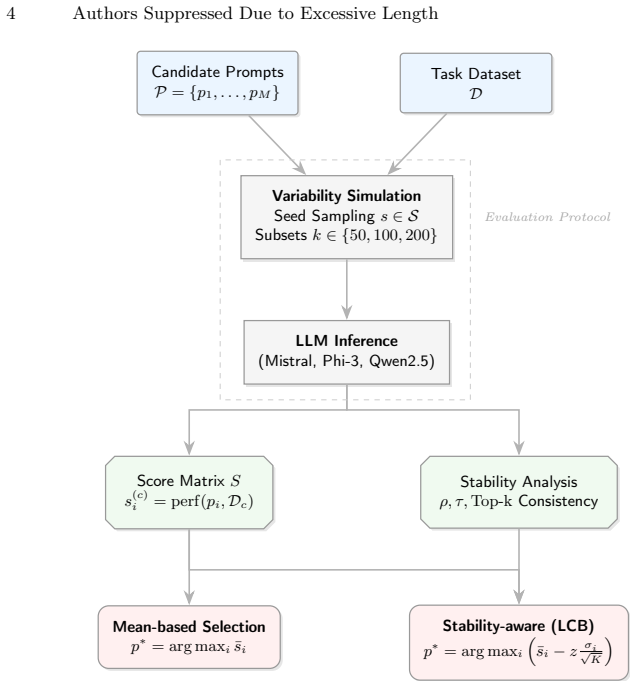
Across three open-weight LLMs and two benchmark tasks, prompt rankings exhibit instability under variations in random seeds and evaluation subsets, with the top-performing prompt changing frequently despite moderate to high overall rank correlations. A lower confidence bound selection strategy that incorporates variance improves robustness in unstable settings while staying competitive in stable ones.
What carries the argument
Lower confidence bound selection that combines mean performance with variance estimates across repeated evaluation conditions to rank prompts.
If this is right
- Selecting the prompt with the highest lower confidence bound reduces the chance of choosing one that only appears best due to a lucky seed or subset.
- Reporting only average performance or rank correlation can mask frequent flips in the actual top prompt.
- Variance-aware selection remains competitive even when evaluation conditions are stable, so the added computation does not sacrifice performance.
- LLM benchmarking workflows that ignore evaluation variance risk publishing or deploying prompts that do not generalize across minor run differences.
Where Pith is reading between the lines
- Standard practice in prompt engineering and model cards may need to include multiple seeds or subset sizes as routine reporting requirements.
- The same lower-confidence-bound logic could apply to other ranking-based decisions such as hyperparameter search or model selection where variance across runs is observable.
- Developers might adopt a default of evaluating each prompt at least three times with different seeds before final selection to surface unstable candidates early.
Load-bearing premise
The variability from random seeds and limited evaluation subsets is representative of the uncertainty that matters for real prompt selection decisions.
What would settle it
Run a large-scale held-out evaluation with many more seeds and full data; check whether the lower-confidence-bound prompt consistently underperforms the prompt that actually scores highest on that held-out set.
Figures
read the original abstract
Prompt-based interaction has become a dominant paradigm for using large language models (LLMs), where multiple candidate prompts are evaluated and the top-ranked one is selected for downstream use. This workflow implicitly assumes that prompt rankings are stable under minor variations in evaluation conditions. In this paper, we systematically study prompt ranking stability under common sources of variability, including random seeds and limited evaluation subsets. Across three open-weight LLMs and two benchmark tasks, we find that while overall rank correlations are often moderate to high, the identity of the top-performing prompt frequently changes, leading to unreliable selection decisions. To address this issue, we propose a simple stability-aware selection strategy based on a lower confidence bound, which accounts for both performance and variance. Our results show that this approach improves robustness in unstable settings while remaining competitive in more stable regimes. These findings highlight the importance of accounting for evaluation uncertainty in prompt selection and LLM benchmarking.
Editorial analysis
A structured set of objections, weighed in public.
Referee Report
Summary. The paper claims that prompt rankings for LLMs are unstable under common sources of variability such as random seeds and limited evaluation subsets: while overall rank correlations are often moderate to high, the identity of the top prompt frequently changes. It proposes a lower-confidence-bound (LCB) selection rule that trades off observed mean performance against variance across replicates and subsets, and reports that this rule improves robustness in unstable regimes while remaining competitive in stable ones. The study is conducted across three open-weight LLMs and two benchmark tasks.
Significance. If the empirical findings hold, the work is significant for LLM evaluation and prompt engineering practice because it identifies a concrete source of unreliability in the standard mean-based selection workflow and offers a simple, variance-aware alternative. The multi-model, multi-task design is a strength that increases the generality of the instability observation.
major comments (2)
- [Abstract and §3] Abstract and §3 (LCB selector definition): the claim that the LCB rule 'improves robustness in unstable settings' rests on variance estimates whose sampling reliability is not verified; with only a handful of seeds or small subsets the sample variance itself has high sampling error, yet no standard errors on the variance estimates, sensitivity analysis to replicate count, or comparison against bootstrap/Bayesian alternatives that propagate variance uncertainty are reported.
- [Experimental results (§4–5)] Experimental results (presumably §4–5): the reported rank correlations and top-prompt change frequencies are presented without accompanying statistical tests or confidence intervals on the instability metrics themselves, so it is unclear whether the observed changes exceed what would be expected from finite-sample noise alone.
minor comments (2)
- [§3] Notation for the LCB formula should be introduced with an explicit equation number and a clear statement of the quantile or multiplier used (e.g., 95 % one-sided bound).
- [§4] The paper should state the exact number of random seeds and subset sizes used in each experiment so that readers can assess the degrees of freedom available for variance estimation.
Simulated Author's Rebuttal
We thank the referee for the constructive comments on our work regarding prompt ranking stability. We address each major comment below.
read point-by-point responses
-
Referee: [Abstract and §3] Abstract and §3 (LCB selector definition): the claim that the LCB rule 'improves robustness in unstable settings' rests on variance estimates whose sampling reliability is not verified; with only a handful of seeds or small subsets the sample variance itself has high sampling error, yet no standard errors on the variance estimates, sensitivity analysis to replicate count, or comparison against bootstrap/Bayesian alternatives that propagate variance uncertainty are reported.
Authors: We agree that sampling variability in the variance estimates merits attention, particularly with limited replicates. Our LCB formulation is presented as a practical heuristic that incorporates observed variance to improve selection robustness, and the empirical gains are shown consistently across three models and two tasks. To strengthen the analysis, we will add a sensitivity study varying the number of replicates used for variance estimation and include standard errors on key variance-derived quantities where appropriate. revision: partial
-
Referee: [Experimental results (§4–5)] Experimental results (presumably §4–5): the reported rank correlations and top-prompt change frequencies are presented without accompanying statistical tests or confidence intervals on the instability metrics themselves, so it is unclear whether the observed changes exceed what would be expected from finite-sample noise alone.
Authors: The reported metrics are intended as descriptive evidence of the instability phenomenon. We will incorporate bootstrap confidence intervals around the rank correlations and top-prompt change frequencies in the revised manuscript to better quantify uncertainty and address whether the observed instability exceeds finite-sample expectations. revision: yes
Circularity Check
Empirical study with no derivation chain or self-referential reductions
full rationale
The paper is an empirical investigation of prompt ranking stability across random seeds and evaluation subsets on three LLMs and two tasks. It reports observed rank correlations and top-prompt changes, then defines an LCB selection rule directly from sample means and variances. No equations, predictions, or uniqueness claims reduce to fitted inputs by construction; the LCB is a standard statistical construct applied to the observed data rather than derived from prior self-citations or ansatzes. The work is self-contained against external benchmarks with no load-bearing self-citation chains.
Axiom & Free-Parameter Ledger
Reference graph
Works this paper leans on
-
[1]
AI, M.: Mistral-7b-instruct-v0.3.https://huggingface.co/mistralai/ Mistral-7B-Instruct-v0.3(2024), accessed: 2026-03-23
2024
-
[2]
In: Larochelle, H., Ranzato, M., Hadsell, R., Balcan, M., Lin, H
Brown, T.B., Mann, B., Ryder, N., Subbiah, M., Kaplan, J., Dhariwal, P., Nee- lakantan, A., Shyam, P., Sastry, G., Askell, A., Agarwal, S., Herbert-Voss, A., Krueger, G., Henighan, T., Child, R., Ramesh, A., Ziegler, D.M., Wu, J., Win- ter, C., Hesse, C., Chen, M., Sigler, E., Litwin, M., Gray, S., Chess, B., Clark, J., Berner, C., McCandlish, S., Radford...
2020
-
[3]
In: Inui, K., Jiang, J., Ng, V., Wan, X
Dodge, J., Gururangan, S., Card, D., Schwartz, R., Smith, N.A.: Show your work: Improved reporting of experimental results. In: Inui, K., Jiang, J., Ng, V., Wan, X. (eds.) Proceedings of the 2019 Conference on Empirical Methods in Natu- ral Language Processing and the 9th International Joint Conference on Natural Language Processing, EMNLP-IJCNLP 2019, Ho...
2019
-
[4]
Show Your Work: Improved Reporting of Experimental Results
pp. 2185–2194. Association for Computational Linguistics (2019).https: //doi.org/10.18653/V1/D19-1224,https://doi.org/10.18653/v1/D19-1224 12 Authors Suppressed Due to Excessive Length
-
[5]
The hitchhiker’s guide to test- ing statistical significance in natural language processing
Dror, R., Baumer, G., Shlomov, S., Reichart, R.: The hitchhiker’s guide to test- ing statistical significance in natural language processing. In: Gurevych, I., Miyao, Y. (eds.) Proceedings of the 56th Annual Meeting of the Association for Com- putational Linguistics, ACL 2018, Melbourne, Australia, July 15-20, 2018, Vol- ume 1: Long Papers. pp. 1383–1392....
-
[6]
In: Koyejo, S., Mohamed, S., Agarwal, A., Bel- grave, D., Cho, K., Oh, A
Kojima, T., Gu, S.S., Reid, M., Matsuo, Y., Iwasawa, Y.: Large language mod- els are zero-shot reasoners. In: Koyejo, S., Mohamed, S., Agarwal, A., Bel- grave, D., Cho, K., Oh, A. (eds.) Advances in Neural Information Process- ing Systems 35: Annual Conference on Neural Information Processing Sys- tems 2022, NeurIPS 2022, New Orleans, LA, USA, November 28...
2022
-
[7]
Microsoft: Phi-3-mini-4k-instruct.https://huggingface.co/microsoft/ Phi-3-mini-4k-instruct(2024), accessed: 2026-03-23
2024
-
[8]
5-7B-Instruct(2024), accessed: 2026-03-23
Qwen Team, A.G.: Qwen2.5-7b-instruct.https://huggingface.co/Qwen/Qwen2. 5-7B-Instruct(2024), accessed: 2026-03-23
2024
-
[9]
In: Proceedings of the 2017 Conference on Empirical Methods in Natural Language Processing, pp
Reimers, N., Gurevych, I.: Reporting score distributions makes a difference: Per- formance study of lstm-networks for sequence tagging. In: Palmer, M., Hwa, R., Riedel, S. (eds.) Proceedings of the 2017 Conference on Empirical Methods in Natural Language Processing, EMNLP 2017, Copenhagen, Denmark, September 9-11, 2017. pp. 338–348. Association for Comput...
-
[10]
Shen, Y., Wang, L., Shi, C., Du, S., Tao, Y., Shen, Y., Zhang, H.: Compara- tive analysis of listwise reranking with large language models in limited-resource language contexts. CoRRabs/2412.20061(2024).https://doi.org/10.48550/ ARXIV.2412.20061,https://doi.org/10.48550/arXiv.2412.20061
-
[11]
In: Croft, W.B., Moffat, A., van Rijsbergen, C.J., Wilkin- son, R., Zobel, J
Voorhees, E.M.: Variations in relevance judgments and the measurement of re- trieval effectiveness. In: Croft, W.B., Moffat, A., van Rijsbergen, C.J., Wilkin- son, R., Zobel, J. (eds.) SIGIR ’98: Proceedings of the 21st Annual International ACM SIGIR Conference on Research and Development in Information Retrieval, August 24-28 1998, Melbourne, Australia. ...
-
[12]
CoRRabs/2502.15770 (2025).https://doi.org/10.48550/ARXIV.2502.15770,https://doi.org/10
Wang, L., Shi, C., Du, S., Tao, Y., Shen, Y., Zheng, H., Shen, Y., Qiu, X.: Per- formance review on LLM for solving leetcode problems. CoRRabs/2502.15770 (2025).https://doi.org/10.48550/ARXIV.2502.15770,https://doi.org/10. 48550/arXiv.2502.15770
-
[13]
In: Koyejo, S., Mohamed, S., Agarwal, A., Bel- grave, D., Cho, K., Oh, A
Wei, J., Wang, X., Schuurmans, D., Bosma, M., Ichter, B., Xia, F., Chi, E.H., Le, Q.V., Zhou, D.: Chain-of-thought prompting elicits reasoning in large language models. In: Koyejo, S., Mohamed, S., Agarwal, A., Bel- grave, D., Cho, K., Oh, A. (eds.) Advances in Neural Information Process- ing Systems 35: Annual Conference on Neural Information Processing ...
2022
discussion (0)
Sign in with ORCID, Apple, or X to comment. Anyone can read and Pith papers without signing in.