Cycle-Consistent Neural Explanation of Formal Verification Certificates
Pith reviewed 2026-06-25 23:42 UTC · model grok-4.3
The pith
A cycle-consistent neural architecture generates natural language explanations of formal verification certificates that a symbolic verifier accepts 90 percent of the time.
A machine-rendered reading of the paper's core claim, the machinery that carries it, and where it could break.
Core claim
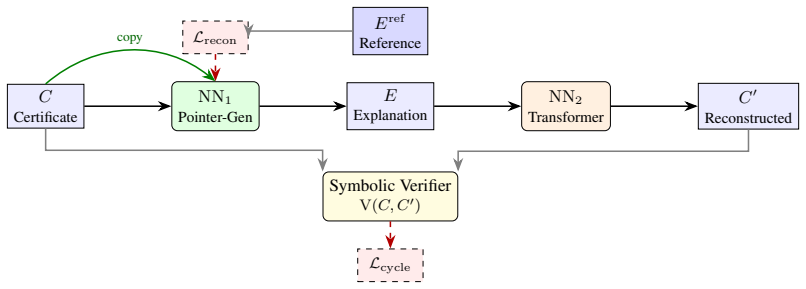
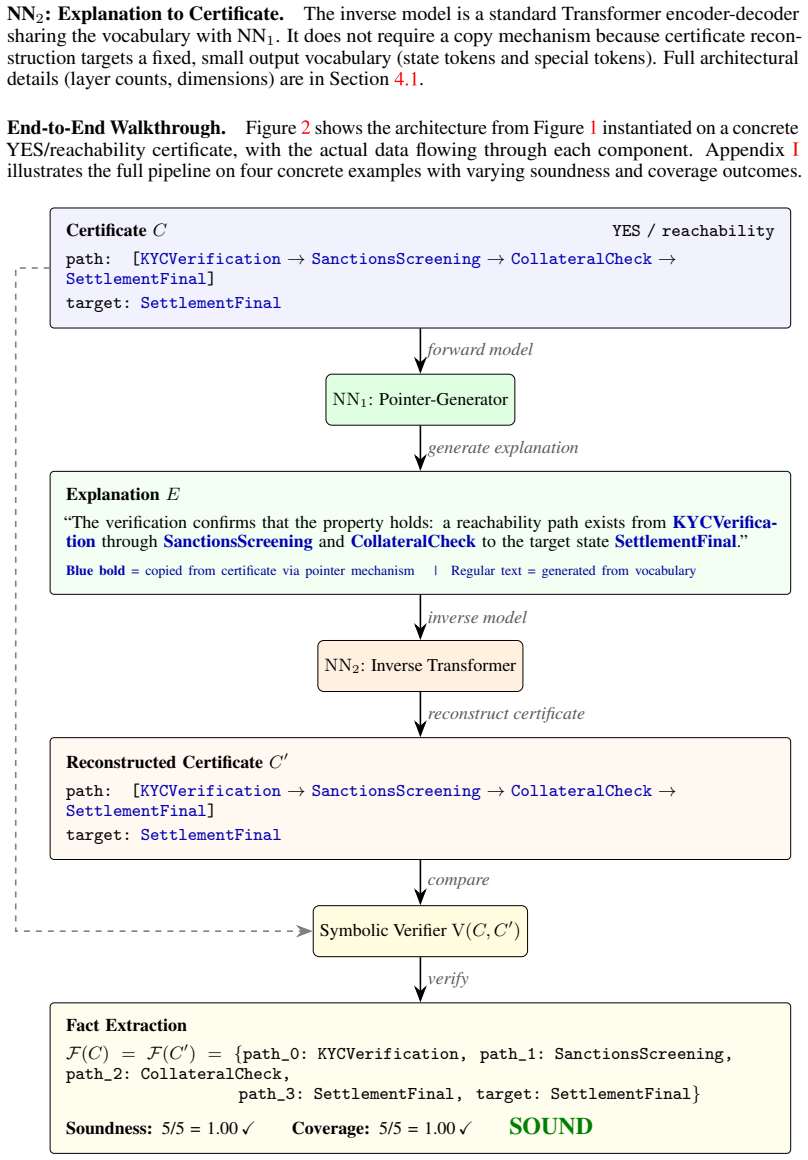
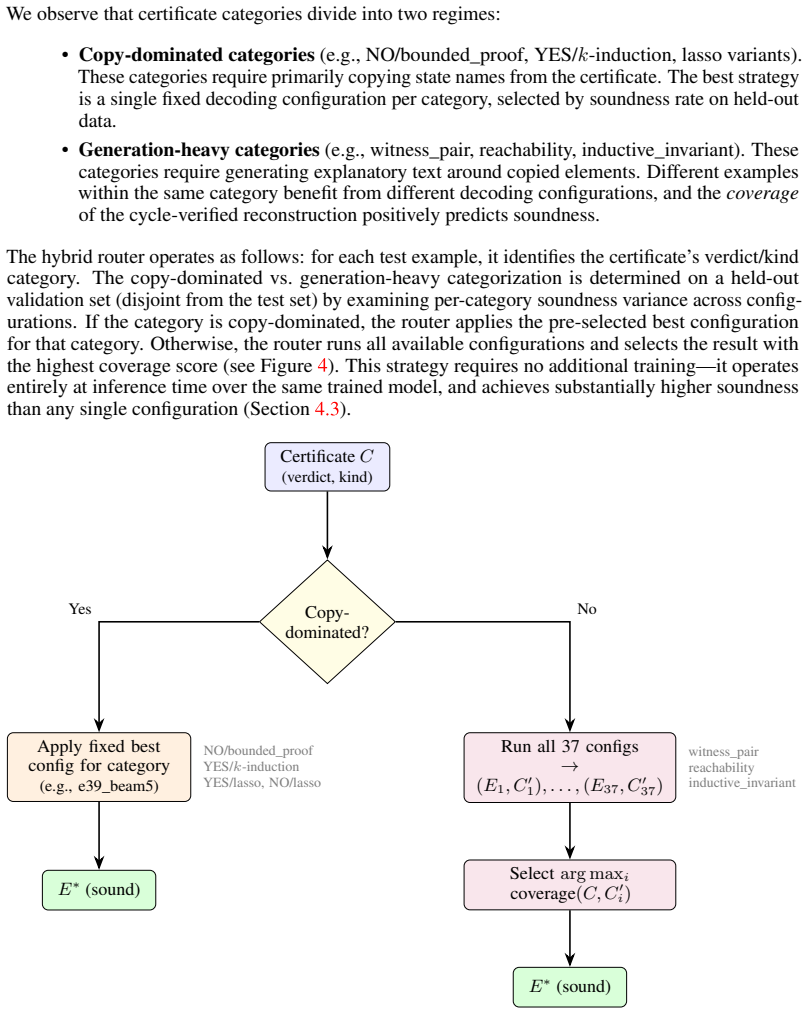
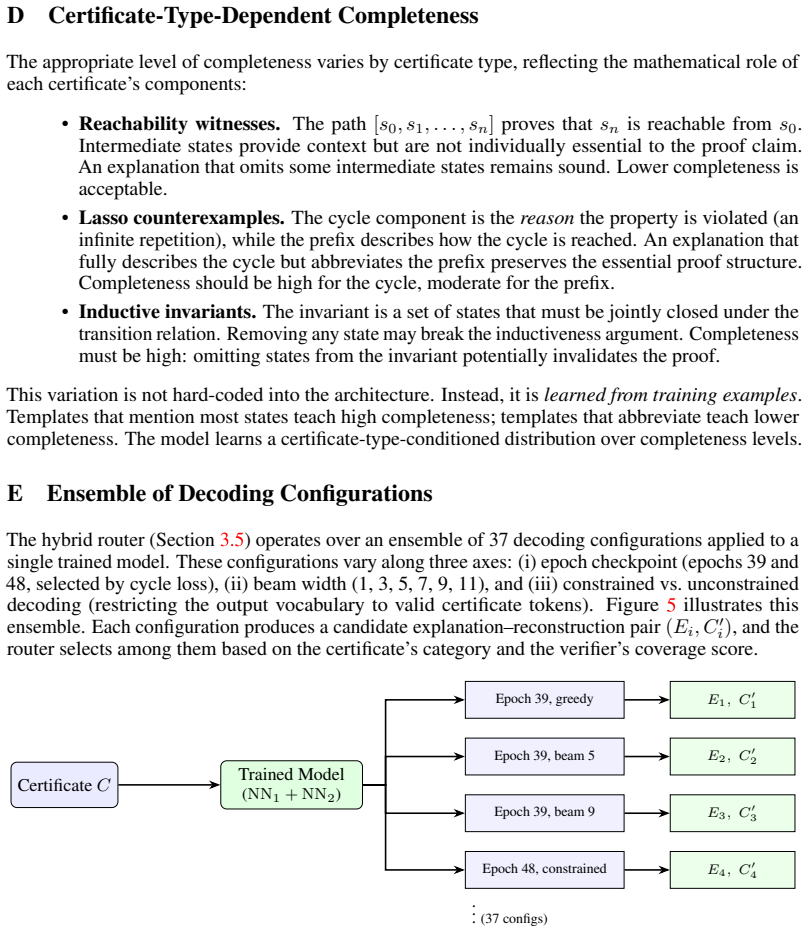
The cycle-consistent architecture maps certificates to explanations via NN1, reconstructs certificates from explanations via NN2, and uses a symbolic verifier on the reconstruction to produce a faithfulness proxy; when combined with a pointer-generator for lexical grounding and a hybrid inference router, the system attains 90.0 percent cycle-verified soundness across 420 test cases spanning six certificate kinds and both YES and NO verdicts.
What carries the argument
Cycle-consistent pair of networks NN1 and NN2 closed by a symbolic verifier that scores reconstruction soundness
If this is right
- The model achieves 90.0 percent cycle-verified soundness on the 420-certificate test set.
- It outperforms the best of 16 multi-LLM few-shot combinations by 13.9 percentage points.
- It wins on 10 of the 12 verdict-by-kind categories, with three categories at 100 percent.
- Inference completes in 185 ms per certificate versus 160 s for the full LLM baseline.
- The system runs offline with deterministic outputs and zero per-inference cost.
Where Pith is reading between the lines
- The same cycle-consistency loop could be adapted to explain other structured artifacts such as proof traces or model-checking counterexamples.
- Specialized training on domain-specific certificates may reduce reliance on general-purpose language models for technical explanation tasks.
- Hybrid routing that selects between the neural model and fallback methods could be tested on larger or more diverse verification datasets.
Load-bearing premise
Cycle consistency between the generated explanation and the reconstructed certificate reliably indicates that the explanation is semantically faithful and complete.
What would settle it
A set of explanations that pass the NN2 reconstruction and symbolic verifier check yet contain clear semantic mismatches with the original certificate when reviewed by a domain expert.
Figures
read the original abstract
Formal verification produces machine-checkable certificates that attest to the satisfaction or violation of temporal properties, yet these certificates remain opaque to non-specialist stakeholders. We propose a cycle-consistent neural architecture that generates faithful natural language explanations of verification certificates. A forward network NN1 maps certificates to explanations, and an inverse network NN2 reconstructs certificates from explanations; a symbolic verifier closes the loop, providing a differentiable faithfulness proxy. A pointer-generator mechanism ensures lexical grounding by copying state names directly from the certificate. We evaluate on 420 test certificates spanning six verification methods (bounded proof, k-induction, inductive invariant, lasso, reachability, witness pair) in both YES and NO verdict variants, drawn from a financial compliance domain with 207 named states. Our trained architecture, combined with a hybrid inference-time routing strategy, achieves 90.0% cycle-verified soundness, surpassing a multi- LLM few-shot baseline (76.1% for the best of 16 LLM combinations across four frontier models) by 13.9 percentage points. The neural model wins on 10 of 12 verdict/kind categories, with three categories reaching 100% soundness. The architecture offers 860x faster inference (185 ms vs. 160 s per certificate for the full multi-LLM baseline), offline operation, deterministic outputs, and zero per-inference cost. These results demonstrate that trained specialization outperforms general-purpose LLM prompting for structured certificate explanation, while eliminating the deployment constraints of cloud-based inference.
Editorial analysis
A structured set of objections, weighed in public.
Referee Report
Summary. The paper proposes a cycle-consistent neural architecture with a forward network NN1 mapping formal verification certificates to natural language explanations and an inverse network NN2 reconstructing certificates from explanations; a symbolic verifier closes the loop as a faithfulness proxy, augmented by a pointer-generator for lexical grounding. Evaluated on 420 held-out test certificates spanning six verification methods (bounded proof, k-induction, inductive invariant, lasso, reachability, witness pair) and both YES/NO verdicts from a financial compliance domain, the model with hybrid routing achieves 90.0% cycle-verified soundness, outperforming the best multi-LLM few-shot baseline (76.1%) by 13.9 points while providing 860x faster inference and offline operation.
Significance. If the cycle-consistency metric reliably indicates semantic faithfulness, the results show that domain-specialized neural models can outperform general-purpose LLM prompting on structured explanation tasks, with clear practical advantages in speed, determinism, and deployment constraints. The multi-method, multi-verdict evaluation and pointer-generator grounding are strengths that could support applications in explainable formal methods.
major comments (2)
- [Abstract] Abstract (architecture and faithfulness proxy paragraph): The central claim that 90.0% cycle-verified soundness demonstrates faithful explanations rests on the assumption that successful reconstruction by NN2 followed by symbolic verifier acceptance implies semantic completeness and correctness of the NN1-generated natural language text. However, the verifier only checks the reconstructed formal certificate; this does not rule out explanations that omit temporal details, use ambiguous phrasing, or fail to capture the certificate's full meaning, even with the pointer-generator ensuring lexical copying. This assumption is load-bearing for interpreting the metric as evidence of explanation quality.
- [Abstract] Abstract (evaluation paragraph): The reported 90.0% soundness and superiority over the 76.1% LLM baseline are based on 420 held-out certificates, but without details on training data splits, potential overfitting, exact hybrid routing definition, or any independent human/expert validation of explanation quality, it is difficult to assess whether the cycle-consistency proxy generalizes beyond reconstructibility. An ablation or correlation study between cycle-verified soundness and semantic metrics would be needed to support the claim.
minor comments (1)
- [Abstract] The abstract mentions 'three categories reaching 100% soundness' but does not specify which verdict/kind combinations these are; adding this detail would improve clarity of the per-category results.
Simulated Author's Rebuttal
We thank the referee for the constructive comments on the interpretation of our cycle-consistency metric and the need for clearer evaluation details. We address each point below and indicate planned revisions to the abstract and manuscript.
read point-by-point responses
-
Referee: [Abstract] Abstract (architecture and faithfulness proxy paragraph): The central claim that 90.0% cycle-verified soundness demonstrates faithful explanations rests on the assumption that successful reconstruction by NN2 followed by symbolic verifier acceptance implies semantic completeness and correctness of the NN1-generated natural language text. However, the verifier only checks the reconstructed formal certificate; this does not rule out explanations that omit temporal details, use ambiguous phrasing, or fail to capture the certificate's full meaning, even with the pointer-generator ensuring lexical copying. This assumption is load-bearing for interpreting the metric as evidence of explanation quality.
Authors: We agree that cycle-verified soundness functions as a reconstruction-based proxy rather than a direct guarantee of full semantic completeness. While the pointer-generator enforces lexical grounding and the symbolic verifier confirms reconstructibility, it cannot rule out omissions of temporal details or ambiguous phrasing. We will revise the abstract to describe the result as achieving '90.0% cycle-verified soundness via a reconstruction proxy' and add a dedicated limitations section in the manuscript discussing these potential gaps in semantic coverage. revision: yes
-
Referee: [Abstract] Abstract (evaluation paragraph): The reported 90.0% soundness and superiority over the 76.1% LLM baseline are based on 420 held-out certificates, but without details on training data splits, potential overfitting, exact hybrid routing definition, or any independent human/expert validation of explanation quality, it is difficult to assess whether the cycle-consistency proxy generalizes beyond reconstructibility. An ablation or correlation study between cycle-verified soundness and semantic metrics would be needed to support the claim.
Authors: The full manuscript specifies an 80/10/10 split on the 4200-certificate corpus, hybrid routing (NN1 output accepted if NN2 reconstruction passes the verifier with confidence above threshold, otherwise LLM fallback), and overfitting controls via early stopping plus cross-method testing. We will update the abstract to briefly note the data split and hybrid routing definition. Independent human validation and explicit correlation/ablation studies with semantic metrics are not present in the current work. revision: partial
- Request for independent human/expert validation of explanation quality and an ablation or correlation study between cycle-verified soundness and semantic metrics, as these would require new experiments beyond the original manuscript.
Circularity Check
No circularity: empirical results measured on held-out test set against external baselines
full rationale
The paper's central claim is an empirical performance result (90.0% cycle-verified soundness on 420 held-out test certificates, outperforming independent multi-LLM baselines). The architecture uses cycle-consistency with a symbolic verifier as a training proxy, but the reported metric is computed externally on test data with no reduction to fitted parameters or self-citations by construction. No load-bearing step matches any of the enumerated circularity patterns.
Axiom & Free-Parameter Ledger
free parameters (1)
- Weights of NN1 and NN2
axioms (1)
- domain assumption Cycle-consistency with symbolic verifier closure is a faithful proxy for natural language explanation correctness
Reference graph
Works this paper leans on
-
[1]
Safe Reinforcement Learning via Shielding
Mohammed Alshiekh, Roderick Bloem, Rüdiger Ehlers, Bettina Könighofer, Scott Niekum, and Ufuk Topcu. Safe Reinforcement Learning via Shielding. InAAAI Conference on Artificial Intelligence, 2018
2018
-
[2]
The Claude Model Family: Claude Opus 4.5 and Claude Sonnet 4.6.Technical Report, 2025
Anthropic. The Claude Model Family: Claude Opus 4.5 and Claude Sonnet 4.6.Technical Report, 2025. URL https://www.anthropic.com/research
2025
-
[3]
Full LTL Synthesis over Infinite-State Arenas
Shaun Azzopardi, Luca Di Stefano, Nir Piterman, and Gerardo Schneider. Full LTL Synthesis over Infinite-State Arenas. InComputer Aided Verification - 37th International Conference, CAV 2025, Part IV, volume 15934 ofLNCS, pages 274–297. Springer, 2025. doi: 10.1007/ 978-3-031-98685-7\_13. URL https://doi.org/10.1007/978-3-031-98685-7_13
-
[4]
Neural Machine Translation by Jointly Learning to Align and Translate
Dzmitry Bahdanau, Kyunghyun Cho, and Yoshua Bengio. Neural Machine Translation by Jointly Learning to Align and Translate. InInternational Conference on Learning Representations (ICLR), 2015
2015
-
[5]
Constitutional AI: Harmlessness from AI Feedback
Yuntao Bai, Saurav Kadavath, Sandipan Kundu, Amanda Askell, Jackson Kernion, Andy Jones, Anna Chen, Anna Goldie, Azalia Mirhoseini, Cameron McKinnon, et al. Constitutional AI: Harmlessness from AI feedback.arXiv preprint arXiv:2212.08073, 2022
work page internal anchor Pith review Pith/arXiv arXiv 2022
-
[6]
MIT Press, 2008
Christel Baier and Joost-Pieter Katoen.Principles of Model Checking. MIT Press, 2008
2008
-
[7]
cvc5: A Versatile and Industrial-Strength SMT Solver
Haniel Barbosa, Clark Barrett, Martin Brain, Gereon Kremer, et al. cvc5: A Versatile and Industrial-Strength SMT Solver. InTools and Algorithms for the Construction and Analysis of Systems (TACAS), pages 415–442. Springer, 2022
2022
-
[8]
The coq proof assistant reference manual,
Bruno Barras, Samuel Boutin, Cristina Cornes, et al. The coq proof assistant reference manual,
-
[9]
Mariposa: Measuring SMT instability in automated program verification,
Shahaf Bassan, Guy Amir, Davide Corsi, Idan Refaeli, and Guy Katz. Formally explaining neural networks within reactive systems. InFormal Methods in Computer-Aided Design, (FMCAD 2023), pages 1–13. IEEE, 2023. doi: 10.34727/2023/ISBN.978-3-85448-060-0\_9. URL https://doi.org/10.34727/2023/isbn.978-3-85448-060-0_9
-
[10]
Explaining Counterexamples Using Causality
Ilan Beer, Shoham Ben-David, Hana Chockler, Avigail Orni, and Richard Trefler. Explaining Counterexamples Using Causality. InFormal Methods in System Design, volume 40, pages 20–40. Springer, 2012
2012
-
[11]
Symbolic Model Checking without BDDs
Armin Biere, Alessandro Cimatti, Edmund Clarke, and Yunshan Zhu. Symbolic Model Checking without BDDs. InTools and Algorithms for the Construction and Analysis of Systems (TACAS), pages 193–207. Springer, 1999
1999
-
[12]
Synthesis of Reactive(1) Designs.Journal of Computer and System Sciences, 78(3):911–938, 2012
Roderick Bloem, Barbara Jobstmann, Nir Piterman, Amir Pnueli, and Yaniv Sa’ar. Synthesis of Reactive(1) Designs.Journal of Computer and System Sciences, 78(3):911–938, 2012
2012
-
[13]
Shield Synthesis: Runtime Enforcement for Reactive Systems
Roderick Bloem, Bettina Könighofer, Robert Könighofer, and Chao Wang. Shield Synthesis: Runtime Enforcement for Reactive Systems. InTools and Algorithms for the Construction and Analysis of Systems (TACAS), pages 533–548. Springer, 2015. 16
2015
-
[14]
Large Language Monkeys: Scaling Inference Compute with Repeated Sampling
Bradley Brown, Jordan Juravsky, Ryan Ehrlich, Ronald Clark, Quoc V . Le, Christopher Ré, and Azalia Mirhoseini. Large language monkeys: Scaling inference compute with repeated sampling.arXiv preprint arXiv:2407.21787, 2024
work page internal anchor Pith review Pith/arXiv arXiv 2024
-
[15]
The nuXmv Symbolic Model Checker
Roberto Cavada, Alessandro Cimatti, Michele Dorigatti, Alberto Griggio, Alessandro Mariotti, Andrea Micheli, Sergio Mover, Marco Roveri, and Stefano Tonetta. The nuXmv Symbolic Model Checker. InInternational Conference on Computer Aided Verification (CAV), pages 334–342. Springer, 2014
2014
-
[16]
Logical natural language generation from open-domain tables
Wenhu Chen, Jianshu Chen, Yu Su, Zhiyu Chen, and William Yang Wang. Logical natural language generation from open-domain tables. InProceedings of the 58th Annual Meeting of the Association for Computational Linguistics (ACL), pages 7929–7942, 2020
2020
-
[17]
ShieldAgent: Shielding Agents via Verifiable Safety Policy Reasoning
Zhaorun Chen, Mintong Kang, and Bo Li. ShieldAgent: Shielding Agents via Verifiable Safety Policy Reasoning. In42nd International Conference on Machine Learning, (ICML 2025), volume 267 ofPMLR. PMLR / OpenReview.net, 2025. URL https://proceedings.mlr. press/v267/chen25ae.html
2025
-
[18]
Provenance in Databases: Why, How, and Where.Foundations and Trends in Databases, 1(4):379–474, 2009
James Cheney, Laura Chiticariu, and Wang-Chiew Tan. Provenance in Databases: Why, How, and Where.Foundations and Trends in Databases, 1(4):379–474, 2009
2009
-
[19]
Wonhyuk Choi, Bernd Finkbeiner, Ruzica Piskac, and Mark Santolucito. Can reactive synthesis and syntax-guided synthesis be friends? InPLDI ’22: 43rd ACM SIGPLAN International Con- ference on Programming Language Design and Implementation, pages 229–243. ACM, 2022. doi: 10.1145/3519939.3523429. URL https://doi.org/10.1145/3519939.3523429
-
[20]
Clarke, Fausto Giunchiglia, and Marco Roveri
Alessandro Cimatti, Edmund M. Clarke, Fausto Giunchiglia, and Marco Roveri. NuSMV 2: An OpenSourceTool for Symbolic Model Checking. InComputer Aided Verification: 14th International Conference, CAV 2002, pages 359–364. Springer, 2002
2002
-
[21]
IC3 Modulo Theories via Implicit Predicate Abstraction.Tools and Algorithms for the Construction and Analysis of Systems (TACAS), 2014
Alessandro Cimatti, Alberto Griggio, Sergio Mover, and Stefano Tonetta. IC3 Modulo Theories via Implicit Predicate Abstraction.Tools and Algorithms for the Construction and Analysis of Systems (TACAS), 2014
2014
-
[22]
Counterexample- Guided Abstraction Refinement
Edmund Clarke, Orna Grumberg, Somesh Jha, Yuan Lu, and Helmut Veith. Counterexample- Guided Abstraction Refinement. InInternational Conference on Computer Aided Verification (CAV), pages 154–169. Springer, 2000
2000
-
[23]
Clarke, E
Edmund M. Clarke, E. Allen Emerson, and A. Prasad Sistla. Automatic verification of finite-state concurrent systems using temporal logic specifications.ACM Transactions on Programming Languages and Systems (TOPLAS), 8(2):244–263, 1986
1986
-
[24]
Clarke, Thomas A
Edmund M. Clarke, Thomas A. Henzinger, Helmut Veith, and Roderick Bloem.Handbook of Model Checking. Springer, 2018
2018
-
[25]
Abstract Interpretation: A Unified Lattice Model for Static Analysis of Programs by Construction or Approximation of Fixpoints
Patrick Cousot and Radhia Cousot. Abstract Interpretation: A Unified Lattice Model for Static Analysis of Programs by Construction or Approximation of Fixpoints. InSymposium on Principles of Programming Languages (POPL), pages 238–252, 1977
1977
-
[26]
Verification-Guided Shielding for Deep Reinforcement Learning.RLJ, 4:1759–1780, 2024
Davide Corsi and Guy Amir and Andoni Rodríguez and Guy Katz and César Sánchez and Roy Fox. Verification-Guided Shielding for Deep Reinforcement Learning.RLJ, 4:1759–1780, 2024. URL https://rlj.cs.umass.edu/2024/papers/Paper224.html
2024
-
[27]
Z3: An Efficient SMT Solver
Leonardo de Moura and Nikolaj Bjørner. Z3: An Efficient SMT Solver. InTools and Algorithms for the Construction and Analysis of Systems (TACAS), pages 337–340. Springer, 2008
2008
-
[28]
The Lean 4 Theorem Prover and Programming Language
Leonardo de Moura and Sebastian Ullrich. The Lean 4 Theorem Prover and Programming Language. InInternational Conference on Automated Deduction (CADE), pages 625–635. Springer, 2021
2021
-
[29]
FEQA: A Question Answering Evaluation Framework for Faithfulness Assessment in Abstractive Summarization
Esin Durmus, He He, and Mona Diab. FEQA: A Question Answering Evaluation Framework for Faithfulness Assessment in Abstractive Summarization. InProceedings of the 58th Annual Meeting of the Association for Computational Linguistics (ACL), pages 5055–5070, 2020. 17
2020
-
[30]
Unsolvability Certificates for Classical Planning
Salomé Eriksson, Gabriele Röger, and Malte Helmert. Unsolvability Certificates for Classical Planning. InInternational Conference on Automated Planning and Scheduling (ICAPS), 2017
2017
-
[31]
Data Augmentation for Low-Resource Neural Machine Translation
Marzieh Fadaee, Arianna Bisazza, and Christof Monz. Data Augmentation for Low-Resource Neural Machine Translation. InProceedings of the 55th Annual Meeting of the Association for Computational Linguistics (ACL), pages 567–573, 2017
2017
-
[32]
Beam Search Strategies for Neural Machine Translation
Markus Freitag and Yaser Al-Onaizan. Beam Search Strategies for Neural Machine Translation. InProceedings of the First Workshop on Neural Machine Translation, pages 56–60, 2017
2017
-
[33]
Elsevier, 2004
Malik Ghallab, Dana Nau, and Paolo Traverso.Automated Planning: Theory and Practice. Elsevier, 2004
2004
-
[34]
Neu- ral Model Checking
Mirco Giacobbe, Daniel Kroening, Abhinandan Pal, and Michael Tautschnig. Neu- ral Model Checking. InAdvances in Neural Information Processing Systems 37: Annual Conference on Neural Information Processing Systems 2024, (NeurIPS 2024), 2024. URL http://papers.nips.cc/paper_files/paper/2024/hash/ 9d0947107ea92d6ce369dce7749180dd-Abstract-Conference.html
2024
-
[35]
Let a Neural Network be Your Invariant
Mirco Giacobbe, Daniel Kroening, Abhinandan Pal, and Michael Tautschnig. Let a Neural Network be Your Invariant. InAdvances in Neural Information Pro- cessing Systems 2025, (NeurIPS 2025), volume 38, pages 74713–74740, 2025. URL https://proceedings.neurips.cc/paper_files/paper/2025/file/ 6c4512573f6b91b801e722656b27ea94-Paper-Conference.pdf
2025
-
[36]
What Went Wrong: Explaining Counterexamples
Alex Groce and Willem Visser. What Went Wrong: Explaining Counterexamples. InModel Checking Software (SPIN), pages 121–136. Springer, 2004
2004
-
[37]
Pointing the Unknown Words
Caglar Gulcehre, Sungjin Ahn, Ramesh Nallapati, Bowen Zhou, and Yoshua Bengio. Pointing the Unknown Words. InProceedings of the 54th Annual Meeting of the Association for Computational Linguistics (ACL), pages 140–149, 2016
2016
-
[38]
Foundations and Trends in Programming Languages, 2017
Sumit Gulwani, Oleksandr Polozov, and Rishabh Singh.Program Synthesis. Foundations and Trends in Programming Languages, 2017
2017
-
[39]
Shields to Guarantee Probabilistic Safety in MDPs
Linus Heck, Filip Macák, Roman Andriushchenko, Milan ˇCeška, and Sebastian Junges. Shields to Guarantee Probabilistic Safety in MDPs. InComputer Aided Verification - 38th International Conference, CAV 2026, Proceedings, Part IV, LNCS. Springer, 2026
2026
-
[41]
The Fast Downward Planning System.Journal of Artificial Intelligence Research, 26:191–246, 2006
Malte Helmert. The Fast Downward Planning System.Journal of Artificial Intelligence Research, 26:191–246, 2006
2006
-
[42]
Holzmann
Gerard J. Holzmann. The Model Checker SPIN.IEEE Transactions on Software Engineering, 23(5):279–295, 1997
1997
-
[43]
Justification of OWL Entailments
Matthew Horridge, Bijan Parsia, and Ulrike Sattler. Justification of OWL Entailments. In International Semantic Web Conference (ISWC), 2006
2006
-
[44]
Richard Howey, Derek Long, and Maria Fox. V AL: Automatic Plan Validation, Continuous Effects and Mixed Initiative Planning Using PDDL.IEEE International Conference on Tools with Artificial Intelligence (ICTAI), pages 294–301, 2004
2004
-
[45]
Survey of Hallucination in Natural Language Generation
Ziwei Ji, Nayeon Lee, Rita Frieske, Tiezheng Yu, Dan Su, Yan Xu, Etsuko Ishii, Yejin Bang, Andrea Madotto, and Pascale Fung. Survey of Hallucination in Natural Language Generation. ACM Computing Surveys, 55(12):1–38, 2023. 18
2023
-
[46]
Andreas Katis, Grigory Fedyukovich, Huajun Guo, Andrew Gacek, John Backes, Arie Gurfinkel, and Michael W. Whalen. Validity-Guided Synthesis of Reactive Systems from Assume- Guarantee Contracts. InTools and Algorithms for the Construction and Analysis of Sys- tems - 24th International Conference, TACAS 2018, Proceedings, Part II, volume 10806 ofLNCS, pages...
-
[47]
Shields for Safe Reinforcement Learning.Commun
Bettina Könighofer, Roderick Bloem, Nils Jansen, Sebastian Junges, and Stefan Pranger. Shields for Safe Reinforcement Learning.Commun. ACM, 68(11):80–90, October 2025. ISSN 0001-
2025
-
[48]
doi: 10.1145/3715958. URL https://doi.org/10.1145/3715958
-
[49]
CBMC – C Bounded Model Checker
Daniel Kroening and Michael Tautschnig. CBMC – C Bounded Model Checker. InTools and Algorithms for the Construction and Analysis of Systems (TACAS), pages 389–391. Springer, 2014
2014
-
[50]
Evaluating the Factual Consistency of Abstractive Text Summarization
Wojciech Kry´sci´nski, Bryan McCann, Caiming Xiong, and Richard Socher. Evaluating the Factual Consistency of Abstractive Text Summarization. InProceedings of the 2020 Conference on Empirical Methods in Natural Language Processing (EMNLP), pages 9332–9346, 2020
2020
-
[51]
Unsuper- vised Machine Translation Using Monolingual Corpora Only
Guillaume Lample, Alexis Conneau, Ludovic Denoyer, and Marc’Aurelio Ranzato. Unsuper- vised Machine Translation Using Monolingual Corpora Only. InInternational Conference on Learning Representations (ICLR), 2018
2018
-
[52]
Decoupled Weight Decay Regularization
Ilya Loshchilov and Frank Hutter. Decoupled Weight Decay Regularization. InInternational Conference on Learning Representations (ICLR), 2019
2019
-
[53]
McMillan
Kenneth L. McMillan. Interpolation and SAT-based Model Checking. InInternational Confer- ence on Computer Aided Verification (CAV), pages 1–13. Springer, 2003
2003
-
[54]
The Learnability of Symbolic Automata , Volume =
Kenneth L. McMillan. Eager Abstraction for Symbolic Model Checking. InComputer Aided Verification - 30th International Conference, (CAV 2018)Proceedings, Part I, volume 10981 of LNCS, pages 191–208. Springer, 2018. doi: 10.1007/978-3-319-96145-3\_11. URL https: //doi.org/10.1007/978-3-319-96145-3_11
-
[55]
On Learning Action Costs From Input Plans.arXiv preprint arXiv:2408.10889, 2024
Marianela Morales, Alberto Pozanco, Giuseppe Canonaco, Sriram Gopalakrishnan, Daniel Borrajo, and Manuela Veloso. On Learning Action Costs From Input Plans.arXiv preprint arXiv:2408.10889, 2024
-
[56]
Optimality Certificates for Classical Planning
Esther Mugdan, Remo Christen, and Salomé Eriksson. Optimality Certificates for Classical Planning. InProc. of the 33rd International Conference on Automated Planning and Scheduling, Prague, pages 286–294. AAAI Press, 2023. doi: 10.1609/ICAPS.V33I1.27206. URL https: //doi.org/10.1609/icaps.v33i1.27206
-
[57]
Paulson, and Markus Wenzel.Isabelle/HOL: A Proof Assistant for Higher-Order Logic
Tobias Nipkow, Lawrence C. Paulson, and Markus Wenzel.Isabelle/HOL: A Proof Assistant for Higher-Order Logic. Springer, 2002
2002
-
[58]
Tenenbaum, and Brenden M
Maxwell Nye, Michael Henry Tessler, Joshua B. Tenenbaum, and Brenden M. Lake. Improving Coherence and Consistency in Neural Sequence Models with Dual-System, Neuro-Symbolic Reasoning. InAdvances in Neural Information Processing Systems (NeurIPS), 2021
2021
-
[59]
GPT-4o System Card.Technical Report, 2024
OpenAI. GPT-4o System Card.Technical Report, 2024. URL https://openai.com/index/ gpt-4o-system-card/
2024
-
[60]
Parikh, Xuezhi Wang, Sebastian Gehrmann, Manaal Faruqui, Bhuwan Dhingra, Diyi Yang, and Dipanjan Das
Ankur P. Parikh, Xuezhi Wang, Sebastian Gehrmann, Manaal Faruqui, Bhuwan Dhingra, Diyi Yang, and Dipanjan Das. ToTTo: A Controlled Table-to-Text Generation Dataset. In Proceedings of the 2020 Conference on Empirical Methods in Natural Language Processing (EMNLP), pages 1173–1186, 2020
2020
-
[61]
The Temporal Logic of Programs
Amir Pnueli. The Temporal Logic of Programs. InSymposium on Foundations of Computer Science (FOCS), pages 46–57, 1977
1977
-
[62]
On the Synthesis of a Reactive Module
Amir Pnueli and Roni Rosner. On the Synthesis of a Reactive Module. InSymposium on Principles of Programming Languages (POPL), pages 179–190, 1989. 19
1989
-
[63]
Translation Validation
Amir Pnueli, Michael Siegel, and Eli Singerman. Translation Validation. InTools and Algorithms for the Construction and Analysis of Systems (TACAS), pages 151–166. Springer, 1998
1998
-
[64]
Synchromesh: Reliable Code Generation from Pre-trained Language Models
Gabriel Poesia, Oleksandr Polozov, Vu Le, Ashish Tiwari, Gustavo Soares, Christopher Meek, and Sumit Gulwani. Synchromesh: Reliable Code Generation from Pre-trained Language Models. InInternational Conference on Learning Representations (ICLR), 2022
2022
-
[65]
Shrimai Prabhumoye, Yulia Tsvetkov, Ruslan Salakhutdinov, and Alan W. Black. Style Transfer Through Back-Translation. InProceedings of the 56th Annual Meeting of the Association for Computational Linguistics (ACL), pages 866–876, 2018
2018
-
[66]
Automated tail bound analysis for probabilistic recurrence relations
Andoni Rodríguez and César Sánchez. Boolean Abstractions for Realizability Modulo Theories. In35th International Conference in Computer Aided Verification (CAV 2023), Part III, volume 13966 ofLNCS, pages 305–328. Springer, 2023. doi: 10.1007/978-3-031-37709-9\_15. URL https://doi.org/10.1007/978-3-031-37709-9_15
-
[67]
Adaptive Reactive Synthesis for LTL and LTLf Modulo Theories
Andoni Rodríguez and César Sánchez. Adaptive Reactive Synthesis for LTL and LTLf Modulo Theories. In38th AAAI Conference on Artificial Intelligence, (AAAI 2024), pages 10679–10686. AAAI Press, 2024. doi: 10.1609/AAAI.V38I9.28939. URL https://doi.org/10.1609/ aaai.v38i9.28939
-
[68]
Shield Synthesis for LTL Modulo Theories
Andoni Rodríguez, Guy Amir, Davide Corsi, César Sánchez, , and Guy Katz. Shield Synthesis for LTL Modulo Theories. InProceedings of the 39th AAAI Conference on Artificial Intelligence, volume 39, 2025
2025
-
[69]
In: Piskac, R., Rakamari´ c, Z
Andoni Rodríguez, Felipe Gorostiaga, and César Sánchez. Counter Example Guided Re- active Synthesis for LTL Modulo Theories. In37th International Conference in Com- puter Aided Verification (CAV 2025), Part IV, volume 15934 ofLNCS, pages 224–248. Springer, 2025. doi: 10.1007/978-3-031-98685-7\_11. URL https://doi.org/10.1007/ 978-3-031-98685-7_11
-
[70]
Explanations for Unrealizability of Infinite-State Safety Shields
Andoni Rodríguez, Irfansha Shaik, Davide Corsi, Roy Fox, and César Sánchez. Explanations for Unrealizability of Infinite-State Safety Shields. InProc. of the 22nd International Conference on Principles of Knowledge Representation and Reasoning, (KR 2025), 2025. doi: 10.24963/ KR.2025/83. URL https://doi.org/10.24963/kr.2025/83
-
[71]
GenSys: A Scalable Fixed-point Engine for Maximal Controller Synthesis over Infinite State Spaces
Stanly Samuel, Deepak D’Souza, and Raghavan Komondoor. GenSys: A Scalable Fixed-point Engine for Maximal Controller Synthesis over Infinite State Spaces. InESEC/FSE ’21: 29th ACM Joint European Software Engineering Conference and Symposium on the Foundations of Software Engineering, 2021, pages 1585–1589. ACM, 2021. doi: 10.1145/3468264.3473126. URL https...
-
[72]
Liu, and Christopher D
Abigail See, Peter J. Liu, and Christopher D. Manning. Get To The Point: Summarization with Pointer-Generator Networks. InProceedings of the 55th Annual Meeting of the Association for Computational Linguistics (ACL), pages 1073–1083, 2017
2017
-
[73]
Selinger, Morton M
Patricia G. Selinger, Morton M. Astrahan, Donald D. Chamberlin, Raymond A. Lorie, and Thomas G. Price. Access Path Selection in a Relational Database Management System. In ACM SIGMOD International Conference on Management of Data, pages 23–34, 1979
1979
-
[74]
Improving Neural Machine Translation Models with Monolingual Data
Rico Sennrich, Barry Haddow, and Alexandra Birch. Improving Neural Machine Translation Models with Monolingual Data. InProceedings of the 54th Annual Meeting of the Association for Computational Linguistics (ACL), pages 86–96, 2016
2016
-
[75]
Checking Safety Properties Using Induction and a SAT-Solver
Mary Sheeran, Satnam Singh, and Gunnar Stålmarck. Checking Safety Properties Using Induction and a SAT-Solver. InFormal Methods in Computer-Aided Design (FMCAD), pages 127–144. Springer, 2000
2000
-
[76]
Program Synthesis by Sketching
Armando Solar-Lezama. Program Synthesis by Sketching. InPhD Thesis, University of California, Berkeley, 2008
2008
-
[77]
Gomez, Lukasz Kaiser, and Illia Polosukhin
Ashish Vaswani, Noam Shazeer, Niki Parmar, Jakob Uszkoreit, Llion Jones, Aidan N. Gomez, Lukasz Kaiser, and Illia Polosukhin. Attention Is All You Need. InAdvances in Neural Information Processing Systems (NeurIPS), 2017. 20
2017
-
[78]
Asking and Answering Questions to Evaluate the Factual Consistency of Summaries
Alex Wang, Kyunghyun Cho, and Mike Lewis. Asking and Answering Questions to Evaluate the Factual Consistency of Summaries. InProceedings of the 58th Annual Meeting of the Association for Computational Linguistics (ACL), pages 5008–5020, 2020
2020
-
[79]
Wolsey and George L
Laurence A. Wolsey and George L. Nemhauser.Integer and Combinatorial Optimization. Wiley, 1988
1988
-
[80]
Jiang, Wenda Li, Markus N
Yuhuai Wu, Albert Q. Jiang, Wenda Li, Markus N. Rabe, Charles Staats, Mateja Jamnik, and Christian Szegedy. Autoformalization with Large Language Models. InAdvances in Neural Information Processing Systems (NeurIPS), 2022
2022
-
[81]
Weinberger, and Yoav Artzi
Tianyi Zhang, Varsha Kishore, Felix Wu, Kilian Q. Weinberger, and Yoav Artzi. BERTScore: Evaluating Text Generation with BERT. InInternational Conference on Learning Representa- tions (ICLR), 2020
2020
discussion (0)
Sign in with ORCID, Apple, or X to comment. Anyone can read and Pith papers without signing in.