Understanding the Intermittency Signal in RHIC-STAR Data through Modeling
Pith reviewed 2026-06-25 22:08 UTC · model grok-4.3
The pith
STAR intermittency data at 7.7-27 GeV are described by small nearly energy-independent critical-like fractions in a hybrid model.
A machine-rendered reading of the paper's core claim, the machinery that carries it, and where it could break.
Core claim
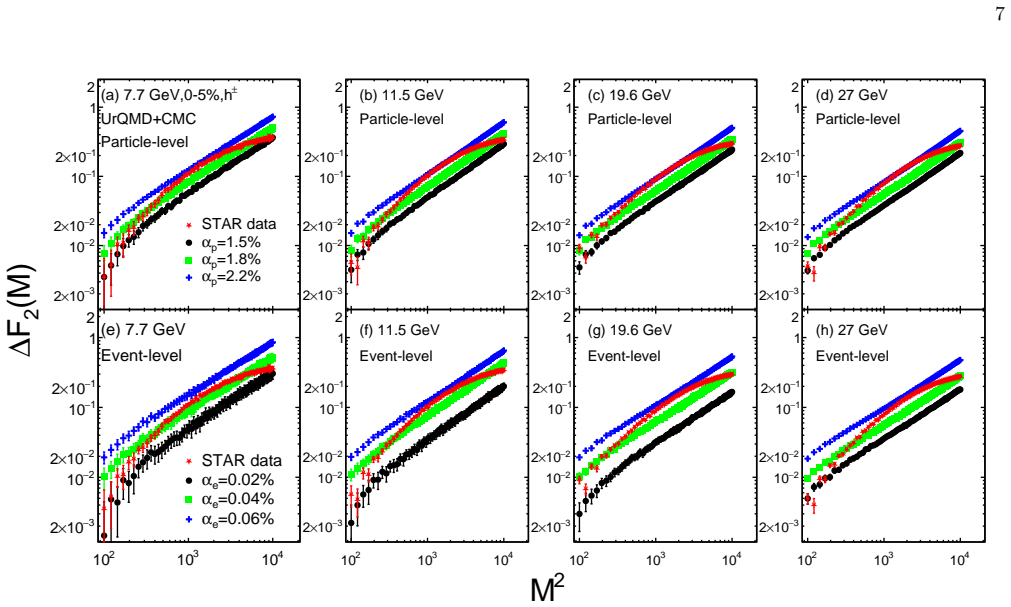
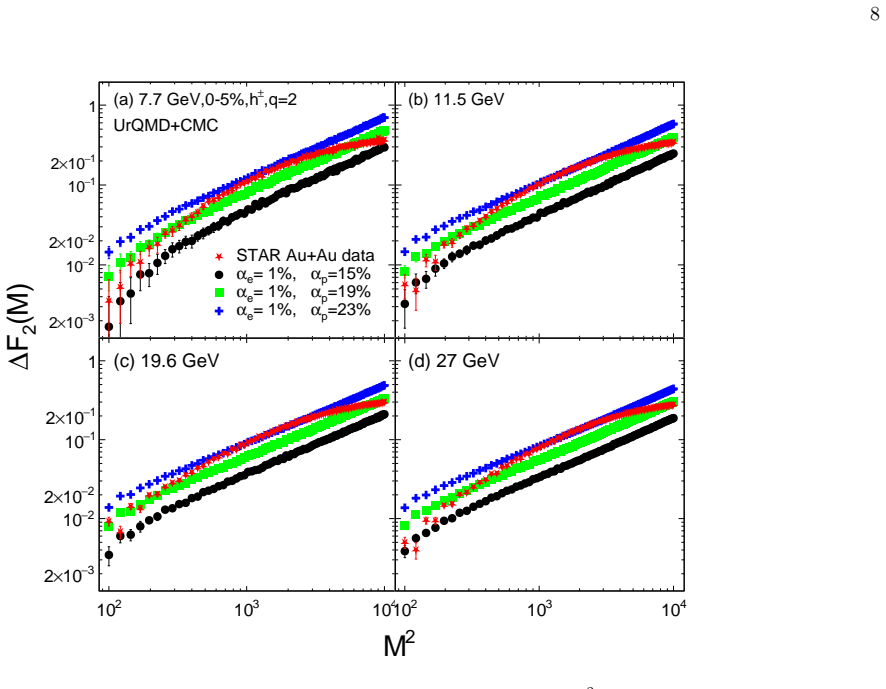
The STAR data at √s_NN=7.7--27 GeV used for model comparison can be consistently described only by small and nearly energy-independent effective critical-like fractions. These results indicate that the current BES-I intermittency signal is weak and exhibits little collision-energy dependence, thereby favoring only a limited critical-like contribution rather than a strong critical-point-induced enhancement localized near a specific collision energy.
What carries the argument
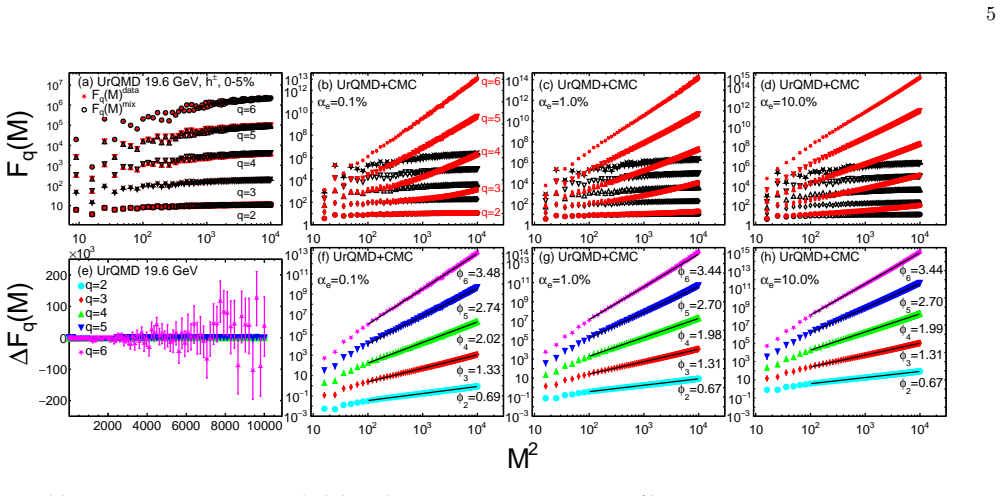
The improved hybrid UrQMD+CMC model that embeds critical-like fluctuations into a non-critical background via event-level, particle-level, and combined replacement schemes, allowing direct point-by-point comparison of ΔF₂(M) without scaling exponents.
If this is right
- The intermittency signal does not require or support a pronounced critical-point enhancement at any single energy in the 7.7-27 GeV range.
- Quantitative limits can be placed on the size of any critical-like contribution without assuming specific scaling behavior.
- Future higher-statistics runs would need to detect larger or more energy-dependent fractions to indicate a nearby critical point.
Where Pith is reading between the lines
- If the background model is accurate, searches for critical-point signals may need to target different observables or higher beam energies.
- The weak signal suggests that any critical region, if present, produces only subtle density fluctuations at these energies.
Load-bearing premise
The model's non-critical background produces factorial moments that can be cleanly separated from any added critical-like component.
What would settle it
New data at the same energies showing a strong rise or peak in the intermittency signal at one specific beam energy would contradict the small constant-fraction description.
Figures
read the original abstract
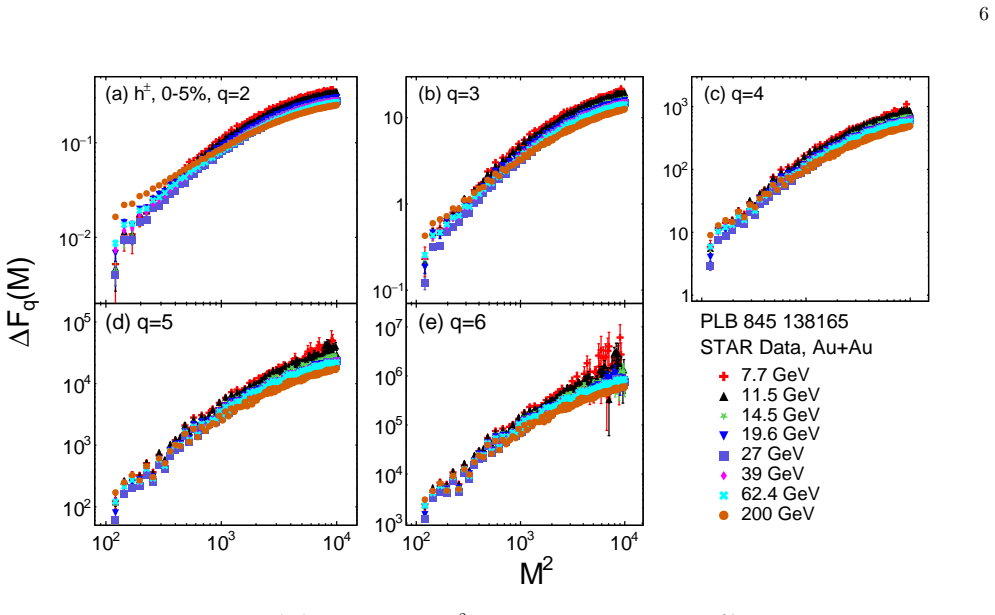
Intermittency analysis provides a promising probe of scale-invariant density fluctuations near the QCD critical point. The intermittency measurements reported in the STAR BES-I data call for a quantitative assessment of the signal strength and a clearer physical understanding of its collision-energy dependence. In this work, we perform such a study for the STAR measurements using an improved hybrid UrQMD+CMC model, in which critical-like fluctuations are embedded into a realistic non-critical background through event-level, particle-level, and combined replacement schemes. By directly comparing the second-order factorial moment $\Delta F_{2}(M)$ between model calculations and experimental data on a point-by-point basis, we constrain the effective critical-like contribution compatible with the STAR measurements without relying on scaling exponents. The STAR data at $\sqrt{s_{\mathrm{NN}}}=7.7$--$27~\mathrm{GeV}$ used for model comparison can be consistently described only by small and nearly energy-independent effective critical-like fractions. These results indicate that the current BES-I intermittency signal is weak and exhibits little collision-energy dependence, thereby favoring only a limited critical-like contribution rather than a strong critical-point-induced enhancement localized near a specific collision energy.
Editorial analysis
A structured set of objections, weighed in public.
Referee Report
Summary. The manuscript uses an improved hybrid UrQMD+CMC model incorporating event-level, particle-level, and combined replacement schemes to embed critical-like fluctuations into a non-critical background. Through direct point-by-point comparison of the second-order factorial moment ΔF₂(M) to STAR BES-I data at √s_NN = 7.7–27 GeV, it constrains the effective critical-like fraction and concludes that the measurements are consistently described only by small, nearly energy-independent fractions, implying a weak intermittency signal with little collision-energy dependence.
Significance. If the background modeling holds, the result would indicate that current BES-I intermittency data do not support a strong, energy-localized critical-point enhancement, providing a quantitative bound on critical-like contributions without invoking scaling exponents. The multi-scheme embedding and direct matching approach is a constructive step toward interpreting intermittency signals in heavy-ion data.
major comments (2)
- [modeling approach and comparison method] The central claim (abstract) that the data 'can be consistently described only by small and nearly energy-independent effective critical-like fractions' rests on the assumption that the pure UrQMD+CMC non-critical background ΔF₂(M) is accurately known and separable. No explicit validation—such as comparison of the background-only model to data subsets, alternative non-critical generators, or regimes with minimal expected critical signal—is described, which directly affects the reliability of the extracted fractions (see replacement schemes description).
- [effective fraction extraction and data comparison] The effective critical-like fraction is introduced as a free parameter constrained by matching to measured ΔF₂(M) values. While the paper states this explicitly, the conclusion that only small fractions are compatible therefore reduces to the outcome of that fit; any unquantified uncertainty in the background model could permit larger or energy-dependent fractions without contradicting the procedure.
minor comments (2)
- [comparison method] Clarify the precise definition and normalization of ΔF₂(M) in the model calculations versus experimental acceptance to ensure the point-by-point comparison is unambiguous.
- [hybrid model description] The abstract refers to the schemes as 'improved'; a brief statement of what prior versions lacked or how the new schemes were validated against known limits would aid readability.
Simulated Author's Rebuttal
We thank the referee for the constructive comments regarding the background model assumptions and the robustness of the extracted critical-like fractions. We address each major comment below and indicate planned revisions.
read point-by-point responses
-
Referee: [modeling approach and comparison method] The central claim (abstract) that the data 'can be consistently described only by small and nearly energy-independent effective critical-like fractions' rests on the assumption that the pure UrQMD+CMC non-critical background ΔF₂(M) is accurately known and separable. No explicit validation—such as comparison of the background-only model to data subsets, alternative non-critical generators, or regimes with minimal expected critical signal—is described, which directly affects the reliability of the extracted fractions (see replacement schemes description).
Authors: We agree that the manuscript does not provide explicit validation of the UrQMD+CMC background ΔF₂(M) against data in regimes with minimal expected critical signal. While UrQMD+CMC is a standard choice for non-critical dynamics, the lack of such validation is a valid concern for the separability assumption. In the revised version, we will add direct comparisons of the background-only predictions to STAR data at higher collision energies (where critical contributions are expected to be suppressed) and discuss sensitivity to alternative non-critical generators. revision: yes
-
Referee: [effective fraction extraction and data comparison] The effective critical-like fraction is introduced as a free parameter constrained by matching to measured ΔF₂(M) values. While the paper states this explicitly, the conclusion that only small fractions are compatible therefore reduces to the outcome of that fit; any unquantified uncertainty in the background model could permit larger or energy-dependent fractions without contradicting the procedure.
Authors: The referee is correct that the conclusion on small fractions follows directly from the fit to data, and unquantified background uncertainties could allow larger or energy-dependent values. The current analysis treats the background as fixed. In revision, we will include a systematic variation of background model parameters and propagate the resulting uncertainty to the allowed range of effective fractions, providing quantitative bounds. revision: yes
Circularity Check
No significant circularity; standard model-to-data parameter fit against external benchmarks.
full rationale
The paper constrains effective critical-like fractions via direct point-by-point comparison of modeled ΔF₂(M) to STAR BES-I data using the UrQMD+CMC hybrid with replacement schemes. The claim that data are described only by small, energy-independent fractions is the explicit output of this fitting procedure, not a reduction of any derived quantity to its own inputs by construction. No self-citations, uniqueness theorems, ansatzes, or renamings appear as load-bearing steps in the abstract or described methodology. The analysis is self-contained against external experimental data.
Axiom & Free-Parameter Ledger
free parameters (1)
- effective critical-like fraction
axioms (2)
- domain assumption UrQMD supplies a realistic non-critical background whose factorial moments can be additively modified by critical-like replacements.
- domain assumption The replacement schemes preserve the overall collision dynamics sufficiently that the extracted fraction directly measures critical-like content.
Reference graph
Works this paper leans on
-
[1]
In the event-level replacement scheme, a subset of these events, amounting toN UrQMD ×α e, is replaced by the same number of CMC events
Event-level replacement fraction (α e): Let the UrQMD background sample containN UrQMD events. In the event-level replacement scheme, a subset of these events, amounting toN UrQMD ×α e, is replaced by the same number of CMC events. Consequently, the resulting hybrid ensemble con- sists of two distinct classes of events: the remaining (1−α e)×N UrQMD event...
-
[2]
Particle-level replacement fraction (α p): The particle-level replacement scheme is characterized by the replacement ratio αp = nCMC nUrQMD ,(4) wheren UrQMD denotes the multiplicity (N ch) of a given UrQMD background event, andn CMC is the number of particles selected from a CMC event and embedded into that UrQMD event. The resulting hybrid event therefo...
-
[3]
Generate a sam- ple of UrQMD events with the desired model set- tings
UrQMD background generation. Generate a sam- ple of UrQMD events with the desired model set- tings. For each event, record the charged-particle multiplicityN ch and the momenta of all final-state particles. 4
-
[4]
Configure the CMC model with the L´ evy parameterµ= 1/6 and pmin/pmax = 10 −7
CMC critical-event construction. Configure the CMC model with the L´ evy parameterµ= 1/6 and pmin/pmax = 10 −7. These choices correspond to a critical system in the 3D Ising universality class with fractal dimensiond F = 1/3 [21, 23]. For each UrQMD event, randomly select one UrQMD particle withp T <0.5 GeV/cas the initial point of a L´ evy random walk. T...
-
[5]
Construct the UrQMD+CMC sample by applying one of the following replacement schemes: (a) Event-level replacement scheme only
Hybridization via replacement schemes. Construct the UrQMD+CMC sample by applying one of the following replacement schemes: (a) Event-level replacement scheme only. Ran- domly select an event from the UrQMD sam- ple, and then replace this entire event with its matched CMC event. Repeat until the num- ber of replaced events reachesα e ×N UrQMD. The hybrid ...
2000
-
[6]
B. E. Aboonaet al.(STAR), Phys. Rev. Lett.135, 142301 (2025), arXiv:2504.00817 [nucl-ex]
arXiv 2025
- [7]
-
[8]
Braun-Munzinger and J
P. Braun-Munzinger and J. Stachel, Nature448, 302 (2007)
2007
-
[9]
M. S. Abdallahet al.(STAR), Phys. Rev. Lett.128, 202303 (2022), arXiv:2112.00240 [nucl-ex]
arXiv 2022
-
[10]
ZHANG, D
Y. ZHANG, D. ZHANG, and X. LUO, Nuclear Tech- niques46, 4 (2023). 10
2023
-
[11]
X. Luo, Q. Wang, N. Xu, and P. Zhuang, eds.,Properties of QCD Matter at High Baryon Density(Springer, 2022)
2022
-
[12]
M. Abdulhamidet al.(STAR), Phys. Lett. B845, 138165 (2023), arXiv:2301.11062 [nucl-ex]
arXiv 2023
-
[13]
J. Wu (STAR), SciPost Phys. Proc.10, 041 (2022), arXiv:2110.09794 [nucl-ex]
arXiv 2022
-
[14]
J. Wu, X. Luo, Z. Li, and Y. Wu, Nuclear Physics Review 41, 580 (2024)
2024
-
[15]
Adhikaryet al.(NA61/SHINE), Eur
H. Adhikaryet al.(NA61/SHINE), Eur. Phys. J. C84, 741 (2024), arXiv:2401.03445 [nucl-ex]
arXiv 2024
-
[16]
V. Z. Reyna Ortiz (NA61/SHINE), Ukr. J. Phys.69, 858 (2024)
2024
-
[17]
Adhikaryet al.(NA61/SHINE), Eur
H. Adhikaryet al.(NA61/SHINE), Eur. Phys. J. C83, 881 (2023), arXiv:2305.07557 [nucl-ex]
arXiv 2023
- [18]
-
[19]
S. A. Basset al., Prog. Part. Nucl. Phys.41, 255 (1998), arXiv:nucl-th/9803035
Pith/arXiv arXiv 1998
-
[20]
H. Petersen, J. Steinheimer, G. Burau, M. Bleicher, and H. St¨ ocker, Phys. Rev. C78, 044901 (2008), arXiv:0806.1695 [nucl-th]
Pith/arXiv arXiv 2008
-
[21]
E. L. Bratkovskaya, M. Bleicher, M. Reiter, S. Soff, H. Stoecker, M. van Leeuwen, S. A. Bass, and W. Cassing, Phys. Rev. C69, 054907 (2004), arXiv:nucl- th/0402026
arXiv 2004
-
[22]
M. J. Bleicher, S. A. Bass, L. V. Bravina, W. Greiner, S. Soff, H. Stoecker, N. Xu, and E. E. Zabrodin, Phys. Rev. C62, 024904 (2000), arXiv:hep-ph/9911420
Pith/arXiv arXiv 2000
-
[23]
J. Wu, Y. Lin, Z. Li, X. Luo, and Y. Wu, Phys. Rev. C 104, 034902 (2021), arXiv:2104.11524 [nucl-th]
arXiv 2021
-
[24]
J. Wu, Z. Li, X. Luo, M. Xu, and Y. Wu, Phys. Rev. C 106, 054905 (2022), arXiv:2209.07135 [nucl-th]
arXiv 2022
-
[25]
J. Wu, Z. Li, and S. Lan, Symmetry18(2026), 10.3390/sym18010138
-
[26]
N. G. Antoniou, F. K. Diakonos, and A. S. Kapoyannis, Phys. Rev. Lett.97, 032002 (2006)
2006
-
[27]
N. G. Antoniou, Y. F. Contoyiannis, F. K. Diakonos, and G. Mavromanolakis, Nucl. Phys. A761, 149 (2005), arXiv:hep-ph/0505185
Pith/arXiv arXiv 2005
-
[28]
J. Wu, Y. Lin, Z. Li, and Y. Wu, Phys. Lett. B801, 135186 (2020), arXiv:1901.11193 [nucl-th]
arXiv 2020
-
[29]
Z. Li, Mod. Phys. Lett. A37, 2230009 (2022), arXiv:2203.01490 [nucl-th]
arXiv 2022
-
[30]
R. Guo, J. Wu, M. Xu, X. Chen, Z. Li, Z. Yin, and Y. Wu, Physics Letters B877, 140458 (2026), arXiv:2510.20336 [hep-ph]
Pith/arXiv arXiv 2026
-
[31]
R. Wang, C. Qiu, C. S. Hu, Z. Li, and Y. Wu, Phys. Lett. B864, 139405 (2025), arXiv:2412.06151 [nucl-th]
arXiv 2025
-
[32]
M. Nahrgang, M. Bluhm, T. Schaefer, and S. A. Bass, Phys. Rev. D99, 116015 (2019), arXiv:1804.05728 [nucl- th]
Pith/arXiv arXiv 2019
-
[33]
X. Li, M. Xu, Y. Zhang, Z. Li, Y. Zhou, J. Fu, and Y. Wu, Phys. Rev. C105, 064904 (2022), arXiv:2107.11382 [cond-mat.stat-mech]
arXiv 2022
- [34]
-
[35]
R. V. Poberezhnyuk, O. Savchuk, M. I. Gorenstein, V. Vovchenko, K. Taradiy, V. V. Begun, L. Satarov, J. Steinheimer, and H. Stoecker, Phys. Rev. C102, 024908 (2020), arXiv:2004.14358 [hep-ph]
arXiv 2020
-
[36]
N. G. Antoniou, F. K. Diakonos, X. N. Maintas, and C. E. Tsagkarakis, Phys. Rev. D97, 034015 (2018), arXiv:1705.09124 [hep-ph]
Pith/arXiv arXiv 2018
-
[37]
Brofas, M
A. Brofas, M. Zampetakis, and F. Diakonos, Physics Letters B863, 139376 (2025)
2025
-
[38]
V. Z. Reyna Ortiz, M. Rybczynski, and Z. Wlodarczyk, Nucl. Phys. B1018, 117051 (2025), arXiv:2502.19045 [hep-ph]
arXiv 2025
-
[39]
B. E. Aboonaet al.(STAR), Nature Commun.16, 9098 (2025), arXiv:2402.01998 [nucl-ex]
arXiv 2025
-
[40]
Bialas and R
A. Bialas and R. B. Peschanski, Nucl. Phys. B273, 703 (1986)
1986
-
[41]
Bialas and R
A. Bialas and R. B. Peschanski, Nucl. Phys. B308, 857 (1988)
1988
-
[42]
T. Anticicet al.(NA49), Eur. Phys. J. C75, 587 (2015), arXiv:1208.5292 [nucl-ex]
Pith/arXiv arXiv 2015
-
[43]
R. C. Hwa and M. T. Nazirov, Phys. Rev. Lett.69, 741 (1992)
1992
-
[44]
T. Anticicet al.(NA49), Phys. Rev. C81, 064907 (2010), arXiv:0912.4198 [nucl-ex]
Pith/arXiv arXiv 2010
-
[45]
N. G. Antoniou, Y. F. Contoyiannis, F. K. Diakonos, A. I. Karanikas, and C. N. Ktorides, Nucl. Phys. A693, 799 (2001), arXiv:hep-ph/0012164
Pith/arXiv arXiv 2001
-
[46]
Prokhorova and N
D. Prokhorova and N. Davis (NA61/SHINE), Universe 5, 103 (2019)
2019
-
[47]
R. C. Hwa, Phys. Rev. D47, 2773 (1993)
1993
-
[48]
R. C. Hwa and C. B. Yang, Phys. Rev. C85, 044914 (2012), arXiv:1111.6651 [nucl-th]
Pith/arXiv arXiv 2012
-
[49]
Ochs and J
W. Ochs and J. Wosiek, Phys. Lett. B214, 617 (1988)
1988
-
[50]
W. Ochs, Z. Phys. C50, 339 (1991)
1991
-
[51]
Y.-L. Xie, G. Chen, J.-L. Wang, Z.-H. Liu, and M.-J. Wang, Nucl. Phys. A920, 33 (2013), arXiv:1303.2183 [nucl-th]
Pith/arXiv arXiv 2013
-
[52]
A. Bzdak, V. Koch, and V. Skokov, Phys. Rev. C87, 014901 (2013), arXiv:1203.4529 [hep-ph]
Pith/arXiv arXiv 2013
- [53]
-
[54]
B. Ling and M. A. Stephanov, Phys. Rev. C93, 034915 (2016), arXiv:1512.09125 [nucl-th]
Pith/arXiv arXiv 2016
-
[55]
A. Bzdak and V. Koch, Phys. Rev. C96, 054905 (2017), arXiv:1707.02640 [nucl-th]
Pith/arXiv arXiv 2017
-
[56]
M. Abdallahet al.(STAR), Phys. Rev. C104, 024902 (2021), arXiv:2101.12413 [nucl-ex]
arXiv 2021
-
[57]
S. Samanta, T. Czopowicz, and M. Gazdzicki, J. Phys. G48, 105106 (2021), arXiv:2105.01763 [nucl-th]
arXiv 2021
-
[58]
Y. F. Wu and L. S. Liu, Phys. Rev. Lett.70, 3197 (1993)
1993
-
[59]
N. M. Agababyanet al.(EHS/NA22), Phys. Lett. B382, 305 (1996), arXiv:hep-ex/9606005
Pith/arXiv arXiv 1996
-
[60]
N. G. Antoniou and F. K. Diakonos, J. Phys. G46, 035101 (2019), arXiv:1802.05857 [hep-ph]
Pith/arXiv arXiv 2019
-
[61]
K.-J. Sun, L.-W. Chen, C. M. Ko, and Z. Xu, Phys. Lett. B774, 103 (2017), arXiv:1702.07620 [nucl-th]
Pith/arXiv arXiv 2017
-
[62]
Y. Zhang, Z. Wang, X. Luo, and N. Xu, The European Physical Journal Special Topics (2026), 10.1140/epjs/s11734-026-02226-w, arXiv:2602.08356 [nucl-ex]
-
[63]
Y. Huang, in31st International Conference on Ultra-relativistic Nucleus-Nucleus Collisions(2025) , arXiv:2512.03493 [nucl-ex]
arXiv 2025
-
[64]
B. E. Aboonaet al.(STAR), Phys. Rev. Lett.135, 072301 (2025), arXiv:2504.02531 [nucl-ex]
arXiv 2025
discussion (0)
Sign in with ORCID, Apple, or X to comment. Anyone can read and Pith papers without signing in.