Enabling Electrical Readout of N\'eel vector reversal in a van der Waals Antiferromagnet
Pith reviewed 2026-06-25 22:35 UTC · model grok-4.3
The pith
Tunneling magnetoresistance detects 180-degree Néel vector reversal in even-layer CrSBr antiferromagnets.
A machine-rendered reading of the paper's core claim, the machinery that carries it, and where it could break.
Core claim
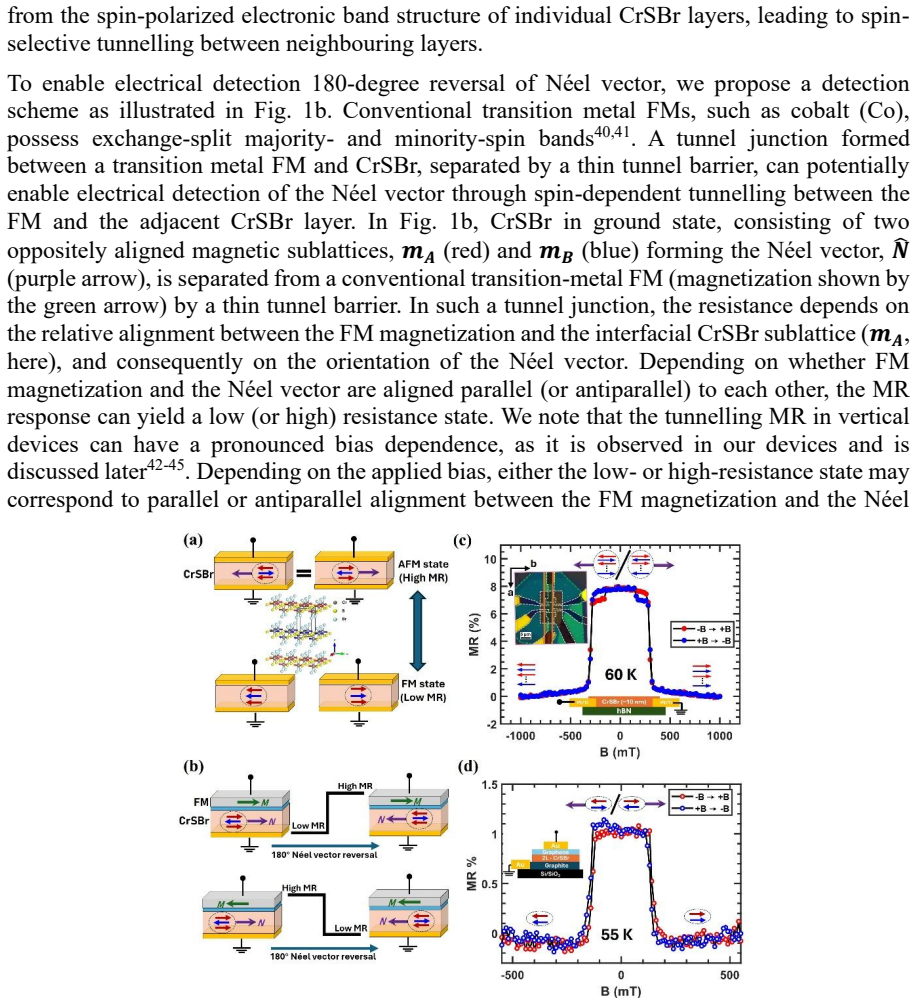
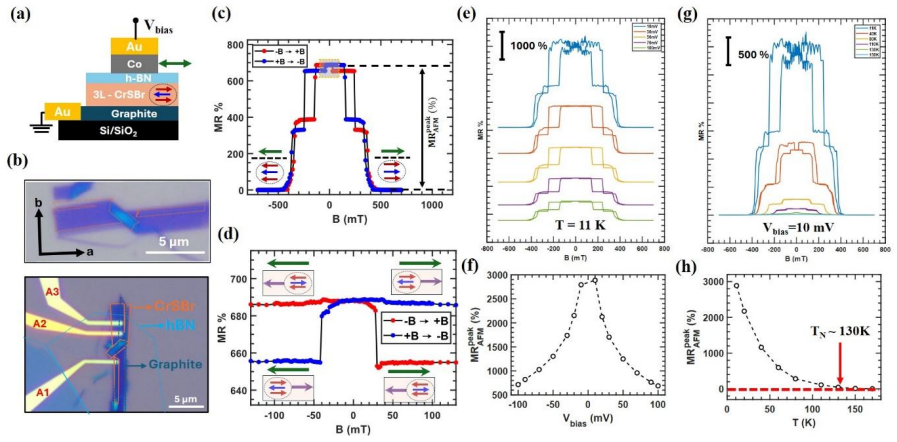
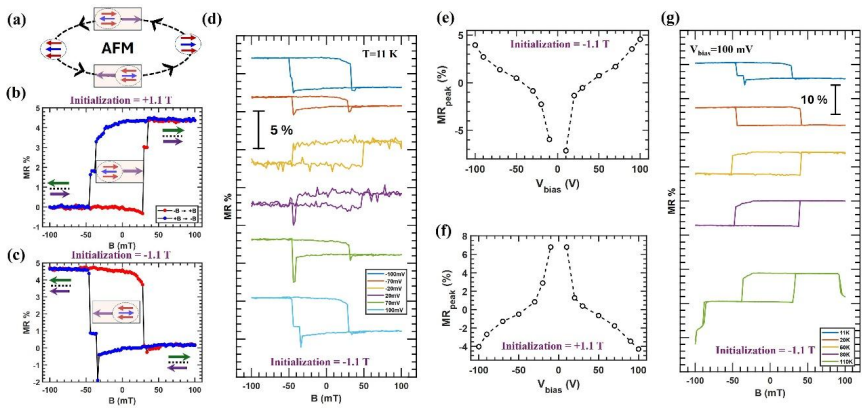
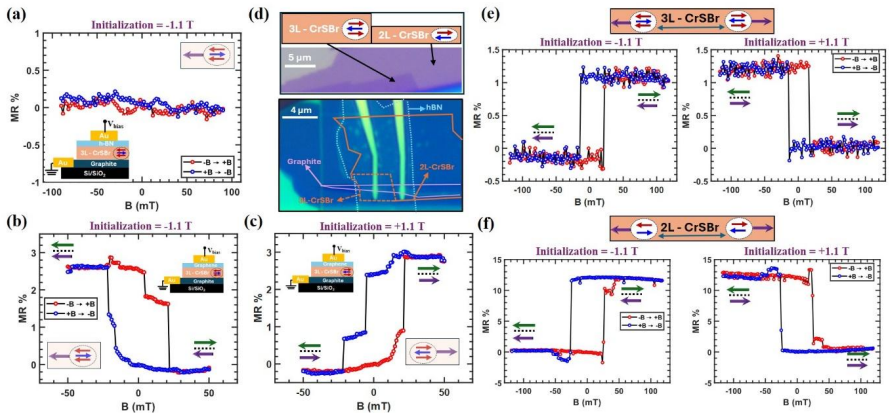
By coupling atomically thin CrSBr to a spin-polarized layer across a tunnel barrier, the spin-dependent tunnelling magnetoresistance becomes sensitive to the relative orientation between the reference electrode magnetization and the interfacial sublattice magnetization of the antiferromagnet, thereby enabling electrical detection of Néel vector orientation and its 180-degree reversal even in even-layer films where adjacent sublattices are exactly compensated and net magnetization vanishes.
What carries the argument
Spin-dependent tunnelling magnetoresistance configuration that couples the antiferromagnet to a spin-polarized reference electrode across a tunnel barrier.
If this is right
- The observed magnetoresistance directly signals 180-degree Néel vector reversal in compensated even-layer CrSBr.
- The same configuration supplies electrical readout of Néel vector orientation in other van der Waals antiferromagnets.
- The method supports construction of antiferromagnet-based magnetic memory devices that function without net magnetization.
- Ultrafast and robust dynamics of the Néel vector become electrically accessible in thin-film van der Waals antiferromagnets.
Where Pith is reading between the lines
- The approach may allow antiferromagnetic layers to be integrated into existing two-dimensional heterostructures without introducing stray magnetic fields.
- Because detection works in the compensated state, it could extend to antiferromagnets that remain insulating or semiconducting at room temperature.
- Voltage-controlled switching of the reference layer could turn the readout on and off on demand in a single device stack.
Load-bearing premise
The tunnelling magnetoresistance is sensitive to the relative orientation between the reference electrode magnetization and the interfacial sublattice magnetization of the antiferromagnet.
What would settle it
Absence of magnetoresistance change when the Néel vector in even-layer CrSBr is reversed by 180 degrees while the reference electrode magnetization is held fixed.
Figures
read the original abstract
Owing to its robustness against external perturbations and intrinsically ultrafast dynamics, the N\'eel vector in antiferromagnets (AFMs) can enable the development of next-generation spintronic and magnonic devices for memory and computing applications. To realize AFM-based magnetic memory devices, one of the key requirements is to demonstrate electrical readout of 180-degree reversal of N\'eel vector in thin film AFMs, which remains critically missing. In this work, we report experimental demonstration of a novel transport methodology to detect N\'eel vector reversal in atomically thin films of a van der Waals (vdW) based A-type AFM. For this, we utilize spin-dependent electronic band properties of CrSBr by coupling it to a spin-polarized layer, separated by a tunnel barrier. In this configuration, the spin-dependent tunnelling magnetoresistance (MR) becomes sensitive to the relative orientation between the magnetization of the reference electrode and the interfacial sublattice magnetization of the AFM layer, in turn enabling electrical detection of the N\'eel vector orientation. Importantly, the observed MR can also reveal 180-degree reversal of N\'eel vector in even-layers of CrSBr, wherein adjacent sublattice magnetic layers are exactly compensated and the net magnetization vanishes and thus establishes a broadly applicable strategy for electrical detection of N\'eel vector in vdW-based AFMs.
Editorial analysis
A structured set of objections, weighed in public.
Referee Report
Summary. The manuscript reports an experimental demonstration of electrical readout of 180-degree Néel vector reversal in atomically thin CrSBr (A-type vdW antiferromagnet) via spin-dependent tunneling magnetoresistance (MR). A heterostructure couples the CrSBr layer to a spin-polarized reference electrode across a tunnel barrier; the MR signal becomes sensitive to the relative orientation between the reference magnetization and the interfacial AFM sublattice magnetization. The central result is that this readout works even for even-layer flakes, where adjacent sublattices are exactly compensated and net magnetization vanishes.
Significance. If the layer-parity controls, device fabrication details, and MR data hold, the work supplies a missing capability for AFM spintronics by enabling electrical detection of Néel vector orientation in compensated vdW antiferromagnets. It leverages intrinsic spin-dependent band properties of CrSBr and provides a broadly applicable strategy without requiring net magnetization.
minor comments (3)
- Figure captions and main text should explicitly label even- versus odd-layer devices and state the number of independent devices measured for each parity to strengthen the compensated-layer claim.
- Include a device schematic (stack cross-section and measurement geometry) early in the manuscript to clarify the reference electrode, tunnel barrier, and current path.
- Minor typographical inconsistencies appear in the abstract and introduction regarding the exact phrasing of 'spin-dependent tunnelling magnetoresistance'; standardize terminology throughout.
Simulated Author's Rebuttal
We thank the referee for their positive assessment of our work and the recommendation for minor revision. No major comments appear in the provided report, so we interpret this as an endorsement of the central claims with only minor issues (if any) to address in revision.
Circularity Check
No significant circularity in experimental demonstration
full rationale
The paper is an experimental report of transport measurements in CrSBr-based tunnel junctions. No derivation chain, equations, or fitted parameters are presented as predictions; the central claim rests on direct observation of MR signals that distinguish Néel vector orientation (including in even-layer compensated flakes) via device fabrication, layer-parity controls, and reference electrode polarization. No self-citations are invoked as load-bearing uniqueness theorems or ansatzes. The work is self-contained against external benchmarks.
Axiom & Free-Parameter Ledger
axioms (1)
- domain assumption Spin-dependent tunneling magnetoresistance is sensitive to the relative orientation between reference magnetization and AFM interfacial sublattice magnetization
Reference graph
Works this paper leans on
-
[1]
Spintronics of antiferromagnetic systems (Review Article)
[1]. E. V . Gomonay and V . M. Loktev, "Spintronics of antiferromagnetic systems (Review Article)", Low Temperature Physics 40, 17 (2014). [2]. J. Han, R. Cheng, L. Liu, H. Ohno, and S. Fukami, "Coherent antiferromagnetic spintronics", Nature Materials 22, 684 (2023). [3]. T. Jungwirth, X. Marti, P. Wadley, and J. Wunderlich, "Antiferromagnetic spintronic...
2014
-
[2]
For tunnel barrier layer, thin hBN flakes were exfoliated onto Si/SiO2 substrates with a 90 nm oxide thickness
Mechanical exfoliation of CrSBr, hBN, and graphite flakes was performed inside an Ar -filled glovebox onto separate Si/SiO2 substrates with a 300 nm oxide layer. For tunnel barrier layer, thin hBN flakes were exfoliated onto Si/SiO2 substrates with a 90 nm oxide thickness. Suitable flakes were first identified by optical microscopy and subsequently charac...
2020
discussion (0)
Sign in with ORCID, Apple, or X to comment. Anyone can read and Pith papers without signing in.