Auxiliary Schmidt Rank as a Resource for Photonic Bell Measurements
Pith reviewed 2026-07-01 06:46 UTC · model grok-4.3
The pith
The Schmidt rank of an auxiliary entangled state sets the exact threshold for complete photonic Bell measurements on qudits of dimension d.
A machine-rendered reading of the paper's core claim, the machinery that carries it, and where it could break.
Core claim
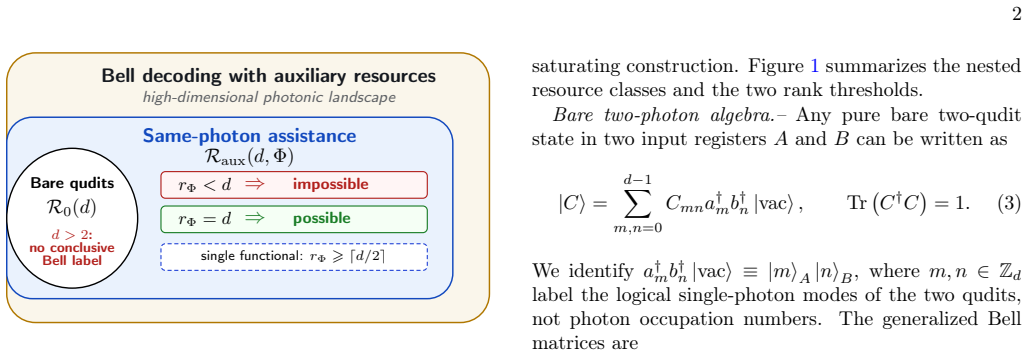
When the same two photons carry d-dimensional system qudits together with a fixed auxiliary entangled state Φ of total Schmidt rank r_Φ, a single conclusive Bell-label functional can occur for r_Φ ≥ ceil(d/2), but deterministic discrimination of all d² Bell-state labels requires r_Φ ≥ d. A maximally entangled rank-d auxiliary state achieves the bound by local Bell-basis sorting between each photon's system and auxiliary degrees of freedom.
What carries the argument
The total Schmidt rank r_Φ of the fixed auxiliary entangled state Φ, which supplies the additional entanglement needed for local Bell-basis sorting to discriminate the system Bell states.
If this is right
- A maximally entangled auxiliary state of rank exactly d suffices for complete, deterministic identification of every Bell state.
- Partial discrimination remains possible at the lower threshold r_Φ ≥ ceil(d/2).
- The scheme works for any dimension d and requires neither extra photons nor dynamic switching.
- The auxiliary state can be distributed across additional degrees of freedom of the original two photons.
Where Pith is reading between the lines
- The threshold may inform the minimal entanglement budget needed for fusion operations in photonic quantum computing architectures.
- Similar rank-based accounting could apply to other linear-optical tasks that rely on embedded entanglement rather than external ancillae.
- Experimental tests could use time-bin or frequency-bin encodings to realize the auxiliary state within the same photons.
Load-bearing premise
The auxiliary entangled state is fixed in advance and carried by the same two photons, possibly using extra degrees of freedom, so that local operations suffice without new photons or active elements.
What would settle it
An experiment that achieves deterministic discrimination of all d² Bell states with an auxiliary state whose Schmidt rank is strictly less than d would falsify the claimed necessity of rank d.
Figures
read the original abstract
In quantum communication and fusion-based quantum computation, photonic Bell measurements are fundamentally limited when only passive linear optics is employed. While for qubits, some Bell states can be unambiguously identified with static beam splitters and no extra photons or entanglement, additional auxiliary photons or at least additional auxiliary degrees of freedom with a certain level of additional entanglement are needed to approach or attain a complete, deterministic Bell measurement. Here, we prove an exact resource threshold when the same two photons carry system qudits of dimension $d$ and a fixed auxiliary entangled state $\Phi$, possibly distributed over several additional degrees of freedom, with total Schmidt rank $r_\Phi$. We show that a single conclusive Bell-label functional can occur for $r_\Phi\geqslant\lceil d/2\rceil$, but deterministic discrimination of all $d^2$ Bell-state labels requires $r_\Phi\geqslant d$. A maximally entangled rank-$d$ auxiliary state achieves the bound by local Bell-basis sorting between each photon's system and auxiliary degrees of freedom. Thus, the auxiliary Schmidt rank is a certified resource for ancilla-photon-free, embedded photonic Bell measurements.
Editorial analysis
A structured set of objections, weighed in public.
Referee Report
Summary. The manuscript establishes exact thresholds on the Schmidt rank r_Φ of a fixed auxiliary entangled state Φ carried by the same two photons as d-dimensional system qudits. It claims that a single conclusive Bell-label functional is possible for r_Φ ≥ ⌈d/2⌉, while deterministic discrimination of all d² Bell-state labels requires r_Φ ≥ d and is achieved by a maximally entangled rank-d auxiliary via local Bell-basis sorting between each photon's system and auxiliary degrees of freedom, all within passive linear optics and without extra photons.
Significance. If the thresholds and the explicit construction hold, the result supplies a sharp, parameter-free resource bound for ancilla-photon-free photonic Bell measurements. This is directly relevant to fusion-based quantum computation and quantum communication protocols that rely on complete Bell discrimination, and the framing of auxiliary Schmidt rank as a certified resource is a clean conceptual contribution.
major comments (2)
- [Abstract] Abstract and the construction paragraph: the achievability direction (r_Φ = d suffices) rests entirely on the assertion that 'local Bell-basis sorting' between system and auxiliary degrees of freedom can be realized by a fixed passive linear-optical unitary on the combined modes of the two photons. No explicit mode transformation, beam-splitter network, or unitary matrix is supplied that demonstrates this sorting is possible without nonlinearities, feed-forward, or additional photons; this step is load-bearing for the exact threshold claim.
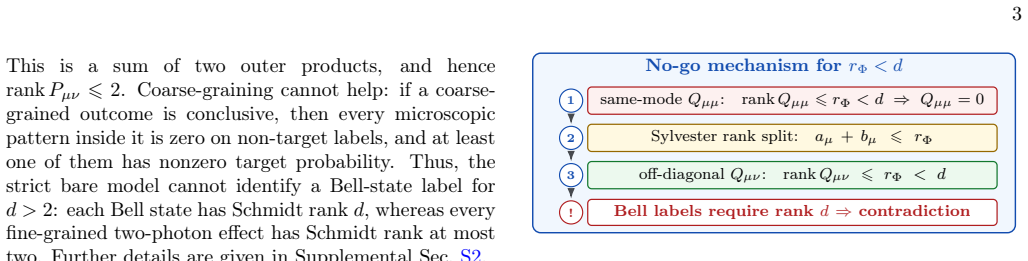
- [Lower-bound section] Lower-bound argument (the paragraph establishing r_Φ ≥ d for full discrimination): the dimension or support-counting argument must be shown to remain valid under the concrete constraints of linear optics acting on a fixed auxiliary state Φ; if the proof only counts abstract projectors without reference to the linear-optical Kraus operators or the shared-mode Hilbert space, the bound may not be tight inside the model's rules.
minor comments (2)
- [Introduction] Notation for the auxiliary state Φ and the Bell-label functionals should be introduced with an explicit definition of the total Hilbert space (system ⊗ auxiliary) before the threshold statements.
- [Abstract] The abstract states 'we prove an exact resource threshold'; the manuscript should include a short statement confirming that all derivations are analytic and contain no numerical fitting or post-hoc parameter choices.
Simulated Author's Rebuttal
We thank the referee for the careful reading and constructive comments. We address the two major comments point by point below and will revise the manuscript to incorporate explicit constructions and clarifications where needed.
read point-by-point responses
-
Referee: [Abstract] Abstract and the construction paragraph: the achievability direction (r_Φ = d suffices) rests entirely on the assertion that 'local Bell-basis sorting' between system and auxiliary degrees of freedom can be realized by a fixed passive linear-optical unitary on the combined modes of the two photons. No explicit mode transformation, beam-splitter network, or unitary matrix is supplied that demonstrates this sorting is possible without nonlinearities, feed-forward, or additional photons; this step is load-bearing for the exact threshold claim.
Authors: We agree that an explicit construction strengthens the presentation. In the revised manuscript we will add a dedicated paragraph (or appendix) supplying the fixed passive linear-optical unitary. It is realized by a beam-splitter and phase-shifter network acting separately on each photon's system-plus-auxiliary modes that maps the d-dimensional Bell states onto orthogonal output ports; the network is static, contains no nonlinear elements or feed-forward, and operates entirely within the two-photon shared-mode Hilbert space. revision: yes
-
Referee: [Lower-bound section] Lower-bound argument (the paragraph establishing r_Φ ≥ d for full discrimination): the dimension or support-counting argument must be shown to remain valid under the concrete constraints of linear optics acting on a fixed auxiliary state Φ; if the proof only counts abstract projectors without reference to the linear-optical Kraus operators or the shared-mode Hilbert space, the bound may not be tight inside the model's rules.
Authors: The lower bound follows from the fact that any linear-optical evolution is a unitary on the total two-photon Hilbert space and the measurement is performed on the fixed auxiliary state Φ. We will expand the lower-bound section to explicitly connect the support-counting argument to the linear-optical Kraus operators, showing that the distinguishable subspace dimension is bounded by r_Φ even after the unitary and that r_Φ < d leaves at least one Bell label indistinguishable under the model's constraints. revision: yes
Circularity Check
No significant circularity; derivation is self-contained mathematical argument
full rationale
The paper states explicit thresholds (r_Φ ≥ ⌈d/2⌉ for single conclusive outcome, r_Φ ≥ d for full deterministic discrimination) and claims achievability via a rank-d auxiliary state using local Bell-basis sorting. These are presented as proven bounds from Schmidt-rank counting and constructive methods on the combined system+auxiliary modes. No equations reduce a claimed prediction to a fitted input by construction, no self-citation chain is load-bearing for the central result, and no ansatz is smuggled via prior work. The derivation relies on dimension/support arguments and explicit constructions that are independent of the target thresholds themselves. The reader's note of score 1.0 aligns with this assessment; the skeptic concern addresses realizability of the sorting operation (a correctness issue) rather than any definitional or self-referential reduction in the proof chain.
Axiom & Free-Parameter Ledger
axioms (1)
- standard math Standard quantum mechanics, Schmidt decomposition, and passive linear optical transformations hold.
Forward citations
Cited by 1 Pith paper
-
Squeezing-enhanced Pairwise Fusion of Photonic Qudits
Squeezing on 2d outputs of fusion interferometers increases heralded success probability for d-rail photonic qudits by accepting selected all-even photon patterns that correspond to pairwise Bell projectors.
Reference graph
Works this paper leans on
-
[1]
Bianchi, C
L. Bianchi, C. Marconi, and D. Bacco, Bell state mea- surements in quantum optics: a review of recent progress and open challenges, Quantum Sci. Technol.11, 023001 (2026)
2026
-
[2]
C. H. Bennett, G. Brassard, C. Crépeau, R. Jozsa, A. Peres, and W. K. Wootters, Teleporting an unknown quantum state via dual classical and Einstein-Podolsky- Rosen channels, Phys. Rev. Lett.70, 1895 (1993)
1993
-
[3]
Bouwmeester, J.-W
D. Bouwmeester, J.-W. Pan, K. Mattle, M. Eibl, H. We- infurter, and A. Zeilinger, Experimental quantum tele- portation, Nature390, 575 (1997)
1997
-
[4]
Event-ready-detectors
M. Żukowski, A. Zeilinger, M. A. Horne, and A. K. Ek- ert, “Event-ready-detectors” Bell experiment via entan- glement swapping, Phys. Rev. Lett.71, 4287 (1993)
1993
-
[5]
J.-W. Pan, D. Bouwmeester, H. Weinfurter, and A. Zeilinger, Experimental entanglement swapping: En- tangling photons that never interacted, Phys. Rev. Lett. 80, 3891 (1998)
1998
-
[6]
C. H. Bennett and S. J. Wiesner, Communication via one- and two-particle operators on Einstein-Podolsky- Rosen states, Phys. Rev. Lett.69, 2881 (1992)
1992
-
[7]
Mattle, H
K. Mattle, H. Weinfurter, P. G. Kwiat, and A. Zeilinger, Dense coding in experimental quantum communication, Phys. Rev. Lett.76, 4656 (1996)
1996
-
[8]
Briegel, W
H.-J. Briegel, W. Dür, J. I. Cirac, and P. Zoller, Quan- tum repeaters: The role of imperfect local operations in quantum communication, Phys. Rev. Lett.81, 5932 (1998)
1998
-
[9]
H. J. Kimble, The quantum internet, Nature453, 1023 (2008)
2008
-
[10]
Wehner, D
S. Wehner, D. Elkouss, and R. Hanson, Quantum inter- net: A vision for the road ahead, Science362, eaam9288 (2018)
2018
-
[11]
Raussendorf and H
R. Raussendorf and H. J. Briegel, A one-way quantum computer, Phys. Rev. Lett.86, 5188 (2001)
2001
-
[12]
Knill, R
E. Knill, R. Laflamme, and G. J. Milburn, A scheme for efficient quantum computation with linear optics, Nature 409, 46 (2001)
2001
-
[13]
D. E. Browne and T. Rudolph, Resource-efficient lin- ear optical quantum computation, Phys. Rev. Lett.95, 010501 (2005)
2005
-
[14]
P. Kok, W. J. Munro, K. Nemoto, T. C. Ralph, J. P. Dowling, and G. J. Milburn, Linear optical quantum computing with photonic qubits, Rev. Mod. Phys.79, 135 (2007)
2007
-
[15]
Weinfurter, Experimental Bell-state analysis, Euro- phys
H. Weinfurter, Experimental Bell-state analysis, Euro- phys. Lett.25, 559 (1994)
1994
-
[16]
S. L. Braunstein and A. Mann, Measurement of the Bell operator and quantum teleportation, Phys. Rev. A51, R1727(R) (1995)
1995
-
[17]
Michler, K
M. Michler, K. Mattle, H. Weinfurter, and A. Zeilinger, Interferometric Bell-state analysis, Phys. Rev. A53, R1209(R) (1996)
1996
-
[18]
Vaidman and N
L. Vaidman and N. Yoran, Methods for reliable telepor- tation, Phys. Rev. A59, 116 (1999)
1999
-
[19]
Lütkenhaus, J
N. Lütkenhaus, J. Calsamiglia, and K.-A. Suominen, Bell measurements for teleportation, Phys. Rev. A59, 3295 (1999)
1999
-
[20]
Calsamiglia and N
J. Calsamiglia and N. Lütkenhaus, Maximum efficiency of a linear-optical Bell-state analyzer, Appl. Phys. B72, 67 (2001)
2001
-
[21]
P. G. Kwiat and H. Weinfurter, Embedded Bell-state analysis, Phys. Rev. A58, R2623(R) (1998)
1998
-
[22]
S. P. Walborn, S. Pádua, and C. H. Monken, Hyperentanglement-assisted Bell-state analysis, Phys. Rev. A68, 042313 (2003)
2003
-
[23]
Schuck, G
C. Schuck, G. Huber, C. Kurtsiefer, and H. Weinfurter, Complete deterministic linear optics Bell state analysis, Phys. Rev. Lett.96, 190501 (2006)
2006
-
[24]
Barbieri, G
M. Barbieri, G. Vallone, P. Mataloni, and F. De Mar- tini, Complete and deterministic discrimination of polar- ization Bell states assisted by momentum entanglement, Phys. Rev. A75, 042317 (2007)
2007
-
[25]
T.-C. Wei, J. T. Barreiro, and P. G. Kwiat, Hyperentan- gled Bell-state analysis, Phys. Rev. A75, 060305(R) (2007)
2007
-
[26]
W. P. Grice, Arbitrarily complete Bell-state measure- ment using only linear optical elements, Phys. Rev. A 84, 042331 (2011)
2011
-
[27]
Ewert and P
F. Ewert and P. van Loock,3/4-efficient Bell measure- 6 ment with passive linear optics and unentangled ancillae, Phys. Rev. Lett.113, 140403 (2014)
2014
-
[28]
Olivo and F
A. Olivo and F. Grosshans, Ancilla-assisted linear optical Bellmeasurementsandtheiroptimality,Phys.Rev.A98, 042323 (2018)
2018
-
[29]
M. J. Bayerbach, S. E. D’Aurelio, P. van Loock, and S. Barz, Bell-state measurement exceeding 50% success probability with linear optics, Sci. Adv.9, eadf4080 (2023)
2023
-
[30]
Hauser, M
N. Hauser, M. J. Bayerbach, S. E. D’Aurelio, R. Weber, M. Santandrea, S. P. Kumar, I. Dhand, and S. Barz, Boosted bell-state measurements for photonic quantum computation, npj Quantum Inf.11, 41 (2025)
2025
-
[31]
B. Baghdasaryan, K. Joarder, and F. Steinlechner, Ef- ficient entanglement swapping in high-dimensions with only linear optics (2025), arXiv:2509.02817 [quant-ph]
-
[32]
H. A. Zaidi and P. van Loock, Beating the one-half limit of ancilla-free linear optics Bell measurements, Phys. Rev. Lett.110, 260501 (2013)
2013
-
[33]
Kilmer and S
T. Kilmer and S. Guha, Boosting linear-optical Bell mea- surement success probability with predetection squeezing and imperfect photon-number-resolving detectors, Phys. Rev. A99, 032302 (2019)
2019
-
[34]
Bianchi, C
L. Bianchi, C. Marconi, J. Sperling, and D. Bacco, Prede- tection squeezing as a resource for high-dimensional Bell- state measurements, Phys. Rev. Res.7, 023038 (2025)
2025
-
[35]
Bianchi, C
L. Bianchi, C. Marconi, G. Guarda, and D. Bacco, Non- linear protocol for high-dimensional quantum teleporta- tion, Phys. Rev. A112, 012615 (2025)
2025
-
[36]
S. E. D’Aurelio, M. J. Bayerbach, and S. Barz, Boosted quantum teleportation, npj Quantum Inf.11, 37 (2025)
2025
-
[37]
Bacco, J
D. Bacco, J. F. F. Bulmer, M. Erhard, M. Huber, and S.Paesani,Proposalforpracticalmultidimensionalquan- tum networks, Phys. Rev. A104, 052618 (2021)
2021
-
[38]
Mirhosseini, O
M. Mirhosseini, O. S. Magaña-Loaiza, M. N. O’Sullivan, B. Rodenburg, M. Malik, M. P. J. Lavery, M. J. Pad- gett, D. J. Gauthier, and R. W. Boyd, High-dimensional quantum cryptography with twisted light, New J. Phys. 17, 033033 (2015)
2015
-
[39]
I. Nape, B. Sephton, P. Ornelas, C. Moodley, and A. Forbes, Quantum structured light in high dimensions, APL Photonics8, 051101 (2023)
2023
-
[40]
Cozzolino, B
D. Cozzolino, B. Da Lio, D. Bacco, and L. K. Oxen- løwe, High-dimensional quantum communication: Bene- fits, progress, andfuturechallenges,Adv.QuantumTech- nol.2, 1900038 (2019)
2019
-
[41]
M.Erhard, M.Krenn,andA.Zeilinger,Advancesinhigh- dimensional quantum entanglement, Nat. Rev. Phys.2, 365 (2020)
2020
-
[42]
Calsamiglia, Generalized measurements by linear ele- ments, Phys
J. Calsamiglia, Generalized measurements by linear ele- ments, Phys. Rev. A65, 030301(R) (2002)
2002
-
[43]
Dušek, Discrimination of the Bell states of qudits by means of linear optics, Optics Commun.199, 161 (2001)
M. Dušek, Discrimination of the Bell states of qudits by means of linear optics, Optics Commun.199, 161 (2001)
2001
-
[44]
Zhang, C
H. Zhang, C. Zhang, X.-M. Hu, B.-H. Liu, Y.-F. Huang, C.-F. Li, and G.-C. Guo, Arbitrary two-particle high- dimensional Bell-state measurement by auxiliary entan- glement, Phys. Rev. A99, 052301 (2019)
2019
-
[45]
Bharos, L
N. Bharos, L. Markovich, and J. Borregaard, Efficient high-dimensional entangled state analyzer with linear op- tics, Quantum9, 1711 (2025)
2025
-
[46]
S.-W. Lee, K. Park, T. C. Ralph, and H. Jeong, Nearly deterministic bell measurement for multiphoton qubits and its application to quantum information processing, Phys. Rev. Lett.114, 113603 (2015)
2015
-
[47]
Ewert, M
F. Ewert, M. Bergmann, and P. van Loock, Ultrafast long-distance quantum communication with static linear optics, Phys. Rev. Lett.117, 210501 (2016)
2016
-
[48]
Ewert and P
F. Ewert and P. van Loock, Ultrafast fault-tolerant long- distance quantum communication with static linear op- tics, Phys. Rev. A95, 012327 (2017)
2017
-
[49]
S.-W. Lee, T. C. Ralph, and H. Jeong, Fundamental building block for all-optical scalable quantum networks, Phys. Rev. A100, 052303 (2019)
2019
-
[50]
Schmidt and P
F. Schmidt and P. van Loock, Efficiencies of logical bell measurements on calderbank-shor-steane codes with static linear optics, Phys. Rev. A99, 062308 (2019)
2019
-
[51]
Hilaire, Y
P. Hilaire, Y. Castor, E. Barnes, S. E. Economou, and F. Grosshans, Linear optical logical Bell state measure- ments with optimal loss-tolerance threshold, PRX Quan- tum4, 040322 (2023)
2023
-
[52]
T. J. Bell, L. A. Pettersson, and S. Paesani, Optimizing graph codes for measurement-based loss tolerance, PRX Quantum4, 020328 (2023)
2023
-
[53]
F. Schmidt and P. van Loock, Generalized fusions of pho- tonic quantum states using static linear optics (2024), arXiv:2410.20261 [quant-ph]
-
[54]
Üstün, E
G. Üstün, E. G. Rieffel, S. J. Devitt, and J. Saied, Fusion for high-dimensional linear-optical quantum computing with improved success probability, Phys. Rev. Appl.24, 044024 (2025)
2025
-
[55]
Yamazaki and K
T. Yamazaki and K. Azuma, Linear-optical fusion boosted by high-dimensional entanglement, Phys. Rev. Lett.134, 200801 (2025)
2025
- [56]
-
[57]
Squeezing-enhanced Pairwise Fusion of Photonic Qudits
P. Laha and P. van Loock, Squeezing-enhanced pair- wise fusion of photonic qudits (2026), arXiv:2606.29432 [quant-ph]
work page internal anchor Pith review Pith/arXiv arXiv 2026
-
[58]
Zeng, Linear-optical four-dimensional Bell state mea- surement for superdense coding assisted by polarization entanglement, J
Z. Zeng, Linear-optical four-dimensional Bell state mea- surement for superdense coding assisted by polarization entanglement, J. Opt. Soc. Am. B42, 93 (2025)
2025
-
[59]
M. Reck, A. Zeilinger, H. J. Bernstein, and P. Bertani, Experimental realization of any discrete unitary opera- tor, Phys. Rev. Lett.73, 58 (1994)
1994
-
[60]
W. R. Clements, P. C. Humphreys, B. J. Metcalf, W. S. Kolthammer, and I. A. Walmsley, Optimal design for uni- versal multiport interferometers, Optica3, 1460 (2016)
2016
-
[61]
van Loock and N
P. van Loock and N. Lütkenhaus, Simple criteria for the implementation of projective measurements with linear optics, Phys. Rev. A69, 012302 (2004)
2004
-
[62]
R. A. Horn and C. R. Johnson,Matrix Analysis, 2nd ed. (Cambridge University Press, 2013)
2013
-
[63]
S. K. Goyal, P. E. Boukama-Dzoussi, S. Ghosh, F. S. Roux, and T. Konrad, Qudit-teleportation for photons with linear optics, Sci. Rep.4, 4543 (2014)
2014
-
[64]
Auxiliary Schmidt Rank as a Resource for Photonic Bell Measurements
C. Zhang, J. F. Chen, C. Cui, J. P. Dowling, Z. Y. Ou, andT.Byrnes,Quantumteleportationofphotonicqudits using linear optics, Phys. Rev. A100, 032330 (2019). 7 Supplemental Material for “Auxiliary Schmidt Rank as a Resource for Photonic Bell Measurements” Pradip Laha and Peter van Loock Institute of Physics, Johannes Gutenberg-Universität Mainz, Staudinger...
2019
-
[65]
The same argument holds if the first detected photon is in theBblock
Thus, the conditional one-photon states for different Bell labels are orthogonal. The same argument holds if the first detected photon is in theBblock. Therefore, the ideal qutrit construction satisfies the van Loock–Lütkenhaus exact distinguishability criteria, and PNR detection followed by the classical rule in Eq. (S50) implements deterministic Bell-la...
discussion (0)
Sign in with ORCID, Apple, or X to comment. Anyone can read and Pith papers without signing in.