Squeezing-enhanced Pairwise Fusion of Photonic Qudits
Pith reviewed 2026-06-30 07:20 UTC · model grok-4.3
The pith
Identical single-mode squeezers applied before photon-number detection raise the success probability of pairwise fusion gates for d-rail photonic qudits by recovering part of the diagonal failure sector.
A machine-rendered reading of the paper's core claim, the machinery that carries it, and where it could break.
Core claim
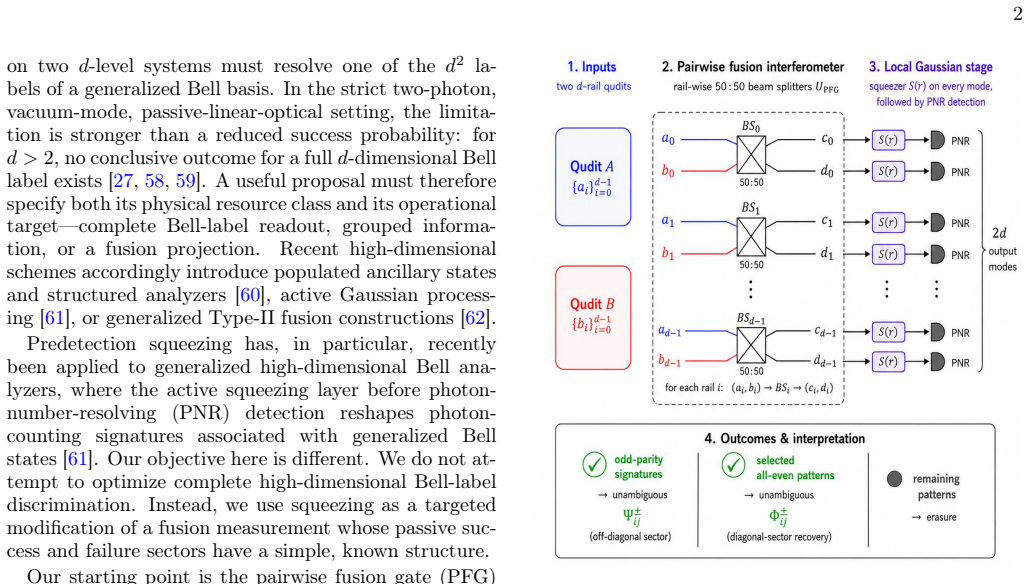
Pairwise fusion gates are linear-optical measurements that herald Bell projections onto two-rail subspaces of two d-rail single-photon qudits. Without ancillary input photons, these passive measurements succeed with probability 1-d^{-1}, with all failures confined to the diagonal logical subspace. Identical single-mode squeezers applied to the 2d interferometer outputs before photon-number-resolving detection recover part of this structured failure sector. Photon-number parity preserves the successful off-diagonal fusion signatures, while selected all-even patterns yield POVM elements proportional to definite pairwise Bell projectors. The paper derives the exact logical-space POVM and proves
What carries the argument
The photon-number-imbalance vector whose acceptance condition (exactly two nonzero components of equal magnitude) selects the diagonal patterns that contribute to the enhanced POVM elements proportional to pairwise Bell projectors.
If this is right
- Success probability rises from 1-1/d to the value of the derived elliptic integral for any d.
- No ancillary photons are required, only 2d squeezing operations and an extended photon-number range at detection.
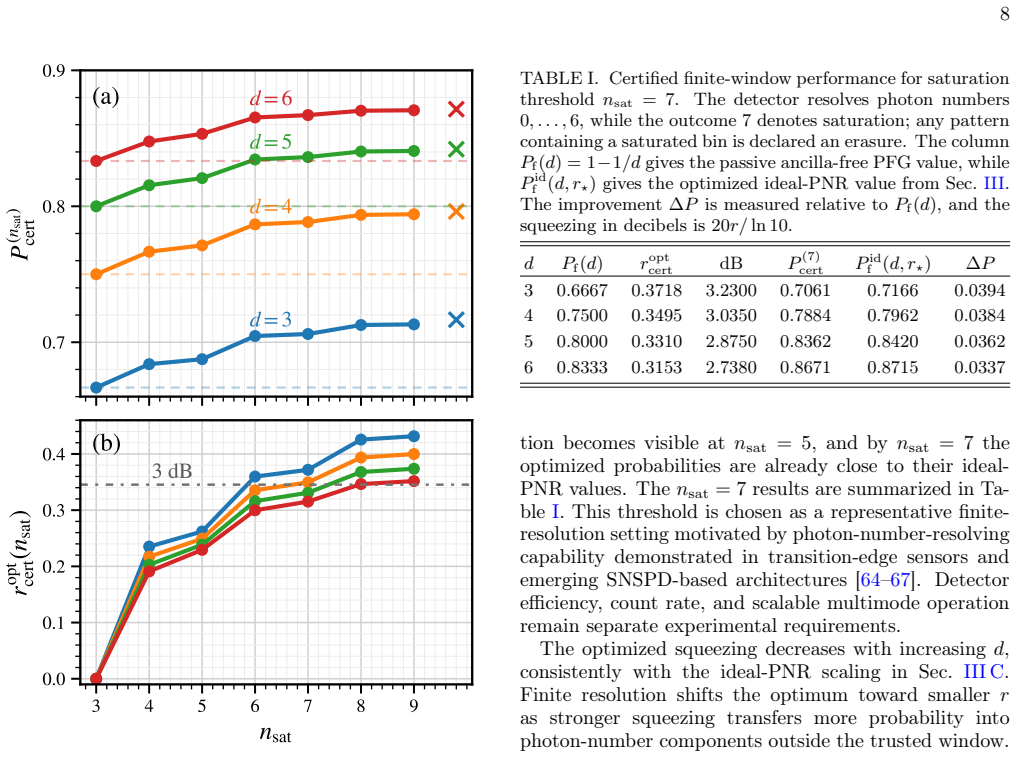
- With detector saturation at seven photons the certified probabilities remain 78.84 percent for d=4 and 86.71 percent for d=6.
- The method recycles only the diagonal failure sector while leaving the off-diagonal success sector unchanged.
Where Pith is reading between the lines
- The same squeezing approach could be tested on fusion gates that already incorporate a small number of ancillary photons to see whether further gains appear.
- Because the acceptance rule depends only on the imbalance vector, the enhancement formula may generalize to other linear-optical measurements whose failure patterns share the same parity structure.
- Finite squeezing strength could be optimized per dimension rather than held identical, potentially increasing the integral expression further.
Load-bearing premise
Photon-number parity continues to protect the off-diagonal success signatures and the chosen all-even patterns produce POVM elements exactly proportional to the desired pairwise Bell projectors once the imbalance-vector acceptance rule is applied.
What would settle it
An explicit computation of the logical POVM for d=4 showing whether the accepted all-even patterns contribute precisely the expected fraction of the Bell projectors or deviate from them.
Figures
read the original abstract
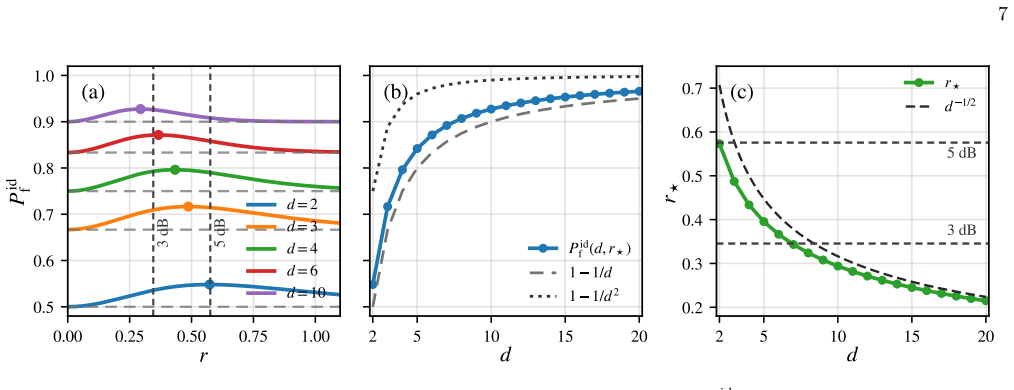
Pairwise fusion gates are linear-optical measurements that herald Bell projections onto two-rail subspaces of two \(d\)-rail single-photon qudits. Without ancillary input photons, these passive measurements succeed with probability \(1-d^{-1}\), with all failures confined to the diagonal logical subspace. We show that identical single-mode squeezers applied to the \(2d\) interferometer outputs before photon-number-resolving detection recover part of this structured failure sector. Photon-number parity preserves the successful off-diagonal fusion signatures, while selected all-even patterns yield POVM elements proportional to definite pairwise Bell projectors. We derive the exact logical-space POVM and prove that a diagonal pattern is accepted if and only if its photon-number-imbalance vector has exactly two nonzero components of equal magnitude. The resulting closed elliptic-integral expression increases the ideal success probability, for instance, from \(75\%\) to \(79.62\%\) for \(d=4\), and from \(83.33\%\) to \(87.15\%\) for \(d=6\). With a representative finite detector saturation threshold, \(n_{\rm sat}=7\), the respective certified values remain \(78.84\%\) and \(86.71\%\). These results establish active Gaussian processing as a method for recycling structured measurement failures without ancillary input photons, at the cost of \(2d\) squeezing operations and a larger photon-number range at detection.
Editorial analysis
A structured set of objections, weighed in public.
Referee Report
Summary. The manuscript claims that identical single-mode squeezers applied to the 2d interferometer outputs before photon-number-resolving detection can recycle part of the diagonal failure sector in pairwise fusion of d-rail photonic qudits. Photon-number parity preserves off-diagonal signatures, and the authors derive the exact logical-space POVM while proving that a diagonal pattern is accepted if and only if its photon-number-imbalance vector has exactly two nonzero components of equal magnitude; the resulting closed elliptic-integral expression raises the success probability (e.g., 75% to 79.62% for d=4; 83.33% to 87.15% for d=6) and remains high (78.84%, 86.71%) at finite detector saturation n_sat=7.
Significance. If the central derivation and proof hold, the work supplies a concrete, ancilla-free route to boosting linear-optical fusion success via Gaussian processing and PNR detection, together with an exact closed-form expression and a proved combinatorial acceptance condition. The explicit numerical gains and saturation-robustness checks are useful for photonic qudit protocols; the absence of free parameters beyond n_sat and the machine-checkable combinatorial structure add strength.
major comments (2)
- [Abstract (POVM derivation paragraph)] Abstract (POVM derivation paragraph): the iff statement on the photon-number-imbalance vector is load-bearing for the claim that selected all-even patterns produce POVM elements exactly proportional to pairwise Bell projectors. An explicit algebraic verification (for d=4, say) that no selected pattern admits a non-proportional component in the logical subspace after squeezing is required; without it the elliptic-integral success probability may overcount heralded Bell events.
- [Success-probability section] Success-probability section: the closed elliptic-integral expression must be shown to integrate only over the patterns whose squeezed-state overlaps are strictly proportional to the two-rail Bell projectors; any residual cross-term would invalidate the quoted numerical improvements (75%→79.62% for d=4).
minor comments (2)
- The representative saturation threshold n_sat=7 is introduced without a general scaling argument; a brief remark on how the certified probabilities behave for other n_sat would aid reproducibility.
- Notation for the 2d-mode interferometer outputs and the imbalance vector could be introduced earlier to improve readability of the combinatorial argument.
Simulated Author's Rebuttal
We thank the referee for the careful reading and the specific requests for additional verification. We respond point by point to the major comments.
read point-by-point responses
-
Referee: [Abstract (POVM derivation paragraph)] Abstract (POVM derivation paragraph): the iff statement on the photon-number-imbalance vector is load-bearing for the claim that selected all-even patterns produce POVM elements exactly proportional to pairwise Bell projectors. An explicit algebraic verification (for d=4, say) that no selected pattern admits a non-proportional component in the logical subspace after squeezing is required; without it the elliptic-integral success probability may overcount heralded Bell events.
Authors: The proof of the iff condition appears in Section III B, where the structure of the squeezed-state overlaps is shown to be proportional to the Bell projector precisely when the imbalance vector has exactly two equal nonzero entries. To meet the request for explicit verification, the revised manuscript will add a short algebraic check for d=4 that enumerates the accepted patterns, computes their logical-space components after squeezing, and confirms that each is strictly proportional to the corresponding pairwise Bell projector with no residual cross-terms. revision: yes
-
Referee: [Success-probability section] Success-probability section: the closed elliptic-integral expression must be shown to integrate only over the patterns whose squeezed-state overlaps are strictly proportional to the two-rail Bell projectors; any residual cross-term would invalidate the quoted numerical improvements (75%→79.62% for d=4).
Authors: The elliptic integral is constructed by summing exclusively over the patterns that satisfy the combinatorial condition proved in Section III. Because that condition guarantees strict proportionality, the integral contains no contributions from patterns with residual cross-terms. The revised success-probability section will include an explicit sentence stating that the integration domain is restricted to these patterns, thereby confirming that the reported numerical gains reflect only valid heralded Bell events. revision: yes
Circularity Check
No circularity: derivation is self-contained algebraic proof
full rationale
The paper derives the exact logical-space POVM from the squeezed 2d-mode Gaussian state and photon-number-resolving detection, then proves the iff acceptance condition on the photon-number-imbalance vector for diagonal patterns. The resulting elliptic-integral success probability is obtained directly from this POVM without any reduction to fitted parameters, self-definitional loops, or load-bearing self-citations. The abstract and described steps present an independent first-principles calculation of the heralded Bell probability, with the combinatorial selection rule established internally rather than imported or renamed from prior results.
Axiom & Free-Parameter Ledger
free parameters (1)
- n_sat =
7
axioms (2)
- standard math Linear optical transformations preserve photon-number parity in the described interferometer outputs
- domain assumption Photon-number-resolving detection can distinguish the required even patterns up to saturation
Forward citations
Cited by 2 Pith papers
-
Auxiliary Schmidt Rank as a Resource for Photonic Bell Measurements
Auxiliary Schmidt rank r_Φ must be at least d for deterministic photonic Bell-state discrimination of d-dimensional qudits, with ceil(d/2) sufficient for partial success.
-
Auxiliary Schmidt Rank as a Resource for Photonic Bell Measurements
Auxiliary Schmidt rank r_Φ ≥ d is necessary and sufficient for deterministic discrimination of all d² Bell states on photonic qudits using a fixed auxiliary entangled state.
Reference graph
Works this paper leans on
-
[1]
QoX q=0 oq(r) #2
Different rail pairs therefore share diag- onal basis components. A PFG does not implement a complete BM on the fulld2-dimensional two-qudit space. Rather, each successful outcome heralds a Bell projec- tion supported on a definite two-rail subspace(i, j); all remaining outcomes are treated as erasures. The passive ancilla-free PFG [63] succeeds with unit...
-
[2]
Forh= 0, ∞X n=0 w2 n(r) =Z 0(r)
Reduction to an elliptic-integral expression Withx= tanh 2 r, the squeezed-vacuum probabilities can be written as wq(r) = √ 1−x 1 4q 2q q xq.(C1) Using the binomial series identity 1√1−u = ∞X q=0 1 4q 2q q uq,|u|<1, the generating function of the weights is Wx(z)≡ ∞X q=0 wq(r)z q = r 1−x 1−xz .(C2) On the unit circle, define Fx(θ) =W x(eiθ)Wx(e−iθ) = 1−x√...
-
[3]
(C14) over0< y <1
Exact optimization condition Becausey= tanh 2(2r)is strictly increasing forr≥0, maximizingp diag(d, r)overris equivalent to maximizing Eq. (C14) over0< y <1. Its logarithmic derivative is d dy lnp diag = 1 y − d−1 2(1−y) + (d−2) K′(y) K(y) .(C15) Introduce the complete elliptic integral of the second kind, E(y) = Z π/2 0 q 1−ysin 2 θ dθ.(C16) Using K′(y) ...
-
[4]
Large-dexpansion For smally, E(y) K(y) = 1− y 2 − y2 16 − y3 32 +O(y 4).(C26) Substituting the ansatz y⋆ = a1 d + a2 d2 + a3 d3 +O(d −4) into Eq. (C18) and matching successive powers of1/d gives y⋆ = 4 d − 18 d2 + 90 d3 +O(d −4).(C27) Sincer ⋆ = 1 2 arctanh √y⋆, this implies r2 ⋆ = 1 d − 11 6d2 +O(d −3).(C28) Finally, using ln 2K(y) π = y 4 + 7y2 64 +O(y ...
-
[5]
Knill, R
E. Knill, R. Laflamme, and G. J. Milburn, A scheme for efficient quantum computation with linear optics, Nature 409, 46 (2001)
2001
-
[6]
P. Kok, W. J. Munro, K. Nemoto, T. C. Ralph, J. P. Dowling, and G. J. Milburn, Linear optical quantum computing with photonic qubits, Rev. Mod. Phys.79, 135 (2007)
2007
-
[7]
C. H. Bennett, G. Brassard, C. Crépeau, R. Jozsa, A. Peres, and W. K. Wootters, Teleporting an unknown quantum state via dual classical and Einstein-Podolsky- Rosen channels, Phys. Rev. Lett.70, 1895 (1993)
1993
-
[8]
S. L. Braunstein and A. Mann, Measurement of the Bell operator and quantum teleportation, Phys. Rev. A51, R1727 (1995)
1995
-
[9]
Bianchi, C
L. Bianchi, C. Marconi, and D. Bacco, Bell state mea- surements in quantum optics: a review of recent progress and open challenges, Quantum Sci. Technol.11, 023001 (2026)
2026
-
[10]
Bouwmeester, J.-W
D. Bouwmeester, J.-W. Pan, K. Mattle, M. Eibl, H. We- infurter, and A. Zeilinger, Experimental quantum tele- portation, Nature390, 575 (1997)
1997
-
[11]
event-ready-detectors
M. Żukowski, A. Zeilinger, M. A. Horne, and A. K. Ek- ert, “event-ready-detectors” Bell experiment via entan- glement swapping, Phys. Rev. Lett.71, 4287 (1993)
1993
-
[12]
J.-W. Pan, D. Bouwmeester, H. Weinfurter, and A. Zeilinger, Experimental entanglement swapping: En- tangling photons that never interacted, Phys. Rev. Lett. 80, 3891 (1998)
1998
-
[13]
D. E. Browne and T. Rudolph, Resource-efficient lin- ear optical quantum computation, Phys. Rev. Lett.95, 010501 (2005)
2005
-
[14]
Gimeno-Segovia, P
M. Gimeno-Segovia, P. Shadbolt, D. E. Browne, and T. Rudolph, From three-photon Greenberger-Horne- Zeilinger states to ballistic universal quantum computa- tion, Phys. Rev. Lett.115, 020502 (2015)
2015
-
[15]
Bartolucci, P
S. Bartolucci, P. Birchall, H. Bombin, H. Cable, C. Daw- son, M. Gimeno-Segovia, E. Johnston, K. Kieling, N. Nickerson, M. Pant, F. Pastawski, T. Rudolph, and C. Sparrow, Fusion-based quantum computation, Nat. Commun.14, 912 (2023)
2023
-
[16]
H.-J.Briegel, W.Dür, J.I.Cirac,andP.Zoller,Quantum repeaters: the role of imperfect local operations in quan- tum communication, Phys. Rev. Lett.81, 5932 (1998)
1998
-
[17]
D.Lukin, J
L.-M.Duan, M. D.Lukin, J. I.Cirac,andP.Zoller,Long- distance quantum communication with atomic ensembles and linear optics, Nature414, 413 (2001)
2001
-
[18]
N.Sangouard, C.Simon, H.deRiedmatten,andN.Gisin, Quantumrepeaters basedonatomicensemblesand linear optics, Rev. Mod. Phys.83, 33 (2011)
2011
-
[19]
Azuma, K
K. Azuma, K. Tamaki, and H.-K. Lo, All-photonic quan- tum repeaters, Nat. Commun.6, 6787 (2015)
2015
-
[20]
Ewert, M
F. Ewert, M. Bergmann, and P. van Loock, Ultrafast long-distance quantum communication with static linear optics, Phys. Rev. Lett.117, 210501 (2016)
2016
-
[21]
Paesani and B
S. Paesani and B. J. Brown, High-threshold quan- tum computing by fusing one-dimensional cluster states, Phys. Rev. Lett.131, 120603 (2023)
2023
-
[22]
Pankovich, A
B. Pankovich, A. Kan, K. H. Wan, M. Ostmann, A. Neville, S. Omkar, A. Sohbi, and K. Brádler, High- photon-loss threshold quantum computing using GHZ- state measurements, Phys. Rev. Lett.133, 050604 (2024)
2024
-
[23]
F. Schmidt and P. van Loock, Generalized fusions of pho- tonic quantum states using static linear optics (2024), arXiv:2410.20261 [quant-ph]
-
[24]
W. Song, N. Kang, Y.-S. Kim, and S.-W. Lee, Encoded- fusion-based quantum computation for high thresholds with linear optics, Phys. Rev. Lett.133, 050605 (2024)
2024
-
[25]
M. Pant, H. Krovi, D. Englund, and S. Guha, Rate- distance tradeoff and resource costs for all-optical quan- tum repeaters, Phys. Rev. A95, 012304 (2017)
2017
-
[26]
Weinfurter, Experimental Bell-state analysis, EPL25, 559 (1994)
H. Weinfurter, Experimental Bell-state analysis, EPL25, 559 (1994)
1994
-
[27]
Vaidman and N
L. Vaidman and N. Yoran, Methods for reliable telepor- tation, Phys. Rev. A59, 116 (1999)
1999
-
[28]
Lütkenhaus, J
N. Lütkenhaus, J. Calsamiglia, and K.-A. Suominen, Bell measurements for teleportation, Phys. Rev. A59, 3295 (1999)
1999
-
[29]
Calsamiglia and N
J. Calsamiglia and N. Lütkenhaus, Maximum efficiency of a linear-optical Bell-state analyzer, Appl. Phys. B72, 67 (2001)
2001
-
[30]
Scheel and N
S. Scheel and N. Lütkenhaus, Upper bounds on success probabilities in linear optics, New J. Phys.6, 51 (2004)
2004
-
[31]
Auxiliary Schmidt Rank as a Resource for Photonic Bell Measurements
P. Laha and P. van Loock, Auxiliary Schmidt rank as a resource for photonic Bell measurements (2026), arXiv:2606.24591 [quant-ph]
work page internal anchor Pith review Pith/arXiv arXiv 2026
-
[32]
W. P. Grice, Arbitrarily complete Bell-state measure- ment using only linear optical elements, Phys. Rev. A 84, 042331 (2011)
2011
-
[33]
Ewert and P
F. Ewert and P. van Loock, 3/4-efficient Bell measure- ment with passive linear optics and unentangled ancillae, Phys. Rev. Lett.113, 140403 (2014)
2014
-
[34]
M. J. Bayerbach, S. E. D’Aurelio, P. van Loock, and S. Barz, Bell-state measurement exceeding 50% success probability with linear optics, Sci. Adv.9, eadf4080 (2023)
2023
-
[35]
Hauser, M
N. Hauser, M. J. Bayerbach, S. E. D’Aurelio, R. Weber, M. Santandrea, S. P. Kumar, I. Dhand, and S. Barz, Boosted Bell-state measurements for photonic quantum computation, npj Quantum Inf.11, 41 (2025)
2025
-
[36]
Olivo and F
A. Olivo and F. Grosshans, Ancilla-assisted linear optical Bellmeasurementsandtheiroptimality,Phys.Rev.A98, 042323 (2018)
2018
-
[37]
P. G. Kwiat and H. Weinfurter, Embedded Bell-state analysis, Phys. Rev. A58, R2623 (1998)
1998
-
[38]
S.-W. Lee, K. Park, T. C. Ralph, and H. Jeong, Nearly deterministic Bell measurement for multiphoton qubits and its application to quantum information processing, Phys. Rev. Lett.114, 113603 (2015)
2015
-
[39]
Schmidt and P
F. Schmidt and P. van Loock, Efficiencies of logical Bell measurements on Calderbank-Shor-Steane codes with static linear optics, Phys. Rev. A99, 062308 (2019)
2019
-
[40]
Hilaire, Y
P. Hilaire, Y. Castor, E. Barnes, S. E. Economou, and F. Grosshans, Linear optical logical Bell state measure- ments with optimal loss-tolerance threshold, PRX Quan- tum4, 040322 (2023)
2023
-
[41]
Ewert and P
F. Ewert and P. van Loock, Ultrafast fault-tolerant long- distance quantum communication with static linear op- tics, Phys. Rev. A95, 012327 (2017)
2017
-
[42]
S.-W. Lee, T. C. Ralph, and H. Jeong, Fundamental building block for all-optical scalable quantum networks, Phys. Rev. A100, 052303 (2019). 14
2019
-
[43]
H. A. Zaidi and P. van Loock, Beating the one-half limit of ancilla-free linear optics Bell measurements, Phys. Rev. Lett.110, 260501 (2013)
2013
-
[44]
Kilmer and S
T. Kilmer and S. Guha, Boosting linear-optical Bell mea- surement success probability with predetection squeezing and imperfect photon-number-resolving detectors, Phys. Rev. A99, 032302 (2019)
2019
-
[45]
S. Wein, K. Heshami, C. A. Fuchs, H. Krovi, Z. Dutton, W. Tittel, and C. Simon, Efficiency of an enhanced lin- ear optical Bell-state measurement scheme with realistic imperfections, Phys. Rev. A94, 032332 (2016)
2016
-
[46]
A. C. Dada, J. Leach, G. S. Buller, M. J. Padgett, and E. Andersson, Experimental high-dimensional two- photon entanglement and violations of generalized Bell inequalities, Nat. Phys.7, 677 (2011)
2011
-
[47]
Cozzolino, B
D. Cozzolino, B. da Lio, D. Bacco, and L. K. Oxen- løwe, High-dimensional quantum communication: bene- fits, progress, andfuturechallenges,Adv.QuantumTech- nol.2, 1900038 (2019)
2019
-
[48]
M.Erhard, M.Krenn,andA.Zeilinger,Advancesinhigh- dimensional quantum entanglement, Nat. Rev. Phys.2, 365 (2020)
2020
-
[49]
Y. Wang, Z. Hu, B. C. Sanders, and S. Kais, Qudits and high-dimensional quantum computing, Front. Phys. 8, 589504 (2020)
2020
-
[50]
Schaeff, R
C. Schaeff, R. Polster, M. Huber, S. Ramelow, and A. Zeilinger, Experimental access to higher-dimensional entangled quantum systems using integrated optics, Op- tica2, 523 (2015)
2015
-
[51]
M. Kues, C. Reimer, P. Roztocki, L. Romero Cortés, S. Sciara, B. Wetzel, Y. Zhang, A. Cino, S. T. Chu, B. E. Little, D. J. Moss, L. Caspani, J. Azaña, and R. Moran- dotti, On-chip generation of high-dimensional entangled quantum states and their coherent control, Nature546, 622 (2017)
2017
-
[52]
W. R. Clements, P. C. Humphreys, B. J. Metcalf, W. S. Kolthammer, and I. A. Walmsley, Optimal design for uni- versal multiport interferometers, Optica3, 1460 (2016)
2016
-
[53]
Imany, J
P. Imany, J. A. Jaramillo-Villegas, M. S. Alshaykh, J. M. Lukens, O. D. Odele, A. J. Moore, D. E. Leaird, M. Qi, and A. M. Weiner, High-dimensional optical quantum logic in large operational spaces, npj Quantum Inf.5, 59 (2019)
2019
-
[54]
Zheng, C
Y. Zheng, C. Zhai, D. Liu, J. Mao, X. Chen, T. Dai, J. Huang, J. Bao, Z. Fu, Y. Tong, X. Zhou, Y. Yang, B. Tang, Z. Li, Y. Li, Q. Gong, H. K. Tsang, D. Dai, and J. Wang, Multichip multidimensional quantum net- works with entanglement retrievability, Science381, 221 (2023)
2023
-
[55]
Luo, H.-S
Y.-H. Luo, H.-S. Zhong, M. Erhard, X.-L. Wang, L.-C. Peng, M. Krenn, X. Jiang, L. Li, N.-L. Liu, C.-Y. Lu, A. Zeilinger, and J.-W. Pan, Quantum teleportation in high dimensions, Phys. Rev. Lett.123, 070505 (2019)
2019
-
[56]
X.-M. Hu, C. Zhang, B.-H. Liu, Y. Cai, X.-J. Ye, Y. Guo, W.-B. Xing, C.-X. Huang, Y.-F. Huang, C.-F. Li, and G.- C. Guo, Experimental high-dimensional quantum tele- portation, Phys. Rev. Lett.125, 230501 (2020)
2020
-
[57]
Tanji, H
K. Tanji, H. Shimizu, and M. Takeoka, High-rate qutrit entanglement swapping with photon-number basis, Phys. Rev. Research8, 013316 (2026)
2026
-
[58]
Bacco, J
D. Bacco, J. F. F. Bulmer, M. Erhard, M. Huber, and S.Paesani,Proposalforpracticalmultidimensionalquan- tum networks, Phys. Rev. A104, 052618 (2021)
2021
-
[59]
Zahidy, D
M. Zahidy, D. Ribezzo, C. De Lazzari, I. Vagniluca, N.Biagi, R.Müller, M.Galili, S.Forchhammer, L.K.Ox- enløwe, and D. Bacco, Practical high-dimensional quan- tum key distribution protocol over deployed multicore fiber, Nat. Commun.15, 1651 (2024)
2024
-
[60]
Paesani, J
S. Paesani, J. F. F. Bulmer, A. E. Jones, R. Santagati, and A. Laing, Scheme for universal high-dimensional quantum computation with linear optics, Phys. Rev. Lett.126, 230504 (2021)
2021
-
[61]
Raissi, E
Z. Raissi, E. Barnes, and S. E. Economou, Deterministic generation of Qudit photonic graph states from quantum emitters, PRX Quantum5, 020346 (2024)
2024
-
[62]
Dušek, Discrimination of the Bell states of qudits by means of linear optics, Opt
M. Dušek, Discrimination of the Bell states of qudits by means of linear optics, Opt. Commun.199, 161 (2001)
2001
-
[63]
Calsamiglia, Generalized measurements by linear ele- ments, Phys
J. Calsamiglia, Generalized measurements by linear ele- ments, Phys. Rev. A65, 030301 (2002)
2002
-
[64]
Bharos, L
N. Bharos, L. Markovich, and J. Borregaard, Efficient high-dimensional entangled state analyzer with linear op- tics, Quantum9, 1711 (2025)
2025
-
[65]
Bianchi, C
L. Bianchi, C. Marconi, J. Sperling, and D. Bacco, Pre- detection squeezing as a resource for high-dimensional Bell-state measurements, Phys. Rev. Research7, 023038 (2025)
2025
-
[66]
Üstün, E
G. Üstün, E. G. Rieffel, S. J. Devitt, and J. Saied, Fusion for high-dimensional linear-optical quantum computing with improved success probability, Phys. Rev. Appl.24, 044024 (2025)
2025
-
[67]
Yamazaki and K
T. Yamazaki and K. Azuma, Linear-optical fusion boosted by high-dimensional entanglement, Phys. Rev. Lett.134, 200801 (2025)
2025
-
[68]
A. E. Lita, A. J. Miller, and S. W. Nam, Counting near- infrared single-photons with 95% efficiency, Opt. Express 16, 3032 (2008)
2008
-
[69]
Fukuda, G
D. Fukuda, G. Fujii, T. Numata, K. Amemiya, A.Yoshizawa, H.Tsuchida, H.Fujino, H.Ishii, T.Itatani, S. Inoue, and T. Zama, Titanium-based transition-edge photon number resolving detector with 98% detection efficiency with index-matched small-gap fiber coupling, Opt. Express19, 870 (2011)
2011
-
[70]
L. A. Morais, T. Weinhold, M. P. de Almeida, A. E. Lita, T. Gerrits, S. W. Nam, A. G. White, and G. G. Gillett, Preciselydeterminingphoton-numberinrealtime,Quan- tum8, 1355 (2024)
2024
-
[71]
Schapeler, N
T. Schapeler, N. Lamberty, T. Hummel, F. Schlue, M. Stefszky, B. Brecht, C. Silberhorn, and T. J. Bart- ley, Electrical trace analysis of superconducting nanowire photon-number-resolving detectors, Phys. Rev. Applied 22, 014024 (2024)
2024
discussion (0)
Sign in with ORCID, Apple, or X to comment. Anyone can read and Pith papers without signing in.