Radiative decays of dynamically generated pentaquarks in the chiral unitary approach: the P_c(4457)to P_c(4312)\,γ transition
Pith reviewed 2026-06-25 23:17 UTC · model grok-4.3
The pith
The radiative decay Pc(4457) to Pc(4312) plus photon has a width of 6.7 keV as a pure M1 transition in the molecular picture.
A machine-rendered reading of the paper's core claim, the machinery that carries it, and where it could break.
Core claim
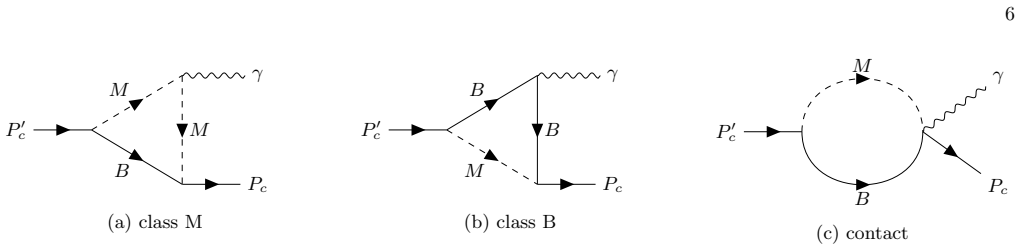
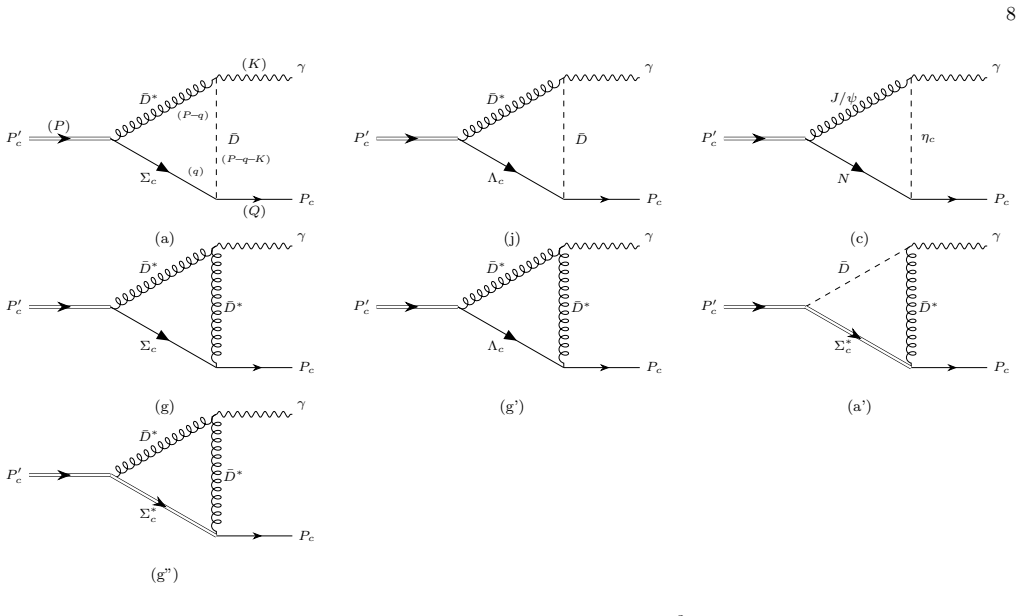
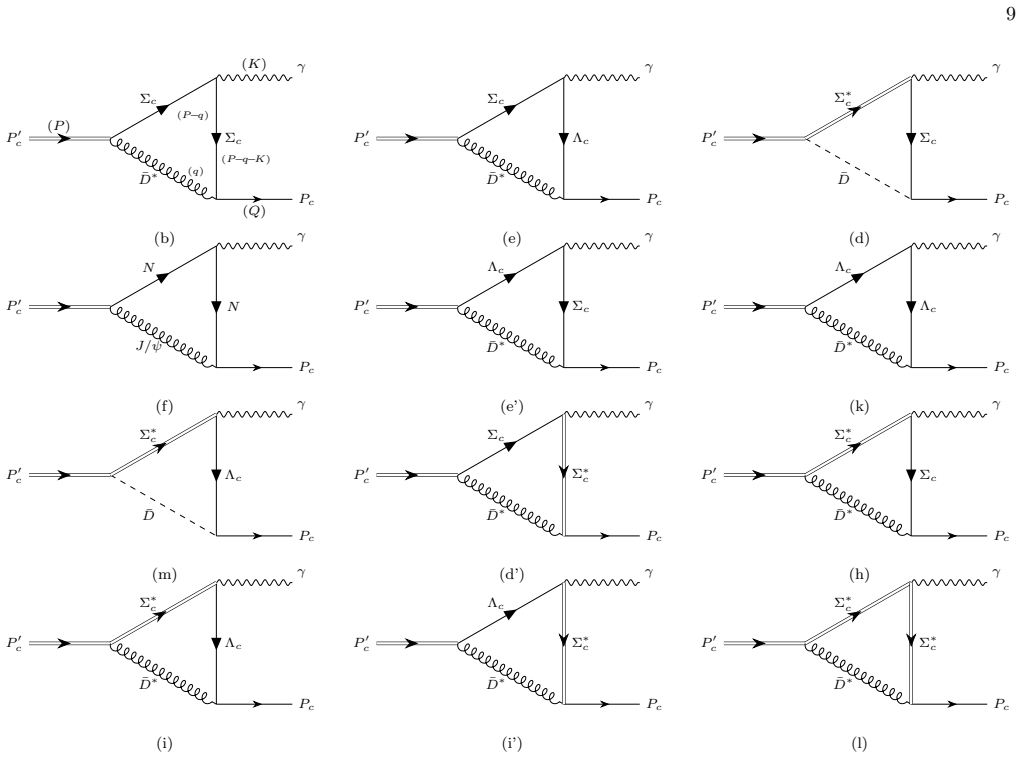
Both the Pc(4457) (3/2-) and Pc(4312) (1/2-) are S-wave hadronic molecules generated from coupled-channel meson-baryon scattering in the chiral unitary approach with heavy-quark spin symmetry. The radiative transition proceeds through the photon coupling to these components, producing a pure M1 amplitude assembled from nineteen triangle loops that are reduced to single quadratures with closed analytic forms. The central width is 6.7 keV (conservative range 2-9 keV) at 143 MeV photon energy; the D*0 D0 gamma loop dominates, the near-threshold D* Lambda_c loop supplies the main correction, and a soft Gaussian form factor on the leading diagram lowers the width to about 2 keV.
What carries the argument
Transverse assembly of nineteen M1 triangle loops whose residues are taken from the chiral unitary coupled-channel solution and whose electromagnetic vertices are fixed by heavy-quark spin symmetry plus the naive quark model, normalized to the measured D*0 to D0 gamma rate.
If this is right
- The decay width is sensitive to the relative phases of the residues in the coupled-channel solution.
- A soft form factor applied to the leading loop reduces the width to roughly 2 keV and the full result to about 4 keV.
- The cascade branching fraction Lambda_b to J/psi p K- gamma can be estimated from the calculated width.
- The ratio of this width to the corresponding Pc(4440) radiative width and the dependence on binding energy serve as tests of the molecular interpretation.
Where Pith is reading between the lines
- Observation of the predicted line shape and angular distribution would strengthen the case that both states are meson-baryon molecules rather than compact multiquark states.
- The same loop machinery can be applied to other radiative transitions among nearby pentaquark candidates once their residues are known.
- The binding-energy dependence of the width offers a direct experimental handle on the spatial size of the molecular wave function.
Load-bearing premise
Electromagnetic vertices not fixed by data are estimated with the naive quark model and heavy-quark spin symmetry.
What would settle it
An experimental width for the Pc(4457) to Pc(4312) gamma transition lying outside the 2-9 keV interval, or a measurable electric-quadrupole component in the angular distribution, would contradict the molecular-loop prediction.
Figures
read the original abstract
We study the radiative decay of dynamically generated pentaquarks and apply the formalism to the transition $P_c(4457)(3/2^-)\to P_c(4312)(1/2^-)\gamma$. Both states are treated as $S$-wave hadronic molecules generated in the chiral unitary approach with heavy-quark spin symmetry and the local hidden gauge interaction. The photon therefore couples to the meson-baryon components of the two poles. The calculation combines the strong coupling residues of the coupled-channel solution, heavy-quark spin symmetry for the electromagnetic vertices, and a transverse assembly of the $M1$ triangle loops. A complete calculation gives nineteen triangle loops. We reduce each loop to a single numerical quadrature and give the closed analytic form. The electromagnetic vertices that are not fixed by data are estimated with the naive-quark model and heavy-quark spin symmetry. We normalize the main $D^*D\gamma$ coupling to $\bar D^{*0}\to\bar D^{0}\gamma$ and test the same convention with $J/\psi\to\eta_c\gamma$. The central width is $6.7\keV$, with a conservative range of about $2$ to $9\keV$. This radiative decay process is a pure $M1$ transition with photon energy $143\MeV$. The $\bar D^{*0}\to\bar D^{0}\gamma$ loop gives the leading contribution. The near-threshold $\bar D^{*}\Lambda_c$ loop gives the main correction. A soft Gaussian form-factor on the leading diagram reduces the width to about $2\keV$, compatible with earlier molecular results, and decreases the full width to about $4\keV$. The coherent result is sensitive to the relative residue phases in the coupled-channel convention. We also estimate the cascade rate for $\Lambda_b^{0}\to J/\psi\,p\,K^{-}\gamma$ and discuss how the line can be searched for. The pure $M1$ content, the ratio to the $P_c(4440)$ radiative decay, and the binding-energy dependence of the width are proposed as tests of the molecular nature.
Editorial analysis
A structured set of objections, weighed in public.
Referee Report
Summary. The paper computes the radiative decay width for the transition Pc(4457)(3/2−) → Pc(4312)(1/2−)γ, treating both states as dynamically generated S-wave hadronic molecules in the chiral unitary approach with heavy-quark spin symmetry. It assembles the photon coupling to the meson-baryon components via 19 M1 triangle loops, reduces each to a single numerical quadrature with closed analytic forms, normalizes the leading D*Dγ vertex to data and estimates the rest via the naive quark model plus HQSS, and reports a central width of 6.7 keV (range ~2–9 keV) that is sensitive to residue phases; the result is proposed as a test of the molecular picture together with a cascade-rate estimate for Λb0 → J/ψ p K− γ.
Significance. If the central numerical result holds, the work supplies a concrete, falsifiable prediction for a pure M1 transition at 143 MeV photon energy that can be searched in LHCb data and offers binding-energy dependence and decay ratios as diagnostics of the molecular interpretation. The technical reduction of nineteen loops to quadratures and the explicit discussion of phase sensitivity constitute clear strengths.
major comments (2)
- [section on EM vertices] Section on EM vertices (abstract and main text): the electromagnetic vertices not fixed by data are estimated with the naive-quark model and heavy-quark spin symmetry after normalizing only the leading D̄*0 → D̄0 γ coupling to experiment. Because the width is obtained from a coherent sum over all 19 loops, an O(1) variation in any unfixed vertex propagates directly into the quadrature and can change both the 6.7 keV central value and the claimed dominance of the D̄*0 D̄0 γ loop.
- [results and discussion] Results and discussion (abstract): the quoted conservative range 2–9 keV already incorporates some modeling uncertainty, yet the range itself is generated from the same quark-model estimates and the same relative-phase convention taken from prior coupled-channel fits; an independent variation of the unfixed couplings or an external benchmark for at least one additional vertex would be required to substantiate the robustness of the quoted interval.
minor comments (1)
- [abstract] The abstract refers to “the local hidden gauge interaction” without a citation; a reference to the standard formulation should be added for completeness.
Simulated Author's Rebuttal
We thank the referee for the careful reading, the positive assessment of the technical reduction of the loops, and the constructive comments on the electromagnetic vertices and uncertainty quantification. We address each major comment below.
read point-by-point responses
-
Referee: Section on EM vertices (abstract and main text): the electromagnetic vertices not fixed by data are estimated with the naive-quark model and heavy-quark spin symmetry after normalizing only the leading D̄*0 → D̄0 γ coupling to experiment. Because the width is obtained from a coherent sum over all 19 loops, an O(1) variation in any unfixed vertex propagates directly into the quadrature and can change both the 6.7 keV central value and the claimed dominance of the D̄*0 D̄0 γ loop.
Authors: We agree that an O(1) change in any unfixed vertex can affect the coherent sum. The leading D* D γ coupling is fixed to the measured D̄*0 → D̄0 γ width; the remaining vertices are obtained from HQSS plus the naive quark model, which is the standard procedure used in the literature for analogous heavy-meson transitions. The manuscript already stresses the sensitivity to the relative phases of the residues taken from the coupled-channel solution. We will revise the text to add an explicit statement that alternative estimates (e.g., from light-cone sum rules where available) could shift the numerical result by a factor of order one, and we will include a short table showing the individual loop contributions so that the dominance of the D̄*0 D̄0 γ diagram remains transparent. revision: partial
-
Referee: Results and discussion (abstract): the quoted conservative range 2–9 keV already incorporates some modeling uncertainty, yet the range itself is generated from the same quark-model estimates and the same relative-phase convention taken from prior coupled-channel fits; an independent variation of the unfixed couplings or an external benchmark for at least one additional vertex would be required to substantiate the robustness of the quoted interval.
Authors: The quoted interval is obtained by (i) the central coherent sum, (ii) the effect of a soft Gaussian form factor applied only to the leading loop (which lowers the width to ~4 keV), and (iii) the spread arising from the two possible relative-phase conventions of the residues. We acknowledge that this procedure does not constitute a full independent scan over every unfixed electromagnetic coupling. We will revise the abstract and the results section to state more explicitly the origin of the range and the underlying assumptions. No additional external data exist for the unfixed vertices, so a completely model-independent error band cannot be provided; the present conservative interval already reflects the dominant sources of uncertainty within the framework we employ. revision: yes
Circularity Check
No significant circularity; forward model calculation from independent inputs
full rationale
The paper derives the radiative width by assembling 19 explicit M1 triangle loops whose strong residues come from a prior coupled-channel solution and whose EM vertices are fixed by normalization to one measured decay plus naive-quark-model estimates. The numerical result (central value 6.7 keV) is obtained from quadrature of these loops and is not fed back into any input; the calculation therefore stands as a genuine prediction rather than a re-expression of its own fitted quantities. No equation equates output to input by construction, and the single external normalization supplies an independent benchmark.
Axiom & Free-Parameter Ledger
free parameters (1)
- D* D gamma coupling =
normalized to known decay
axioms (2)
- domain assumption Heavy-quark spin symmetry holds for the electromagnetic vertices
- domain assumption Both states are S-wave hadronic molecules generated in the chiral unitary approach
Reference graph
Works this paper leans on
-
[1]
The scalar andS·ϵ vertices need no such factor
vertex. The scalar andS·ϵ vertices need no such factor. In Eq. (14) both theP ′ c and the Σ ∗ c carry spin 3 2, so the vector-meson spinσis recoupled between the two transition operators. This is the structure we mark as a spin-2 recoupling below. Every vertex in Eqs. (12) to (17) is anS-wave coupling. It is allowed because in each channelη M ηB =−1 = ηP ...
2024
-
[2]
1 − 1 2 + −S·ϵ ∗ V + (13)P ′ c →P B ∗( 3
-
[3]
0 − 3 2 + −1+ (14)P ′ c →V B ∗( 3
-
[4]
1 − 3 2 + −S † ·(σ·ϵ ∗ V )S+ (15)P c →P B( 1
-
[5]
0 − 1 2 + −1+ (16)P c →V B( 1
-
[6]
1 − 1 2 + −σ·ϵ ∗ V + (17)P c →V B ∗( 3
-
[7]
Parity audit of the six molecular vertices
1 − 3 2 + −S † B ·ϵ∗ V + TABLE II. Parity audit of the six molecular vertices. The last column is the product of the parity eigenvalues of the spin operator and of all participating fields, including the 1 − polarization flipϵ V → −ϵV and the−1 of the negative-parityχ P (′) c . It equals +1 for every vertex. Σ∗ c →Σ c and Σ ∗ c →Λ c lines with the magneti...
-
[8]
remaining seven loops
The numerator is Eq. (25) for class M, with general factors X(2Ms,α)λc, and isq-independent sX(2M1,α)(2M2,α)˜µα Tfor class B. As two explicit cases, loop (a) and loop (b) read A(a) =g 1g2 Mi 16π2 X α C2 α λα (2MΣαc )I α a , I α a = Z 1 0 dx Z 1−x 0 dy y sαa(x, y) ,(29) A(b) = 2g 1 g3√ 3 1 16π2 X α C2 α ˜µΣα c (2MΣα c )2 I α b , I α b = Z 1 0 dx Z 1−x 0 dy...
-
[9]
(6), giving the entry 1/3 for loop (d ′)
state the chain isP k Sk(S†·A)Sk = 1 3 A·S, the second relation in Eq. (6), giving the entry 1/3 for loop (d ′). For the elastic vector-meson loops (g, g ′, g′′) the spin-1 magnetic matrix element⟨ϵ ′ V |S(1)|ϵV ⟩= −i(ϵ′∗ V ×ϵ V ), inserted between theS·ϵ V and (σ·ϵ ′ V )/ √ 3 vertices and summed over the two polarizations, collapses to−S·A, the entry−1. ...
-
[10]
Meson side.The transition vertexV(ϵ V )→P γ defined in Eq
Magnetic vertices and quark-model magnetic moments a. Meson side.The transition vertexV(ϵ V )→P γ defined in Eq. (18) carries the couplingλ. Its values for the heavy-meson channels are λ0 =N(µ u +µ c) = +1.766 GeV−1, λ− =N(µ d +µ c) =−0.445 GeV −1, λψ = 2N µ c = +0.633 GeV−1,(B1) withN= 0.783 GeV −1/µN of Eq. (20). The quark- model estimateλ − =−0.445 GeV...
-
[11]
B 1 are not the only structures that can sit on an internal line
Appearance of magnetic vertices in loop diagrams The magnetic vertices of Sec. B 1 are not the only structures that can sit on an internal line. On any elastic radiation (V→V γorB→Bγ) the photon can also cou- ple convectively (minimally) through the electric charge, in addition to the magnetic structures above. On a tran- sition radiation ( ¯D∗ → ¯Dγ,J/ψ→...
-
[12]
We treat the cases in whichs X is determined by direct evaluation, and mark with a dagger (†) the six loops that carry both a Σ ∗ c and a ¯D∗ in the triangle
Spin factorss X from the baryon line With every photon vertex magnetic, the spin algebra of each triangle reduces to a single scalars X multiplyingT. We treat the cases in whichs X is determined by direct evaluation, and mark with a dagger (†) the six loops that carry both a Σ ∗ c and a ¯D∗ in the triangle. The latter involve a 3 2 ⊗1 recoupling whose lea...
-
[13]
Aaijet al.(LHCb Collaboration), Phys
R. Aaijet al.(LHCb Collaboration), Phys. Rev. Lett. 122, 222001 (2019), arXiv:1904.03947 [hep-ex]
Pith/arXiv arXiv 2019
-
[14]
Aaijet al.(LHCb Collaboration), Phys
R. Aaijet al.(LHCb Collaboration), Phys. Rev. Lett. 115, 072001 (2015), arXiv:1507.03414 [hep-ex]
Pith/arXiv arXiv 2015
-
[15]
C. W. Xiao, J. Nieves, and E. Oset, Phys. Rev. D88, 056012 (2013), arXiv:1304.5368 [hep-ph]
Pith/arXiv arXiv 2013
-
[16]
C. W. Xiao, J. Nieves, and E. Oset, Phys. Rev. D100, 014021 (2019), arXiv:1904.01296 [hep-ph]
Pith/arXiv arXiv 2019
-
[17]
N. Kaiser, P. B. Siegel, and W. Weise, Nucl. Phys. A594, 325 (1995), arXiv:nucl-th/9505043
Pith/arXiv arXiv 1995
-
[18]
J. A. Oller and E. Oset, Nucl. Phys. A620, 438 (1997), [Erratum: Nucl. Phys. A 652, 407 (1999)], arXiv:hep- 20 ph/9702314
arXiv 1997
-
[19]
E. Oset and A. Ramos, Nucl. Phys. A635, 99 (1998), arXiv:nucl-th/9711022
Pith/arXiv arXiv 1998
-
[20]
J. A. Oller, E. Oset, and J. R. Pel´ aez, Phys. Rev. D 59, 074001 (1999), [Erratum: Phys. Rev. D 60, 099906 (1999); 75, 099903 (2007)], arXiv:hep-ph/9804209
Pith/arXiv arXiv 1999
-
[21]
J. J. Wu, R. Molina, E. Oset, and B. S. Zou, Phys. Rev. Lett.105, 232001 (2010), arXiv:1007.0573 [nucl-th]
Pith/arXiv arXiv 2010
-
[22]
J. J. Wu, R. Molina, E. Oset, and B. S. Zou, Phys. Rev. C84, 015202 (2011), arXiv:1011.2399 [nucl-th]
Pith/arXiv arXiv 2011
-
[23]
J. Hofmann and M. F. M. Lutz, Nucl. Phys. A763, 90 (2005), arXiv:hep-ph/0507071
Pith/arXiv arXiv 2005
-
[24]
M. Karliner and J. L. Rosner, Phys. Rev. Lett.115, 122001 (2015), arXiv:1506.06386 [hep-ph]
Pith/arXiv arXiv 2015
-
[25]
R. Chen, X. Liu, X. Q. Li, and S. L. Zhu, Phys. Rev. Lett.115, 132002 (2015), arXiv:1507.03704 [hep-ph]
Pith/arXiv arXiv 2015
- [26]
-
[27]
M. Z. Liu, Y. W. Pan, F. Z. Peng, M. S´ anchez S´ anchez, L. S. Geng, A. Hosaka, and M. Pavon Valderrama, Phys. Rev. Lett.122, 242001 (2019), arXiv:1903.11560 [hep- ph]
Pith/arXiv arXiv 2019
-
[28]
R. Chen, Z. F. Sun, X. Liu, and S. L. Zhu, Phys. Rev. D 100, 011502 (2019), arXiv:1903.11013 [hep-ph]
Pith/arXiv arXiv 2019
-
[29]
J. He, Eur. Phys. J. C79, 393 (2019), arXiv:1903.11872 [hep-ph]
Pith/arXiv arXiv 2019
-
[30]
M. L. Du, V. Baru, F. K. Guo, C. Hanhart, U. G. Meißner, J. A. Oller, and Q. Wang, Phys. Rev. Lett.124, 072001 (2020), arXiv:1910.11846 [hep-ph]
arXiv 2020
-
[31]
Z. H. Guo and J. A. Oller, Phys. Lett. B793, 144 (2019), arXiv:1904.00851 [hep-ph]
Pith/arXiv arXiv 2019
-
[32]
L. Roca, J. Nieves, and E. Oset, Phys. Rev. D92, 094003 (2015), arXiv:1507.04249 [hep-ph]
Pith/arXiv arXiv 2015
-
[33]
H. X. Chen, W. Chen, X. Liu, and S. L. Zhu, Phys. Rept. 639, 1 (2016), arXiv:1601.02092 [hep-ph]
Pith/arXiv arXiv 2016
-
[34]
F. K. Guo, C. Hanhart, U. G. Meißner, Q. Wang, Q. Zhao, and B. S. Zou, Rev. Mod. Phys.90, 015004 (2018), arXiv:1705.00141 [hep-ph]
Pith/arXiv arXiv 2018
-
[35]
Y. R. Liu, H. X. Chen, W. Chen, X. Liu, and S. L. Zhu, Prog. Part. Nucl. Phys.107, 237 (2019), arXiv:1903.11976 [hep-ph]
Pith/arXiv arXiv 2019
-
[36]
N. Brambilla, S. Eidelman, C. Hanhart, A. Nefediev, C. P. Shen, C. E. Thomas, A. Vairo, and C. Z. Yuan, Phys. Rept.873, 1 (2020), arXiv:1907.07583 [hep-ex]
arXiv 2020
-
[37]
H. X. Chen, W. Chen, X. Liu, Y. R. Liu, and S. L. Zhu, Rept. Prog. Phys.86, 026201 (2023), arXiv:2204.02649 [hep-ph]
arXiv 2023
-
[38]
L. Maiani, A. D. Polosa, and V. Riquer, Phys. Lett. B 749, 289 (2015), arXiv:1507.04980 [hep-ph]
Pith/arXiv arXiv 2015
-
[39]
R. F. Lebed, Phys. Lett. B749, 454 (2015), arXiv:1507.05867 [hep-ph]
Pith/arXiv arXiv 2015
-
[40]
Z. G. Wang, Eur. Phys. J. C76, 70 (2016), arXiv:1508.01468 [hep-ph]
Pith/arXiv arXiv 2016
-
[41]
F. K. Guo, U. G. Meißner, W. Wang, and Z. Yang, Phys. Rev. D92, 071502 (2015), arXiv:1507.04950 [hep-ph]
Pith/arXiv arXiv 2015
-
[42]
M. Bayar, F. Aceti, F. K. Guo, and E. Oset, Phys. Rev. D94, 074039 (2016), arXiv:1609.04133 [hep-ph]
Pith/arXiv arXiv 2016
-
[43]
G. J. Wang, R. Chen, L. Ma, X. Liu, and S. L. Zhu, Phys. Rev. D94, 094018 (2016), arXiv:1605.01337 [hep-ph]
Pith/arXiv arXiv 2016
-
[44]
E. Ortiz-Pacheco, R. Bijker, and C. Fern´ andez-Ram´ ırez, J. Phys. G46, 065104 (2019), arXiv:1808.10512 [hep-ph]
Pith/arXiv arXiv 2019
-
[45]
G. J. Wang, L. Y. Xiao, R. Chen, X. H. Liu, X. Liu, and S. L. Zhu, Phys. Rev. D102, 036012 (2020), arXiv:1911.09613 [hep-ph]
arXiv 2020
-
[46]
M. W. Li, Z. W. Liu, Z. F. Sun, and R. Chen, Phys. Rev. D104, 054016 (2021), arXiv:2106.15053 [hep-ph]
arXiv 2021
-
[47]
B. J. Lai, F. L. Wang, and X. Liu, Phys. Rev. D109, 054036 (2024), arXiv:2402.07195 [hep-ph]
arXiv 2024
-
[48]
X. Z. Ling, J. X. Lu, M. Z. Liu, and L. S. Geng, Phys. Rev. D104, 074022 (2021), arXiv:2106.12250 [hep-ph]
arXiv 2021
-
[49]
U. ¨Ozdem and K. Azizi, Eur. Phys. J. C78, 379 (2018), arXiv:1803.06831 [hep-ph]
Pith/arXiv arXiv 2018
- [50]
-
[51]
Y. J. Xu, Y. L. Liu, and M. Q. Huang, Eur. Phys. J. C 81, 421 (2021), arXiv:2008.07937 [hep-ph]
arXiv 2021
-
[52]
Isgur and M
N. Isgur and M. B. Wise, Phys. Lett. B232, 113 (1989)
1989
-
[53]
Isgur and M
N. Isgur and M. B. Wise, Phys. Lett. B237, 527 (1990)
1990
- [54]
-
[55]
A. V. Manohar and M. B. Wise,Heavy Quark Physics, Camb. Monogr. Part. Phys. Nucl. Phys. Cosmol., Vol. 10 (Cambridge University Press, 2000)
2000
-
[56]
D. Gamermann, C. E. Jim´ enez-Tejero, and A. Ramos, Phys. Rev. D83, 074018 (2011), arXiv:1011.5381 [hep- ph]
Pith/arXiv arXiv 2011
-
[57]
M. D¨ oring, E. Oset, and S. Sarkar, Phys. Rev. C74, 065204 (2006), arXiv:nucl-th/0601027
Pith/arXiv arXiv 2006
-
[58]
B.-X. Sun, E. J. Garzon, and E. Oset, Phys. Rev. D82, 034028 (2010), arXiv:1003.4664 [hep-ph]
Pith/arXiv arXiv 2010
-
[59]
D. Gamermann, L. R. Dai, and E. Oset, Phys. Rev. C 76, 055205 (2007), arXiv:0709.2339 [hep-ph]
Pith/arXiv arXiv 2007
-
[60]
Bando, T
M. Bando, T. Kugo, and K. Yamawaki, Phys. Rept.164, 217 (1988)
1988
-
[61]
M. B. Wise, Phys. Rev. D45, R2188 (1992)
1992
-
[62]
T. M. Yan, H. Y. Cheng, C. Y. Cheung, Y. C. Lin, G. L. Lin, and H. L. Yu, Phys. Rev. D46, 1148 (1992), [Erra- tum: Phys. Rev. D 55, 5851 (1997)]
1992
-
[63]
J. F. Amundson, C. G. Boyd, E. Jenkins, M. Luke, A. V. Manohar, H. D. Politzer, M. B. Wise, and A. F. Falk, Phys. Lett. B296, 415 (1992), arXiv:hep-ph/9209241
Pith/arXiv arXiv 1992
-
[64]
P. L. Cho and M. B. Wise, Phys. Rev. D49, 6228 (1994), arXiv:hep-ph/9401301
Pith/arXiv arXiv 1994
-
[65]
R. Casalbuoni, A. Deandrea, N. Di Bartolomeo, R. Gatto, F. Feruglio, and G. Nardulli, Phys. Rept.281, 145 (1997), arXiv:hep-ph/9605342
Pith/arXiv arXiv 1997
-
[66]
Navaset al.(Particle Data Group), Phys
S. Navaset al.(Particle Data Group), Phys. Rev. D110, 030001 (2024)
2024
-
[67]
H. F. Jones and M. D. Scadron, Annals Phys.81, 1 (1973)
1973
-
[68]
D. Jido, M. Doring, and E. Oset, Phys. Rev. C77, 065207 (2008), arXiv:0712.0038 [nucl-th]
Pith/arXiv arXiv 2008
- [69]
-
[70]
Haberzettl, Phys
H. Haberzettl, Phys. Rev. C56, 2041 (1997)
2041
-
[71]
R. M. Davidson and R. Workman, Phys. Rev. C63, 025210 (2001), arXiv:nucl-th/0101066
Pith/arXiv arXiv 2001
-
[72]
H. Haberzettl, Phys. Rev. D104, 056001 (2021), arXiv:2105.11554 [nucl-th]
arXiv 2021
-
[73]
H. Nagahiro, L. Roca, A. Hosaka, and E. Oset, Phys. Rev. D79, 014015 (2009), arXiv:0809.0943 [hep-ph]
Pith/arXiv arXiv 2009
-
[74]
Q. Wang, X. H. Liu, and Q. Zhao, Phys. Rev. D92, 034022 (2015), arXiv:1508.00339 [hep-ph]
Pith/arXiv arXiv 2015
-
[75]
V. Kubarovsky and M. B. Voloshin, Phys. Rev. D92, 031502 (2015), arXiv:1508.00888 [hep-ph]
Pith/arXiv arXiv 2015
-
[76]
M. Karliner and J. L. Rosner, Phys. Lett. B752, 329 (2016), arXiv:1508.01496 [hep-ph]. 21
Pith/arXiv arXiv 2016
-
[77]
Aliet al.(GlueX Collaboration), Phys
A. Aliet al.(GlueX Collaboration), Phys. Rev. Lett.123, 072001 (2019), arXiv:1905.10811 [nucl-ex]
arXiv 2019
-
[78]
Ponkhuha, R
N. Ponkhuha, R. Suntharawirat, and D. Samart, In preparation. (2026)
2026
-
[79]
Aaijet al.(LHCb Collaboration), Sci
R. Aaijet al.(LHCb Collaboration), Sci. Bull.66, 1278 (2021), arXiv:2012.10380 [hep-ex]
arXiv 2021
-
[80]
Aaijet al.(LHCb Collaboration), Phys
R. Aaijet al.(LHCb Collaboration), Phys. Rev. Lett. 131, 031901 (2023), arXiv:2210.10346 [hep-ex]
arXiv 2023
discussion (0)
Sign in with ORCID, Apple, or X to comment. Anyone can read and Pith papers without signing in.