Optical mapping of phases and phase boundaries in nanoconfined fluids
Pith reviewed 2026-06-25 21:48 UTC · model grok-4.3
The pith
The surface force balance can be used to reconstruct refractive index profiles and thereby map phases and interfaces in nanoconfined fluids.
A machine-rendered reading of the paper's core claim, the machinery that carries it, and where it could break.
Core claim
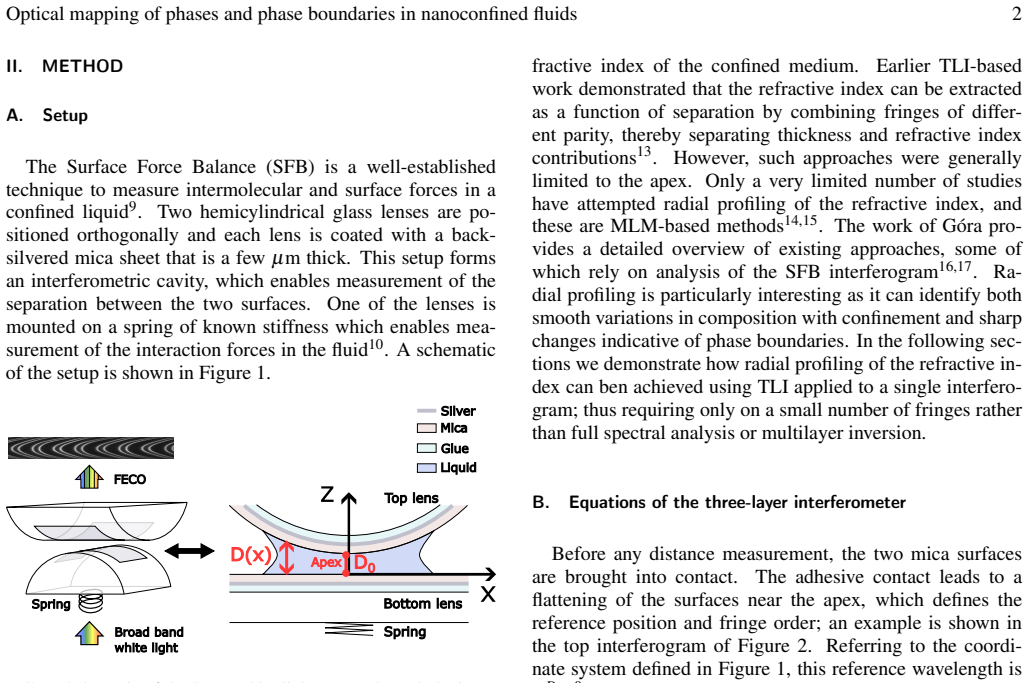
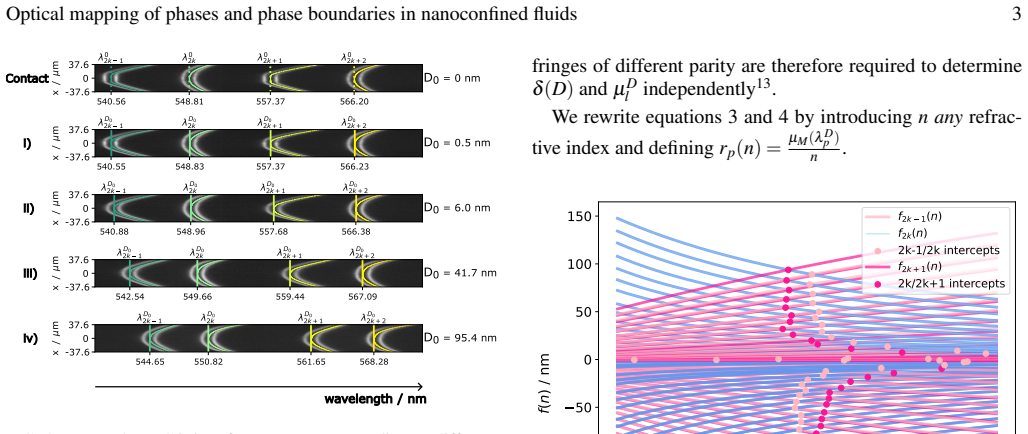
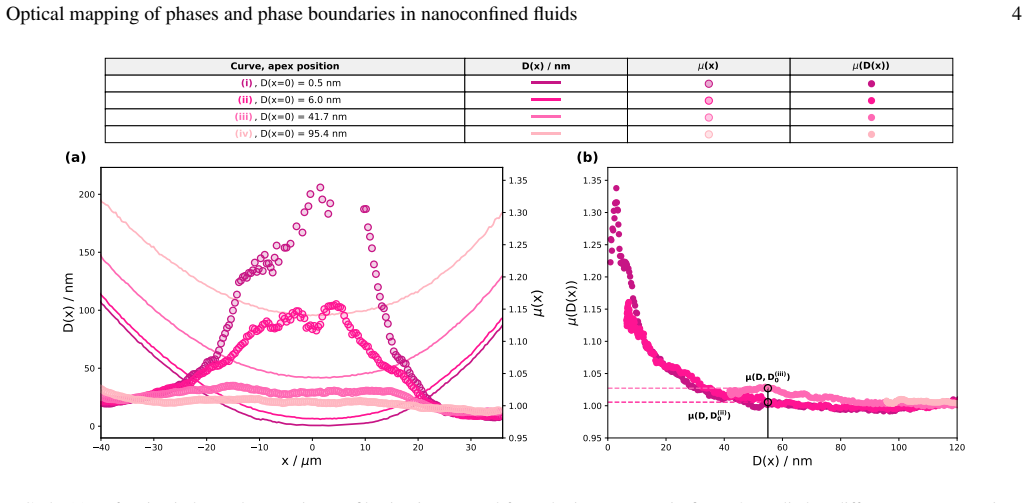
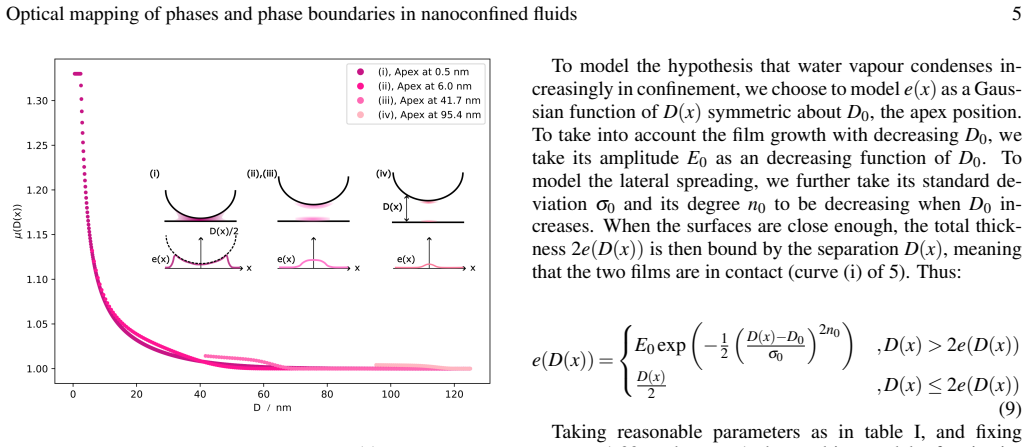
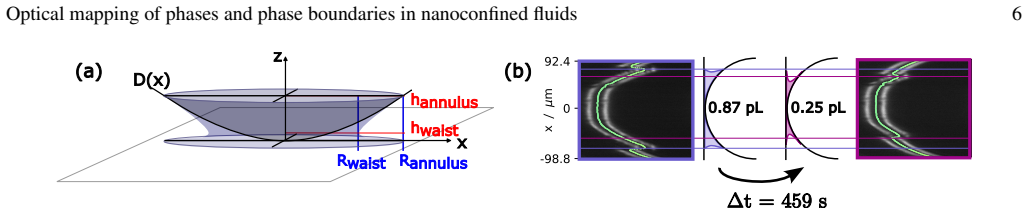
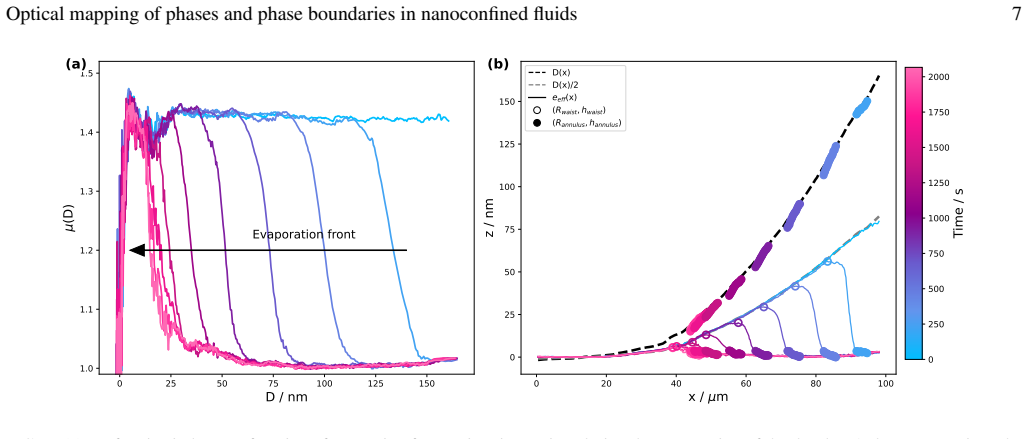
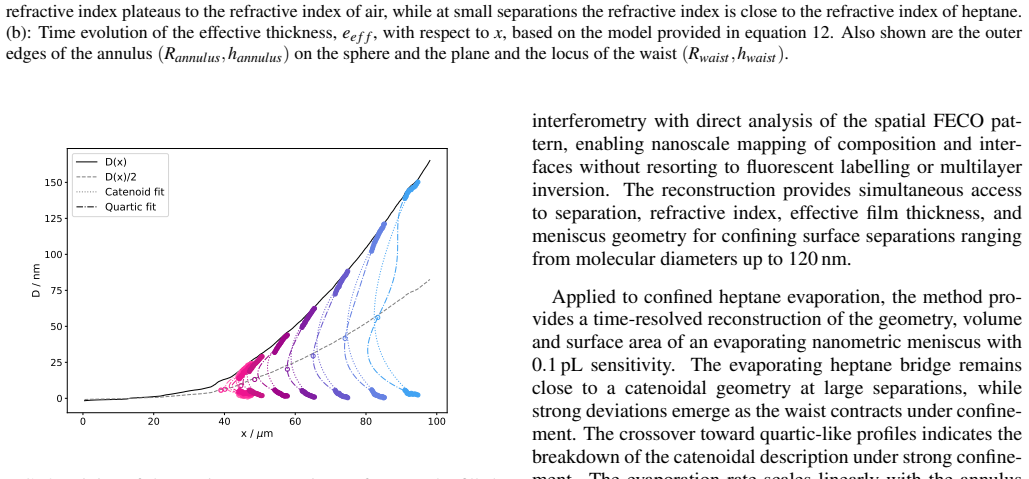
The method extends conventional SFB analysis from apex measurements to spatially resolved reconstruction of refractive index profiles within confined fluids. When multiple phases are present, the refractive index profiles provide direct access to the position and geometry of the nanoconfined fluid interfaces. We describe the interferogram analysis in detail and establish its range of validity through two model scenarios. Measurements in air demonstrate the precision of the method and allow detection of a nanometric wetting capillary. Analysis of dynamic evaporation of a confined heptane droplet provides a time-resolved reconstruction of the meniscus geometry, which remains catenoidal down to
What carries the argument
Spatially resolved reconstruction of refractive index profiles from SFB interferograms
If this is right
- The method detects a nanometric wetting capillary in air.
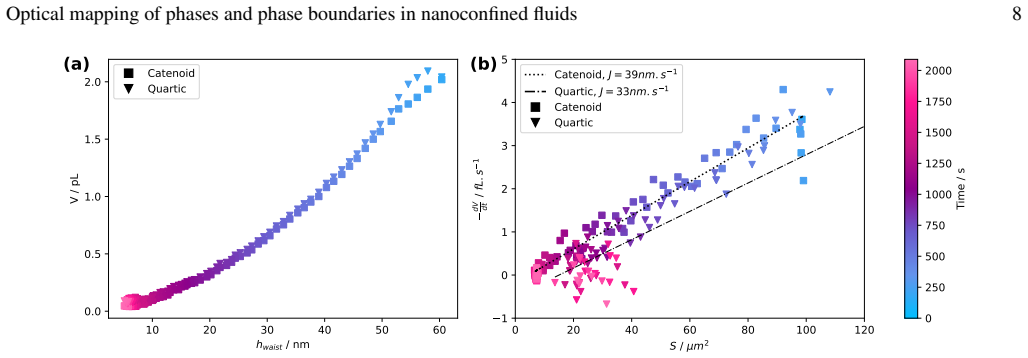
- It provides time-resolved reconstruction of the meniscus geometry during evaporation of a 0.1 pL heptane droplet.
- The meniscus remains catenoidal down to heights of approximately 80 nm.
- Deviations from the catenoidal profile emerge at smaller separations, signaling a shift from surface tension to confinement dominated regime.
Where Pith is reading between the lines
- This mapping could be used to study confinement effects in a wider range of fluid mixtures or under varying temperatures and pressures.
- Direct geometric data on interfaces may enable measurement of nanoscale line energies or wetting energies.
- The approach might be adapted to observe phase separation dynamics in real time in other confined geometries.
Load-bearing premise
The interferogram analysis accurately reconstructs refractive index profiles from SFB measurements assuming that optical effects are dominated by composition variations without significant contributions from scattering or non-equilibrium dynamics.
What would settle it
An independent measurement of the meniscus shape at separations below 80 nm that differs from the reconstructed catenoidal profile with deviations would show the reconstruction is not accurate.
Figures

read the original abstract
In confined space, deviations from bulk structure and properties are expected due to additional thermodynamic variables. In particular, composition variations arising from surface interactions may lead to additional phases and altered phase transitions. Here, we introduce a non-invasive method for nanoscale composition mapping in confined liquids using the surface force balance (SFB). The method extends conventional SFB analysis from apex measurements to spatially resolved reconstruction of refractive index profiles within confined fluids. When multiple phases are present, the refractive index profiles provide direct access to the position and geometry of the nanoconfined fluid interfaces. We describe the interferogram analysis in detail and establish its range of validity through two model scenarios. First, measurements in air demonstrate the precision of the method and allow detection of a nanometric wetting capillary. Second, we analyse dynamic evaporation of a confined heptane droplet down to 0.1 pL volume. The method provides a time-resolved reconstruction of the meniscus geometry throughout the evaporation process. Although evaporation continuously drives the system out of equilibrium, the meniscus remains well described by a catenoidal geometry down to heights of approximately 80 nm. At smaller separations, systematic deviations from the catenoidal profile emerge, indicating a crossover from a surface tension-dominated regime to a confinement-dominated regime. Overall, we demonstrate composition profiling as a framework to analyse confinement-induced composition variations and to quantify interfacial thermodynamic effects at the nanoscale.
Editorial analysis
A structured set of objections, weighed in public.
Referee Report
Summary. The manuscript introduces a non-invasive method using the surface force balance (SFB) for nanoscale composition mapping in confined liquids via spatially resolved reconstruction of refractive index profiles from interferograms. This extends conventional apex-only SFB analysis to enable direct access to the position and geometry of nanoconfined fluid interfaces when multiple phases arise from surface interactions. Validity is established via two model scenarios: air measurements detecting a nanometric wetting capillary, and time-resolved analysis of dynamic heptane droplet evaporation showing a catenoidal meniscus down to ~80 nm with deviations at smaller separations indicating a crossover to confinement-dominated regime.
Significance. If validated, the approach would offer a useful extension of SFB capabilities for probing confinement-induced phase behavior and interfacial effects at the nanoscale, with potential for dynamic studies as shown in the evaporation case. The explicit note of the ~80 nm crossover provides a falsifiable observation that could guide further tests of surface-tension vs. confinement regimes.
major comments (2)
- [Abstract] Abstract: The two model scenarios (air and evaporating heptane) test simple single-component geometries but omit multi-phase composition gradients arising from surface interactions (e.g., binary mixtures or preferential enrichment), which is the central advertised application for locating phase boundaries. This leaves the key assumption—that interferogram inversion is dominated by composition-driven RI changes without confounding from scattering or non-equilibrium effects—untested precisely where the method claims new access.
- [Abstract] Abstract: No quantitative data, error bars, fitting details, or full methods are provided for the interferogram analysis or the two scenarios, so the claimed precision, range of validity, and reconstruction accuracy cannot be assessed.
Simulated Author's Rebuttal
We thank the referee for their review and constructive comments. We address each major comment below, indicating revisions where appropriate. The model scenarios validate the reconstruction method, which is generalizable to composition mapping.
read point-by-point responses
-
Referee: [Abstract] Abstract: The two model scenarios (air and evaporating heptane) test simple single-component geometries but omit multi-phase composition gradients arising from surface interactions (e.g., binary mixtures or preferential enrichment), which is the central advertised application for locating phase boundaries. This leaves the key assumption—that interferogram inversion is dominated by composition-driven RI changes without confounding from scattering or non-equilibrium effects—untested precisely where the method claims new access.
Authors: The scenarios establish the validity and precision of the spatially resolved RI reconstruction using controlled single-component cases with known geometries. The air case quantifies detection of nanometric features, while heptane evaporation tests performance under dynamic non-equilibrium conditions, confirming the catenoid description to ~80 nm. The underlying inversion is based on RI, which directly maps composition variations regardless of single- or multi-component nature. We have added a discussion paragraph explaining extension to binary mixtures and addressing potential scattering or non-equilibrium confounders. revision: partial
-
Referee: [Abstract] Abstract: No quantitative data, error bars, fitting details, or full methods are provided for the interferogram analysis or the two scenarios, so the claimed precision, range of validity, and reconstruction accuracy cannot be assessed.
Authors: The full manuscript details the interferogram analysis and reconstruction in the Methods section, with quantitative fitting results, precision estimates, and scenario data presented in Results and figures. We have revised the abstract to incorporate key quantitative elements (e.g., the 80 nm crossover) and added explicit references to the Methods and supplementary information containing error bars and fitting procedures. revision: yes
Circularity Check
No circularity: method description and independent validation scenarios
full rationale
The paper introduces an interferogram analysis method for reconstructing refractive index profiles from SFB measurements and validates it on two separate model systems (air wetting capillary and dynamic heptane evaporation). No load-bearing step reduces by construction to a fitted input, self-citation, or renamed ansatz; the central reconstruction procedure is presented as an extension of conventional SFB optics with explicit range-of-validity checks on independent geometries. The derivation chain remains self-contained against external optical benchmarks.
Axiom & Free-Parameter Ledger
Reference graph
Works this paper leans on
-
[1]
author author J. T. \ Avaro , author S. L. P. \ Wolf , author K. Hauser , \ and\ author D. Gebauer ,\ title title Stable prenucleation calcium carbonate clusters define liquid–liquid phase separation , \ https://doi.org/10.1002/anie.201915350 journal journal Angewandte Chemie International Edition \ volume 59 ,\ pages 6155--6159 ( year 2020 ) NoStop
-
[2]
author author B. Jin , author Y. Chen , author H. Pyles , author M. D. \ Baer , author B. A. \ Legg , author Z. Wang , author N. M. \ Washton , author K. T. \ Mueller , author D. Baker , author G. K. \ Schenter , author C. J. \ Mundy , \ and\ author J. J. \ De Yoreo ,\ title title Formation, chemical evolution and solidification of the dense liquid phase ...
-
[3]
author author B. Wang , author L. Zhang , author T. Dai , author Z. Qin , author H. Lu , author L. Zhang , \ and\ author F. Zhou ,\ title title Liquid--liquid phase separation in human health and diseases , \ 10.1038/s41392-021-00678-1 journal journal Signal Transduction and Targeted Therapy \ volume 6 ,\ pages 290 ( year 2021 ) NoStop
-
[4]
author author K. Binder , author S. Puri , author S. K. \ Das , \ and\ author J. Horbach ,\ title title Phase separation in confined geometries , \ 10.1007/s10955-010-9924-9 journal journal Journal of Statistical Physics \ volume 138 ,\ pages 51--84 ( year 2010 ) NoStop
-
[5]
author author R. Evans \ and\ author U. Marini Bettolo Marconi ,\ title title Phase equilibria and solvation forces for fluids confined between parallel walls , \ 10.1063/1.452363 journal journal The Journal of Chemical Physics \ volume 86 ,\ pages 7138--7148 ( year 1987 ) NoStop
-
[6]
author author J. E. \ Bramham \ and\ author A. P. \ Golovanov ,\ title title Temporal and spatial characterisation of protein liquid-liquid phase separation using nmr spectroscopy , \ 10.1038/s41467-022-29408-z journal journal Nature Communications \ volume 13 ,\ pages 1767 ( year 2022 ) NoStop
-
[7]
author author A. C. \ Murthy \ and\ author N. L. \ Fawzi ,\ title title The (un)structural biology of biomolecular liquid-liquid phase separation using nmr spectroscopy , \ 10.1074/jbc.REV119.009847 journal journal Journal of Biological Chemistry \ volume 295 ,\ pages 2375--2384 ( year 2020 ) NoStop
-
[8]
author author M. Streit , author M. Budiarta , author M. Jungblut , \ and\ author G. Beliu ,\ title title Fluorescent labeling strategies for molecular bioimaging , \ https://doi.org/10.1016/j.bpr.2025.100200 journal journal Biophysical Reports \ volume 5 ,\ pages 100200 ( year 2025 ) NoStop
-
[9]
author author H. J. \ Hayler , author T. S. \ Groves , author A. Guerrini , author A. Southam , author W. Zheng , \ and\ author S. Perkin ,\ title title The surface force balance: direct measurement of interactions in fluids and soft matter , \ 10.1088/1361-6633/ad2b9b journal journal Reports on Progress in Physics \ volume 87 ,\ pages 046601 ( year 2024 ) NoStop
-
[10]
author author J. Israelachvili ,\ title title Thin film studies using multiple-beam interferometry , \ https://doi.org/10.1016/0021-9797(73)90218-X journal journal Journal of Colloid and Interface Science \ volume 44 ,\ pages 259--272 ( year 1973 ) NoStop
-
[11]
author author R. Tadmor , author N. Chen , \ and\ author J. N. \ Israelachvili ,\ title title Thickness and refractive index measurements using multiple beam interference fringes (feco) , \ https://doi.org/10.1016/S0021-9797(03)00405-3 journal journal Journal of Colloid and Interface Science \ volume 264 ,\ pages 548--553 ( year 2003 ) NoStop
-
[12]
Heuberger ,\ title title The extended surface forces apparatus
author author M. Heuberger ,\ title title The extended surface forces apparatus. part i. fast spectral correlation interferometry , \ 10.1063/1.1347978 journal journal Review of Scientific Instruments \ volume 72 ,\ pages 1700--1707 ( year 2001 ) NoStop
-
[13]
author author P. Kekicheff \ and\ author O. Spalla ,\ title title Refractive index of thin aqueous films confined between two hydrophobic surfaces , \ 10.1021/la00017a043 journal journal Langmuir \ volume 10 ,\ pages 1584--1591 ( year 1994 ) NoStop
-
[14]
author author D. Nowak , author M. Heuberger , author M. Zäch , \ and\ author H. K. \ Christenson ,\ title title Thermodynamic and kinetic supercooling of liquid in a wedge pore , \ 10.1063/1.2996293 journal journal The Journal of Chemical Physics \ volume 129 ,\ pages 154509 ( year 2008 ) NoStop
-
[15]
author author D. F. \ Kienle \ and\ author T. L. \ Kuhl ,\ title title Analyzing refractive index profiles of confined fluids by interferometry , \ 10.1021/ac503469x journal journal Analytical Chemistry \ volume 86 ,\ pages 11860--11867 ( year 2014 ) ,\ note pMID: 25365770 NoStop
-
[16]
author author M. Góra , author U. Schütz , author E. Hack , author P. Zhang , \ and\ author M. Heuberger ,\ title title The accuracy of measuring confined fluid properties using white light interferometry , \ 10.1063/5.0245879 journal journal Review of Scientific Instruments \ volume 96 ,\ pages 035109 ( year 2025 a ) NoStop
-
[17]
author author M. Góra , author A. Southam , author U. Schütz , author P. Zhang , \ and\ author M. Heuberger ,\ title title Integrated accuracy enhancement for the fabry–pérot interferometer: The multi-parameter approach series (mpas) , \ 10.1063/5.0278750 journal journal Review of Scientific Instruments \ volume 96 ,\ pages 085206 ( year 2025 b ) NoStop
-
[18]
author author A. I. \ Bailey \ and\ author S. M. \ Kay ,\ title title Measurement of refractive index and dispersion of mica, employing multiple beam interference techniques , \ 10.1088/0508-3443/16/1/307 journal journal British Journal of Applied Physics \ volume 16 ,\ pages 39 ( year 1965 ) NoStop
-
[19]
author author P.-G. \ de Gennes , author F. Brochard-Wyart , \ and\ author D. Quéré ,\ 10.1007/978-0-387-21656-0 title Capillarity and Wetting Phenomena: Drops, Bubbles, Pearls, Waves \ ( publisher Springer ,\ year 2004 ) NoStop
discussion (0)
Sign in with ORCID, Apple, or X to comment. Anyone can read and Pith papers without signing in.