Retrieval-Augmented Personalization with Foundation Models for Wearable Stress Detection
Pith reviewed 2026-06-26 00:25 UTC · model grok-4.3
The pith
Frozen foundation models retrieve user history patterns to personalize wearable stress detection without labeled data.
A machine-rendered reading of the paper's core claim, the machinery that carries it, and where it could break.
Core claim
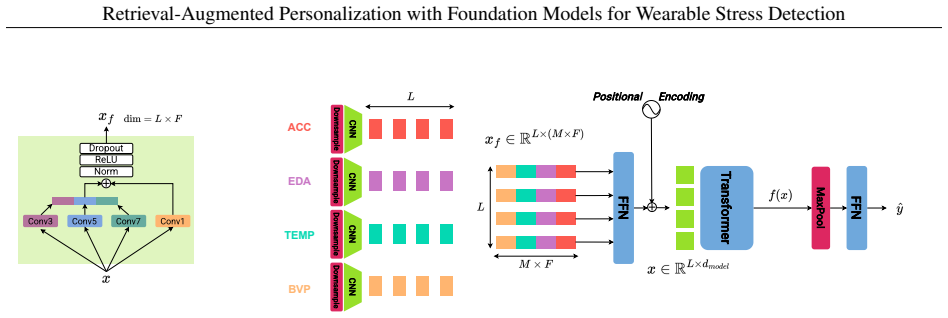
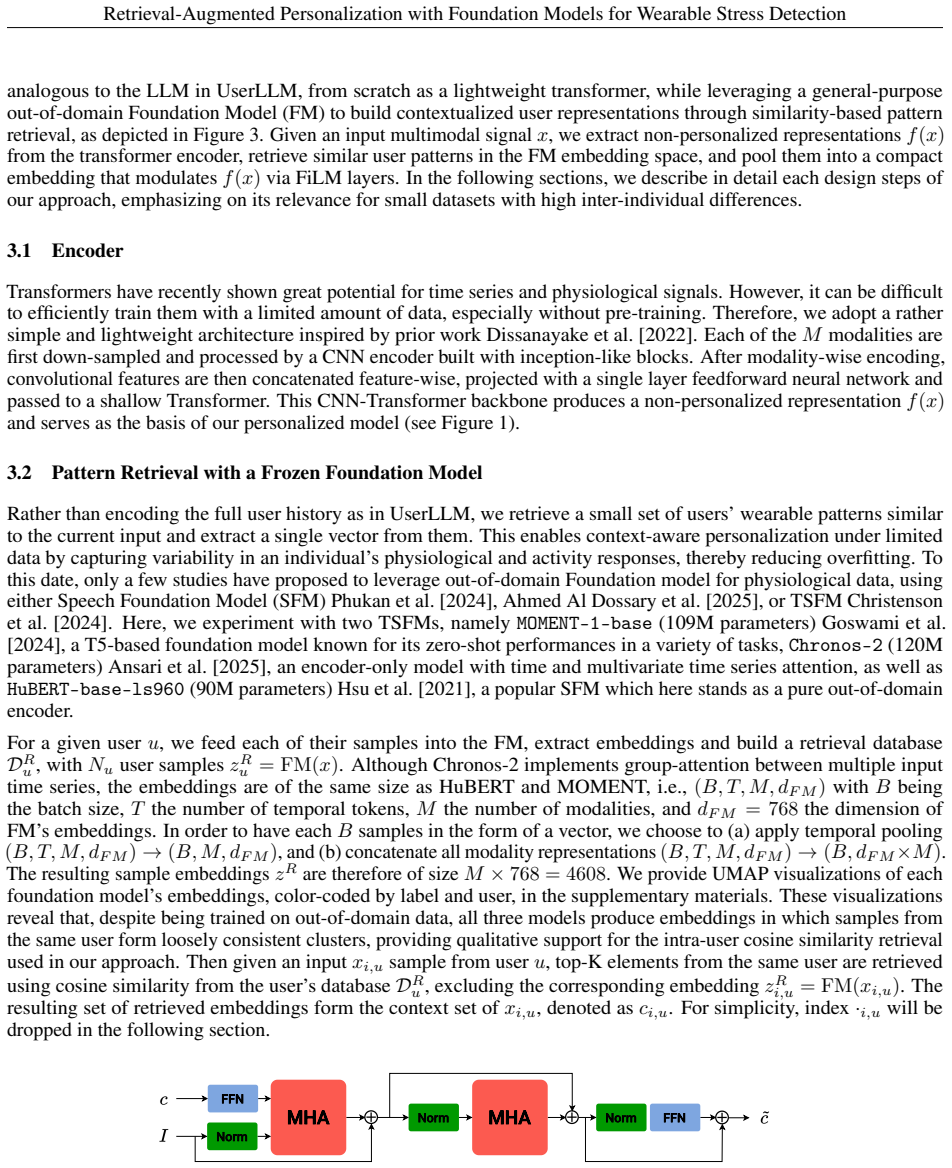
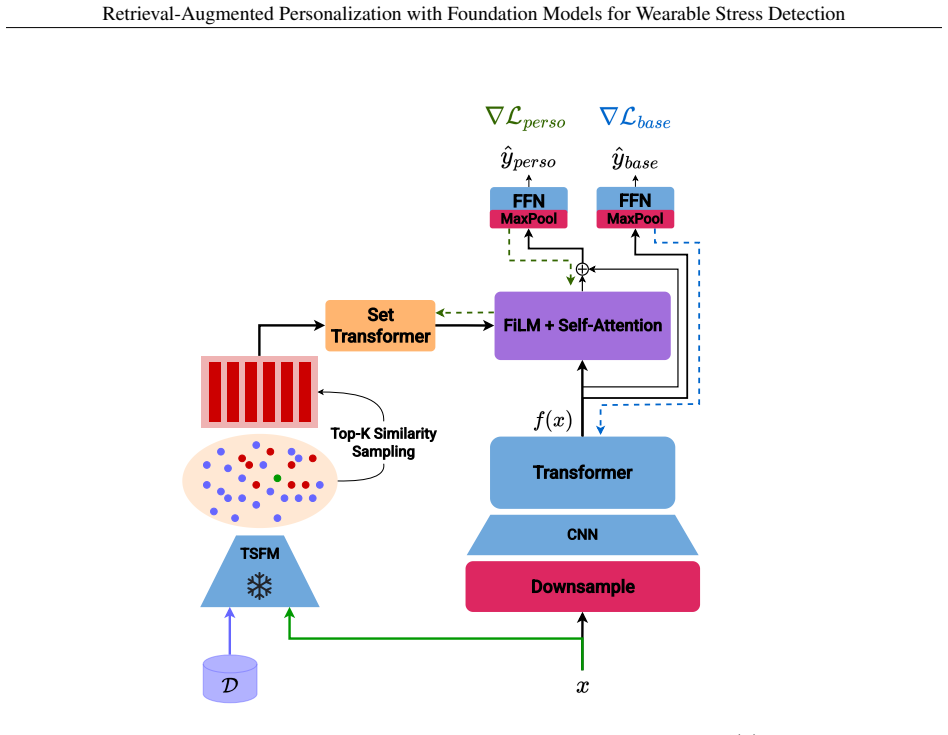
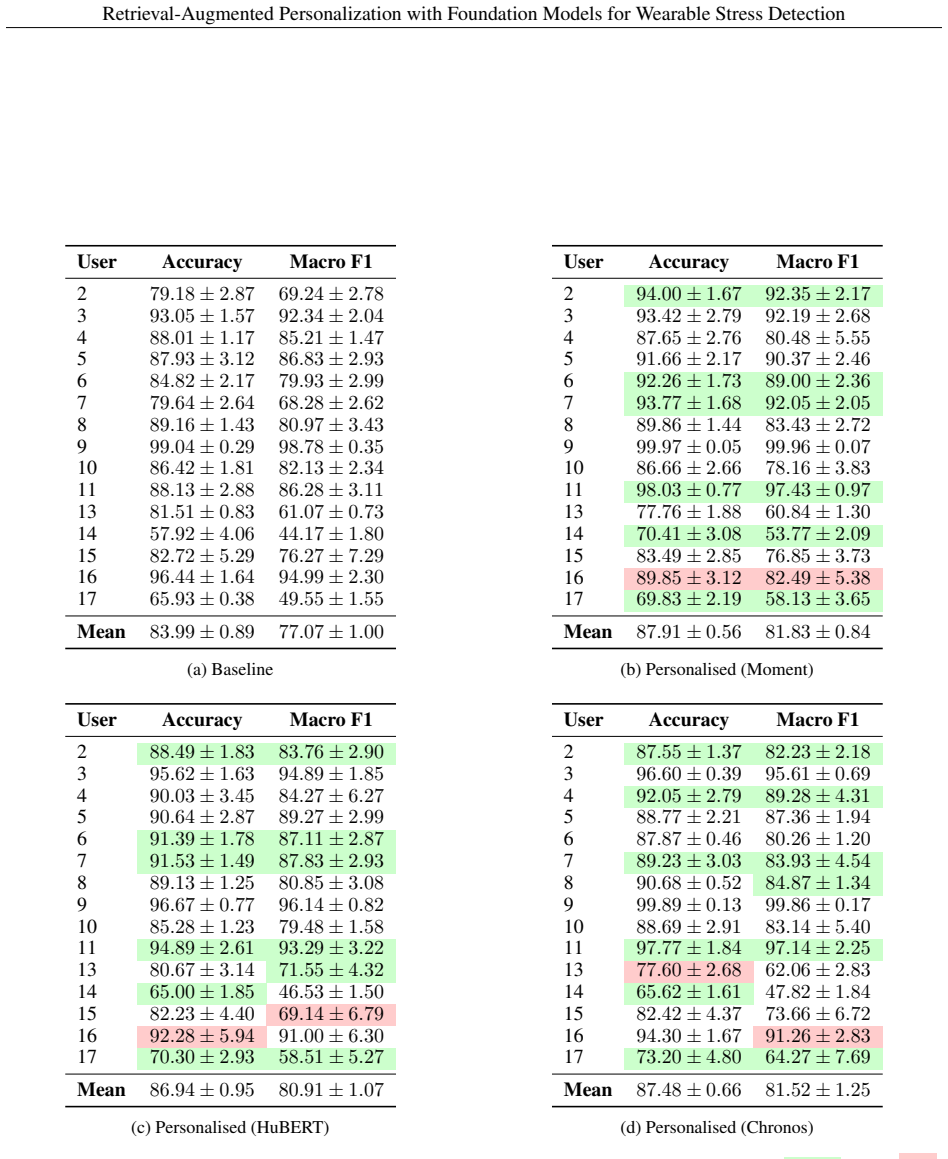
Our method leverages frozen, out-of-domain foundation models to retrieve similar patterns from a target user's history and encode them into a compact personalized embedding that modulates representations extracted by a lightweight transformer network. We evaluate our approach on the WESAD stress detection dataset with N=15 users, comprising wrist-worn physiological (EDA, BVP, temperature) and activity (accelerometer) signals, and report gains of +3.92% in accuracy and +4.76% in macro F1-score over a non-personalized transformer baseline, approaching supervised fine-tuning performance without requiring any labeled user data.
What carries the argument
Compact personalized embedding from frozen foundation model retrieval of user history patterns, which modulates the representations of a lightweight transformer network.
If this is right
- Personalization succeeds without any labeled data from the target user.
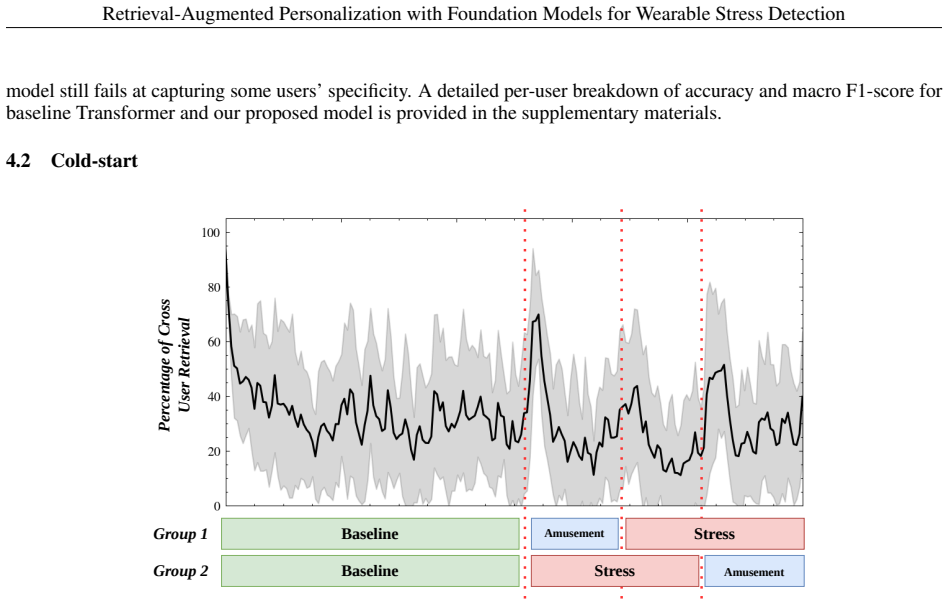
- Temporal retrieval using only prior user samples performs close to full intra-user retrieval.
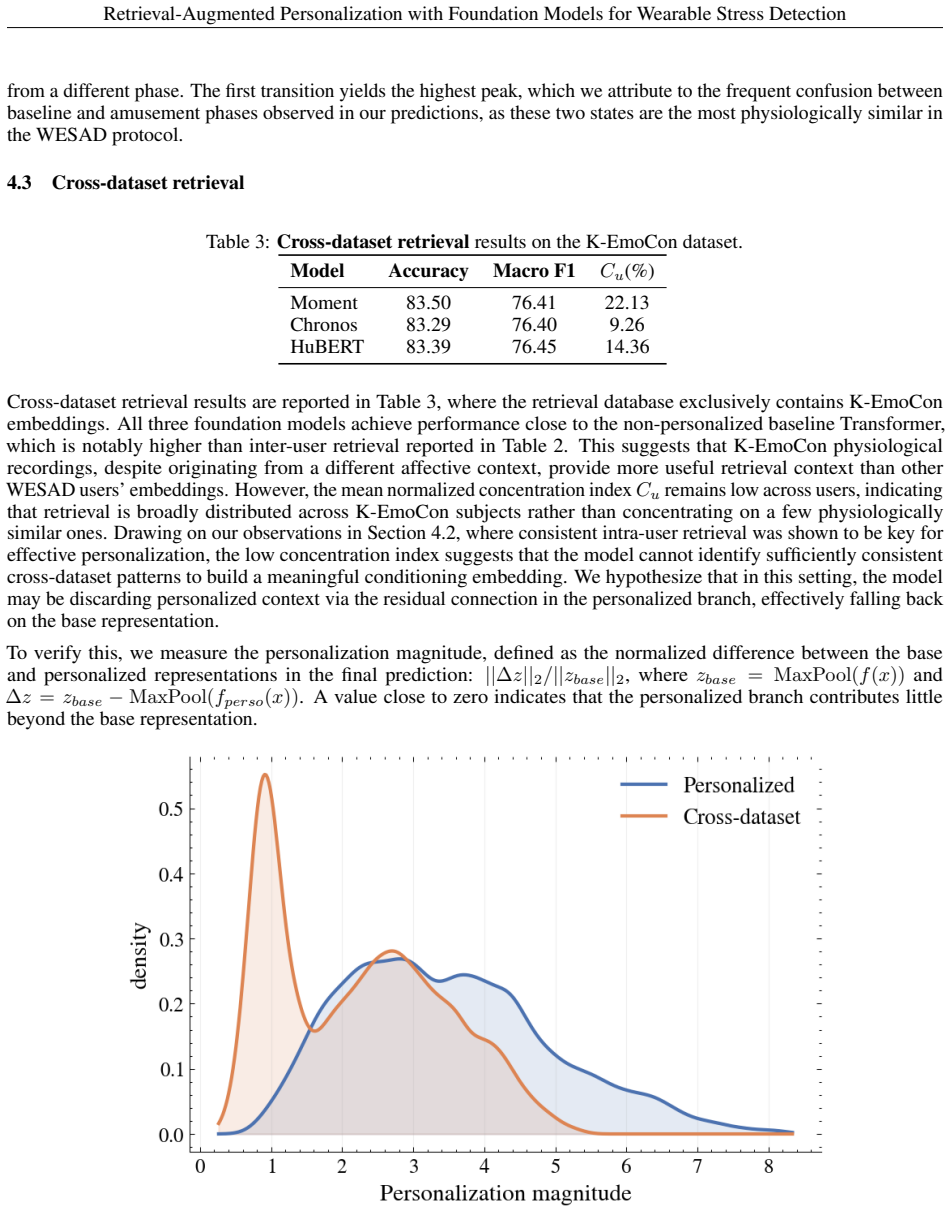
- Cross-dataset retrieval from embeddings of the K-Emocon dataset personalizes stress detection on WESAD.
- The approach remains lightweight and avoids costly user-specific fine-tuning or large-scale pre-training.
Where Pith is reading between the lines
- This approach may apply to other wearable tasks such as activity recognition or sleep staging where inter-user variability is high.
- It implies that general foundation models can support physiological personalization through retrieval rather than direct adaptation.
- Real-world deployment could benefit from reduced privacy concerns since no labeled target-user data is collected.
- Scaling the retrieval corpus size or testing different foundation models could further improve gains.
Load-bearing premise
That retrieval of similar patterns using out-of-domain foundation models from user history provides effective personalization for the stress detection task on the WESAD dataset.
What would settle it
Observing no accuracy or F1 improvement, or a performance drop, when applying the retrieval-augmented method to a new set of users or a different wearable stress dataset would falsify the central claim.
Figures
read the original abstract
Personalization in wearable-based stress detection remains challenging due to substantial inter-individual variability in physiological and behavioral responses. While traditional approaches rely on user-specific fine-tuning or costly self-supervised pre-training on large datasets, we propose a lightweight alternative based on retrieval-augmented personalization. Our method leverages frozen, out-of-domain foundation models to retrieve similar patterns from a target user's history and encode them into a compact personalized embedding that modulates representations extracted by a lightweight transformer network. We evaluate our approach on the WESAD stress detection dataset with N=15 users, comprising wrist-worn physiological (EDA, BVP, temperature) and activity (accelerometer) signals, and report gains of +3.92\% in accuracy and +4.76\% in macro F1-score over a non-personalized transformer baseline, approaching supervised fine-tuning performance without requiring any labeled user data. We further show that temporal retrieval, where only prior user samples are available, achieves performance close to full intra-user retrieval, demonstrating robustness to limited user history. Finally, we explore personalization in a cross-dataset retrieval setting, leveraging embeddings from the K-Emocon dataset to personalize representations for stress detection on the WESAD dataset.
Editorial analysis
A structured set of objections, weighed in public.
Referee Report
Summary. The manuscript proposes a retrieval-augmented personalization method for wearable stress detection that leverages frozen out-of-domain foundation models to retrieve similar patterns from a target user's history, encodes them into a compact personalized embedding, and uses this embedding to modulate representations from a lightweight transformer network. On the WESAD dataset (N=15 users, wrist-worn EDA/BVP/temperature/accelerometer signals), the approach reports +3.92% accuracy and +4.76% macro F1 gains over a non-personalized transformer baseline while approaching supervised fine-tuning performance without any labeled user data. Additional results cover temporal retrieval (prior samples only) and cross-dataset retrieval from K-Emocon to WESAD.
Significance. If the empirical claims hold under rigorous controls, the work offers a practical, label-efficient route to personalization in physiological signal tasks where inter-user variability is high and labeled data per user is scarce. The explicit use of frozen foundation models and the temporal-retrieval ablation are strengths that could translate to deployment settings with limited history. The cross-dataset experiment further tests generalization of the retrieval mechanism.
major comments (1)
- [Abstract / Evaluation] Abstract and Evaluation section: the reported gains (+3.92% accuracy, +4.76% macro F1) are presented without any description of the experimental protocol (train/test split, cross-validation scheme, number of retrieval candidates, foundation-model choice and embedding dimension, or statistical tests). Because these details are load-bearing for the central claim that retrieval substitutes for labeled fine-tuning, the support for the performance numbers cannot be assessed from the provided text.
Simulated Author's Rebuttal
We thank the referee for their constructive feedback and recommendation. We respond to the major comment below.
read point-by-point responses
-
Referee: [Abstract / Evaluation] Abstract and Evaluation section: the reported gains (+3.92% accuracy, +4.76% macro F1) are presented without any description of the experimental protocol (train/test split, cross-validation scheme, number of retrieval candidates, foundation-model choice and embedding dimension, or statistical tests). Because these details are load-bearing for the central claim that retrieval substitutes for labeled fine-tuning, the support for the performance numbers cannot be assessed from the provided text.
Authors: We agree that the abstract and Evaluation section as presented lack a complete description of the experimental protocol, which limits assessment of the reported gains. We will revise the abstract to include a concise statement of the protocol and expand the Evaluation section to explicitly detail the train/test split, cross-validation scheme, number of retrieval candidates, foundation-model choice and embedding dimension, and statistical tests. These revisions will be incorporated in the next manuscript version. revision: yes
Circularity Check
No significant circularity detected
full rationale
The paper is an empirical ML methods paper proposing retrieval-augmented personalization using frozen out-of-domain foundation models to generate embeddings for a lightweight transformer on wearable stress data. No equations, derivations, or first-principles claims appear in the provided text. The central claims rest on experimental comparisons (gains over non-personalized baseline on WESAD, temporal and cross-dataset results) rather than any reduction of a 'prediction' to fitted inputs or self-citation chains. Self-citations, if present, are not load-bearing for any uniqueness theorem or ansatz. The derivation chain is therefore self-contained against external benchmarks.
Axiom & Free-Parameter Ledger
Reference graph
Works this paper leans on
-
[1]
Proceedings of the AAAI Conference on Artificial Intelligence , author =. 2018 , keywords =. doi:10.1609/aaai.v32i1.11671 , abstract =
-
[2]
Set Transformer: A Framework for Attention-based Permutation-Invariant Neural Networks
Lee, Juho and Lee, Yoonho and Kim, Jungtaek and Kosiorek, Adam R. and Choi, Seungjin and Teh, Yee Whye , month = may, year =. Set. doi:10.48550/arXiv.1810.00825 , abstract =
work page internal anchor Pith review Pith/arXiv arXiv doi:10.48550/arxiv.1810.00825
-
[3]
Perceiver:
Jaegle, Andrew and Gimeno, Felix and Brock, Andy and Vinyals, Oriol and Zisserman, Andrew and Carreira, Joao , month = jul, year =. Perceiver:. Proceedings of the 38th
-
[4]
Douze, Matthijs and Guzhva, Alexandr and Deng, Chengqi and Johnson, Jeff and Szilvasy, Gergely and Mazaré, Pierre-Emmanuel and Lomeli, Maria and Hosseini, Lucas and Jégou, Hervé , month = oct, year =. The. doi:10.48550/arXiv.2401.08281 , abstract =
work page internal anchor Pith review Pith/arXiv arXiv doi:10.48550/arxiv.2401.08281
-
[5]
Christenson, Matthias and Geary, Cove and Locke, Brian and Koirala, Pranav and Pettine, Warren Woodrich , month = dec, year =. Assessing. doi:10.48550/arXiv.2412.03427 , abstract =
-
[6]
Phukan, Orchid Chetia and Behera, Swarup Ranjan and Girish and Akhtar, Mohd Mujtaba and Buduru, Arun Balaji and Sharma, Rajesh , month = oct, year =. Beyond. doi:10.48550/arXiv.2410.12645 , abstract =
-
[7]
Chetia Phukan, Orchid and Behera, Swarup and. Beyond. 2025 , doi =
2025
-
[8]
Ahmed Al Dossary, Alia and Chollet, Mathieu and Vinciarelli, Alessandro , month = oct, year =. From. Proceedings of the 27th. doi:10.1145/3716553.3750753 , language =
-
[9]
Proceedings of the 41st
Goswami, Mononito and Szafer, Konrad and Choudhry, Arjun and Cai, Yifu and Li, Shuo and Dubrawski, Artur , month = jul, year =. Proceedings of the 41st
-
[10]
npj Digital Medicine , author =
Self-supervised learning for human activity recognition using 700,000 person-days of wearable data , volume =. npj Digital Medicine , author =. 2024 , note =. doi:10.1038/s41746-024-01062-3 , abstract =
-
[11]
Pillai, Arvind and Spathis, Dimitris and Kawsar, Fahim and Malekzadeh, Mohammad , month = oct, year =
-
[12]
and Narayanan, Shrikanth , month = oct, year =
Avramidis, Kleanthis and Feng, Tiantian and Jeong, Woojae and Lee, Jihwan and Cui, Wenhui and Leahy, Richard M. and Narayanan, Shrikanth , month = oct, year =. Neural. doi:10.48550/arXiv.2510.09095 , abstract =
-
[13]
and Mascolo, Cecilia , month = apr, year =
Spathis, Dimitris and Perez-Pozuelo, Ignacio and Brage, Soren and Wareham, Nicholas J. and Mascolo, Cecilia , month = apr, year =. Self-supervised transfer learning of physiological representations from free-living wearable data , url =. Proceedings of the. doi:10.1145/3450439.3451863 , abstract =
-
[14]
and Futoma, Joseph , month = oct, year =
Erturk, Eray and Kamran, Fahad and Abbaspourazad, Salar and Jewell, Sean and Sharma, Harsh and Li, Yujie and Williamson, Sinead and Foti, Nicholas J. and Futoma, Joseph , month = oct, year =. Beyond. Proceedings of the 42nd
-
[15]
and Futoma, Joseph , month = jun, year =
Erturk, Eray and Kamran, Fahad and Abbaspourazad, Salar and Jewell, Sean and Sharma, Harsh and Li, Yujie and Williamson, Sinead and Foti, Nicholas J. and Futoma, Joseph , month = jun, year =. Beyond. doi:10.48550/arXiv.2507.00191 , abstract =
-
[16]
Foundation
Lee, Simon and Akamatsu, Kai , month = aug, year =. Foundation
-
[17]
Luo, Yunfei and Chen, Yuliang and Salekin, Asif and Rahman, Tauhidur , month = may, year =. Toward. doi:10.48550/arXiv.2412.09758 , abstract =
-
[18]
Agarwal, Rohit and Sinha, Aman and Vishwakarma, Ayan and Coubez, Xavier and Clausel, Marianne and Constant, Mathieu and Horsch, Alexander and Prasad, Dilip K. , month = aug, year =. No. doi:10.48550/arXiv.2309.08698 , abstract =
-
[19]
Huynh, Lam and Nguyen, Tri and Nguyen, Thu and Pirttikangas, Susanna and Siirtola, Pekka , month = sep, year =. Adjunct. doi:10.1145/3460418.3479320 , language =
-
[20]
Proceedings of the ACM on Interactive, Mobile, Wearable and Ubiquitous Technologies , author =
Systematic. Proceedings of the ACM on Interactive, Mobile, Wearable and Ubiquitous Technologies , author =. 2024 , pages =. doi:10.1145/3699724 , abstract =
-
[21]
Sensors (Basel, Switzerland) , author =
Can. Sensors (Basel, Switzerland) , author =. 2020 , pmid =. doi:10.3390/s20226535 , abstract =
-
[22]
Villaboni, Davide and Castellini, Alberto and Danesi, Ivan Luciano and Farinelli, Alessandro , month = mar, year =. Sentinel:. doi:10.48550/arXiv.2503.17658 , abstract =
-
[23]
A Time Series is Worth 64 Words: Long-term Forecasting with Transformers
Nie, Yuqi and Nguyen, Nam H. and Sinthong, Phanwadee and Kalagnanam, Jayant , month = mar, year =. A. doi:10.48550/arXiv.2211.14730 , abstract =
work page internal anchor Pith review Pith/arXiv arXiv doi:10.48550/arxiv.2211.14730
-
[25]
WE- SAD: a multimodal dataset for wearable stress and affect detection
Schmidt, Philip and Reiss, Attila and Duerichen, Robert and Marberger, Claus and Van Laerhoven, Kristof , month = oct, year =. Introducing. Proceedings of the 20th. doi:10.1145/3242969.3242985 , abstract =
-
[26]
2025 , note =
google-research/tuning\_playbook , url =. 2025 , note =
2025
-
[27]
On the. SIAM J. Numer. Anal. , author =. 1979 , pages =. doi:10.1137/0716058 , abstract =
-
[28]
Huang, Yingsong and Bai, Bing and Zhao, Shengwei and Bai, Kun and Wang, Fei , month = jul, year =. Uncertainty-. doi:10.48550/arXiv.2207.05471 , abstract =
-
[29]
and Shah, Mubarak , month = apr, year =
Rizve, Mamshad Nayeem and Duarte, Kevin and Rawat, Yogesh S. and Shah, Mubarak , month = apr, year =. In. doi:10.48550/arXiv.2101.06329 , abstract =
-
[30]
Learning From Noisy Labels By Regularized Estimation Of Annotator Confusion
Tanno, Ryutaro and Saeedi, Ardavan and Sankaranarayanan, Swami and Alexander, Daniel C. and Silberman, Nathan , month = jun, year =. Learning. doi:10.48550/arXiv.1902.03680 , abstract =
work page internal anchor Pith review Pith/arXiv arXiv doi:10.48550/arxiv.1902.03680 1902
-
[31]
doi:10.48550/arXiv.2011.07734 , abstract =
Wang, Can and Chen, Jiawei and Zhou, Sheng and Shi, Qihao and Feng, Yan and Chen, Chun , month = jul, year =. doi:10.48550/arXiv.2011.07734 , abstract =
-
[32]
ACM Transactions on Intelligent Systems and Technology , author =
Labeling. ACM Transactions on Intelligent Systems and Technology , author =. 2024 , pages =. doi:10.1145/3626242 , abstract =
-
[33]
Yu, Wenhui and Qin, Zheng , month = jul, year =. Sampler. Proceedings of the 43rd. doi:10.1145/3397271.3401155 , language =
-
[34]
Zhang, Wenzhen and Cheng, Debo and Lu, Guangquan and Zhou, Bo and Li, Jiaye and Zhang, Shichao , month = feb, year =. Efficient. doi:10.48550/arXiv.2502.00386 , abstract =
-
[35]
Bayesian. Neural Networks , author =. 2024 , keywords =. doi:10.1016/j.neunet.2024.106122 , abstract =
-
[36]
Liu, Jiarun and Jiang, Daguang and Yang, Yukun and Li, Ruirui , month = aug, year =. Agreement or. doi:10.48550/arXiv.2203.15317 , abstract =
-
[37]
Song, Hwanjun and Kim, Minseok and Park, Dongmin and Shin, Yooju and Lee, Jae-Gil , month = mar, year =. Learning from. doi:10.48550/arXiv.2007.08199 , abstract =
-
[38]
Han, Jiangfan and Luo, Ping and Wang, Xiaogang , month = aug, year =. Deep. doi:10.48550/arXiv.1908.02160 , abstract =
-
[39]
Bai, Sihan , month = apr, year =. Pairwise. doi:10.48550/arXiv.2404.01853 , abstract =
-
[40]
doi:10.48550/arXiv.2402.17589 , abstract =
Liu, Xiaoyu and Zhou, Beitong and Yue, Zuogong and Cheng, Cheng , month = nov, year =. doi:10.48550/arXiv.2402.17589 , abstract =
-
[41]
Saravanan, Darshana and Manwani, Naresh and Gandhi, Vineet , month = jun, year =. Pseudo-labelling meets. doi:10.48550/arXiv.2402.04835 , abstract =
-
[42]
Patrini, Giorgio and Rozza, Alessandro and Menon, Aditya and Nock, Richard and Qu, Lizhen , month = mar, year =. Making. doi:10.48550/arXiv.1609.03683 , abstract =
work page internal anchor Pith review Pith/arXiv arXiv doi:10.48550/arxiv.1609.03683
-
[43]
Mixed Precision , author =
Tinkering. Mixed Precision , author =
-
[44]
Spathis, Dimitris and Servia-Rodriguez, Sandra and Farrahi, Katayoun and Mascolo, Cecilia and Rentfrow, Jason , year =. Sequence. Proceedings of the 25th. doi:10.1145/3292500.3330730 , abstract =
-
[45]
Wu, Zhenchao and Zhou, Xiao , month = jul, year =. Proceedings of the 46th. doi:10.1145/3539618.3591719 , language =
-
[46]
Yu, Runsheng and Gong, Yu and He, Xu and An, Bo and Zhu, Yu and Liu, Qingwen and Ou, Wenwu , month = dec, year =. Personalized. doi:10.48550/arXiv.2012.11842 , abstract =
-
[47]
and Jain, Shomik and Chima, Kourtney and Rudovic, Ognjen and Matarić, Maja J
Shi, Zhonghao and Groechel, Thomas R. and Jain, Shomik and Chima, Kourtney and Rudovic, Ognjen and Matarić, Maja J. , month = jan, year =. Toward. doi:10.48550/arXiv.2101.10580 , abstract =
-
[48]
Personalized machine learning for robot perception of affect and engagement in autism therapy , volume =. Science Robotics , author =. 2018 , pmid =. doi:10.1126/scirobotics.aao6760 , abstract =
-
[49]
Huber, Bernd and Fazelnia, Ghazal and Damianou, Andreas and Peleato, Sebastian and Lefarov, Max and Ravichandran, Praveen and Nadai, Marco De and Lalmas-Roellke, Mounia and Bennett, Paul N. , month = may, year =. Embedding-to-. doi:10.48550/arXiv.2505.17051 , abstract =
-
[50]
Quantizable
Bondarenko, Yelysei and Nagel, Markus and Blankevoort, Tijmen , month = nov, year =. Quantizable
-
[51]
Qiu, Yilun and Shi, Tianhao and Zhao, Xiaoyan and Zhu, Fengbin and Zhang, Yang and Feng, Fuli , month = jul, year =. Latent. doi:10.48550/arXiv.2507.20849 , abstract =
-
[52]
Bahdanau, Dzmitry and Cho, Kyunghyun and Bengio, Yoshua , editor =. Neural. 3rd
-
[53]
CoRR , author =
Neural. CoRR , author =
-
[54]
Horn, Max and Moor, Michael and Bock, Christian and Rieck, Bastian and Borgwardt, Karsten , month = nov, year =. Set. Proceedings of the 37th
-
[55]
Advances in
Choi, Edward and Bahadori, Mohammad Taha and Sun, Jimeng and Kulas, Joshua and Schuetz, Andy and Stewart, Walter , year =. Advances in
-
[56]
4369-4375, Macao, China
In Proceedings of the 28th International Joint Conference on Artificial Intelligence (IJCAI-2019), pp. 4369-4375, Macao, China. , author =
2019
-
[57]
Chen, Ricky T. Q. and Rubanova, Yulia and Bettencourt, Jesse and Duvenaud, David K , year =. Neural. Advances in
-
[58]
Rubanova, Yulia and Chen, Ricky T. Q. and Duvenaud, David K , year =. Latent. Advances in
-
[59]
Monitoring
Harit, Anoushka and Sun, Zhongtian and Yu, Jongmin and Moubayed, Noura Al , month = oct, year =. Monitoring
-
[61]
Li, Yang and Du, Nan and Bengio, Samy , month = feb, year =. Time-
-
[62]
(. doi:10.48550/arXiv.1711.06350 , abstract =
work page internal anchor Pith review Pith/arXiv arXiv doi:10.48550/arxiv.1711.06350
-
[63]
Bucur, Ana-Maria and Cosma, Adrian and Rosso, Paolo and Dinu, Liviu P. , year =. It’s. Advances in. doi:10.1007/978-3-031-28244-7_13 , abstract =
-
[65]
Shaw, Peter and Uszkoreit, Jakob and Vaswani, Ashish , editor =. Self-. Proceedings of the 2018. 2018 , pages =. doi:10.18653/v1/N18-2074 , abstract =
-
[66]
Unsupervised
Tsitsulin, Anton and Munkhoeva, Marina and Perozzi, Bryan , month = sep, year =. Unsupervised. Proceedings of 2nd
-
[67]
Xie, Sang Michael and Ermon, Stefano , month = feb, year =. Reparameterizable. doi:10.48550/arXiv.1901.10517 , abstract =
-
[68]
Attention is
Vaswani, Ashish and Shazeer, Noam and Parmar, Niki and Uszkoreit, Jakob and Jones, Llion and Gomez, Aidan N and Kaiser, Ł ukasz and Polosukhin, Illia , year =. Attention is. Advances in
-
[69]
Personalized
Shaw, Abhinav and Simsiri, Natcha and Deznabi, Iman and Fiterau, Madalina and Rahaman, Tauhidur , month = may, year =. Personalized
-
[70]
Personalized
Anonymous , month = may, year =. Personalized
-
[71]
ResearchGate , doi =
(. ResearchGate , doi =
-
[72]
Kazemi, Seyed Mehran and Goel, Rishab and Eghbali, Sepehr and Ramanan, Janahan and Sahota, Jaspreet and Thakur, Sanjay and Wu, Stella and Smyth, Cathal and Poupart, Pascal and Brubaker, Marcus , month = sep, year =
-
[73]
Shukla, Satya Narayan and Marlin, Benjamin , month = oct, year =. Multi-
-
[74]
Prototypical networks for few-shot learning , isbn =
Snell, Jake and Swersky, Kevin and Zemel, Richard , year =. Prototypical networks for few-shot learning , isbn =. Proceedings of the 31st
-
[75]
Bardes, Adrien and Ponce, Jean and Lecun, Yann , month = apr, year =
-
[76]
Advances in Neural Information Processing Systems , author =
Achieving. Advances in Neural Information Processing Systems , author =. 2023 , pages =
2023
-
[77]
Jiang, Wei-Bang and Fu, Xi and Ding, Yi and Guan, Cuntai , month = jun, year =. Towards. doi:10.48550/arXiv.2504.19596 , abstract =
-
[78]
Self-supervised. ACM Comput. Surv. , author =. 2025 , note =. doi:10.1145/3736574 , abstract =
-
[79]
Applications of. IEEE Access , author =. 2023 , keywords =. doi:10.1109/ACCESS.2023.3344531 , abstract =
-
[80]
Frontiers in Human Neuroscience , author =
Self supervised learning based emotion recognition using physiological signals , volume =. Frontiers in Human Neuroscience , author =. 2024 , note =. doi:10.3389/fnhum.2024.1334721 , abstract =
-
[81]
K-. Scientific Data , author =. 2020 , note =. doi:10.1038/s41597-020-00630-y , abstract =
-
[82]
and Trajanovski, Stojan , month = oct, year =
Saeed, Aaqib and Ozcelebi, Tanir and Lukkien, Johan and van Erp, Jan B.F. and Trajanovski, Stojan , month = oct, year =. Model. 2018. doi:10.1109/DSAA.2018.00031 , abstract =
-
[83]
IEEE transactions on affective computing , author =
Personalized. IEEE transactions on affective computing , author =. 2020 , pmid =. doi:10.1109/TAFFC.2017.2784832 , abstract =
discussion (0)
Sign in with ORCID, Apple, or X to comment. Anyone can read and Pith papers without signing in.