Formation of Black Hole-White Dwarf X-ray Binaries in Globular Clusters
Pith reviewed 2026-06-25 22:29 UTC · model grok-4.3
The pith
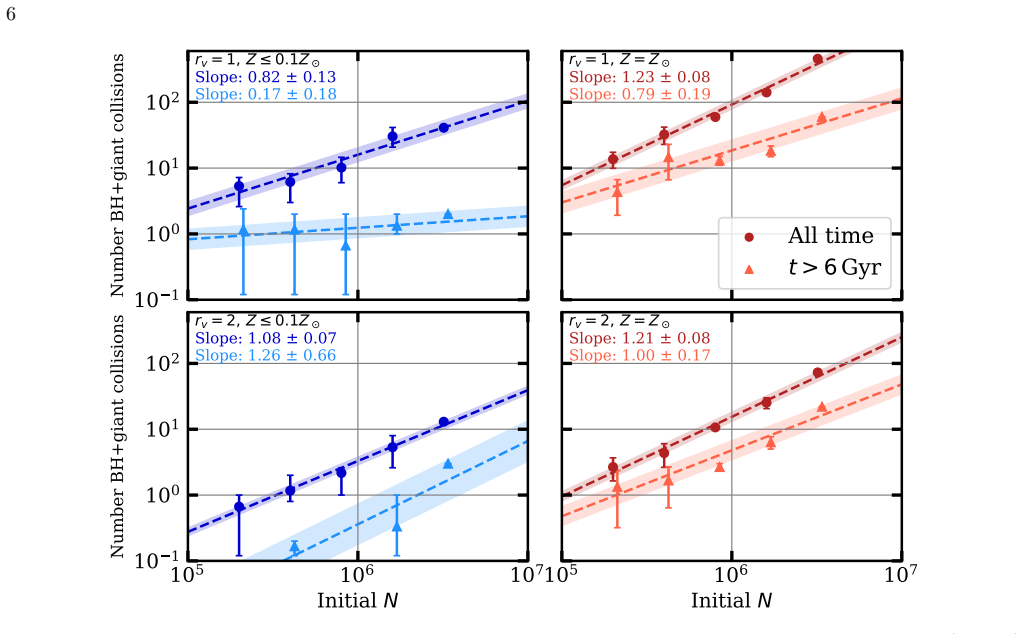
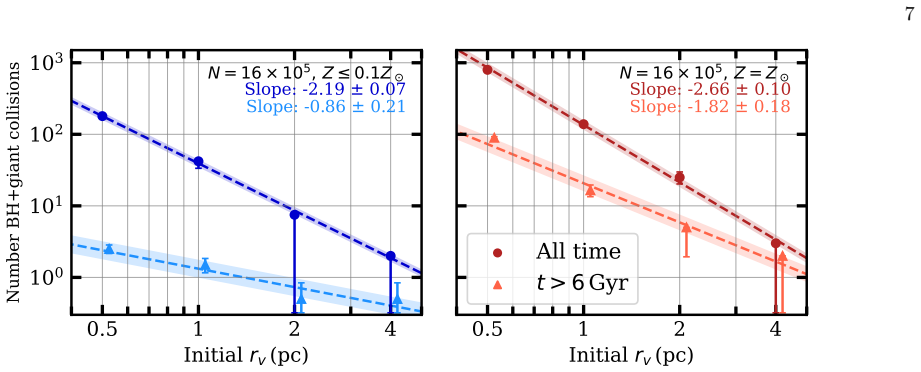
Black hole plus giant star collisions form most ultracompact black hole-white dwarf binaries in globular clusters.
A machine-rendered reading of the paper's core claim, the machinery that carries it, and where it could break.
Core claim
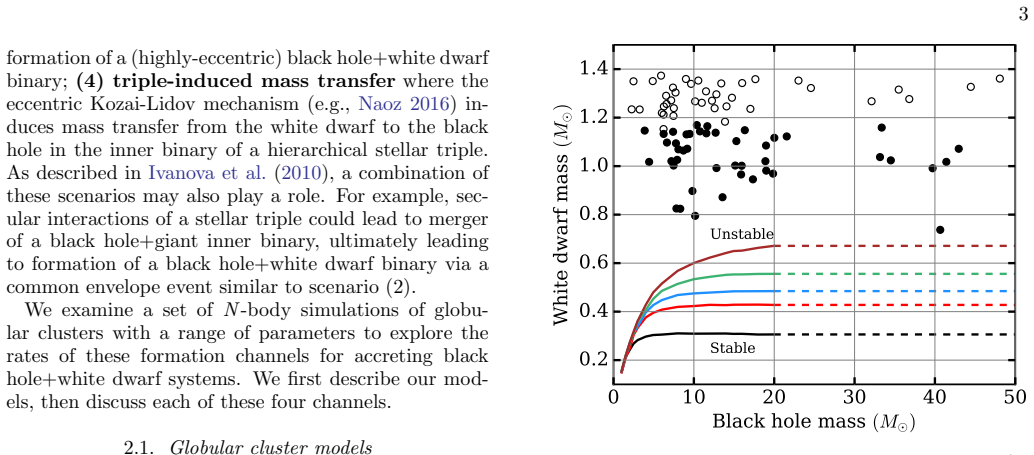
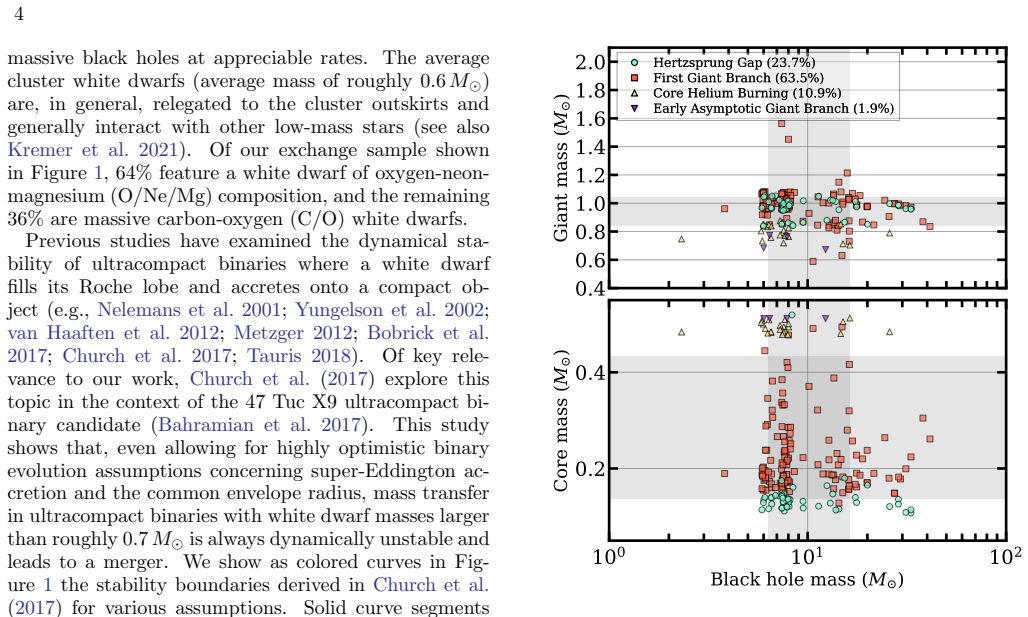
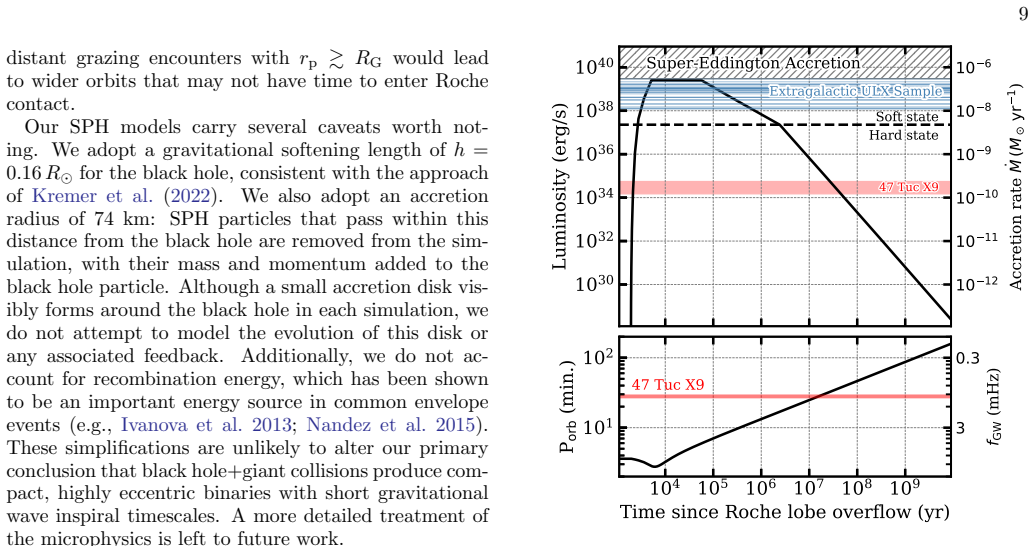
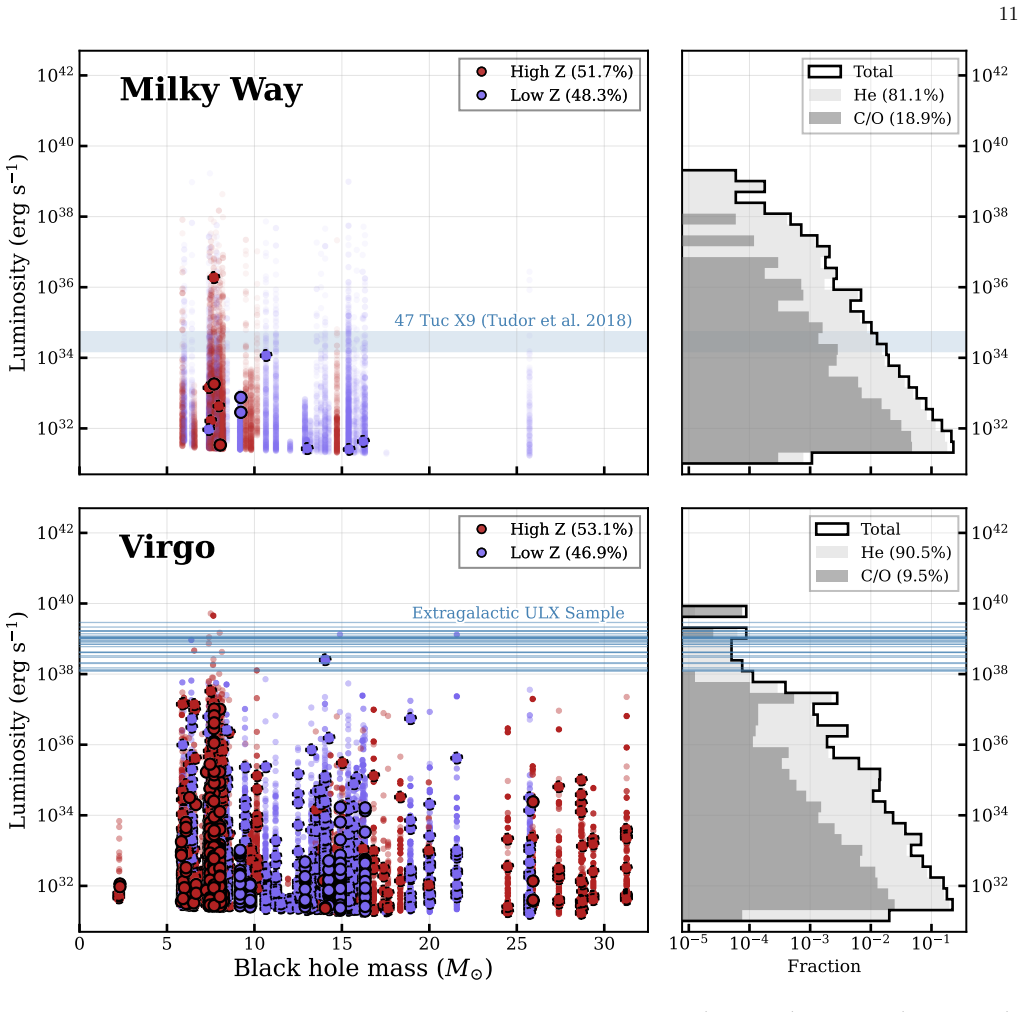
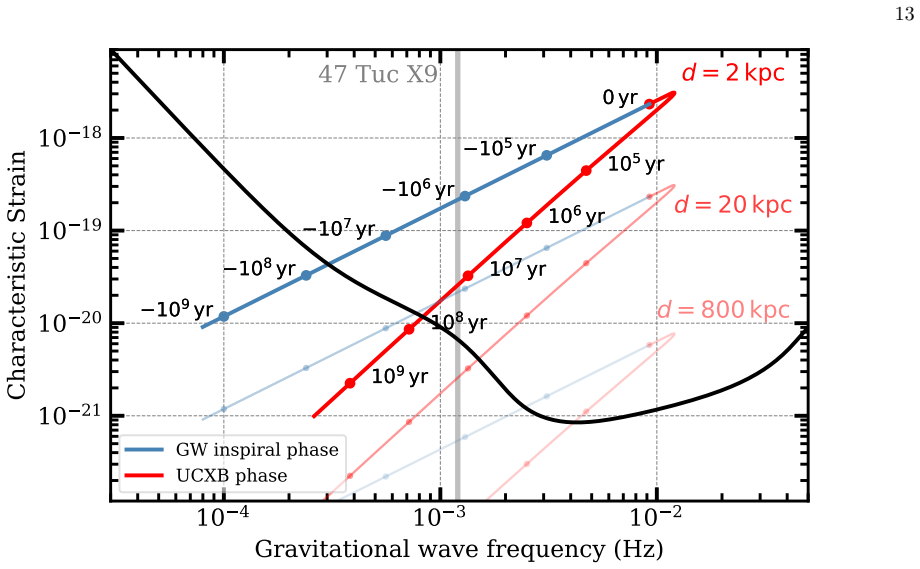
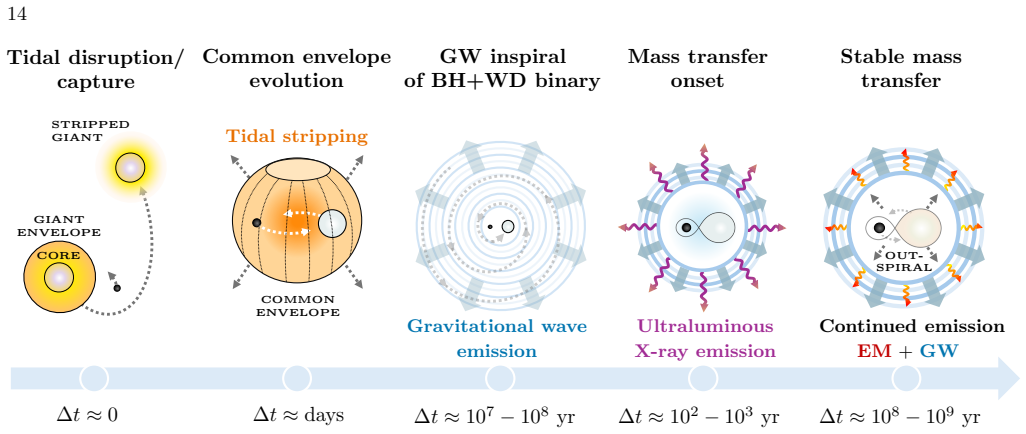
Black hole plus giant collisions are the primary mechanism that forms black hole-white dwarf binaries with orbital periods under one hour. Smoothed-particle hydrodynamics modeling of these collisions produces white-dwarf companions that inspiral to contact via gravitational waves within a billion years. A mock catalog of the resulting X-ray sources matches observed candidates such as 47 Tuc X9 and RZ 2109, and the calculated gravitational-wave strain indicates that of order one source may be resolved by LISA in the Milky Way.
What carries the argument
Black hole-giant star collisions treated as common-envelope-like events inside Cluster Monte Carlo dynamics simulations and verified with StarSmasher smoothed-particle hydrodynamics.
If this is right
- Black hole-giant collisions dominate formation of these binaries over other dynamical channels.
- The collision products reach Roche-lobe contact on sub-Gyr timescales via gravitational-wave inspiral.
- The simulated population produces roughly one LISA-resolvable source in the Milky Way.
- The mock catalog of X-ray sources aligns with observed candidates in the Milky Way and external galaxies.
Where Pith is reading between the lines
- LISA detections of these sources could yield independent mass measurements for black holes residing in globular clusters.
- The same collision channel may operate for other compact-object pairs formed in dense environments.
- X-ray luminosity functions of ultracompact sources in clusters could provide an observational test of the collision rates.
Load-bearing premise
The smoothed-particle hydrodynamics modeling of black hole-giant collisions produces white-dwarf companions whose gravitational-wave inspiral times to Roche contact are correctly predicted to be sub-Gyr.
What would settle it
A deep X-ray or gravitational-wave survey of Milky Way globular clusters that finds zero or far more than one ultracompact black hole-white dwarf source would directly test the predicted formation rate and population size.
Figures
read the original abstract
Globular clusters are host to significant populations of dynamically-active stellar remnants that connect to a variety of astrophysical sources. Using simulations performed with the Cluster Monte Carlo dynamics code, we study the formation of ultracompact binaries in which a stellar-mass black hole accretes material from a white dwarf companion in a sub-hour orbit. These binary systems are prime multimessenger targets, as they can be observed as both luminous X-ray sources, and as millihertz gravitational wave sources detectable by the Laser Interferometer Space Antenna (LISA). We find that black hole+giant collisions are the primary mechanism through which such systems form. We model the outcomes of these ``common envelope''-like events using the smoothed particle hydrodynamics code StarSmasher, and verify these collisions yield black hole+white dwarf binaries that enter Roche contact on sub-Gyr timescales via gravitational wave inspiral. We construct a mock catalog of local ultracompact X-ray sources and compare to candidate sources observed in globular clusters in the Milky Way (e.g., 47 Tuc X9) and external galaxies (e.g., RZ 2109 in NGC 4472). Finally, we compute the gravitational wave strain for these sources, and show that of order one source may be resolvable in the Milky Way by LISA, representing a potentially powerful tool for observing new black holes in globular clusters.
Editorial analysis
A structured set of objections, weighed in public.
Referee Report
Summary. The paper uses Cluster Monte Carlo (CMC) simulations of globular cluster dynamics to identify black hole + giant star collisions as the primary formation channel for ultracompact black hole-white dwarf X-ray binaries. These collisions are modeled with the StarSmasher SPH code, which the authors state produces bound BH+WD systems that reach Roche-lobe contact on sub-Gyr timescales through gravitational-wave inspiral. A mock catalog of such sources is constructed and compared to observed candidates (e.g., 47 Tuc X9, RZ 2109), and the expected LISA gravitational-wave strain is computed, yielding an estimate of order one resolvable source in the Milky Way.
Significance. If the SPH collision outcomes are shown to robustly satisfy the sub-Gyr inspiral condition, the work supplies a concrete dynamical pathway linking cluster evolution to multimessenger sources observable in both X-rays and millihertz GWs. The explicit use of hydrodynamical modeling for the collision phase is a positive feature relative to purely analytic common-envelope prescriptions.
major comments (3)
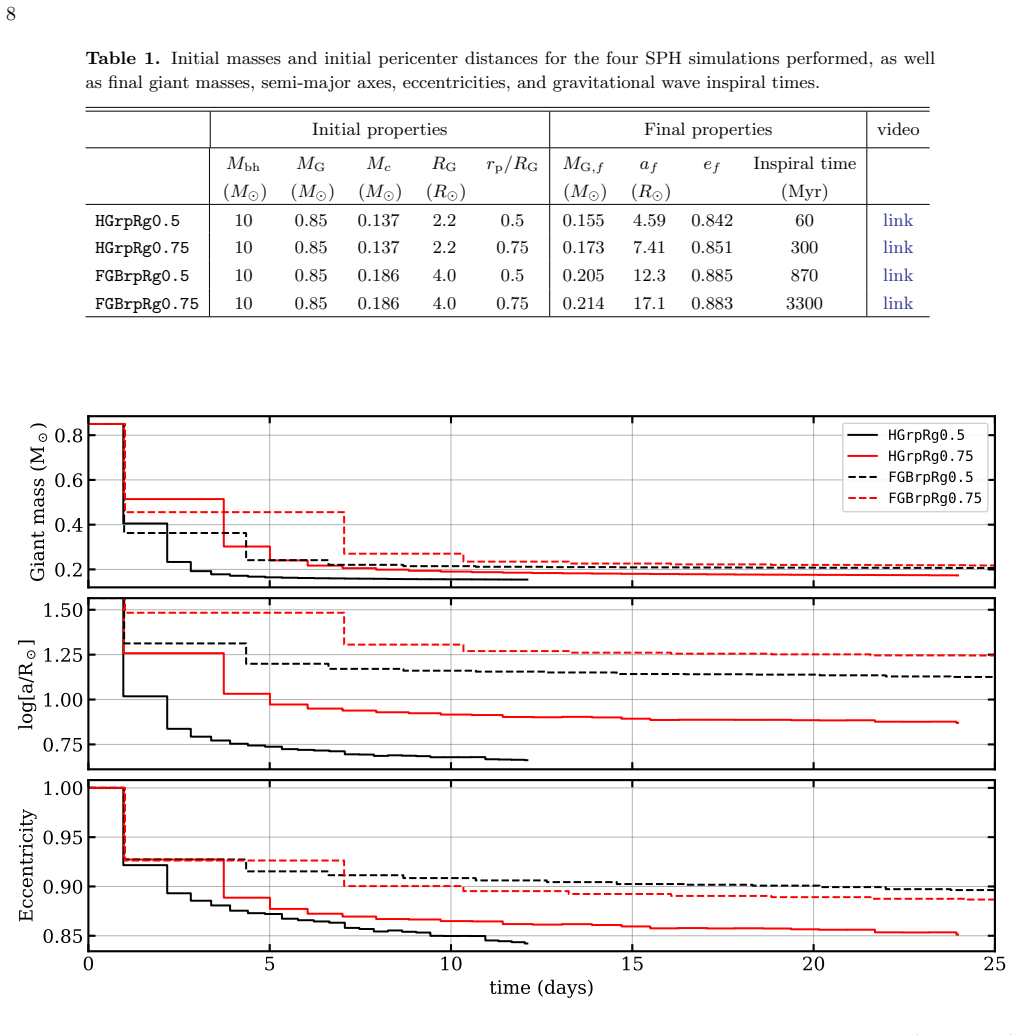
- [section on collision outcomes / StarSmasher modeling] The central claim that BH+giant collisions are the primary mechanism and produce observable ultracompact systems rests on the StarSmasher runs yielding post-collision orbits whose GW inspiral time is <1 Gyr. The manuscript must explicitly tabulate or plot the post-collision semi-major axis a, eccentricity e, component masses, and the resulting t_GW computed via the Peters (1964) formula for the simulated impact parameters and mass ratios (section on collision outcomes). Without these quantities, the sub-Gyr timescale verification cannot be assessed.
- [CMC dynamics results / formation channel comparison] The statement that collisions are the 'primary mechanism' is derived from the relative rates in the CMC runs. The manuscript should report the fractional contribution of this channel versus other channels (e.g., exchange encounters) across multiple realizations, together with the sensitivity of that fraction to the free parameters listed in the Cluster Monte Carlo setup.
- [LISA strain / mock catalog section] The LISA resolvability estimate ('of order one source') depends on the absolute formation rate and the assumed Milky Way globular cluster population. The manuscript should provide the range or standard deviation of the predicted number of resolvable sources across the simulation ensemble rather than a single order-of-magnitude figure.
minor comments (2)
- [collision outcomes paragraph] The abstract states that the systems 'enter Roche contact on sub-Gyr timescales via gravitational wave inspiral'; the corresponding section should cite the exact form of the Peters merger-time integral used.
- [methods] Notation for the binary orbital elements after the SPH run should be defined consistently with the subsequent GW evolution equations.
Simulated Author's Rebuttal
We thank the referee for their constructive comments, which highlight areas where additional detail will strengthen the manuscript. We address each major comment below and will incorporate the requested information in the revised version.
read point-by-point responses
-
Referee: The central claim that BH+giant collisions are the primary mechanism and produce observable ultracompact systems rests on the StarSmasher runs yielding post-collision orbits whose GW inspiral time is <1 Gyr. The manuscript must explicitly tabulate or plot the post-collision semi-major axis a, eccentricity e, component masses, and the resulting t_GW computed via the Peters (1964) formula for the simulated impact parameters and mass ratios (section on collision outcomes). Without these quantities, the sub-Gyr timescale verification cannot be assessed.
Authors: We agree that explicit presentation of these quantities will allow independent verification of the sub-Gyr inspiral times. In the revised manuscript we will add a table in the StarSmasher section listing post-collision semi-major axis, eccentricity, component masses, and t_GW (computed with the Peters 1964 formula) for each simulated impact parameter and mass ratio. This directly addresses the request and substantiates the claim that the resulting BH+WD systems reach Roche contact on sub-Gyr timescales. revision: yes
-
Referee: The statement that collisions are the 'primary mechanism' is derived from the relative rates in the CMC runs. The manuscript should report the fractional contribution of this channel versus other channels (e.g., exchange encounters) across multiple realizations, together with the sensitivity of that fraction to the free parameters listed in the Cluster Monte Carlo setup.
Authors: The CMC runs were performed with an ensemble of realizations. We will revise the dynamics results section to report the mean fractional contribution of the BH+giant collision channel relative to other channels (including exchanges) across realizations, together with a brief discussion of sensitivity to the principal Cluster Monte Carlo parameters (initial binary fraction, stellar IMF, and cluster concentration). revision: yes
-
Referee: The LISA resolvability estimate ('of order one source') depends on the absolute formation rate and the assumed Milky Way globular cluster population. The manuscript should provide the range or standard deviation of the predicted number of resolvable sources across the simulation ensemble rather than a single order-of-magnitude figure.
Authors: The quoted estimate is based on the full simulation ensemble and mock catalog. In the revised LISA section we will report both the mean number of resolvable sources and the standard deviation (or range) obtained across the CMC realizations and variations in the assumed Milky Way globular cluster population, thereby quantifying the uncertainty in the prediction. revision: yes
Circularity Check
No significant circularity; forward simulations compared to external data
full rationale
The derivation proceeds via independent forward modeling: Cluster Monte Carlo dynamics runs generate encounter rates, StarSmasher SPH runs produce post-collision orbital elements and remnant properties, standard Peters (1964) GW inspiral times are computed from those outputs, a mock catalog is built from the resulting population, and LISA strains are evaluated with standard formulas. These steps are compared against observed candidates (47 Tuc X9, RZ 2109) that are not used to tune any simulation parameters. No equation reduces a reported count, timescale, or strain to a quantity fitted from the same data; self-citations are not load-bearing for the central claims.
Axiom & Free-Parameter Ledger
free parameters (1)
- Cluster Monte Carlo and StarSmasher internal parameters
axioms (1)
- domain assumption Black hole-giant encounters can be modeled as common-envelope-like events whose outcomes are captured by smoothed-particle hydrodynamics
Reference graph
Works this paper leans on
-
[1]
Abbott, B. P., Abbott, R., Abbott, T. D., et al. 2016, PhRvL, 116, 061102, doi: 10.1103/PhysRevLett.116.061102
-
[2]
2023, Living Reviews in Relativity, 26, 2, doi: 10.1007/s41114-022-00041-y
Amaro-Seoane, P., Andrews, J., Arca Sedda, M., et al. 2023, Living Reviews in Relativity, 26, 2, doi: 10.1007/s41114-022-00041-y 17
-
[3]
Antonini, F., & Gieles, M. 2020, MNRAS, 492, 2936, doi: 10.1093/mnras/stz3584
-
[4]
2018, MNRAS, 478, 1844, doi: 10.1093/mnras/sty1186
Askar, A., Arca Sedda, M., & Giersz, M. 2018, MNRAS, 478, 1844, doi: 10.1093/mnras/sty1186
-
[5]
2017, MNRAS, 464, L36, doi: 10.1093/mnrasl/slw177
Askar, A., Szkudlarek, M., Gondek-Rosi´ nska, D., Giersz, M., & Bulik, T. 2017, MNRAS, 464, L36, doi: 10.1093/mnrasl/slw177
-
[6]
Athukoralalage, W. R., Dage, K. C., Zepf, S. E., et al. 2023, MNRAS, 518, 855, doi: 10.1093/mnras/stac3145
-
[7]
2023, in Handbook of X-ray and Gamma-ray Astrophysics, 120, doi: 10.1007/978-981-16-4544-0 94-1
Bahramian, A., & Degenaar, N. 2023, in Handbook of X-ray and Gamma-ray Astrophysics, 120, doi: 10.1007/978-981-16-4544-0 94-1
-
[8]
Bahramian, A., Heinke, C. O., Tudor, V., et al. 2017, MNRAS, 467, 2199, doi: 10.1093/mnras/stx166
-
[9]
Rocha-Pinto, H. J. 2017, MNRAS, 471, 2812, doi: 10.1093/mnras/stx1763
-
[10]
Bobrick, A., Davies, M. B., & Church, R. P. 2017, MNRAS, 467, 3556, doi: 10.1093/mnras/stx312
-
[11]
2022, MNRAS, 510, 3758, doi: 10.1093/mnras/stab3574
Church, R. 2022, MNRAS, 510, 3758, doi: 10.1093/mnras/stab3574
-
[12]
Breen, P. G., & Heggie, D. C. 2013, MNRAS, 432, 2779, doi: 10.1093/mnras/stt628
-
[13]
Breivik, K., Rodriguez, C. L., Larson, S. L., Kalogera, V., & Rasio, F. A. 2016, ApJL, 830, L18, doi: 10.3847/2041-8205/830/1/L18
-
[14]
2020, ApJ, 898, 71, doi: 10.3847/1538-4357/ab9d85
Breivik, K., Coughlin, S., Zevin, M., et al. 2020, ApJ, 898, 71, doi: 10.3847/1538-4357/ab9d85
-
[15]
Brodie, J. P., & Strader, J. 2006, ARA&A, 44, 193, doi: 10.1146/annurev.astro.44.051905.092441
-
[16]
Chomiuk, L., Strader, J., Maccarone, T. J., et al. 2013, ApJ, 777, 69, doi: 10.1088/0004-637X/777/1/69
-
[17]
Church, R. P., Strader, J., Davies, M. B., & Bobrick, A. 2017, ApJL, 851, L4, doi: 10.3847/2041-8213/aa9aeb
-
[18]
Dage, K. C., Zepf, S. E., Peacock, M. B., et al. 2019a, MNRAS, 485, 1694, doi: 10.1093/mnras/stz479
-
[19]
Dage, K. C., Zepf, S. E., Thygesen, E., et al. 2020, MNRAS, 497, 596, doi: 10.1093/mnras/staa1963
-
[20]
Dage, K. C., Zepf, S. E., Bahramian, A., et al. 2019b, MNRAS, 489, 4783, doi: 10.1093/mnras/stz2514
-
[21]
C., Kundu, A., Thygesen, E., et al
Dage, K. C., Kundu, A., Thygesen, E., et al. 2021, MNRAS, 504, 1545, doi: 10.1093/mnras/stab943
-
[22]
Dickson, N., H´ enault-Brunet, V., Baumgardt, H., Gieles, M., & Smith, P. J. 2023, MNRAS, 522, 5320, doi: 10.1093/mnras/stad1254
-
[23]
Fabian, A. C., Pringle, J. E., & Rees, M. J. 1975, MNRAS, 172, 15, doi: 10.1093/mnras/172.1.15P
-
[24]
Fishbach, M., Holz, D. E., & Farr, B. 2017, ApJL, 840, L24, doi: 10.3847/2041-8213/aa7045
-
[25]
Fragione, G., Martinez, M. A. S., Kremer, K., et al. 2020, ApJ, 900, 16, doi: 10.3847/1538-4357/aba89b
-
[26]
Rasio, F. A. 2004, MNRAS, 352, 1, doi: 10.1111/j.1365-2966.2004.07914.x
-
[27]
2009, MNRAS, 395, 1319, doi: 10.1111/j.1365-2966.2009.14654.x
Gaburov, E., Lombardi, James C., J., & Portegies Zwart, S. 2010, MNRAS, 402, 105, doi: 10.1111/j.1365-2966.2009.15900.x
-
[28]
Gibson, C. F. A., Kiro˘ glu, F., Lombardi, J. C., et al. 2025, ApJ, 980, 109, doi: 10.3847/1538-4357/ad9b80
-
[29]
2018, MNRAS, 475, L15, doi: 10.1093/mnrasl/slx203
Giesers, B., Dreizler, S., Husser, T.-O., et al. 2018, MNRAS, 475, L15, doi: 10.1093/mnrasl/slx203
-
[30]
Giesers, B., Kamann, S., Dreizler, S., et al. 2019, A&A, 632, A3, doi: 10.1051/0004-6361/201936203 Gonz´ alez, E., Kremer, K., Chatterjee, S., et al. 2021, ApJL, 908, L29, doi: 10.3847/2041-8213/abdf5b Gonz´ alez Prieto, E., Lombardi, Jr., J. C., Rose, S. C., et al. 2026, arXiv e-prints, arXiv:2602.10191, doi: 10.48550/arXiv.2602.10191
-
[31]
Greene, J. E., Strader, J., & Ho, L. C. 2020, Annual Review of Astronomy and Astrophysics, 58, 257–312, doi: 10.1146/annurev-astro-032620-021835
work page internal anchor Pith review doi:10.1146/annurev-astro-032620-021835 2020
-
[32]
Harris, W. E. 1996, AJ, 112, 1487, doi: 10.1086/118116 —. 2009, ApJ, 703, 939, doi: 10.1088/0004-637X/703/1/939
-
[33]
Harris, W. E., Harris, G. L. H., & Alessi, M. 2013, ApJ, 772, 82, doi: 10.1088/0004-637X/772/2/82
-
[34]
2003, The Gravitational Million-Body Problem: A Multidisciplinary Approach to Star Cluster Dynamics
Heggie, D., & Hut, P. 2003, The Gravitational Million-Body Problem: A Multidisciplinary Approach to Star Cluster Dynamics
2003
-
[35]
Hurley, J. R., Tout, C. A., & Pols, O. R. 2002, MNRAS, 329, 897, doi: 10.1046/j.1365-8711.2002.05038.x
-
[36]
Irwin, J. A. 2005, ApJ, 631, 511, doi: 10.1086/432611
-
[37]
Irwin, J. A., Brink, T. G., Bregman, J. N., & Roberts, T. P. 2010, ApJL, 712, L1, doi: 10.1088/2041-8205/712/1/L1
-
[38]
2010, ApJ, 717, 948, doi: 10.1088/0004-637X/717/2/948
Ivanova, N., Chaichenets, S., Fregeau, J., et al. 2010, ApJ, 717, 948, doi: 10.1088/0004-637X/717/2/948
-
[39]
Lombardi, J. C. 2013, Science, 339, 433, doi: 10.1126/science.1225540
-
[40]
Ivanova, N., Rasio, F. A., Lombardi, Jr., J. C., Dooley, K. L., & Proulx, Z. F. 2005, ApJL, 621, L109, doi: 10.1086/429220
-
[41]
2006, AJ, 132, 189, doi: 10.1086/504599 Jord´ an, A., Peng, E
Jha, S., Branch, D., Chornock, R., et al. 2006, AJ, 132, 189, doi: 10.1086/504599 Jord´ an, A., Peng, E. W., Blakeslee, J. P., et al. 2009, ApJS, 180, 54, doi: 10.1088/0067-0049/180/1/54
-
[42]
2013, ApJ, 764, 98, doi: 10.1088/0004-637X/764/1/98
Kim, D.-W., Fabbiano, G., Ivanova, N., et al. 2013, ApJ, 764, 98, doi: 10.1088/0004-637X/764/1/98
-
[43]
2006, ApJ, 652, 1090, doi: 10.1086/508415 18
Kim, D.-W., Fabbiano, G., Kalogera, V., et al. 2006, ApJ, 652, 1090, doi: 10.1086/508415 18
-
[44]
2008, ApJ, 683, 1006, doi: 10.1086/589987
Knigge, C., Dieball, A., Ma´ ız Apell´ aniz, J., et al. 2008, ApJ, 683, 1006, doi: 10.1086/589987
-
[45]
Kremer, K., Chatterjee, S., Rodriguez, C. L., & Rasio, F. A. 2018a, ApJ, 852, 29, doi: 10.3847/1538-4357/aa99df
-
[46]
Kremer, K., Lombardi, J. C., Lu, W., Piro, A. L., & Rasio, F. A. 2022, The Astrophysical Journal, 933, 203, doi: 10.3847/1538-4357/ac714f
-
[47]
Kremer, K., Rui, N. Z., Weatherford, N. C., et al. 2021, ApJ, 917, 28, doi: 10.3847/1538-4357/ac06d4
-
[48]
Kremer, K., Weatherford, N. C., Hopkins, P. F., Rui, N. Z., & Ye, C. S. 2025, ApJL, 993, L34, doi: 10.3847/2041-8213/ae1233
-
[49]
Rasio, F. A. 2018b, ApJL, 855, L15, doi: 10.3847/2041-8213/aab26c
-
[50]
Rasio, F. A. 2020a, in IAU Symposium, Vol. 351, Star Clusters: From the Milky Way to the Early Universe, ed. A. Bragaglia, M. Davies, A. Sills, & E. Vesperini, 357–366, doi: 10.1017/S1743921319007269
-
[51]
Kremer, K., Rodriguez, C. L., Amaro-Seoane, P., et al. 2019, PhRvD, 99, 063003, doi: 10.1103/PhysRevD.99.063003
-
[52]
Kremer, K., Ye, C. S., Rui, N. Z., et al. 2020b, ApJS, 247, 48, doi: 10.3847/1538-4365/ab7919
-
[53]
Kroupa, P. 2001, MNRAS, 322, 231, doi: 10.1046/j.1365-8711.2001.04022.x
-
[54]
Kulkarni, S. R., Hut, P., & McMillan, S. 1993, Nature, 364, 421, doi: 10.1038/364421a0
-
[55]
Kundu, A., Maccarone, T. J., & Zepf, S. E. 2002, ApJL, 574, L5, doi: 10.1086/342353 —. 2007, ApJ, 662, 525, doi: 10.1086/518021
-
[56]
Kundu, A., Maccarone, T. J., Zepf, S. E., & Puzia, T. H. 2003, ApJL, 589, L81, doi: 10.1086/376493
-
[57]
Lee, H. M., & Ostriker, J. P. 1986, ApJ, 310, 176, doi: 10.1086/164674
-
[58]
Lehmer, B. D., Ferrell, A. P., Doore, K., et al. 2020, ApJS, 248, 31, doi: 10.3847/1538-4365/ab9175
-
[59]
Leigh, N. W. C., Giersz, M., Marks, M., et al. 2015, MNRAS, 446, 226, doi: 10.1093/mnras/stu2110
-
[60]
Lombardi, Jr., J. C., Proulx, Z. F., Dooley, K. L., et al. 2006, ApJ, 640, 441, doi: 10.1086/499938
-
[61]
Maccarone, T. J. 2003, A&A, 409, 697, doi: 10.1051/0004-6361:20031146
-
[62]
Maccarone, T. J., Kundu, A., Zepf, S. E., & Rhode, K. L. 2007, Nature, 445, 183, doi: 10.1038/nature05434
-
[63]
Mackey, A. D., Wilkinson, M. I., Davies, M. B., & Gilmore, G. F. 2008, MNRAS, 386, 65, doi: 10.1111/j.1365-2966.2008.13052.x
-
[64]
Mai, A., Kremer, K., & Kıro˘ glu, F. 2026, ApJ, 998, 138, doi: 10.3847/1538-4357/ae2de5
-
[65]
Mandel, I., & Broekgaarden, F. S. 2022, Living Reviews in Relativity, 25, 1, doi: 10.1007/s41114-021-00034-3
-
[66]
Metzger, B. D. 2012, MNRAS, 419, 827, doi: 10.1111/j.1365-2966.2011.19747.x
-
[67]
Miller-Jones, J. C. A., Strader, J., Heinke, C. O., et al. 2015, MNRAS, 453, 3918, doi: 10.1093/mnras/stv1869
-
[68]
Milone, A. P., Piotto, G., Bedin, L. R., et al. 2012, A&A, 540, A16, doi: 10.1051/0004-6361/201016384
-
[69]
Morscher, M., Pattabiraman, B., Rodriguez, C., Rasio, F. A., & Umbreit, S. 2015, ApJ, 800, 9, doi: 10.1088/0004-637X/800/1/9
-
[70]
Nair, S., Dage, K. C., Haggard, D., et al. 2023, MNRAS, 524, 3662, doi: 10.1093/mnras/stad1927
-
[71]
Nandez, J. L. A., Ivanova, N., & Lombardi, J. C. J. 2015, MNRAS, 450, L39, doi: 10.1093/mnrasl/slv043
-
[72]
2016, ARA&A, 54, 441, doi: 10.1146/annurev-astro-081915-023315
Naoz, S. 2016, ARA&A, 54, 441, doi: 10.1146/annurev-astro-081915-023315
-
[73]
Narayan, R., & McClintock, J. E. 2008, NewAR, 51, 733, doi: 10.1016/j.newar.2008.03.002
-
[74]
An analytical approach to binary populations in globular clusters
Nelemans, G., Yungelson, L. R., & Portegies Zwart, S. F. 2001, A&A, 375, 890, doi: 10.1051/0004-6361:20010683 O’Connor, C. E., Kremer, K., & Rasio, F. A. 2026, arXiv e-prints, arXiv:2604.02412, doi: 10.48550/arXiv.2604.02412
work page internal anchor Pith review Pith/arXiv arXiv doi:10.1051/0004-6361:20010683 2001
-
[75]
Oh, K., Dage, K. C., Bobrick, A., et al. 2025, MNRAS, 537, 3884, doi: 10.1093/mnras/staf207
-
[76]
2011, ApJS, 192, 3, doi: 10.1088/0067-0049/192/1/3
Paxton, B., Bildsten, L., Dotter, A., et al. 2011, ApJS, 192, 3, doi: 10.1088/0067-0049/192/1/3
-
[77]
2013, ApJS, 208, 4, doi: 10.1088/0067-0049/208/1/4 22
Paxton, B., Cantiello, M., Arras, P., et al. 2013, ApJS, 208, 4, doi: 10.1088/0067-0049/208/1/4
work page internal anchor Pith review doi:10.1088/0067-0049/208/1/4 2013
-
[78]
2015, ApJS, 220, 15, doi: 10.1088/0067-0049/220/1/15
Paxton, B., Marchant, P., Schwab, J., et al. 2015, ApJS, 220, 15, doi: 10.1088/0067-0049/220/1/15
work page internal anchor Pith review doi:10.1088/0067-0049/220/1/15 2015
-
[79]
Paxton, B., Schwab, J., Bauer, E. B., et al. 2018, ApJS, 234, 34, doi: 10.3847/1538-4365/aaa5a8
work page internal anchor Pith review doi:10.3847/1538-4365/aaa5a8 2018
-
[80]
2019, ApJS, 243, 10, doi: 10.3847/1538-4365/ab2241
Paxton, B., Smolec, R., Schwab, J., et al. 2019, ApJS, 243, 10, doi: 10.3847/1538-4365/ab2241
discussion (0)
Sign in with ORCID, Apple, or X to comment. Anyone can read and Pith papers without signing in.