Majorana-Pauli stabilizer codes and duality webs of fermionic topological phases
Pith reviewed 2026-06-25 23:37 UTC · model grok-4.3
The pith
Majorana-Pauli stabilizer codes provide exact realizations of the fermionic toric code and other intrinsically fermionic topological phases.
A machine-rendered reading of the paper's core claim, the machinery that carries it, and where it could break.
Core claim
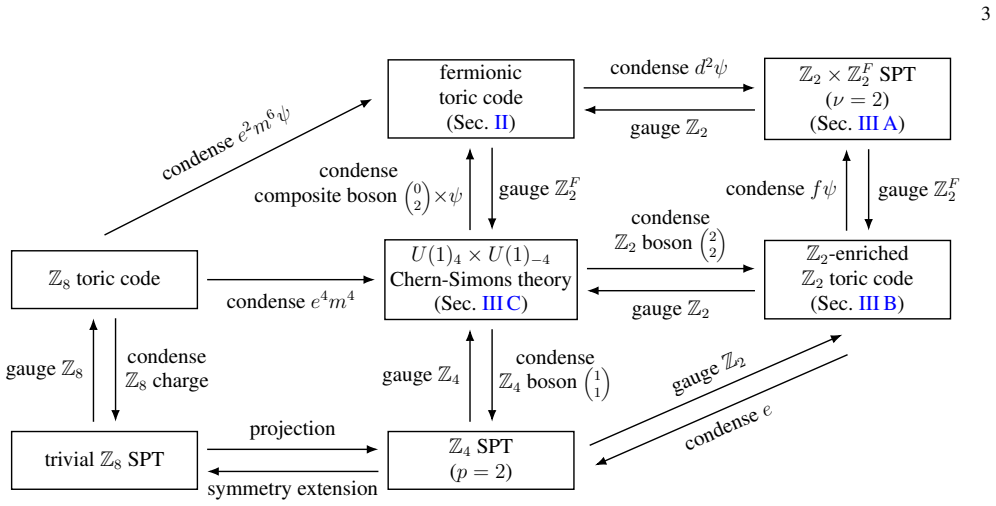
We introduce Majorana-Pauli stabilizer codes whose stabilizers are built from both generalized Pauli operators and Majorana operators, and use them to construct an exactly solvable realization of the fermionic toric code whose anyons, string operators, fusion rules, and braiding statistics follow from the stabilizer algebra. This code belongs to a duality web connecting bosonic topological orders, symmetry-enriched topological phases, and bosonic and fermionic symmetry-protected topological phases.
What carries the argument
Majorana-Pauli stabilizers constructed from Z_8 Pauli operators coupled to Majorana modes, whose algebraic relations enforce the fermionic statistics and intrinsic fermionic character of the topological order.
If this is right
- The construction extends to all Abelian fermionic topological orders with gapped boundaries.
- It covers all supercohomology fermionic SPT phases in (2+1) dimensions.
- Fermionic versions of clock and shift operators enable an exact bosonization map for Z_D^F symmetries when D is even.
- A stabilizer model is realized for a nontrivial Z_8^F fermionic SPT phase with no free-fermion analog.
Where Pith is reading between the lines
- The duality web may offer a unified stabilizer-based classification of mixed bosonic-fermionic phases.
- These codes could inspire new quantum error correcting codes that protect against errors in fermionic systems.
- Extending the approach beyond Abelian cases might address non-Abelian fermionic orders.
Load-bearing premise
The algebraic relations of the Majorana-Pauli stabilizers are sufficient to enforce the correct fermionic statistics and intrinsic fermionic character without additional lattice or boundary assumptions.
What would settle it
An explicit computation of the braiding phase between anyons in the model that deviates from the expected value for the fermionic toric code would disprove the construction.
Figures
read the original abstract
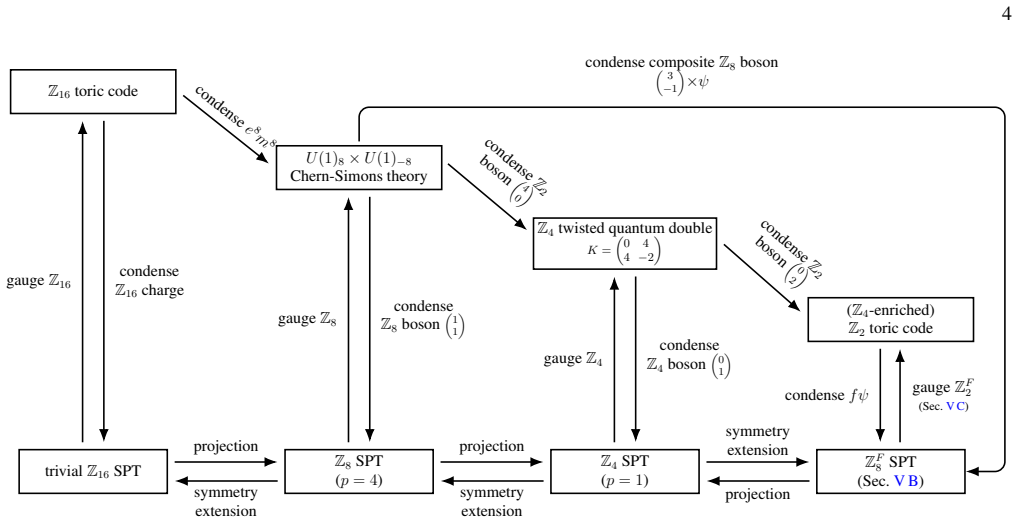
Stabilizer codes provide exact lattice realizations of bosonic topological orders. In contrast, systematic stabilizer descriptions of intrinsically fermionic topological phases remain much less developed. In this work, we introduce Majorana-Pauli stabilizer codes, a class of exactly solvable fermionic lattice models whose stabilizers are built from both generalized Pauli operators and Majorana operators. As a main example, we construct an exactly solvable stabilizer realization of the fermionic toric code: an intrinsically fermionic $\mathbb Z_2$ topological order in $(2{+}1)$ dimensions, using $\mathbb Z_8$ Pauli operators coupled to Majorana modes. Within this stabilizer framework, the anyons, string operators, fusion rules, and braiding statistics all follow naturally from the stabilizer algebra. More broadly, we show that the fermionic toric code belongs to a duality web generated by anyon condensation and by gauging bosonic or fermion-parity symmetries. This web connects bosonic topological orders, symmetry-enriched topological phases, and both bosonic and fermionic symmetry-protected topological phases, all within a common stabilizer description. We further show that the construction extends to all Abelian fermionic topological orders with gapped boundaries and to all supercohomology fermionic SPT phases in $(2{+}1)$ dimensions. Going beyond Majorana operators, we introduce fermionic versions of the clock and shift operators and use them to construct an exact bosonization map for $\mathbb Z_D^F$ symmetries for $D$ even. Using this, we realize a stabilizer model for a nontrivial $\mathbb Z_8^F$ fermionic SPT phase with no free-fermion analog. Altogether, these results extend the stabilizer-code paradigm to a broad class of intrinsically fermionic phases bridging fermionic quantum many-body physics to quantum error correction.
Editorial analysis
A structured set of objections, weighed in public.
Referee Report
Summary. The manuscript introduces Majorana-Pauli stabilizer codes that combine generalized Pauli operators with Majorana modes to produce exactly solvable lattice models of intrinsically fermionic topological phases. The central construction is a stabilizer realization of the fermionic toric code (an intrinsically fermionic Z_2 order in 2+1D) using Z_8 Pauli operators coupled to Majorana modes, with the claim that anyons, string operators, fusion rules, and braiding statistics are all determined directly by the stabilizer algebra. The work further embeds this model in a duality web generated by anyon condensation and gauging of bosonic or fermion-parity symmetries, extends the framework to all Abelian fermionic topological orders with gapped boundaries and to supercohomology fermionic SPT phases, and introduces fermionic clock and shift operators to obtain an exact bosonization map for Z_D^F symmetries (D even), including a nontrivial Z_8^F SPT model with no free-fermion analog.
Significance. If the algebraic constructions are shown to enforce the correct intrinsic fermionic braiding phases without additional lattice or boundary data, the results would provide a systematic stabilizer-code route to fermionic topological orders and a unified duality web connecting bosonic, symmetry-enriched, and fermionic phases. This would be a notable advance for exactly solvable models in quantum many-body physics and for extending quantum error correction techniques to fermionic systems.
major comments (2)
- [fermionic toric code construction (abstract and main example)] Abstract and fermionic toric code construction: the central claim that 'the anyons, string operators, fusion rules, and braiding statistics all follow naturally from the stabilizer algebra' is load-bearing. The manuscript must supply the explicit commutation relations among the Majorana-Pauli stabilizers and the string operators, followed by the direct algebraic computation of the mutual braiding phase obtained when one string is transported around the other; without this calculation it remains unclear whether the algebra alone selects the fermionic Z_2 statistics (transparent fermion plus semionic mutual braiding) or defaults to the bosonic toric code.
- [duality web generated by anyon condensation and gauging] Duality web and gauging sections: the statement that the fermionic toric code belongs to a web generated by anyon condensation and gauging of fermion-parity symmetries requires an explicit demonstration that the stabilizer algebra encodes the intrinsic fermionic character (e.g., the transparent fermion) independently of concrete lattice embedding or boundary conditions; otherwise the web construction risks implicitly relying on the lattice realization to fix the statistics.
minor comments (1)
- [abstract] Notation: the abstract refers to both 'Z_8 Pauli operators' and 'Majorana-Pauli stabilizer codes'; a brief clarification of how the Z_8 operators are defined in terms of the Majorana modes would improve readability.
Simulated Author's Rebuttal
We thank the referee for the careful and constructive report. The major comments correctly identify the need for fully explicit algebraic derivations to substantiate the central claims. We have revised the manuscript to incorporate the requested calculations and demonstrations, which we believe address the concerns while preserving the original results.
read point-by-point responses
-
Referee: [fermionic toric code construction (abstract and main example)] Abstract and fermionic toric code construction: the central claim that 'the anyons, string operators, fusion rules, and braiding statistics all follow naturally from the stabilizer algebra' is load-bearing. The manuscript must supply the explicit commutation relations among the Majorana-Pauli stabilizers and the string operators, followed by the direct algebraic computation of the mutual braiding phase obtained when one string is transported around the other; without this calculation it remains unclear whether the algebra alone selects the fermionic Z_2 statistics (transparent fermion plus semionic mutual braiding) or defaults to the bosonic toric code.
Authors: We agree that an explicit, self-contained computation of the braiding phase is essential. While the stabilizer algebra and string operators are defined in Sections III and IV, the original presentation derived the relations at a higher level. In the revised manuscript we have inserted a new subsection (IV.B) that tabulates all relevant commutation relations between the Majorana-Pauli stabilizers and the string operators, then performs the direct algebraic calculation of the phase acquired when one string is transported around the other. The computation yields a mutual braiding phase of −1 together with the transparent-fermion property, obtained solely from the defining relations of the algebra and without reference to any concrete lattice embedding or boundary conditions. This establishes that the fermionic Z_2 statistics are selected by the stabilizer algebra itself. revision: yes
-
Referee: [duality web generated by anyon condensation and gauging] Duality web and gauging sections: the statement that the fermionic toric code belongs to a web generated by anyon condensation and gauging of fermion-parity symmetries requires an explicit demonstration that the stabilizer algebra encodes the intrinsic fermionic character (e.g., the transparent fermion) independently of concrete lattice embedding or boundary conditions; otherwise the web construction risks implicitly relying on the lattice realization to fix the statistics.
Authors: We concur that the duality-web construction must be shown to rest on algebraic properties alone. In the revised Section V we have added an explicit algebraic argument demonstrating that the transparent fermion is fixed by the anticommutation relations inherent to the Majorana-Pauli stabilizer algebra. The argument proceeds by considering the action of the fermion operator on the abstract anyon creation operators and showing that the resulting commutation/anticommutation pattern is determined entirely by the stabilizer relations, independent of any particular lattice realization or choice of boundary conditions. This algebraic characterization is then used to generate the full web of dualities via anyon condensation and gauging, thereby confirming that the fermionic character propagates through the web without additional lattice data. revision: yes
Circularity Check
Stabilizer algebra derivations are self-contained without circular reductions
full rationale
The paper introduces Majorana-Pauli stabilizer codes from algebraic properties of Z_8 Pauli operators coupled to Majorana modes and states that anyons, string operators, fusion rules, and braiding statistics follow naturally from the stabilizer algebra. No load-bearing steps reduce by construction to inputs via self-definition, fitted parameters renamed as predictions, or chains of self-citations. The duality web, extensions to Abelian fermionic orders, and bosonization maps are presented as derived within the defined framework. This matches the default case of a self-contained constructive model with independent algebraic content.
Axiom & Free-Parameter Ledger
axioms (2)
- standard math Algebraic properties of Majorana operators (self-adjoint, square to identity, mutually anticommute) and generalized Pauli operators
- domain assumption Z_8 Pauli operators can be consistently coupled to Majorana modes on a lattice while preserving the required commutation relations
invented entities (2)
-
Majorana-Pauli stabilizer
no independent evidence
-
fermionic clock and shift operators
no independent evidence
Reference graph
Works this paper leans on
-
[1]
K-matrix formalism construction TheK-matrix of a Abelian fermionic twisted quantum dou- ble is of the form KfTQD = 0M×M N N−S I .(307) Here N=diag(n 1, . . . , nM), n i >0∈Z even.(308) The choice ofn i to be even integers is connected to the choice of diagonal elements of the matrixS I, which we explain in Appendix B 1.S I is a symmetric integer matrix SI...
-
[2]
Lattice-level construction We are now in the position to introduce the Majorana- Pauli stabilizer construction for the fermionic twisted Abelian gauge theories in Eq. (307). We follow the condensation pre- scription in the last section Sec. VI A 1. Our starting point is a stack of toric codes together with a transparent physical fermion as described by Eq...
-
[3]
Namely, ifn i is odd, then an odd di- agonal entrys i ofS I can be turned into an even one after stacking with a trivial local fermion block
Whyn i only needs to be even We assumed that the fermionic entries ofS I occur only in sectors with evenn i. Namely, ifn i is odd, then an odd di- agonal entrys i ofS I can be turned into an even one after stacking with a trivial local fermion block. Thus, the corre- sponding fermionic twisted quantum double is stably equiv- alent to a bosonic twisted qua...
-
[4]
VI A 1, it is enough to chooseS I containing only a single odd diagonal entry
Single odd diagonal inK fTQD We now explain why, for theK-matrices describing the twisted fermionic gauge theories in Sec. VI A 1, it is enough to chooseS I containing only a single odd diagonal entry. We use the result of Appendix B 1: after stacking with a trivial local fermion block, every odd diagonal entrys i with oddn i can be made even. Therefore, ...
-
[5]
, n′ M),(B16) and tT V= (1,0,
= 1, χ(a ′ i) = 0fori >1.(B15) Equivalently, there exist matricesU, V∈GL M(Z)such that U N V=N ′, N ′ =diag(n ′ 1, . . . , n′ M),(B16) and tT V= (1,0, . . . ,0)mod2.(B17) This is a diagonal cyclic presentation, obtained by Smith-type row and column operations, chosen so that the non-trivialZ 2 characterχis supported on the first cyclic factor. We show the...
-
[6]
VI B it is suffi- cient to construct explicitly only the phases associated with a non-split cyclic fermionic symmetryZ F 2n
Sufficiency of non-splitZ F 2n In this Appendix, we explain why in Sec. VI B it is suffi- cient to construct explicitly only the phases associated with a non-split cyclic fermionic symmetryZ F 2n. We first take the central extension for a fermionic symmetryG f 1→Z F 2 →G f →G b →1. (B38) SinceG f is assumed to be Abelian, the corresponding exten- sion cla...
-
[7]
Affleck, T
I. Affleck, T. Kennedy, E. H. Lieb, and H. Tasaki, Rigorous re- sults on valence-bond ground states in antiferromagnets, Phys. Rev. Lett.59, 799 (1987)
1987
-
[8]
Kitaev, Fault-tolerant quantum computation by anyons, An- nals of Physics303, 2 (2003)
A. Kitaev, Fault-tolerant quantum computation by anyons, An- nals of Physics303, 2 (2003)
2003
-
[9]
M. A. Levin and X.-G. Wen, String-net condensation: A physi- cal mechanism for topological phases, Phys. Rev. B71, 045110 (2005)
2005
-
[10]
Kitaev, Anyons in an exactly solved model and beyond, An- nals of Physics321, 2 (2006), january Special Issue
A. Kitaev, Anyons in an exactly solved model and beyond, An- nals of Physics321, 2 (2006), january Special Issue
2006
-
[11]
Chen, Z.-X
X. Chen, Z.-X. Liu, and X.-G. Wen, Two-dimensional symmetry-protected topological orders and their protected gap- less edge excitations, Phys. Rev. B84, 235141 (2011)
2011
-
[12]
Chen, Z.-C
X. Chen, Z.-C. Gu, Z.-X. Liu, and X.-G. Wen, Symmetry pro- tected topological orders and the group cohomology of their symmetry group, Phys. Rev. B87, 155114 (2013)
2013
-
[13]
Levin and Z.-C
M. Levin and Z.-C. Gu, Braiding statistics approach to symmetry-protected topological phases, Phys. Rev. B86, 115109 (2012)
2012
-
[14]
Chen, Y .-M
X. Chen, Y .-M. Lu, and A. Vishwanath, Symmetry-protected topological phases from decorated domain walls, Nature com- munications5, 3507 (2014)
2014
-
[15]
Heinrich, F
C. Heinrich, F. Burnell, L. Fidkowski, and M. Levin, Symmetry-enriched string nets: Exactly solvable models for set phases, Phys. Rev. B94, 235136 (2016)
2016
-
[16]
Cheng, Z.-C
M. Cheng, Z.-C. Gu, S. Jiang, and Y . Qi, Exactly solvable mod- els for symmetry-enriched topological phases, Phys. Rev. B96, 115107 (2017)
2017
-
[17]
Walker and Z
K. Walker and Z. Wang, (3+1)-TQFTs and topological insula- tors, Frontiers of Physics7, 150 (2012)
2012
-
[18]
Fidkowski, J
L. Fidkowski, J. Haah, M. B. Hastings, and N. Tantivasadakarn, Disentangling the generalized double semion model, Commu- nications in Mathematical Physics380, 1151 (2020)
2020
-
[19]
Fidkowski, J
L. Fidkowski, J. Haah, and M. B. Hastings, Exactly solvable model for a4 + 1Dbeyond-cohomology symmetry-protected topological phase, Phys. Rev. B101, 155124 (2020)
2020
-
[20]
Tantivasadakarn, W
N. Tantivasadakarn, W. Ji, and S. Vijay, Hybrid fracton phases: Parent orders for liquid and nonliquid quantum phases, Phys. Rev. B103, 245136 (2021)
2021
-
[21]
Tantivasadakarn, W
N. Tantivasadakarn, W. Ji, and S. Vijay, Non-abelian hybrid fracton orders, Phys. Rev. B104, 115117 (2021)
2021
-
[22]
T. D. Ellison, Y .-A. Chen, A. Dua, W. Shirley, N. Tanti- vasadakarn, and D. J. Williamson, Pauli stabilizer models of twisted quantum doubles, PRX Quantum3, 010353 (2022)
2022
-
[23]
Shirley, Y .-A
W. Shirley, Y .-A. Chen, A. Dua, T. D. Ellison, N. Tanti- vasadakarn, and D. J. Williamson, Three-dimensional quantum cellular automata from chiral semion surface topological order and beyond, PRX Quantum3, 030326 (2022). 37
2022
-
[24]
T. D. Ellison, Y .-A. Chen, A. Dua, W. Shirley, N. Tanti- vasadakarn, and D. J. Williamson, Pauli topological subsystem codes from Abelian anyon theories, Quantum7, 1137 (2023)
2023
-
[25]
Chamon, Quantum glassiness in strongly correlated clean systems: An example of topological overprotection, Phys
C. Chamon, Quantum glassiness in strongly correlated clean systems: An example of topological overprotection, Phys. Rev. Lett.94, 040402 (2005)
2005
-
[26]
Haah, Local stabilizer codes in three dimensions without string logical operators, Phys
J. Haah, Local stabilizer codes in three dimensions without string logical operators, Phys. Rev. A83, 042330 (2011)
2011
-
[27]
Vijay, J
S. Vijay, J. Haah, and L. Fu, Fracton topological order, general- ized lattice gauge theory, and duality, Phys. Rev. B94, 235157 (2016)
2016
-
[28]
H. Ma, E. Lake, X. Chen, and M. Hermele, Fracton topological order via coupled layers, Phys. Rev. B95, 245126 (2017)
2017
-
[29]
Prem, S.-J
A. Prem, S.-J. Huang, H. Song, and M. Hermele, Cage-net frac- ton models, Phys. Rev. X9, 021010 (2019)
2019
-
[30]
Shirley, K
W. Shirley, K. Slagle, and X. Chen, Foliated fracton order from gauging subsystem symmetries, SciPost Phys.6, 041 (2019)
2019
-
[31]
Aasen, D
D. Aasen, D. Bulmash, A. Prem, K. Slagle, and D. J. Williamson, Topological defect networks for fractons of all types, Phys. Rev. Res.2, 043165 (2020)
2020
-
[32]
Vadali, Z
A. Vadali, Z. Wang, A. Dua, W. Shirley, and X. Chen, Compos- ite subsystem symmetries and decoration of sub-dimensional excitations, SciPost Phys.17, 071 (2024)
2024
-
[33]
Y . Feng, H. Xue, R. Kobayashi, P.-S. Hsin, and Y .-A. Chen, Pauli stabilizer formalism for topological quantum field theo- ries and generalized statistics (2026), arXiv:2601.00064 [quant- ph]
Pith/arXiv arXiv 2026
-
[34]
Haah, Invertible Subalgebras, Communications in Mathemat- ical Physics403, 661 (2023)
J. Haah, Invertible Subalgebras, Communications in Mathemat- ical Physics403, 661 (2023)
2023
-
[35]
M. Sun, B. Yang, Z. Wang, N. Tantivasadakarn, and Y .-A. Chen, Clifford quantum cellular automata from topological quantum field theories and invertible subalgebras, PRX Quan- tum7, 010362 (2026)
2026
-
[36]
Gottesman,Stabilizer codes and quantum error correction (California Institute of Technology, 1997)
D. Gottesman,Stabilizer codes and quantum error correction (California Institute of Technology, 1997)
1997
-
[37]
Dennis, A
E. Dennis, A. Kitaev, A. Landahl, and J. Preskill, Topological quantum memory, Journal of Mathematical Physics43, 4452 (2002)
2002
-
[38]
Bombin, G
H. Bombin, G. Duclos-Cianci, and D. Poulin, Universal topo- logical phase of two-dimensional stabilizer codes, New Journal of Physics14, 073048 (2012)
2012
-
[39]
Bombín, Structure of 2D Topological Stabilizer Codes, Communications in Mathematical Physics327, 387 (2014)
H. Bombín, Structure of 2D Topological Stabilizer Codes, Communications in Mathematical Physics327, 387 (2014)
2014
-
[40]
J. Haah, Classification of translation invariant topological pauli stabilizer codes for prime dimensional qudits on two- dimensional lattices, Journal of Mathematical Physics62, 012201 (2021)
2021
-
[41]
Gu and X.-G
Z.-C. Gu and X.-G. Wen, Symmetry-protected topological or- ders for interacting fermions: Fermionic topological nonlinear σmodels and a special group supercohomology theory, Phys. Rev. B90, 115141 (2014)
2014
-
[42]
Z.-C. Gu, Z. Wang, and X.-G. Wen, Lattice model for fermionic toric code, Phys. Rev. B90, 085140 (2014)
2014
-
[43]
Gaiotto and A
D. Gaiotto and A. Kapustin, Spin tqfts and fermionic phases of matter, International Journal of Modern Physics A31, 1645044 (2016)
2016
-
[44]
Wang, Braiding statistics and classification of two- dimensional charge-2msuperconductors, Phys
C. Wang, Braiding statistics and classification of two- dimensional charge-2msuperconductors, Phys. Rev. B94, 085130 (2016)
2016
-
[45]
Bhardwaj, D
L. Bhardwaj, D. Gaiotto, and A. Kapustin, State sum con- structions of spin-tfts and string net constructions of fermionic phases of matter, Journal of High Energy Physics2017, 96 (2017)
2017
-
[46]
Wang, C.-H
C. Wang, C.-H. Lin, and Z.-C. Gu, Interacting fermionic symmetry-protected topological phases in two dimensions, Phys. Rev. B95, 195147 (2017)
2017
-
[47]
Aasen, E
D. Aasen, E. Lake, and K. Walker, Fermion condensation and super pivotal categories, Journal of Mathematical Physics60, 121901 (2019)
2019
-
[48]
Q.-R. Wang and Z.-C. Gu, Construction and classifica- tion of symmetry protected topological phases in interacting fermion systems, arXiv e-prints , arXiv:1811.00536 (2018), arXiv:1811.00536 [cond-mat.str-el]
arXiv 2018
-
[49]
Cheng, N
M. Cheng, N. Tantivasadakarn, and C. Wang, Loop braiding statistics and interacting fermionic symmetry-protected topo- logical phases in three dimensions, Phys. Rev. X8, 011054 (2018)
2018
-
[50]
Wang, S.-Q
Z. Wang, S.-Q. Ning, and X. Chen, Exactly solvable model for two-dimensional topological superconductors, Phys. Rev. B98, 094502 (2018)
2018
-
[51]
Tarantino and L
N. Tarantino and L. Fidkowski, Discrete spin structures and commuting projector models for two-dimensional fermionic symmetry-protected topological phases, Phys. Rev. B94, 115115 (2016)
2016
-
[52]
B. Ware, J. H. Son, M. Cheng, R. V . Mishmash, J. Alicea, and B. Bauer, Ising anyons in frustration-free majorana-dimer mod- els, Phys. Rev. B94, 115127 (2016)
2016
-
[53]
Tantivasadakarn and A
N. Tantivasadakarn and A. Vishwanath, Full commuting projec- tor hamiltonians of interacting symmetry-protected topological phases of fermions, Phys. Rev. B98, 165104 (2018)
2018
-
[54]
T. D. Ellison and L. Fidkowski, Disentangling interacting symmetry-protected phases of fermions in two dimensions, Phys. Rev. X9, 011016 (2019)
2019
-
[55]
J. H. Son and J. Alicea, Commuting-projector hamiltonians for chiral topological phases built from parafermions, Phys. Rev. B 97, 245144 (2018)
2018
-
[56]
J. H. Son and J. Alicea, Commuting-projector hamiltonians for two-dimensional topological insulators: Edge physics and many-body invariants, Phys. Rev. B100, 155107 (2019)
2019
-
[57]
Y .-A. Chen, T. D. Ellison, and N. Tantivasadakarn, Disentan- gling supercohomology symmetry-protected topological phases in three spatial dimensions, Phys. Rev. Res.3, 013056 (2021)
2021
-
[58]
Sullivan and M
J. Sullivan and M. Cheng, Interacting edge states of fermionic symmetry-protected topological phases in two dimensions, Sci- Post Phys.9, 016 (2020)
2020
-
[59]
J. C. Magdalena de la Fuente, N. Tarantino, and J. Eisert, Non- Pauli topological stabilizer codes from twisted quantum dou- bles, Quantum5, 398 (2021)
2021
-
[60]
Bravyi, B
S. Bravyi, B. M. Terhal, and B. Leemhuis, Majorana fermion codes, New Journal of Physics12, 083039 (2010)
2010
-
[61]
Vijay, T
S. Vijay, T. H. Hsieh, and L. Fu, Majorana fermion surface code for universal quantum computation, Phys. Rev. X5, 041038 (2015)
2015
-
[62]
Vijay, J
S. Vijay, J. Haah, and L. Fu, A new kind of topological quan- tum order: A dimensional hierarchy of quasiparticles built from stationary excitations, Phys. Rev. B92, 235136 (2015)
2015
-
[63]
Wang, X.-G
J. Wang, X.-G. Wen, and E. Witten, Symmetric gapped inter- faces of spt and set states: Systematic constructions, Phys. Rev. X8, 031048 (2018)
2018
-
[64]
Y .-A. Chen, A. Kapustin, and D. Radicevic, Exact bosonization in two spatial dimensions and a new class of lattice gauge theo- ries, Annals of Physics393, 234 (2018)
2018
-
[65]
X. G. Wen and A. Zee, Classification of abelian quantum hall states and matrix formulation of topological fluids, Phys. Rev. B46, 2290 (1992)
1992
-
[66]
Gaiotto and T
D. Gaiotto and T. Johnson-Freyd, Symmetry protected topolog- ical phases and generalized cohomology, Journal of High En- ergy Physics2019, 7 (2019). 38
2019
-
[67]
Barkeshli, Y .-A
M. Barkeshli, Y .-A. Chen, P.-S. Hsin, and N. Manjunath, Clas- sification of(2 + 1)d invertible fermionic topological phases with symmetry, Phys. Rev. B105, 235143 (2022)
2022
-
[68]
D. V . Else and C. Nayak, Classifying symmetry-protected topo- logical phases through the anomalous action of the symmetry on the edge, Phys. Rev. B90, 235137 (2014)
2014
-
[69]
Barkeshli, P
M. Barkeshli, P. Bonderson, M. Cheng, and Z. Wang, Sym- metry fractionalization, defects, and gauging of topological phases, Phys. Rev. B100, 115147 (2019)
2019
-
[70]
Tarantino, N
N. Tarantino, N. Lindner, and L. Fidkowski, Symmetry frac- tionalization and twist defects, New Journal of Physics18, 035006 (2016)
2016
-
[71]
Lu and A
Y .-M. Lu and A. Vishwanath, Classification and properties of symmetry-enriched topological phases: Chern-simons ap- proach with applications toZ 2 spin liquids, Phys. Rev. B93, 155121 (2016)
2016
-
[72]
J. Haah, L. Fidkowski, and M. B. Hastings, Nontrivial Quan- tum Cellular Automata in Higher Dimensions, arXiv e-prints , arXiv:1812.01625 (2018), arXiv:1812.01625 [quant-ph]
arXiv 2018
-
[73]
A. Chew, D. F. Mross, and J. Alicea, Fermionized parafermions and symmetry-enriched majorana modes, Phys. Rev. B98, 085143 (2018)
2018
-
[74]
Chen and A
Y .-A. Chen and A. Kapustin, Bosonization in three spatial di- mensions and a 2-form gauge theory, Phys. Rev. B100, 245127 (2019)
2019
-
[75]
Chen, Exact bosonization in arbitrary dimensions, Phys
Y .-A. Chen, Exact bosonization in arbitrary dimensions, Phys. Rev. Res.2, 033527 (2020)
2020
-
[76]
Levin and A
M. Levin and A. Stern, Classification and analysis of two- dimensional abelian fractional topological insulators, Phys. Rev. B86, 115131 (2012)
2012
-
[77]
T. D. Ellison and M. Cheng, Toward a classification of mixed- state topological orders in two dimensions, PRX Quantum6, 010315 (2025)
2025
-
[78]
Sohal and A
R. Sohal and A. Prem, Noisy approach to intrinsically mixed- state topological order, PRX Quantum6, 010313 (2025)
2025
-
[79]
Haah, Commuting pauli hamiltonians as maps between free modules, Communications in Mathematical Physics324, 351 (2013)
J. Haah, Commuting pauli hamiltonians as maps between free modules, Communications in Mathematical Physics324, 351 (2013)
2013
-
[80]
Haah, Algebraic methods for quantum codes on lattices, Re- vista colombiana de matematicas50, 299 (2016)
J. Haah, Algebraic methods for quantum codes on lattices, Re- vista colombiana de matematicas50, 299 (2016)
2016
discussion (0)
Sign in with ORCID, Apple, or X to comment. Anyone can read and Pith papers without signing in.