The Nearest Galactic Nucleus: Studying the Galactic Centre with SKA-Mid
Pith reviewed 2026-06-25 23:22 UTC · model grok-4.3
The pith
A single SKA-Mid survey of the Galactic Centre can tackle multiple nuclear physics questions with one dataset.
A machine-rendered reading of the paper's core claim, the machinery that carries it, and where it could break.
Core claim
The Galactic Centre is the nearest nucleus of a galaxy and the most extreme environment observable down to physical scales of a few hundred astronomical units, with no other Milky Way region matching its stellar density, turbulence, temperature, large-scale magnetic field, concentration of stellar remnants, or mean star formation rate. A large-area multi-wavelength continuum survey with SKA-Mid covering about 2.0 deg by 0.4 deg centred on Sagittarius A* together with repeated deep observations of the nuclear star cluster over a decade will allow the community to address multiple science problems with a single dataset.
What carries the argument
The proposed SKA-Mid large-area multi-wavelength continuum survey of 2.0 by 0.4 degrees plus decade-long repeated deep observations of the nuclear star cluster.
If this is right
- Detection and study of extremely massive stars and stellar remnants becomes possible at a single well-known distance.
- The physics of galactic nuclei can be examined in detail through the unique conditions of stellar density and magnetic fields.
- Properties of the interstellar medium such as turbulence, temperature, and large-scale magnetic field strength can be mapped comprehensively.
- The mean star formation rate in an extreme environment can be measured directly.
- Time-domain phenomena can be tracked through repeated observations spanning a decade.
Where Pith is reading between the lines
- The resulting catalog could act as a local benchmark for interpreting observations of more distant galactic nuclei with future instruments.
- The wide-field data might uncover unexpected populations of objects or structures not highlighted in the listed science cases.
- Comprehensive census information could tighten constraints on models of how the central black hole interacts with its surrounding stellar and gaseous environment.
Load-bearing premise
That the planned SKA-Mid sensitivity, angular resolution, and survey parameters will be delivered as expected and will prove sufficient to address the listed science problems without needing substantial extra targeted observations.
What would settle it
A test observation or simulation showing that the angular resolution or sensitivity at the required frequencies falls short of what is needed to resolve or detect the targeted stellar remnants and massive stars at distances of a few hundred AU from Sagittarius A*.
Figures
read the original abstract
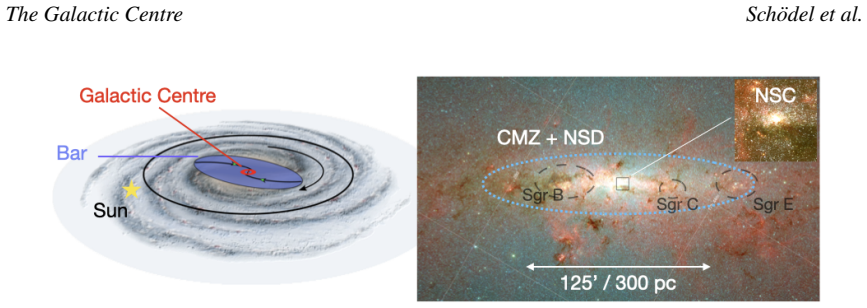
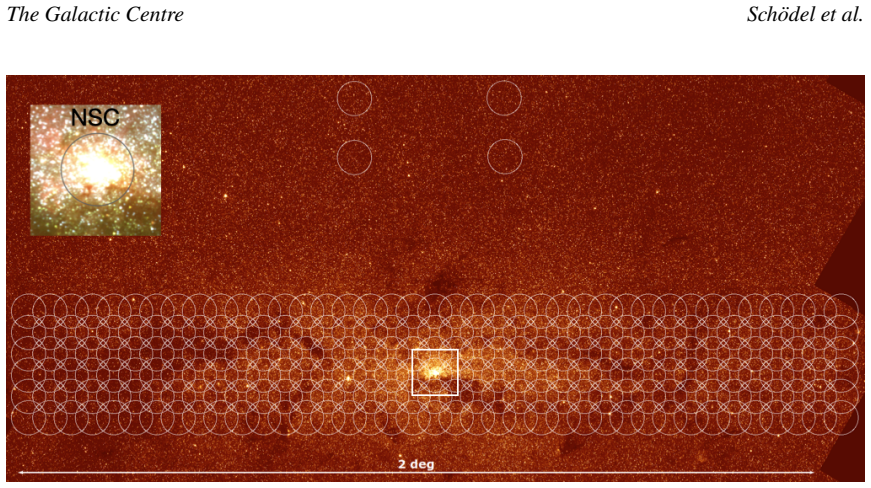
The Galactic Centre is the nearest nucleus of a galaxy and the most extreme environment that we can observe down to physical scales of a few hundred astronomical units. There is no other region in the Milky Way that can match its unique characteristics, such as its stellar density, turbulence and temperature of the interstellar medium, strong large scale magnetic field, concentration of stellar remnants, or mean star formation rate. The Galactic Centre is a unique target to understand the physics of galactic nuclei and study a large number of rare objects, such as extremely massive stars and stellar remnants, at a well-defined distance. The Galactic Centre has been and is being studied intensively with the most advanced facilities. In this chapter, we advocate for a large-area, multi-wavelength continuum survey with the Square Kilometre Array of an area of about 2.0deg x 0.4deg (~290pc x 60pc), centred on the massive black hole Sagittarius A* and for repeated deep observations of the nuclear star cluster over a decade, which will allow the community to address multiple science problems with single dataset.
Editorial analysis
A structured set of objections, weighed in public.
Referee Report
Summary. The manuscript presents a science case advocating a large-area (approximately 2.0° × 0.4°, or ~290 pc × 60 pc), multi-wavelength continuum survey with SKA-Mid centered on Sagittarius A* in the Galactic Centre, together with repeated deep observations of the nuclear star cluster spanning a decade. It argues that this single dataset would enable the community to address multiple science problems, including the physics of galactic nuclei, the study of rare objects such as extremely massive stars and stellar remnants, and properties of the interstellar medium in this extreme environment.
Significance. If the proposed survey parameters prove feasible, the resulting high-resolution, multi-epoch radio data on the nearest galactic nucleus would provide a valuable resource for studying stellar populations, magnetic fields, and black-hole environments at scales of a few hundred AU, with potential to inform models of galactic nuclei across the Universe.
major comments (1)
- [Abstract] Abstract: the central claim that the proposed survey 'will allow the community to address multiple science problems with single dataset' lacks any supporting quantitative sensitivity calculations, simulations, or error analysis showing that the stated area, depth, cadence, and multi-wavelength coverage are sufficient to deliver the listed science goals without additional targeted observations.
Simulated Author's Rebuttal
We thank the referee for their constructive feedback on our science case for an SKA-Mid survey of the Galactic Centre. We address the single major comment below.
read point-by-point responses
-
Referee: [Abstract] Abstract: the central claim that the proposed survey 'will allow the community to address multiple science problems with single dataset' lacks any supporting quantitative sensitivity calculations, simulations, or error analysis showing that the stated area, depth, cadence, and multi-wavelength coverage are sufficient to deliver the listed science goals without additional targeted observations.
Authors: We agree that the abstract presents a strong claim without accompanying quantitative support. The manuscript is structured as a high-level science case chapter rather than a detailed technical proposal, with the body providing qualitative justification drawn from existing multi-wavelength data on the Galactic Centre. To address this point directly, we will revise the abstract and add a concise new subsection (or expanded paragraph in the introduction) that includes order-of-magnitude sensitivity estimates using published SKA-Mid performance specifications for the primary goals, such as detection thresholds for stellar remnants, magnetic field mapping via synchrotron emission, and variability monitoring of Sgr A*. Full end-to-end simulations and formal error budgets lie outside the scope of this advocacy paper and would require dedicated follow-up work; we will note this limitation explicitly in the revision. revision: partial
Circularity Check
No significant circularity in this science proposal
full rationale
This manuscript is a science-case proposal advocating SKA-Mid observations of the Galactic Centre. It contains no mathematical derivations, model fits, quantitative predictions, or equations whose outputs could reduce to their inputs. The recommendation rests on established external knowledge of the target region rather than any self-referential logic, self-citation chains, or fitted parameters renamed as predictions. No circular steps are present.
Axiom & Free-Parameter Ledger
Reference graph
Works this paper leans on
-
[1]
doi: 10.1088/0004-637X/697/2/
-
[2]
doi: 10.3847/1538-4357/abadf6. A. Báez-Rubio et al.A&A, 571:L4, Nov
-
[3]
doi: 10.1051/0004-6361/201424389. J. Bally et al.arXiv e-prints, art. arXiv:2412.10983, Dec
-
[4]
doi: 10.48550/arXiv.2412.10983. H. Bartko et al.ApJ, 708:834–840, Jan
-
[5]
doi: 10.1088/0004-637X/708/1/834. H. Baumgardt, P. Amaro-Seoane, and R. Schödel.A&A, 609:A28, Jan
-
[6]
doi: 10.1111/j.1365-2966.2006.10467.x. H. K. Bhat et al.ApJ, 929(2):178, Apr
-
[7]
doi: 10.3847/1538-4357/ac6106. E. Bianchi et al.ApJ, 944(2):208, Feb
-
[8]
doi: 10.3847/1538-4357/acb5e8. L. A. Busch et al.A&A, 668:A183, Dec
-
[9]
doi: 10.1051/0004-6361/202244870. M. Cano-González et al.A&A, 692:A23, Dec
-
[10]
doi: 10.1051/0004-6361/202451771. M. Cano-González et al.A&A, 700:A246, Aug
-
[11]
doi: 10.1051/0004-6361/202554533. J. S. Clark et al.A&A, 649:A43, May
-
[12]
doi: 10.1051/0004-6361/202039205. J. S. Clark et al.MNRAS, 521(3):4473–4489, May
-
[13]
doi: 10.1093/mnras/stad449. S. Corbel et al.MNRAS, 428(3):2500–2515, Jan
-
[14]
doi: 10.1093/mnras/sts215. P. de Vicente, J. Martín-Pintado, R. Neri, and P. Colom.A&A, 361:1058–1072, Sept
-
[15]
doi: 10.48550/arXiv.astro-ph/0009195. J. S. Deneva, J. M. Cordes, and T. J. W. Lazio.ApJ, 702(2):L177–L181, Sept
work page internal anchor Pith review Pith/arXiv arXiv doi:10.48550/arxiv.astro-ph/0009195
-
[16]
doi: 10.1088/0004-637X/702/2/L177. J. Dexter and R. M. O’Leary.ApJ, 783(1):L7, Mar
-
[17]
doi: 10.1088/2041-8205/783/1/L7. H. Dong et al.MNRAS, 417:114–135, Oct
-
[18]
2011, MNRAS, 417, 2571, doi: 10.1111/j.1365-2966.2011.19423.x
doi: 10.1111/j.1365-2966.2011.19013.x. 21 The Galactic Centre Schödel et al. R.Eatoughetal. InAdvancingAstrophysicswiththeSquareKilometreArray(AASKA14),page45, Apr
-
[19]
doi: 10.1086/175498. A. Feldmeier-Krause et al.MNRAS, 466:4040, May
-
[20]
doi: 10.1093/mnras/stw3377. R. P. Fender, T. M. Belloni, and E. Gallo.MNRAS, 355(4):1105–1118, Dec
-
[21]
doi: 10.1111/j. 1365-2966.2004.08384.x. G. Fragione, B. Kocsis, F. A. Rasio, and J. Silk.ApJ, 927(2):231, Mar
work page doi:10.1111/j 2004
-
[22]
M.Freitag,P.Amaro-Seoane,andV.Kalogera.ApJ,649:91–117,Sept.2006
doi: 10.3847/ 1538-4357/ac5026. M.Freitag,P.Amaro-Seoane,andV.Kalogera.ApJ,649:91–117,Sept.2006. doi: 10.1086/506193. A. T. Gallego-Calvente et al.A&A, 647:A110, Mar
-
[23]
doi: 10.1051/0004-6361/202039172. A. T. Gallego-Calvente et al.A&A, 664:A49, Aug
-
[24]
doi: 10.1051/0004-6361/202141895. E. Gallego-Cano et al.A&A, 634:A71, Feb
-
[25]
doi: 10.1051/0004-6361/201935303. E. Gallo et al.MNRAS, 445(1):290–300, Nov
-
[26]
doi: 10.1093/mnras/stu1599. E. Gallo, N. Degenaar, and J. van den Eijnden.MNRAS, 478(1):L132–L136, Jul
-
[27]
doi: 10.1093/mnrasl/sly083. G. Garay and S. Lizano.PASP, 111(763):1049–1087, Sept
-
[28]
doi: 10.1086/316416. A. Generozov, N. C. Stone, B. D. Metzger, and J. P. Ostriker.MNRAS, May
-
[29]
R.Genzel, F.Eisenhauer, andS.Gillessen.ReviewsofModernPhysics, 82:3121–3195, Oct.2010
doi: 10.1093/ mnras/sty1262. R.Genzel, F.Eisenhauer, andS.Gillessen.ReviewsofModernPhysics, 82:3121–3195, Oct.2010. doi: 10.1103/RevModPhys.82.3121. Gravity Collaboration et al.A&A, 636:L5, Apr
-
[30]
doi: 10.1051/0004-6361/202037813. J. E. Greene, J. Strader, and L. C. Ho.ARA&A, 58:257–312, Aug
-
[31]
doi: 10.1051/0004-6361/ 202453324. C. J. Hailey et al.Nature, 556:70–73, Apr
-
[32]
doi: 10.1038/nature25029. N. Harada et al.ApJ, 884(2):100, Oct
-
[33]
doi: 10.3847/1538-4357/ab41ff. H. Hassani et al.MNRAS, 510(1):11–31, Feb
-
[34]
doi: 10.1093/mnras/stab3202. J. D. Henshaw et al. In S. Inutsuka et al., editors,Protostars and Planets VII, volume 534 of Astronomical Society of the Pacific Conference Series, page 83, July
-
[35]
In: Proceedings of the 5th Con- ference on Robot Learning, pp
doi: 10.48550/arXiv. 2203.11223. I. Heywood et al.Nature, 573(7773):235–237, Sept. 2019a. doi: 10.1038/s41586-019-1532-5. I. Heywood et al.Nature, 573(7773):235–237, Sep 2019b. doi: 10.1038/s41586-019-1532-5. I. Heywood et al.arXiv e-prints, art. arXiv:2201.10541, Jan
work page internal anchor Pith review doi:10.48550/arxiv
-
[36]
doi: 10.1016/j. physletb.2011.02.029. J. Hosek, Matthew W. et al.ApJ, 870(1):44, Jan
work page doi:10.1016/j 2011
-
[37]
doi: 10.3847/1538-4357/aaef90. J. Hosek, Matthew W. et al.AJ, 160(3):143, Sept
-
[38]
doi: 10.3847/1538-3881/aba533. S. E. Hosseini et al.ApJ, 975(2):261, Nov
-
[39]
doi: 10.3847/1538-4357/ad7d06. B. Hußmann et al.A&A, 540:A57, Apr
-
[40]
doi: 10.1051/0004-6361/201117637. F. Jankowski et al.MNRAS, 473(4):4436–4458, Feb
-
[41]
doi: 10.1093/mnras/stx2476. I. Jiménez-Serra et al.Astrobiology, 20(9):1048–1066, Sept
-
[42]
doi: 10.1089/ast.2019.2125. I. Jiménez-Serra et al.Frontiers in Astronomy and Space Sciences, 9:843766, Mar. 2022a. doi: 22 The Galactic Centre Schödel et al. 10.3389/fspas.2022.843766. I. Jiménez-Serra et al.A&A, 663:A181, July 2022b. doi: 10.1051/0004-6361/202142699. A. Karska et al. InAdvancing Astrophysics with the SKA – II (AASKAII)
-
[43]
doi: 10.1142/S0218271816300299. M. Kramer et al.New A Rev., 48(11-12):993–1002, Dec
-
[44]
doi: 10.1016/j.newar.2004.09.020. J. M. D. Kruijssen and S. N. Longmore.MNRAS, 435(3):2598–2603, Nov
-
[45]
doi: 10.1093/mnras/stu494. M. Labaj et al.A&A, 702:A233, Oct
-
[46]
doi: 10.1051/0004-6361/202554982. C. C. Lang, K. E. Johnson, W. M. Goss, and L. F. Rodríguez.AJ, 130:2185–2196, Nov
-
[47]
doi: 10.1086/496976. M. A. Latif, D. R. G. Schleicher, W. Schmidt, and J. C. Niemeyer.MNRAS, 436(4):2989–2996, Dec
-
[48]
R.Launhardt,R.Zylka,andP.G.Mezger.A&A,384:112–139,Mar.2002.doi: 10.1051/0004-6361: 20020017
doi: 10.1093/mnras/stt1786. R.Launhardt,R.Zylka,andP.G.Mezger.A&A,384:112–139,Mar.2002.doi: 10.1051/0004-6361: 20020017. C. Leitherer, J. M. Chapman, and B. Koribalski.ApJ, 481(2):898–911, May
-
[49]
doi: 10.1088/0004-637X/747/1/1. A. Loeb and F. A. Rasio.ApJ, 432:52, Sept
-
[50]
doi: 10.1086/174548. S. N. Longmore et al.MNRAS, 429(2):987–1000, Feb
-
[51]
doi: 10.1093/mnras/sts376. M. E. Lower, S. Dai, and S. Johnston.arXiv e-prints, art. arXiv:2404.09098, Apr
-
[52]
doi: 10.48550/arXiv.2404.09098. J. R. Lu et al.ApJ, 764:155, Feb
-
[53]
doi: 10.1088/0004-637X/764/2/155. P. Madau and M. J. Rees.ApJ, 551(1):L27–L30, Apr
-
[54]
doi: 10.1086/319848. S. Mandel et al.ApJ, 985(2):202, June
-
[55]
doi: 10.3847/1538-4357/adc07e. S. Martín et al.A&A, 656:A46, Dec
-
[56]
doi: 10.1051/0004-6361/202141567. J. Martín-Pintado et al.ApJ, 628(1):L61–L64, July
-
[57]
doi: 10.1086/432684. Á. Martínez-Arranz et al.A&A, 683:A3, Mar. 2024a. doi: 10.1051/0004-6361/202347937. A. Martínez-Arranz et al.A&A, 685:L7, May 2024b. doi: 10.1051/0004-6361/202449877. Á. Martínez Arranz, R. Schödel, H. Bouy, and F. Nogueras-Lara.arXiv e-prints, art. arXiv:2510.11966, Oct
-
[58]
doi: 10.3847/1538-4357/acebcd. J. C. Mauerhan et al.ApJ, 710:706–728, Feb
-
[59]
doi: 10.1088/0004-637X/710/1/706. F. Mazoochi et al.ApJ, 997(1):31, Jan
-
[60]
doi: 10.3847/1538-4357/ae1b93. M. C. Miller and D. P. Hamilton.MNRAS, 330(1):232–240, Feb
-
[61]
doi: 10.1046/j.1365-8711. 2002.05112.x. E. A. C. Mills et al.ApJ, 868(1):7, Nov
-
[62]
doi: 10.3847/1538-4357/aae581. K. Mori et al.ApJ, 921(2):148, Nov
-
[63]
doi: 10.3847/1538-4357/ac1da5. M. Morris.ApJ, 408:496–506, May
-
[64]
doi: 10.1086/172607. G. Nandakumar et al.MNRAS, 478:4374–4389, Aug
-
[65]
doi: 10.1093/mnras/sty1255. M. R. Nasirzadeh et al.A&A, 691:A199, Nov
-
[66]
23 The Galactic Centre Schödel et al
doi: 10.1051/0004-6361/202451110. 23 The Galactic Centre Schödel et al. F. Nogueras-Lara et al.A&A, 631:A20, Nov
-
[67]
F.Nogueras-Laraetal.NatureAstronomy,4:377–381,Jan.2020.doi: 10.1038/s41550-019-0967-9
doi: 10.1051/0004-6361/201936263. F.Nogueras-Laraetal.NatureAstronomy,4:377–381,Jan.2020.doi: 10.1038/s41550-019-0967-9. F.Nogueras-Lara,R.Schödel,andN.Neumayer.NatureAstronomy,6:1178–1184,Aug.2022. doi: 10.1038/s41550-022-01755-3. T. Panamarev et al.MNRAS, 484(3):3279–3290, Apr
-
[68]
doi: 10.1093/mnras/stz208. F. Peißker et al.ApJ, 970(1):74, July
-
[69]
doi: 10.3847/1538-4357/ad4098. O. Pfuhl et al.ApJ, 741:108, Nov
-
[70]
doi: 10.1088/0004-637X/741/2/108. G. Ponti et al.Nature, 567(7748):347–350, Mar
-
[71]
doi: 10.1038/s41586-019-1009-6. G. Ponti et al.A&A, 646:A66, Feb
-
[72]
doi: 10.1051/0004-6361/202039636. S. F. Portegies Zwart and S. L. W. McMillan.ApJ, 576(2):899–907, Sept
-
[73]
doi: 10.3847/0004-637X/818/2/
-
[74]
doi: 10.1051/0004-6361/202037800. M. J. Reid et al.ApJ, 783:130, Mar
-
[75]
doi: 10.1088/0004-637X/783/2/130. M. A. Requena-Torres, J. Martín-Pintado, S. Martín, and M. R. Morris.ApJ, 672(1):352–360, Jan
-
[76]
doi: 10.1086/523627. R. M. Rich et al.AJ, 154:239, Dec
-
[77]
doi: 10.3847/1538-3881/aa970a. V. M. Rivilla et al.MNRAS, 506(1):L79–L84, Sept
-
[78]
doi: 10.1093/mnrasl/slab074. V. M. Rivilla et al.ApJ, 929(1):L11, Apr
-
[79]
doi: 10.3847/2041-8213/ac6186. V. M. Rivilla et al.ApJ, 953(2):L20, Aug
-
[80]
doi: 10.3847/2041-8213/ace977. L. F. Rodríguez-Almeida et al.ApJ, 912(1):L11, May 2021a. doi: 10.3847/2041-8213/abf7cb. L. F. Rodríguez-Almeida et al.A&A, 654:L1, Oct. 2021b. doi: 10.1051/0004-6361/202141989. S. C. Rose, S. Naoz, R. Sari, and I. Linial.ApJ, 929(2):L22, Apr
discussion (0)
Sign in with ORCID, Apple, or X to comment. Anyone can read and Pith papers without signing in.