Nonlocal Quantum Phase Transitions
Pith reviewed 2026-06-25 23:32 UTC · model grok-4.3
The pith
Entanglement shared between environmental modes induces a nonlocal quantum phase transition in remote systems.
A machine-rendered reading of the paper's core claim, the machinery that carries it, and where it could break.
Core claim
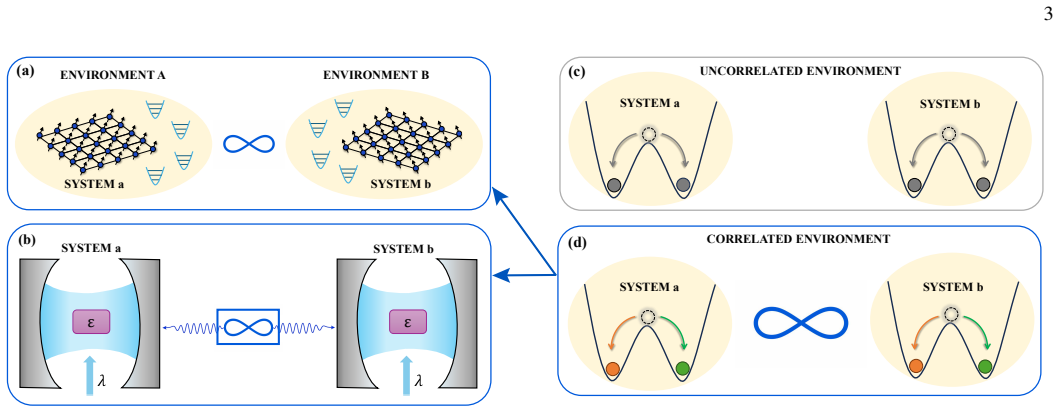
We introduce nonlocal quantum fluctuations as a new fundamental mechanism to drive phase transitions. We show that entanglement shared between environmental modes can induce a correlated symmetry breaking in remote systems, independent of their spatial separation. Using the framework of driven-dissipative phase transitions, we theoretically investigate a system composed of two nonlinear quantum resonators placed at arbitrarily large spatial separations, each coupled to independent local Markovian baths. We consider the regime in which remote environmental modes are prepared in broadband entangled states. We show that near the critical point, where the susceptibility to weak perturbations div
What carries the argument
Driven-dissipative phase transitions of two nonlinear quantum resonators coupled to local Markovian baths but sharing broadband entangled environmental modes.
If this is right
- The divergence of susceptibility at the critical point is controlled by environmental quantum correlations rather than local fluctuations.
- A collective mode shared by the remote systems undergoes spontaneous symmetry breaking.
- The phase transition occurs without any direct coupling between the separated systems.
- Local observations register only effective thermal fluctuations while the global behavior is governed by the nonlocal correlations.
Where Pith is reading between the lines
- This mechanism suggests a route to synchronize quantum phases across distributed systems by engineering bath entanglement.
- The same environmental-correlation approach could be tested in other open quantum platforms such as atomic ensembles or circuit QED arrays.
- Extensions to more than two systems would show whether multi-partite environmental entanglement produces higher-order collective symmetry breaking.
Load-bearing premise
Remote environmental modes can be prepared in broadband entangled states that remain effective at arbitrarily large separations, with the local Markovian baths plus this shared entanglement sufficient to produce the collective symmetry breaking.
What would settle it
Prepare two distant nonlinear resonators with entangled environmental modes and measure whether a collective mode shows spontaneous symmetry breaking at the predicted critical point, versus the absence of such breaking when the environmental modes are not entangled.
Figures
read the original abstract
Phase transitions are paradigmatic examples of emergent phenomena, in which symmetries present at the microscopic level can be spontaneously broken in the thermodynamic limit. Two primary physical mechanisms can drive this symmetry breaking: thermal fluctuations in classical phase transitions and quantum fluctuations in quantum critical phenomena. Here, we introduce $nonlocal$ $quantum$ $fluctuations$ as a new fundamental mechanism to drive phase transitions. We show that entanglement shared between environmental modes can induce a correlated symmetry breaking in remote systems, independent of their spatial separation. Using the framework of driven-dissipative phase transitions, we theoretically investigate a system composed of two nonlinear quantum resonators placed at arbitrarily large spatial separations, each coupled to independent local Markovian baths. We consider the regime in which remote environmental modes are prepared in broadband entangled states. We show that near the critical point, where the susceptibility to weak perturbations diverges, quantum correlations in the environments govern the system critical behavior. While these correlations manifest locally only as effective thermal fluctuations, at the global level they give rise to an emergent nonlocal phase transition, marked by the spontaneous symmetry breaking of a collective mode shared by the two remote systems.
Editorial analysis
A structured set of objections, weighed in public.
Referee Report
Summary. The manuscript introduces nonlocal quantum fluctuations arising from entanglement shared between environmental modes as a new mechanism for driving phase transitions. It considers two nonlinear quantum resonators at arbitrarily large spatial separations, each coupled to independent local Markovian baths, with remote bath modes prepared in broadband entangled states. Near the critical point, these environmental correlations are claimed to govern critical behavior, manifesting locally as effective thermal fluctuations but producing an emergent nonlocal phase transition via spontaneous symmetry breaking of a collective mode shared by the two remote systems.
Significance. If the central claim is substantiated by explicit derivations, the work would identify a distinct route to symmetry breaking in driven-dissipative systems that relies on initial bath entanglement rather than direct system-system coupling or local fluctuations alone. This extends the standard framework by showing how quantum correlations in the environment can induce global collective behavior at arbitrary separations, potentially relevant to open quantum many-body physics.
major comments (1)
- [Abstract] Abstract: the central claim that remote environmental modes prepared in broadband entangled states produce a nonzero effective cross-correlation leading to collective symmetry breaking relies on this entanglement surviving the large-separation Markovian limit without violating the local-bath assumption. No explicit bath correlation functions or derived master equation are supplied to confirm the mechanism.
Simulated Author's Rebuttal
We thank the referee for their thoughtful review and for identifying a point that requires clarification regarding the explicit support for our central mechanism. We respond to the major comment below.
read point-by-point responses
-
Referee: [Abstract] Abstract: the central claim that remote environmental modes prepared in broadband entangled states produce a nonzero effective cross-correlation leading to collective symmetry breaking relies on this entanglement surviving the large-separation Markovian limit without violating the local-bath assumption. No explicit bath correlation functions or derived master equation are supplied to confirm the mechanism.
Authors: We agree that the abstract is concise and does not itself contain the derivations. The full manuscript derives the bath correlation functions from the initial broadband entangled state of the remote modes and obtains the corresponding master equation in Section II (including the explicit two-time bath correlators that yield nonzero cross-dissipation terms). These correlators remain finite in the Markovian limit because the entanglement is prepared with a short correlation time consistent with the broadband assumption; the local-bath condition is preserved since each resonator couples only to its own set of modes, with the entanglement acting solely as an initial condition on the traced-out environment. The resulting effective dynamics therefore contains the claimed nonlocal terms without direct system-system coupling. To address the concern directly, we will revise the abstract to reference these derivations and include the explicit forms of the relevant bath correlation functions in the main text. revision: yes
Circularity Check
No circularity: derivation follows from standard driven-dissipative setup plus explicit bath-entanglement input
full rationale
The abstract and described framework present the nonlocal phase transition as a consequence of preparing remote environmental modes in broadband entangled states within independent local Markovian baths. This preparation is an external modeling assumption, not derived from the result itself. No equations or steps are shown that define the collective symmetry breaking in terms of the output or that rename a fitted parameter as a prediction. The driven-dissipative framework is invoked as standard, with no load-bearing self-citation or uniqueness theorem reducing the claim to prior author work. The central claim therefore remains independent of its own outputs.
Axiom & Free-Parameter Ledger
axioms (1)
- domain assumption Driven-dissipative phase transitions in nonlinear resonators coupled to independent Markovian baths can be analyzed near a critical point where susceptibility diverges.
invented entities (1)
-
nonlocal quantum fluctuations
no independent evidence
Reference graph
Works this paper leans on
-
[1]
Albash and D
T. Albash and D. A. Lidar, Adiabatic quantum computation, Rev. Mod. Phys.90, 015002 (2018)
2018
-
[2]
Montenegro, C
V. Montenegro, C. Mukhopadhyay, R. Yousefjani, S. Sarkar, U. Mishra, M. G. Paris, and A. Bayat, Review: Quantum metrology and sensing with many-body systems, Physics Reports1134, 1 (2025)
2025
-
[3]
Mihailescu, U
G. Mihailescu, U. Alushi, R. Di Candia, S. Felicetti, and K. Gietka, Critical quantum sensing: A tutorial on parameter estimation near quantum phase transitions, PRX Quantum7, 020201 (2026)
2026
-
[4]
Huang,Statistical Mechanics, 2nd ed
K. Huang,Statistical Mechanics, 2nd ed. (John Wiley & Sons, New York, 1987)
1987
-
[5]
Sachdev,Quantum Phase Transitions, 2nd ed
S. Sachdev,Quantum Phase Transitions, 2nd ed. (Cambridge University Press, Cambridge, 2011)
2011
-
[6]
M. F. Maghrebi and A. V. Gorshkov, Nonequilibrium many-body steady states via keldysh formalism, Phys. Rev. B93, 014307 (2016)
2016
-
[7]
Minganti, A
F. Minganti, A. Biella, N. Bartolo, and C. Ciuti, Spectral theory of liouvillians for dissipative phase transitions, Phys. Rev. A98, 042118 (2018)
2018
-
[8]
Baumann, C
K. Baumann, C. Guerlin, F. Brennecke, and T. Esslinger, Dicke quantum phase transition with a superfluid gas in an optical cavity, Nature464, 1301 (2010)
2010
-
[9]
D. Nagy, G. K ´onya, G. Szirmai, and P. Domokos, Dicke-Model Phase Transition in the Quantum Motion of a Bose-Einstein Condensate in an Optical Cavity, Physical Review Letters104, 130401 (2010)
2010
-
[10]
Klinder, H
J. Klinder, H. Keßler, M. Wolke, L. Mathey, and A. Hemmerich, Dynamical phase transition in the open Dicke model, Proceedings of the National Academy of Sciences112, 3290 (2015)
2015
-
[11]
Ferri, R
F. Ferri, R. Rosa-Medina, F. Finger, N. Dogra, M. Soriente, O. Zilberberg, T. Donner, and T. Esslinger, Emerging dissipative phases in a superradiant quantum gas with tunable decay, Phys. Rev. X11, 041046 (2021)
2021
-
[12]
Cai, Z.-D
M.-L. Cai, Z.-D. Liu, W.-D. Zhao, Y.-K. Wu, Q.-X. Mei, Y. Jiang, L. He, X. Zhang, Z.-C. Zhou, and L.-M. Duan, Observation of a quantum phase transition in the quantum Rabi model with a single trapped ion, Nat. Commun.12, 1126 (2021)
2021
-
[13]
Helson, T
V. Helson, T. Zwettler, F. Mivehvar, E. Colella, K. Roux, H. Konishi, H. Ritsch, and J.-P. Brantut, Density-wave ordering in a unitary Fermi gas with photon-mediated interactions, Nature618, 716 (2023)
2023
-
[14]
E. Y. Song, D. Barberena, D. J. Young, E. Chaparro, A. Chu, S. Agarwal, Z. Niu, J. T. Young, A. M. Rey, and J. K. Thompson, A dissipation-induced superradiant transition in a strontium cavity-QED system, Science Advances11, eadu5799 (2025)
2025
-
[15]
S. R. K. Rodriguez, W. Casteels, F. Storme, N. Carlon Zambon, I. Sagnes, L. Le Gratiet, E. Galopin, A. Lema ˆıtre, A. Amo, C. Ciuti, and J. Bloch, Probing a dissipative phase transition via dynamical optical hysteresis, Phys. Rev. Lett.118, 247402 (2017)
2017
-
[16]
Fitzpatrick, N
M. Fitzpatrick, N. M. Sundaresan, A. C. Y. Li, J. Koch, and A. A. Houck, Observation of a dissipative phase transition in a one-dimensional circuit qed lattice, Phys. Rev. X7, 011016 (2017)
2017
-
[17]
J. M. Fink, A. Dombi, A. Vukics, A. Wallraff, and P. Domokos, Observation of the photon-blockade breakdown phase transition, Phys. Rev. X 7, 011012 (2017)
2017
-
[18]
T. Fink, A. Schade, S. H¨ofling, C. Schneider, and A. Imamoˇglu, Signatures of a dissipative phase transition in photon correlation measurements, Nat. Phys.14, 365 (2018)
2018
-
[19]
Brookes, G
P. Brookes, G. Tancredi, A. D. Patterson, J. Rahamim, M. Esposito, T. K. Mavrogordatos, P. J. Leek, E. Ginossar, and M. H. Szymanska, Critical slowing down in circuit quantum electrodynamics, Sci. Adv.7, eabe9492 (2021)
2021
-
[20]
Z. Li, F. Claude, T. Boulier, E. Giacobino, Q. Glorieux, A. Bramati, and C. Ciuti, Dissipative phase transition with driving-controlled spatial dimension and diffusive boundary conditions, Phys. Rev. Lett.128, 093601 (2022)
2022
-
[21]
R. Sett, F. Hassani, D. Phan, S. Barzanjeh, A. Vukics, and J. M. Fink, Emergent macroscopic bistability induced by a single superconducting qubit (2022), arXiv:2210.14182 [quant-ph]
arXiv 2022
-
[22]
Q.-M. Chen, M. Fischer, Y. Nojiri, M. Renger, E. Xie, M. Partanen, S. Pogorzalek, K. G. Fedorov, A. Marx, F. Deppe,et al., Quantum behavior of the duffing oscillator at the dissipative phase transition, Nat. Commun.14, 2896 (2023)
2023
-
[23]
Beaulieu, F
G. Beaulieu, F. Minganti, S. Frasca, V. Savona, S. Felicetti, R. Di Candia, and P. Scarlino, Observation of first- and second-order dissipative phase transitions in a two-photon driven Kerr resonator, Nature Communications16, 1954 (2025)
1954
-
[24]
Ding, Z.-K
D.-S. Ding, Z.-K. Liu, B.-S. Shi, G.-C. Guo, K. Mølmer, and C. S. Adams, Enhanced metrology at the critical point of a many-body Rydberg atomic system, Nat. Phys.18, 1447 (2022)
2022
-
[25]
K. Petrovnin, J. Wang, M. Perelshtein, P. Hakonen, and G. S. Paraoanu, Microwave photon detection at parametric criticality, arXiv:2308.07084 (2023)
arXiv 2023
-
[26]
Beaulieu, F
G. Beaulieu, F. Minganti, S. Frasca, M. Scigliuzzo, S. Felicetti, R. Di Candia, and P. Scarlino, Criticality-Enhanced Quantum Sensing with a Parametric Superconducting Resonator, PRX Quantum6, 020301 (2025)
2025
-
[27]
Hwang, R
M.-J. Hwang, R. Puebla, and M. B. Plenio, Quantum phase transition and universal dynamics in the Rabi model, Phys. Rev. Lett.115, 180404 (2015)
2015
-
[28]
Felicetti and A
S. Felicetti and A. Le Boit ´e, Universal spectral features of ultrastrongly coupled systems, Phys. Rev. Lett.124, 040404 (2020)
2020
-
[29]
Grimm, N
A. Grimm, N. E. Frattini, S. Puri, S. O. Mundhada, S. Touzard, M. Mirrahimi, S. M. Girvin, S. Shankar, and M. H. Devoret, Stabilization and operation of a Kerr-cat qubit, Nature584, 205 (2020)
2020
-
[30]
Van Leent, M
T. Van Leent, M. Bock, F. Fertig, R. Garthoff, S. Eppelt, Y. Zhou, P. Malik, M. Seubert, T. Bauer, W. Rosenfeld, W. Zhang, C. Becher, and H. Weinfurter, Entangling single atoms over 33 km telecom fibre, Nature607, 69 (2022)
2022
-
[31]
Krutyanskiy, M
V. Krutyanskiy, M. Galli, V. Krcmarsky, S. Baier, D. Fioretto, Y. Pu, A. Mazloom, P. Sekatski, M. Canteri, M. Teller, J. Schupp, J. Bate, M. Meraner, N. Sangouard, B. Lanyon, and T. Northup, Entanglement of Trapped-Ion Qubits Separated by 230 Meters, Physical Review Letters 130, 050803 (2023)
2023
-
[32]
C. M. Knaut, A. Suleymanzade, Y.-C. Wei, D. R. Assumpcao, P.-J. Stas, Y. Q. Huan, B. Machielse, E. N. Knall, M. Sutula, G. Baranes, N. Sinclair, C. De-Eknamkul, D. S. Levonian, M. K. Bhaskar, H. Park, M. Lonˇcar, and M. D. Lukin, Entanglement of nanophotonic quantum memory nodes in a telecom network, Nature629, 573 (2024)
2024
-
[33]
Ruskuc, C.-J
A. Ruskuc, C.-J. Wu, E. Green, S. L. N. Hermans, W. Pajak, J. Choi, and A. Faraon, Multiplexed entanglement of multi-emitter quantum network nodes, Nature639, 54 (2025). 22
2025
-
[34]
Magnard, S
P. Magnard, S. Storz, P. Kurpiers, J. Sch¨ar, F. Marxer, J. L¨ utolf, T. Walter, J.-C. Besse, M. Gabureac, K. Reuer, A. Akin, B. Royer, A. Blais, and A. Wallraff, Microwave Quantum Link between Superconducting Circuits Housed in Spatially Separated Cryogenic Systems, Physical Review Letters125, 260502 (2020)
2020
-
[35]
K. G. Fedorov, M. Renger, S. Pogorzalek, R. Di Candia, Q. Chen, Y. Nojiri, K. Inomata, Y. Nakamura, M. Partanen, A. Marx, R. Gross, and F. Deppe, Experimental quantum teleportation of propagating microwaves, Science Advances7, eabk0891 (2021)
2021
-
[36]
Casariego, E
M. Casariego, E. Zambrini Cruzeiro, S. Gherardini, T. Gonzalez-Raya, R. Andr ´e, G. Fraz ˜ao, G. Catto, M. M ¨ott¨onen, D. Datta, K. Viisanen, J. Govenius, M. Prunnila, K. Tuominen, M. Reichert, M. Renger, K. G. Fedorov, F. Deppe, H. Van Der Vliet, A. J. Matthews, Y. Fern ´andez, R. Assouly, R. Dassonneville, B. Huard, M. Sanz, and Y. Omar, Propagating qu...
2023
-
[37]
Storz, J
S. Storz, J. Sch ¨ar, A. Kulikov, P. Magnard, P. Kurpiers, J. L¨ utolf, T. Walter, A. Copetudo, K. Reuer, A. Akin, J.-C. Besse, M. Gabureac, G. J. Norris, A. Rosario, F. Martin, J. Martinez, W. Amaya, M. W. Mitchell, C. Abellan, J.-D. Bancal, N. Sangouard, B. Royer, A. Blais, and A. Wallraff, Loophole-free Bell inequality violation with superconducting ci...
2023
-
[38]
W. K. Yam, M. Renger, S. Gandorfer, F. Fesquet, M. Handschuh, K. E. Honasoge, F. Kronowetter, Y. Nojiri, M. Partanen, M. Pfeiffer, H. Van Der Vliet, A. J. Matthews, J. Govenius, R. N. Jabdaraghi, M. Prunnila, A. Marx, F. Deppe, R. Gross, and K. G. Fedorov, Cryogenic microwave link for quantum local area networks, npj Quantum Information11, 87 (2025)
2025
-
[39]
A. Andr ´es-Juanes, J. Agust´ı, R. Sett, E. S. Redchenko, L. Kapoor, S. Hawaldar, P. Rabl, and J. M. Fink, Entangling remote qubits through a two-mode squeezed reservoir (2025), arXiv:2510.07139 [quant-ph]
arXiv 2025
-
[40]
Garbe, O
L. Garbe, O. Abah, S. Felicetti, and R. Puebla, Critical quantum metrology with fully-connected models: from Heisenberg to Kibble–Zurek scaling, Quantum Sci. Technol.7, 035010 (2022)
2022
-
[41]
Breuer and F
H. Breuer and F. Petruccione,The Theory of Open Quantum Systems(Oxford University Press, Oxford, 2007)
2007
-
[42]
Serafini,Quantum Continuous Variables: A Primer of Theoretical Methods(Taylor & Francis Group, 2017)
A. Serafini,Quantum Continuous Variables: A Primer of Theoretical Methods(Taylor & Francis Group, 2017)
2017
-
[43]
Carusotto and C
I. Carusotto and C. Ciuti, Quantum fluids of light, Rev. Mod. Phys.85, 299
-
[44]
Di Candia, F
R. Di Candia, F. Minganti, K. Petrovnin, G. Paraoanu, and S. Felicetti, Critical parametric quantum sensing, npj Quantum Inf.9, 23 (2023)
2023
-
[45]
Hutt and H
A. Hutt and H. Haken, eds.,Synergetics(Springer US, New York, NY, 2020)
2020
-
[46]
Dykman,Fluctuating nonlinear oscillators: from nanomechanics to quantum superconducting circuits(Oxford University Press, 2012)
M. Dykman,Fluctuating nonlinear oscillators: from nanomechanics to quantum superconducting circuits(Oxford University Press, 2012)
2012
-
[47]
Dusuel and J
S. Dusuel and J. Vidal, Continuous unitary transformations and finite-size scaling exponents in the lipkin-meshkov-glick model, Phys. Rev. B 71, 224420 (2005)
2005
-
[48]
Cohen-Tannoudji, J
C. Cohen-Tannoudji, J. Dupont-Roc, and G. Grynberg,Atom-photon interactions: basic processes and applications(John Wiley & Sons, 2024)
2024
-
[49]
H. J. Carmichael,Statistical Methods in Quantum Optics 1: Master Equations and Fokker-Planck Equations(Springer, Berlin, 1999)
1999
-
[50]
Binder, Finite size scaling analysis of ising model block distribution functions, Zeitschrift f¨ ur Physik B Condensed Matter43, 119–140 (1981)
K. Binder, Finite size scaling analysis of ising model block distribution functions, Zeitschrift f¨ ur Physik B Condensed Matter43, 119–140 (1981)
1981
-
[51]
Del Rio, A
L. Del Rio, A. Hutter, R. Renner, and S. Wehner, Relative thermalization, Physical Review E94, 022104 (2016)
2016
-
[52]
M. N. Bera, A. Riera, M. Lewenstein, and A. Winter, Generalized laws of thermodynamics in the presence of correlations, Nature Communi- cations8, 2180 (2017)
2017
-
[53]
F. C. Alcaraz, M. N. Barber, M. T. Batchelor, R. J. Baxter, and G. R. W. Quispel, Surface exponents of the quantum XXZ, Ashkin-Teller and Potts models, Journal of Physics A: Mathematical and General20, 6397 (1987)
1987
-
[54]
Scigliuzzo, L
M. Scigliuzzo, L. Peyruchat, R. M. Marabini, C. Becker, V. Jouanny, P. Delsing, and P. Scarlino, Quantum Acoustics with Tunable Nonlinearity in the Superstrong Coupling Regime, PRX Quantum7, 010359 (2026)
2026
-
[55]
F. J. Garcia-Vidal, C. Ciuti, and T. W. Ebbesen, Manipulating matter by strong coupling to vacuum fields, Science373, eabd0336 (2021)
2021
-
[56]
P.-J. Stas, Y.-C. Wei, M. Sirotin, Y. Q. Huan, U. Yazlar, F. Abdo Arias, E. Knyazev, G. Baranes, B. Machielse, S. Grandi, D. Riedel, J. Borregaard, H. Park, M. Lon ˇcar, A. Suleymanzade, and M. D. Lukin, Entanglement-assisted non-local optical interferometry in a quantum network, Nature 10.1038/s41586-026-10171-w (2026)
-
[57]
Alushi, A
U. Alushi, A. Coppo, V. Brosco, R. Di Candia, and S. Felicetti, Collective quantum enhancement in critical quantum sensing, Communications Physics8, 74 (2025)
2025
-
[58]
J. Kn ¨orzer, X. Liu, B. F. Schiffer, and J. Tura, Distributed quantum information processing: A review of recent progress (2025), arXiv:2510.15630 [quant-ph]
arXiv 2025
-
[59]
J. Wagner, J. Maki, O. Zilberberg, and K. Seibold, Generalized master equation for driven quantum oscillators: microscopic origin of nonlinear dissipation and asymmetric resonances (2026), arXiv:2605.08021 [quant-ph]
Pith/arXiv arXiv 2026
-
[60]
L. A. Correa and J. Glatthard, Potential renormalisation, Lamb shift and mean-force Gibbs state – to shift or not to shift?, Quantum9, 1868 (2025)
2025
discussion (0)
Sign in with ORCID, Apple, or X to comment. Anyone can read and Pith papers without signing in.