Accelerating Chemical Potential Calculations with Minimal Normalizing Flows
Pith reviewed 2026-06-25 21:18 UTC · model grok-4.3
The pith
Minimal normalizing flows with low-dimensional radial mappings accelerate chemical potential calculations by at least 10 times.
A machine-rendered reading of the paper's core claim, the machinery that carries it, and where it could break.
Core claim
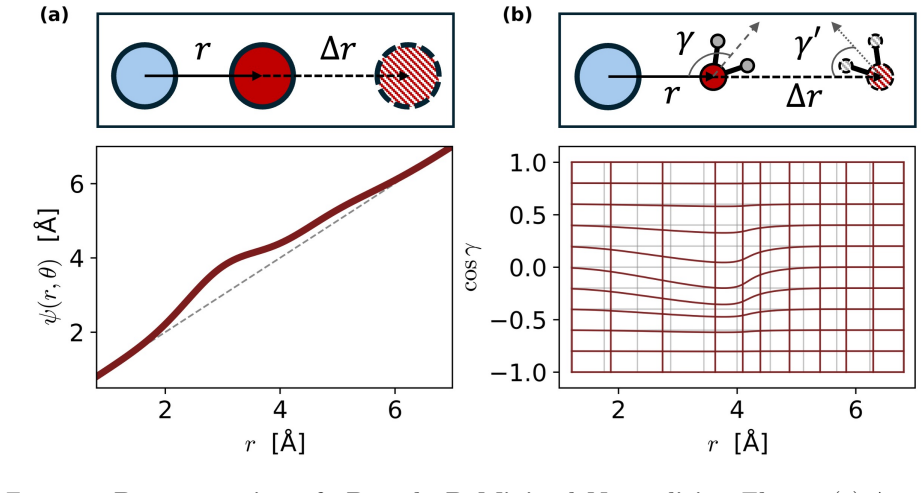
A minimal normalizing flow applies a trainable but deliberately low-expressivity bijective mapping, built from radial (and optionally orientational) transformations, to improve overlap between the ensembles with and without an inserted particle or charge, thereby reducing the variance of free-energy estimates obtained from molecular simulations.
What carries the argument
A minimal normalizing flow (MNF): a trainable bijective mapping restricted to low-dimensional, physically informed transformations such as radial scaling that maps configurations between two Boltzmann distributions.
If this is right
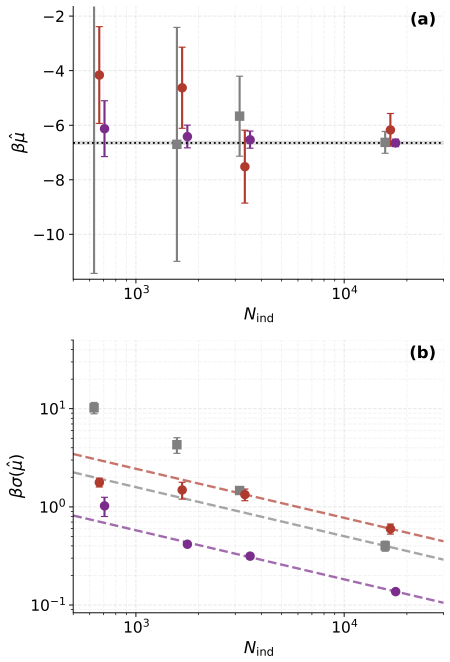
- Chemical potential calculations for Lennard-Jones fluids achieve at least a 10-fold reduction in computational cost.
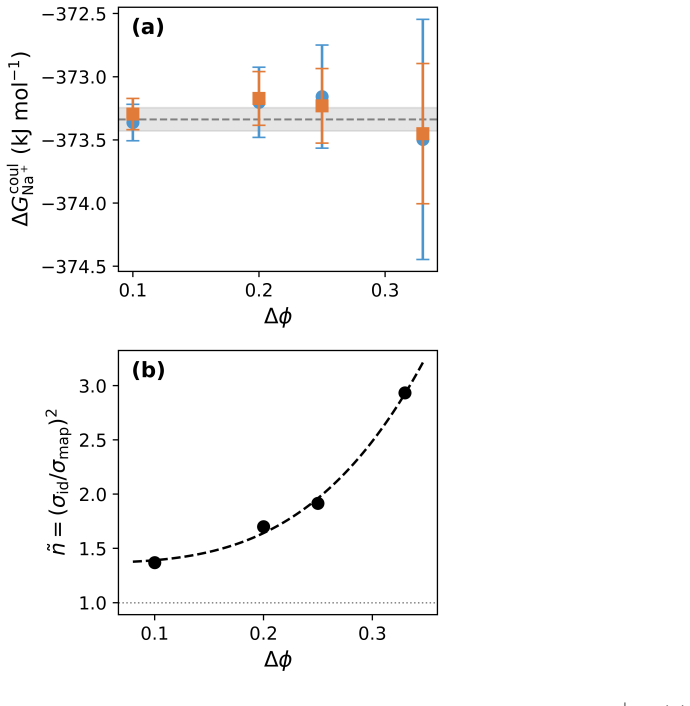
- Charging free-energy calculations for ions in water gain a 3-fold increase in effective sample size.
- Free-energy differences arising from force-field perturbations gain an 8-fold increase in effective sample size.
- Training completes in approximately one minute of GPU time, enabling on-the-fly use for new systems.
- The same low-dimensional strategy supplies a practical route to physically informed mappings for other free-energy problems.
Where Pith is reading between the lines
- The same radial-mapping idea could be tested on other alchemical transformations such as mutating one atom type into another.
- Combining MNFs with existing enhanced-sampling methods might compound the efficiency gains for larger biomolecules.
- If the radial transformation proves sufficient for many liquids, it suggests that domain knowledge can substitute for network depth in distribution-mapping tasks.
- The method's low training cost opens the possibility of adapting the mapping continuously during a long simulation rather than training once upfront.
Load-bearing premise
Low-dimensional radial and orientational transformations are expressive enough to produce useful mappings between the relevant inserted and non-inserted Boltzmann distributions without overfitting or convergence failure.
What would settle it
Repeated tests on Lennard-Jones systems showing acceleration factors below 2x or training times exceeding a few minutes on standard GPU hardware would falsify the central performance claim.
Figures

read the original abstract
Chemical potentials are among the most important properties that can be obtained from a molecular simulation since they define many technologically relevant collective properties. The chemical potential of a species in solution is obtained by computing the free energy change of adding that species into a bulk system, a calculation typically very expensive for systems such as electrolytes, due to the lack of phase space overlap between "not-inserted" and "inserted" states. Recently, normalizing flows have been introduced as a way to accelerate free energy computations by learning a bijective function, constructed to be as expressive as possible, that maps the configuration space of one Boltzmann distribution onto another. This expressivity makes them difficult to train, limiting their ability to be generated "on-the-fly" for any new system, and in practice these mappings have shown only modest sampling improvements for liquids. We address these issues by introducing a "minimal" normalizing flow (MNF). This is a trainable bijective mapping that is intentionally limited in expressivity, and instead applies low-dimensional, physically informed transformations. Useful MNFs can be trained in 1 minute of GPU time due to their simplicity and our introduction of a novel training strategy. We show how calculations of chemical potentials of Lennard-Jones particle systems can be accelerated by at least 10 times with a simple radial mapping. We also apply a radial and orientational mapping to ion solvation in water, showing that MNFs can increase the effective sample size by 3 times for charging free energy calculations and 8 times for calculating free energy changes due to force field perturbations. This provides the foundation for the development of physically-informed mappings that can accelerate complex free energy calculations while retaining low training costs.
Editorial analysis
A structured set of objections, weighed in public.
Referee Report
Summary. The manuscript introduces Minimal Normalizing Flows (MNFs) as intentionally low-expressivity bijective mappings that apply low-dimensional physically informed transformations (radial scaling for Lennard-Jones particle insertions; radial plus orientational for ion solvation in water). It claims these mappings, trained via a novel strategy in ~1 min of GPU time, accelerate chemical-potential calculations by at least 10× for LJ systems and increase effective sample size by 3× (charging free energies) and 8× (force-field perturbations) for aqueous ions, while avoiding the training difficulties of more expressive normalizing flows.
Significance. If the reported speedups are shown to be unbiased and reproducible with standard error controls, the work would supply a practical, low-cost route to improving phase-space overlap in free-energy calculations for liquids and electrolytes. The emphasis on minimal, physics-informed transformations and rapid training distinguishes it from prior normalizing-flow applications that have shown only modest gains in condensed-phase systems.
major comments (3)
- [Abstract / Results] Abstract and Results: the central performance claims (≥10× acceleration for LJ; 3× and 8× ESS gains for water) are presented without error bars, explicit baseline definitions, or the precise functional form of the radial/orientational mappings, preventing verification that the Jacobian-corrected estimates remain unbiased relative to direct insertion or thermodynamic integration.
- [Methods] Methods: the novel training strategy is asserted to avoid overfitting, yet no diagnostics (train/validation loss curves, ESS saturation versus training-set size, or comparison to an independent reference free-energy calculation) are supplied to confirm that the learned map has converged to the true optimal transport rather than an incomplete approximation.
- [Results (ion solvation)] Water/electrolyte results: the assumption that a single radial scaling plus rigid-body rotation suffices to capture the dominant distribution shift is load-bearing for the 3×/8× claims, but many-body polarization, hydrogen-bond rearrangement, and long-range screening are not obviously spanned by these coordinates; residual mismatch would produce systematic bias in the estimated charging or perturbation free energies.
minor comments (2)
- [Methods] Notation for effective sample size and the precise definition of the MNF Jacobian should be stated explicitly in the main text rather than left to supplementary material.
- [Figures] Figure captions should include the number of independent runs and the precise definition of the baseline (e.g., standard Widom insertion) used for the reported speedups.
Simulated Author's Rebuttal
We thank the referee for their constructive report and the opportunity to respond. We address each major comment below, indicating revisions where the manuscript will be strengthened.
read point-by-point responses
-
Referee: [Abstract / Results] Abstract and Results: the central performance claims (≥10× acceleration for LJ; 3× and 8× ESS gains for water) are presented without error bars, explicit baseline definitions, or the precise functional form of the radial/orientational mappings, preventing verification that the Jacobian-corrected estimates remain unbiased relative to direct insertion or thermodynamic integration.
Authors: We agree that error bars, explicit baseline definitions, and expanded descriptions of the mappings will improve verifiability. The radial and orientational transformations are defined in the Methods, but we will add explicit functional forms and equations. Error bars from independent replicate runs will be added to all performance metrics, and baselines (direct insertion, thermodynamic integration) will be stated clearly. The Jacobian correction is derived to preserve unbiasedness, and we will include a short verification against reference calculations. These changes will be incorporated in the revised manuscript. revision: yes
-
Referee: [Methods] Methods: the novel training strategy is asserted to avoid overfitting, yet no diagnostics (train/validation loss curves, ESS saturation versus training-set size, or comparison to an independent reference free-energy calculation) are supplied to confirm that the learned map has converged to the true optimal transport rather than an incomplete approximation.
Authors: The intentionally low expressivity of MNFs combined with the novel training strategy is designed to promote rapid, stable convergence without overfitting. We acknowledge that explicit diagnostics would strengthen this claim. In revision we will add training and validation loss curves, plots of ESS versus training-set size, and direct comparisons of the resulting free energies to independent reference calculations (thermodynamic integration) to demonstrate convergence to the optimal transport. revision: yes
-
Referee: [Results (ion solvation)] Water/electrolyte results: the assumption that a single radial scaling plus rigid-body rotation suffices to capture the dominant distribution shift is load-bearing for the 3×/8× claims, but many-body polarization, hydrogen-bond rearrangement, and long-range screening are not obviously spanned by these coordinates; residual mismatch would produce systematic bias in the estimated charging or perturbation free energies.
Authors: The chosen low-dimensional transformations are physics-informed approximations that target the dominant radial and orientational shifts; the reported ESS gains indicate they are effective for the quantities studied. We recognize that many-body effects are not explicitly spanned and could introduce residual bias in more demanding regimes. In the revision we will add an explicit limitations paragraph discussing these effects, the conditions under which the approximation remains accurate, and how more expressive mappings could be substituted when needed. The core numerical claims will remain unchanged as they are supported by the observed improvements. revision: partial
Circularity Check
No circularity; empirical speedups are measured outcomes, not tautological reductions
full rationale
The paper introduces MNFs as intentionally restricted, physically motivated low-dimensional maps (radial for LJ; radial+orientational for ions) and reports measured performance gains (10x acceleration, 3x/8x effective sample size increases) from direct simulation comparisons. These quantities are obtained by applying the trained bijections to compute free-energy differences and are not defined by or equivalent to the training loss or fitted parameters themselves. No equations reduce a claimed result to its own inputs by construction, no self-citation chain bears the central claim, and no uniqueness theorem is invoked. The work is an empirical demonstration of a new sampling technique whose validity rests on numerical benchmarks rather than definitional equivalence.
Axiom & Free-Parameter Ledger
invented entities (1)
-
Minimal Normalizing Flow (MNF)
no independent evidence
Reference graph
Works this paper leans on
-
[1]
James Bradbury and Roy Frostig and Peter Hawkins and Matthew James Johnson and Yash Katariya and Chris Leary and Dougal Maclaurin and George Necula and Adam Paszke and Jake Vander
-
[2]
Berendsen, H. J. C. and Grigera, J. R. and Straatsma, T. P. , title =. J. Phys. Chem. , volume =. doi:10.1021/j100308a038 , year =
-
[3]
, TITLE =
Bhattacharyya, A. , TITLE =. Bull. Calcutta Math. Soc. , FJOURNAL =. 1943 , PAGES =
1943
-
[4]
and Smit, B
Frenkel, D. and Smit, B. , title =. 2002 , isbn =
2002
-
[5]
McQuarrie, D. A. , title =. 2000 , isbn =
2000
-
[6]
Chen, W and Ferguson, AL , title =. J. Comput. Chem. , volume =. doi:10.1002/jcc.25520 , year =
-
[7]
Shirts, MR and Bair, E and Hooker, G and Pande, VS , title =. Phys. Rev. Lett. , volume =. doi:10.1103/PhysRevLett.91.140601 , year =
-
[8]
Baron, P. B. and Panagiotopoulos, A. Z. , title =. J. Chem. Phys. , volume =. 2025 , doi =
2025
-
[9]
Crooks, G. E. , title =. Phys. Rev. E , volume =. 2000 , doi =
2000
-
[10]
and Hummer, G
Dellago, C. and Hummer, G. , title =. Entropy , volume =. 2014 , doi =
2014
-
[11]
, title =
Jarzynski, C. , title =. Phys. Rev. Lett. , volume =. 1997 , doi =
1997
-
[12]
and Nalisnick, E
Papamakarios, G. and Nalisnick, E. and Rezende, D. J. and Mohamed, S. and Lakshminarayanan, B. , title =. J. Mach. Learn. Res. , volume =
-
[13]
Pham, T. T. and Shirts, M. R. , title =. J. Chem. Phys. , volume =. 2012 , doi =
2012
-
[14]
and Kuznets-Speck, B
Zhong, A. and Kuznets-Speck, B. and DeWeese, M. R. , title =. Phys. Rev. E , volume =. 2024 , doi =
2024
-
[15]
and Kim, S
Aykol, M. and Kim, S. and Hegde, V. I. and Snydacker, D. and Lu, Z. and Hao, S. Q. and Kirklin, S. and Morgan, D. and Wolverton, C. , title =. Nat. Commun. , volume =. 2016 , doi =
2016
-
[16]
and Bekasov, A
Durkan, C. and Bekasov, A. and Murray, I. and Papamakarios, G. , title =. Advances in Neural Information Processing Systems , editor =. 2019 , volume =
2019
-
[17]
and Serra, E
Ghidini, A. and Serra, E. and Cavalli, A. , title =. Acc. Chem. Res. , volume =. 2025 , doi =
2025
-
[18]
Panagiotopoulos, A. Z. , title =. J. Phys. Condens. Matter , volume =. 2000 , doi =
2000
-
[19]
Sadybekov, A. V. and Katritch, V. , title =. Nature , volume =. 2023 , doi =
2023
-
[20]
and Sanz, E
Vega, C. and Sanz, E. and Abascal, J. L. F. and Noya, E. G. , title =. J. Phys. Condens. Matter , volume =. 2008 , doi =
2008
-
[21]
and Cai, W
Ahmad, R. and Cai, W. , title =. Modell. Simul. Mater. Sci. Eng. , volume =. 2022 , doi =
2022
-
[22]
Klein, L. and Kr. Equivariant Flow Matching , booktitle =. 2023 , volume =
2023
-
[23]
and Papamakarios, G
Wirnsberger, P. and Papamakarios, G. and Ibarz, B. and Racanière, S. and Ballard, A. J. and Pritzel, A. and Blundell, C. , title =. Mach. Learn.: Sci. Technol. , volume =. 2022 , doi =
2022
-
[24]
Boltzmann generators: Sampling equilibrium states of many-body systems with deep learning , journal =
No. Boltzmann generators: Sampling equilibrium states of many-body systems with deep learning , journal =. 2019 , doi =
2019
- [25]
-
[26]
Midgley, L. I. and Stimper, V. and Simm, G. N. C. and Sch. Flow Annealed Importance Sampling Bootstrap , booktitle =. 2023 , eprinttype =. 2208.01893 , url =
arXiv 2023
-
[27]
Felardos, L. and H. Designing losses for data-free training of normalizing flows on. 2301.05475 , eprintclass =
-
[28]
Schebek, M. and No. Scalable. 2509.25486 , eprintclass =
-
[29]
and Liu, Y
Olehnovics, E. and Liu, Y. M. and Mehio, N. and Sheikh, A. Y. and Shirts, M. R. and Salvalaglio, M. , title =. J. Chem. Theory Comput. , volume =. 2024 , doi =
2024
-
[30]
and Liu, Y
Olehnovics, E. and Liu, Y. M. and Mehio, N. and Sheikh, A. Y. and Shirts, M. R. and Salvalaglio, M. , title =. J. Chem. Theory Comput. , volume =. 2025 , doi =
2025
-
[31]
and Shirts, M
Paliwal, H. and Shirts, M. R. , title =. J. Chem. Phys. , volume =. 2013 , doi =
2013
-
[32]
and Shirts, M
Paliwal, H. and Shirts, M. R. , title =. J. Chem. Theory Comput. , volume =. 2025 , doi =
2025
-
[33]
and Carloni, P
Rizzi, A. and Carloni, P. and Parrinello, M. , title =. J. Phys. Chem. Lett. , volume =. 2021 , doi =
2021
-
[34]
and He, J
Schebek, M. and He, J. J. and Hoffmann, E. and Du, Y. Q. and Noé, F. and Rogal, J. , title =. J. Chem. Phys. , volume =. 2026 , doi =
2026
-
[35]
Schieber, N. P. and Shirts, M. R. , title =. J. Chem. Phys. , volume =. 2019 , doi =
2019
-
[36]
Tan, C. B. and Bose, A. J. and Lin, C. and Klein, L. and Bronstein, M. M. and Tong, A. , title =. Proceedings of the 42nd International Conference on Machine Learning , editor =. 2025 , volume =
2025
-
[37]
Tan, T. B. and Schultz, A. J. and Kofke, D. A. , title =. J. Chem. Phys. , volume =. 2010 , doi =
2010
-
[38]
Willow, S. Y. and Kang, L. L. and Minh, D. D. L. , title =. J. Chem. Phys. , volume =. 2023 , doi =
2023
-
[39]
and Falkner, S
Coretti, A. and Falkner, S. and Geissler, P. L. and Dellago, C. , title =. J. Chem. Phys. , volume =. 2025 , doi =
2025
-
[40]
Hahn, A. M. and Then, H. , title =. Phys. Rev. E , volume =. 2009 , doi =
2009
-
[41]
, title =
Jarzynski, C. , title =. Phys. Rev. E , volume =. 2002 , doi =
2002
-
[42]
and Invernizzi, M
Schebek, M. and Invernizzi, M. and Noé, F. and Rogal, J. , title =. Mach. Learn.: Sci. Technol. , volume =. 2024 , doi =
2024
-
[43]
and Ballard, A
Wirnsberger, P. and Ballard, A. J. and Papamakarios, G. and Abercrombie, S. and Racanière, S. and Pritzel, A. and Rezende, D. J. and Blundell, C. , title =. J. Chem. Phys. , volume =. 2020 , doi =
2020
-
[44]
Chase, M. W., Jr. , title =. 1998 , address =
1998
-
[45]
and Dicu-Gohoreanu, C
Baran, L. and Dicu-Gohoreanu, C. A. and MacDowell, L. G. , title =. J. Chem. Phys. , volume =. 2025 , doi =
2025
-
[46]
and Rahman, A
Parrinello, M. and Rahman, A. , title =. J. Appl. Phys. , volume =. 1981 , doi =
1981
-
[47]
Abascal, J. L. F. and Vega, C. , title =. J. Chem. Phys. , volume =. 2005 , doi =
2005
-
[48]
Addula, R. K. R. and Veesam, S. K. and Punnathanam, S. N. , title =. Mol. Simul. , volume =. 2021 , doi =
2021
-
[49]
and Marin-Rimoldi, E
Agbodekhe, B. and Marin-Rimoldi, E. and Zhang, Y. and Dowling, A. W. and Maginn, E. J. , title =. J. Chem. Eng. Data , year =
-
[50]
Aktulga, H. M. and Kaymak, M. C. and Rahnamoun, A. and O'Hearn, K. A. and Merz, K. M. Jr and van Duin, A. C. T. , title =. J. Chem. Theory Comput. , volume =. 2022 , doi =
2022
-
[51]
and Wang, P
Anderko, A. and Wang, P. M. and Rafal, M. , title =. Fluid Phase Equilib. , volume =. 2002 , doi =
2002
-
[52]
Aragones, J. L. and Noya, E. G. and Valeriani, C. and Vega, C. , title =. J. Chem. Phys. , volume =. 2013 , doi =
2013
-
[53]
Aragones, J. L. and Valeriani, C. and Vega, C. , title =. J. Chem. Phys. , volume =. 2012 , doi =
2012
-
[54]
Arora, J. S. and Elwakeil, O. A. and Chahande, A. I. and Hsieh, C. C. , title =. Struct. Optim. , volume =
-
[55]
and Musaelian, A
Batzner, S. and Musaelian, A. and Sun, L. X. and Geiger, M. and Mailoa, J. P. and Kornbluth, M. and Molinari, N. and Smidt, T. E. and Kozinsky, B. , title =. Nat. Commun. , volume =. 2022 , doi =
2022
-
[56]
Befort, B. J. and DeFever, R. S. and Tow, G. M. and Dowling, A. W. and Maginn, E. J. , title =. J. Chem. Inf. Model. , volume =. 2021 , doi =
2021
-
[57]
Benavides, A. L. and Aragones, J. L. and Vega, C. , title =. J. Chem. Phys. , volume =. 2016 , doi =
2016
-
[58]
Benavides, A. L. and Portillo, M. A. and Chamorro, V. C. and Espinosa, J. R. and Abascal, J. L. F. and Vega, C. , title =. J. Chem. Phys. , volume =. 2017 , doi =
2017
-
[59]
Bennett, C. H. , title =. J. Comput. Phys. , volume =. 1976 , doi =
1976
-
[60]
Berkowitz, M. L. , title =. J. Phys. Chem. B , volume =. 2021 , doi =
2021
-
[61]
and Conde, M
Bianco, V. and Conde, M. M. and Lamas, C. P. and Noya, E. G. and Sanz, E. , title =. J. Chem. Phys. , volume =. 2022 , doi =
2022
-
[62]
and Conde, M
Blazquez, S. and Conde, M. M. and Vega, C. , title =. J. Chem. Phys. , volume =. 2023 , doi =
2023
-
[63]
and Kumar, R
Carrillo-Bohórquez, O. and Kumar, R. and Kuroda, D. G. , title =. J. Phys. Chem. C , volume =. 2024 , doi =
2024
-
[64]
and Zhu, X
Caruso, A. and Zhu, X. Y. and Fulton, J. L. and Paesani, F. , title =. J. Phys. Chem. B , volume =. 2022 , doi =
2022
-
[65]
and Noya, E
Cassinello, G. and Noya, E. G. and Sanz, E. and Lamas, C. P. , title =. Mol. Phys. , volume =. 2024 , doi =
2024
-
[66]
and Mandalaparthy, V
Chattopadhyay, A. and Mandalaparthy, V. and van der Vegt, N. F. A. , title =. J. Chem. Phys. , volume =. 2025 , doi =
2025
-
[67]
and Ko, H
Chen, M. and Ko, H. Y. and Remsing, R. C. and Andrade, M. F. C. and Santra, B. and Sun, Z. R. and Selloni, A. and Car, R. and Klein, M. L. and Perdew, J. P. and Wu, X. F. , title =. Proc. Natl. Acad. Sci. U. S. A. , volume =. 2017 , doi =
2017
-
[68]
Chodera, J. D. and Swope, W. C. and Pitera, J. W. and Seok, C. and Dill, K. A. , title =. J. Chem. Theory Comput. , volume =. 2007 , doi =
2007
-
[69]
Cramer, S. D. , title =. Ind. Eng. Chem. Process Des. Dev. , volume =
-
[70]
Crooks, G. E. , title =. Phys. Rev. Lett. , volume =. 2007 , doi =
2007
-
[71]
Davies, C. W. , title =. J. Chem. Soc. , pages =
-
[72]
and Intan, N
Dinpajooh, M. and Intan, N. N. and Duignan, T. T. and Biasin, E. and Fulton, J. L. and Kathmann, S. M. and Schenter, G. K. and Mundy, C. J. , title =. J. Chem. Phys. , volume =. 2024 , doi =
2024
-
[73]
and Lisal, M
Dockal, J. and Lisal, M. and Moucka, F. , title =. J. Chem. Theory Comput. , volume =. 2020 , doi =
2020
-
[74]
and Lisal, M
Dockal, J. and Lisal, M. and Moucka, F. , title =. J. Mol. Liq. , volume =. 2022 , doi =
2022
-
[75]
and Geissler, P
Dodin, A. and Geissler, P. L. , title =. J. Chem. Theory Comput. , volume =. 2023 , doi =
2023
-
[76]
and Brotzakis, Z
Dutta, R. and Brotzakis, Z. F. and Mira, A. , title =. J. Chem. Phys. , volume =. 2018 , doi =
2018
-
[77]
Espinosa, J. R. and Young, J. M. and Jiang, H. and Gupta, D. and Vega, C. and Sanz, E. and Debenedetti, P. G. and Panagiotopoulos, A. Z. , title =. J. Chem. Phys. , volume =. 2016 , doi =
2016
-
[78]
and Alvarez, J
Fernández-Prini, R. and Alvarez, J. L. and Harvey, A. H. , title =. J. Phys. Chem. Ref. Data , volume =. 2003 , doi =
2003
-
[79]
Gee, M. B. and Cox, N. R. and Jiao, Y. F. and Bentenitis, N. and Weerasinghe, S. and Smith, P. E. , title =. J. Chem. Theory Comput. , volume =. 2011 , doi =
2011
-
[80]
and Polat, H
Habibi, P. and Polat, H. M. and Blazquez, S. and Vega, C. and Dey, P. and Vlugt, T. J. H. and Moultos, O. A. , title =. J. Phys. Chem. Lett. , volume =. 2024 , doi =
2024
discussion (0)
Sign in with ORCID, Apple, or X to comment. Anyone can read and Pith papers without signing in.