The renormalization of the shell-model neutrinoless double-beta decay operator starting from effective field theory (I)
Pith reviewed 2026-06-25 19:52 UTC · model grok-4.3
The pith
The neutrinoless double-beta decay operator is renormalized consistently with the shell-model Hamiltonian using chiral perturbation theory.
A machine-rendered reading of the paper's core claim, the machinery that carries it, and where it could break.
Core claim
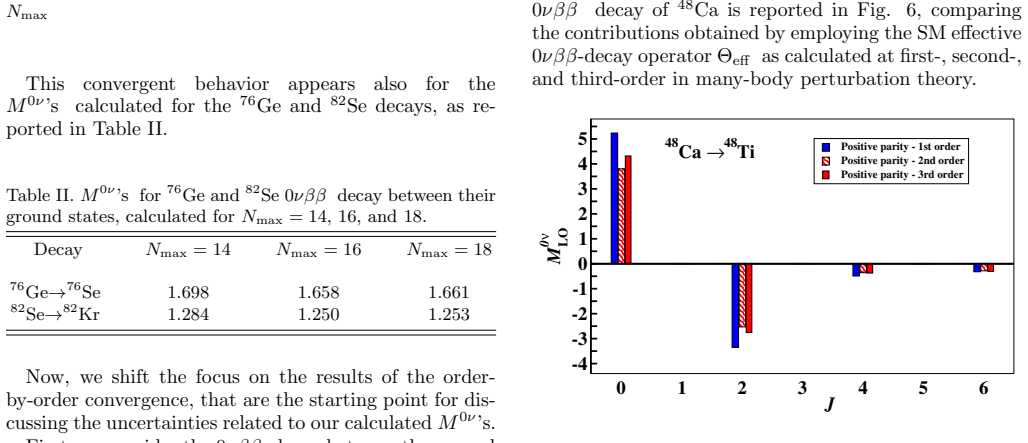
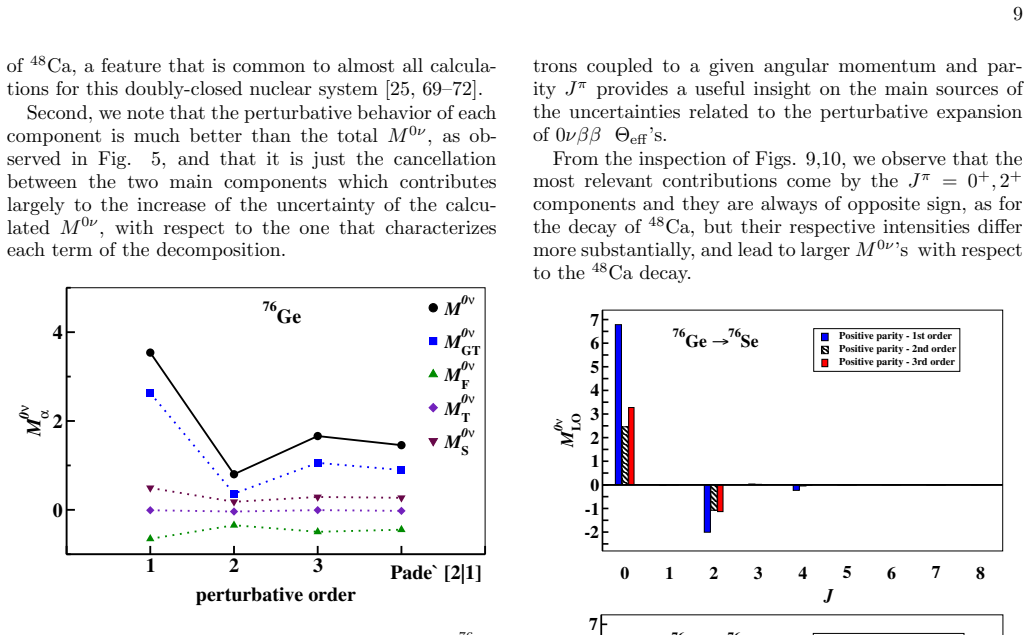
The effective shell-model Hamiltonian and all transition operators have been constructed by way of the many-body perturbation theory, and then employed to calculate both spectroscopic properties of the nuclei involved in the decays under our consideration - namely 48Ca, 76Ge, and 82Se -, as well as the nuclear matrix elements of the electromagnetic and neutrinoless double-beta decays.
What carries the argument
Renormalization of the neutrinoless double-beta decay operator through many-body perturbation theory starting from chiral effective field theory.
If this is right
- Spectroscopic properties of 48Ca, 76Ge, and 82Se can be obtained within the same consistent framework.
- Nuclear matrix elements for electromagnetic transitions are computed with operators derived identically to the Hamiltonian.
- Nuclear matrix elements for neutrinoless double-beta decay are obtained after explicit renormalization of the operator.
- Convergence behavior with perturbative order provides a quantitative handle on theoretical uncertainty.
Where Pith is reading between the lines
- The same construction could be applied to additional candidate nuclei to test consistency across the chart.
- Extension to three-body forces or higher chiral orders would test how sensitive the matrix elements remain to the input EFT truncation.
- Direct comparison of these matrix elements with those from other many-body methods could isolate the effect of the consistent operator renormalization.
Load-bearing premise
Many-body perturbation theory converges sufficiently to produce accurate effective Hamiltonians and transition operators for the nuclei 48Ca, 76Ge, and 82Se at the chosen chiral order and cutoff.
What would settle it
A higher-order many-body perturbation theory calculation or a change in cutoff that shifts the neutrinoless double-beta decay matrix elements by more than the estimated uncertainty would show the current results are not yet converged.
Figures
read the original abstract
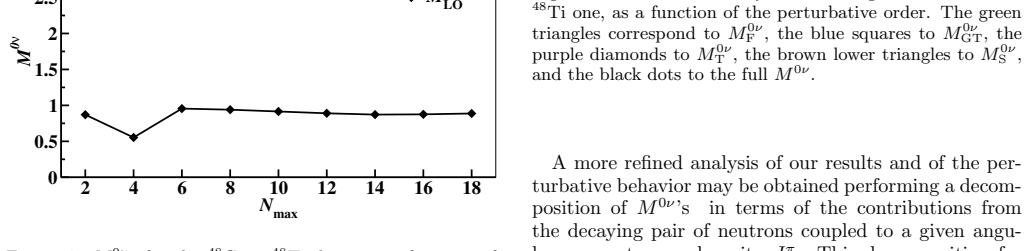
In this work, we approach for the first time the task to perform a shell-model calculation of the matrix element for the neutrinoless double-beta decay, within a fully-consistent framework where the expressions of the nuclear Hamiltonian and of the decay operators have been derived through chiral perturbation theory. More precisely, the effective shell-model Hamiltonian and all transition operators have been constructed by way of the many-body perturbation theory, and then employed to calculate both spectroscopic properties of the nuclei involved in the decays under our consideration - namely 48Ca, 76Ge, and 82Se -, as well as the nuclear matrix elements of the electromagnetic and neutrinoless double-beta decays. We also present a study of the convergence properties of the calculated matrix elements in order to provide the elements for an estimate of the theoretical uncertainty.
Editorial analysis
A structured set of objections, weighed in public.
Referee Report
Summary. The manuscript develops a consistent framework for shell-model calculations of neutrinoless double-beta decay matrix elements by deriving both the effective Hamiltonian and all transition operators from chiral effective field theory via many-body perturbation theory. It applies the method to 48Ca, 76Ge, and 82Se, computes spectroscopic properties together with electromagnetic and 0νββ matrix elements, and presents a convergence study to support an uncertainty estimate.
Significance. If the MBPT truncation errors for the two- and three-body operators prove small, the work supplies the first fully EFT-derived, parameter-free effective operators for 0νββ shell-model calculations, allowing systematic uncertainty quantification that is currently unavailable in phenomenological approaches.
major comments (1)
- [Convergence study section] The central claim that the framework is fully consistent and that the convergence study supplies a reliable uncertainty estimate rests on the unverified assumption that MBPT truncation errors remain small for the 0νββ operators at the chosen chiral order and cutoff. No order-by-order comparison, coupled-cluster benchmark, or exact-diagonalization cross-check for the transition operators in 48Ca, 76Ge, or 82Se is described that would quantify residual MBPT error.
minor comments (1)
- [Abstract] The abstract asserts the calculation is performed 'for the first time' in a fully consistent framework but does not cite the specific prior shell-model or EFT works whose consistency is being improved upon.
Simulated Author's Rebuttal
We thank the referee for the careful reading of our manuscript and for the positive assessment of its significance. We address the single major comment below.
read point-by-point responses
-
Referee: [Convergence study section] The central claim that the framework is fully consistent and that the convergence study supplies a reliable uncertainty estimate rests on the unverified assumption that MBPT truncation errors remain small for the 0νββ operators at the chosen chiral order and cutoff. No order-by-order comparison, coupled-cluster benchmark, or exact-diagonalization cross-check for the transition operators in 48Ca, 76Ge, or 82Se is described that would quantify residual MBPT error.
Authors: We agree that direct, operator-specific benchmarks (order-by-order comparisons, coupled-cluster cross-checks, or exact diagonalization in 48Ca) would provide stronger validation of the MBPT truncation error for the 0νββ operators themselves. Our convergence analysis is performed on the final nuclear matrix elements, which incorporate both the effective Hamiltonian and the transition operators derived at the same chiral order and cutoff via MBPT. This study examines the stability of the matrix elements under changes in the MBPT truncation level and other parameters, thereby supplying quantitative elements for an uncertainty estimate as stated in the abstract. We do not claim that the present analysis fully quantifies the residual MBPT error on the operators in isolation. In the revised manuscript we will add an explicit paragraph in the convergence section acknowledging this limitation and clarifying that the reported uncertainty estimate is based on the observed stability of the matrix elements rather than on separate operator benchmarks. revision: partial
Circularity Check
No significant circularity; derivation starts from chiral EFT + MBPT inputs
full rationale
The paper constructs the effective shell-model Hamiltonian and all transition operators via many-body perturbation theory applied to chiral EFT expressions, then computes spectroscopic properties and 0νββ matrix elements for 48Ca, 76Ge, and 82Se while studying convergence. No quoted step reduces the target matrix element to a fitted parameter by construction, invokes a self-citation as the sole justification for uniqueness, or renames a known result; the central claim remains independent of the final numerical output.
Axiom & Free-Parameter Ledger
axioms (1)
- domain assumption Chiral effective field theory supplies a valid low-energy description of nuclear forces and currents
Reference graph
Works this paper leans on
-
[1]
Weinberg, Physica96A, 327 (1979)
S. Weinberg, Physica96A, 327 (1979)
1979
-
[2]
Weinberg, Phys
S. Weinberg, Phys. Lett. B251, 288 (1990)
1990
-
[3]
Weinberg, Nucl
S. Weinberg, Nucl. Phys. B363, 3 (1991)
1991
-
[4]
Epelbaum, H.-W
E. Epelbaum, H.-W. Hammer, and U.-G. Meißner, Rev. Mod. Phys.81, 1773 (2009)
2009
-
[5]
Machleidt and D
R. Machleidt and D. R. Entem, Phys. Rep.503, 1 (2011)
2011
-
[6]
G. B. King, L. Andreoli, S. Pastore, M. Piarulli, R. Schi- avilla, R. B. Wiringa, J. Carlson, and S. Gandolfi, Phys. Rev. C102, 025501 (2020)
2020
-
[7]
Baroni, G
A. Baroni, G. B. King, and S. Pastore, Few-Body Syst. 62, 114 (2021)
2021
-
[8]
Gnech, L
A. Gnech, L. E. Marcucci, R. Schiavilla, and M. Viviani, Phys. Rev. C104, 035501 (2021)
2021
-
[9]
Gnech and R
A. Gnech and R. Schiavilla, Phys. Rev. C106, 044001 (2022)
2022
-
[10]
G. B. King, A. Baroni, V. Cirigliano, S. Gandolfi, L. Hayen, E. Mereghetti, S. Pastore, and M. Piarulli, Phys. Rev. C107, 015503 (2023)
2023
-
[11]
Gysbers, G
P. Gysbers, G. Hagen, J. D. Holt, G. R. Jansen, T. D. Morris, P. Navr´ atil, T. Papenbrock, S. Quaglioni, A. Schwenk, S. R. Stroberg, et al., Nature Phys.15, 428 (2019)
2019
-
[12]
Coraggio, N
L. Coraggio, N. Itaco, G. De Gregorio, A. Gargano, Z. H. Cheng, Y. Z. Ma, F. R. Xu, and M. Viviani, Phys. Rev. C109, 014301 (2024)
2024
-
[13]
Cirigliano, W
V. Cirigliano, W. Dekens, E. Mereghetti, and A. Walker- Loud, Phys. Rev. C97, 065501 (2018)
2018
-
[14]
Cirigliano, W
V. Cirigliano, W. Dekens, J. de Vries, M. L. Graesser, E. Mereghetti, S. Pastore, M. Piarulli, U. van Kolck, and R. B. Wiringa, Phys. Rev. C100, 055504 (2019)
2019
-
[15]
Tomoda, Rep
T. Tomoda, Rep. Prog. Phys.54, 53 (1991)
1991
-
[16]
J. D. Vergados, H. Ejiri, and F. ˇSimkovic, Rep. Prog. Phys.75, 106301 (2012)
2012
-
[17]
Cirigliano, W
V. Cirigliano, W. Dekens, J. de Vries, M. Hoferichter, and E. Mereghetti, Phys. Rev. Lett.126, 172002 (2021)
2021
-
[18]
J. T. Suhonen, Frontiers in Physics5, 55 (2017)
2017
-
[19]
T. T. S. Kuo, J. Shurpin, K. C. Tam, E. Osnes, and P. J. Ellis, Ann. Phys. (NY)132, 237 (1981)
1981
-
[20]
Suzuki and R
K. Suzuki and R. Okamoto, Prog. Theor. Phys.93, 905 (1995)
1995
-
[21]
Coraggio, A
L. Coraggio, A. Covello, A. Gargano, N. Itaco, and T. T. S. Kuo, Ann. Phys. (NY)327, 2125 (2012)
2012
-
[22]
Coraggio and N
L. Coraggio and N. Itaco, Frontiers in Physics8, 345 (2020)
2020
-
[23]
D. R. Entem and R. Machleidt, Phys. Rev. C66, 014002 (2002)
2002
-
[24]
Machleidt, Phys
R. Machleidt, Phys. Rev. C63, 024001 (2001)
2001
-
[25]
Coraggio, A
L. Coraggio, A. Gargano, N. Itaco, R. Mancino, and F. Nowacki, Phys. Rev. C101, 044315 (2020)
2020
-
[26]
Castillo, L
D. Castillo, L. Jokiniemi, P. Soriano, and J. Men´ endez, Physics Letters B860, 139181 (2025), ISSN 0370-2693
2025
-
[27]
van Kolck, Prog
U. van Kolck, Prog. Part. Nucl. Phys.43, 337 (1999)
1999
-
[28]
D. R. Entem and R. Machleidt, Phys. Rev. C68, 041001(R) (2003)
2003
-
[29]
Fukui, L
T. Fukui, L. De Angelis, Y. Z. Ma, L. Coraggio, A. Gargano, N. Itaco, and F. R. Xu, Phys. Rev. C98, 044305 (2018)
2018
-
[30]
Y. Z. Ma, L. Coraggio, L. De Angelis, T. Fukui, A. Gargano, N. Itaco, and F. R. Xu, Phys. Rev. C100, 034324 (2019)
2019
-
[31]
Coraggio, G
L. Coraggio, G. De Gregorio, A. Gargano, N. Itaco, T. Fukui, Y. Z. Ma, and F. R. Xu, Phys. Rev. C102, 054326 (2020)
2020
-
[32]
Coraggio, G
L. Coraggio, G. De Gregorio, A. Gargano, N. Itaco, T. Fukui, Y. Z. Ma, and F. R. Xu, Phys. Rev. C104, 054304 (2021)
2021
-
[33]
S. L. Lyu, G. De Gregorio, T. Fukui, N. Itaco, and L. Cor- aggio, Phys. Rev. C112, 054314 (2025)
2025
-
[34]
Navr´ atil, V
P. Navr´ atil, V. G. Gueorguiev, J. P. Vary, W. E. Ormand, and A. Nogga, Phys. Rev. Lett.99, 042501 (2007)
2007
-
[35]
T. S. Park, D. P. Min, and M. Rho, Phys. Rep.233, 341 (1993)
1993
-
[36]
Pastore, L
S. Pastore, L. Girlanda, R. Schiavilla, M. Viviani, and R. B. Wiringa, Phys. Rev. C80, 034004 (2009). 12
2009
-
[37]
K¨ olling, E
S. K¨ olling, E. Epelbaum, H. Krebs, and U. G. Meißner, Phys. Rev. C80, 045502 (2009)
2009
-
[38]
Baroni, L
A. Baroni, L. Girlanda, S. Pastore, R. Schiavilla, and M. Viviani, Phys. Rev. C93, 015501 (2016)
2016
-
[39]
Krebs, E
H. Krebs, E. Epelbaum, and U.-G. Meißner, Annals of Physics378, 317 (2017)
2017
-
[40]
Krebs, Eur
H. Krebs, Eur. Phys. J. A56, 234 (2020)
2020
-
[41]
Hyuga and A
H. Hyuga and A. Arima, J. Phys. Soc. Jpn. Suppl.34, 538 (1973)
1973
-
[42]
I. S. Towner and K. F. C. Khanna, Nucl. Phys. A399, 334 (1983)
1983
-
[43]
Mart´ ınez-Pinedo, A
G. Mart´ ınez-Pinedo, A. Poves, E. Caurier, and A. P. Zuker, Phys. Rev. C53, R2602 (1996)
1996
-
[44]
Cirigliano, W
V. Cirigliano, W. Dekens, J. de Vries, M. L. Graesser, E. Mereghetti, S. Pastore, and U. van Kolck, Phys. Rev. Lett.120, 202001 (2018)
2018
-
[45]
Chambers-Wall, J
G. Chambers-Wall, J. Lieffers, G. B. King, E. Mereghetti, S. Pastore, M. Piarulli, and R. B. Wiringa, Phys. Rev. C 113, 025502 (2026)
2026
-
[46]
Wirth, J
R. Wirth, J. M. Yao, and H. Hergert, Phys. Rev. Lett. 127, 242502 (2021)
2021
-
[47]
Jokiniemi, P
L. Jokiniemi, P. Soriano, and J. Men´ endez, Physics Let- ters B823, 136720 (2021), ISSN 0370-2693
2021
-
[48]
Belley, J
A. Belley, J. M. Yao, B. Bally, J. Pitcher, J. Engel, H. Hergert, J. D. Holt, T. Miyagi, T. R. Rodr´ ıguez, A. M. Romero, et al., Phys. Rev. Lett.132, 182502 (2024)
2024
-
[49]
Kotila and F
J. Kotila and F. Iachello, Phys. Rev. C85, 034316 (2012)
2012
-
[50]
Kotila and F
J. Kotila and F. Iachello, Phys. Rev. C87, 024313 (2013)
2013
-
[51]
Engel and J
J. Engel and J. Men´ endez, Rep. Prog. Phys.80, 046301 (2017)
2017
-
[52]
Coraggio, G
L. Coraggio, G. De Gregorio, T. Fukui, A. Gargano, Y. Ma, Z. Cheng, and F. Xu, Progress in Particle and Nuclear Physics134, 104079 (2024)
2024
-
[53]
Blomqvist and A
J. Blomqvist and A. Molinari, Nucl. Phys. A106, 545 (1968)
1968
-
[54]
Suzuki and S
K. Suzuki and S. Y. Lee, Prog. Theor. Phys.64, 2091 (1980)
2091
-
[55]
R. S. Stroberg, H. Heiko, S. K. Bogner, and J. D. Holt, Annu. Rev. Nucl. Part. Sci.69, 307 (2019)
2019
-
[56]
T. T. S. Kuo and E. Osnes,Lecture Notes in Physics, vol. 364 (Springer-Verlag, Berlin, 1990)
1990
-
[57]
Hjorth-Jensen, T
M. Hjorth-Jensen, T. T. S. Kuo, and E. Osnes, Phys. Rep.261, 125 (1995)
1995
-
[58]
Coraggio, L
L. Coraggio, L. De Angelis, T. Fukui, A. Gargano, and N. Itaco, J. Phys. Conf. Ser.1056, 012012 (2018)
2018
-
[59]
E. M. Krenciglowa and T. T. S. Kuo, Nucl. Phys. A235, 171 (1974)
1974
-
[60]
Suzuki, R
K. Suzuki, R. Okamoto, H. Kumagai, and S. Fujii, Phys. Rev. C83, 024304 (2011)
2011
-
[61]
S. R. Stroberg, A. Calci, H. Hergert, J. D. Holt, S. K. Bogner, R. Roth, and A. Schwenk, Phys. Rev. Lett.118, 032502 (2017)
2017
-
[62]
Coraggio, L
L. Coraggio, L. De Angelis, T. Fukui, A. Gargano, and N. Itaco, Phys. Rev. C95, 064324 (2017)
2017
-
[63]
Coraggio, L
L. Coraggio, L. De Angelis, T. Fukui, A. Gargano, N. Itaco, and F. Nowacki, Phys. Rev. C100, 014316 (2019)
2019
-
[64]
Coraggio, N
L. Coraggio, N. Itaco, G. De Gregorio, A. Gargano, R. Mancino, and F. Nowacki, Phys. Rev. C105, 034312 (2022)
2022
-
[65]
bnl.gov/ensdf
Data extracted using the NNDC On-line Data Service from the ENSDF database., URLhttps://www.nndc. bnl.gov/ensdf
-
[66]
Y. Toh, C. J. Chiara, E. A. McCutchan, W. B. Walters, R. V. F. Janssens, M. P. Carpenter, S. Zhu, R. Broda, B. Fornal, B. P. Kay, et al., Phys. Rev. C87, 041304 (2013)
2013
-
[67]
Barabash, Universe6, 159 (2020)
A. Barabash, Universe6, 159 (2020)
2020
-
[68]
G. A. Baker and J. L. Gammel,The Pad´ e Approximant in Theoretical Physics, vol. 71 ofMathematics in Science and Engineering(Academic Press, New York, 1970)
1970
-
[69]
R. A. Sen’kov and M. Horoi, Phys. Rev. C88, 064312 (2013)
2013
-
[70]
R. A. Sen’kov and M. Horoi, Phys. Rev. C93, 044334 (2016)
2016
-
[71]
R. A. Sen’kov, M. Horoi, and B. A. Brown, Phys. Rev. C89, 054304 (2014)
2014
-
[72]
C. F. Jiao, M. Horoi, and A. Neacsu, Phys. Rev. C98, 064324 (2018)
2018
discussion (0)
Sign in with ORCID, Apple, or X to comment. Anyone can read and Pith papers without signing in.